 By
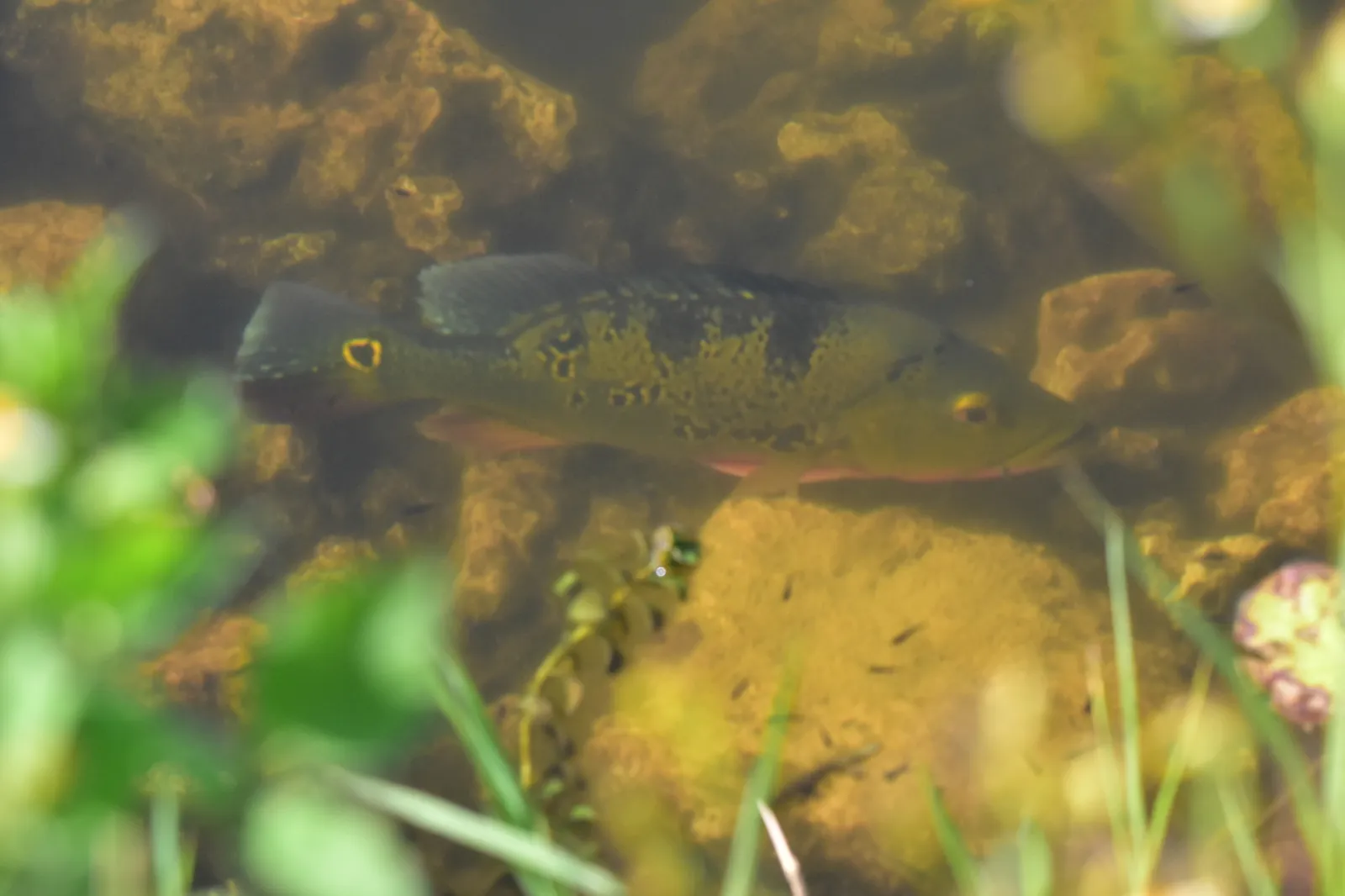
Peacock bass in the US means the butterfly peacock. Nearly all of the fishing is in the warm canals of Miami-Dade and Broward counties in South Florida. Fish for them in daylight, with a 3 in live shiner or a small minnow-shaped lure. Use light spinning tackle and 6 to 8 lb line. They fight in open water, not in the weeds. And they aren’t bass at all.
A peacock bass can’t live in water colder than 60 °F. That one number is why Florida’s peacocks stay in the canals around Miami and Fort Lauderdale.
What is a peacock bass?
A peacock bass is a South American cichlid that only looks like a bass. Its body is shaped like a largemouth bass, but it’s from a different family. So it’s not one of the types of bass Florida counts as black bass. It also goes by tucunaré and pavón.
The fish in Florida is the butterfly peacock, and the state put it there on purpose in 1984. Its job was to eat the exotic fish crowding the southeast canals, the African spotted tilapia above all. It has spawned and come through the winter every year since.
Here’s the whole fishery on one table.
| What | The number | What it means for you |
|---|---|---|
| Coldest water they live in | 60 °F (16 °C) | They’re only common in the warm canals of coastal Miami-Dade and Broward |
| Saltiest water they live in | 18 ppt (parts per thousand) | They stay in fresh canal water, not salt |
| When they feed | Daylight only | No night fishing for peacocks |
| Best months for big fish | February to May | Most fish over 4 lb are caught then |
| Spawn | April to September, peak May and June | Pairs guard their young in the shallows |
| Size at 16 to 18 months | 12–14 in (30–36 cm) | After that they add weight fast |
| Daily bag | 2, only one 17 in (43 cm) or longer | Separate from the 5 black bass you may keep |
How do you identify a peacock bass?
Look at the tail first. A butterfly peacock has a black spot ringed in yellow-gold on its tail fin, like the eye on a peacock feather. The rest: a body shaped like a largemouth, usually golden, with three black bars down the side.
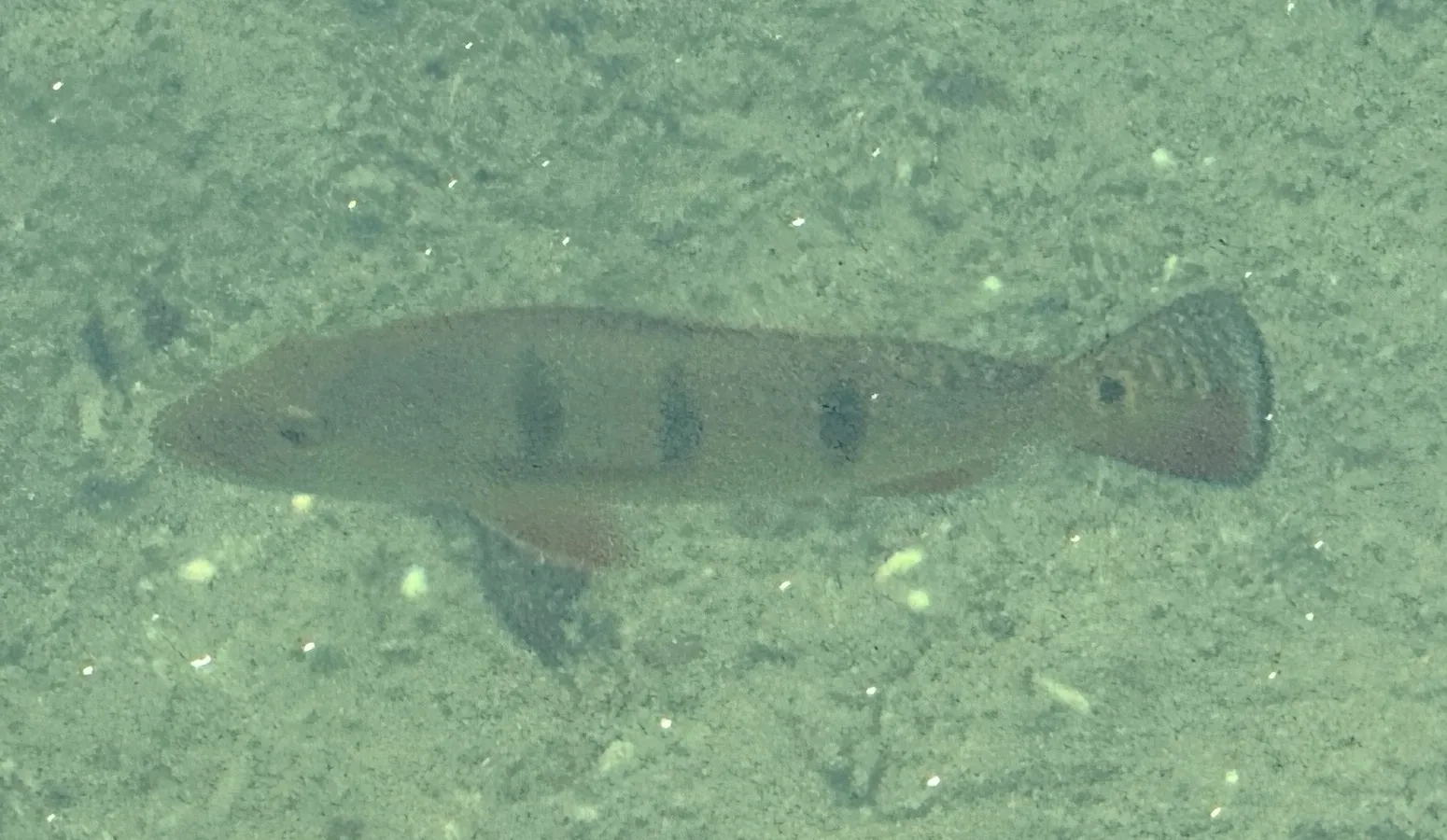
The three bars and the tail spot, on a butterfly peacock at Kendale Lake, Miami. Photo: Samuel Paul Galick, iNaturalist observation 248263352 (CC0).
The color changes a lot from fish to fish, so don’t lean on it. The bars tend to fade with age and may be gone on an old fish. The tail spot is the mark that stays.
In spawning season the males often grow a hump on the forehead, so a humped fish is most likely a male.
If you’re not sure whether you’ve got a peacock or a largemouth, check the tail. The gold-ringed spot settles it, and it decides which bag limit the fish counts against.

Free PDF · Water temperature chart Which fish are biting at today's water temperature?
One reading, and the 16-page chart shows which of 26 fish are spawning, feeding hard or slowing down; for bass, crappie, bluegill and walleye, where they sit and what to throw. Every number sourced.
No card, nothing to buy, and the PDF is yours to keep. Confirm with one click and it's on its way. Then a few short emails and one a week on what's biting. Unsubscribe anytime. Privacy.
Where can you catch peacock bass in the US?
South Florida is the place. More than 300 miles of urban canals in Miami-Dade and Broward counties hold fishable numbers of butterfly peacocks, FWC says. Many urban lakes around Miami and Fort Lauderdale hold them too.
They’ve spread a little past those two counties. FWC’s forecast for Palm Beach County has them in the Ida-Osborne chain of lakes. And its guide to the Golden Gate Canal near Naples says a population has held there since 2009. Most likely someone put them there illegally.
Other places have them too. This is where the USGS lists them, and what it says about each.
| Where | Status (USGS) | Worth knowing |
|---|---|---|
| South Florida | Established | Canals and urban lakes from Miami to Fort Lauderdale |
| Hawaii | Established | Hawaii calls it tucunare. It’s well established in the state’s reservoirs |
| Puerto Rico | Established | — |
| Guam | Established | — |
| Texas | Gone by 1992 | Texas stocked them from 1978. Some survived and spawned for a short time, then all died |
Hawaii is the other US option. Its Public Fishing Area on Oʻahu is Wahiawā, part of the Wahiawā Reservoir, also called Lake Wilson. Tucunare there are catch and release only. You can’t keep, hold or kill one, and it goes back in the water right away. You need Hawaii’s Freshwater Game Fishing License, an entry permit and a Coast Guard approved life jacket. Most other reservoirs in Hawaii are private, so outside the Public Fishing Areas you need the landowner’s permission. Hawaii’s tucunare average 2 to 3 lb, and the state record is 9 lb 4.2 oz, from 1990. It’s also against the law there to sell an introduced game fish.
Why do peacock bass only live in South Florida?
Cold water kills them. Butterfly peacocks die in water colder than 60 °F. Of all the exotic fish living in Florida, they handle cold the worst.
The state learned that the hard way. In 1964 about 10,000 young peacocks were released around Fort Lauderdale. It looks like none survived that winter.
Then in the early 1980s it turned out that the coastal canals of southeast Florida stayed warmer than other water through the winter. Some rarely dropped below 65 °F (18 °C). The reason is underground. The Biscayne Aquifer sits just a few feet below the surface there, and its warm water flows into the canals in winter.
Salt sets the other edge. Butterfly peacocks can’t take water saltier than 18 ppt, and they don’t head out into salt water. So the fish stay boxed in: too cold to the north and west, too salty to the east. A cold snap still kills some now and then, but the canals have carried the fishery since 1984. In November 2026, FWC’s forecast for Lake Osborne in Palm Beach County said its peacocks were still recovering from the previous winter’s die-off.
That’s also why you won’t find them in most of the Everglades. Cold winters keep them to the southernmost counties.
Where do peacock bass hold in a canal?
Fish the shade and the corners. The spots: bridges, culverts, canal intersections, dead ends, bends and fallen trees. Shade from bridges, culverts and plants gives some of the best fishing.
Here’s how to work a stretch of canal from the bank:
- Start at a bridge or culvert. Cast into the shade.
- Walk to the next intersection. Where two canals meet, the fish gather.
- Fish every dead end and bend. Peacocks hang around both.
- Cast to fallen trees. A tree in the water is cover in a bare canal.
- Watch the shallow edges. Peacocks spawn and often feed in shallow water next to banks with overhanging plants.
- Fish it in daylight. Peacocks don’t feed at night.
Not sure which canal to start in? FWC has a free angler guide for each of these, with directions to the boat ramps. For Miami-Dade it names three to try first: the Aerojet, Cutler Drain and Tamiami canals. The guides date from 2015 to 2020, so take the numbers in them as a starting point.
| Canal | Name | County | What its guide says about peacocks |
|---|---|---|---|
| C-111 | Aerojet Canal | Miami-Dade | Good catches, in Florida’s southernmost freshwater canal |
| C-100 | Cutler Drain Canal | Miami-Dade | Best March through May, caught all year |
| C-4 | Tamiami Canal | Miami-Dade | Excellent numbers of peacocks and largemouth |
| C-1 | Black Creek Canal | Miami-Dade | The first canal stocked, in August 1984, and still producing |
| C-2 | Snapper Creek Canal | Miami-Dade | A few more peacocks than other canals, but a little smaller |
| C-9 | Snake Creek Canal | Miami-Dade and Broward | They average 14.4 in (2 lb) |
| C-11 | South New River Canal | Broward | They average 14.1 in (1.9 lb) |
| G-15 | North New River Canal | Broward | Fewer peacocks, but bigger on average |
One canal to skip for peacocks: the C-14, Cypress Creek. It was the northernmost canal the state stocked, and its guide says the 2010 freeze all but wiped out its peacocks. For a first trip without a guide, FWC’s brochure suggests asking a local freshwater tackle shop for the best spots and baits.
When is peacock bass fishing best?
Go during the day. You’ll only catch them in daylight, because they don’t feed at night.
The season is long. Fishing is good all year, but most peacocks over 4 lb are caught from February through May. If you’re after one big fish, those are your months.
The spawn runs from April through September, with a peak in May and June. Both parents clear a flat, hard spot near shore and lay 4,000 to 10,000 eggs. Both guard the young, sometimes for several months. That’s when sight fishing works. Small tubes and jigs are often cast to peacocks that are aggressively guarding beds near the shore.
How do you catch peacock bass?
The easiest way is live bait. Use a small golden shiner about 3 in long. Locals call it a “peacock shiner”.
Fish it one of two ways:
- Under a float. A bobber holds the shiner at the depth you want while you watch it.
- Free-lined. Free-lining means no float and no weight, so the shiner swims on its own. Cast it, or troll it slowly with an electric motor along the canal edge. Pinch on a small split shot if you need it deeper.
You can catch live bait yourself or buy it, and our page on minnows covers golden shiners and the other bait minnows.
Lures work well too: topwater lures with and without propellers, minnow-shaped crankbaits and jigs, on casting or spinning tackle. FWC’s Miami-Dade canal forecast for fall 2026 kept it simple. When you see peacocks breaking the surface, throw a Heddon Torpedo or a small gold or silver Pop-R. If you lose the school, switch to a Rapala X-Rap or a Rat-L-Trap under the surface.
| Lure type | What FWC names |
|---|---|
| Topwater | Heddon Torpedo, MirrO propbait, a small gold or silver Pop-R. The older brochure adds Wobble Pops and Tiny Torpedos |
| Minnow lures (jerkbaits) | Rapala X-Rap. The brochure names floating and sinking Rapalas and Yo-Zuri minnows |
| Crankbaits | Shad Raps and Rat-L-Traps |
| Jigs | A twin-tailed plastic minnow on a jig, buzzed across the top or cast to fish you can see deeper |
| Tubes and small jigs | Cast to fish guarding beds near shore |
Two things set peacocks apart from largemouth. First, they rarely hit plastic worms, so leave the Texas rig in the box. Second, go small. Baits under 3 in catch more consistently, FWC’s brochure says. Bigger baits, up to 5 in, may draw more trophy fish, but even big peacocks will take baits smaller than a bass angler usually throws.
For color, many anglers pick gold, fire tiger or natural colors. A small gold Rapala fits all three rules: minnow-shaped, small and gold.
Fly anglers have a good shot too. Popular flies are Dahlberg Divers, Deceivers, Clousers, epoxy minnows, Zonkers and poppers. Chartreuse or yellow flies with a flashy strip are favorites.
Peacock or largemouth: what changes?
Plenty of canal anglers fish for both in one day. These are the differences that matter, so you can switch over without wasting casts.
| Butterfly peacock | Largemouth bass | |
|---|---|---|
| Plastic worms | Rarely hit them | A standard bait |
| Bait size | Under 3 in catches more consistently | Bass anglers usually throw bigger |
| Feeding hours | Daylight only | — |
| Daily bag in Florida | 2, only one 17 in or longer | 5 black bass, only one 16 in or longer |
| Lip grip | Doesn’t hold the fish still | The usual way to hold one |
| Livewell | Survives it less well, so release fast | Survives it better |
The short version: smaller, shinier, daytime, and back in the water quickly. If your worm gets no peacock bites, that’s normal. Tie on a small gold minnow lure and try the next culvert.
What rod, reel and line do you need?
Bring light gear. Most peacock anglers use light spinning tackle with 6 to 8 lb test line, FWC’s brochure says. Light line and tippet draw more strikes than heavy line. And you don’t need heavy line, because canal peacocks fight in open water, not in thick cover.
So keep it simple: a light spinning rod and reel, spooled with 6 to 8 lb line such as monofilament. Your largemouth tackle will do too, from a boat or from the bank.
How big do peacock bass get?
Peacocks grow fast, to 12 to 14 in within their first 16 to 18 months. After that they get much heavier with every inch. A 17 in fish weighs about 3 lb. Past that FWC’s own numbers spread out. Its chart puts an 18 to 19 in fish at 3.6 to 4.2 lb. Its species profile says a 19 in fish can reach 5 lb.
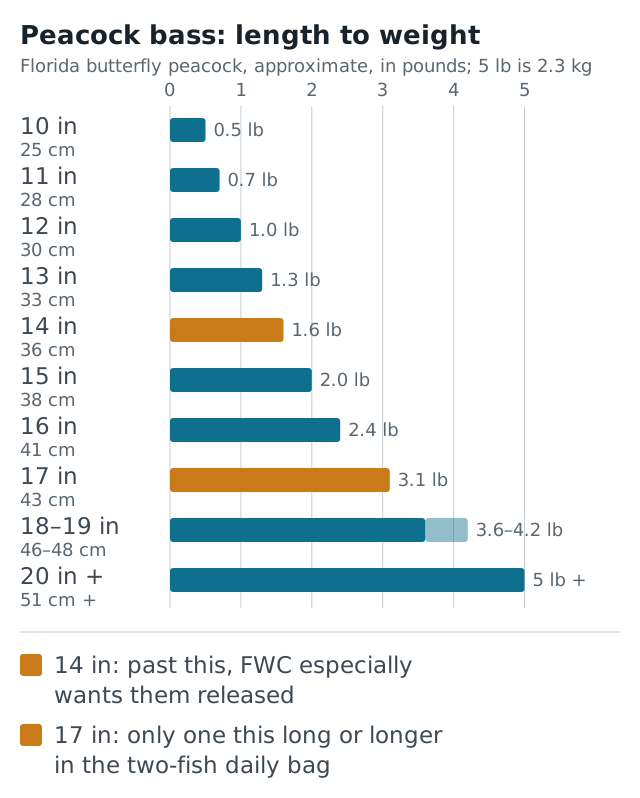
Use the chart when you’re standing on the bank with a tape. The 17 in mark matters most, because only one fish that long or longer may go in your bag. A fish past 14 in is one FWC especially wants back in the water.
The records tell the rest:
| Record | Weight | Length | Details |
|---|---|---|---|
| Florida state record | 9.11 lb (4.1 kg) | 23 5/16 in (59 cm) | Felipe Prieto, Broward County, October 8, 2021 |
| Biggest Florida fish FWC knows of | 12.0 lb (5.4 kg) | 25.5 in (65 cm) | Never submitted as a state record |
| IGFA all-tackle world record | 12 lb 9 oz (5.71 kg) | — | Antonio Campa G., Chiguao River, Venezuela, January 6, 2000 |
Florida holds 16 of the 21 IGFA line-class, tippet and junior records for the butterfly peacock. The all-tackle record still came from Venezuela. Bigger fish than the state record have been documented, but they didn’t meet every reporting rule. How long do they live? Nobody knows for sure. Early data points to about six years.
What are the peacock bass rules in Florida?
You may keep two butterfly peacocks a day, and only one of them may be 17 in or longer. That bag limit is separate from Florida’s black bass limit of five, and peacocks aren’t on the black bass list.
The other rules to know:
- You need a Florida freshwater fishing license. It covers native and nonnative freshwater fish alike. A nonresident three-day license costs $17.
- Keep the fish whole until you’re done. Peacock bass may not be filleted, or have the head or tail fin removed, until you’ve finished fishing for the day.
- Never move a live one. Florida law makes it unlawful to release a nonnative animal in the state without FWC’s say-so. FWC’s peacock brochure spells it out: a live peacock goes back only into the water it came from.
- Don’t use one as bait. Peacock bass, or any part of one, may not be used as bait in Florida.
- Release the big ones if you can. FWC encourages catch and release, especially of fish over 14 in.
The 17 in rule is there to protect the large fish that keep the fishery good. Rules change, so check FWC’s current freshwater regulations before your trip.
How do you handle and release a peacock bass?
Grab the lower jaw, like you would a largemouth. The grip won’t hold a peacock still, though. And the teeth are like sandpaper, so a day of lipping peacocks leaves you with scraped thumbs. Tape your thumb, wear a leather thumb guard or use a lip-gripping tool.
Peacocks are tough. Nearly 100 percent survive being caught and released when handled properly. But they don’t last as long out of the water as a largemouth, and they don’t do as well in a livewell. So unhook it fast, take your photo quickly and get it back in. The catch and release guide covers the rest.
Are peacock bass good to eat?
Yes. FWC calls them good to eat. But it says their real value is the fishing and the job they do eating exotic fish. So it asks anglers to release them, especially those longer than 14 in.
If you keep one, stay inside the bag. That’s two fish, only one of them 17 in or longer, kept whole until you’re done for the day. Check Florida’s current fish consumption advisory before you eat the catch.
Are peacock bass invasive?
FWC lists the butterfly peacock as nonnative, but it’s no accident. The state calls it a justified exception to its general rule against bringing in exotic fish. It was released only after years of research. The brochure says the fishery has been cited as a model program by several environmental groups.
About 20,000 young butterfly peacocks went into the big canals of southeast Florida from 1984 to 1987. No fish have been stocked since. Anglers now spend more than $8 million a year chasing them.
A fish that does good in one place can do harm in another, and that’s one reason it’s illegal to move one. Elsewhere, peacocks have. Peacocks were put into Lake Gatun in Panama. After that the lake’s food web and its mix of fish changed on a large scale. In Florida’s canals the record is mixed. Peacocks have helped thin out the spotted tilapia, but there’s some sign they may keep largemouth off spawning areas.
What about the peacock bass of the Amazon?
The giant peacocks of the Amazon trips are a different fish. The speckled peacock lives in clear and black-water rivers of the Rio Negro and Orinoco basins and in the central Amazon. It grows to 99 cm, about 39 in. The IGFA all-tackle record is 29 lb 1 oz (13.19 kg), from the Rio Negro in Brazil. The butterfly peacock tops out at 70 cm, about 28 in.
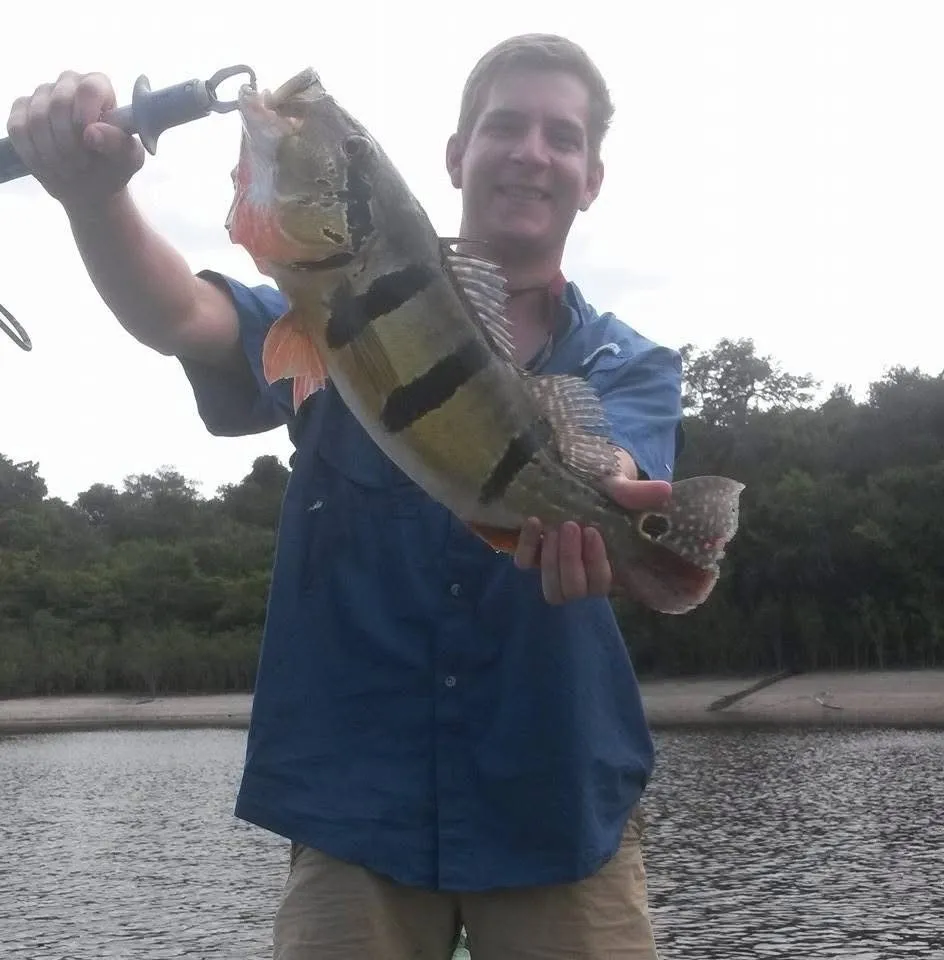
A speckled peacock bass near Novo Airão, on the Rio Negro in Brazil. Photo: Nick Loveland, iNaturalist observation 279027128 (CC0).
| Butterfly peacock | Speckled peacock | |
|---|---|---|
| Other names | Tucunaré, pavón, eyespot cichlid | Speckled pavon, tucunare pinema, royal pavon |
| Grows to | 70 cm (about 28 in) | 99 cm (about 39 in) |
| Home range | South America (the USGS says the true species is from the Guianas) | Rio Negro, Orinoco and the central Amazon |
| In the US | Established in South Florida, Hawaii, Puerto Rico, Guam | None. Florida stocked 110 fish and Texas tried too. Both are thought to be gone |
Florida tried the speckled peacock too. Its stocking involved only 110 fish, the last released in 1988. They made it through at least two winters, but they’re now thought to be gone from the state. Florida’s rule still covers it: you may not kill or keep a speckled peacock. If you ever catch one, it goes straight back. So the speckled peacock is a fish you travel for.
One more thing the USGS points out: some fish that agencies call butterfly peacock may be another peacock species, or a hybrid. The name on the rule card is still butterfly peacock.
What do peacock bass eat?
They eat fish, almost nothing else. They run their prey down at speed, and only by day. So a live shiner or a small, fish-shaped lure is what they want, and a plastic worm isn’t.
Another South American fish has turned up in Florida water, and its diet could include peacocks. The arapaima page has that story. For the bass that share the canals, start with the largemouth bass.

Free PDF · 16 pages
Stop guessing. Know what's biting before your first cast
A whole Saturday on the water with nothing to show for it. One reading tells you who's feeding.
The Water Temperature Fishing Chart. Take one water temperature reading, find it on the chart, and see which of 26 freshwater fish are spawning, feeding hard or slowing down.
- Where bass, crappie, bluegill and walleye sit, and what to throw. Trout: the reading where you stop.
- Why a 3 ft drop beats a cold front, and what to throw each day of the front
- The three thermometer mistakes that make a reading lie
The chart's numbers come from state fish and wildlife agencies and fisheries research: 61 sources, each listed on the site.
No card, nothing to buy. Confirm with one click and the PDF is on its way, one version for your phone and one to print, yours to keep. Then a few short emails and one a week on what's biting, with an unsubscribe link in every one. Privacy.
Sources (20)
- Florida Fish and Wildlife Conservation Commission, Butterfly Peacock (species profile)
- Florida Fish and Wildlife Conservation Commission, Butterfly Peacock Bass Fishing Tips
- Florida Fish and Wildlife Conservation Commission, Fishing for Florida's Butterfly Peacock Bass (brochure)
- Florida Fish and Wildlife Conservation Commission, General Statewide Bag and Length Limits
- Florida Fish and Wildlife Conservation Commission, Freshwater State Records
Show all 20 sourcesShow fewer sources
- Florida Fish and Wildlife Conservation Commission, Freshwater Fishing License
- U.S. Geological Survey, Nonindigenous Aquatic Species: Butterfly Peacock Bass (Cichla ocellaris)
- U.S. Geological Survey, Nonindigenous Aquatic Species: speckled pavon (Cichla temensis)
- Hawaii Division of Aquatic Resources, Freshwater Fishing
- Hawaii Division of Aquatic Resources, Regulated Fishing Areas on Oahu
- Hawaii Division of Aquatic Resources, Introduced Sport Fishes
- Florida Fish and Wildlife Conservation Commission, Metropolitan Southeast Florida Canals (site and forecast)
- Florida Fish and Wildlife Conservation Commission, Angler Guide to C14 Cypress Creek Canal
- Florida Fish and Wildlife Conservation Commission, Angler Guide to Golden Gate Canal
- Florida Fish and Wildlife Conservation Commission, Osborne Chain-of-Lakes
- Florida Fish and Wildlife Conservation Commission, 2026-2027 Florida Freshwater Fishing Regulations
- Florida Administrative Code 68A-23.005, Bag Limits, Length Limits, Open Season: Freshwater Fish
- Florida Statutes 379.231, Release of nonnative animals
- International Game Fish Association, World Records: Peacock, butterfly
- International Game Fish Association, World Records: Peacock, speckled