 By
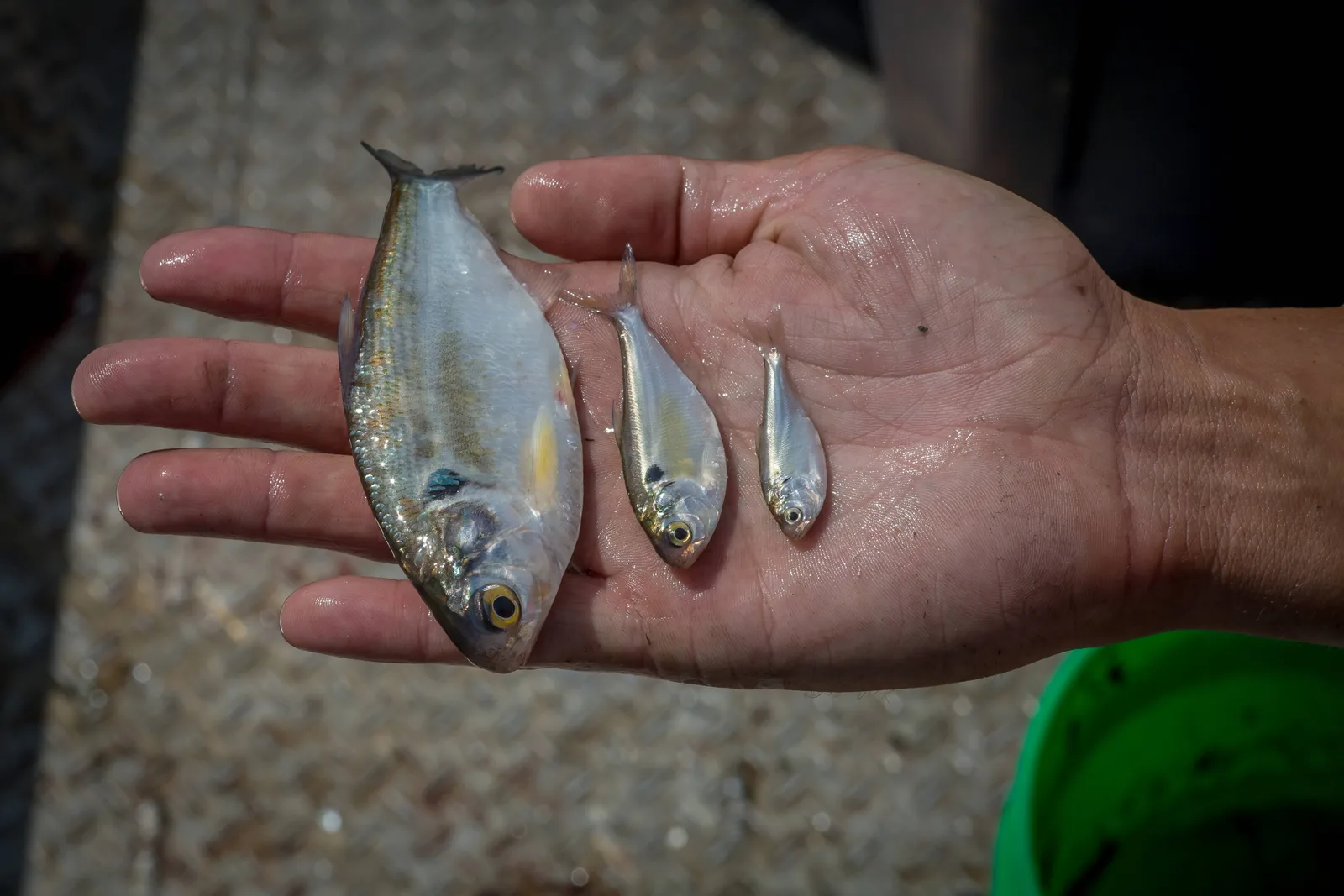
A gizzard shad is a silver, deep-bodied baitfish that commonly grows 9 to 14 inches long. Big bass, stripers and blue catfish hunt it in rivers and reservoirs. You get one with a cast net, not a hook, and you can fish it live or cut it up for catfish. Read your state’s bait rules first, because several won’t let you carry one alive.
Run a finger forward under the mouth. If your nail catches the upper jaw and opens the mouth, you’re most likely holding a gizzard shad, not a threadfin.
What does a gizzard shad look like?
It’s silver, deep in the body and flat from side to side, with a forked tail. Three marks give it away.
- The long last ray. The last ray of the dorsal fin, the fin on the back, runs out into a long thin whip.
- The shoulder spot. There’s a large dark or purple spot just behind the gill cover. It can fade on big adults, so don’t lean on it with a 14-incher in your hand.
- The mouth. It’s small, has no teeth and sits under a blunt snout.
Run a thumb along the belly and you’ll feel a row of sharp scales. Those can save its life. Missouri’s field guide says a predator that flips a shad around to swallow it headfirst may drop it.
Depending on where you fish, you’ll hear it called mud shad, hickory shad or skipjack. Skipjack herring is a different fish, with no long ray and no spot.
Gizzard shad vs threadfin shad: how do you tell them apart?
Check the mouth first. On a gizzard, the upper jaw hangs well past the lower one. On a threadfin shad, it doesn’t. That’s what the fingernail test finds, and Texas Parks and Wildlife says it’s right in most cases. The USGS lists the same split: a blunt snout on the gizzard, a pointed one with a jutting lower jaw on the threadfin.
| Check | Gizzard shad | Threadfin shad |
|---|---|---|
| Upper jaw | Hangs well past the lower jaw | Does not pass the lower jaw |
| Size | Commonly 9–14 in (23–36 cm) | Commonly 4–5 in (10–13 cm), rarely over 6 in (15 cm) |
| Anal fin rays | Usually 29–35 | Usually 20–25 |
| Chin and floor of the mouth | No black speckles | Speckled with black |
| Where it feeds | Mostly on the bottom | Open water |
| Cold water | Tougher, with heavy losses below 39 °F (4 °C) | Die-offs reported below 45 °F (7 °C) |
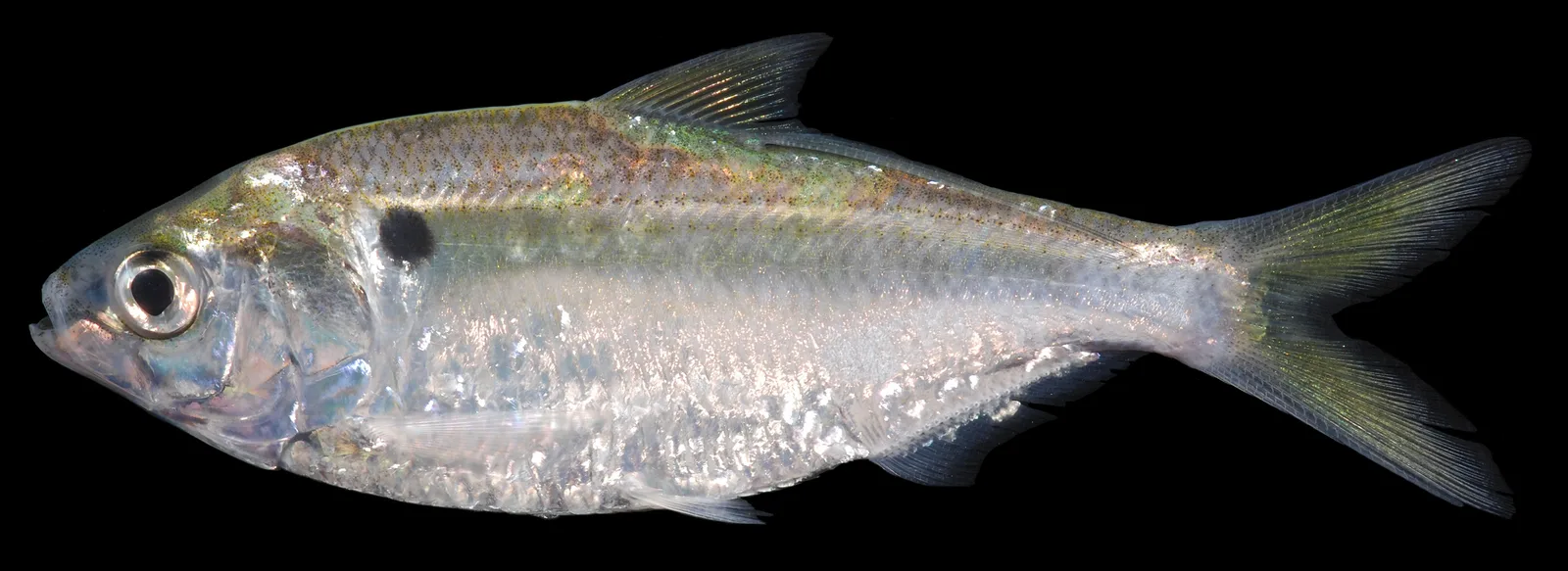
A threadfin shad. It carries the same shoulder spot as a gizzard, so check the jaw, and the yellow in the fins. Photo: Robert Aguilar, Smithsonian Environmental Research Center (CC BY 2.0).
The difference matters because they aren’t the same meal. A threadfin stays bait-sized its whole life. A gizzard can outgrow most of the fish hunting it. And threadfin rarely live north of Interstate 40, Bassmaster says, so a shad in a northern net is more likely a gizzard.
Free PDF · Water temperature chart Which fish are biting at today's water temperature?
One reading, and the 16-page chart shows which of 26 fish are spawning, feeding hard or slowing down; for bass, crappie, bluegill and walleye, where they sit and what to throw. Every number sourced.
No card, nothing to buy, and the PDF is yours to keep. Confirm with one click and it's on its way. Then a few short emails and one a week on what's biting. Unsubscribe anytime. Privacy.
Where are gizzard shad, and when?
They’re native from Quebec to central North Dakota and New Mexico, and south to Florida and Mexico. The USGS says it’s unclear whether they’re native to the southern Great Lakes. They’ve been stocked as forage well beyond that range. Look in big, warm, fertile water: lowland lakes, reservoirs and the backwaters of large rivers. They stay out of steep streams. They travel in big schools, often near the surface in open water, so look for them on your depthfinder or under diving birds.
| Season | Where the shad are | What to do |
|---|---|---|
| Spring | Shallow protected bays and the backs of coves and creeks, spawning at 50–70 °F (10–21 °C) | Net stained water that the sun warmed all day. Fish big baits mid-depth and higher |
| Summer | Main lake and coves, open water above the thermocline | Watch the depthfinder. Fish where the school meets a dropoff or hump |
| Fall | Coves and creek mouths as the lake turns over, moving shallow in low light | Follow them back. Look for diving birds and fish under the school |
| Winter | Feeder creeks, low-head dams, warm-water outlets, marinas and deep coves, often in small groups on the bottom | Net at night. Throw a big crankbait on hard spots |
Lake Fork pro Lee Livesay sees the biggest gizzard crowds from the middle of March to the end of April, on the spawn. That’s his lake, so yours may run later or earlier. In winter he finds them in “groups of 12 to 15, compared to 12,000 threadfin,” scurrying right on the bottom. That’s why a big bait on the same hard spot at the same time of day can work.
Why do bass, stripers and catfish follow gizzard shad?
A gizzard is a big meal in one bite, and where they’re plentiful they’re the main food in the lake.
Bass. In West Point Lake on the Alabama–Georgia line, shad became the main food of bass over 8 inches. Several West Point bass of 26 to 27 inches had eaten 9-inch gizzards. Size is the catch. In Missouri a gizzard is about 5 inches after its first year and about 11 at age three. By mid to late fall, Bassmaster says, most are too big for all but the biggest bass in the lake. Even that year’s hatch grows fast. Elmer Heyob of Ohio’s Department of Natural Resources told Bassmaster it’s often 5 inches by late fall, a little too big for most of his state’s largemouths. So in fall, throw a swimbait that matches the shad of the year in your lake. Keep a big bait tied on for the big fish. Livesay’s take: “When you’re targeting the ones eating gizzard shad, you’re targeting a better-than-average quality fish.” He keeps three or four big crankbaits tied on in winter.
Stripers. South Carolina lists gizzard shad with threadfin and blueback herring as the striper’s preferred food in freshwater. The landlocked world record, a 69 lb 9 oz striper from Alabama’s Black Warrior River, took a live gizzard of about 10 inches.
Catfish. Shad and skipjack are very oily fish, and catfish guide Chad Ferguson’s rule for cut bait is the oilier the better. So blue catfish anglers want them fresh and cut. On Jim Moyer’s calendar, a live 6 to 8 inch gizzard at night is the June bait.
Gar and the rest. Gar eat them too. Gizzards were 90% of what adult spotted gar ate in Missouri’s Mingo Swamp. They turn up in the diet of plenty of other freshwater fish as well.
| What you’re after | Size of gizzard | How to fish it |
|---|---|---|
| Bass in fall | Shad of the year, often 5 in (13 cm) by late fall in Ohio | A swimbait or crankbait that matches it |
| Big largemouth bass | Bass of 26–27 in (65–68 cm) have eaten 9 in (23 cm) gizzards | Big crankbait, or a 5 in (13 cm) topwater |
| Stripers | About 10 in (25 cm) took the landlocked record | Live |
| Blue catfish in June | 6–8 in (15–20 cm) | Live, at night |
| Blue catfish, other months | A bigger gizzard, cut in half | Fresh cut bait on a slip-sinker rig |
How do you catch gizzard shad?
Use a cast net, a round weighted net you throw by hand. Gizzards eat by filtering the water, so they rarely take a hook. Missouri says anglers mostly catch them by accident, and Iowa says they’re seldom taken on hook and line.
Wait for dark if you can. An Alabama state biologist told Bassmaster his crew waits for evening to net shad, because “as soon as it’s real dark they move into shallows and coves.” In daylight, try a stained creek arm, or the warm water around a dam or power-plant outlet in winter. The shad netter Outdoor Life profiled throws an 8 or 10 foot net. Several states cap a net at 10 feet across, so read the table below before you buy a bigger one.
You’ll see a rod-and-reel gizzard now and then. Michigan’s state record was caught spincasting. It’s still the net you want for a day’s bait.
How do you keep gizzard shad alive?
They’re hard to keep. Game & Fish calls them “very temperamental and difficult to keep.” Four things help.
- Wash them first. Dump the net in a tub of clean lake water, not straight in the tank, so the extra slime rinses off.
- Use a round or oval tank. A smooth wall keeps them from battering themselves. Keep the flow gentle, because In-Fisherman says strong jets of water can kill shad.
- Add salt. Start at a cup per 10 gallons, and more for gizzards, Game & Fish says. Use kosher or ice cream salt, never iodized table salt.
- Keep it cool. Under 60 °F (16 °C) is the goal, Game & Fish and In-Fisherman both say. Go slow with ice. One Texas guide warns that cooling too fast shocks the bait, and that ice carries chlorine, so he treats the water when he adds it.
Don’t crowd the tank, and hook a live one through the nose with a single hook. For cut bait, a bigger gizzard gets cut in half. Use it fresh. Ferguson says fresh bait outfishes frozen almost every day. The best catfish bait page covers how to salt and store it.
Can you use gizzard shad as live bait?
It depends on your state, and the rules run from “kill it now” to “no length limit”. These are the rules as nine states wrote them when this page was checked in November 2026. Rules change, so read this year’s book before you throw a net.
| State | The rule on live shad | The net |
|---|---|---|
| Iowa | “You cannot possess live Gizzard Shad at any lake.” Shad taken for bait “must be killed immediately” | Cast net up to 10 ft across |
| Indiana | Live only on Brookville, Cecil M. Harden, Freeman, Hardy, Monroe, Patoka and Shafer lakes and the Ohio River main stem (not its embayments), and not moved from where you caught them. Elsewhere, and in a lake’s tailwaters, kill them at once | Mesh up to 2 in stretch for shad |
| Nebraska | Only “in the same waters” you caught them, and cast-net shad only the same day | Up to 10 ft across, mesh up to 3/8 in, June–November, listed waters |
| Pennsylvania | Not as live bait in any other water | Permit per water, up to 20 ft across, mesh at least 3/8 in, 100 a day with alewife |
| Tennessee | Not carried off alive from the Mississippi River or Barkley, Kentucky and Pickwick reservoirs, or any of their tributaries or oxbows | Radius up to 10 ft, mesh 1/4–1 in |
| Kansas | Live only within the drainage where caught, and not above a dam upstream that blocks fish. From waters listed for invasive species, only on that water | Mesh up to 1 in, 500 baitfish possession |
| Missouri | No length limit as bait. Live bait from public waters may not go to other states | Throw net legal, 150 a day combined with crayfish, shrimp and other non-game fish |
| Minnesota | Cast nets only for gizzard shad as bait, July 1 to November 30 | DNR permit, radius up to 5 ft, on listed stretches of the Mississippi, Minnesota and St. Croix rivers |
| Texas | This page of the rules doesn’t say | Cast net legal only for nongame fish and other aquatic animal life, up to 14 ft across |
The pattern is clear enough. Most states want a live shad to stay on the water it came from, and some want it dead before it leaves. Never let one go in a new lake or a pond. Iowa warns that unauthorized stocking brings in unwanted fish, and it names gizzard shad. Missouri says the fish has long been argued over. Adults can grow too big to be eaten, and they may compete with the fish you came for.
How big do gizzard shad get?
Most run 9 to 14 inches and a pound or less. Illinois puts the usual fish at 8 to 12 inches. Missouri puts the top end at about 20 inches and 3 lb 7 oz, and Illinois at 20 inches and 4 pounds.
The International Game Fish Association’s all-tackle record weighs 4 lb 6 oz (1.98 kg). Mike Berg caught it in the Indiana waters of Lake Michigan on March 2, 1996. Michigan’s state record is heavier at 4.45 pounds and 20.3 inches. Sedrick Neinhuis caught it on the Grand River in 2026, and it’s on the state DNR’s record list. It isn’t on the IGFA list as of November 2026. The Michigan fish he beat, from Lake St. Clair in 1996, was longer at 21 inches and lighter at 4.12 pounds.
Heavier ones have come from South Dakota’s Lake Sharpe, but not on a rod. Coastal Angler reported a 4 lb 15 oz fish that Sam Gilkerson speared there in January 2023 and called it a new state record. Bassmaster reports a 5 lb 4 oz fish a bowfisherman took from the same lake. Neither one counts for the rod-and-reel book.
Are gizzard shad good to eat?
Not really. Missouri calls the flesh soft and tasteless, and Iowa says they have little value as a food fish. You’ll find people cooking them on video, but nearly everyone keeps a gizzard shad for bait. In Iowa, the flesh and the gizzard itself sometimes get fermented for catfish bait.
What do gizzard shad eat, and how do they grow?
They filter plankton, algae, small insect larvae and detritus (the dead stuff on the bottom) out of the water. Adults feed mostly along the bottom, which is why they’re called mud shad. The name “gizzard” comes from the muscular stomach, which uses sand to grind food.
They spawn in spring in shallow, protected water. A single female can lay more than 250,000 eggs, which stick to the first thing they touch and hatch in 2 to 7 days. Most gizzards live 4 to 6 years and mature in their second or third year. That’s a lot of food in the water. It’s why the big fish in your lake are rarely far from a school of shad.

Free PDF · 16 pages
Stop guessing. Know what's biting before your first cast
A whole Saturday on the water with nothing to show for it. One reading tells you who's feeding.
The Water Temperature Fishing Chart. Take one water temperature reading, find it on the chart, and see which of 26 freshwater fish are spawning, feeding hard or slowing down.
- Where bass, crappie, bluegill and walleye sit, and what to throw. Trout: the reading where you stop.
- Why a 3 ft drop beats a cold front, and what to throw each day of the front
- The three thermometer mistakes that make a reading lie
The chart's numbers come from state fish and wildlife agencies and fisheries research: 61 sources, each listed on the site.
No card, nothing to buy. Confirm with one click and the PDF is on its way, one version for your phone and one to print, yours to keep. Then a few short emails and one a week on what's biting, with an unsubscribe link in every one. Privacy.
Related
Section guide
Freshwater Fish Species Outside the Big Families: Sturgeon, Gar, Bowfin, BurbotThe freshwater fish species outside the bass, trout, catfish and pike families: sturgeon, gar, bowfin, burbot, drum, eel and paddlefish, with records.
 Creek Chub: How to Identify, Catch and Use Them as Bait
A creek chub is a 5 to 7 in minnow with a black spot on its back fin. How to identify one, catch it on light tackle, and rig it as live bait.
 Shad Fishing: When the Run Hits, What to Throw, What You Can Keep
Shad fishing for American and hickory shad: when the spring run hits each river, the darts and spoons to throw, and which states let you keep one.
 Smelt Fishing: Net a Spring Run or Jig Them Through the Ice
Smelt fishing two ways: dip a spring run at night or jig them through the ice. When the run hits, the gear, and each state's rule.
 Beluga Sturgeon: How Big It Gets, Where It Lives and the Caviar Ban
The beluga sturgeon reaches 26 ft on the books and lives only in the Caspian and Black Sea basins. Its size, record, status and the US caviar rules.
 Goliath Tigerfish: How Big They Get, Teeth, and the Crocodile Stories
Goliath tigerfish facts that hold up: the 97 lb IGFA record, real size, the teeth, the attack and crocodile stories, and where anglers go.
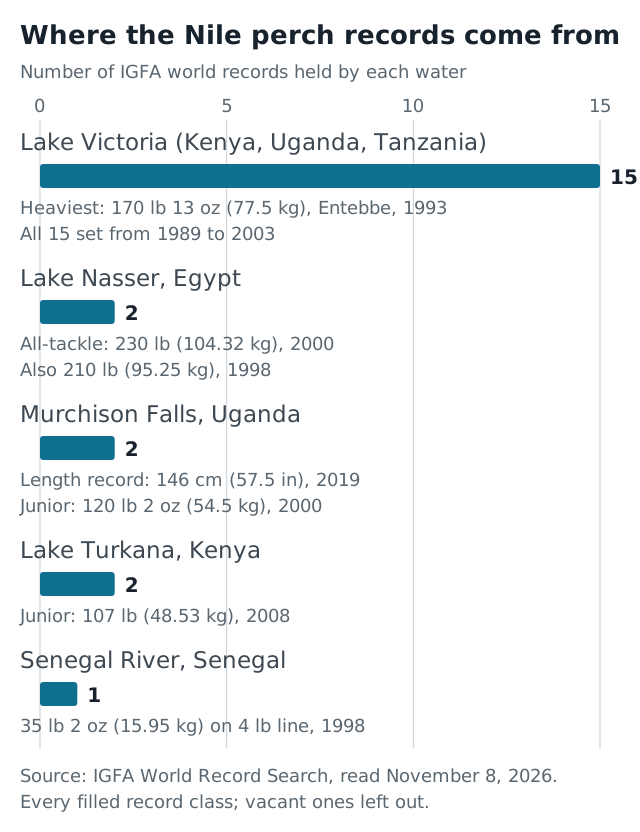 Nile Perch: How Big They Get, the Record, and Where to Catch One
Nile perch grow to about 2 m and 200 kg, and the record is 230 lb from Lake Nasser. Where to catch one, why the US bans it, and the Lake Victoria story.
Sources (42)
- International Game Fish Association, World record search: shad, gizzard, all-tackle (member-portal API, read 2026-11-09)
- Missouri Department of Conservation, Gizzard shad (field guide)
- Missouri Department of Conservation, Threadfin shad (field guide)
- Texas Parks and Wildlife, Gizzard shad (Dorosoma cepedianum)
- Texas Parks and Wildlife, Threadfin shad (Dorosoma petenense)
Show all 42 sourcesShow fewer sources
- Fishes of Texas, Dorosoma cepedianum
- Iowa DNR, Fish Iowa: gizzard shad
- Illinois DNR, Gizzard shad
- Iowa DNR, Fishing regulations and laws
- Iowa fishing regulations (eRegulations), general fishing regulations
- Indiana Administrative Code, 312 IAC 9-6-8: carp and gizzard shad as bait
- Indiana fishing regulations (eRegulations), basic fishing information
- Nebraska Administrative Code, title 163, chapter 2, section 009: bait collecting and dealer regulations
- Pennsylvania Code, 58 Pa. Code 63.48: permit for the use of cast nets or throw nets
- Tennessee Wildlife Resources Agency, Bait regulations
- Tennessee fishing regulations (eRegulations), live bait regulations
- Kansas Administrative Regulations 115-7-3: taking and use of baitfish or minnows
- Missouri Department of Conservation, Live bait regulations
- Minnesota Statutes 97C.345, Restrictions on using and possessing nets and spears
- Minnesota fishing regulations (eRegulations), general regulations
- Texas Parks and Wildlife, Outdoor Annual: legal devices, methods and restrictions
- Michigan DNR, Current state record fish
- WXYZ Detroit, gizzard shad caught in West Michigan breaks state record
- WGVU News, 4.45 Pounds of History: Angler catches new state record fish in Grand River
- Coastal Angler, That's A Mighty Big Bait
- David A. Brown, Get 'em on the gizzards (Bassmaster, 2026)
- Bassmaster, Understanding bass forage: Shad
- Bassmaster, Gizzard shad
- Bassmaster, How to fish for bass during a shad kill
- In-Fisherman, Science of shad winterkill
- In-Fisherman, Baitfish care and survival
- Game & Fish, Fresh bait
- TX Fishing Guide, How to catch and keep shad alive
- Outdoor Life, Live Bait Bosses: The Shad Man
- U.S. Fish and Wildlife Service, Gizzard shad (other common names)
- U.S. Geological Survey, Nonindigenous Aquatic Species: gizzard shad (Dorosoma cepedianum)
- Timmons, T. J. and Pawaputanon, O. (1980), Relative size relationship in prey selection by largemouth bass in West Point Lake, Alabama–Georgia, Proc. SEAFWA 34:248–252
- South Carolina DNR, Striped bass
- Fishing Loft, World record striped bass (Bramlett's 10 in gizzard shad)
- In-Fisherman, Blue catfish seasons (by Jim Moyer as told to Don Wirth)
- Catfish Edge (Chad Ferguson), Best catfish bait
- Missouri Department of Conservation, Spotted gar (field guide)