 By
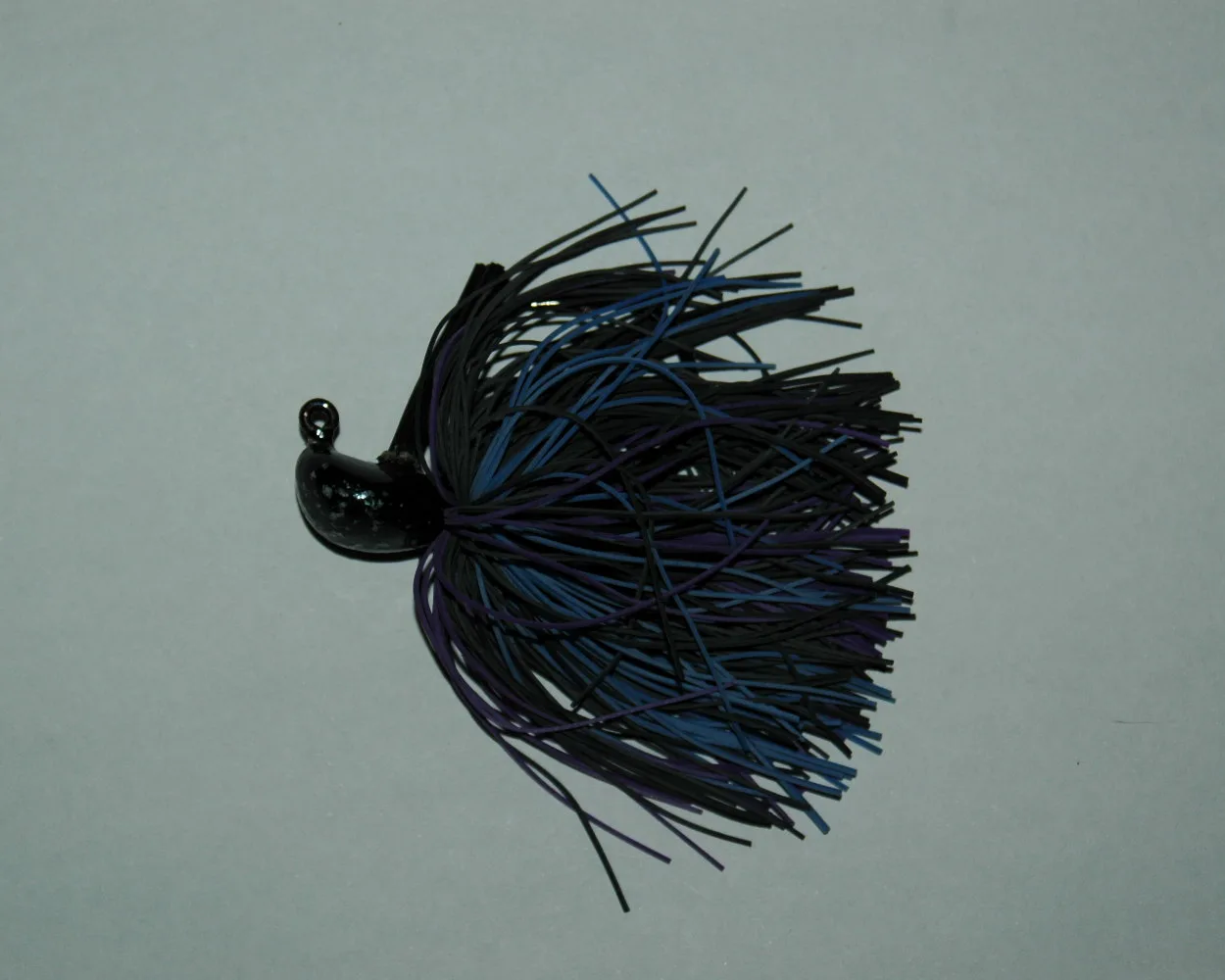
A bass jig is a lead or tungsten head on a single hook, dressed with a rubber or silicone skirt, usually guarded by a fiber weedguard and fished with a soft-plastic trailer. There are nine types, and each head does a job the others cannot. A football head slides over rock, a pointed swim jig slips through grass, a scoop-headed skipping jig planes under a dock. If you buy one, make it a 3/8 or 1/2 oz casting jig in green pumpkin or black and blue.
On the last day of the 2017 Bassmaster Classic, mechanical trouble pinned Jordan Lee to one offshore spot. He slowed down with a football jig, caught over 27 pounds from a 30-yard area, and won.
Which jig for which job?
The nine are football, finesse, skipping, flipping, casting, swim, grass, hair and vibrating. Six of them do most of the work. Adult largemouth feed almost only on fish and large invertebrates such as crayfish. So a jig with a craw trailer is the crayfish; with a swimming trailer it is a bluegill or a shad.
| Type | Head and hook | Weight | Where | Trailer |
|---|---|---|---|---|
| Football | Widest head; more surface on the bottom, slides over rock | 1/2 oz to start, up to 1 oz (14–28 g) | Rock, gravel, ledges, offshore structure | Craw, chunk, twin-tail grub |
| Flipping | Pointed head for grass, rounder Arkie head for wood; heavier hook, thicker weedguard | 3/4–1 oz (21–28 g) for heavy cover | Reeds, cattails, brush, laydowns | Craw, creature bait |
| Casting (Arkie) | Wide, flattened head, regular wire hook, standard weedguard | 3/8–1/2 oz (11–14 g) | Docks, laydowns, brush, points | Craw, chunk |
| Swim | Pointed bullet head, line tie at the front | 1/4–1/2 oz (7–14 g) | Grass, docks, open water | Paddle-tail swimbait, grub |
| Finesse | Round or ball head, lighter hook, thin weedguard, short skirt | About 3/16–7/16 oz (5–12 g) | Rock, cold water, smallmouth and spotted bass | Small chunk or grub |
| Hair | Hair, marabou or bucktail instead of a rubber skirt | 1/16 oz (1.8 g) to about 1 oz | Smallmouth on rock; shad on southern ledges | Optional; a small beaver |
If you could have only one jig, make it a regular Arkie-style casting jig. By BassResource’s reckoning, standard Arky jigs have likely caught more bass than any other jig style, and the most-used sizes are 3/8 and 1/2 oz. A casting jig can be skipped under a dock, flipped into a laydown and dragged through brush. The jigs hub sets every jig side by side, and the rigs hub covers the soft-plastic rigs.
What about skipping, grass and bladed jigs?
Skipping jigs are built to skim across the surface under docks and limbs. They have a horizontal eye, a scoop-shaped head with most of the weight on a planing surface, a medium weedguard and a stout round-bend hook. They come mostly in green, brown or black, because under a dock you are imitating bluegill and crawfish, not shad.
Grass jigs are the big brother of the swim jig and the grass-flipping jig. They have pointed heads, more weight, and beefier hooks and weedguards; the Medlock Jig had two weedguards. They are flipped into hydrilla clumps, reeds and mats, and they are among the most seldom-used jigs in bass fishing.
Vibrating jigs add a hinged blade to the front of a jig, and some anglers say that blade disqualifies them from the category. They are reeled through the water column, from a foot of water out to 20 ft (6 m); the chatterbait pages cover them.

Free PDF · Water temperature chart When do bass bite?
One water temperature reading, and the 16-page chart tells you who's spawning, who's feeding hard, where they sit and what to throw. 26 fish, every number sourced.
Enter your email, confirm it with one click, and the PDF is in your inbox. Plus one email a week on what's biting. Unsubscribe anytime. Privacy.
Flipping jig or football jig?
The difference is the head and the cover. A football head is the widest of all, so it keeps contact with a hard bottom. It slides over rocks where a pointed head would wedge in the cracks. That makes it a dragging jig for clean bottom, rock and offshore structure.
A flipping jig is built to go into cover. It is beefier, with a bigger, stouter hook and a thicker weedguard, often in 3/4 and 1 oz to get through branches. Its head comes in two shapes. A pointed one sheds grass but hangs in wood; a rounder Arkie-style head comes through wood and rock without wedging.
So drag the football where the bottom is hard and clean. Flip the flipping jig into anything you can see.
How heavy, and lead or tungsten?
Weight follows depth and cover, and the rule is bottom contact: keeping the jig on the bottom is one of the biggest keys to deep jig fishing. Go lighter for shallow water and heavier for deep. These are the anchors from the pros:
- Football: Jordan Lee calls a 3/4 oz “a good all-purpose size,” fished “from 3 feet to 30 feet deep.” Others start at 1/2 oz.
- Full-size and finesse: Matt Arey ties on a 1/2 or 5/8 oz jig for big largemouth. Where spotted bass and smallmouth live too, he uses a 5/16 or 7/16 oz finesse jig. After a harsh cold front, he says, finesse wins.
- Reaction: a slightly heavier jig falls faster and draws reaction bites from aggressive summer fish.
Tungsten is 19.3 g/cm³ against lead’s 11.35, so a tungsten head is about 59% the size of a lead head of the same weight. The smaller head slips through cover and transmits more of the bottom.
It also matters for the law. New Hampshire has banned lead jigs of 1 oz or less in all fresh water since June 1, 2016, skirted or painted. Maine bans unpainted lead jigs of 1 oz or less, or 2.5 in or shorter. Painted lead jigs that size can no longer be sold there, and since Sept. 1, 2026, they cannot be used on inland waters either. In the fresh water of both states a lead casting jig is now illegal, and tungsten is the way around it.
Which trailer and which color?
Trailers set the fall and the action. The rule for football jigs works for all of them: the warmer the water, the more action. Use a twin-tail grub or a craw with flapping claws as the water warms, and a chunk or beaver-style bait as it cools. A flipping jig takes a craw or creature bait, a finesse jig a small chunk or grub, a swim jig a paddle-tail swimbait or grub. Thread the trailer on straight against the keeper molded on the collar.
Colors stay simple. Matt Arey fishes a shade of green pumpkin 95% of the time, and switches to black and blue only in very dirty water. A handful of jigs in green pumpkin and black and blue covers most situations. Swim jigs are the exception: white or shad colors when bass are feeding on baitfish. Hair jigs split by size: small black marabou for northern smallmouth, big white bucktail for southern ledge fish feeding on shad.
How do you fish each one?
- Football jig on rock. Cast past the structure and drag the jig slowly so the head rolls and the trailer stands up. In summer, add sharp snaps of the rod tip. Lee fishes his on a 7 ft 4 in (2.2 m) heavy rod and 17 lb fluorocarbon.
- Flipping jig in cover. Flip or pitch it into the reeds, the brush or the laydown, let it fall straight down and watch the line for subtle movement on the way down. Arey yo-yos it for a second or two to keep it in a small strike zone. Use a stout rod, heavier line or braid, and a hard hookset to get a big fish out.
- Casting jig on docks and points. Skip it under docks or cast it to points and brush, then drag or hop it home. Slow and steady in cold water, a more aggressive hop when the water is warm.
- Skipping jig under docks. A low sidearm cast bounces it across the surface into the shade. The scoop head is what makes it skip instead of dive.
- Swim jig through grass. Reel it steadily, vary the speed, and twitch or pause it to trigger a strike. Think of it as a spinnerbait without a blade arm.
- Finesse jig on rock. A slow, deliberate drag that never loses the bottom, on fluorocarbon, around rocks, docks and light vegetation. Arey drops to 12 lb line when he drags it deeper than 15 ft (4.6 m).
- Hair jig for cold smallmouth. Bounce it along the bottom or swim it just above. In very cold water a silicone skirt clumps and barely moves; hair keeps breathing. Jigs of 1/4 oz or less go on spinning tackle.
What does a jig bite feel like?
Many bites come as the jig falls, and they are subtle. Watch the line on the way down, and set the hook on any small movement that looks different.
Set the hook hard. For football jigs, a 7:1 to 8:1 reel keeps the line tight after the hookset, on a rod of 7 ft 3 in (2.2 m) or longer, medium-heavy to heavy. The rods and fluorocarbon line pages cover the choices.
Which jigs win, and which to buy?
Bill Lowen won the Bassmaster Elite event on the St. Johns River in February 2025 with 73 lb 14 oz. His two baits were a 3/8 oz Bill Lowen Signature Series jig with a Zoom Super Chunk, and a 5/16 oz Lowen swim jig with a Zoom Super Speed Craw, both in Blue Craw. Tucker Smith won the Lake Fork Elite in May with 127 lb 8 oz. His key baits were a jighead minnow and a Yamamoto Yama Craw on a 3/4 oz Picasso football head. The best bass lures page carries the season’s whole list.
For the jigs themselves, Shaye Baker’s buyer’s guide at Wired2Fish names these by type:
| Type | Picks |
|---|---|
| Football | Strike King Tour Grade Football, V&M Pacemaker |
| Finesse | Jewel Tactical Finesse HD, Strike King Tour Grade Finesse |
| Skipping | Strike King and Berkley skipping jigs |
| Flipping | Z-Man CrossEyeZ, Berkley Flippin’, Missile Ike’s Mini Flip |
| Casting | Greenfish Brandon Cobb, Dirty Jigs Luke Clausen |
| Swim | Dirty Jigs, Beast Coast, Strike King Hack Attack, 6th Sense Divine |
| Grass | Strike King Hack Attack Flipping Jig |
| Hair | Cumberland Pro Prayer, Outkast Feider |
When does something else win?
When bass are chasing shad in open water, cover water with a spinnerbait, a chatterbait or a crankbait. For pressured bass in clear water, a Ned rig is a smaller bait still than a finesse jig. When the jig keeps hanging up in thick grass, a Texas rig with a pegged weight goes through.
The bass hub has where all three bass are in each season, which tells you where to drop the jig.
Free PDF · 16 pages
Know what's biting before your first cast
The Water Temperature Fishing Chart. Take one water temperature reading, find it on the chart, and you know which of 26 freshwater fish are feeding today, where they are and what to throw. For your phone and the tackle box.
- The 26-fish chart: who's spawning, feeding hard or shut down at your reading
- Where they sit and what to throw at every band: bass, crappie, bluegill, walleye, catfish and trout
- The best hours at your reading, the cold front day by day, and the spawn calendar from ice-out to midsummer
- The three thermometer mistakes that make a reading lie (the first one is the surface)
Every number from state fish and wildlife agencies and fisheries research: 61 sources, all on the site.
Enter your email, confirm it with one click, and the PDF is in your inbox. Plus one email a week on what's biting. Unsubscribe anytime. Privacy.
Related
Section guide
Bass Fishing: Where the Bass Are, What to Throw, and the Three Bass You Will MeetBass fishing by water temperature: where largemouth, smallmouth and spotted bass sit from 48 to 90 °F, what to throw first, and how to tell them apart.
 Meanmouth Bass: How to Identify the Hybrid, and the Records
A meanmouth bass is a smallmouth crossed with a spotted or largemouth bass. How to identify one, where they turn up, and the IGFA records.
- Types of Bass: Every Fish Called Bass and How to Tell Them Apart
The types of bass, from largemouth and smallmouth to striped and black sea bass: which family each is, where it lives, its record and how to tell them apart.
 What Do Bass Eat? The Diet by Size, Season and Species
Adult bass eat mostly fish and crayfish: 59% and 38% by weight in an Arkansas study. The diet by size, season and species, from six studies.
 Is Bass Good to Eat? Yes, If You Keep the Small Ones and Check the Water
Yes, bass is good to eat: mild, white and firm. Which bass to keep, what mercury advice says about bass against panfish, and why most go back.
- World Record Smallmouth Bass: The Hayes Fish and the False Affidavit
The world record smallmouth bass weighs 11 lb 15 oz, caught at Dale Hollow in 1955. How it was struck off and restored, the IGFA records, the state records.
 Bass Bait: The Best Live Bait and Lures, Matched to What Bass Eat
The best bass bait is whatever your bass already eat: shiners, crawfish, shad or bluegill, live or as a lure. What works, what size, and where it's legal.
Sources
- Wired2Fish (Shaye Baker), best bass jigs
- BassResource (Tyler Brinks), 6 bass jigs explained
- BassResource, Matt Arey on how to choose jig size
- Tackle Warehouse, how to choose the right jig
- Tackle Warehouse, football jig patterns and techniques
- Discount Tackle, the essential jig types for bass fishing
- Wired2Fish (Luke Stoner), Jordan Lee's football jig tips for offshore bass
- WesternBass (Tyler Brinks), hair jigs for smallmouth
- Bassmaster, top lures at St. Johns River 2025
- In-Fisherman, rookie Smith wins Lake Fork by less than a pound (2025)
- Maine IFW, lead fishing tackle
- On The Water, New Hampshire's new lead jig law (2016)
- Maine Legislature, 12 MRS §12664: unlawful use of lead sinkers and lead jigs
- NIST ESTAR, composition of tungsten (density 19.3 g/cm³)
- NIST ESTAR, composition of lead (density 11.35 g/cm³)
- Tackle Warehouse, Strike King Hack Attack Heavy Cover Swim Jig (1/4 to 1/2 oz)
- Texas Parks and Wildlife, largemouth bass species profile