 By
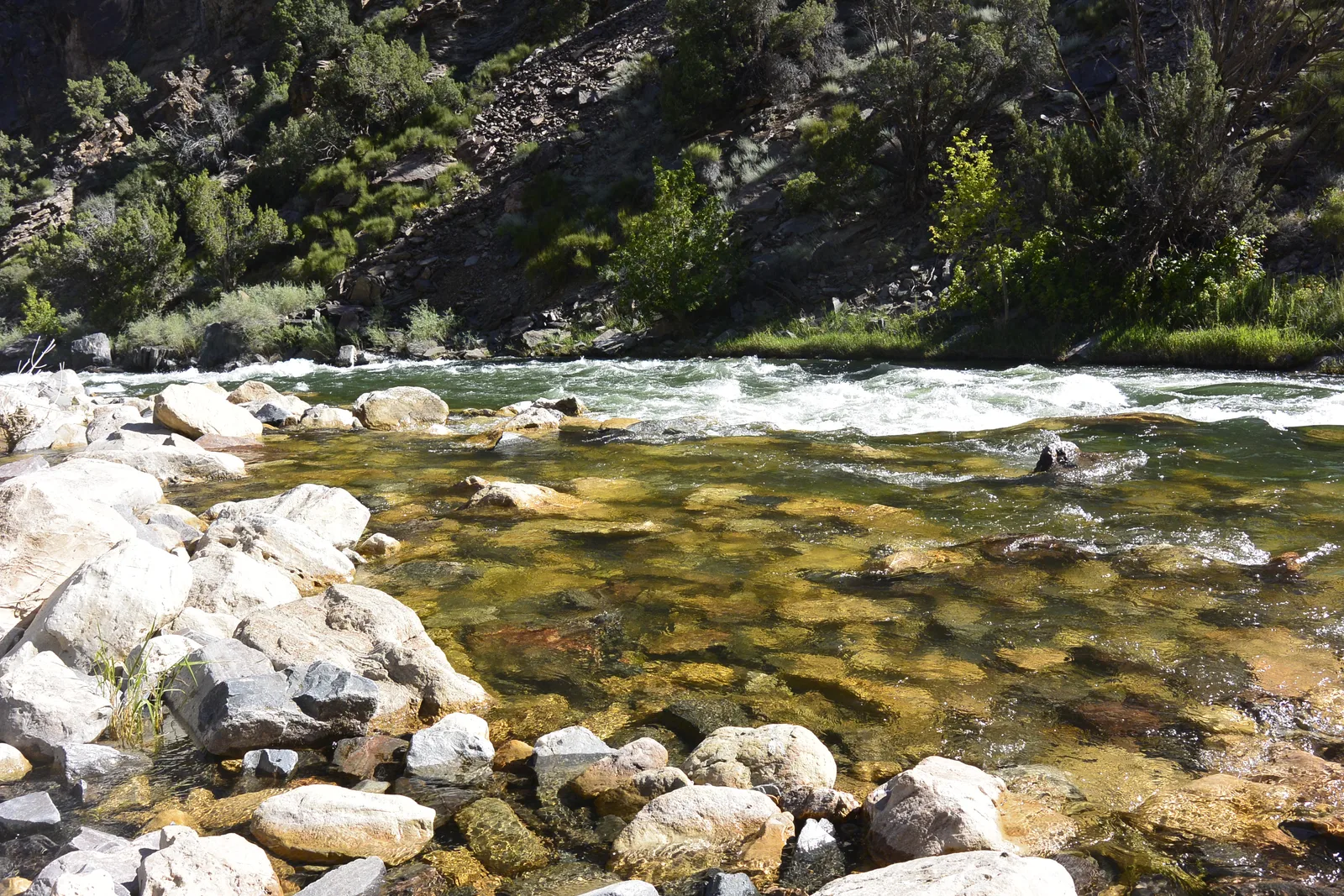
Colorado fishing never closes: the state’s waters are open day and night, all year, unless a rule for one water says otherwise. That’s more than 6,000 miles of streams and over 1,300 lakes and reservoirs, with over 35 kinds of fish. Trout lead the way, and the statewide limit is four a day.
A Gold Medal water in Colorado has to hold at least 12 trout of 14 inches or longer on every acre, year after year.
Start here
- Colorado fishing license: every 2026-27 fee, the Habitat Stamp, and which license is cheapest for your trip.
- Rainbow trout and brown trout: where they hold in a river and what to throw.
- Kokanee salmon: the one fish you may snag in Colorado, on listed waters only.
- Tiger muskie: one a day, and only at 36 in (91 cm) or longer.
When is fishing season in Colorado?
Always, with exceptions by water. The 2026 brochure’s special regulations, water by water, are where closures live. Two of the new ones for 2026 sit above Dillon Reservoir. Stretches of the Blue River and of Tenmile Creek close to fishing from Sept. 15 to Dec. 1.
Summer heat can close water too. CPW can shut a stream when the water tops 71 °F (22 °C) or flows drop to half of normal. At 71 °F and up, trout you release are less likely to recover. In a dry summer, CPW’s advice is to head for alpine lakes and streams, where your water stays cooler, or to go after warm-water fish.
The free fishing weekend is the first full weekend of June. In 2026 it was June 6–7, with no license or Habitat Stamp needed.
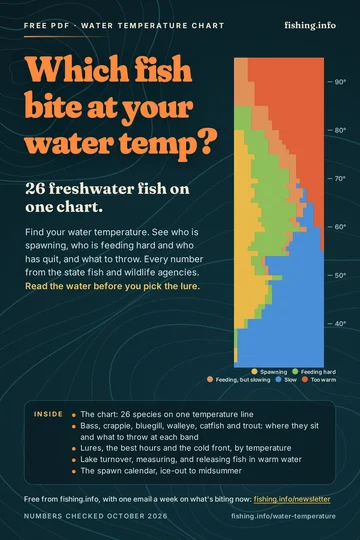
Free PDF · Water temperature chart Which fish are biting at today's water temperature?
One reading, and the 16-page chart shows which of 26 fish are spawning, feeding hard or slowing down; for bass, crappie, bluegill and walleye, where they sit and what to throw. Every number sourced.
No card, nothing to buy, and the PDF is yours to keep. It's in your inbox a minute later. Then a few short emails and one a week on what's biting. Unsubscribe anytime. Privacy.
Do you need a fishing license in Colorado?
Yes, from age 16. A resident pays $44.87 for the year, a nonresident $124.01. Most adults add the $12.76 Habitat Stamp once a year. Kids under 16 fish free, and the license year runs March 1 to March 31 of the next year. The license guide works out when day licenses beat the annual.
What fish can you catch, and where?
Cold water and warm water both. Trout first: rainbow, brown, brook, cutthroat and lake trout, plus kokanee. Then walleye, wiper (a white bass and striped bass cross), bass, catfish, crappie, pike and tiger muskie. You can fish most state parks, though you may pay an entrance fee.
Start with the stocking report. CPW runs 19 hatcheries that stock over 90 million fish a year. The report shows where catchable trout, about 10 inches, went in last week. It’s updated every Friday in season.
The Colorado Fishing Atlas, CPW’s online map, finds you water by species or by distance from your home. It also shows boat ramps, accessible fishing spots and special rules. CPW’s fishing report comes out weekly from April 1 to Oct. 31, and twice a month in winter.
What can you keep?
These are Colorado’s statewide limits for 2026-27. A water’s own rule in the brochure overrides them. The bag and possession limits are explained in the glossary.
| Fish | Daily | Possession |
|---|---|---|
| Trout, char, grayling, salmon, whitefish, together (not kokanee) | 4 | 8 |
| Kokanee | 10 | 10 |
| Walleye, saugeye, sauger, together | 5 (10 in Arkansas and S. Fork Republican drainages) | same |
| Largemouth, smallmouth, spotted bass, together | 5 (smallmouth unlimited west of the Divide) | same |
| White bass, striped bass, wiper, together | 10 (20 in Arkansas and S. Fork Republican drainages) | same |
| Channel, flathead, blue catfish | 10 | 10 |
| Crappie; bluegill and other sunfish | 20 of each group | 20 of each group |
| Yellow perch | 20 east of the Divide, unlimited west | same |
| Tiger muskie, 36 in (91 cm) or longer | 1 | 1 |
| Northern pike, bullhead | unlimited | unlimited |
On top of the trout limit you may keep 10 brook trout of 8 in (20 cm) or less. A fish you release at once doesn’t count. One on a stringer or in a live well does, and frozen fish at home count toward possession until you eat them.
Some reservoirs have no limit at all on certain fish, and CPW asks you to keep them. Stagecoach Reservoir has no limit on northern pike, smallmouth or walleye. Elkhead and Rifle Gap have none on pike and smallmouth. New for 2026, the same goes for tiger muskie in Grand Lake, Lake Granby and the North Fork of the Colorado.
Where are the Gold Medal waters?
Gold Medal is CPW’s top grade for trout water. It takes at least 60 lb of trout per acre, and 12 trout of 14 in (36 cm) or longer per acre. A river stretch must run at least two miles, a lake at least 50 acres.
| Water | Gold Medal stretch |
|---|---|
| North Delaney Butte Lake | the lake, Jackson County |
| Spinney Mountain Reservoir | the reservoir, Park County |
| Steamboat Lake | the lake, Routt County |
| Arkansas River | Lake Fork confluence near Leadville to Parkdale |
| South Platte River | five stretches, including Cheesman dam to the Wigwam Club |
| Fryingpan River | Ruedi Reservoir dam to the Roaring Fork |
| Gunnison River | Almont to the U.S. 50 bridge, and below Crystal dam to the North Fork |
| Taylor River | Taylor Park Reservoir dam to Almont |
The Animas, Blue, Colorado, Gore Creek, North Platte, Rio Grande and Roaring Fork have Gold Medal stretches too. Each water’s own rules sit in the brochure, marked with a G. Past the trout, CPW also lists more than 50 Quality Waters: productive lakes and streams with good public access, for one species or many.
Which rules catch visitors?
- No live fish for bait west of the Continental Divide, or above 7,000 ft (2,134 m) on the east side. Navajo Reservoir is the one exception. The ban is on live fish. Worms are another matter, unless the water is flies and lures only.
- Three hooks per line. All the hooks on one lure count as one.
- No snagging, except kokanee on waters the brochure lists.
- Never move a fish from one water to another. It’s illegal.
- Private land needn’t be posted. Touch it without permission, even from a boat, and you can be suspended for up to five years.
- Greenback cutthroat trout go back at once. They’re protected.
What are the rules on the ice?
Colorado’s ice rules are short. Holes can be no wider than 10 in (25 cm), round or square. Fires must be in a container, and nothing gets left on the ice. A portable shelter comes off at the end of the day. A permanent shelter, where one is allowed, shows the owner’s name and customer ID on the side facing shore. The letters are at least 2 in (5 cm) high.
A second tip-up or rod needs the $14.24 second-rod stamp, kids under 16 included. The ice fishing guide covers the gear and the safety.
All articles
 Colorado Fishing License 2026: Cost, Who Needs One and Where to Buy
A Colorado fishing license is $44.87 for residents and $124.01 for nonresidents, plus a $12.76 Habitat Stamp. The 2026-27 fees and who fishes free.

Free PDF · 16 pages
Stop guessing. Know what's biting before your first cast
A whole Saturday on the water with nothing to show for it. One reading tells you who's feeding.
The Water Temperature Fishing Chart. Take one water temperature reading, find it on the chart, and see which of 26 freshwater fish are spawning, feeding hard or slowing down.
- Where bass, crappie, bluegill and walleye sit, and what to throw. Trout: the reading where you stop.
- Why a 3 ft drop beats a cold front, and what to throw each day of the front
- The three thermometer mistakes that make a reading lie
The chart's numbers come from state fish and wildlife agencies and fisheries research: 64 sources, each listed on the site.
No card, nothing to buy. The PDF is in your inbox a minute later, one version for your phone and one to print, yours to keep. Then a few short emails and one a week on what's biting, with an unsubscribe link in every one. Privacy.