 By
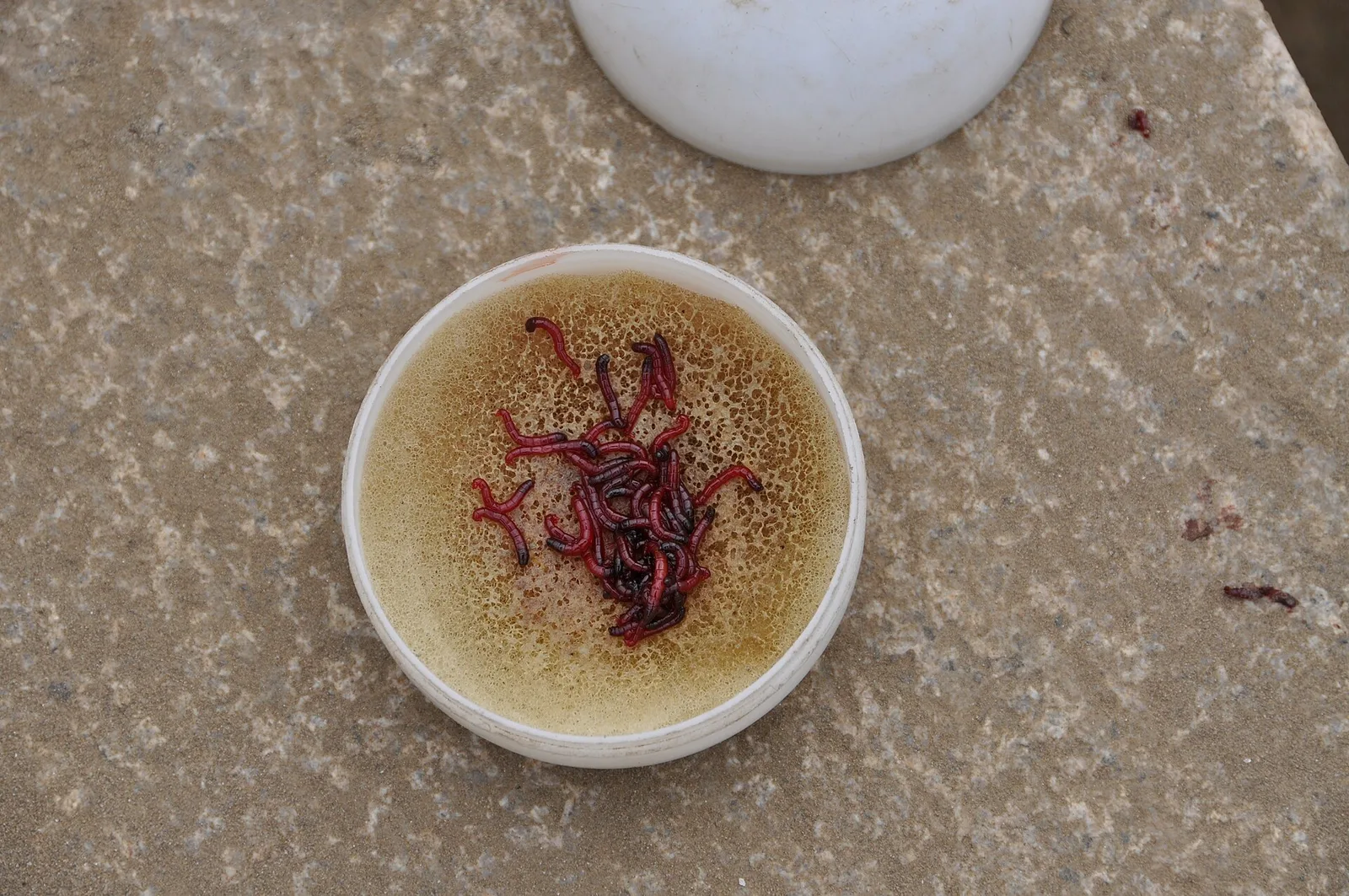
Live bait is any bait still alive on the hook: worms, minnows, leeches, crawfish, crickets and, in salt water, shrimp. For most freshwater fishing, buy a box of nightcrawlers or a scoop of minnows. Hook it so it keeps kicking and keep it cool. Check the rules before you carry it from one lake to the next. That’s most of the game.
One gallon of water keeps 12 to 24 small to medium minnows alive. Crowd more in and you’re paying for dead bait.
Which live bait should you use?
Use what the fish already eats where you’re fishing. A worm works on nearly everything, so it’s the safe first buy. Minnows are the pick when the fish you want eats other fish. The rest are for a certain fish or a certain kind of water.
This is the short list, with the hook and the rig for each. Hook sizes run backwards, so a size 6 is smaller than a size 2. The hook size chart shows what they look like.
| Live bait | Best for | Hook | Rig |
|---|---|---|---|
| Nightcrawler | Almost every freshwater fish | A small hook for a piece, bigger for a whole crawler | Under a bobber, or on the bottom |
| Small minnow | Crappie, perch, walleye | No. 6 to No. 4, fine wire | Under a bobber |
| Big minnow or shiner | Bass, pike, big crappie | Up to 1/0 or 2/0 | Under a bobber, or drifted with a split shot or two |
| Leech | Walleye, late spring to early fall | A small hook through the big sucker | Under a bobber |
| Crawfish | Bass of all kinds, catfish, trout | 1/0 to 4, through the tail | Drifted, or split shot a foot up |
| Hellgrammite | River smallmouth, trout | 2 to 6, fine wire, under the collar | One or two split shot |
| Cricket | Bluegill, crappie | Very fine wire, light line | Under a small bobber |
| Mealworm | Panfish, trout | A tiny hook | Weighted, or under a small float |
| Shad | Stripers, big blue and flathead catfish | 4/0 to 2 on an 18 to 36 in leader | A 1/2 to 1 1/2 oz egg sinker above a swivel |
| Live shrimp | Nearly everything inshore | A No. 2 treble, or a 1/8 to 1/4 oz jig | Free-lined, with one split shot a foot up |
If you’re not sure, ask at the bait shop nearest the water. They know what’s biting this week, and they’ll often show you how to hook it.
The fishing bait page has the full bait-by-fish chart, with cut and prepared bait next to the live stuff. For crappie fishing and walleye fishing, the minnow is the main event, and the minnows page goes through the kinds.
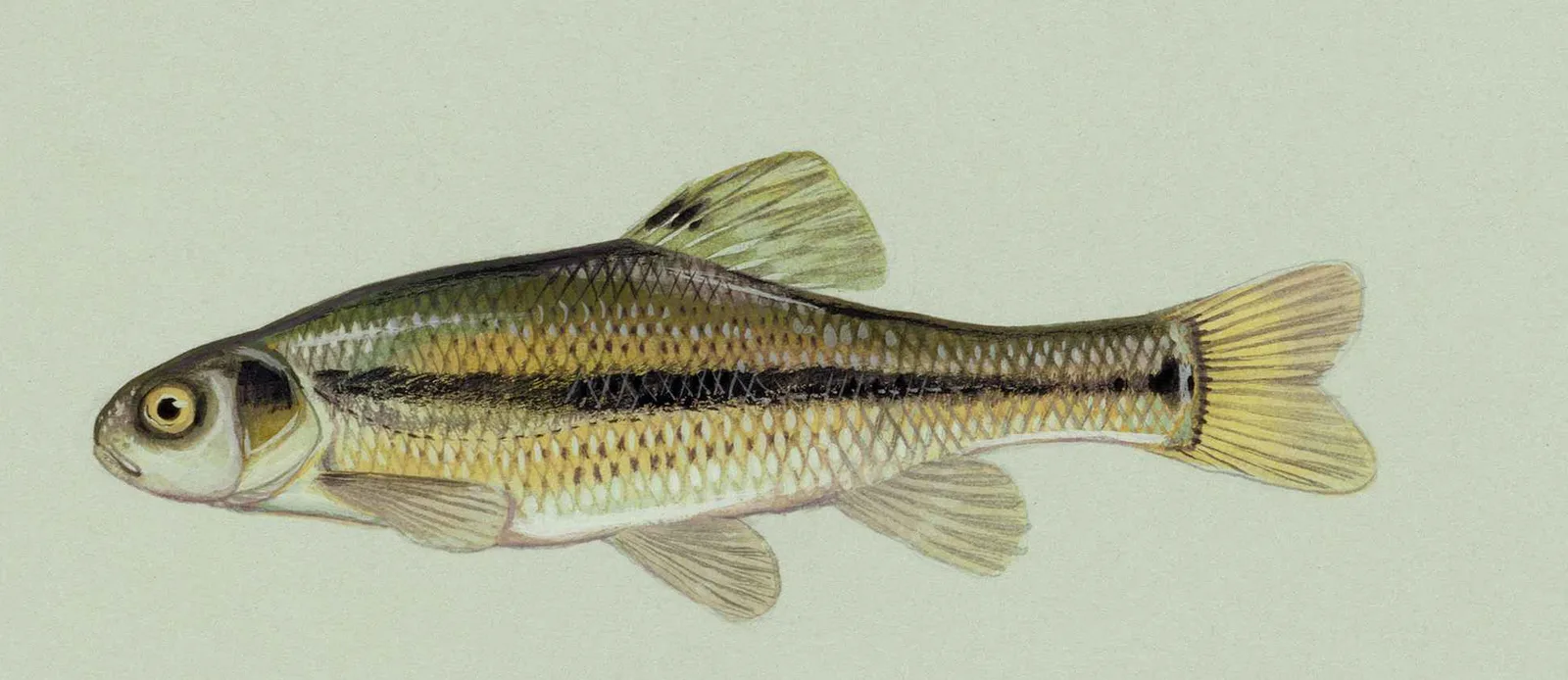
The fathead minnow, one of the bait minnows on New York’s list of fish shops may sell. Illustration: Duane Raver, U.S. Fish and Wildlife Service (public domain).
How do you hook live bait so it stays alive?
A live bait only works while it’s alive. So hook it lightly, in a spot that doesn’t kill it, and leave the point clear. Use the thinnest hook that will hold the fish. Sutton’s advice for minnows holds for all of them: a fine-wire hook hurts the bait less than a heavy one.
- Minnows: through both lips, from the bottom up. That’s the best way overall for a bait you cast or move. For a minnow that hangs still under a bobber, go through the back, just behind the top fin. Skip the eye. It’s more likely to kill the minnow.
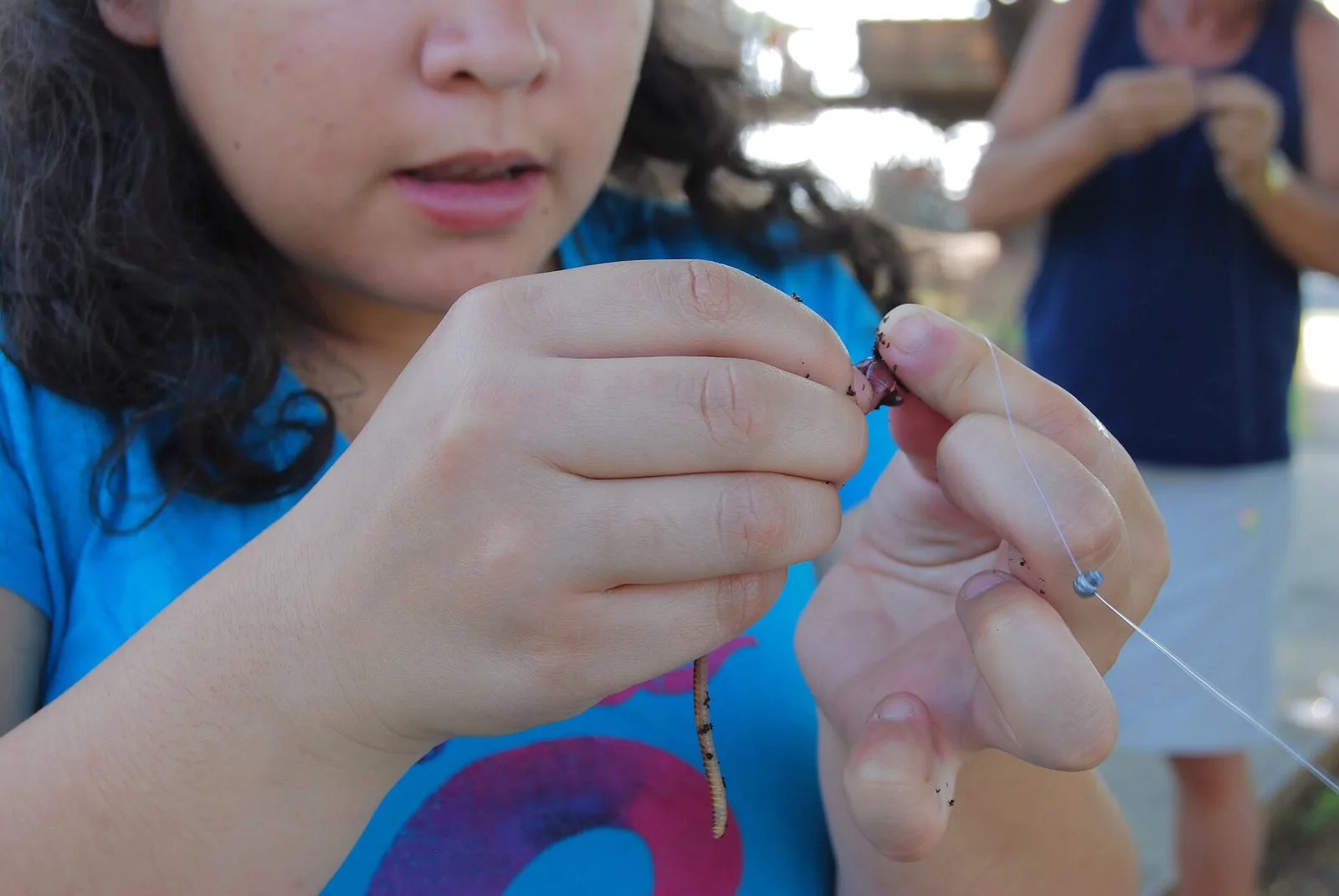
- Nightcrawlers: pin a small worm, or thread on a piece of a big one. On a whole crawler, go through the head end, the shorter side of the band. It holds better there.
- Leeches: right through the middle of the big sucker.
- Crawfish: through the lower edge of the tail, with the hook point facing up.
- Hellgrammites: once under the collar, just behind the head.
- Live shrimp: through the head, under the horn and in front of the dark spot. For a jig, go through the tail.
- A live bluegill, where it’s legal: a 3 to 5 in fish on a 2/0 baitholder hook, through the back just ahead of the top fin. It’s a bait for flathead catfish, pike and muskies.
Then size the hook to the bait. Sutton’s crappie numbers are a good guide: No. 6 to No. 4 for small minnows, No. 3 to No. 1 for medium ones, up to 1/0 or 2/0 for big ones.
Free PDF · Water temperature chart Which fish are biting at today's water temperature?
One reading, and the 16-page chart shows which of 26 fish are spawning, feeding hard or slowing down; for bass, crappie, bluegill and walleye, where they sit and what to throw. Every number sourced.
No card, nothing to buy, and the PDF is yours to keep. Confirm with one click and it's on its way. Then a few short emails and one a week on what's biting. Unsubscribe anytime. Privacy.
Which rig should you use with live bait?
The simplest rig is the best one to start. “The best gear is the simplest,” Bass Pro says: a hook and a sinker under a bobber. Here’s when to switch to something else.
| Rig | When to use it | How to set it up |
|---|---|---|
| Bobber | Panfish, crappie, a minnow in spring | Hook, one split shot, a bobber. For a live bluegill, a big bobber 1 to 2 ft up |
| Split shot, no bobber | Crawfish and hellgrammites in a river, live shrimp around a jetty | One or two small split shot about a foot above the bait |
| No weight at all | A bait that dives for the bottom by itself in a river, like a madtom (a small catfish) | Just the hook. Cast up and across and let it drift |
| Sliding sinker | Big bait on the bottom: shad, a big minnow | An egg sinker above a swivel, then an 18 to 36 in leader |
A split shot is a small round weight you pinch onto the line. The fishing weights page has the other shapes, and the fishing terms page explains the rest of the words.
The sliding sinker is built like a Carolina rig. The weight rides on the main line above a swivel. The bait swims on the leader below it. In salt water from a pier or a beach, the fish-finder rig does the same job.
Give the bait room to swim. A minnow pinned under a heavy sinker doesn’t look like dinner. It looks like it’s stuck.
What about live bait in salt water?
Start with live shrimp. In the Gulf, as Robert Sloan of Salt Water Sportsman puts it, “everything eats shrimp.” Free-line one around a jetty. Sloan pinches one split shot about a foot above the hook, just heavy enough to take the shrimp down to the fish. Or hook it through the tail on a 1/8 to 1/4 oz jig.
Three more are worth knowing.
- Killifish, also sold as mud minnows or mummichogs. They live in fresh, brackish and salt water. In salt, Outdoor Life’s Joe Cermele says to put one on a jighead for flounder, redfish, seatrout and stripers. They don’t need a bucket of water. Keep them in a cooler on soaked newspaper over ice, so their gills stay moist.
- Sand fleas, the small sand crabs of Gulf and Atlantic beaches. Run the hook through the rear of the shell and fish it on the bottom with a bank sinker. Pompano, flounder, drum and croakers eat them.
- Croakers, sold by the dozen at Texas bait camps from about June through October. Sloan calls a live croaker over a reef, at the jetties or in the surf “an absolute killer for trout and reds.” Rig it on a No. 3 to No. 6 Kahle hook and an 18 in fluorocarbon leader.
Flounder are suckers for finger mullet and mud minnows, Sloan says. Fish them on a Carolina rig, because flounder bite softly and slowly.
Stripers along the coast want bigger bait: a live menhaden, also called bunker, or a live eel. The striper fishing page covers when and where those work.
How do you keep live bait alive?
Bait dies from heat, from running out of air and from bad water. Each bait has one number that matters most. Here they are.
| Bait | How to keep it | The number |
|---|---|---|
| Minnows | Cool water without chlorine, an aerator running | 50 to 65 °F (10–18 °C), 12 to 24 per gallon |
| Leeches | Lake water in a jug in the fridge | Change the water every couple of days |
| Nightcrawlers | Bedding in a foam box, in the fridge | 38 to 45 °F (3–7 °C), In-Fisherman says. Bass Pro says 45 to 50 °F |
| Crawfish | A cool bucket with wet grass | An inch or two of water, no more |
| Crickets | A cricket basket with a slice of potato | Several days, if they aren’t crowded |
| Shad | A big round tank with air running | Rock salt and ice help, Bass Pro says |
| Killifish | A cooler with ice under soaked newspaper | No water needed. Keep the gills moist |
Minnows are the hardest, so here’s more on them. Use water without chlorine. If all you have is tap water, let it stand overnight first. Change the temperature slowly. Sutton says a bag of minnows set on ice “may be full of belly-up bait in minutes.” Heat kills them as fast as cold. A little ice in the water on a warm day is fine, says John Woods of Mississippi Sportsman.
The Texas Parks and Wildlife magazine gives two more rules. Keep the bait bucket within 10 degrees of the water the bait came from. And every few hours in warm weather, swap about a third of the water.
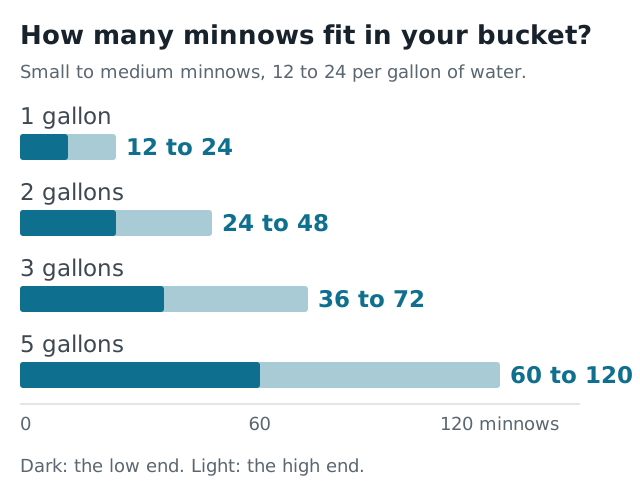
Minnows per bucket, from the rule of 12 to 24 small to medium minnows per gallon. Chart: fishing.info.
Leeches are easy if you don’t fuss. Keep them in lake water or well water, in the fridge. Treat tap water with a dechlorinator first. Don’t feed them. In-Fisherman calls feeding “the worst thing you can do.”
Crawlers want it cold. Turn the box over every few days. On the water, set the box on blocks of ice in a cooler, not on ice cubes. With cubes, In-Fisherman says, the crawlers escape into the water.
Crawfish are the trap. They seem like water animals, so people fill the bucket. Missouri’s advice is an inch or two of water and plenty of tall grass. In standing water, crawfish use up the oxygen and suffocate.
Can you take live bait home, or to another lake?
Often you can’t. Bait carries diseases and invaders from one water to the next. So states limit where it goes after you’re done. Here are five, quoted from each state’s own rules.
| State | The rule | What it means for you |
|---|---|---|
| Minnesota | “You can’t import live minnows or leeches into Minnesota.” “All minnows and leeches must be transported in tap/well or bottled water.” | Keeping your bait? Swap the bucket water for tap or bottled water before you leave. Ice fishing is the exception, but not on Lake Superior |
| Wisconsin | Minnows bought from a Wisconsin bait dealer can leave with you and go back to the same water. They can go to other water “if no lake or river water was added to the bait container” | Up to 2 gallons of water to keep them alive. Minnows you catch yourself can’t leave that water alive |
| New York | “Baitfish without a receipt or with a receipt that is older than 10 days shall be considered uncertified bait.” | Keep the receipt. Bait you catch yourself stays on the water it came from |
| Missouri | “Live bait taken from public waters of Missouri may not be sold or transported to other states.” | Bighead and silver carp can’t be live bait. Dead or cut, they can |
| Texas | “It is unlawful to use any game fish, or part of a game fish, as bait.” | Check your bait fish isn’t a game fish before you hook it |
These are only five states, and rules change. Read your own state’s bait page once a year, before the first trip. Worms, leeches and insects are generally still legal to use in Wisconsin, even where the minnow rules are strict.
What do you do with the leftovers?
Put them in the trash. “Dispose of unwanted bait in the trash,” Minnesota says, and “It is illegal to release bait into Minnesota lakes and rivers.” Dumping a bucket of minnows feels kind. It’s how invaders spread. Or keep the bait cold and use it next weekend. That’s cheaper anyway.
Is live bait better than a lure?
Not always. Florida’s TrophyCatch program logged 168 bass of 13 pounds or more, and 53 percent came on lures and 47 percent on natural bait. At the very top, that’s close to a coin toss.
Bait wins when fish are cold, deep or won’t chase. It sits still, smells right and moves on its own. A lure wins when you need to find the fish, because you can cover far more water with it. The bass bait page shows which lures copy which live bait, so you can switch without changing what the fish sees.
The risk with live bait is a deep hook. Wait too long and the fish may swallow bait and hook, Bass Pro’s Gerald Almy warns. In a Texas test on bass, fish hooked in the throat died at 48 percent, and the kind of bait made no difference. If you plan to let fish go, keep the slack out and set the hook early. A circle hook cut deep hooking in half in an Illinois test on bass, but it also landed only half as many fish.
Where do you get live bait?
The bait shop closest to the water is the best place, because the bait is fresh and so is the advice. Call ahead for minnows, leeches or live shrimp, above all on a holiday weekend. Some parks even have a live bait vending machine, like this one in Michigan.
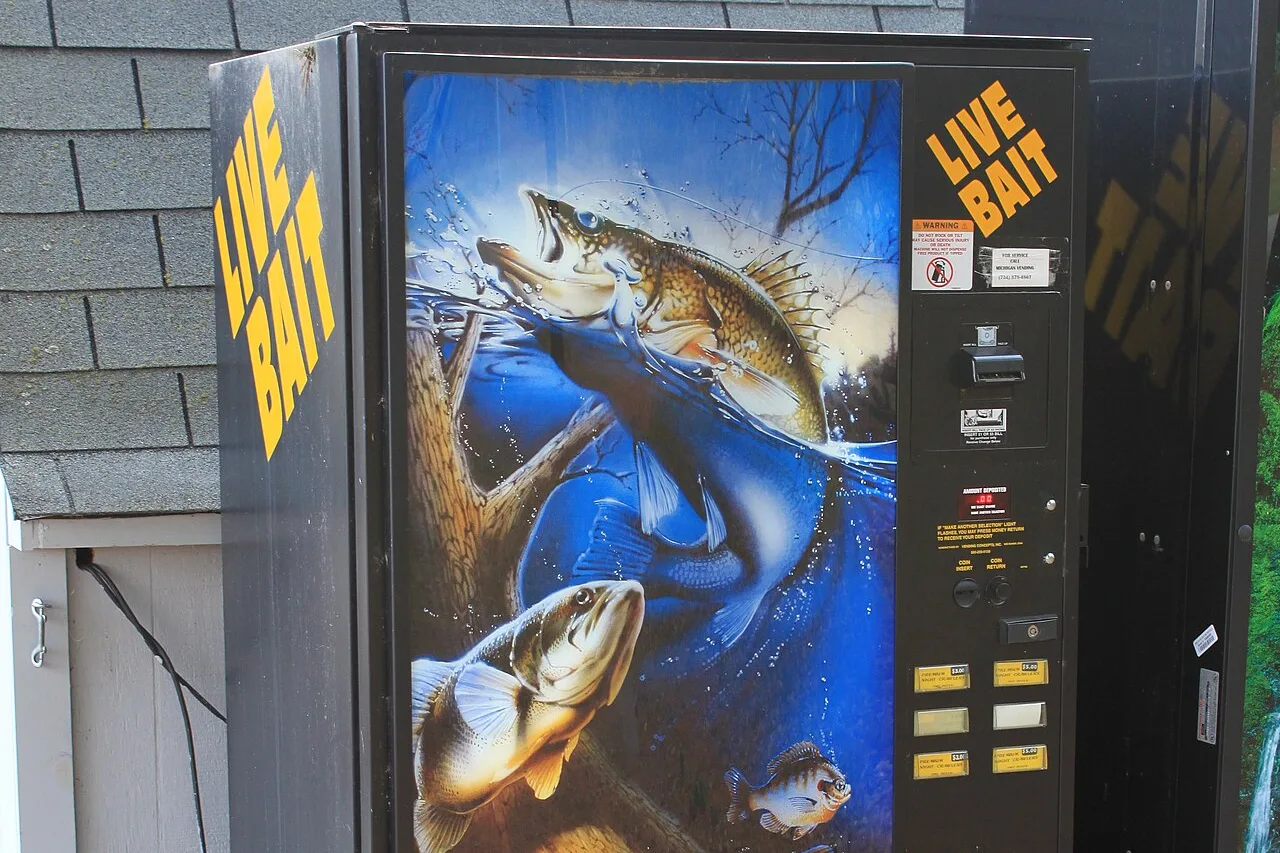
A live bait vending machine at Brighton Recreation Area, Michigan. Photo: Dwight Burdette, Wikimedia Commons (CC BY 3.0, cropped).
You can catch a lot of it yourself. Crawlers come out on a lawn at night after rain. Crawfish hide under rocks in creeks. Hellgrammites live under rocks in fast water. Minnows go in a trap or a seine. Check your state’s rules first, because catching bait has its own limits. In Missouri, for one, a bait trap must be checked at least once every 24 hours.
Pick the bait the fish wants, not the cheapest. For catfish, the best catfish bait page sorts live, cut and punch bait by the three big catfish.
What kills live bait fastest?
These five mistakes waste the most bait.
- A full bucket. Stay at 12 to 24 minnows a gallon. Overcrowding stresses them and kills them, Sutton says.
- Tap water straight from the hose. Minnows and leeches want water without chlorine. Let it stand overnight, or use a dechlorinator.
- Sudden heat or cold. Mix the water slowly when you change it. Keep the bucket in the shade.
- Crawfish under water. Use an inch or two of water and wet grass, not a full bucket.
- A hook in the wrong place. Go through the lips, the tail, the collar or the sucker. Through the eye, a minnow is more likely to die.
Get those five right and you’ll throw away far less bait. If a word on this page was new, the fishing terms page explains it.

Free PDF · 16 pages
Stop guessing. Know what's biting before your first cast
A whole Saturday on the water with nothing to show for it. One reading tells you who's feeding.
The Water Temperature Fishing Chart. Take one water temperature reading, find it on the chart, and see which of 26 freshwater fish are spawning, feeding hard or slowing down.
- Where bass, crappie, bluegill and walleye sit, and what to throw. Trout: the reading where you stop.
- Why a 3 ft drop beats a cold front, and what to throw each day of the front
- The three thermometer mistakes that make a reading lie
The chart's numbers come from state fish and wildlife agencies and fisheries research: 61 sources, each listed on the site.
No card, nothing to buy. Confirm with one click and the PDF is on its way, one version for your phone and one to print, yours to keep. Then a few short emails and one a week on what's biting, with an unsubscribe link in every one. Privacy.
Related
Section guide
Fishing Bait: Live, Cut and Prepared, and Which One to UseFishing bait made simple: live, cut and prepared bait, what to use for each fish, how to hook it and how to keep it alive until you fish.
 Minnows: What They Are, Which to Buy and What Size to Use
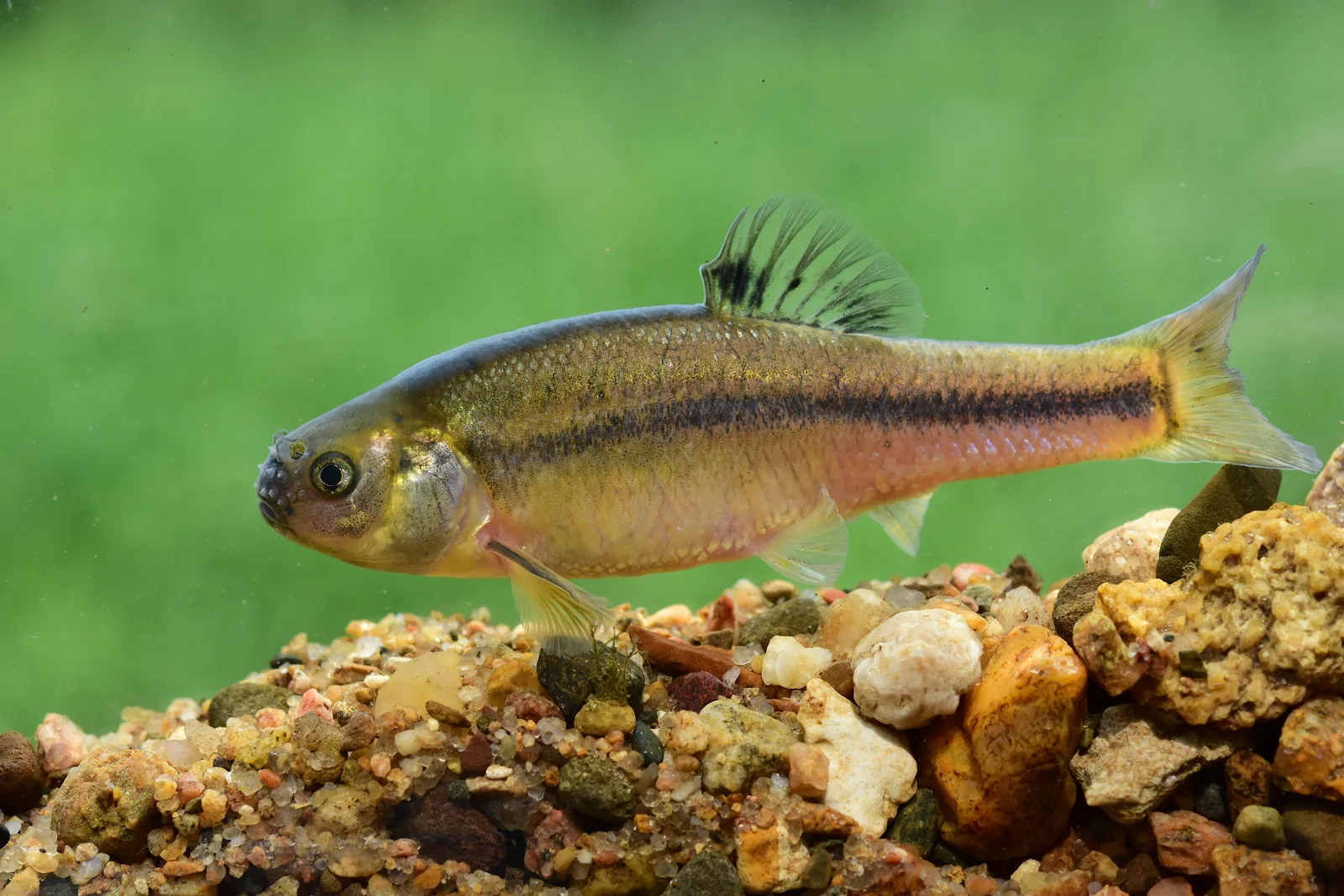
Minnows are small fish of the minnow family, and the top live bait. Which minnows bait shops sell, what size for each fish, and when they work.
 Sand Fleas: What They Are, Do They Bite, and How to Catch Them
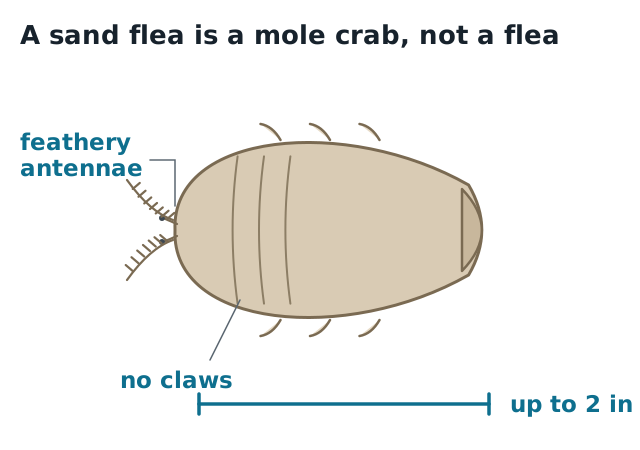
The sand flea surf anglers dig is a clawless mole crab, not an insect. What bites you instead, and how to rake, keep and hook sand fleas.
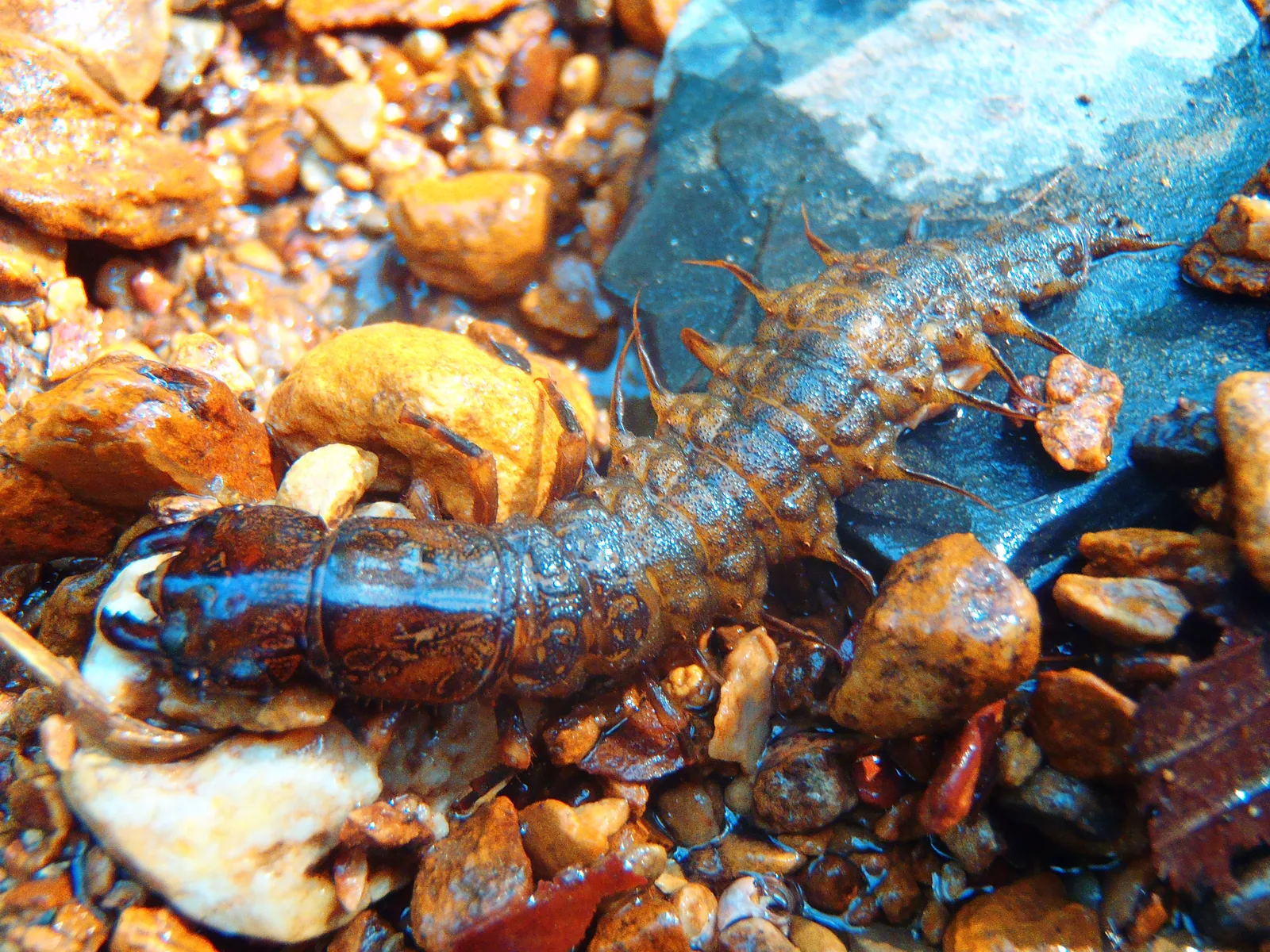 Hellgrammite: What It Is, Where to Find It, How to Fish It
A hellgrammite is a dobsonfly larva up to 4 inches long and a top smallmouth bait. How to find one, hold it without a pinch, hook it and fish it.
Sources (20)
- Gerald Almy, 5 Best Live Baits and How to Fish Them, Bass Pro Shops 1Source (updated April 3, 2026)
- Bass Pro Shops 1Source, The Best 6 Live Fishing Baits for Beginning Anglers (updated April 3, 2026)
- Joe Cermele, The Best Live Baits Most Anglers Ignore (But Fish Can't Resist), Outdoor Life (April 6, 2026)
- Mark Goodwin, Live Bait Basics, Missouri Conservationist (2009)
- Keith Sutton, Minnows and crappie fishing are an inseparable duo, Arkansas Democrat-Gazette (May 14, 2017)
Show all 20 sourcesShow fewer sources
- John J. Woods, Be sure minnows are alive and kicking, Mississippi Sportsman (May 15, 2015)
- Gibbs Milliken, Bait Buckets, Texas Parks & Wildlife magazine (June 2002)
- In-Fisherman, Storing Crawlers and Leeches in Warm Weather (July 26, 2012)
- Justin Hoffman, Become a Worm Picker, Bass Pro Shops 1Source
- Robert Sloan, Fishing With Live Bait, Salt Water Sportsman
- Iowa DNR, Walleye
- Capt. Vincent Daniello, A Guide to Saltwater Live Baits, Sport Fishing
- Minnesota DNR Fishing Regulations, General Regulations (eRegulations)
- Wisconsin DNR, How VHS rules affect anglers
- New York DEC, Baitfish regulations
- Missouri Department of Conservation, Live Bait Regulations
- Texas Parks and Wildlife, general fishing regulations (bait)
- Lindelien, S. and Cimbaro, J. (FWC) (2026), Want fishing tips? Consult the data, The Florida Specifier, Jan. 19, 2026
- Myers, R. A. and Poarch, S. M. (2000), Effects of bait type and hooking location on post-release mortality of largemouth bass, Proc. SEAFWA 54:39-45
- Cooke, S. J. et al. (2003), Injury rates, hooking efficiency and mortality potential of largemouth bass captured on circle hooks and octopus hooks, Fisheries Research 61:135-144