The best fishing line for bass is not one line but four setups. Use braid to a leader for finesse, straight fluorocarbon for bottom baits and crankbaits, monofilament for floating topwater, and 50–65 lb braid for frogs and heavy cover. The reason is physics: fluorocarbon sinks, mono floats and stretches, and braid is thin and does not stretch at all. If you own one spinning rod, spool 10 lb braid and tie on a 6–8 lb fluorocarbon leader.
Twenty-pound braid is as thin as 6 lb mono. PowerPro’s 20 lb measures 0.009 in on the spec chart; Berkley Trilene Big Game in 20 lb measures 0.018 in, twice as thick.
Which line for one, two, three or four rods?
Most anglers do not carry a rod for every technique. Two pros who have published their line choices, Matt Allen of Tactical Bassin and Bassmaster Elite Series winner Bobby Lane Jr., land on the same split. Rod by rod, their numbers add up to this plan.
- One spinning rod: 10 lb braid to a 6–8 lb fluorocarbon leader. Both pros use 10 lb braid for finesse work, and Lane names spinning tackle outright. It covers the drop shot, the Ned rig, the wacky rig and a light shaky head, and the leader hides the braid near the bait. Join the two with a double uni or an FG knot.
- In crystal-clear water, go lighter on the leader, not the braid. For finesse fishing Allen drops to a 5–8 lb fluorocarbon leader in crystal-clear water, and uses 6–10 lb mono when it is merely clean.
- Add a casting rod: 12 lb fluorocarbon, no leader. That is Allen’s straight-fluorocarbon line for crankbaits and jerkbaits. For finesse jigs he ties a fluorocarbon or mono leader to 30 lb braid. The line sinks with a jig or a Texas rig, and Lane calls it “more sensitive than monofilament.”
- A third rod: 50–65 lb braid, no leader. Frogs, punching mats and flipping wood. Both pros agree on the weight and on leaving the leader off.
- A fourth rod: 10–20 lb mono. Lane’s line for floating topwaters and treble-hooked crankbaits, because the stretch makes it tougher for a bass to throw the lure during the fight. It is also the cheapest line to respool every season.
- Fishing rock, brush and shell with a Texas or Carolina rig: try mono before fluorocarbon. Lane finds it holds up better there.
Which line for which technique?
Allen’s list (2018) and Lane’s answers (first published 2013, reposted 2017) give a main line and a leader for nearly every bass technique. Rows marked (A) are Allen’s, (L) Lane’s. Neither gives leader lengths, except Lane’s “short (2- to 3-foot)” fluorocarbon leader on spinning gear.
| Technique | Main line | Leader | Why |
|---|---|---|---|
| Finesse rigs such as the drop shot or Ned rig, crystal-clear water (A) | 10 lb braid | 5–8 lb fluorocarbon | Braid casts a light bait far; the leader is hard to see |
| The same in clean water (A) | 10 lb braid | 6–10 lb mono | Allen’s choice when the water is not crystal-clear |
| Spinning gear, long casts (L) | 10 lb braid | Fluorocarbon, 2–3 ft (0.6–0.9 m) | Lane adds the leader only “occasionally” |
| Shaky head (A) | 30 lb braid | 10 lb mono | Braid feels the bottom; mono at the bait |
| Texas rig (A) | 40 lb braid | 12–17 lb mono | Braid’s strength in cover, mono at the hook |
| Jig (A) | 50 lb braid | 15–20 lb mono | The same, one size up |
| Flipping heavy cover (L); frogs, punching (A) | 50–65 lb braid | None | “An extra knot is something that can go wrong,” Lane says |
| Crankbait (A) | 12 lb fluorocarbon, or 20 lb braid | None, or 12 lb mono | Fluorocarbon sinks; the mono leader adds stretch |
| Jerkbait (A) | 12 lb fluorocarbon, or 20 lb braid | None, or 10 lb mono | The same two options |
| Floating topwater (L) | 10–20 lb mono | None | It floats and is less visible than braid |
| Big swimbait (A) | 80 lb braid | 30 lb mono | Heavy baits, big fish |
Allen puts a mono leader, not fluorocarbon, on most of his braid setups. Lane spools straight mono, 10 to 20 lb, for Texas and Carolina rigs around rock, brush and shell, because he finds it holds up better there than fluorocarbon.
Jason Sealock of Wired2Fish puts the general rule simply: most bass anglers throw fluorocarbon or braid, and mono gets the nod when the budget is tight, a little stretch helps or the line must not sink.
Free card: what 26 species do at your water temperature
Plus one email a week on what's biting now. No sales pitches. Privacy.
Why does each line do what it does?
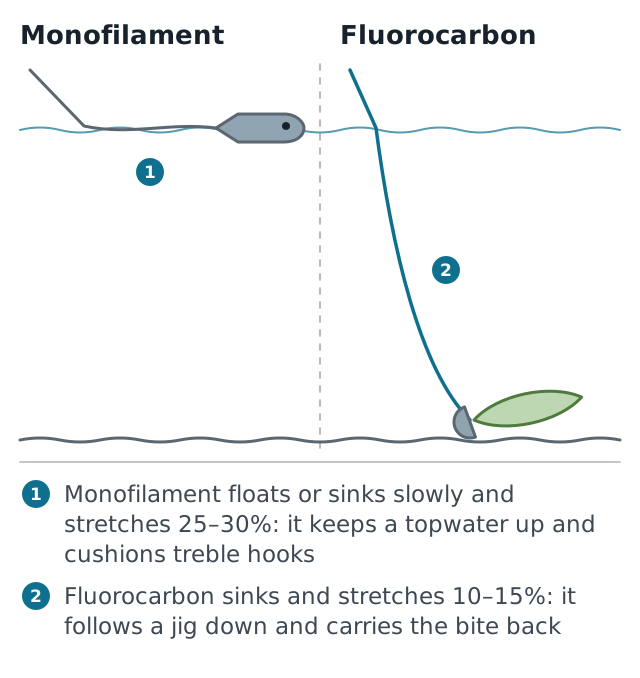
Where each line lies in the water. Drawing: fishing.info.
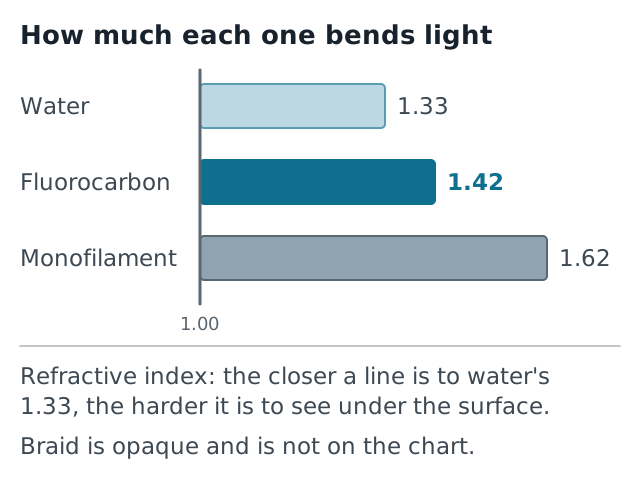
Fluorocarbon bends light almost as water does. Its refractive index is 1.42, against 1.33 for water and 1.62 for nylon, which is why it is hard to see under the surface. It sinks faster than mono or braid, which puts a jig or a worm on the bottom on a straight line. It stretches 10–15 percent, enough to feel a bite and set a single hook. More on the material is on the fluorocarbon fishing line page.
Monofilament stretches 25–30 percent and floats. That keeps a topwater’s nose up and cushions treble hooks that would tear out on a tight line. It is also the cheaper line. The monofilament fishing line page covers the brands and the copolymers.
Braid has close to zero stretch, so it feels everything and casts far. But fish can see it, and rock and shell cut it, which is why it wants a leader in clear water and around sharp structure. The braided fishing line page covers strands and spooling.
Which of the other two resists abrasion better is disputed. One tackle guide rates fluorocarbon’s abrasion resistance high and mono’s moderate, while Lane says fluorocarbon “may not be as abrasion-resistant” as mono. The full side-by-side is on fluorocarbon vs monofilament.
What does 20 lb mean in each line?
Pound test says how hard a line pulls before it breaks, not how thick it is. At the same rating, braid is a little over half the diameter of mono or fluorocarbon; PowerPro against Big Game is exactly half. That is why it cuts through grass, casts farther and fits more yards on a spool. It is also why 20 lb PowerPro has the diameter of 6 lb mono, and why Sufix lists 20 lb 832 as a 6 lb mono equivalent.
| Rated test | Fluorocarbon (Seaguar InvizX) | Braid (PowerPro Super8Slick V2) | Mono (Trilene Big Game) |
|---|---|---|---|
| 10 lb | 0.010 in (0.26 mm) | 0.006 in (0.15 mm) | 0.012 in (0.31 mm) |
| 15 lb | 0.013 in (0.33 mm) | 0.008 in (0.20 mm) | 0.015 in (0.38 mm) |
| 20 lb | 0.016 in (0.40 mm) | 0.009 in (0.23 mm) | 0.018 in (0.46 mm) |
| 50 lb | n/a | 0.014 in (0.36 mm) | n/a |
Berkley mono and fluorocarbon and Spiderwire Stealth braid show the same pattern at 20 lb: 0.016 in for mono and fluorocarbon, 0.010 in for braid.
So which is stronger, 20 lb braid or 20 lb mono? On the label, neither. For the same thickness, braid is three to four times stronger: Sufix rates its 20 lb 832 at the diameter of 6 lb mono and its 65 lb at 17 lb. A 50 lb braid goes through cover in a line thinner than 15 lb mono.
Is 30 or 40 lb braid too much for bass? Not with a leader. Allen runs 30 lb braid to a 10 lb mono leader on a shaky head and 40 lb to 12–17 lb mono on a Texas rig: the braid’s strength is for the cover, the leader sets the presentation.
Braid, fluorocarbon or mono on a baitcaster?
All three work on a baitcaster, and the technique table puts each one there. Two things change with braid.
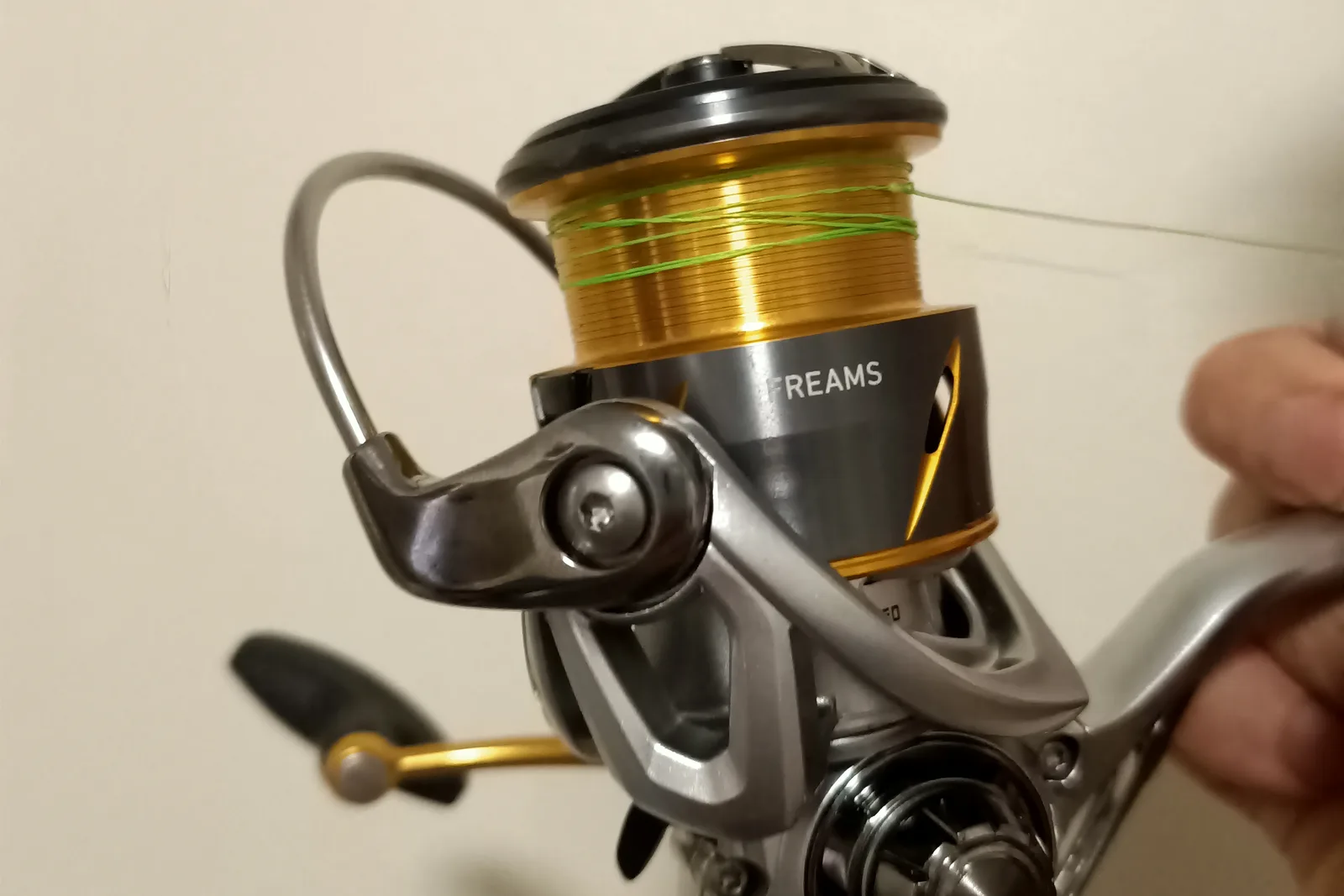
It slips on a bare spool, so when you put the line on the reel, lay down a layer of mono first as backing; mono grips the arbor better. Take Me Fishing’s example for a size-2500 spinning reel is 20–30 yards (18–27 m) of 8–10 lb mono under the braid.
And braid digs into itself under load, so set the drag lighter than with mono. On casting gear Lane goes to “the heavier sizes”; on spinning gear he runs 10 lb braid.
When should you not use braid?
- Straight to a crankbait in open water. No stretch, a treble hook and a jumping bass: the hooks tear out. Allen ties a 12 lb mono leader to his crankbait braid; Lane uses mono or fluorocarbon.
- Clear water with pressured fish, without a leader. Braid is visible, and braid alone can cost bites there.
- On a floating topwater, if you want it invisible. Lane picks mono over braid for topwaters for exactly that reason.
- Over sharp rock and shell. Rock and shell cut braid quickly. A mono or fluorocarbon leader takes the wear.
For which braid to buy, see the best braided fishing line picks.
The three mistakes
- Fluorocarbon on a floating topwater. The line sinks and drags the lure’s nose under, and the walking bait stops walking. “Use it for topwater and it will drive you insane,” Allen writes. Mono, or braid to a mono leader.
- Braid straight onto a bare spool. It can slip around the arbor instead of gripping it. Put a layer of mono backing on first.
- A dry knot in fluorocarbon. When he joins braid to a fluorocarbon leader, Allen calls it “critical” that the knot is wet when it is cinched, or the fluorocarbon burns. Wet it, then pull it down slowly.
How long does line last?
Rough working lifespans: mono three to six months of use, fluorocarbon one to two years and braid two to five. Replace mono at least once a season, twice if you fish hard. Fluorocarbon is not affected by UV and absorbs very little water, which explains its longer life.
Whatever the material, the last few feet do the work. Run them through your fingers after every fish and every snag, and retie the moment the line feels rough.
How we chose the picks
The product boxes carry one line per job, each chosen from the review guides and spec charts in the sources, not from tests by this site. Seaguar InvizX is the casting-rod fluorocarbon; Sunline Sniper the thin finesse fluorocarbon and leader. PowerPro Super8Slick V2 is Wired2Fish’s 2026 all-around braid; Sufix 832 is the braid Allen names for his crankbait setup. Berkley Trilene Big Game is the cheap mono for topwater and squarebills.
The lures that go on the end of these lines are on the bass hub, and the material-by-material comparison on the fishing line hub.
Free download
The water temperature card
Read your water temperature and the card tells you who is spawning, who is feeding and what to throw. 26 species, 16 pages, for your phone and the tackle box.
Plus one email a week on what's biting now. No sales pitches. Privacy.
Related
Section guide
Fishing Line: Monofilament, Fluorocarbon and Braid ComparedFishing line compared: mono stretches 25–30%, fluorocarbon 10–15%, braid almost none. Which line each technique wants, and when braid needs a leader.
 Monofilament Fishing Line: What It Is Good For, and Where It Loses
Monofilament fishing line is nylon: it stretches 25–30%, barely sinks and costs 1–3 cents a yard. Where it wins, where it loses, and which test to buy.
 Fluorocarbon Fishing Line: What It Does, and When Not to Use It
Fluorocarbon fishing line sinks, stretches less than mono and is nearly invisible to fish. Where it wins, where it loses, and how to tie it so it holds.
 Best Braided Fishing Line: The Reviewers' Picks Compared
The best braided fishing line: eight braids compared on carriers, diameter and price per yard, with picks for flipping, finesse, inshore, surf, catfish and ice.
- Fluorocarbon vs Monofilament: Which Line Wins for Each Technique
Fluorocarbon versus monofilament on the numbers: stretch, visibility, sink rate, abrasion and price, then a technique-by-technique verdict with pound tests.
 Braided Fishing Line: Strength, Diameter, Pros and Cons Explained
Braided fishing line is a little over half as thick as mono of the same test: 30 lb braid matches 8 lb mono. Tables, test by fishing, leaders and knots.
Sources
- Matt Allen, Best fishing line: braid, mono or fluorocarbon?, Tactical Bassin (2018)
- Bobby Lane Jr., Ask the experts: what line should I use?, Bassmaster (first published April 2013, reposted Nov. 2017)
- Jason Sealock, Best fishing lines for 2026, Wired2Fish
- Sam Hudson, Best braided lines for fishing (2026), Wired2Fish
- Seaguar, FAQ: refractive index, stretch, sink rate, UV, braid with a fluorocarbon leader
- Tackle Warehouse, Seaguar InvizX fluorocarbon spec chart
- Tackle Warehouse, PowerPro Super8Slick V2 braid spec chart
- Tackle Warehouse, Sunline Super FC Sniper fluorocarbon spec chart
- Ezoko Fishing, Berkley Trilene Big Game monofilament spec chart
- Tomo's Tackle, Sufix 832 Advanced Superline spec chart
- Tackle Village, fishing line diameter chart
- The Tackle Room, mono vs fluorocarbon vs braid: stretch, abrasion and lifespan
- Take Me Fishing, how to spool a spinning reel with braided line (mono backing)
- Wikipedia, Power Pro (braid digs into itself; set the drag lighter)