 By
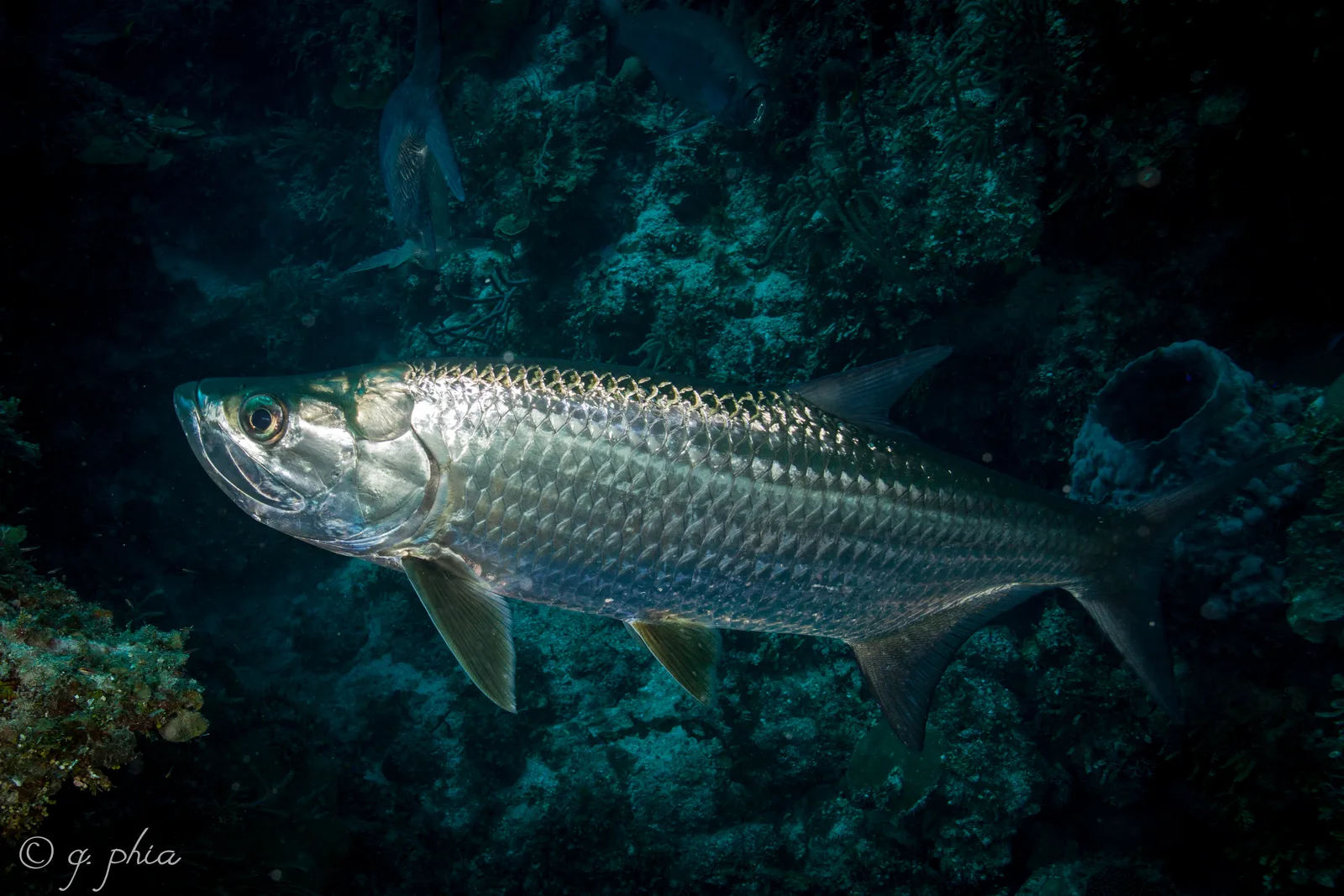
A tarpon is a big, silver, air-breathing fish of the warm Atlantic coast. In the US you find it mostly around Florida and the Gulf. It eats crabs, mullet and other baitfish, jumps like crazy once hooked, and can top 200 lb. In Florida every tarpon goes back. So the game is hooking one, surviving the jumps and letting it swim off strong.
A young tarpon has to breathe air to live. That’s why you see tarpon roll at the surface: they’re gulping air, even in water with plenty of oxygen.
What is a tarpon?
A tarpon is the “silver king”: a long, deep fish with bright silver sides made of huge scales. The back is dark blue to greenish-black, and the big mouth turns up. The lower jaw sticks out far past the upper. Texas says the scales can be up to 3 in across. Fish that live inland can look brownish or brassy instead of silver.
Two marks settle it. The last ray of the top fin runs back into a long, heavy thread, and the tail is deeply forked. The fins carry no spines at all.
The mouth looks big enough to swallow a bucket, but the teeth are tiny, fine and packed tight. A bony plate runs along the lower jaw, which crushes crabs and shrimp. With teeth that small, a tarpon swallows most of its food whole.
| Tarpon at a glance | |
|---|---|
| Other name | Silver king |
| Where | Both sides of the Atlantic. In the US mostly Florida and the Gulf, and not uncommon north to Cape Hatteras |
| Grows to | Over 8.2 ft (2.5 m) and near 355 lb (161 kg), females. Males stay smaller |
| World record | 286 lb 9 oz (129.98 kg), Rubane, Guinea-Bissau, 2003 (IGFA) |
| Lives | Males over 30 years, females past 50 |
| Mature at | 6 to 7 years, about 4 ft (1.2 m) |
| Spawns | Offshore, mostly May to July |
| Can you keep one? | Florida: catch and release only. Texas: 1 a day, 85 in minimum. North Carolina: no |
Where and when can you catch tarpon?
Tarpon live along the coast: bays, estuaries and mangrove lagoons, usually in water no deeper than 98 ft (30 m). In the Western Atlantic they gather around the Gulf, Florida and the West Indies. Strays reach Nova Scotia to the north and Argentina to the south.
They aren’t fussy about salt. Tarpon handle fresh water and salt alike, and they often swim up rivers into fresh water. Capt. Billy Norris guides in Southwest Florida. He says they turn up in nearly every coastal water in the state: reefs, wrecks, beaches, grass flats, estuaries, even freshwater lakes and ponds.
Cold is the one thing they can’t take. A fast drop in temperature can kill tarpon in large numbers, the Florida Museum says. When it turns cold they slide into warmer, deeper water.
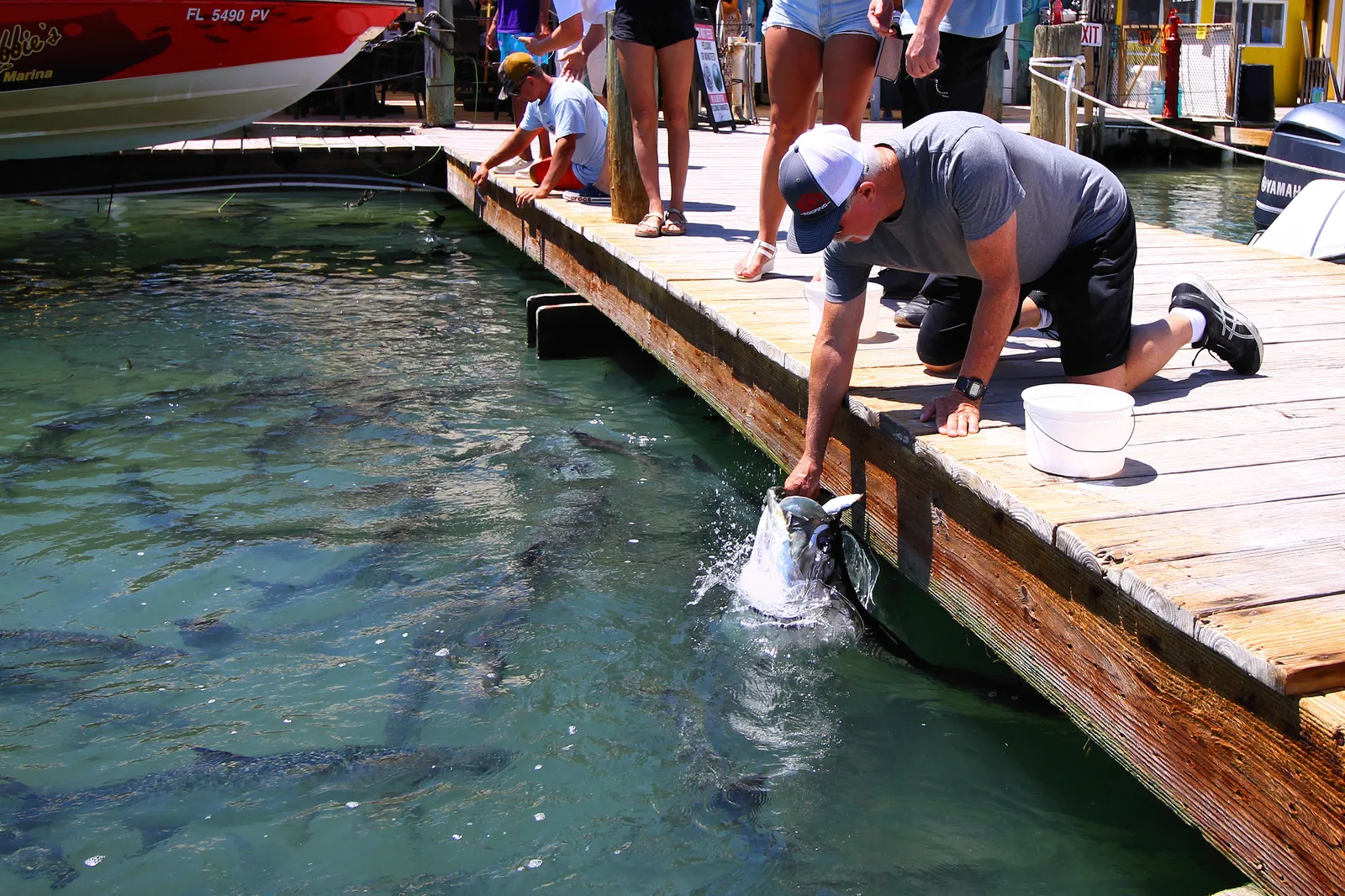
Tarpon at Robbie’s of Islamorada in the Florida Keys, where visitors hand-feed them. Photo: Larry D. Moore (CC BY 4.0)
When to go. In the Florida Keys, April through June are the prime months for the tarpon migration. That’s when the guides there make most of their money. Tarpon feed by day and by night.
Texas and the rest of the Gulf. Texas says tarpon of any size are most often caught off the beachfront in the Gulf. South Texas has the most tarpon fishing, with guides who specialize in tarpon. Young tarpon of 6 to 18 in turn up in river mouths, lakes and ditches.
Farther north. Tarpon move. The Bonefish & Tarpon Trust tagged 200 of them to follow where they go. The fish were tagged from Apalachicola, Charlotte Harbor and South Florida to Georgia and South Carolina. In North Carolina a tarpon you catch goes back.
Free PDF · Water temperature chart Which fish are biting at today's water temperature?
One reading, and the 16-page chart shows which of 26 fish are spawning, feeding hard or slowing down; for bass, crappie, bluegill and walleye, where they sit and what to throw. Every number sourced.
No card, nothing to buy, and the PDF is yours to keep. Confirm with one click and it's on its way. Then a few short emails and one a week on what's biting. Unsubscribe anytime. Privacy.
How do you catch a tarpon?
Fish live bait on a circle hook, let it swim free, and use tackle heavy enough to end the fight fast. That’s the short version. The details below are what land the fish.
Bait. Crabs, mullet, threadfin herring, pilchards and pinfish all catch tarpon. Norris says they’ll eat almost anything, but often lock onto one bait at a time. In the Keys, near Marathon, he’s seen fish at Bahia Honda eat only crabs while fish at the Seven Mile Bridge wanted mullet. So bring more than one kind. His rule for crab size: about as wide across the shell as three of your fingers. Texas adds live pinfish and mullet under a cork, and menhaden drifted.
How to fish it. Norris almost always freelines the bait, meaning no weight, just the bait swimming on the hook. When he needs the bait held up, he hangs it under a cork. Tarpon also hit trolled spoons and jigs, Texas says.
The tackle. FWC’s best-practice list for big tarpon is a good shopping list. Its goal is to end the fight quickly, so the fish swims away with energy left.
| Gear for big tarpon | Spinning or conventional | Fly |
|---|---|---|
| Rod | Medium to extra heavy | 10 to 12 weight |
| Reel | 5,000 to 10,000 size spinning reel | Line to match the rod |
| Drag | At least 12 lb | Tight enough to tire the fish fast |
| Line and leader | 50 to 60 lb braid, 60 to 80 lb mono or fluorocarbon leader | Break section of 15 to 25 lb in the leader |
| Hook | 6/0 to 10/0 circle hook. With bait: non-stainless, non-offset, barbless | Barb crimped down |
Norris runs 50 lb braid and goes up to 80 lb for bigger fish. For the leader he starts with 7 ft of 80 lb fluorocarbon. In very clear water he drops to 50 lb, because tarpon can be leader-shy. Our saltwater reel guide has the drag settings by fish.
What’s a break section? It’s a short piece of the leader that’s weaker than the rest. If a shark shows up, you can snap the fish free and only that piece breaks. FWC also wants single-hook rigs, a fighting belt for leverage and a long-handled dehooking tool on board.
The jumps. A hooked tarpon jumps. When it does, bow: push the rod tip toward the fish and drop it while you keep reeling. The slack means fewer break-offs and fewer pulled hooks, Norris says. He tells his clients to stab the rod tip into the water the moment they see the fish rising.
Expect to lose some. Guides talk about “flying” a tarpon: a fish hooked and jumped, landed or not. Norris gives a day as “flew 5 landed 2,” and says landing only a small share of hooked fish is normal.
The fight. Keep it short. Pull low and hard with the backbone of the rod, the opposite way the fish is running. Gain line with short turns of the reel. Keep the drag tight enough to wear the fish down quickly. If it heads under the boat, move to the bow so the line doesn’t break. A long fight leaves a tired tarpon that sharks pick off.
Sharks. If a shark shows up, end it. Bring the fish in fast and cut the line close to the hook. Or break it off, so it still has the energy to get away. Then move to another spot.
Bridges and piers. FWC recommends you don’t fish for tarpon from them. A big one can’t be lifted out, so you’d have to cut it off and leave a long line trailing behind it.
Can you keep a tarpon? The rules by state
Mostly no. Tarpon are a catch-and-release fish in Florida and North Carolina, and Texas lets you keep only a giant. These were the rules on November 14, 2026.
| State | Can you keep one? | Size | Notes |
|---|---|---|---|
| Florida | Only with a tarpon tag, to chase a state or world record | No minimum. Over 40 in stays in the water | 1 tag per person per year. Hook and line only, no snagging. Rules reach into federal waters |
| Texas | Yes, 1 per day | 85 in minimum | Rules valid Sept. 1, 2026 through Aug. 31, 2027 |
| North Carolina | No | — | Unlawful to possess |
The Florida tag. It costs $51.50 a year, you buy it before you fish, and you get it only at a tax collector’s office. You also need a saltwater fishing license. Without a tag, you may hold a tarpon only briefly, for a photo or to measure its length and girth. A fish over 40 in stays in the water while you do. You can’t sell a tarpon in Florida. The tag is old. Since 1989 you’ve needed one to kill a tarpon in Florida. The count of tarpon killed dropped from 342 in 1989 to 70 in 1998, the Florida Museum says.
Snagging. In Florida, catching or trying to catch a tarpon that wasn’t drawn to strike your bait or lure is snagging, and it’s banned statewide. With live or dead bait, a treble or any other multiple hook is banned too.
Boca Grande Pass. This pass has its own gear rule, for any fish, all year. You may not fish a weight that hangs lower than the hook when the line hangs straight down from the rod. That includes a jig whose weight can slide down the shank. In April, May and June a boat may run no more than three lines there, and breakaway gear is banned.
Circle hooks. In Florida they’re recommended for tarpon, not required. Both FWC and the Bonefish & Tarpon Trust tell you to use them with bait.
Other Gulf and Atlantic states set their own rules. Check yours before you go.
How do you release a tarpon?
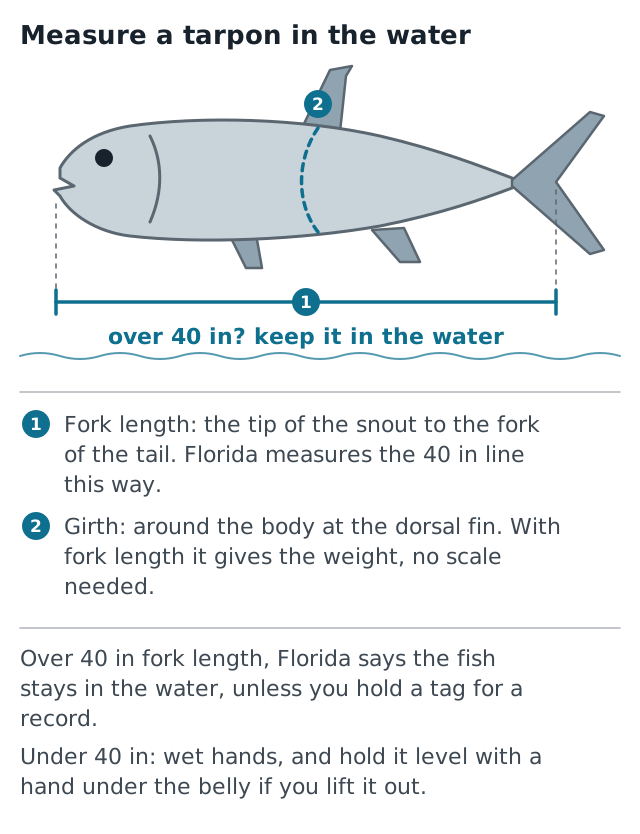
A big tarpon never leaves the water. In Florida that’s the law for any fish over 40 in fork length: snout to the fork of the tail (fork length). The Bonefish & Tarpon Trust says lifting one out does too much damage and stress, and cuts its odds of living.
- Keep the fight short. It’s the part you control. In warm water, cut the fight and the handling time even more.
- Get the hook out without touching the fish. Use a long-handled dehooking tool, or cut the line as close to the hook as you can.
- Cut it if it’s swallowed. A hook deep in the throat does less harm left in than pulled out, the Trust says.
- Keep the gills wet and your fingers out. Stay away from the gills and eyes. Don’t drag the fish over the gunwale, rocks or a railing.
- Small one in the boat? A tarpon under 40 in may come out. Wet your hands and hold it level, one hand under the belly. Skip the lip gripper on a lively fish, since it can hurt the jaw.
- Revive it. Hold the fish level in the water so water runs over the gills from front to back. If it rolls over or noses into the bottom, keep at it until it swims upright. Then shorten the fight on the next one.
Want a photo? Get the camera ready before the fish comes near. A big one gets its picture in the water. For a small one you lift, the Trust’s test is simple: if the fish isn’t still dripping in the picture, it was out too long. Our catch and release guide covers the rest of handling a fish you’re putting back.
Why go to all that trouble? Florida’s museum says most tarpon that die after being caught die from injuries when they’re landed, such as a swallowed hook, or from sharks. A worn-out fish that isn’t revived can die from lack of oxygen.
How big do tarpon get?
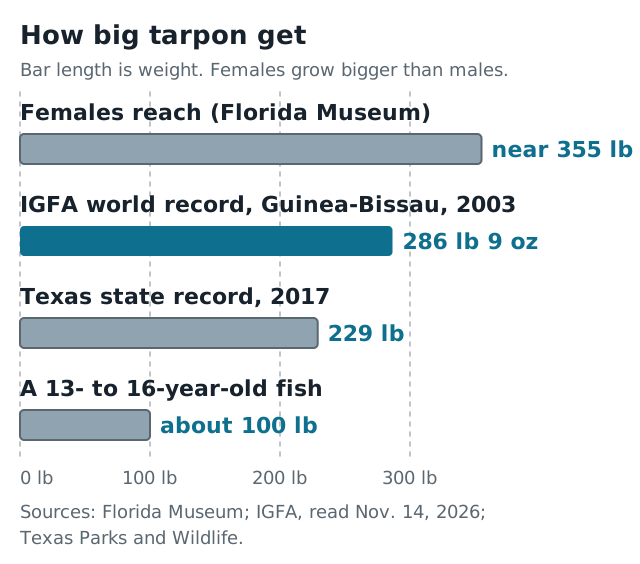
Big. Females reach over 8.2 ft and near 355 lb, the Florida Museum says, and males stay smaller. The IGFA all-tackle world record weighed 286 lb 9 oz, caught by Max Domecq at Rubane, Guinea-Bissau, on March 20, 2003. The Texas state record is 229 lb and 90 in, from 2017.
How long do tarpon live?
Males live past 30 years and females past 50, the Florida Museum says. A female at Chicago’s Shedd Aquarium died in 1998 at age 63. They grow slowly: a tarpon of about 100 lb is usually 13 to 16 years old.
How much does my tarpon weigh?
You can’t weigh it in Florida if it’s over 40 in, but you can work it out. Measure the fork length and the girth around the body at the dorsal fin, with the fish in the water. The Bonefish & Tarpon Trust turns those two numbers into a weight with a formula. This table is that formula, worked out for common sizes. Find your fork length on the left and the closest girth across the top.
| Fork length | 20 in girth | 30 in girth | 40 in girth | 50 in girth |
|---|---|---|---|---|
| 40 in (102 cm) | 24 lb | 39 lb | 55 lb | 73 lb |
| 50 in (127 cm) | 35 lb | 57 lb | 82 lb | 108 lb |
| 60 in (152 cm) | 48 lb | 79 lb | 112 lb | 148 lb |
| 70 in (178 cm) | 63 lb | 103 lb | 147 lb | 194 lb |
| 80 in (203 cm) | 79 lb | 131 lb | 186 lb | 245 lb |
It’s an estimate, not a scale. Length tells you age too, roughly. On the Trust’s age chart, a tarpon with a 58 in fork length is about 22 years old if it’s a male. A female that long is about 15. You can’t tell a male from a female by looking, and the chart is built on Florida fish.
Can you eat tarpon?
You can, but almost nobody in the US does, and in Florida you can’t keep one to eat anyway. Texas calls the meat edible but says tarpon aren’t usually eaten there. The Florida Museum says the flesh isn’t prized in the US. In Panama, the West Indies and Africa people do eat tarpon and treat it as a delicacy. If you do keep a Texas fish, check your state’s fish advisory for the water you fished.
Are tarpon dangerous?
Once in a while, and usually by accident. Tarpon spook easily and stay wary around people, the Florida Museum says. Most injuries happen when anglers try to release a tarpon after the fight, and the museum says a thrashing tarpon has reportedly killed an angler. So don’t bring a fish alongside while it’s still “green,” full of fight. Heavy tackle is how you get there fast. Now and then a tarpon even jumps into a boat, and guides have reported rods and electronics wrecked that way.
Why do tarpon roll? The biology behind the fishing
They breathe air. A tarpon’s swim bladder works partly like a lung. It’s lined with spongy tissue and connects to the throat, so the fish can fill it with a gulp of air at the surface. Young tarpon must breathe air to survive. Adults in water with plenty of oxygen still roll and gulp. That gulp of air lets tarpon move into stagnant brackish and fresh water with almost no oxygen left, the IGFA notes. More on how fish get oxygen in how do fish breathe.
They eat in the middle of the water. Adults eat mullet, pinfish, marine catfish, needlefish, sardines, shrimp and crabs, day and night. Bull and hammerhead sharks are their main enemies, and porpoises and alligators take some too. Birds eat the young in the nursery waters.
They spawn far offshore. Tarpon mature at 6 to 7 years and about 4 ft. They spawn mostly in May, June and July, maybe year-round, and travel offshore to do it. A 6.6 ft (2 m) female carries about 12 million eggs. Currents then carry the larvae to inshore nursery water.
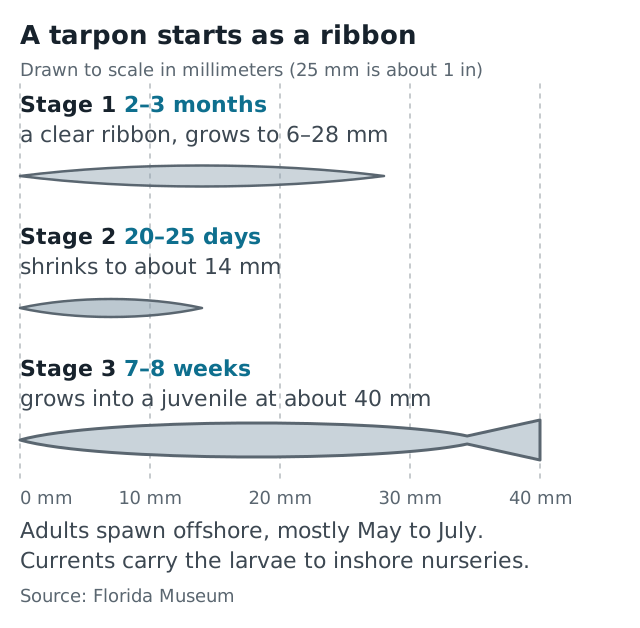
They start life as a see-through ribbon. A baby tarpon is a leptocephalus, a clear, flat larva. Only its close relatives the bonefish and ladyfish, plus the true eels, share it. The larva grows to as much as 28 mm, a little over an inch, then shrinks to about 14 mm before it grows again. At about 40 mm it finally looks like a tarpon.
The name. Its Latin name is Megalops atlanticus. Megalops is Greek for “large-eyed,” and one look at the photo at the top shows why. Its only cousin in the same genus is the ox-eye. For every other fish we cover, start at fish species.

Free PDF · 16 pages
Stop guessing. Know what's biting before your first cast
A whole Saturday on the water with nothing to show for it. One reading tells you who's feeding.
The Water Temperature Fishing Chart. Take one water temperature reading, find it on the chart, and see which of 26 freshwater fish are spawning, feeding hard or slowing down.
- Where bass, crappie, bluegill and walleye sit, and what to throw. Trout: the reading where you stop.
- Why a 3 ft drop beats a cold front, and what to throw each day of the front
- The three thermometer mistakes that make a reading lie
The chart's numbers come from state fish and wildlife agencies and fisheries research: 61 sources, each listed on the site.
No card, nothing to buy. Confirm with one click and the PDF is on its way, one version for your phone and one to print, yours to keep. Then a few short emails and one a week on what's biting, with an unsubscribe link in every one. Privacy.
Sources (12)
- Florida Museum of Natural History, Discover Fishes: Tarpon (Sean Morey)
- Florida Fish and Wildlife Conservation Commission, Tarpon (regulations, Boca Grande Pass, best fishing practices)
- Florida Fish and Wildlife Conservation Commission, Frequently Asked Questions: Recreational Tarpon and Boca Grande Tarpon Gear
- Florida Fish and Wildlife Conservation Commission, Saltwater fishing licenses (tarpon tags)
- Texas Parks and Wildlife Department, Tarpon Bag & Length Limits
Show all 12 sourcesShow fewer sources
- Texas Parks and Wildlife Department, Tarpon (Megalops atlanticus)
- North Carolina Division of Marine Fisheries, Recreational size and bag limits
- Bonefish & Tarpon Trust, Best Practices For Catch & Release Fishing For Tarpon
- Bonefish & Tarpon Trust, Tarpon Weight and Age Calculators (Ault and Luo 2013; Crabtree, Cyr and Dean 1995)
- Bonefish & Tarpon Trust, Tarpon Acoustic Tagging Project
- IGFA World Record Search: Tarpon, all-tackle
- Coastal Angler Magazine, Tarpon Fishing (Capt. Billy Norris, June 30, 2023)