 By
A snook is one of Florida’s favorite inshore gamefish: golden yellow, with a black stripe down its side. It waits by mangroves, docks and bridges for the tide to bring it food. You can keep one a day in season, 28 to 33 in on the Gulf or 28 to 32 in on the Atlantic. Fish a falling tide with live bait, or a lure that looks like it.
Every snook starts life as a male. Some turn female between 18 and 22 inches, and most big snook are females. That’s why the slot sends the giants back.
Is snook season open in Florida right now?
It depends on your coast and the month. On the Gulf coast you can keep a snook in March and April, and again from September 1 through November 30. From Charlotte Harbor south that fall season starts October 1. On the Atlantic coast it’s February through May, and September 1 through December 14.
FWC splits Florida into nine snook regions, each with its own dates. The table is the FWC rule as it read on November 14, 2026. FWC looks at every region again each year, so check its page before a trip in a new season.
| Region | Where it runs | Closed to harvest | Slot |
|---|---|---|---|
| Panhandle | Alabama line to Alligator Point | Dec. 1–end of Feb., May 1–Aug. 31 | 28–33 in (71–84 cm) |
| Big Bend | Alligator Point to Fred Howard Park (Pasco–Pinellas line) | Dec. 1–end of Feb., May 1–Aug. 31 | 28–33 in |
| Tampa Bay | Fred Howard Park to State Road 64, Manatee County | Dec. 1–end of Feb., May 1–Aug. 31 | 28–33 in |
| Sarasota Bay | State Road 64 to near Venice Municipal Airport | Dec. 1–end of Feb., May 1–Aug. 31 | 28–33 in |
| Charlotte Harbor | Venice to near Vanderbilt Beach Road, Collier County | Dec. 1–end of Feb., May 1–Sept. 30 | 28–33 in |
| Southwest | Vanderbilt Beach Road through the Keys to the Monroe/Miami-Dade line, plus Everglades National Park | Dec. 1–end of Feb., May 1–Sept. 30 | 28–33 in |
| Southeast | Martin–Palm Beach line to the Miami-Dade/Monroe line | Dec. 15–Jan. 31, June 1–Aug. 31 | 28–32 in (71–81 cm) |
| Indian River Lagoon | New Smyrna Beach to the Martin–Palm Beach line, plus Lake Okeechobee | Dec. 15–Jan. 31, June 1–Aug. 31 | 28–32 in |
| Northeast | Georgia line to New Smyrna Beach, plus the St. Johns River | Dec. 15–Jan. 31, June 1–Aug. 31 | 28–32 in |
The rest is the same everywhere in Florida:
- One snook per person per day, measured in total length.
- A snook permit and a recreational fishing license. Check the rules where you’ll fish before you buy the permit. FWC gives no refunds, even if your area is closed. The permit money goes only to snook work: hatchery trials, tagging, and monthly surveys in Tampa Bay, Charlotte Harbor and the Indian River Lagoon.
- Hook and line only, and no treble or other multiple hook. No snatching either.
- Keep it whole until you’re back on land.
- On a charter, the captain and crew can’t keep a bag limit.
- No one may sell a snook.
A closed season means no keeping fish. You can still fish for snook and let them go. Biscayne National Park adds its own snook rules on top of the state’s.
The slot limit is a size window. A fish under 28 in or over the top number goes back, even in season.
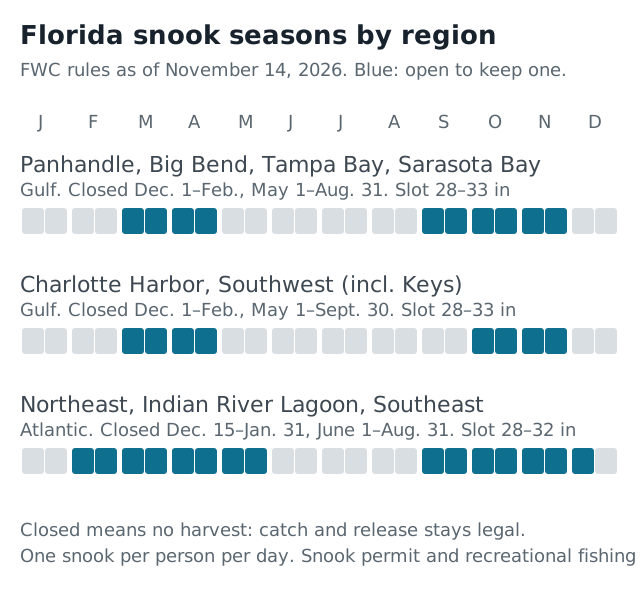
The open months by region. Drawing: fishing.info, from FWC’s rules as of November 14, 2026.
The closures sit where the fish are weakest. They’re there to protect snook through cold spells and through the height of the spawn.
Texas has snook too, with a lower slot. There you can keep one a day, from 24 to 28 inches. That’s the Texas Parks and Wildlife rule from September 1, 2026 through August 31, 2027.
How do you identify a snook?
Look for the stripe. A common snook has a sharp black line down its side that runs right onto the tail. The Florida Museum calls the body golden yellow. Add a sloping forehead, a big mouth with the lower jaw sticking out past the upper, and a high back fin split in two. The pelvic fins underneath are yellow.
Anglers call it a linesider, and robalo too. The name itself is Dutch: “snook” comes from snoek, the Dutch word for pike, FWC says. Most people say it like “took”. In parts of south Florida you’ll hear “snuke”, like fluke.
Mind the gill covers when you grab one. They’re razor-sharp.
Florida has five kinds of snook, but the common snook is the big one and the one most anglers catch. The others stay small and live mostly up coastal rivers and in the brackish upper ends of bays, from south-central Florida down to the tip.
| Snook | How big | How to tell it |
|---|---|---|
| Common snook | FWC lists it to 48 in (122 cm) and 50 lb (23 kg) | Long body, black line onto the tail, yellow pelvic fins |
| Fat snook | Common to 10 in, may reach 28 in (71 cm) | Deeper body, mouth ends below the center of the eye |
| Tarpon snook | Common to 15 in, may reach 22 in (56 cm) | Lower jaw curves up like a tarpon’s, 7 anal fin rays (others have 6) |
| Swordspine snook | Common to 10 in, may reach 15 in (38 cm) | The smallest, with the biggest scales and a long spine in the anal fin |
The fifth, the large-scale fat snook, was only confirmed in Florida in 2006. FWC has found it only on the east coast, between Sebastian and Jupiter.
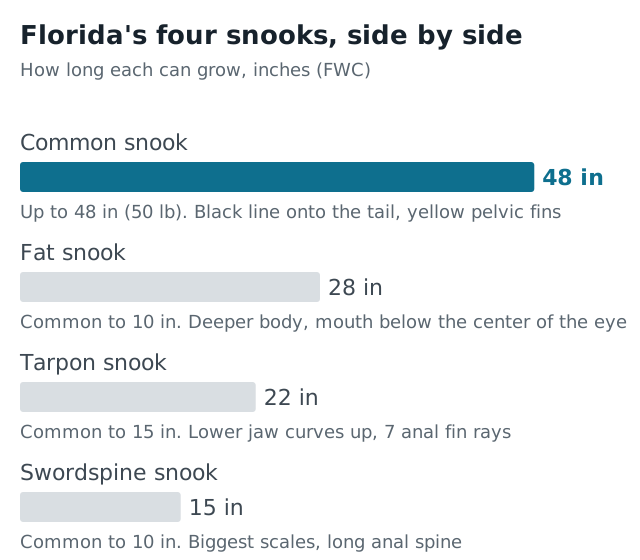
Drawing: fishing.info, from FWC’s species profiles.
Free PDF · Water temperature chart Which fish are biting at today's water temperature?
One reading, and the 16-page chart shows which of 26 fish are spawning, feeding hard or slowing down; for bass, crappie, bluegill and walleye, where they sit and what to throw. Every number sourced.
No card, nothing to buy, and the PDF is yours to keep. Confirm with one click and it's on its way. Then a few short emails and one a week on what's biting. Unsubscribe anytime. Privacy.
Where do snook live?
Snook are a south Florida fish. They’re abundant on the Atlantic side from Cape Canaveral south through the Keys, and up the Gulf side to Cedar Key, the Florida Museum says. Past that they show up now and then on the Texas coast to Galveston, and then all the way south to Brazil.
Cold sets the edge. Snook turn sluggish under 65 °F (18 °C), and FWC says they can’t tolerate water below 60 °F (16 °C). A hard cold snap kills them. The Florida Museum puts the limit at 42.8 to 53.6 °F (6–12 °C) for adults and 48.2 to 57.2 °F (9–14 °C) for juveniles. In a run of warm winters a few push north. In 1989, after twelve mild winters, a 16 lb snook was caught at the mouth of the Mississippi River.
In winter they hole up in the upper bays and rivers, where the water is less salty. That also keeps them away from sharks, dolphins and barracuda. The rest of the year adults use mangrove shorelines, beaches, river mouths, nearshore reefs, salt marsh and seagrass. They handle fresh water too.
Young snook grow up in quiet, mangrove-lined backwaters, creeks and rivers with shade and cover. At about 10 to 14 in they start moving down toward saltier water.
Some snook travel. Gulf coast fish mostly stay put. But snook tagged at Jupiter Inlet on the Atlantic side have been caught again in Lake Okeechobee and in Charlotte Harbor. They crossed the state.
When and where do snook bite?
Fish the current. Snook face into moving water and wait for food to wash past. FWC’s first choice is a falling tide, at cuts between islands, points next to sandbars and channels through the flats. It’s not the only good tide: Capt. Chris Rush finds the incoming hot too, where bait flushes over oyster bars.
Pick your day too. Fish days with four tides when you can. On two-tide days the current runs slow, FWC warns, and the bite is weak or dead.
Where they sit changes with the water temperature. This is the snook year as FWC’s fishing guide lays it out. The baits are FWC’s and Salt Water Sportsman’s.
| When | Where to look | What to throw |
|---|---|---|
| Winter | Upper bays and rivers. On cold, windy days, a bar or sandy bank on the northeast shore of a canal or bayou | Lures: a MirrOlure 7M, Yo-Zuri Crystal Minnow or a plastic grub. Lures usually beat bait in winter |
| Late spring to early summer | Fish leave the upper bays for the passes, inlets and river mouths where they spawn | Live bait from here on: sardines, pinfish, shrimp |
| Summer | Inlets, passes, beaches and bridges. The spawn runs April or May to September or October | Live bait. At night, a shrimp at the edge of a dock light |
| Late summer to fall | Back up into the bays and rivers for the winter | FWC names no bait for fall. Live bait while the water is warm, lures once it cools |
Two of FWC’s tips are worth a screenshot. In summer, find a dock light close to the water. Soak a shrimp at the edge of the light, not in it. No shrimp? Try a chartreuse or goldeneye Bomber. And for the big ones, fish bridges at night through the first two or three hours of the falling tide. Anchor up-current and cast a live ladyfish, pinfish or grunt to the base of the pilings.
The deep holes at the mouths of coastal rivers, and in their channels, always hold a few big snook. Try a live sardine there as the tide starts to fall.
Snook don’t move far in winter. If you spook a spot, back off and come back in about 30 minutes. They’ll be there again.
Salt Water Sportsman puts the best Gulf coast action from April through September, from Crystal River south through the Everglades.
Can you catch snook from shore?
Yes. You don’t need a boat for snook. Wading anglers fish the beaches and some mangrove shorelines, Salt Water Sportsman says, though a boat reaches far more water.
The beach is the best show. In the summer spawn, walk the sand near an inlet in the late afternoon on a calm day, with the sun in front of you. Watch the surf zone for shadows. Those are probably snook. Cast in front of the fish, near it but never on top of it. FWC says they’ll take a fly that looks like a shrimp or an anchovy.
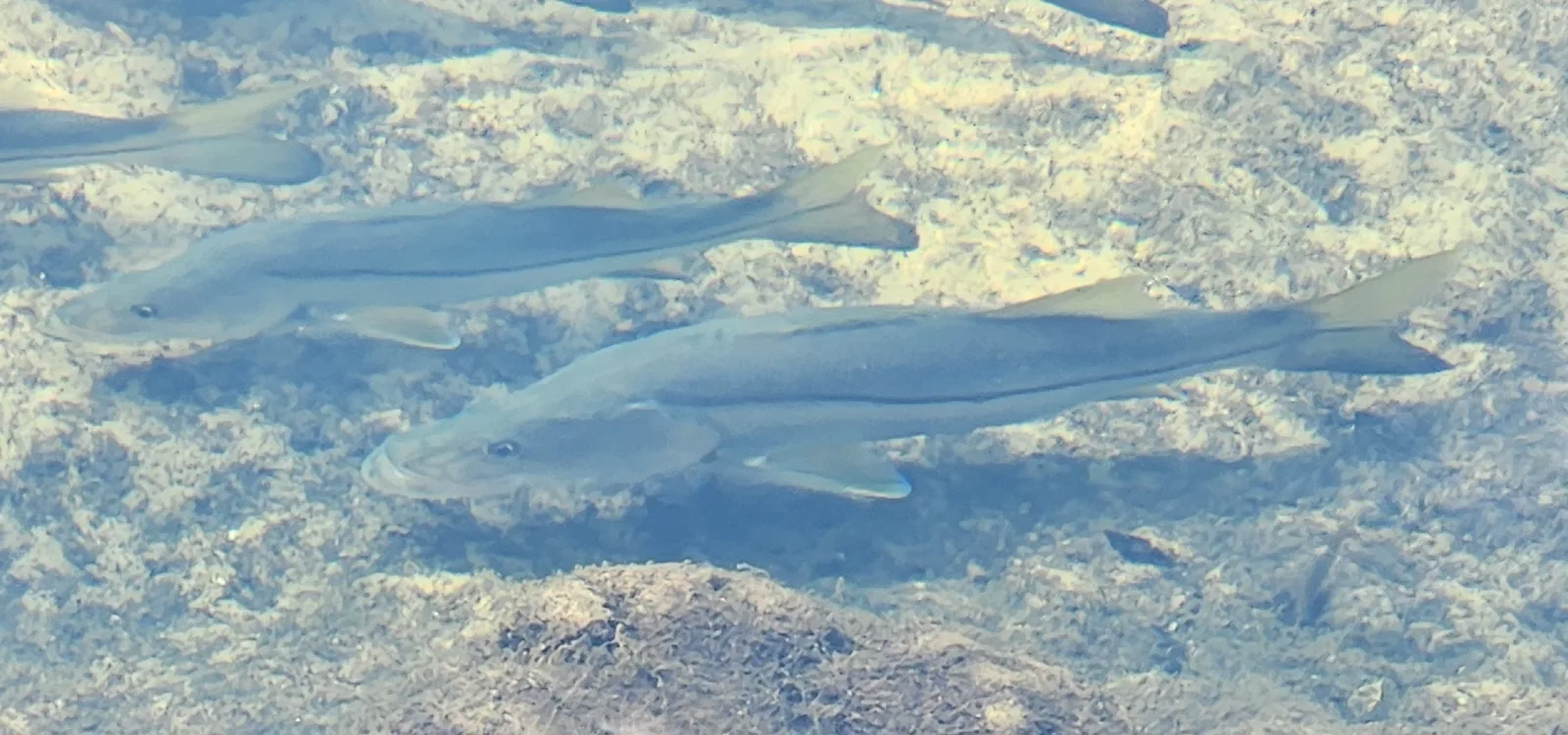
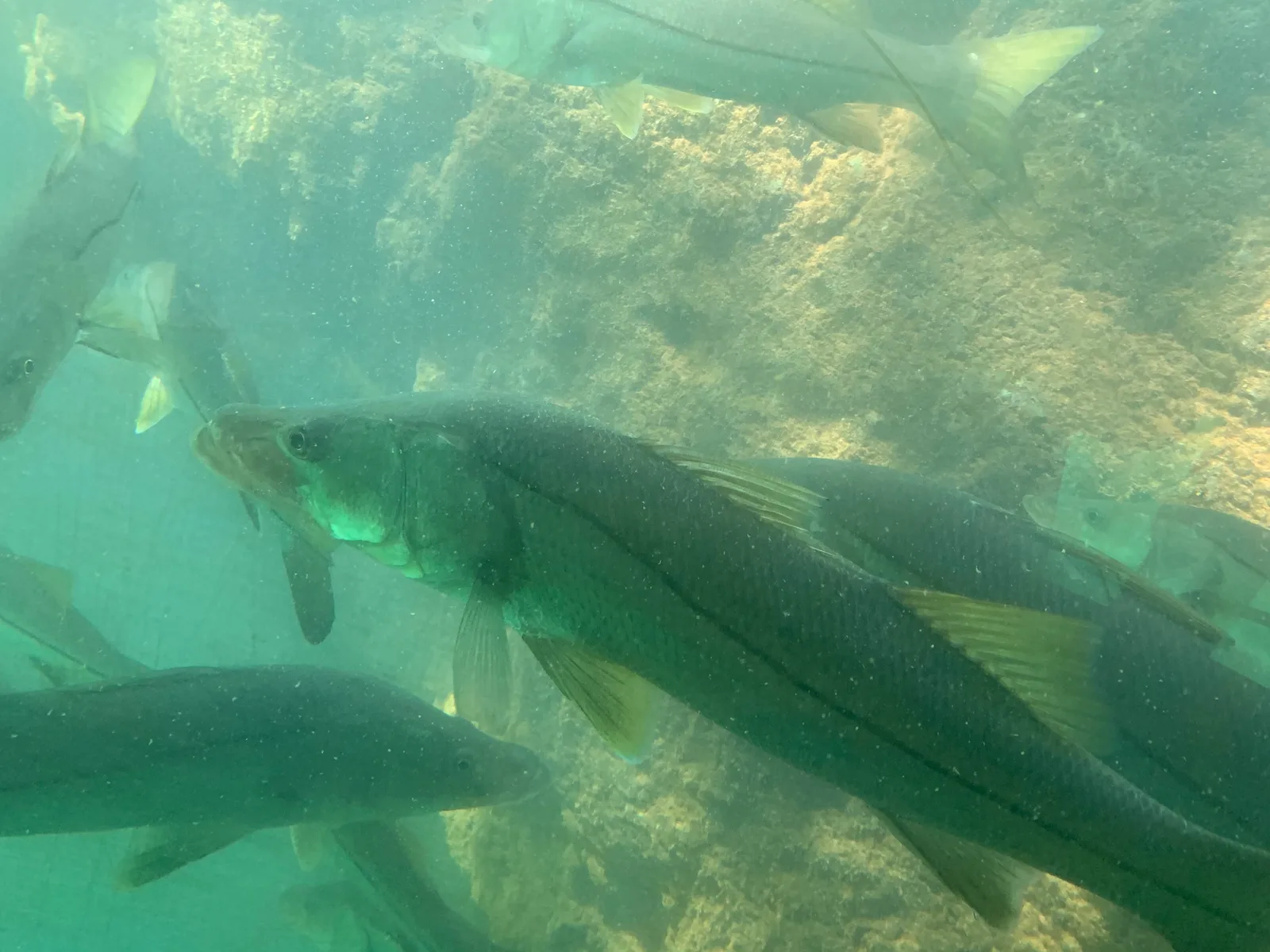
What you’re looking for: snook in clear shallows at Homosassa, Florida. Photo: dande, iNaturalist observation 258083400 (CC0).
The smaller snook stay “inside”, on the flats and around structure close to shore. The big spawners hang around the Intracoastal bridges and inside the inlets. FWC’s bridge tip starts from an anchored boat. On foot, your best bets are a beach near an inlet in summer and a dock light at night.
What’s the best bait for snook fishing?
Live bait first. Snook eat fish and shrimp. Live pinfish, small mullet, shrimp and sardines all work, free-lined (no weight) or on the bottom with a fish-finder rig. Salt Water Sportsman’s Gulf coast pick is live threadfin herring, pilchards or pinfish. If you can catch live bait, that’s the one to bring.
Hook it so it swims. Capt. Erik Flett puts a pilchard on a 2/0 to 4/0 circle hook through the clear spot between its upper lip and its eyes. Capt. Chris Rush hooks a live 5-inch threadfin through the nose on a 4/0 circle.
When the fish won’t eat, try FWC’s trick. Crush a few sardines in your hand, toss them at the spot, then drop a lively one in the middle.
Lures work too, and they’re the better choice in winter. Throw things that look like a baitfish or a shrimp. Salt Water Sportsman’s list:
- Soft-plastic shad and jerk shads (Bass Assassin, Gulp! Swimmin’ Mullet, Fin-S Fish) on 1/4 to 1/2 oz jig heads.
- A 3 to 4 in D.O.A. Shrimp.
- MirrOlure plugs. The 7M is the one FWC names for cold days.
- Zoom grubs on a jig head.
- At night, a chartreuse or red-and-white Bomber Long-A, from FWC’s list.
Most of those plugs come with treble hooks. Florida bans a treble or any other multiple hook for snook, so swap them for single hooks before you fish.
Place the cast. Snook are ambush fish that won’t chase far. Don’t hit the fish with the bait, but don’t land it out of reach either. Rush puts it bluntly: snook stay tight to the roots, and a cast a foot short often won’t get hit.
What tackle do you need for snook?
One 7-foot spinning outfit rated for 20 to 30 lb line handles most snook fishing. This is Salt Water Sportsman’s Gulf coast setup.
| Part | What to use |
|---|---|
| Rod | 7 ft (2.1 m) saltwater rod, spinning or conventional, medium to heavy, rated 20–30 lb line |
| Reel | Size 4000–5000 saltwater spinning reel, or 12–16 conventional |
| Line | 15–30 lb braid |
| Leader | 30–40 lb fluorocarbon |
| Hook | 3/0–4/0 circle hook, Owner Mutu Light or Gamakatsu Octopus |
Why so heavy? Snook jump clear of the water and burst into long runs, and they live in roots and pilings. Even a 30 lb leader can part. In that same Salt Water Sportsman story, a 20 lb snook jumped and cut one after a 10-minute fight.
Rush goes light on the main line, 15 lb braid. That lets him sit well off the fish, stay unseen and still reach it with a long cast. He adds a top shot of 30 lb fluorocarbon as the leader.
How big do snook get?
A keeper weighs about 7 to 12 pounds. FWC weighed thousands of snook on both coasts, and its averages show what the slot means on a scale.
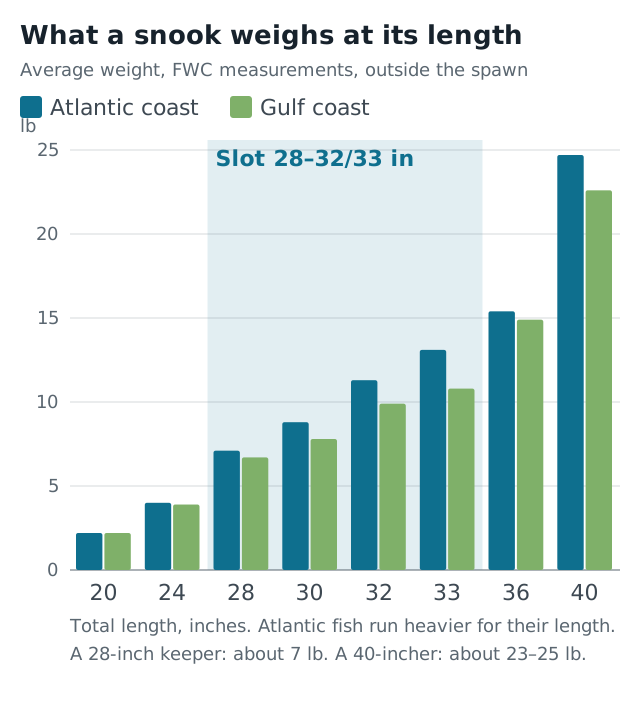
Average weights outside the spawn (Nov.–Apr. Atlantic, Oct.–Mar. Gulf). Drawing: fishing.info, from FWC’s length and weight table.
A 28 in snook averages about 7 lb on either coast. At the top of the slot, an Atlantic fish of 32 in averages 11.3 lb and a Gulf fish of 33 in about 10.8 pounds. Atlantic snook are heavier for their length. And don’t trust the usual length-times-girth formula on a snook: FWC says it doesn’t fit them. Fishing Broward, Miami-Dade, the Keys or from Volusia County north? Your fish may not match these numbers, because FWC’s table has no snook from there.
Long doesn’t always mean heavy. The heaviest Atlantic snook in FWC’s table went 37.5 lb at only 43 in. The longest, at 45 in, weighed 35.4 lb.
| Record | Weight | Where and when |
|---|---|---|
| World, common snook (IGFA all-tackle) | 53 lb 10 oz (24.32 kg) | Parismina Ranch, Costa Rica, October 1978 |
| Florida | 45 lb 12 oz | Near Sebastian |
The 72 lb 9 oz snook from Costa Rica in May 2026 was a Pacific black snook. That’s a different fish, with its own IGFA record.
Females get bigger and older. They live about 21 years and reach 48 in. Males live about 15 years and top out near 39 in.
How do you release a snook so it lives?
Most released snook live. FWC puts the death rate at only two percent. Most of the ones that die were caught on live bait.
- Use a circle hook, and don’t let a snook run off with live bait. The longer it runs, the more likely it swallows the hook.
- Crimp the barbs if you can. The hook comes out faster.
- Leave it in the water while you take the hook out with pliers.
- Cut the line on a deep hook. In FWC’s test, 4 of 12 deep-hooked snook died when the hook was pulled. None of the 12 died when the leader was cut and the hook left in.
- Hold a big one flat. One hand on the lower jaw, the other under the belly. Hung by the jaw alone, a big snook can tear the link between its head and body and starve. Don’t hang it from a lip-gripper either.
- Revive it gently. Hold it nose into the current until it swims off. Don’t saw it back and forth.
There’s more on hooks, handling and photos in the catch and release guide.
Is snook good to eat?
Yes. FWC calls snook excellent table fare. Skin the fillets, bellies included, and keep the fish on ice: fresh and iced, the meat tastes excellent.
Why don’t you see snook on Florida menus? Because it can’t be sold. Florida made snook a gamefish in 1957 and banned its sale, and Texas allows no commercial harvest either.
Keep only what you’ll eat, and send the big ones back. A fish over the slot is most likely a female. For how often to eat any fish you keep, check Florida’s fish consumption advice for your water.
Why does the slot protect the big snook?
Because the big snook are the mothers. Snook are born male, and some become females between 18 and 22 inches. The change can take as little as 90 days, in the fall after the spawn. There’s no way to tell a male from a female by looking.
Half of the males can spawn at about 18 in and two years old. Half of the females aren’t ready until about 30 in and five years. So a female needs years in the water before she adds to the next generation.
Each female may spawn every two days in summer and release about 1.25 million eggs each time. The spawn runs from April or May to September or October, at river mouths and the big inlets and passes. Jupiter and Lake Worth inlets on the Atlantic are spawning spots, and so are John’s Pass and Clearwater Pass on the Gulf. Schools of up to 400 or 500 snook come back to the same spot every year.
That’s why the height of the summer spawn is closed, and why the slot stops at 32 or 33 inches. FWC puts it simply: let the big ones go, and your own chance at a big one goes up.
It worked. In 1985 Florida’s snook were called severely depleted. Today the stocks beat FWC’s goal on both coasts.
The species guide has every other fish we cover. Heading offshore? The grouper guide has the rules out there.

Free PDF · 16 pages
Stop guessing. Know what's biting before your first cast
A whole Saturday on the water with nothing to show for it. One reading tells you who's feeding.
The Water Temperature Fishing Chart. Take one water temperature reading, find it on the chart, and see which of 26 freshwater fish are spawning, feeding hard or slowing down.
- Where bass, crappie, bluegill and walleye sit, and what to throw. Trout: the reading where you stop.
- Why a 3 ft drop beats a cold front, and what to throw each day of the front
- The three thermometer mistakes that make a reading lie
The chart's numbers come from state fish and wildlife agencies and fisheries research: 61 sources, each listed on the site.
No card, nothing to buy. Confirm with one click and the PDF is on its way, one version for your phone and one to print, yours to keep. Then a few short emails and one a week on what's biting, with an unsubscribe link in every one. Privacy.
Sources (15)
- FWC, Snook recreational regulations (management regions, seasons, slot and bag limits)
- FWC, Snook species profile
- FWC, Fat snook species profile
- FWC, Tarpon snook species profile
- FWC, Swordspine snook species profile
Show all 15 sourcesShow fewer sources
- FWC Fish and Wildlife Research Institute, A Sketch of the Common Snook in Florida
- FWC Fish and Wildlife Research Institute, Observed Weights of Florida's Common Snook From Known Length and Weight Data
- FWC Fish and Wildlife Research Institute, Techniques to Reduce Catch-and-Release Mortality
- Florida Museum of Natural History, Common Snook (Centropomus undecimalis) species profile
- Texas Parks and Wildlife Department, Snook bag and length limits (valid Sep. 1, 2026 through Aug. 31, 2027)
- Salt Water Sportsman, Targeting Gulf Coast Snook (Nick Honachefsky)
- FWC, How Florida's Snook Permit Benefits Florida's Snook Population
- Florida Administrative Code, Rule 68B-21.006: Allowed and Prohibited Gear and Methods of Harvest (snook)
- IGFA, 20 Enduring IGFA World Records (common snook, Gilbert Ponce, 1978)
- IGFA, Massive Snook Catches: The Largest IGFA Snook World Records