 By
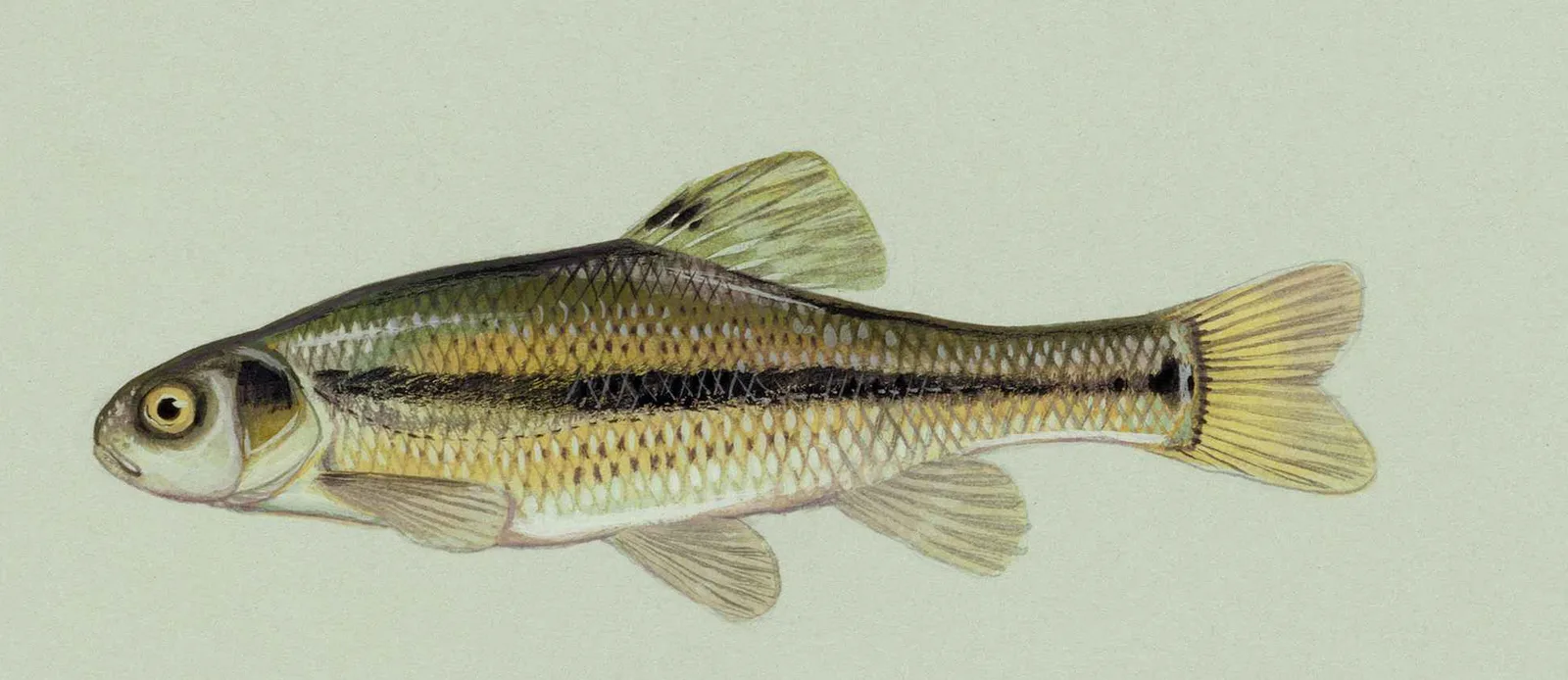
A fathead minnow is a chubby, blunt-headed minnow, usually 2 to 3 in long, and it’s the most common minnow sold as bait. It survives where other fish can’t, which is why it lasts in your bucket. For a new pond, buy about 3 lb per acre and put them in before the bass. If the minnow is orange, you’ve got a rosy red, the same fish in a different color.
Fathead minnows rarely live past three years. Yet as many as 12,000 eggs have been found in a single nest.
How do you identify a fathead minnow?
Look at the shape first. A fathead is chubby, with a blunt, rounded snout and short, rounded fins. Then check for these:
- A dusky stripe down the middle of the side, and a spot at the base of the tail. The stripe is easy to see in clear water and faint in muddy water.
- A small mouth at the very front of the snout, with no barbel.
- A dark olive back, copper or brass color behind the head, and a white belly.
- A lateral line that quits partway down the body. That’s the row of pored scales along the side.
Spawning males look like another fish. The head turns nearly black, with hard bumps on the snout called breeding tubercles. Light bars ring the body behind the head and under the back fin. A spongy pad grows along the back, from the head almost to the back fin. The fish’s other common name is the toughie.
| Look-alike | How it differs from a fathead |
|---|---|
| Bluntnose minnow | Mouth set just under the snout, and a lateral line that runs the whole way. The side stripe ends in an intense dark spot. Reaches 4 to 4 1/2 in |
| Golden shiner | Golden or silvery sides and a fleshy keel along the belly. Much bigger, at 3 to 6 in and up to about 8 in |
| Creek chub | Usually 5 to 7 in, with a black blotch at the front of the back fin |
How big do fathead minnows get?
Expect 2 to 3 in long. Missouri lists 1 1/2 to 2 3/4 in, with about 3 in at most. Iowa also tops them out near 3 in long. Ohio says they can reach 4 in long. Males grow bigger than females. A young fish can hit about 2 in in its first 90 days, and that’s bait size.

Free PDF · Water temperature chart Which fish are biting at today's water temperature?
One reading, and the 16-page chart shows which of 26 fish are spawning, feeding hard or slowing down; for bass, crappie, bluegill and walleye, where they sit and what to throw. Every number sourced.
No card, nothing to buy, and the PDF is yours to keep. Confirm with one click and it's on its way. Then a few short emails and one a week on what's biting. Unsubscribe anytime. Privacy.
How many fathead minnows are in a pound?
Plan on about 200 to the pound. Fatheads are sold by weight, and the count swings with the size:
| Size | Per pound | Seller |
|---|---|---|
| 1 to 2 in | About 200 | Mid-Atlantic Stocking |
| 1 1/2 in | About 250 | Anderson Minnow Farm |
| 2 1/4 in | About 160 | Anderson Minnow Farm |
| 2 1/2 in | About 50 to 83 | Anderson Minnow Farm |
Anderson grades its fish by width, so it calls its counts approximate. Another pond company says about 220 to the pound at 2 to 3 in. Ask your seller for the count before you do the math.
Are fathead minnows good bait?
Yes, and they’re the ones that last. Fatheads are “hardier by far than any shiner,” Darl Black writes in Crappie Now. He also says anglers who’ve fished both think the flashier emerald shiner draws more strikes. So buy fatheads first, and add a few shiners if you can keep them alive. The minnows page sorts out the other bait minnows.
North Dakota anglers use them three ways: tipping a jig, dead-sticking through the ice, and bottom fishing rivers in spring. Iowa calls the fathead the best baitfish available, and says millions sell in its bait shops every year. Fatheads and golden shiners are the two crappie anglers use most, Keith Sutton writes. For walleye from late fall to ice-up, Iowa’s plan is a jig or 3-way rig with a fathead, fished slow.
Size the minnow to the fishing. For crappie through the ice and at ice-out, Black likes a 1 to 1 1/2 in minnow on a No. 8 or 10 hook. In summer he goes to 2 1/2 to 3 in on a No. 2. Most crappie anglers want one about 2 in long, he says.
Hook it for how you’re fishing. Still fishing, Black goes through the upper back, between the back fin and the tail, so the minnow struggles to swim away. Casting or trolling, go through the lips. Not sure? Lip-hook it.
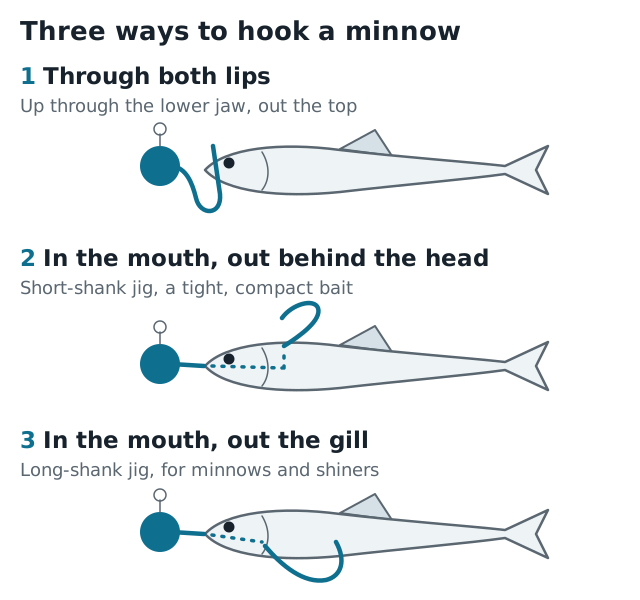
Three ways to put a minnow on a jig. Drawing: fishing.info
You can catch your own in a minnow trap, but read your state’s bait rule first. North Dakota’s legal live baitfish are fathead minnows, creek chubs and sticklebacks, and some waters there ban live baitfish outright. In Michigan, minnows you collect “may only be used in the waters where they are collected.” Leftovers go “in a trash receptacle.” Don’t move your bait from one lake to another.
How do you keep fathead minnows alive?
Keep them cold and give them air. Your bait shop likely holds its minnows in water in the low 40s °F (about 5 °C), and that cold keeps the fish quiet.
- Fill up at the bait shop. That water is already cold. “Cold, untreated well water is ideal,” Jeff Sundin says. If you use treated tap water, add a fish water treatment from a pet shop.
- Use an insulated bucket and keep the lid shut. Sun heats the water fast. A bigger container gives the minnows more room.
- Run an aerator. Carry spare batteries, so the pump never stops. Fine bubbles put in the most oxygen.
- On a warm day, cool it down. Add a little ice. A frozen water bottle or a cooler pack is better than loose ice dumped in.
- Change dirty water. Ammonia from the minnows’ own waste can kill them.
How long they last depends on all that, and we found nobody who gives a firm number of days. Sundin runs a 12-volt pump and uses the same water all day, even in midsummer. He says he’s “barely losing a single minnow.” He keeps leftovers overnight and fishes them the next day. The fishing bait guide has a keep-it-alive table for worms, crickets and crawfish too.
Fatheads have an edge here. They handle high heat, very muddy water and low oxygen, which is how they live in the stagnant pools of dried-up prairie creeks.
How many fathead minnows do you stock in a pond?
Start with 3 lb per acre in a new pond, about 600 fish, and get them in before the bass. Two university extension services print that number, and it’s cheap. If you want more food in the first year, go up to Texas A&M’s 5 to 15 lb.
Here’s what each one says:
| Who says it | New pond rate | When |
|---|---|---|
| Mississippi State | 3 lb per acre (optional) | Fall or winter, with bluegill. Bass the next spring |
| University of Missouri | 3 lb per acre, 3 to 5 lb in ponds of 1 acre or less | Fall and early winter |
| Pond Boss | 5 lb per acre | New ponds, ahead of bass fingerlings |
| Texas A&M | 5 to 15 lb per acre | Fall, with bluegill and redear. Bass in spring |
| Missouri Conservation | 300 to 500 fish per acre | As soon as there’s water, a growing season ahead of bass |
| New York DEC | 300 to 400 fingerlings per acre | A year or two ahead of yearling or adult bass |
| Mid-Atlantic Stocking (seller) | Up to 20 lb per acre | New ponds |
These numbers look far apart until you put them on one scale. At about 200 to the pound, Missouri’s 300 to 500 fish weigh 1 1/2 to 2 1/2 lb in all. New York’s 300 to 400 weigh 1 1/2 to 2 lb in all. That sits close to the 3 lb the universities print. Texas A&M’s top rate is the one that’s really different, at about 3,000 fish an acre.
Here’s what to buy, at about 200 fish to the pound:
| Pond size | At 3 lb per acre | At 15 lb per acre |
|---|---|---|
| 1/4 acre (0.1 ha) | 3/4 lb, about 150 fish | 3 3/4 lb, about 750 fish |
| 1/2 acre (0.2 ha) | 1 1/2 lb, about 300 fish | 7 1/2 lb, about 1,500 fish |
| 1 acre (0.4 ha) | 3 lb, about 600 fish | 15 lb, about 3,000 fish |
| 2 acres (0.8 ha) | 6 lb, about 1,200 fish | 30 lb, about 6,000 fish |
How much do fathead minnows cost?
Mid-Atlantic Stocking lists fatheads at $21.95 a pound for 1 to 9 lb, as of November 2026. That makes 3 lb about $66. Anderson Minnow Farm lists permits as required in CA, CT, NM, NV, OH, SD, VT and WY. Check your state before you order.
Why stock them before the bass?
They need time to spawn before the largemouth bass go in, Missouri says, ideally a full May to September season ahead. Some of the benefit still comes if they go in at the same time as the bass fingerlings.
Give them something to spawn under. Missouri suggests cedar shingles driven into the bank at a 45-degree angle. Space them about 2 to 3 ft (0.6 to 0.9 m) apart, no deeper than 1 1/2 ft (0.5 m). Buy a mix of sizes too, since males run bigger. “Stocking mostly large minnows could result in poor spawning success.”
Can you put too many fathead minnows in a pond?
No agency we read sets a ceiling. The sellers go higher than the states do, up to 20 lb per acre and, from one pond company, 100 lb. The real limit is that it’s money you’ll watch get eaten. Fatheads are slow swimmers, and Texas A&M expects you to stop seeing them within a couple of months of stocking bass. That’s fine. Their job is to feed the first year’s bass and bluegill.
Don’t stock them to fix a pond that already has bass. Missouri says the fish already there would likely eat them right away. They “serve only as short-lived, expensive fish food.” Pond Boss calls them “a quick, expensive meal.”
If bass are already in there, golden shiners make more sense. They’re fast enough to have the “physical tools to escape predation,” Pond Boss says. It puts their rate at 5 to 50 lb per acre. New York says to stock minnows or shiners a year or two before you add yearling or adult bass.
What are rosy red minnows?
A rosy red is a fathead minnow bred for an orange color. It’s the same fish, so the rules on this page for keeping and spawning them still apply. Texas A&M credits the strain to Billy Bland Fishery, and other accounts date it to Arkansas breeding farms in 1985.
| Wild fathead | Rosy red | |
|---|---|---|
| Color | Olive above, silver-bronze sides | Orange-red back, head and tail, silver-orange below |
| Where you get it | Bait shops, or a trap | Pet stores as feeder fish, some bait dealers |
| Size | 2 to 3 in | Alberta says 2 to 6 cm, about 3/4 to 2 1/2 in |
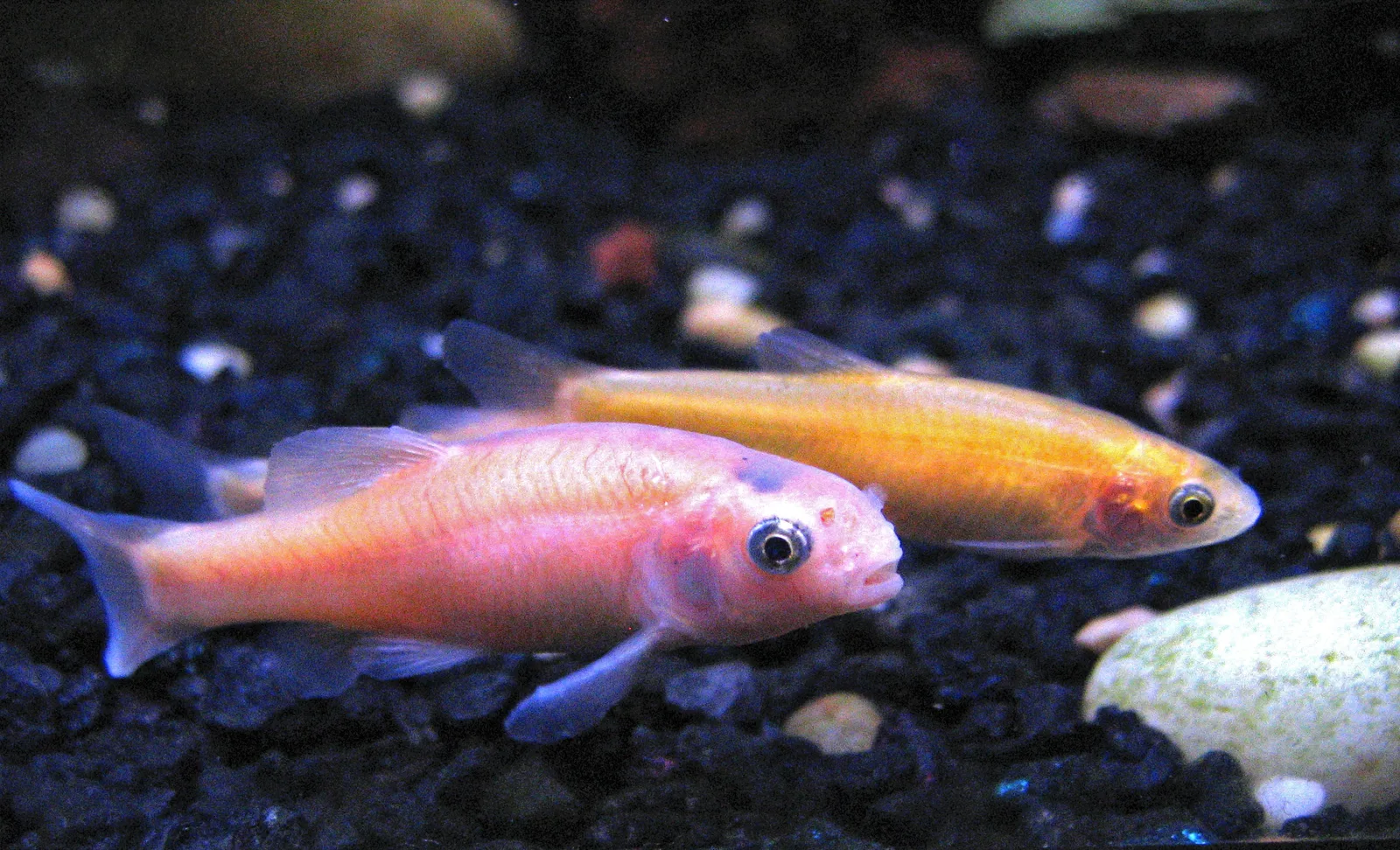
Rosy red fathead minnows in a home aquarium: a male in front and a female behind him. Photo: Enziarro, via Wikimedia Commons (public domain)
Can you keep them in a tank? Yes. Pet stores sell them as feeders, and Iowa says aquarium owners collect the wild ones too. Just never let one go. Alberta has found rosy reds in 3 locations, likely from dumped aquarium fish or illegal bait. It warns they could threaten native fish. If you’re done with them, give them to another fish keeper or ask the store.
Where do fathead minnows live?
They’re native from central Canada down the Rockies to Texas, and east to Virginia and the Northeast. Bait buckets carried them to both coasts. Iowa finds them in every watershed in the state, mostly in slow creeks, ditches and ponds with soft mud.
They do best where little else can live. In midsummer, fatheads, creek chubs, black bullheads and green sunfish often make up the whole fish population of a shrinking prairie creek. Put them with a lot of other fish and they’re seldom abundant, Missouri says. Agencies don’t agree on how much they matter to game fish. North Dakota calls them the main food in many of its waters. Missouri says they’re seldom abundant enough where big game fish live to be of much value.
What do fathead minnows eat?
Mostly algae and other plant material, plus some small insects and tiny crustaceans. Iowa adds insect larvae and the odd fish.
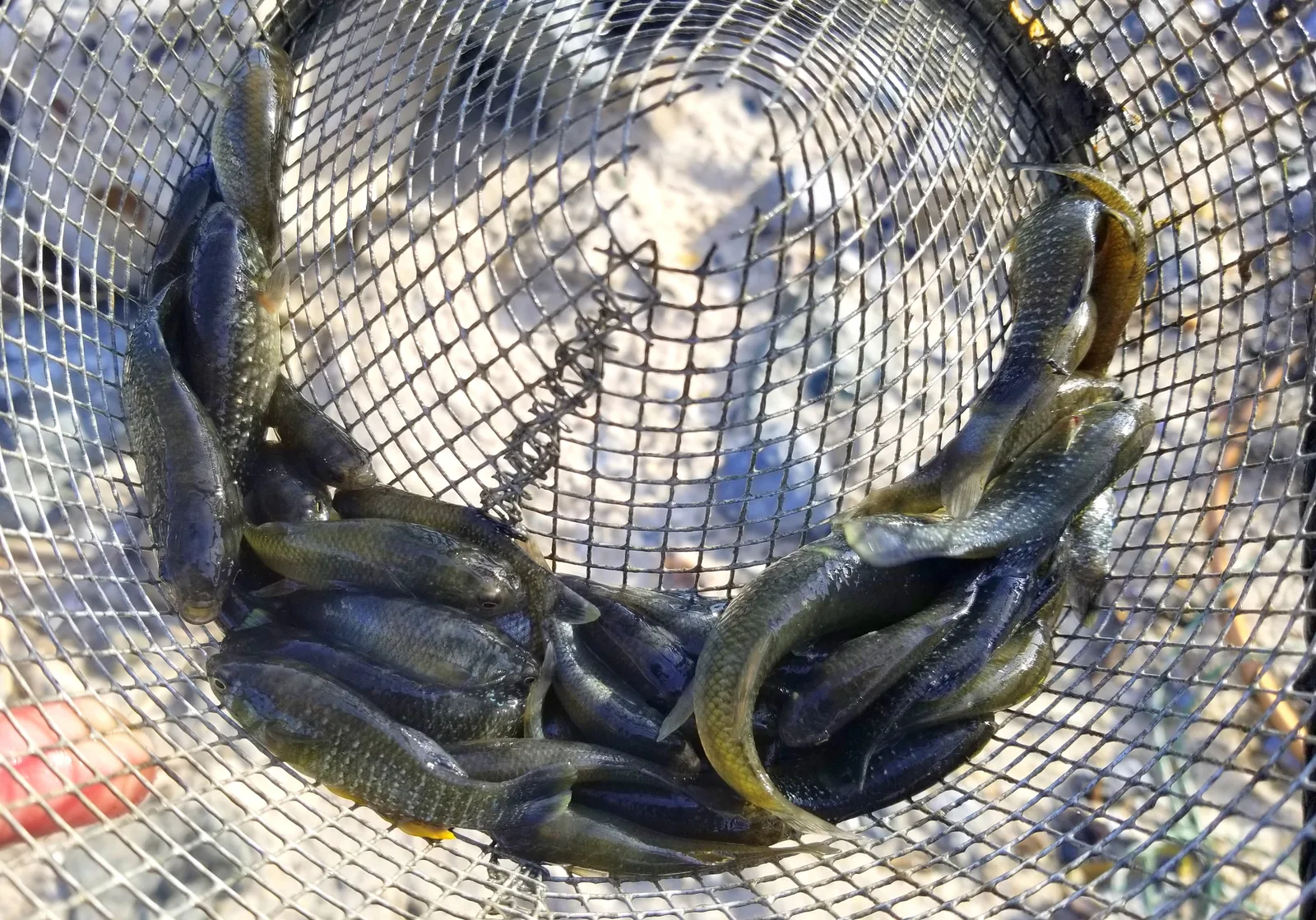
Bait minnows in a dip net. Photo: khairil77 / Depositphotos.
Are fathead minnows good to eat?
You can eat them, but almost nobody does. Minnows from clean water are safe to eat, Pond Informer says, and fatheads are among the ones people occasionally eat. Their bones are fine and they’re too small to fillet. They’re “usually eaten whole – bones and all.” Some minnows taste like liver, it says. Check your state’s consumption advisories if you keep any from a creek or ditch. They’re better on a hook.
The biology behind the fishing
Fatheads start spawning when the water passes about 64 °F (18 °C) and quit near 84 °F (29 °C), Texas A&M says. In Missouri, that means May through August. The male cleans a spot under a rock, board or floating object, and the eggs stick to the underside. He stays with them until they hatch in 5 to 6 days.
A female can spawn more than 12 times in one summer and produce 4,000 or more young. Most fatheads die after spawning by their first birthday, and they rarely see three. Predators cut that even shorter, Missouri says.
Fatheads carry an alarm chemical in their skin. Injure one and the others nearby hide or bolt. They’ve got a lab job too. The U.S. EPA names the fathead minnow in its standard toxicity tests for wastewater.
The other freshwater fish hub has more of what lives in small water. If a word here was new, the fishing terms page explains it.

Free PDF · 16 pages
Stop guessing. Know what's biting before your first cast
A whole Saturday on the water with nothing to show for it. One reading tells you who's feeding.
The Water Temperature Fishing Chart. Take one water temperature reading, find it on the chart, and see which of 26 freshwater fish are spawning, feeding hard or slowing down.
- Where bass, crappie, bluegill and walleye sit, and what to throw. Trout: the reading where you stop.
- Why a 3 ft drop beats a cold front, and what to throw each day of the front
- The three thermometer mistakes that make a reading lie
The chart's numbers come from state fish and wildlife agencies and fisheries research: 61 sources, each listed on the site.
No card, nothing to buy. Confirm with one click and the PDF is on its way, one version for your phone and one to print, yours to keep. Then a few short emails and one a week on what's biting, with an unsubscribe link in every one. Privacy.
Related
Section guide
Freshwater Fish Species Outside the Big Families: Sturgeon, Gar, Bowfin, BurbotThe freshwater fish species outside the bass, trout, catfish and pike families: sturgeon, gar, bowfin, burbot, drum, eel and paddlefish, with records.
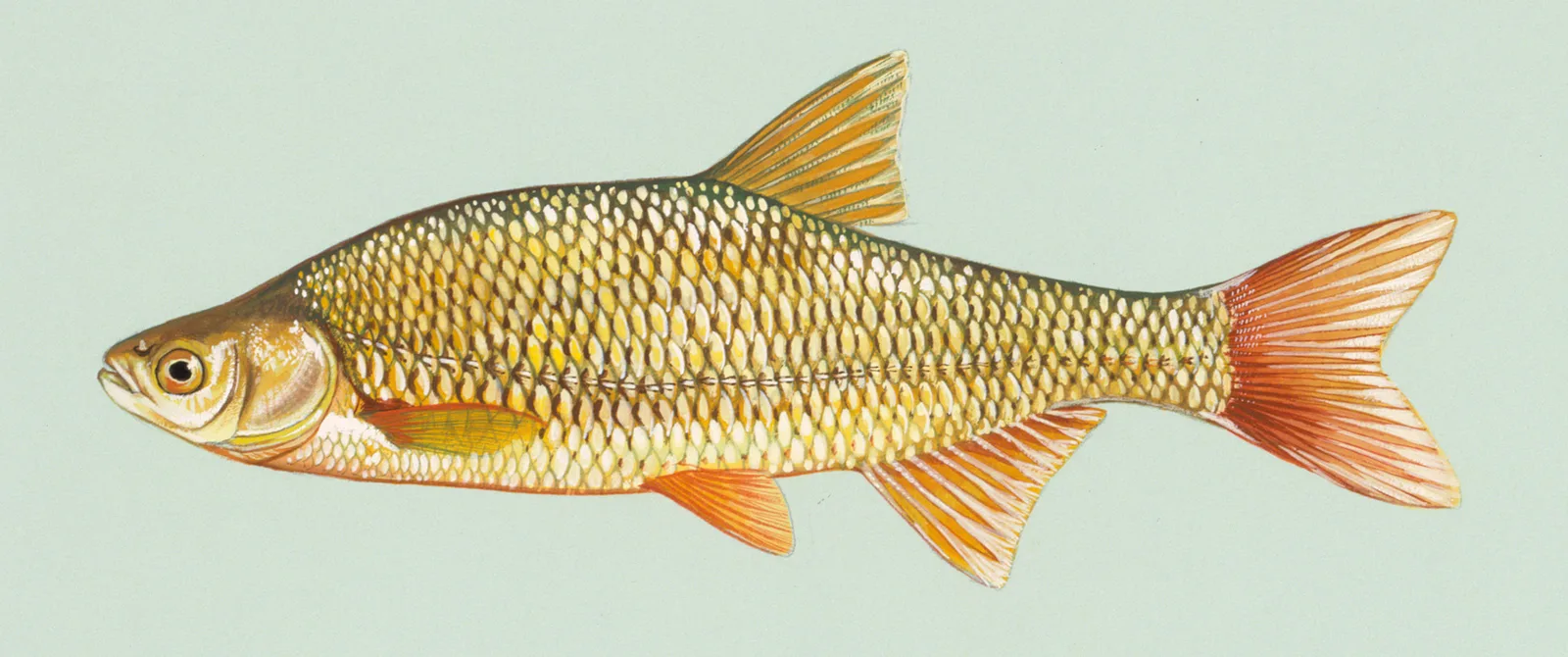 Golden Shiner: How to ID, Catch and Fish This Trophy Bait
Golden shiners are deep-bodied minnows and Florida's top live bait for big bass. How to tell one from a rudd, catch your own, and hook it right.
 Snakehead Fish: How to Identify, Catch, and Handle One
The snakehead fish is an invasive, air-breathing predator. How to identify one, catch one on a frog, and what each state says to do with it.
 Creek Chub: How to Identify, Catch and Use Them as Bait
A creek chub is a 5 to 7 in minnow with a black spot on its back fin. How to identify one, catch it on light tackle, and rig it as live bait.
 Gizzard Shad: How to Identify, Catch and Use Them for Bait
Gizzard shad commonly run 9 to 14 in. How to tell one from a threadfin, net it, keep it alive, and which states ban it as live bait.
 Shad Fishing: When the Run Hits, What to Throw, What You Can Keep
Shad fishing for American and hickory shad: when the spring run hits each river, the darts and spoons to throw, and which states let you keep one.
 Smelt Fishing: Net a Spring Run or Jig Them Through the Ice
Smelt fishing two ways: dip a spring run at night or jig them through the ice. When the run hits, the gear, and each state's rule.
Sources (31)
- Missouri Department of Conservation, Fathead Minnow (field guide)
- Missouri Department of Conservation, Fathead Minnows in New Ponds
- Iowa DNR, Fathead Minnow (Fish Iowa species profile)
- Iowa DNR, Bluntnose Minnow (Fish Iowa species profile)
- Fish of Ohio, Fathead Minnow
Show all 31 sourcesShow fewer sources
- Fish of Ohio, Bluntnose Minnow
- Missouri Department of Conservation, Golden Shiner (field guide)
- Missouri Department of Conservation, Creek Chub (field guide)
- Texas A&M, Fathead Minnows - Aquaculture, Fisheries, & Pond Management
- Mississippi State University Extension Service, Stocking Recommendations for Ponds 1 Acre or Larger
- Robert A. Pierce II and Charles E. Hicks, Managing Ponds and Lakes for Aquaculture and Fisheries in Missouri: Fish Selection and Stocking for Sport Fishing, University of Missouri Extension G9475
- New York State DEC, Farm Pond Fish Management
- Bob Lusk, ABC's of Forage Fish, Pond Boss
- Scott Gangl, Thoughts on Fatheads, North Dakota Outdoors (May 2025)
- Doug Leier, North Dakota Outdoors: A little bit about baitfish in North Dakota, Minot Daily News (August 2025)
- Michigan DNR Fishing Guide, Lawful Fishing Methods (eRegulations)
- Iowa DNR, Walleye
- Arkansas Democrat-Gazette (Keith Sutton), minnows and crappie fishing are an inseparable duo
- Darl Black, Sometimes Live Bait Matters, Crappie Now
- John J. Woods, Be sure minnows are alive and kicking, Mississippi Sportsman (May 15, 2015)
- Jeff Sundin, Keep Your Bait Alive (2010, updated 2012)
- Ron Presley, Aluminum Boat Bait Storage: Keeping Your Bait Healthy, Crappie Now
- Government of Alberta, Rosy red minnow
- Wikipedia, Fathead minnow
- U.S. EPA, Whole Effluent Toxicity Methods
- Mid-Atlantic Stocking, Fathead Minnow (price and count, read November 9, 2026)
- Anderson Minnow Farm, Fathead Minnow (sizes, counts and permit states, read November 9, 2026)
- Fathead Minnows, aquaticbiologists.com (count and stocking suggestion, read November 9, 2026)
- Pond Informer, Can You Eat Minnows? (Nutrition & Recipes)
- Enziarro, Rosy Red Minnows (photo, public domain, via Wikimedia Commons)
- Duane Raver, U.S. Fish and Wildlife Service, Fathead minnow (illustration, via Wikimedia Commons)