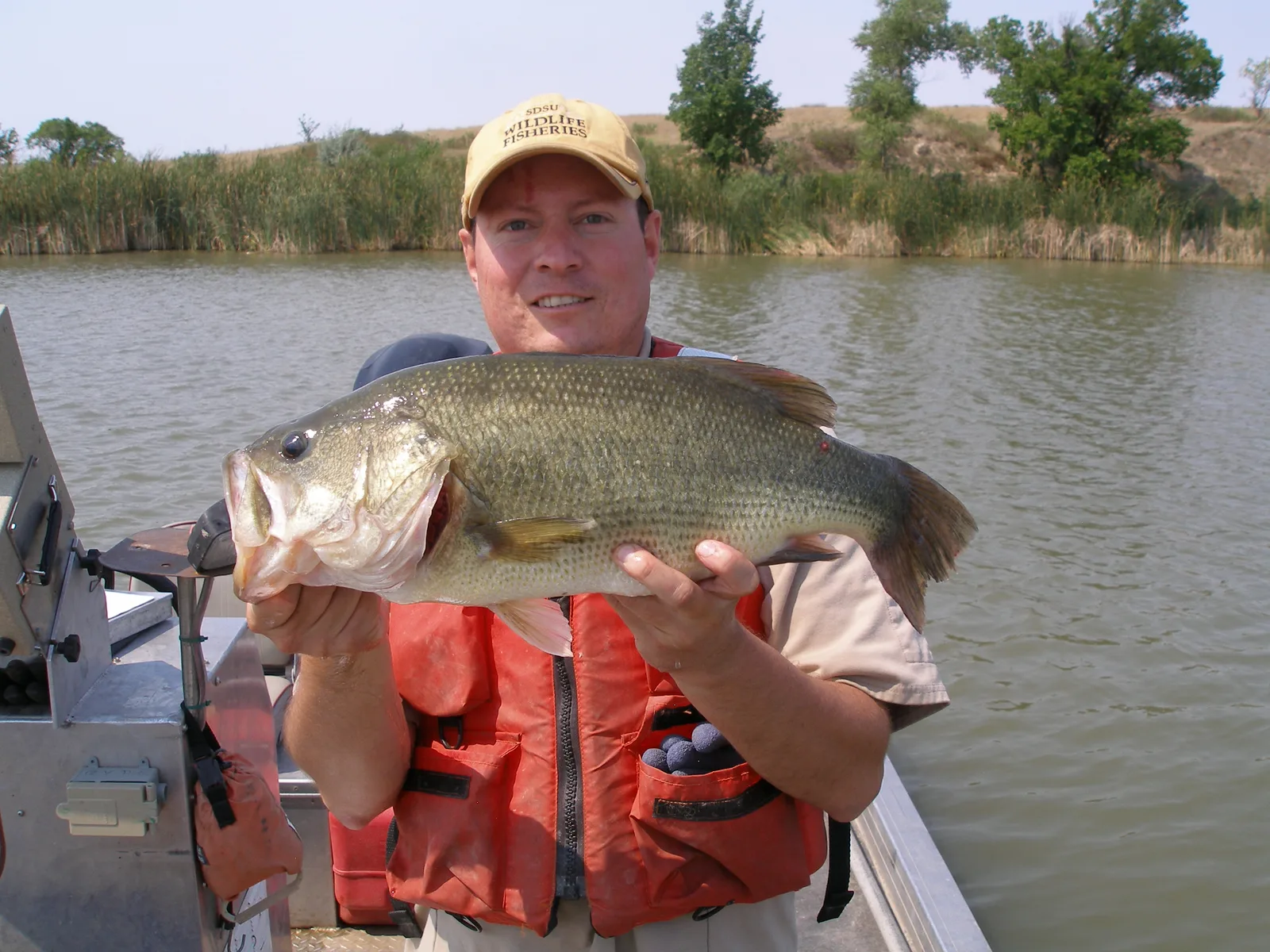
Adult bass eat mostly fish and crayfish. In 748 largemouth from DeGray Reservoir, Arkansas, fish made up 59% of the diet by weight and crayfish nearly 38%. Smallmouth lean harder on crayfish and, in rivers, on aquatic insects. What a given bass eats comes down to its size, the season and what lives in its water.
A fisheries biologist found a 9.5 in shad inside a 16 in bass: one meal, 59% of the fish’s own length.
What does a bass eat at each size?
A bass changes its diet several times on the way to adulthood, and each change follows the size of its mouth. The bass hub covers the species; the steps below are for largemouth, the best-studied of them.
- Fry. Newly hatched largemouth eat copepods and water fleas, the zooplankton drifting around the nest. Insect larvae come next.
- 1.5–4 in (4–10 cm). At about 1.5–2 in, young largemouth start to eat fish. In a Georgia–Alabama reservoir study of 224 young bass, the switch from insects and zooplankton to fish came by about 4 in (10 cm). Those bass chose prey about 35% of their own length, smaller than the largest they could swallow.
- 4–8 in (10–20 cm). Mostly small fish. In West Point Lake on the Alabama–Georgia line, bass under 6 in (15 cm) ate mainly bluegill. In DeGray, fish were 84% of the food weight of bass under 8 in.
- Over 8 in (20 cm). Crayfish arrive in force. In DeGray they were about 12% of the food weight of bass under 8 in and 42% for bigger ones. In West Point Lake, shad became the main food of bass over 8 in.
- Over about 18 in (45 cm). West Point bass this size had essentially stopped eating bluegill and fed on shad. A slim shad goes down easier than a deep-bodied sunfish.
Texas Parks and Wildlife sums up the adult menu in one line: “almost exclusively” other fish and large invertebrates such as crayfish. The U.S. Fish & Wildlife Service adds frogs, snakes and mice, and notes that some largemouth eat other bass.
What have bass been caught eating, study by study?
Six diet studies, read from the stomachs of wild bass, give the numbers behind the menu. Read the shares as what bass ate in that water, not as a rule for every lake.
| Study | Water | Bass | What they ate |
|---|---|---|---|
| Bryant and Moen 1980 | DeGray Reservoir, Arkansas | 748 largemouth, April–November 1976 | Fish 59% by weight (sunfish 28%, shad 23%), crayfish nearly 38%; crayfish 74% by mid-November |
| Timmons and Pawaputanon 1980 | West Point Lake, Alabama–Georgia | Over 3,000 largemouth stomachs, 1975–1979 | Bluegill, gizzard shad and threadfin shad; bluegill for bass under 6 in (15 cm), shad over 8 in (20 cm) |
| Bonds 2000 | Claytor Lake, Virginia (little vegetation) | Largemouth, smallmouth, spotted, 1996–1998 | Crayfish about 20% of the largemouth diet, about 75% for smallmouth and spotted bass |
| Murphy and others 2005 | Shenandoah River basin, Virginia | 460 smallmouth, 2002 | By weight, across three rivers: aquatic insects 32–48%, crayfish 19–31%, fish 22–29% |
| Crane and Einhouse 2016 | Lake Erie (New York DEC survey) | Smallmouth | Crayfish in 53.5% of stomachs before the round goby; gobies in 73.3% after |
| Cochran and Adelman 1982 | Lake Rebecca, Minnesota | Subadult largemouth, May–October 1978 | Large bluegill and insects early; young-of-year bass and bluegill later in the season |
Two patterns run through the table. Largemouth are fish eaters that take crayfish once they are big enough, and smallmouth are crayfish and insect eaters that also take fish. And in every water the menu follows what is common: shad where shad swarm, bluegill in a pond, gobies in Lake Erie once gobies spread.
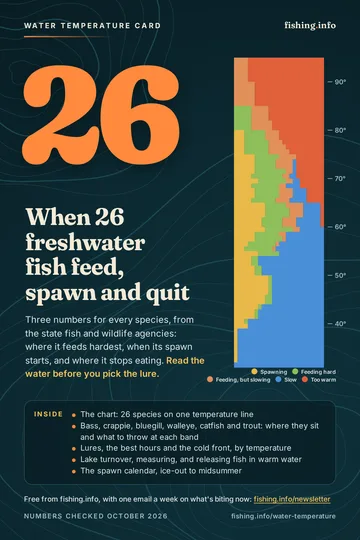
Free card: what 26 species do at your water temperature
Plus one email a week on what's biting now. No sales pitches. Privacy.
Largemouth or smallmouth: do they eat different things?
Yes, and the difference matches where each lives. A largemouth bass holds in weeds and wood and ambushes fish that swim past. Its wide mouth takes a deep-bodied bluegill or a long shad.
A smallmouth bass lives over rock, where crayfish hide. The Wisconsin DNR calls the crayfish its “favorite food,” and Craig Bonds’s Claytor Lake numbers back that up: about 75% crayfish against 20% for largemouth. That Virginia lake had little vegetation, though. Lakes with hydrilla hold plenty of crayfish, and largemouth go in after them. In Virginia’s rivers, smaller smallmouth ate mostly aquatic insects and shifted to crayfish and fish as they grew.
The Lake Erie result shows how fast the menu can change. Shortly after the invasive round goby reached the lake, it replaced crayfish as the smallmouth’s main food. Smallmouth aged 2 to 4 grew 11–15% longer than before. A new food in the lake changed the size of the bass in it.
Spotted bass sit at the smallmouth end, at about 75% crayfish in the same Claytor Lake data. The smallmouth vs largemouth page covers the other differences.
How big a meal can a bass swallow?
Bigger than most anglers expect. Auburn researchers measured the prey in more than 3,000 largemouth stomachs from West Point Lake. A largemouth, they found, can swallow a bluegill about 40% of its own length and a shad about 50%. A bluegill is deep-bodied, so the bass runs out of mouth sooner. The limit is bone, not appetite: a pair of rigid bones behind the gills, the cleithra, sets how wide the throat can open.
| Bass length | Largest bluegill (0.4×) | Largest shad (0.5×) |
|---|---|---|
| 10 in (25 cm) | 4 in (10 cm) | 5 in (13 cm) |
| 12 in (30 cm) | 4.8 in (12 cm) | 6 in (15 cm) |
| 15 in (38 cm) | 6 in (15 cm) | 7.5 in (19 cm) |
| 18 in (46 cm) | 7.2 in (18 cm) | 9 in (23 cm) |
| 20 in (51 cm) | 8 in (20 cm) | 10 in (25 cm) |
These are ceilings, worked out from the study’s two ratios, which it gives for bass of 4–20 in. Most meals are much smaller. The study’s regression line for shad puts the average meal at roughly 30–32% of the bass’s length for bass of 8–20 in. The young Georgia bass, too, picked prey smaller than they could swallow.
Up to about 12 in, the biggest shad found ran 45–52% of the bass’s length. Past that, the biggest meals shrink a little relative to the bass: 45% at 16 in, 38% at 19 in and 34% at 27 in. A bass eats big when it can and small most of the time.
Big bass still eat big fish. Several West Point bass of 26–27 in (65–68 cm) had eaten gizzard shad 9 in (23 cm) long. A Florida biologist once found a 12 in gizzard shad inside a 10 lb largemouth. And the 16 in bass in the pull quote beat the ceiling: its shad was 59% of its length.
What do bass eat in spring, summer, fall and winter?
The season changes both what bass eat and how much.
- Spring. Often only mid-sized and large prey are around, so a bigger lure matches it. Then comes the spawn, and largemouth normally do not feed on the nest. Even bass too young to spawn can go hungry. In Lake Rebecca, Minnesota, subadult largemouth ate almost nothing in mid-May and early June, apparently for lack of forage fish the right size. They started to grow only once the year’s young bass and bluegill came on the menu.
- Summer. Summer and early fall bring an abundance of small prey. In DeGray, the year’s young shad first showed up in bass stomachs in mid-May and made up 68% of the food weight by late June. In Lake Rebecca the bass turned to young-of-year bass and bluegill. Their daily ration, the food eaten in a day as a share of body weight, climbed past 5% by late August. Downsize to match.
- Fall. Crayfish peak. In DeGray they were 66% of the food weight on November 1 and 74% two weeks later. Shad schools move into the backs of creeks, and bass follow them; best time to fish for bass puts the fall feed on the calendar.
- Winter. When the water drops, threadfin shad weaken from cold stress, and bass gorge on the easy meals. Cold water slows their digestion, and largemouth normally stop feeding below 41 °F (5 °C). The bass water temperature page sets out the bands in between.
How often do bass eat?
There is no fixed schedule; temperature sets it. Food may be digested five to six times faster in summer than in winter, the DeGray authors note from earlier work. In a lab study of smallmouth, the time to clear 90% of a meal from the stomach ranged from 4 to 95 hours. Warmer water and bigger fish digested faster, and bigger meals took longer.
Read for an angler, that range says a bass in warm summer water can empty its stomach and feed again the same day. A bass in cold water may go days on one meal. That is the reason behind the usual advice: a small, slow bait in winter, a faster one in summer. Largemouth normally stop feeding above 98.6 °F (37 °C) as well as below 41 °F.
Nor is every bass full at any one time. In DeGray, 83% of the stomachs held food, and the authors read that as intense feeding. Two other reservoir studies they cite found food in fewer than half.
What do bass eat in a pond?
Bluegill, by design. A stocked pond is built so the bass have something to eat. Mississippi State’s Extension service recommends 500 bream per acre, all bluegill or a bluegill and redear mix, in fall or winter. Then come 50 largemouth per acre the next spring, a 10-to-1 ratio. The bass “feed on the small bream, preventing an overpopulation of bream,” and fathead minnows at 3 lb per acre are an optional extra meal.
Bluegill can carry a pond alone. Bonds says a pond can hold a quality bass fishery with no other forage, because females spawn several times a season and keep small sunfish coming. That is why a pond bass eats bluegill and their fry first, then crayfish, frogs and whatever else the pond holds.
Do bass eat frogs, snakes, mice and ducklings?
Yes, but rarely. Craig Bonds lists other fish, crayfish, frogs, salamanders, snakes, mice, turtles and the occasional duckling among what adult bass eat. Frogs, he found, made up “only a minute portion” of the largemouth diet, even though frog lures catch plenty of bass. In DeGray, amphibians came to 2% of the food weight. A Florida biologist has found eels, snakes and baby ducks in bass stomachs, and a Virginia biologist often finds hooks and pieces of lures.
Bass also eat bass. Young-of-year largemouth were a main prey of the subadult bass in Lake Rebecca, and USFWS notes that some largemouth are cannibals. In California, largemouth often eat rainbow trout 10–12 in long.
What does the diet mean for your lure?
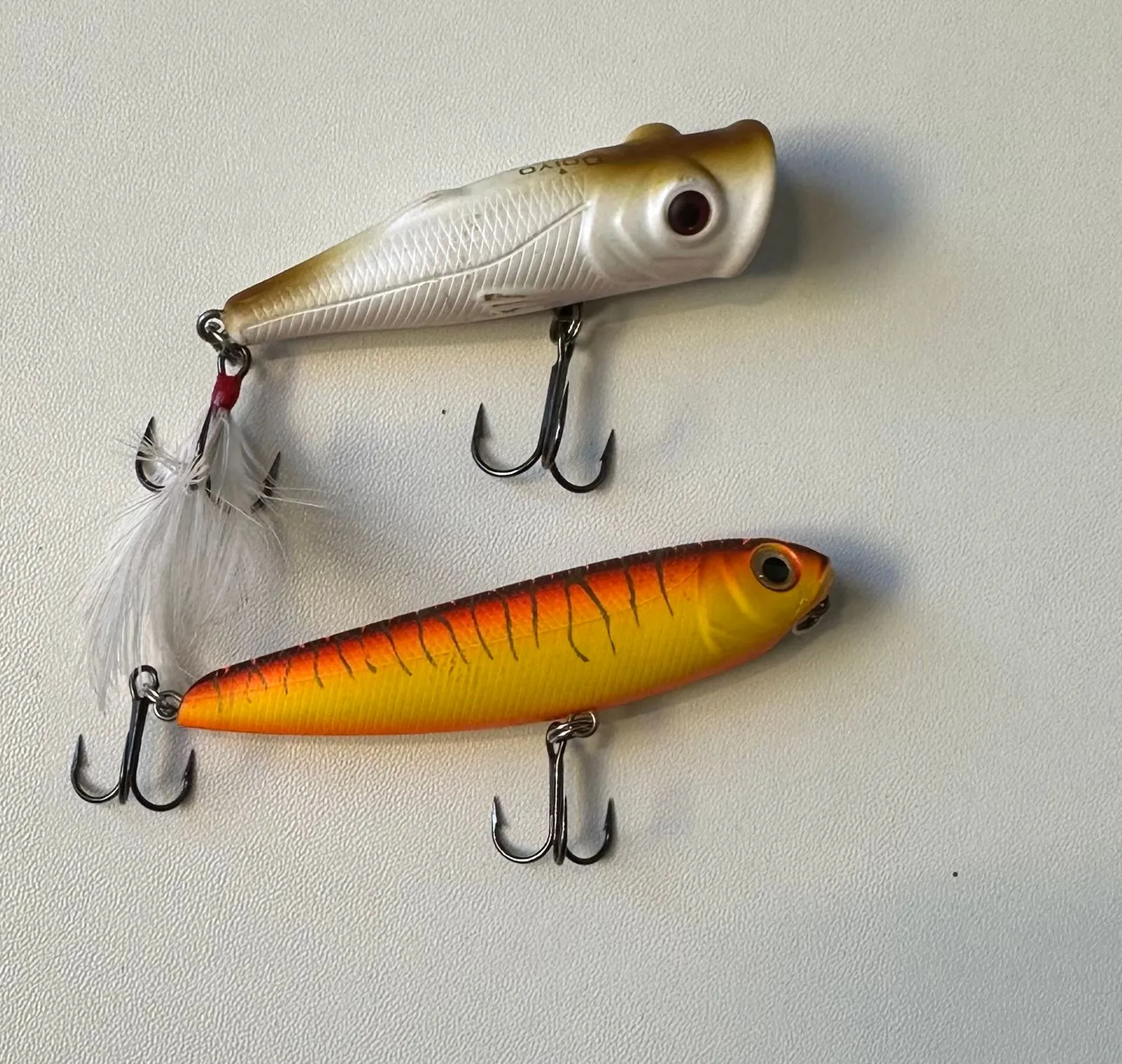
Match the forage in your water. In a shad reservoir that means a slim, silver bait, such as a swimbait or a lipless crankbait. In a weedy pond it means a bluegill pattern, and over rock a crayfish-colored jig or tube, above all in fall.
Size the bait to the season as well: big in spring, small in summer, slow in winter. Live bait follows the same rule: the best one is a creature the bass already eats in that water, and the bass bait guide covers which ones the law allows. For lure picks by season, go to best bass lures.
Gear for bass
Gear guide
Best Bass Lures: What Won the 2025 and 2026 Elite Series, Season by SeasonBest bass lures from two seasons of Elite Series winning baits: a lure for each water color, depth, cover and season, with smallmouth and spotted bass picks.
Free download
The water temperature card
Read your water temperature and the card tells you who is spawning, who is feeding and what to throw. 26 species, 16 pages, for your phone and the tackle box.
Plus one email a week on what's biting now. No sales pitches. Privacy.
Related
Section guide
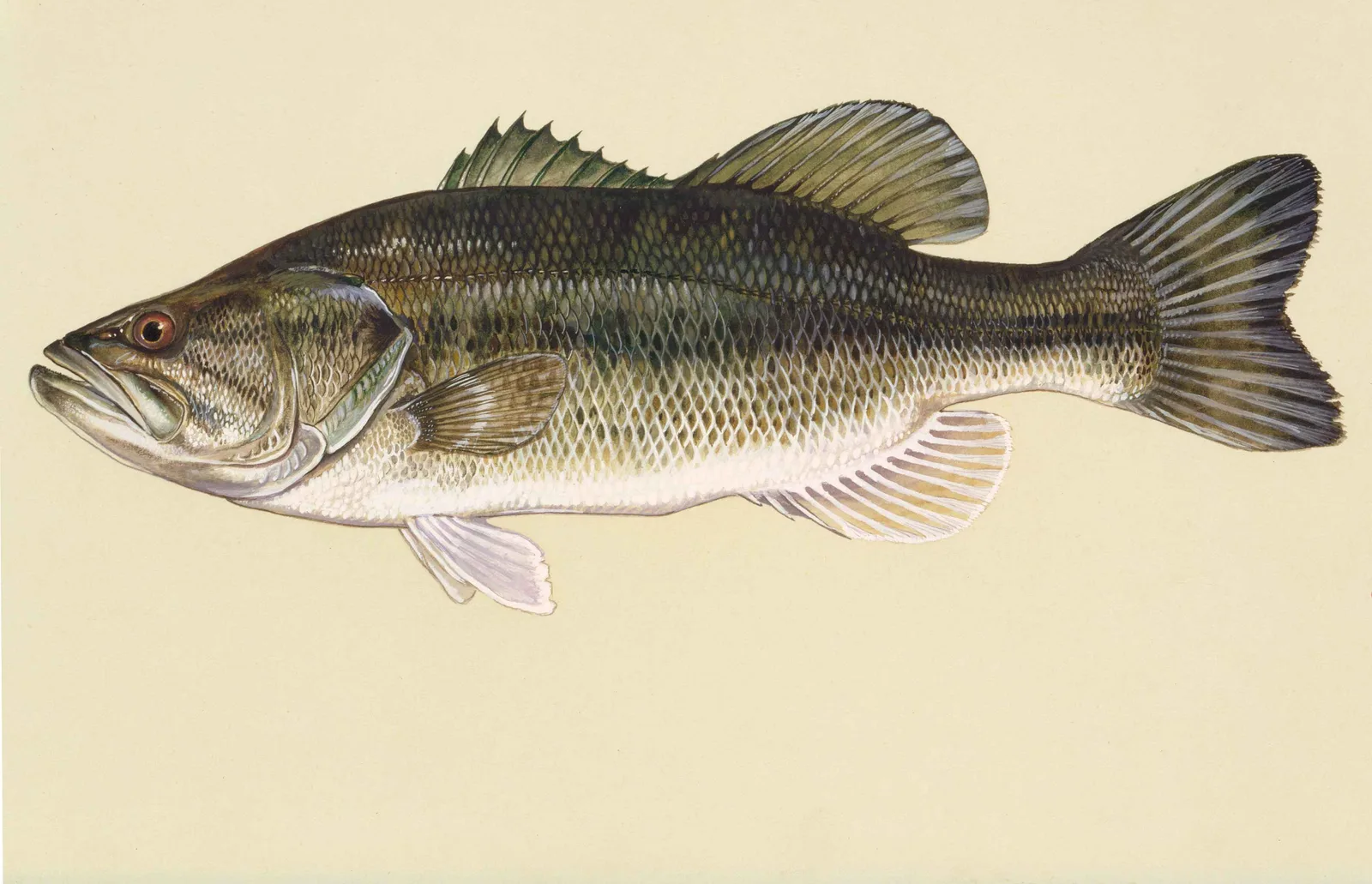
Bass Fishing: Where the Bass Are, What to Throw, and the Three Bass You Will MeetBass fishing from the angler's side: where largemouth, smallmouth and spotted bass are at each water temperature, what to throw first, how to tell them apart.
- Types of Bass: Every Fish Called Bass and How to Tell Them Apart
The types of bass, from largemouth and smallmouth to striped and black sea bass: which family each is, where it lives, its record and how to tell them apart.
 Is Bass Good to Eat? Yes, If You Keep the Small Ones and Check the Water
Yes, bass is good to eat: mild, white and firm. Which bass to keep, what mercury advice says about bass against panfish, and why most go back.
 World Record Smallmouth Bass: The Hayes Fish and the False Affidavit
The world record smallmouth bass weighs 11 lb 15 oz, caught at Dale Hollow in 1955. How it was struck off and restored, the IGFA records, the state records.
 Bass Bait: The Best Live Bait and Lures, Matched to What Bass Eat
The best bass bait is whatever your bass already eat: shiners, crawfish, shad or bluegill, live or as a lure. What works, what size, and where it's legal.
- Black Bass: What the Name Means, and All 19 Species
Black bass are the genus Micropterus: 19 species, from largemouth to Bartram's bass. What the name means in science, law and the record book.
 Best Time to Fish for Bass: Season, Time of Day and Weather
The best time to fish for bass is the pre-spawn at 48–55 °F and the fall feed, at dawn and dusk. Season table, hours, night and weather.
Sources
- Bryant, H. E. and Moen, T. E. (1980), Food of largemouth bass in DeGray Reservoir, Arkansas, 1976, Journal of the Arkansas Academy of Science 34
- Timmons, T. J. and Pawaputanon, O. (1980), Relative size relationship in prey selection by largemouth bass in West Point Lake, Alabama–Georgia, Proc. SEAFWA 34:248–252
- Goldstein, R. M. (1993), Size selection of prey by young largemouth bass, Proc. SEAFWA 47:596–604
- Murphy, G. W., Newcomb, T. J., Orth, D. J. and Reeser, S. J. (2005), Food habits of selected fish species in the Shenandoah River basin, Virginia, Proc. SEAFWA 59:325–335
- Crane, D. P. and Einhouse, D. W. (2016), Changes in growth and diet of smallmouth bass following invasion of Lake Erie by the round goby, Journal of Great Lakes Research 42(2), IAGLR release
- Cochran, P. A. and Adelman, I. R. (1982), Seasonal aspects of daily ration and diet of largemouth bass, Environmental Biology of Fishes 7:265–275
- Rogers, J. B. and Burley, C. C. (1991), A sigmoid model to predict gastric evacuation rates of smallmouth bass fed juvenile salmon, Canadian Journal of Fisheries and Aquatic Sciences 48:933–937
- Bonds, C. C. (2000), Assessment of the response of piscivorous sportfishes to the establishment of gizzard shad in Claytor Lake, Virginia, master's thesis, Virginia Tech
- Hodge, L. D. (2007), Bass buffet, Texas Parks & Wildlife magazine (interview with Craig Bonds on his diet study)
- U.S. Fish & Wildlife Service, largemouth bass
- Texas Parks and Wildlife, largemouth bass species profile
- Wisconsin DNR, smallmouth bass
- Mississippi State University Extension, stocking recommendations for ponds 1 acre or larger
- Hart, D. (2007, reposted 2019), What bass eat, Bassmaster