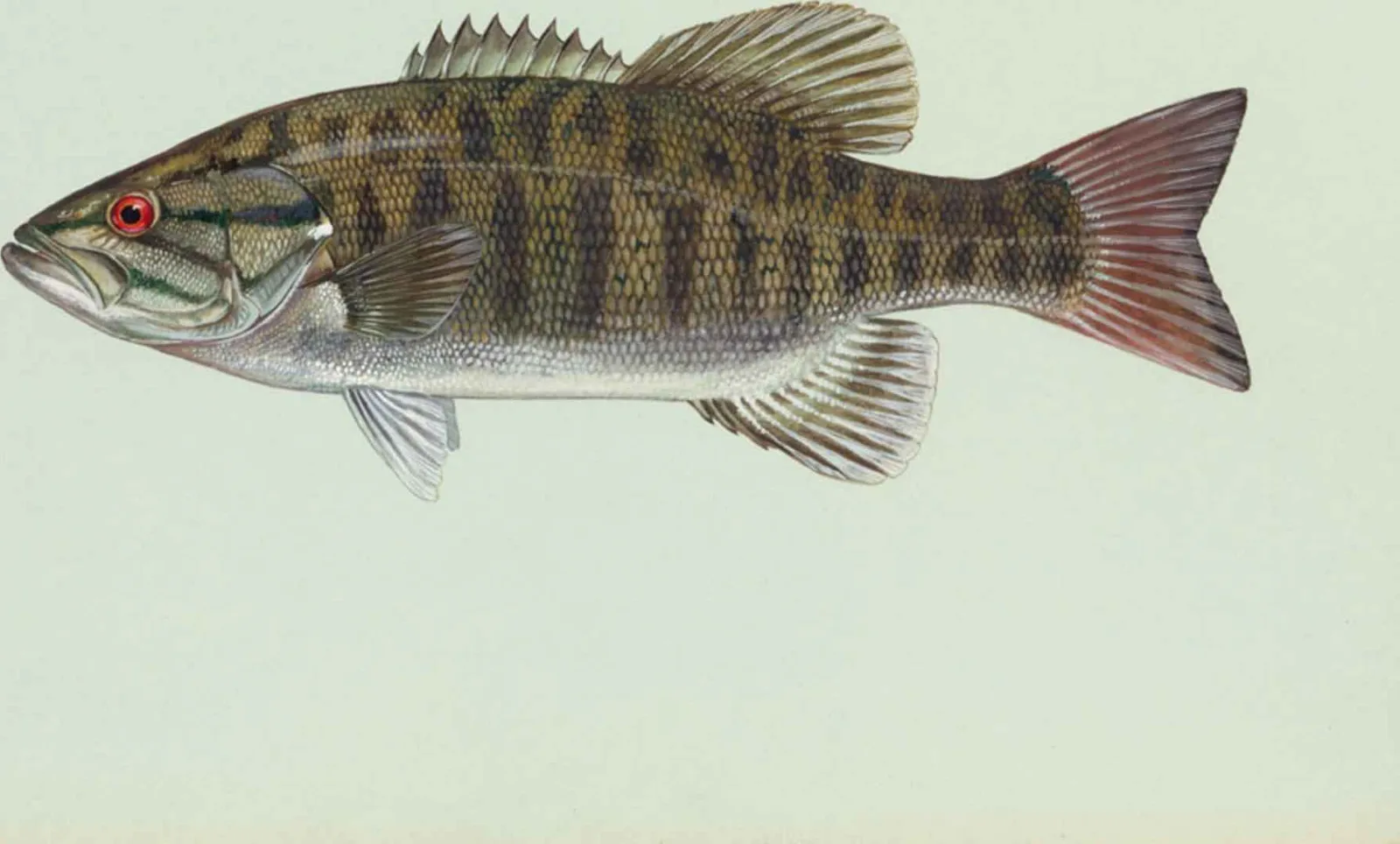
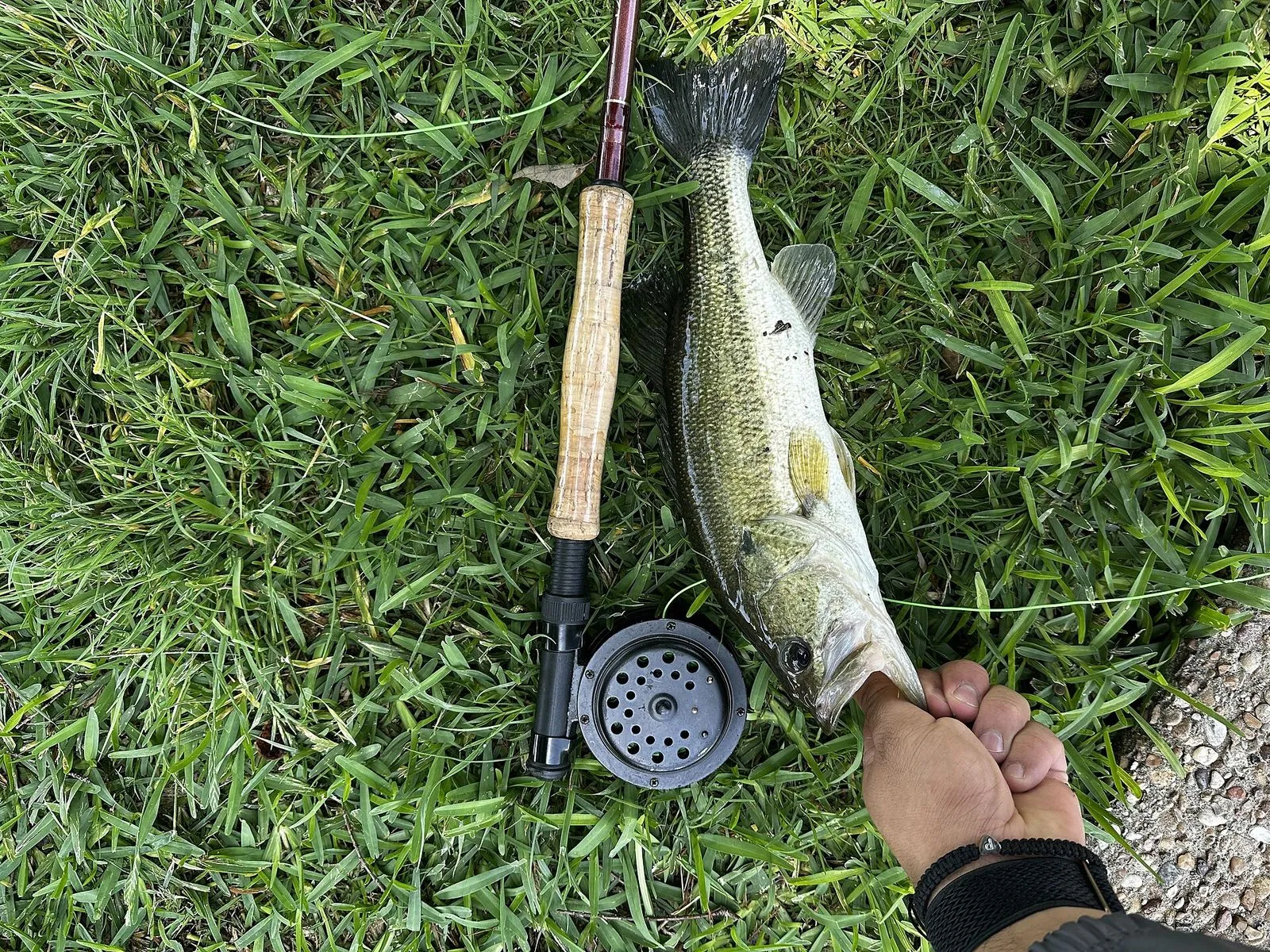
Close the fish’s mouth and look where the upper jaw ends. On a largemouth bass it reaches past the rear edge of the eye; on a smallmouth bass it never does. That single mark settles smallmouth vs largemouth on nearly every fish you will ever hold. The flank backs it up: a largemouth wears a dark horizontal stripe on green, a smallmouth vertical bars on bronze.
A largemouth’s upper jaw reaches past the eye; a smallmouth’s stops under it. Learn that one mark and you will never mix them up again.
How do you tell them apart?
The jaw comes first, the stripe second. The rest of the table confirms what those two have already told you.
| Feature | Largemouth bass | Smallmouth bass |
|---|---|---|
| Upper jaw | Extends well past the rear edge of the eye | Never extends beyond the eye |
| Flank pattern | Dark blotches joined into a horizontal stripe | Dark vertical bands, no horizontal stripe |
| Color | Green back, pale belly | Bronze to brown, hence “bronzeback” and “brown bass” |
| Dorsal fin | Nearly divided in two; 9 spines, 12–13 soft rays | Shallow notch, one continuous fin; 13–15 soft rays |
| Eye | Usually dark | Often red or orange-tinted |
| Scientific name | Micropterus nigricans (until 2022 M. salmoides) | Micropterus dolomieu |
| All-tackle record | 22 lb 4 oz (10.1 kg), Georgia, 1932; tied in Japan, 2009 | 11 lb 15 oz (5.4 kg), Dale Hollow Lake, 1955 |
| Common length | 16 in (41 cm), USFWS | 12–16 in (30–41 cm) in most waters |
Two more checks help when the fish is small or the light is bad. The dorsal fin on a largemouth is so deeply notched that the spiny front half and the soft rear half look like two separate fins. On a smallmouth the notch is shallow and the fin reads as one. And smallmouth often carry three dark bars radiating back from the eye across the cheek, which largemouth lack.
Color alone can fool you. A largemouth from stained water can be nearly black, and a smallmouth from a clear lake can look pale olive. The jaw and the stripe do not change with the water.
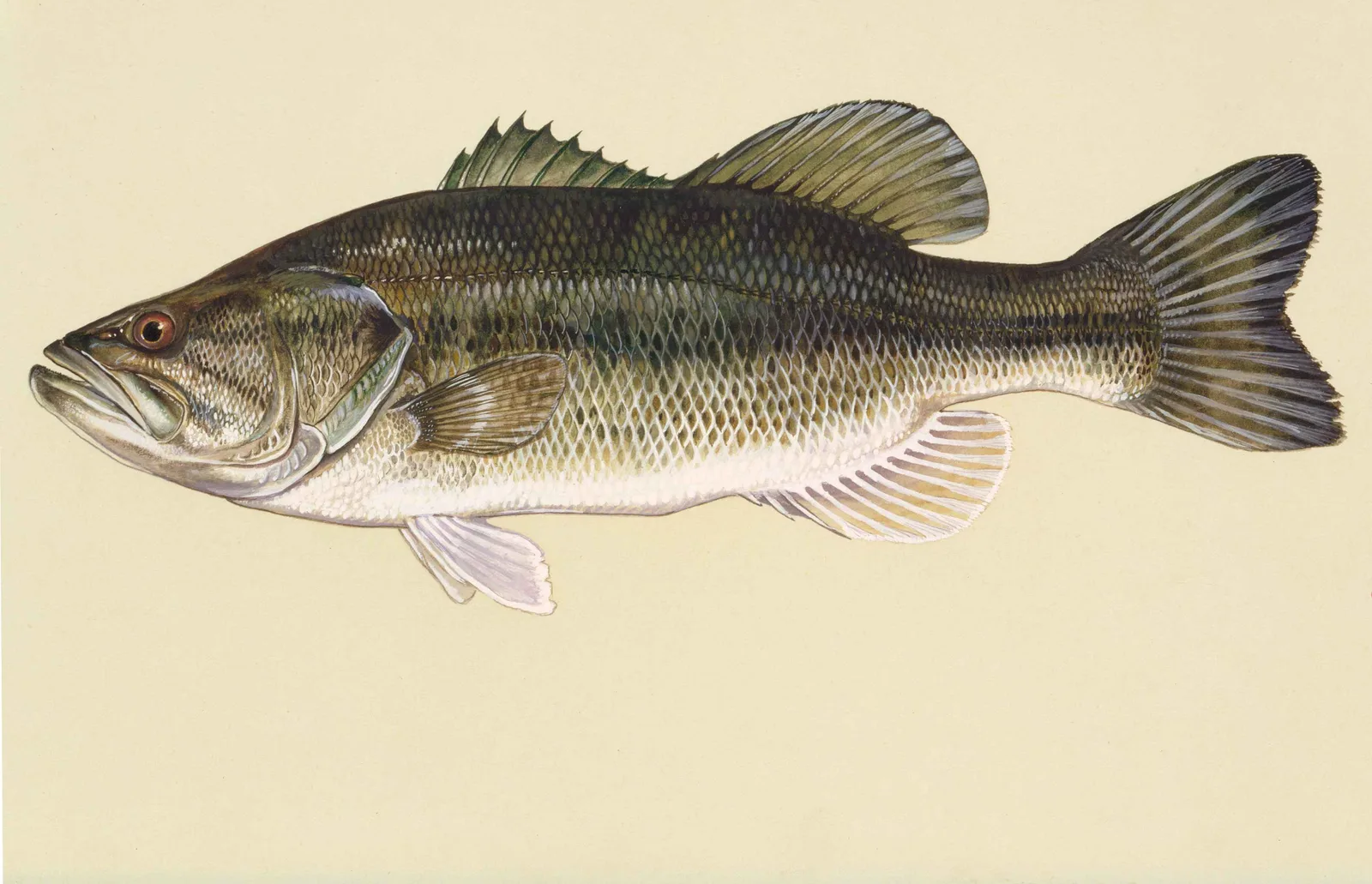
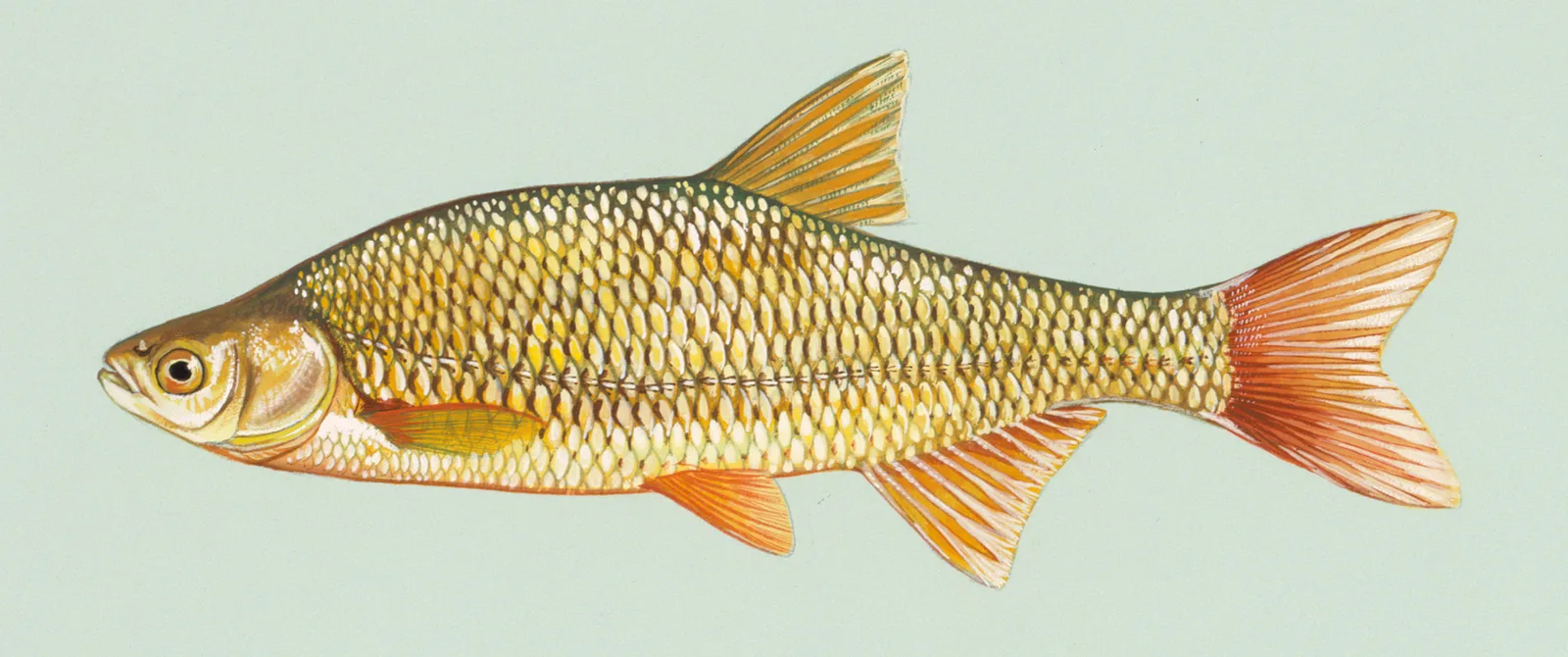
The largemouth, for comparison: the jaw runs past the eye and the flank carries a horizontal stripe. Illustration: Duane Raver, U.S. Fish and Wildlife Service (public domain).
Where does each one live?
The two species split the country’s water between them by temperature, clarity and bottom.
Largemouth are native east of the Rockies, from the Great Lakes down the Mississippi basin to northern Mexico, and have been stocked almost everywhere else. The U.S. Fish and Wildlife Service describes their home as “clear, vegetated lakes, ponds, swamps, and the backwaters of pools, creeks and rivers.” They want cover: weed beds, laydowns, docks, flooded brush. Texas Parks and Wildlife adds that they “prefer clear quiet water, but will survive quite well in a variety of habitats.” That is why a farm pond and a muddy reservoir both hold them.
Smallmouth are native from Minnesota and southern Quebec south to the Tennessee River and west to eastern Oklahoma. They now live in most states except Florida and Louisiana. Their water is cooler and cleaner: lakes larger than 100 acres and deeper than 30 ft (9 m) by the Texas profile, and cool, clear, gravel-bottomed streams. In one line, they want a rocky stream or lake where crayfish are abundant. In Wisconsin’s survey, a good smallmouth stream has a summer water temperature above 72 °F (22 °C), coarse rock and gravel, and pools 3–4 ft (1–1.2 m) deep.
The practical rule at the ramp: weeds and wood, think largemouth; rock, gravel and current, think smallmouth. Many lakes hold both. There the largemouth own the weedy bays while the smallmouth own the rocky points and reefs.
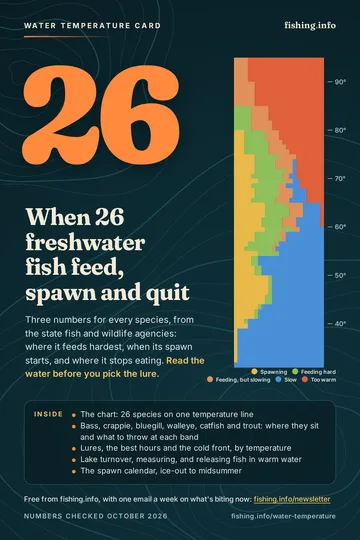
Free card: what 26 species do at your water temperature
Plus one email a week on what's biting now. No sales pitches. Privacy.
How do their seasons differ?
Both species spawn when the water reaches about 60 °F (16 °C), and in both the male builds and guards the nest. The differences are in the nest site and the timing.
| Largemouth | Smallmouth | |
|---|---|---|
| Spawn trigger | About 60 °F; USFWS gives 59–75 °F (15–24 °C) | About 60 °F; Wisconsin DNR gives usually 62–64 °F (17–18 °C), recorded as low as 53 °F |
| Season | February in the South to May in the North | Mostly May and June; mid-May through June in southern Wisconsin |
| Nest site | Sand, mud or gravel in 2–8 ft (0.6–2.4 m) among vegetation | Gravel bed next to a log or boulder in 3–10 ft (1–3 m); downstream of boulders in streams |
| Eggs | 2,000–43,000 | 2,000–15,000; average nest about 2,500 |
| Hatch | 5–10 days | About 10 days in the mid-50s °F, 2–3 days in the mid-70s |
| Male guards | Fry for 7–10 days | Up to a month |
Because smallmouth spawn a little later and in cooler water, a lake with both species gives you two spawns a few weeks apart. The largemouth are on beds in the back of the bays first. The smallmouth follow on the gravel flats and rocky shorelines as the main lake warms.
Through summer the largemouth stay with cover in the shallows or move to deep weed edges. Smallmouth drop onto rock humps, points and river channel edges and feed on crayfish. In fall both chase baitfish. In winter, smallmouth in particular gather in deep, slow water, where they can be caught in numbers on a jig or a blade bait.
Which grows bigger, and which fights harder?
Largemouth are the bigger fish. The all-tackle record is 22 lb 4 oz (10.1 kg), caught by George Perry at Montgomery Lake, Georgia, in 1932. Manabu Kurita tied it at Lake Biwa, Japan, in 2009. A 10-pounder is a fish of a lifetime in most states. Growth in Texas runs 4–6 in (10–15 cm) in the first year, 8–12 in at two years and 16 in (41 cm) at three.
The smallmouth record is 11 lb 15 oz (5.4 kg), caught by David L. Hayes at Dale Hollow Lake on the Tennessee–Kentucky line on July 9, 1955. The fish was struck from the record book in 1996 after an affidavit alleged weight had been added, and reinstated after later documentation. A 5 lb (2.3 kg) smallmouth is a trophy almost anywhere; a 6 lb fish is news.
On the fight, the smallmouth has the reputation: pound for pound, it pulls harder. It jumps more, runs longer and does not give up at the boat. Largemouth make one or two heavy surges and a head-shaking jump, then come in. Part of that is water. Smallmouth live in cooler, better-oxygenated water and current, and they are built for it.
How do you fish for each one?
The tackle overlaps; the presentations lean different ways.
- Largemouth: cover fishing. Texas-rigged plastics and jigs flipped to wood and grass, spinnerbaits and chatterbaits along weed edges, topwater frogs over mats in summer. Medium-heavy casting gear, 15–20 lb fluorocarbon or braid. The how to catch bass page and the best bass lures list go deeper.
- Smallmouth: rock and current, usually smaller baits. Tubes and Ned rigs dragged on gravel, drop shots on deep rock, small crankbaits and jerkbaits along points, topwater walkers on calm mornings. Spinning gear, 6–10 lb fluorocarbon, is the standard. Crayfish colors (green pumpkin, brown, orange) match what they eat.
Both species pages, largemouth bass and smallmouth bass, carry the full season tables. The bass hub sets these two beside the spotted, Alabama and Guadalupe bass, which are more often confused with each other than with either of these.
Which bass looks like both?
A spotted bass looks like a largemouth with a smallmouth’s jaw; the types of bass page sorts the rest of the family. It has the horizontal stripe of a largemouth, but the upper jaw stops at the rear edge of the eye. Its dorsal fin is only shallowly notched, and it carries a rough tooth patch on the tongue that neither largemouth nor smallmouth have. Rows of dark spots below the lateral line give it its name. The spotted bass page shows how to separate it from the Alabama bass, which by eye you cannot.
Gear for bass
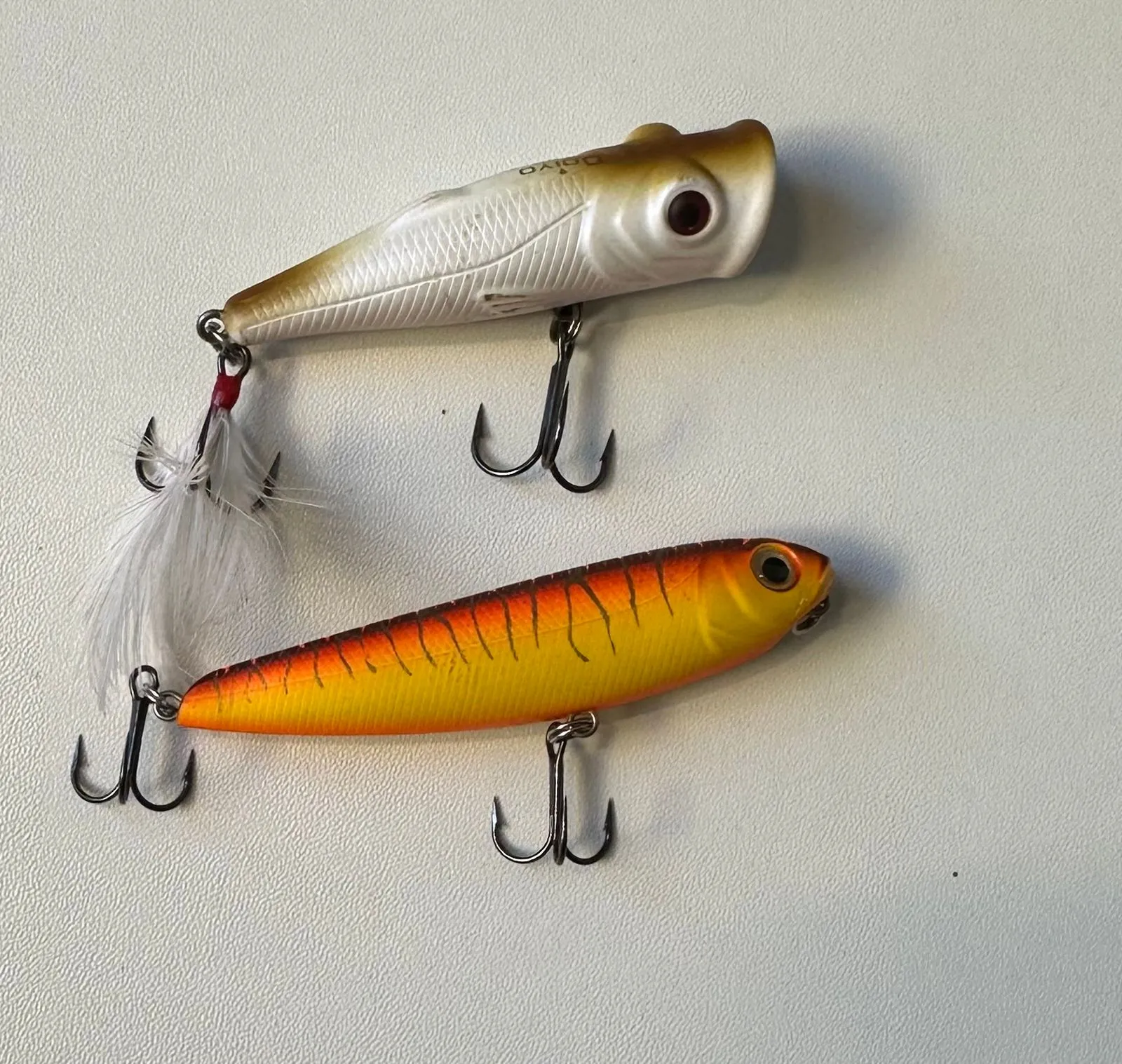
Gear guide
Best Bass Lures: What Won the 2025 and 2026 Elite Series, Season by SeasonBest bass lures from two seasons of Elite Series winning baits: a lure for each water color, depth, cover and season, with smallmouth and spotted bass picks.
Free download
The water temperature card
Read your water temperature and the card tells you who is spawning, who is feeding and what to throw. 26 species, 16 pages, for your phone and the tackle box.
Plus one email a week on what's biting now. No sales pitches. Privacy.
Related
Section guide
Bass Fishing: Where the Bass Are, What to Throw, and the Three Bass You Will MeetBass fishing from the angler's side: where largemouth, smallmouth and spotted bass are at each water temperature, what to throw first, how to tell them apart.
 Bass Bait: The Best Live Bait and Lures, Matched to What Bass Eat
The best bass bait is whatever your bass already eat: shiners, crawfish, shad or bluegill, live or as a lure. What works, what size, and where it's legal.
 Black Bass: What the Name Means, and All 19 Species
Black bass are the genus Micropterus: 19 species, from largemouth to Bartram's bass. What the name means in science, law and the record book.
 Best Time to Fish for Bass: Season, Time of Day and Weather
The best time to fish for bass is the pre-spawn at 48–55 °F and the fall feed, at dawn and dusk. Season table, hours, night and weather.
 When Do Bass Spawn? Water Temperature and Timing by Region
Bass spawn when the water holds about 60 °F: February in Florida, June in Minnesota. The temperature bands, a calendar by region and how to fish each stage.
 How to Fish for Bass: A Beginner's Season-by-Season Guide
How to fish for bass from the first cast: one rod and reel, five lures, where bass are at each water temperature, and a numbered method for a day on the water.
- Best Bass Lures: What Won the 2025 and 2026 Elite Series, Season by Season
Best bass lures from two seasons of Elite Series winning baits: a lure for each water color, depth, cover and season, with smallmouth and spotted bass picks.