 By
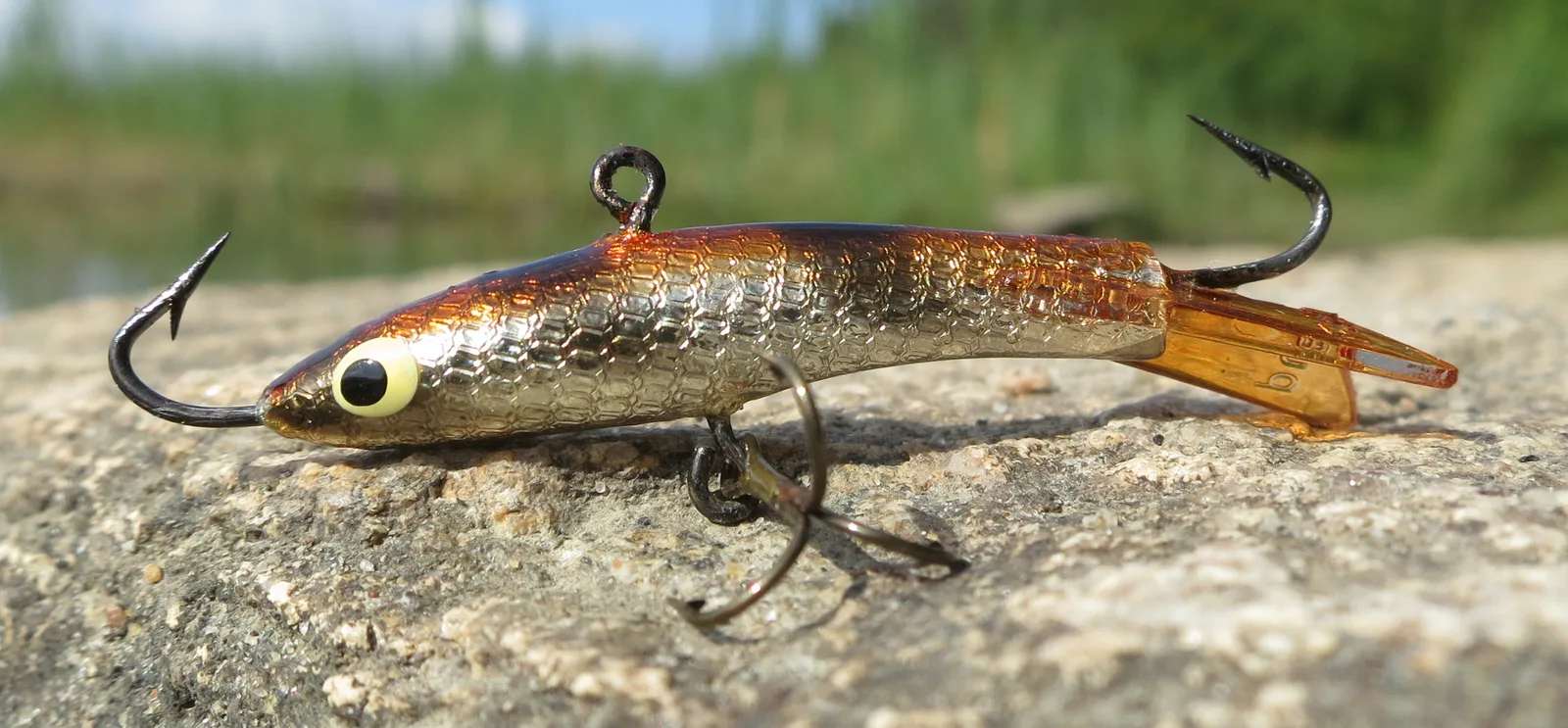
Three kinds of ice fishing lures cover most days on the ice. A tiny jig, which is a hook with a weighted head, catches panfish with a bit of live bait on it. A jigging spoon takes walleye and lake trout, and a swimming lure like Rapala’s Jigging Rap takes walleye and perch. Ice fishing jigs for panfish are smaller than you’d guess: Minnesota DNR lists 1/64, 1/32 and 1/16 oz as the common sizes.
Jig it a few times, then hold it still for a few seconds. Fish generally hit during the pause, New York DEC says.
Which ice fishing lure for which fish?
Start with the size of the fish’s mouth. Bluegill have small mouths and eat mostly insects and tiny crustaceans, so Minnesota DNR says to start with smaller jigs. Crappie also eat minnows, darters and big insects, so Minnesota starts them on medium jigs. Walleye get a spoon or a jig with a minnow on it, worked near the bottom. Pike are a tip-up fish. A tip-up is a spool on a stick that holds a baited line through the hole. When a fish takes the bait, usually a minnow, a flag pops up. Minnesota calls it the best way to catch pike in winter.
Most lures in ice fishing go down with bait on the hook, New York DEC says. That’s called tipping the lure, commonly with minnows or fly larvae called spikes or mousies. Each fish has its favorites among the ice fishing baits, and the last column shows them.
Depth matters as much as the lure. The table puts each agency’s spot for the fish beside the lure it names.
| Fish | Where it sits under the ice | Lure and size | Tip it with |
|---|---|---|---|
| Bluegill | Over or along weed beds in 15 ft (4.6 m) or less (New York) | Small jig or teardrop (New York, Iowa), 1/64–1/16 oz (Minnesota) | Spikes (New York), wax worms or wigglers (Iowa) |
| Crappie | Suspended, from a few feet under the ice to inches off the bottom (New York) | Jig of 1/64–1/16 oz, starting medium, or a small jigging spoon (Minnesota) | A crappie minnow or its head, wax worms (Minnesota) |
| Perch | Near the bottom, from weeds under 10 ft (3 m) to flats at 40 ft (12 m) (New York) | Small, colorful teardrop jig (Wisconsin), 1/64–1/16 oz (Minnesota) | Wax worms or mousies (Wisconsin), spikes (New York) |
| Walleye | Points, flats and shoals, within a foot of the bottom (New York) | Jigging spoon (New York) | A minnow, minnow head or minnow tail (Minnesota) |
| Northern pike | Around or over weed beds in 5–15 ft (1.5–4.6 m) (New York) | A tip-up, the minnow jigged now and then (Minnesota) | A large minnow, 4–7 in (10–18 cm) (New York) |
| Lake trout | 30–40 ft (9–12 m), out to 90–100 ft (27–30 m) (Minnesota) | Large jigging spoon (New York), silver or white (Minnesota) | Heads or chunks of sucker, chub or large minnow (Minnesota) |
The walleye row shifts through the day. Minnesota says many anglers fish shallow, perhaps 10 ft (3 m) or less, at dawn and dusk and move deeper once the sun is up. Crappie are harder to pin down. They tend to hang in open water between the ice and the bottom, often a little deeper than the bluegill.
None of this is fixed. For panfish and walleye, Minnesota’s advice is to carry a variety of lures and experiment, because some work better than others on a given lake. Its other tip costs nothing. The staff at the bait shop know the sizes, colors and styles that are catching fish, and they want you to catch some too.
What kinds of ice lures are there, and which do you need first?
The ice wall at a tackle shop can look like a few hundred lures. They come down to seven kinds, and a jig, a spoon and a swimming lure cover most days. New York’s range runs from small ice flies for panfish to large jigging spoons for lake trout. A spoon is a curved piece of metal that flutters and flashes as it falls. The table gives one example of each kind, in the maker’s own words, with the fish it names and the sizes it sells.
| Kind | Example | What the maker says it does | Fish the maker names | Sizes |
|---|---|---|---|---|
| Tungsten jig | Clam Drop Jig | Hangs at about 45 degrees | Crappie, bluegill, perch, walleye, bass, pike | 1/32, 1/16 oz |
| Flutter spoon | Clam Leech Flutter Spoon | A slow fall, like a wounded leech or baitfish | None named | 1/16–1/4 oz |
| Rattle spoon | Northland Buck-Shot | A brass rattle. Jig it hard, lift and fall | Perch, walleye, trout, bass, pike | 1/16–1 oz |
| Tungsten spoon | VMC Tungsten Torpedo | “Ultra fast sinking” | None named | 1/8–5/16 oz |
| Swimming lure | Rapala Jigging Rap | Swims in circles under the ice | “Suspended game fish” | 1/8–1 oz |
| Lipless rattle bait | Rapala Ultra Light Rippin’ Rap | Cranks, swims and rips (the text is about open water) | None named | 1/16, 3/16 oz |
| Soft plastic | Clam Maki | Looks like a five-legged water spider | None named | One size, trim the head |
Which do you buy first? For bluegill, crappie or perch, a handful of jigs in 1/32 and 1/16 oz and some wax worms or spikes cover it. For crappie, add one small jigging spoon. Minnesota says not to be afraid of louder or flashier jigs, even small spoons, to draw them in.
For walleye, take one jigging spoon, one Jigging Rap, and minnows to tip them with. That’s two lures, not twenty. The lipless baits, the tungsten spoons and the plastics can wait until you know your lake.
Ice rods are short. New York says jigging rods are usually 2 to 3 ft (60–90 cm) long, and the right ice fishing rod length depends on the fish. The rest of the kit, from the auger to the bucket you sit on, is on the ice fishing gear checklist. Past the rod, a few jigs and the bait to tip them are all you need to start.
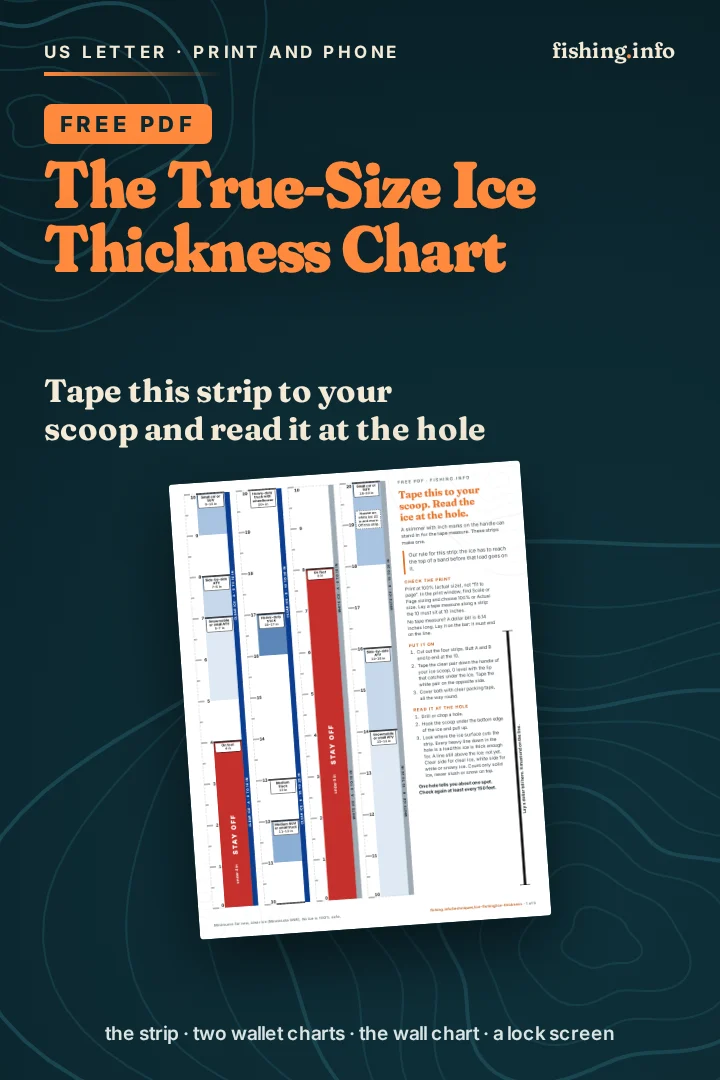
Free PDF · Ice thickness chart How thick is the ice? Read it at the hole.
Print the free chart, tape the strip to your scoop and hook it under the ice. It shows what that ice is thick enough for, clear or white. Two wallet charts and a wall chart come with it.
No card, nothing to buy, and the PDF is yours to keep. Confirm with one click and it's on its way. Then a few short emails and one a week on what's biting. Unsubscribe anytime. Privacy.
Are tungsten ice jigs worth the money?
In deep water, yes. Tungsten is a metal much denser than lead, so tungsten jigs fall faster than lead jigs of the same size, Minnesota DNR says. FishUSA’s staff say it wins in deep water, current and wind, and on pressured fish, the wary ones on busy lakes.
The numbers show why. The Royal Society of Chemistry lists tungsten at 19.3 grams per cubic centimeter and lead at 11.3. That’s about 1.7 times as dense. By our arithmetic for the bare metals, the same weight of tungsten takes about 41% less room than lead, and is about 16% narrower across. You get the weight of a bigger lead jig in a small, panfish-sized body.
| Metal | Density (g/cm³) | Room it takes for the same weight, against lead (our arithmetic) |
|---|---|---|
| Tungsten | 19.3 | About 41% less, 16% narrower across |
| Lead | 11.3 | The baseline |
| Zinc | 7.134 | About 58% more |
These are pure-metal densities. A real jig is a head plus a hook, and Clam’s spoon below is a zinc alloy, so take the figures as close, not exact.
A flasher is the sonar that shows your lure and the fish under the hole. On one, tungsten typically shows up as a thin, bright mark that’s easy to track, FishUSA says.
Where do lead and zinc fit?
Zinc is the other end, about 58% bigger than lead for the same weight. Clam makes its Leech Flutter Spoon from a zinc alloy and sells it on its slow fall. Outdoor Life’s Ross Robertson says it sinks like a stone, so don’t expect a crawl.
Lead still has a place. FishUSA says lead sinks slower and typically glides or drifts more. In 4 to 8 ft (1.2–2.4 m), an ultra-fast tungsten fall can spook fish. The catch with tungsten is the price. FishUSA’s verdict on that is three words: “Tungsten is expensive.” On our jig heads page, one maker’s tungsten head cost about twice its lead one in October 2026, $5.00 against about $2.50 a head.
What size ice fishing jig do you need?
Use the lightest jig that still pulls the kinks out of your line. Minnesota’s rule is heavy enough for that, but not so big the fish can’t inhale it. For bluegill, crappie and perch, the common sizes are 1/64 to 1/16 oz. Need it down faster? Pinch a split shot or two, small round weights, onto the line about a foot (30 cm) above the jig.
Heavy isn’t always better. A heavier jig gets your bait to the fish quicker. But sometimes a very light one that seems to take forever to sink is the one that works.
Then put the bait on. Minnesota lists wax worms, meal worms, Eurolarvae (dyed fly maggots) and half a crappie minnow, the head end. New York adds spikes.
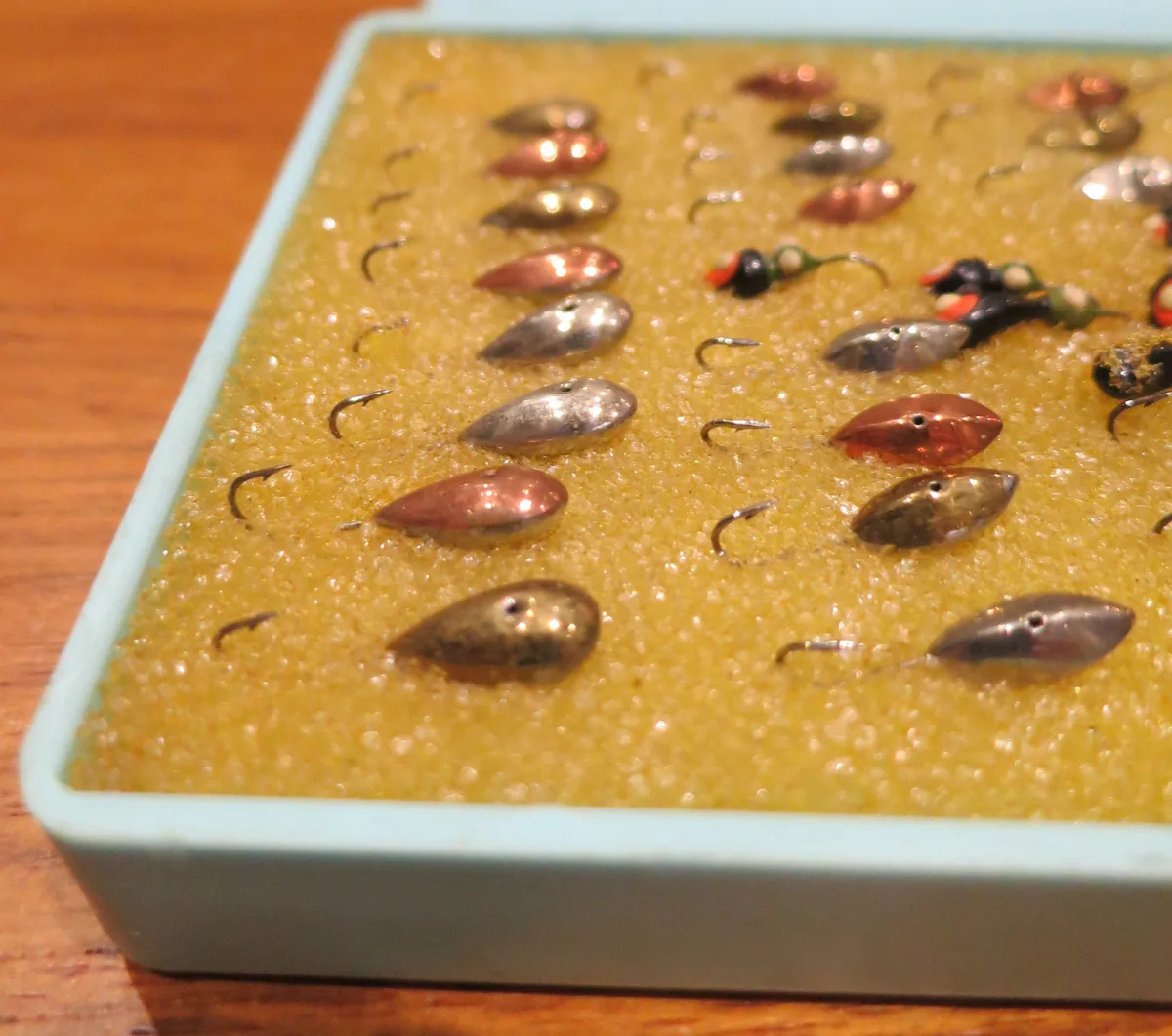
Small teardrop ice jigs, which the photographer files as mormyshkas. Iowa DNR’s bluegill and crappie pick is a wax worm or a wiggler, a mayfly larva, on a small teardrop. Photo: R. Henrik Nilsson, Wikimedia Commons (CC BY 4.0)
How do you jig an ice lure?
Lift it a few inches, let it drop, and stop. That’s New York DEC’s whole recipe. Raise the bait up and down a few inches, jig it a few times, then pause for a few seconds. Fish generally hit during the pause.
Don’t overdo it. You can over-jig and scare fish away instead of drawing them in, Minnesota warns. Big jigging motions call fish from a distance. Small ones work on a fish that’s already near your lure. Watch your flasher if you have one. When a fish rises toward the lure, go small.
Start near the bottom. For perch, drop the lure until the line goes slack, which means it hit bottom, then lift it a few feet. Walleye anglers sometimes drop the lure onto the bottom on purpose. It kicks up a small cloud of silt that may catch a walleye’s eye. When a walleye hits, most anglers set the hook right away. Crappie are the gentle ones: their soft mouths can tear if you set the hook too hard.
Should one rod sit still?
Fish two lines where your state allows it. Panfish anglers commonly jig one rod and leave the other alone with a still bait, Minnesota says. Sometimes the jigged rod catches most of the fish, and sometimes the still one does. If the still one wins, you’re jigging too hard. On crappie the jigging rod becomes a calling rod: it pulls fish to the hole, and they bite the minnow on the second line. That still second rod is a deadstick.
In a roomy fish house, jig one rod and run a rattle reel as the second line. A rattle reel is a reel fixed to the wall of the shack.
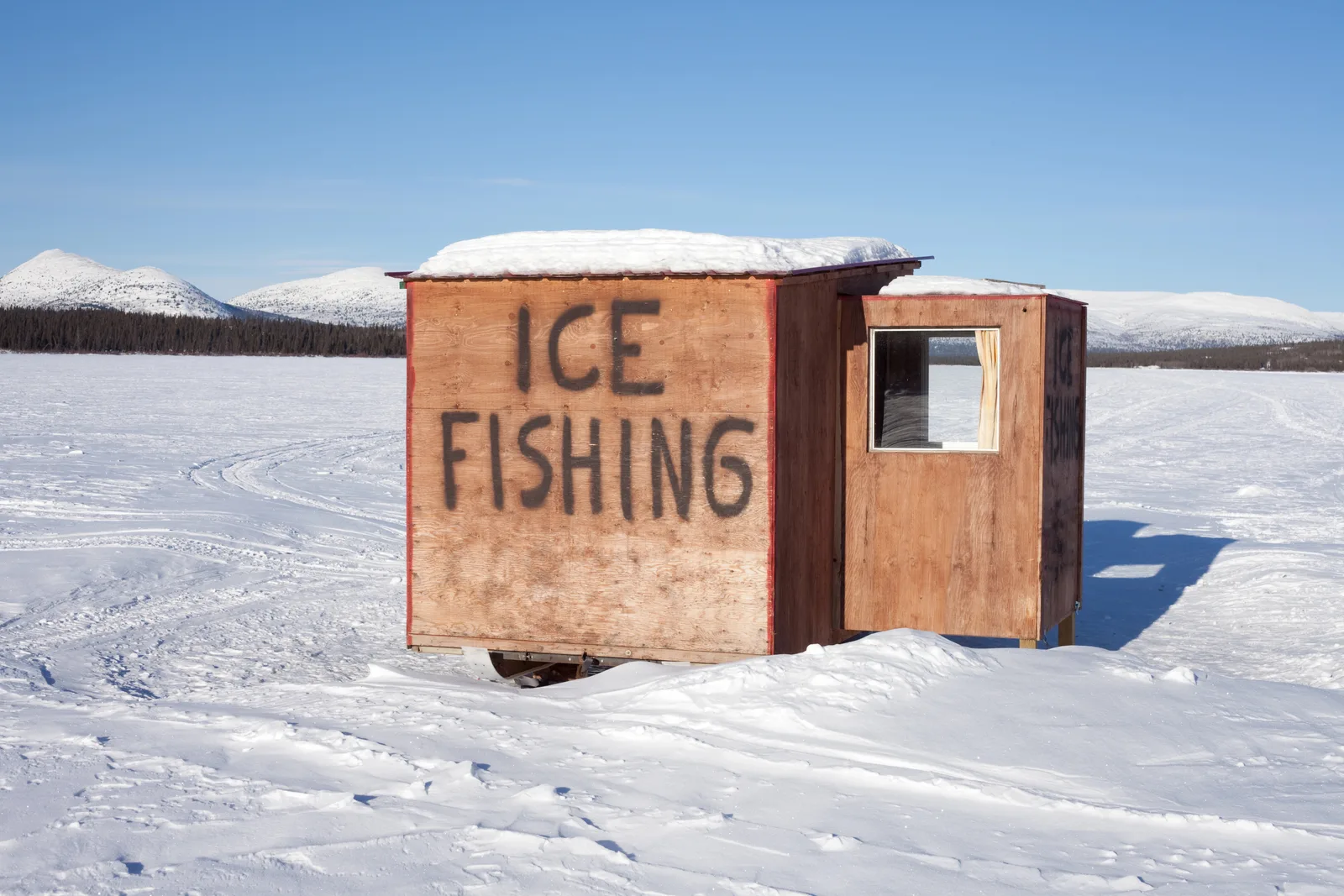
A wooden fish house on a frozen lake. Inside one, Minnesota’s tip is a jigging rod in your hand and a rattle reel on the wall. Photo: Depositphotos.
Wherever you set up, check the ice thickness before you walk out, and keep checking as you go.
How do you fish a jigging spoon through the ice?
Ice fishing spoons are heavy metal lures you lift and drop straight below you. Two styles matter here. Flutter spoons wobble down slowly, and rattle spoons make noise. Walleye sometimes want a thin, flashy fluttering spoon, Minnesota says. Other times they want a jig that hardly moves, in the shape and color of a minnow. That’s why you carry both.
Fish a rattle spoon hard. Northland’s instructions for its Buck-Shot are to jig aggressively in a lift-fall, and to tip it with minnow heads or wax worms. It names perch, walleye, trout, bass and pike for it.
A flutter spoon is built to fall slowly. Clam says its Leech Flutter Spoon looks like a wounded leech or baitfish on the way down. Robertson calls the original one of the best walleye ice lures, and says its action seems to drive perch and walleye nuts.
Getting down fast is the tungsten spoon’s job. VMC builds its Tungsten Torpedo to sink fast and reach fish before they pass by. Clam calls its Dancin’ Drop the first fluttering tungsten spoon.
Rule of thumb: Jig a rattle spoon hard, in a lift and fall. Let a flutter spoon drop slowly.
Then tip it. For walleye, New York says to put a minnow on the spoon. For lake trout, Minnesota says to tip the hooks with heads or chunks of sucker, chub or large minnow. Jig them on a medium-heavy or heavy rod. Pick silver or white for lake trout, to match the ciscoes and smelt they eat.
What is a Jigging Rap, and what size do you need?
The Jigging Rap is Rapala’s weighted minnow for jigging. It has a single hook at each end, a treble (a hook with three points) under the belly and a tail fin. Lift and drop it, and the fin makes it swim in circles under the ice. Rapala aims it at suspended game fish, and says you can also bounce it yo-yo style off the bottom. Its weight is there to get your bait down quick.
Robertson is blunt about it: “This timeless lure should be grandfathered into any ice fishing lures list.” It comes in six sizes, which Rapala names W2 to W11. Robertson uses the small 2 and 3 for perch and the 5, 7 and 9 for walleye and other big fish. On the small ones he recommends a larger treble than the factory hook. It’s on our best walleye lures and best crappie lures lists too.
| Size | Length | Weight | Price (Rapala) | Robertson uses it for |
|---|---|---|---|---|
| W2 | 1-1/4 in (3.2 cm) | 1/8 oz (3.5 g) | $8.49 | Perch |
| W3 | 1-1/2 in (3.8 cm) | 3/16 oz (5.3 g) | $8.49 | Perch |
| W5 | 2 in (5.1 cm) | 5/16 oz (8.9 g) | $9.99 | Walleye |
| W7 | 2-3/4 in (7.0 cm) | 5/8 oz (17.7 g) | $10.99 | Walleye |
| W9 | 3-1/2 in (8.9 cm) | 7/8 oz (24.8 g) | $11.99 | Walleye |
| W11 | 4-3/8 in (11.1 cm) | 1 oz (28.3 g) | $12.49 | Not named |
Prices are Rapala’s own, read on November 15, 2026.
Rapala makes a few relatives. The Jigging Shadow Rap is lighter than the original and darts more slowly, and Rapala aims it at perch, walleye and trout. The Slab Rap shoots off in wide, erratic directions when you snap the rod and swings back to center on the pause. Robertson finds its swimming motion much less aggressive than the Jigging Rap’s. A Jigging Rap Magnum of 1-1/8 oz is built for picking off single fish with forward-facing sonar. That’s a sonar that shows fish live in the water out to the side, not only below the hole. The Jigging Shad Rap is gone from Rapala’s US catalog.
Do lipless rattle baits work through the ice?
Yes. A lipless crankbait is a flat-sided lure with a rattle and no diving lip. Rapala’s Rippin’ Rap is one. Its Ultra Light version comes in 1/16 and 3/16 oz sizes. Rapala’s own text for it is about open water: pulling through grass, bouncing off timber, ripping through rocks. The word “ice” isn’t in it. Its store still files the Ultra Light under Vertical Jigging Lures and its Pro Ice Fishing and Best Selling Ice Fishing Gear picks.
In-Fisherman says late-ice crappie start to feed heavily, often smashing larger lures like rattle baits and minnow-style glide baits. Minnesota’s list for lake trout includes blade baits, thin metal lures that buzz when you lift them, and plastic hardbaits, the hard plastic lures, too. So a rattle bait is a late-season or big-fish lure, not one for your first trip.
Good to know: Rapala’s text for the Rippin’ Rap is about open water. Its store still lists the Ultra Light with the ice gear.
Which soft plastics go on an ice jig?
A small plastic can stand in for live bait on a tungsten jig. Clam’s Maki is shaped like a five-legged water spider and infused with scent. Fish it whole for a full profile, Clam says, or customize it by trimming the head. VMC builds its Larv-Eye jig to hold live or imitation bait at a 90-degree angle. For lake trout the plastics get bigger. Minnesota lists jigs with tubes, hollow plastics with a tentacle skirt, and soft plastic swimbaits shaped like a small fish.
What color ice lure works best?
Start bright. Iowa DNR says ice jigs come brightly colored, in purple, chartreuse, pink and orange, to catch a fish’s eye. For crappie after dark it suggests jigs that glow. Past that there’s no rule, so carry a few colors and see what works on your lake. Two details are firmer. For lake trout, anglers often choose silver or white to match the ciscoes and smelt. For walleye, a nearly still jig in the shape and color of a minnow sometimes works best. Rapala sells the Jigging Rap in glow colors, and VMC says its Ultra Glow lasts up to 15 minutes. When in doubt, ask the bait shop what’s working this week.
What are the best ice fishing lures to buy first?
Here’s what to buy first, at the makers’ own prices on November 15, 2026.
| Trip | Lure and size | Price |
|---|---|---|
| Panfish | A few Clam Drop Jigs, 1/32 and 1/16 oz | $6.99–7.99 |
| Panfish | Clam Maki plastic, for the same jigs | $4.99 a pack |
| Walleye | Rapala Jigging Rap, W5 or W7 | $9.99–10.99 |
| Walleye | Northland Buck-Shot Rattle Spoon, 1/16–1 oz | $8.99 |
| Deep water | VMC Tungsten Torpedo Spoon, 1/8–5/16 oz | $9.99–12.99 |
| Tight budget | Acme Bladed Ice Kastmaster, 1/24–1/8 oz | $6.99–7.99 |
Tip the panfish jigs with a wax worm or spike, and the walleye lures with a minnow head. On a tight budget, Acme’s Bladed Ice Kastmaster costs $6.99–7.99. Robertson’s praise is for the plain Kastmaster, which he likes in 1/12 to 3/8 oz, and in the classic paint jobs over the newer ones.
How we chose
We started from the state agencies’ ice guides for bluegill, crappie, perch, walleye, pike and lake trout, from Minnesota, New York, Wisconsin and Iowa. Then we read each maker’s page for sizes, wording and prices on November 15, 2026. Every opinion on the page is credited where it stands. The tungsten and zinc size figures are our arithmetic from the Royal Society of Chemistry’s densities. Nothing on this page was fished by us.

Free PDF · 5 pages
Stop guessing the ice. Tape this strip to your scoop and read it at the hole
Ice that is 6 or 7 inches thick in one spot can be 2 inches close by. You can't tell by looking.
The True-Size Ice Thickness Chart. Print it, tape the strip to your ice scoop, hook it under the ice and read the band at the surface: on foot, sled or truck. One side for clear ice, one for white.
- A true-size strip for your scoop handle, marked from "stay off" to a truck with a wheelhouse
- Two wallet charts, one for your buddy, with five moves that get you out if you go through
- Why 8 inches of white ice counts as 4, and the ice to stay off at any thickness
Every clear-ice number is the Minnesota DNR's, set beside the 29 sources on the page, the Army Corps of Engineers among them.
No card, nothing to buy. Confirm with one click and the PDF is on its way, one version for your phone and one to print, yours to keep. Then a few short emails and one a week on what's biting, with an unsubscribe link in every one. Privacy.
Related
Section guide
Fishing Lures: The Six Types, What Each Catches and When to Throw ItFishing lures explained: the six families and what each imitates, which lure for which fish, water temperature and clarity, color, cost and a first box.
 Alabama Rig: How to Rig and Fish It, and Where It Is Legal
The Alabama rig casts five swimbaits at once. How to rig it, the tackle, how and when to fish it, why the pro tours banned it, and hook limits by state.
 Best Fishing Lures: The Ten to Buy First, by What Each One Does
The best fishing lures for a first box: ten that cover every season and depth, what the pros threw in 2025, a season table, a species table and colors.
 Fishing Advent Calendars 2026: What Is Behind the Doors, Priced Per Door
Fishing advent calendars for 2026, door by door: 12 or 24 doors, 80 cents to $5 a door for US calendars, what is inside, and when to order.
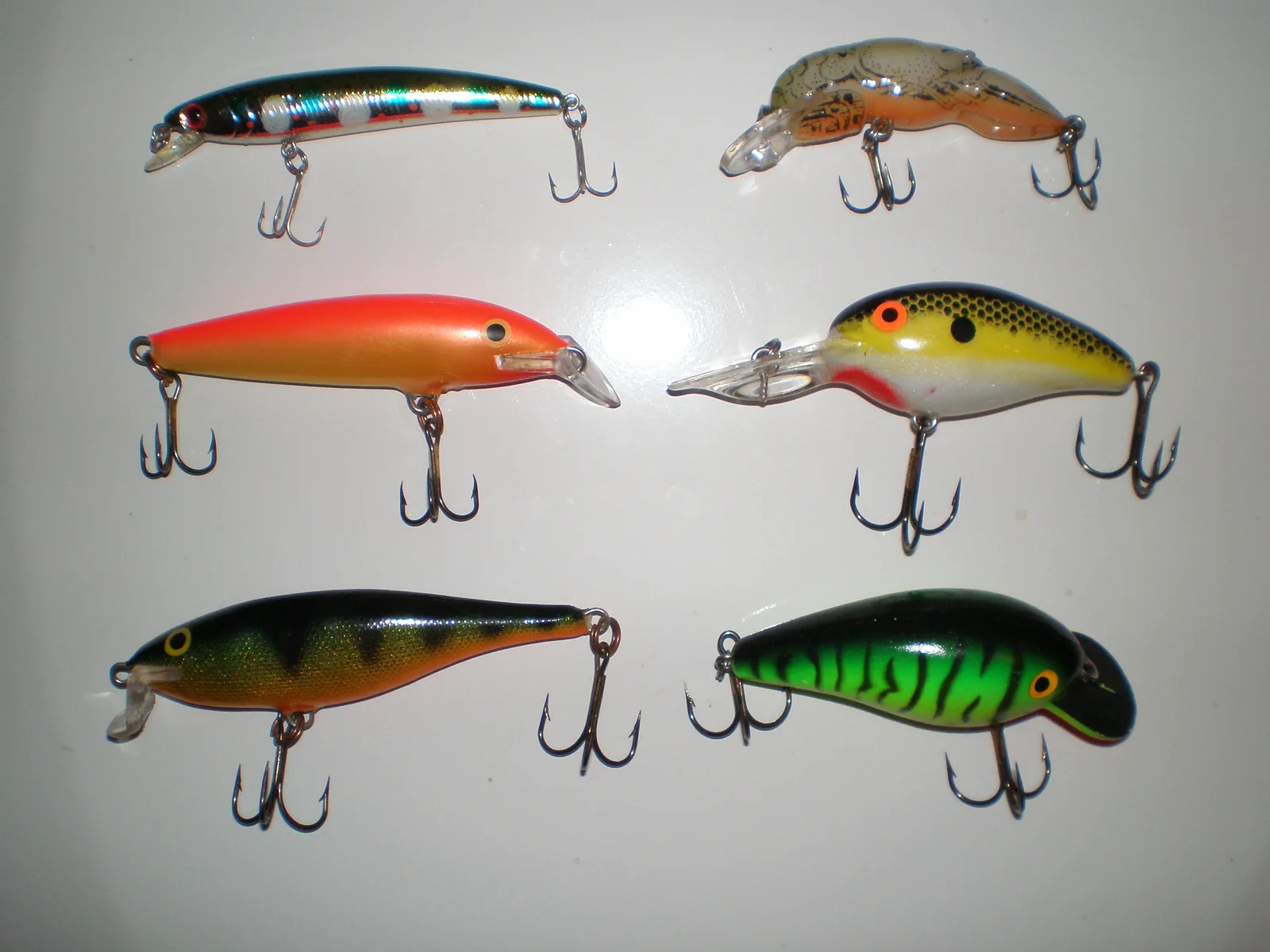 Types of Fishing Lures: The Six Families, What Each Does and When
Types of fishing lures by family: crankbaits, topwater, spinnerbaits, jigs, soft plastics, spoons, swimbaits and flies, with depth, retrieve and season.
Sources (29)
- Minnesota DNR, Ice fishing for crappie
- Minnesota DNR, Ice fishing for perch
- Minnesota DNR, Ice fishing for bluegill
- Minnesota DNR, Ice fishing for walleye
- Minnesota DNR, Ice fishing for northern pike
Show all 29 sourcesShow fewer sources
- Minnesota DNR, Ice fishing for lake trout
- New York State DEC, Guide to Ice Fishing (I FISH NY)
- New York State DEC, How to Ice Fish
- Wisconsin DNR, Yellow Perch (PUBL-FM-710 08)
- Iowa DNR, Ice Fishing
- Rapala, Jigging Rap: sizes, weights and prices
- Rapala, Jigging Rap Magnum
- Rapala, Jigging Shadow Rap
- Rapala, Slab Rap
- Rapala, Ultra Light Rippin' Rap
- VMC, Tungsten Larv-Eye Jig
- VMC, Tungsten Torpedo Spoon
- Clam Outdoors, Drop Jig
- Clam Outdoors, Leech Flutter Spoon
- Clam Outdoors, Dancin' Drop Spoon
- Clam Outdoors, Maki
- Northland Tackle, Buck-Shot Rattle Spoon
- Acme Tackle, Bladed Ice Kastmaster Moonshine Glow
- Royal Society of Chemistry, Periodic Table: Tungsten (density)
- Royal Society of Chemistry, Periodic Table: Lead (density)
- Royal Society of Chemistry, Periodic Table: Zinc (density)
- FishUSA Staff, Tungsten vs. Lead for Ice Fishing: When Each Jig Wins (last updated October 2026)
- Outdoor Life (Ross Robertson), The Best Walleye Ice Fishing Lures (updated Dec 20, 2023)
- In-Fisherman, Late-Ice Crappie Tips