 By
For most anglers the right ice auger is an 8 in (20 cm) battery model. Eskimo, Jiffy and StrikeMaster each sell their electric auger in that size. Fishing only for panfish a few times a winter? A 6 or 7 in hand auger for about $78 does the job. Specs and prices below are from the makers’ own pages on November 15, 2026, and no auger was tested by this site.
One charge of Eskimo’s 8 in E40 cuts up to 1,300 in of ice, the maker says. In 24 in of ice, that’s about 54 holes.
Which ice auger should you buy?
Buy for how many holes you’ll drill and how thick your ice gets. Here’s the pick for each kind of trip.
- You drill a lot, all season: Eskimo 8 in E40 Steel, $499.99. In stock, 17.5 lb, and the best-documented electric we read.
- You hop holes all day on thick ice: Jiffy 8 in Model 60, $699.99. It claims the most ice per charge.
- You carry everything on foot: Eskimo 8 in E40 Composite, $579.99. At 13.5 lb it’s the lightest electric we read, and it was in stock.
- You already own a strong cordless drill: Eskimo 8 in Redneck Bit, $169.99. Check your drill against Eskimo’s minimum first.
- You want the twist off your wrists: Clam Drill Plate Pro, $119.99 plus a bit. The plate takes the twist, not you.
- A few trips a year, panfish: StrikeMaster Mora 7 in hand auger, $77.99. You don’t need a battery auger yet, and Minnesota DNR calls modern hand augers “affordable and highly portable.”
What size ice auger do you need?
Match the hole to the biggest fish you’re after. Minnesota DNR’s line is simple: unless you’re fishing for northern pike or lake trout, “a 6-inch auger is more than sufficient.” A smaller hole is less work, too. “The larger the hole diameter the more work it is to drill,” the DNR says.
| Hole | Good for | Who says |
|---|---|---|
| 4.5 in (11 cm) | The smallest of the three common hand-auger sizes | Minnesota DNR |
| 6 in (15 cm) | Crappie, perch and smaller walleye. Enough for anything but pike and lake trout | Cast & Spear, Minnesota DNR |
| 8 in (20 cm) | The all-around size: bigger walleye, bass, average lake trout, most electronics | Cast & Spear |
| 10 in (25 cm) | Trophy northern pike, very big lake trout, spearing | Jiffy, Cast & Spear |
The size gap is bigger than it looks. By our math, an 8 in hole is 1.78 times the ice of a 6 in hole. A 10 in hole is 1.56 times an 8 in hole. That’s ice your battery or your arms have to move.
The makers’ own figures show it. StrikeMaster rates its 24V auger at 100 six-inch holes per charge, or 50 eight-inch holes. Eskimo’s E40 goes from up to 1,300 in of ice per charge with the 8 in bit to 800 in with the 10 in bit. It drills half as fast, too.
So why go bigger? “For larger gamefish you may prefer a 10” hole,” Jiffy says. Electronics are the other reason. Cast & Spear warns that a 6 in hole may be tight for bulky transducers, the part of a flasher that hangs in the hole. It calls 8 in “the most popular all-around size.” If one auger has to do everything, that’s the size.
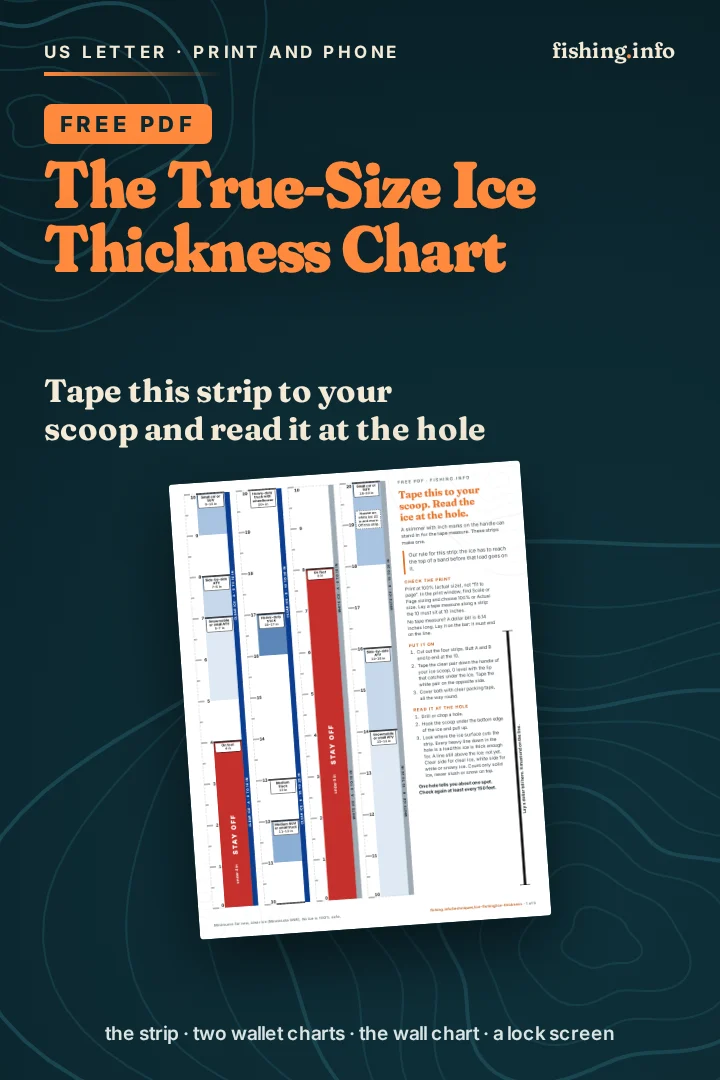
Free PDF · Ice thickness chart How thick is the ice? Read it at the hole.
Print the free chart, tape the strip to your scoop and hook it under the ice. It shows what that ice is thick enough for, clear or white. Two wallet charts and a wall chart come with it.
No card, nothing to buy, and the PDF is yours to keep. Confirm with one click and it's on its way. Then a few short emails and one a week on what's biting. Unsubscribe anytime. Privacy.
Hand, drill, electric or gas: which type?
There are four kinds, and they differ most in weight and price. On the makers’ stores, an ice auger costs from $77.99 for a hand auger to $749.99 for a 10 in battery model. All of them are a corkscrew with a blade at the bottom. Michigan DNR adds that on extremely thick ice, power augers on batteries or small gas engines “make creating holes much easier.”
| Type | Weight (maker) | Price on maker stores, Nov 15, 2026 | Best for |
|---|---|---|---|
| Hand | 6 to 8.5 lb (2.7 to 3.9 kg) | $77.99 to $140.99 | A few holes, early ice, a tight budget |
| Drill bit on your drill | 3.9 to 8.2 lb bit, about 12.5 to 14 lb with drill | $169.99 to $279.99 a bit | Anyone who owns a strong brushless drill |
| Electric | 13.5 to 19.9 lb (6.1 to 9 kg) | $379.99 to $749.99 | Many holes, thick ice, hole hopping |
| Gas | 32 lb (15 kg), Eskimo Mako, 2024 page | Gone from the three makers’ stores | Very thick ice, heavy use |
Hand augers are the cheap, quiet start. StrikeMaster’s Mora weighs 6 to 8 lb and breaks into two pieces for the truck. The catch is your shoulders on thick ice.
Electric augers are where the makers have gone. Each runs on its maker’s own lithium battery, and a spare costs about $230 to $250 on the three stores. The three electrics we picked all have a reverse switch to clear slush. The Maven puts a deadman safety switch on its power button.
Are gas and propane augers still sold?
Not on the makers’ own stores. On November 15, 2026, StrikeMaster’s US store, which runs on Rapala’s site, listed three electric augers, two hand augers and three drill units. It had no gas model. Eskimo’s gas Mako page returned an error, and Jiffy’s store sold only its electric Model 60.
At retailers, stock looks thin. Cast & Spear found no in-stock Amazon listing for Eskimo’s Quantum 8 in gas auger or Jiffy’s 46X-Treme propane auger in September 2026. Check the date on any listing you find.
They’re heavy. A 2024 copy of Eskimo’s Mako page listed 32 lb for its 43cc 8 in auger, against 17.5 lb for the E40 Steel. They’re loud, too. Minnesota DNR warns that “the roar of a gas powered ice auger can scare away the fish temporarily.”
Cast & Spear still gives gas one job: it “excels in extreme cold/high volume drilling where battery charging is impossible.” Run one outdoors only, it adds: “Never run a gas or propane engine inside a closed shelter.”
How many holes will one charge drill?
Fewer than the box seems to say, once your ice gets thick. Makers don’t count the same way. Eskimo and Jiffy give inches of ice per charge. StrikeMaster gives holes, tested in 16 in of ice. We turned each claim into holes in 12 in and 24 in of ice.
| Auger | Maker’s claim per charge | Inches of ice | Holes in 12 in (30 cm) | Holes in 24 in (61 cm) |
|---|---|---|---|---|
| Eskimo E40, 8 in | Up to 1,300 in of ice | 1,300 | about 108 | about 54 |
| Eskimo E40, 10 in | Up to 800 in of ice | 800 | about 66 | about 33 |
| Jiffy Model 60, 8 in | Up to 2,800 in of ice | 2,800 | about 233 | about 116 |
| StrikeMaster 24V, 6 in | 100 holes in 16 in of ice | 1,600 | about 133 | about 66 |
| StrikeMaster 24V, 8 in | 50 holes in 16 in of ice | 800 | about 66 | about 33 |
The math is ours: inches per charge divided by ice thickness, rounded down. Every figure is the maker’s own, and most say “up to.” A slush-clearing pass or a dull blade costs you holes, and no maker says how many. StrikeMaster’s Maven page gives no per-charge figure, so the Maven isn’t in the table. The 24V was out of stock on StrikeMaster’s store on November 15, 2026.
Two things follow. Early ice is cheap on a battery and late-season ice is not. The same charge gives half the holes in 2 ft of ice that it gives in 1 ft of ice. And if you hole-hop on thick ice, a spare battery or Jiffy’s bigger claim matters more than a pound of weight. For a day of 20 holes on a panfish lake, every auger in the table covers it, on the makers’ figures.
These are makers’ numbers, not tests. Jiffy’s claim is more than double Eskimo’s on a battery of the same 4 amp-hours. Jiffy’s runs at 60V and Eskimo’s at 40V, so by our math it holds about half again as much energy. We found no independent test that puts them side by side.
Can you use a drill as an ice auger?
Yes, and it’s the cheapest way into power drilling. You buy only the bit, about $170 to $280 on the makers’ stores, and chuck it into a cordless drill. Not every drill is strong enough, so check yours against what the bit’s maker asks for.
| Bit or plate | Torque the maker asks for | The rest of the maker’s list |
|---|---|---|
| Eskimo Redneck and Pistol bits | At least 725 in-lb | Side stabilizer arm, 1/2 in chuck, 18V 4Ah or more, brushless |
| Nils 8 in convertible | “700 inches of torque or better” (Nils’s wording) | Two-speed, high torque, 18V minimum, brushless recommended |
| StrikeMaster Lite-Flite | Not stated | Professional-quality 18V or more, brushless, 1/2 in chuck |
| Clam Drill Plate Pro | Not stated | Most current 18V and 20V drills with a 1/2 in chuck |
Look for the torque figure on your drill’s spec sheet or box before you buy a bit. The side arm is there for the twist, which ends up in your wrists.
Clam’s answer to that twist is the Drill Plate Pro, $119.99, sold as easier on “your wrists and forearms.” You bolt your drill onto it, and its bearing “absorbs torque from the auger so your drill only needs to spin—not support the load.” It takes any bit with an 18 mm bore and weighs 5 lb.
Buy a bit with a safety plate if you can. Eskimo’s Redneck and Pistol bits have one. If your drill “accidentally comes unchucked from the bit during operation, you won’t lose the bit down the hole,” Eskimo says. Nils adds that its cutting head needs no downward pressure, and that pressing down isn’t recommended.
Is a drill rig heavier than an electric auger?
About the same. Clam puts its plate with a bit and its test drill at about 14 lb, everything included. Nils says its 8 in auger on a Milwaukee 18V Fuel drill comes to about 12.5 lb in total. The lightest electric here, Eskimo’s 8 in E40 Composite, weighs 13.5 lb on its own. So a drill rig weighs about the same, and costs far less if the drill is already in your garage.
Sharpen the blades, or replace them?
Replace them. StrikeMaster sells a $9.49 sharpener, and says plainly it isn’t the fix. “This tool provides a temporary edge to get you through the day and it is not a permanent solution,” the maker says. “Blades must be replaced.” Using it too long “can compromise the auger’s integrity,” the maker adds.
Nils is the exception. It lists no replacement blades, and its cutting head has no bolts. Instead it sends you to factory-authorized sharpening shops.
New blades cost about $35 to $55 a set on the makers’ stores. Buy them by model and size, since each maker lists them that way.
| Replacement blades | Price on the maker’s store, Nov 15, 2026 |
|---|---|
| StrikeMaster Mora, 6 in, two blades | $34.99 |
| StrikeMaster Mora, 7 in, two blades | $38.99 |
| Eskimo Turbo, 8 in | $49.99 |
| Eskimo Turbo, 10 in | $54.99 |
| Jiffy RipSaw Hybrid, 8 or 10 in | $49.99 |
Keep the cover on whenever the auger isn’t in the ice. Every hand auger here ships with one, the Maven has a magnetic snap cover, and Eskimo sells blade protectors for $29.99. Eskimo said of its old gas auger’s protector that it helps “extend life and sharpness.” Take Me Fishing’s gear list puts the hand-auger kit simply: “an extension shaft, a blade guard, a replacement blade.”
How do you keep the holes open?
Clear the slush first. A fresh hole is full of ice chips and slush, and Michigan DNR says it needs clearing. Its tool is a skimmer: “a small cup with holes in it on a long handle.” It’s the cheapest thing on the ice, and you want one even with the best auger.
On an electric auger, the reverse switch does the first pass. Eskimo says to “flush the slush down freshly cut holes” with it. Jiffy’s Model 60 has a momentary reverse that “clears slush after drilling.” Then skim what’s left.
A hole that skinned over while you fished elsewhere doesn’t need a new one. Re-drill it, or open it with a spud bar. Minnesota DNR calls a chisel “handy for enlarging holes, opening holes that are slightly frozen.” Eskimo’s Turbo blades are built for “re-drilling old ones” too.
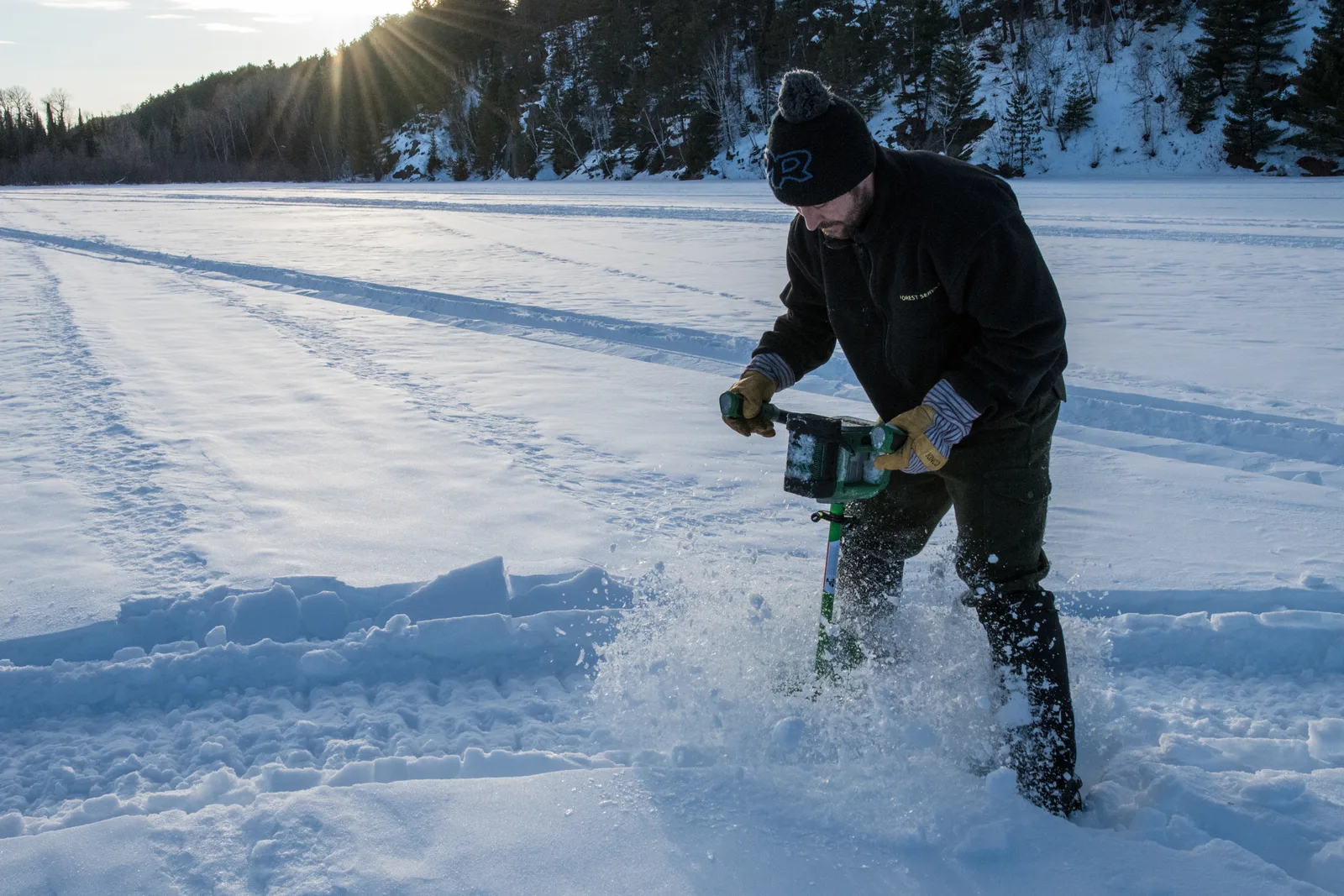
Drilling through about two feet of ice on Bass Lake, Superior National Forest, Minnesota. Photo: Lance Cheung, USDA Forest Service (public domain).
How do you use an ice auger safely?
Treat it like a power tool, because it is one. Cast & Spear’s short list is the right one. “Keep your hands clear of the blades, set your footing before you drill, avoid loose clothing that can catch.”
Your auger is also your best ice-checking tool. Minnesota DNR says to “start by checking thickness near shore and to frequently stop and check as you go.” Put a tape measure into the hole and hook the bottom edge of the ice. Don’t guess from the drilling. The DNR warns, “Don’t judge ice thickness by how easily a chisel or drill breaks the surface.” It wants at least 4 in of new, clear ice before you walk out.
A few habits keep the auger itself safe:
- Blade cover on for every carry: in the truck, on the ice fishing sled and over your shoulder.
- Safety plate on drill bits. It keeps the bit from going down the hole if it comes out of the chuck.
- Gas outdoors only. Never run a gas or propane auger inside a closed shelter.
How do the augers compare?
Prices are what each maker’s store showed on November 15, 2026. Weights are the makers’ spec figures.
| Auger | Type, hole | Weight | Price, stock |
|---|---|---|---|
| Eskimo E40, steel or composite | Electric 40V, 8 in | 17.5 or 13.5 lb (7.9 or 6.1 kg) | $499.99 or $579.99, in stock |
| Jiffy Model 60 | Electric 60V, 8 in | 19.9 lb (9 kg) | $699.99, in stock |
| StrikeMaster Maven | Electric 40V, 8 or 10 in | 14.5 or 15.5 lb (6.6 or 7 kg) | $579.99 (8 in out of stock), $599.99 |
| Eskimo Redneck Bit | Drill bit, steel, 8 in | 8.2 lb (3.7 kg) plus drill | $169.99, in stock |
| Clam Drill Plate Pro | Drill plate, any 18 mm bit | 5 lb (2.3 kg), about 14 lb all-in | $119.99, in stock |
| StrikeMaster Lite-Flite Lazer Drill | Drill bit, 6 or 8 in | 4.4 or 5.3 lb (2 or 2.4 kg) | $218.49 or $243.49 |
| StrikeMaster Mora | Hand, 6, 7 or 8 in | 6 to 8 lb (2.7 to 3.6 kg) | $77.99 to $79.99 (6 in out of stock) |
The picks in detail
Eskimo 8 in E40 Steel: best electric auger
If you want one electric that does everything, start here. Of the 8 in electrics we priced, it was the cheapest one in stock. A variable-speed trigger gives you a gentle start. The auger has a 5-year warranty and the battery 3 years. Skip the 10 in unless you need the hole: Eskimo’s own claim drops to 800 in per charge.
Jiffy 8 in Model 60: most ice per charge
Its two blades mix serrations with a shaver wing, which Jiffy says plows through “tough or dirty ice.” It’s the pick for anglers who drill all day on thick ice, not for a few holes a trip. Fish a few weekends a winter and the extra $200 over the E40 buys charge you won’t use. A spare 60V battery is another $249.99 on Jiffy’s store.
StrikeMaster Maven 40V: bigger battery than the E40
It runs a 40V 5Ah battery, where the Eskimo has a 4Ah, and it has a built-in light. StrikeMaster calls it the lightest 40V auger in its class, but Eskimo’s composite E40 is a pound lighter on paper. With no per-charge figure, you can’t hold it against the table above. Want a 10 in? The Maven’s was in stock at $599.99. Eskimo’s 10 in composite E40 cost the same and weighs 14 lb to the Maven’s 15.5 lb.
Eskimo 8 in Redneck Bit: best drill auger
A steel bit with Eskimo’s Turbo blades and a safety recovery plate. If the drill is already in your garage, it’s $330 less than the E40 Steel. Eskimo’s composite Pistol Bit 2.0 weighs only 3.9 lb, but the 8 in was out of stock at $249.99. Watch for it if weight matters most: it’s the lightest bit we read.
The number: $169.99 buys Eskimo’s 8 in Redneck Bit, the cheapest way into power drilling if your drill is strong enough.
Clam Drill Plate Pro: easiest on your drill
Not an auger but a frame. Your 18V or 20V drill bolts on, and a bearing takes the bite. Budget for a bit with an 18 mm bore on top of the $119.99.
StrikeMaster Lite-Flite Lazer Drill: light drill bit, in stock
At 5.3 lb, the 8 in is about 3 lb lighter than the Redneck, and $73.50 more. It also fits a StrikeMaster power head, and a blade guard and a two-stage drill adapter come in the box with it.
StrikeMaster Mora MD-7: best hand auger for the money
It’s the cheapest auger we found on a maker’s store, and for a few panfish holes on early ice it’s all you need. The 8 in is $79.99. StrikeMaster’s Lazer hand auger costs more, $132.49 to $140.99, and both sizes were out of stock. The Lazer cuts with chrome-alloy stainless blades, the Mora with high-alloy carbon steel.
How we chose
We read each maker’s own product page and store on November 15, 2026, for weight, battery, per-charge claims, blades and price. Picks had to have a maker page with a price, and we noted stock where the store showed it. We left out augers we found only at retailers, such as ION and K-Drill. We couldn’t find a maker page for either to check the numbers against. The per-charge table is our arithmetic on the makers’ claims, not a test on the ice. No auger was tested by this site, and prices move, so check before you buy.
Minnesota DNR names three big-ticket items for the ice: an auger, a shelter and a sonar unit. The rest of the ice fishing gear costs far less. Once the hole is open, ice fishing is about knowing what’s under it.

Free PDF · 5 pages
Stop guessing the ice. Tape this strip to your scoop and read it at the hole
Ice that is 6 or 7 inches thick in one spot can be 2 inches close by. You can't tell by looking.
The True-Size Ice Thickness Chart. Print it, tape the strip to your ice scoop, hook it under the ice and read the band at the surface: on foot, sled or truck. One side for clear ice, one for white.
- A true-size strip for your scoop handle, marked from "stay off" to a truck with a wheelhouse
- Two wallet charts, one for your buddy, with five moves that get you out if you go through
- Why 8 inches of white ice counts as 4, and the ice to stay off at any thickness
Every clear-ice number is the Minnesota DNR's, set beside the 29 sources on the page, the Army Corps of Engineers among them.
No card, nothing to buy. Confirm with one click and the PDF is on its way, one version for your phone and one to print, yours to keep. Then a few short emails and one a week on what's biting, with an unsubscribe link in every one. Privacy.
Related

Section guide
Ice Fishing Gear: The Checklist and What a Starter Kit CostsThe ice fishing gear and equipment checklist, safety first, priced from makers' stores: a bare kit for about $320, a comfortable one for about $2,010.
 What to Wear Ice Fishing: Layers, Bibs, Float Suits and Boots
What to wear ice fishing: three layers and no cotton, ice fishing bibs or a float suit, boots by their rating and gloves, with makers' prices.
 Ice Fishing Rod and Reel: The Length for Each Fish, and the Picks
Which ice fishing rod length and power for panfish, walleye and pike, inline or spinning reel, which line, and seven picks with the makers' prices.
 Ice Fishing Shelter: Hub or Flip-Over, and 7 Picks by Floor per Pound
Ice fishing shelter or tent: a flip-over to fish alone and move, a hub for two or three. Square feet per pound from maker specs, 7 picks, safe heat.
 Ice Fishing Sled: What Size You Need, Hitches, and 9 Sleds Compared
An ice fishing sled sized to your shelter: three-person hubs pack 52 to 65 in long. Hand-pull or ATV sleds, hitch load limits, and 9 sleds compared.
 Ice Fishing Tip-Ups: How to Set One, and Which to Buy
Ice fishing tip ups: what one is, how to set it in eight steps, how many your state allows, and five to buy at the makers' own prices.
Sources (21)
- Eskimo, 8" E40 Steel (with the 10" and composite comparison chart)
- Eskimo, 8" Redneck Bit
- Eskimo, 8" Pistol Bit 2.0
- Jiffy, 8" Model 60
- StrikeMaster (Rapala), Maven 40V Auger
Show all 21 sourcesShow fewer sources
- StrikeMaster (Rapala), Lithium 24V Auger
- StrikeMaster (Rapala), Mora hand auger
- StrikeMaster (Rapala), Lazer hand auger
- StrikeMaster (Rapala), Lite-Flite Lazer Drill
- StrikeMaster (Rapala), Lazer Deluxe Ice Auger Sharpener
- StrikeMaster (Rapala), Mora Hand Replacement Blades
- Clam, Drill Plate Pro
- Nils Master USA, Convertible hand augers
- Nils Master, Ice Augers
- Nils Master USA, Blade Sharpening
- Eskimo, M43 Mako 8" 43cc gas auger (Internet Archive copy, September 8, 2024)
- Minnesota DNR, Learn to ice fish
- Minnesota DNR, How to check ice thickness
- Michigan DNR, Ice fish
- Take Me Fishing, An Ice Fishing Gear List (Tom Keer, January 2015)
- Cast & Spear, 6 Best Ice Augers: Expert Reviews (Electric, Hand, Drill), Jon Stenstrom