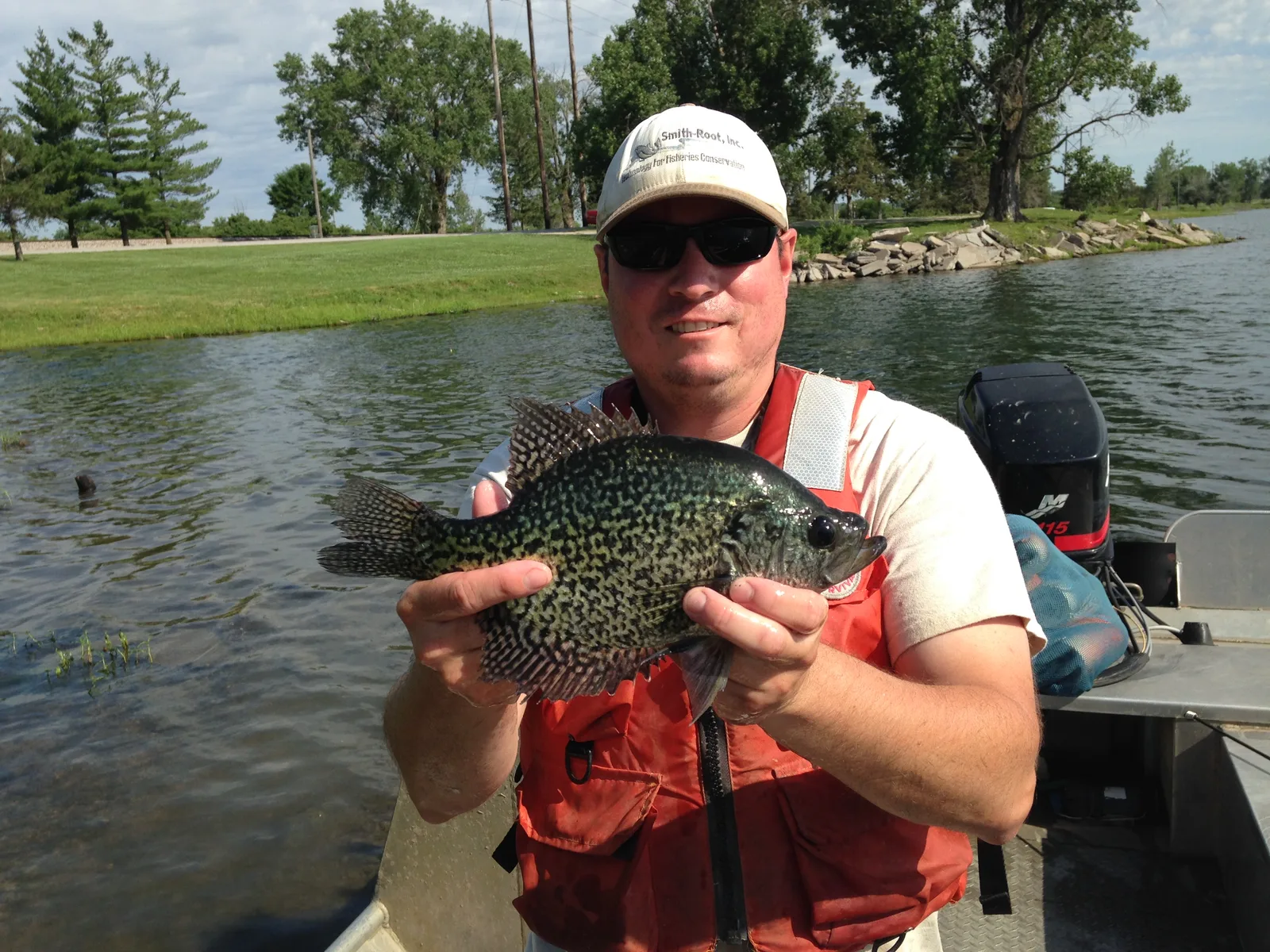
Crappie fishing comes down to depth: crappie sit shallow in spring and fall and deep in summer and winter, and they bite a small jig or minnow held at their level. Find the school, put a 1/32–1/8 oz bait at or just above it on 4–8 lb line, and one fish often turns into a dozen. Two species share the name, the black crappie and the white crappie, and they fish the same way.
“A crappie always feeds in an upward position and will completely ignore a bait that passes just six inches under its nose.” Rod Wall, a former guide, in Carolina Sportsman.
Why crappie are easy one day and hard the next
Crappie live in schools, and a school moves. It holds on brush, docks and channel edges, or it hangs in open water over the deep basin. That is why a spot that gave you a limit on Saturday can be empty on Sunday: the fish are still in the lake, just not where you left them.
The second reason is how they feed. Crappie look up for their food, and in stained water they may see a bait only about two feet away, by Rod Wall’s estimate. A jig a foot under the school is nearly invisible to them. In our reading of Wall’s point, a slow day is usually a depth problem, not a lure problem.
The two species differ in the water they tolerate. Black crappie handle muddy water and silt worse than white crappie, Missouri’s field guide notes; both live near timber or weeds in still water and slow backwaters. Plenty of reservoirs hold both, often on the same brush pile. For telling them apart and for size, records and names, start at the crappie hub.
What you need
Crappie tackle is light. Pennsylvania’s Fish and Boat Commission lists 4–8 lb line for black crappie and 2–6 lb for white, hooks in sizes 4 to 8 and lures of 1/32 to 1/8 oz. That covers almost every crappie method.
- Rod: a 6–7.5 ft light or medium-light spinning rod casts and skips a small jig. For vertical jigging from a boat, Oklahoma’s wildlife department suggests 9–12 ft. Jason Sealock of Wired2Fish carries three rods to cover everything: a 6 ft rod for shooting docks, a 7–7.5 ft medium-light for casting and a 10–12 ft pole for dipping cover.
- Reel: a small spinning reel, or a spincast reel for a beginner.
- Line: 4–6 lb monofilament for most crappie fishing, inside Oklahoma’s 4–8 lb range; use the heavy end around thick brush.
- Jigs: 1/32, 1/16 and 1/8 oz crappie jig heads with 1.5–3 in soft plastics or hair jigs, the weight matched to the depth: 1/16 oz is the all-round size, 1/8 oz when the fish are active or deep.
- Live bait: small minnows on a thin-wire hook, under a float or on a split shot.
- A float: a fixed or slip bobber to hang the bait at a set depth.
- A net: a crappie’s mouth tears easily, so lift the good ones in a net rather than by the line.
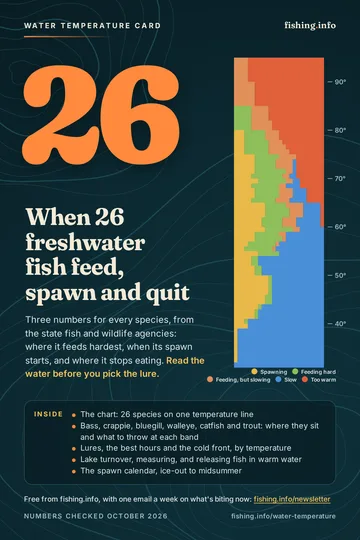
Free card: what 26 species do at your water temperature
Plus one email a week on what's biting now. No sales pitches. Privacy.
How to catch crappie, step by step
- Pick the season’s depth before you pick a lure. The Missouri rule of thumb: shallow in spring and fall, deep in summer and winter. The table below gives the depth for each season.
- Find the cover at that depth. Brush piles, standing timber, docks, bridge piers and the edges of creek channels gather crappie. A brush pile in 15–20 ft of water is where Missouri says to look in summer.
- Find the fish on that cover. A sonar screen shows the school and its depth. Without one, fish the cover from the top down until the first bite.
- Set your bait at or just above the fish. A slip bobber, a counted-down jig or a vertical drop does it. Remember Wall’s six inches: too deep is the commonest miss.
- Move it slowly. Swim a jig back on a slow, steady retrieve, or hold it still under a float. Cold-water crappie in particular will not chase.
- When you catch one, stay. Note the depth and put the next bait at the same level. A crappie school is large and dense, Missouri notes, so the next fish is usually a cast away.
- When the bites stop, move a few feet. Oklahoma fisheries supervisor Ryan Ryswyk suggests shifting slightly when the bite dies and coming back the next day; the school may only have slid along the cover.
What a crappie bite feels like
Often you feel nothing at all. A crappie rises, inhales the jig and keeps swimming, and the line just goes slack or ticks sideways. Watch the line where it enters the water and set the hook on any change.
Under a float, the classic sign is the bobber lying flat instead of sinking. Oklahoma’s guide says it typically lies flat when a crappie bites: the fish has risen with the bait and taken its weight off the float. Set the hook then.
Set gently. Crappie are called papermouths for the paper-thin membrane around the mouth, and a hard hookset tears the hook free. A smooth sweep of the rod is enough, and a light drag lets a big fish run without ripping out.
Where are crappie each season, and how deep?
Shallow in spring and fall, deep in summer and winter. The depths below are from the Missouri Department of Conservation unless another source is named. Your lake will differ in the numbers, not in the pattern. Water temperature sets the timing; the crappie water temperature guide gives the spawn and feeding bands.
| Season | Where they hold | How deep | What to fish |
|---|---|---|---|
| Winter | Deep water; shallower in a warm spell | 20–40 ft (6–12 m); under 5 ft (1.5 m) in a warm January spell | A slow jig or small jigging spoon raised 1–2 ft and dropped |
| Pre-spawn and spawn (March to May) | Coves, pea-gravel banks and shallow cover | 1–2 ft (0.3–0.6 m) in stained water; 20 ft (6 m) or more in exceptionally clear water | A 1/32–1/16 oz jig flipped along the bank, or a jig under a float |
| After a spring cold front | Steep banks near the spawning areas | A little deeper, still close to the bank | The same jig, slower |
| Summer (post-spawn to September) | Brush in 15–20 ft (4.6–6 m); bridge piers over 20 ft (6 m) | Fish 10–15 ft (3–4.6 m) down | Vertical jig or a minnow; near the thermocline, split shot and a small minnow |
| Summer nights (July and August) | Under lights that draw insects and baitfish | Start at 5–10 ft (1.5–3 m) in muddy water and 20–30 ft (6–9 m) in clear water (Keith Sutton, Bass Pro) | Jigs and minnows under a lantern or a submersible light |
| Fall (October and November) | Docks and the creek arms | The upper 10 ft (3 m) | A jig allowed to sink 2–3 seconds, then retrieved slowly |
Missouri calls crappie very predictable and aggressive in October and November. In spring the fish come to the bank, which makes it the season for shore anglers. In Oklahoma the best bank fishing runs from late March to early May, once overnight lows stay above 50 °F (10 °C).
In summer the fish go deep and often sit just above the thermocline, the layer where warm surface water meets cold, oxygen-poor water below. Find that depth on the sonar and fish just above it. Near concrete bridge piers, Missouri suggests starting a vertical minnow at about 10 ft and working deeper.
What time of day do crappie bite best?
Early and late. Wisconsin’s DNR says crappie feed all day, with peaks in the evening and early morning, and in summer it sends anglers to deep holes, channel edges and sunken brush. Pennsylvania’s guide gives daytime for spring and early in the day for summer and fall.
At night, lights change the rules. Sutton’s explanation: a green light attracts plankton, plankton draws baitfish and the baitfish bring in the crappie. Anchor near a bridge or channel edge, hang the light and fish jigs or minnows at several depths until the school arrives.
How to adjust when they will not bite
Change the depth first, then the speed, then the bait. A school that ignores a jig at 8 ft may eat it at 7. Then slow down; cold water and a cold front both make crappie lazy.
Color comes third. Oklahoma’s guide suggests chartreuse for murky water and brighter pinks, oranges and neons around the spawning areas. Sealock’s core list adds white, black and a hologram pearl anglers call Monkey Milk. Where lakes have cleared, he writes, smoke and silver glitter have become go-to colors.
When a jig still gets no bites, try a live minnow on the same rig. And if you mark fish but cannot reach them, shorten your casts and fish straight down.
Mistakes to avoid
- Fishing below the school. Keep the bait at or above the fish; they rarely feed down.
- Heavy line and a hard hookset. Stay in the 4–8 lb range for a small jig, and sweep the rod instead of jerking it; a hard set tears the papermouth.
- Leaving a school to look for another. If you caught one, the rest are close. Move feet, not miles.
- Ignoring wind and fronts. Oklahoma’s guide reads several days of south wind in March and April as a sign to fish the coves, points and dams on the north side. After a cold front, slow down and go deeper; the cold fronts and wind page explains why.
- Forgetting the limits. Daily limits run from 10 in Minnesota to 25 in Texas and 30 in Missouri. Texas adds a 10 in (25 cm) minimum length, and some lakes set their own rules.
Other ways to catch crappie
- Vertical jigging: a long rod held over brush or timber, the jig lowered straight down. Sealock calls 1/16 oz the norm, 1/8 oz when fish are active and 1/4 oz for deep water in wind.
- Spider rigging: several long rods fanned from the bow, pushed slowly over channels and flats. Sutton writes that six to eight rods are most common; the anglers he followed use 12–16 ft trolling rods.
- Dock shooting: a short rod bent like a slingshot to fire a small jig far under a dock, where shade holds crappie in summer and fall.
On a pond full of small fish, crappie and bluegill often share the water; the bluegill page covers the other half of the panfish catch.
Free download
The water temperature card
Read your water temperature and the card tells you who is spawning, who is feeding and what to throw. 26 species, 16 pages, for your phone and the tackle box.
Plus one email a week on what's biting now. No sales pitches. Privacy.
Related
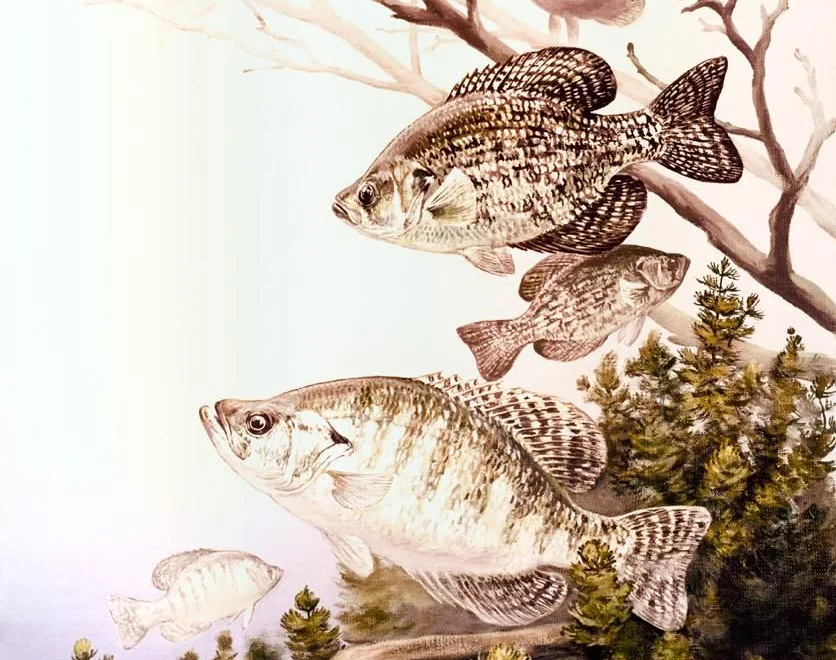
Section guide
Crappie: Black or White, Where They Bite, How Big They GetCrappie are two fish, black and white: the spine count that tells them apart, where each lives, when they spawn, how big they get and the limits.
Sources
- Missouri Department of Conservation, crappie: tips for fishing
- Missouri Department of Conservation, black crappie field guide
- Oklahoma Department of Wildlife Conservation, crappie angler guide: top tips and area highlights
- Pennsylvania Fish and Boat Commission, catch PA fish: crappie
- Wisconsin DNR, Crappie (PUBL-FH-712)
- Carolina Sportsman (Phillip Gentry), what does your jig weigh? (Rod Wall)
- Bass Pro Shops 1Source (Keith Sutton), crappie fishing after dark
- Bass Pro Shops 1Source (Keith Sutton), spider rigging for crappie
- Wired2Fish (Jason Sealock), best crappie fishing rods
- Wired2Fish (Jason Sealock), best crappie jigs: buying and fishing guide
- Minnesota Rules 6262.0200, possession and size limits
- Missouri Department of Conservation, crappie fishing regulations
- Texas Parks and Wildlife, freshwater bag and length limits