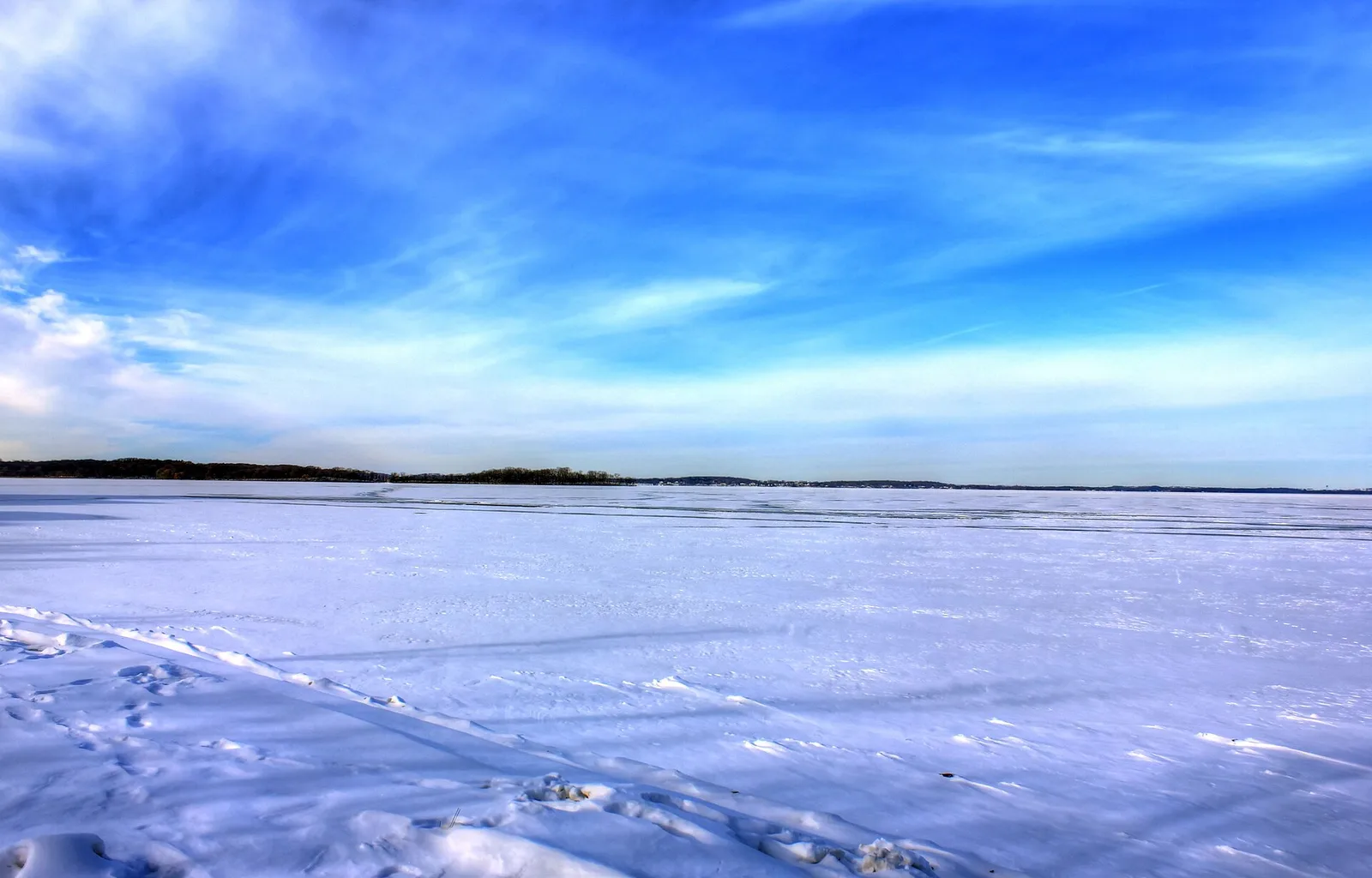
Ice fishing in Madison, Wisconsin, means five lakes within a few miles of the capitol dome: Mendota, Monona, Waubesa, Kegonsa and Wingra. They hold 18,750 acres of water strung along the Yahara River, and they do not freeze together. Lake Wingra, 14 ft (4.3 m) deep, has closed around December 1 on the median. Lake Mendota, 83 ft (25 m) deep and the largest at 9,781 acres, does not close until December 21 on the median, and in the last six winters never before Christmas.
Lake Mendota counts as frozen when a rowboat can no longer cross between Picnic Point and Maple Bluff. The rule dates from the limnologists E. A. Birge and Chancey Juday, who rowed that line to deliver a case of beer to friends in Maple Bluff.
Which lake, and where do you walk on?
The numbers are the DNR’s, from its page for each lake, and so are the fish ratings: panfish are “abundant” on all five.
| Lake | Acres (ha) | Max depth | On the ice | Walk on from |
|---|---|---|---|---|
| Mendota | 9,781 (3,958) | 83 ft (25 m) | perch and walleye in deep water; last to freeze | Tenney Park, Warner Park, Mendota County Park (county permit), Picnic Point |
| Monona | 3,359 (1,359) | 74 ft (23 m) | bluegill and crappie in Monona Bay; first panfish ice of the big lakes | Brittingham Park on Monona Bay off John Nolen Drive, Olin Park |
| Waubesa | 2,074 (839) | 38 ft (12 m) | panfish, largemouth “abundant”, northern pike | Upper Mud Lake site, 4020 Terminal Drive, McFarland (county permit) |
| Kegonsa | 3,200 (1,295) | 32 ft (10 m) | panfish and pike on a shallow bowl | Lake Kegonsa State Park |
| Wingra | 336 (136) | 14 ft (4.3 m) | first ice of all, panfish; muskie “common” but closed in winter | Vilas Park, the Arboretum shore |
Mendota is the lake that made Madison a perch town. A 1921 Bureau of Fisheries bulletin on the habits of yellow perch put the catch through its ice at about 282,960 perch a winter. It printed a photograph of a man kneeling at his hole, with a basket and a pile of perch on the snow, to prove it. The deep basin is where the schools suspend. That is why the DNR’s technique page says to jig for perch at 35 ft (11 m) with small live minnows or weighted ice flies and insect larvae; the yellow perch page has the fish itself.
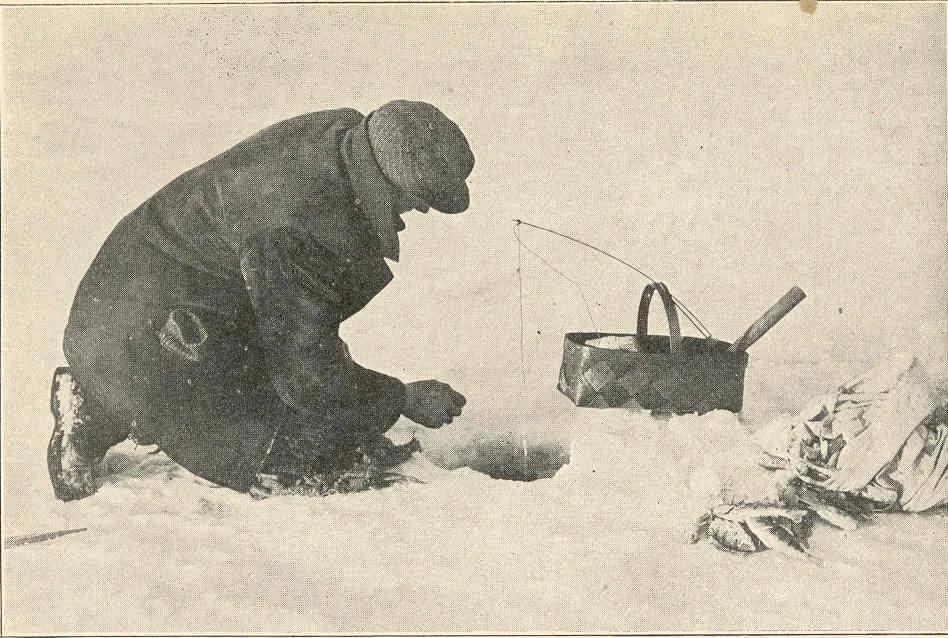
A perch fisherman on Lake Mendota in 1921, from the Bureau of Fisheries bulletin that put the winter catch at 282,960 perch. Photograph by L. W. Brown, public domain.
Monona is the urban lake, and Monona Bay off John Nolen Drive is the urban spot: shallow, sheltered and close to parking. It is the home of the Yahara Fishing Club’s Kids Ice Fishing Day at Brittingham Park, held for the 25th time in 2023 and called off in January 2026 for extreme cold. Waubesa and Kegonsa, downstream, are the shallow panfish and pike lakes. Dane County built its Upper Mud Lake access in McFarland for ice fishing, with a parking lot that opens only in winter. Wingra, in the Arboretum, freezes first.
When does the ice come?
Over the whole record, Mendota’s median freeze falls on December 21 and its median opening on April 3, with a mean of 102 days of ice. The earliest freeze was November 23, 1880, the latest January 30, 1932. The longest winter lasted 161 days, in 1880–81; the shortest lasted 21, in 2001–02.
The State Climatology Office has recorded the freeze and thaw of Lake Mendota every winter since 1855–56, and Monona and Wingra for nearly as long. Monona and Wingra count as frozen at about 50 percent cover, watched from South Few Street and Vilas Park. No date is fixed until the lake stays closed a second day.
The trend is the number anglers feel. The first 30 winters of the record averaged 118 days of ice and a median freeze of December 13. The last 30 averaged 81 days and a median freeze of January 2.
| Winter | Mendota froze | Mendota opened | Days of ice |
|---|---|---|---|
| 2020–21 | January 3 | March 20 | 76 |
| 2021–22 | January 7 | April 2 | 85 |
| 2022–23 | December 25 | April 2 | 98 |
| 2023–24 | January 15 | February 28 | 44 |
| 2024–25 | January 7 | March 15 | 69 |
| 2025–26 | January 1 | March 13 | 71 |
The small lakes run weeks ahead. In 2025–26 Wingra closed on December 1 and Monona on December 12, a month before Mendota’s January 1, and Wingra had 96 days of ice to Mendota’s 71. That gives the order to fish the chain in. Start on Wingra and Monona Bay for the first panfish ice in December, then Waubesa and Kegonsa, then Mendota’s deep perch and walleye from January, and the shallow bays again at last ice in March.
Is the ice safe?
The Wisconsin DNR’s answer is that there is no such thing as 100 percent safe ice. Strength cannot be judged by appearance, age, thickness or snow cover alone, and the department does not monitor ice anywhere. It sends anglers to bait shops, fishing clubs and resorts, which “serve winter anglers every day.” Dane County Parks says the same of its sites. The DNR’s rules are plain:
- Do not go alone; tell someone where you are and when you are due back.
- Stay off ice near inlets, outlets and narrows, where current thins it.
- Look for clear ice, which is stronger than snow-covered or bubbled ice.
- Carry ice picks, a rope, a life jacket and a phone in a waterproof bag.
- If you go through: clothes on, back the way you came, picks in, kick, and roll away from the hole rather than stand.
On the Yahara chain the current warning has names. The Yahara River enters Mendota at Cherokee Marsh and leaves it at Tenney Park’s locks. It passes between Monona and Waubesa under the Highway 12/18 bridge and through Upper Mud Lake, and leaves Waubesa through Lower Mud Lake toward Kegonsa. Every one of those channels is thin where the lakes beside them are not.
The thickness figures anglers quote are Minnesota’s guideline: 4 in (10 cm) of new clear ice to walk, 5–7 in (13–18 cm) for a snowmobile, 9–12 in (23–30 cm) for a small car. The glossary has them under safe ice. Wisconsin’s DNR publishes no chart, and a spud bar every few steps is the reading to trust.
Which rules differ lake by lake?
The 2026–27 guide’s Dane County table sets the Madison lakes apart from the southern-zone defaults, and the differences are not small.
| Water | Panfish a day | Walleye | Northern pike | Muskie |
|---|---|---|---|---|
| Mendota, with Cherokee Lake, Warner Park lagoons, lower Sixmile and Pheasant Branch creeks | 10 | 18 in (46 cm), 3 | 1, at least 40 in (102 cm) | 40 in; closed Jan. 1 – May 1 |
| Monona, with the Yahara to Tenney Locks and Starkweather Creek | 25 | 15 in (38 cm), 3 | 2, at least 26 in (66 cm) | 50 in (127 cm); closed Jan. 1 – May 1 |
| Waubesa, with Upper Mud Lake, Nine Springs and Swan creeks | 25 | 15 in, 3 | 2, 26 in | 50 in; closed in winter |
| Kegonsa, with Lower Mud Lake | 25 | 15 in, 3 | 2, 26 in | 40 in; closed Jan. 1 – May 1 |
| Wingra | 25 | 15 in, 3 | 2, 26 in | 50 in; closed in winter; one bass, 18 in (46 cm) |
Two of those lines change a winter day. The Mendota panfish limit is 10, so a bucket of 25 perch that is legal on Monona is a citation half a mile away. The limit counts bluegill, pumpkinseed, sunfish, crappie and yellow perch together; the panfish page has the evidence that lower limits grow bigger bluegill.
And the muskie season closes on December 31 everywhere inland. A muskie that takes a pike tip-up on Wingra in January goes back, and fishing for them on purpose is illegal even to release. The muskie page covers that fish, the northern pike page the one you may keep.
What does a license cost, and when is it free?
A Wisconsin resident annual license is $20 and runs April 1 to March 31. A nonresident pays $55 for the year, $15 for a day or $29 for four days, and kids 15 and under need no license at all. The Wisconsin page has every fee and the full 2026–27 season table, and the states hub sets them beside eight other states.
On the winter free fishing weekend, January 16–17, 2027, nobody needs one; it is the full weekend before the third Monday in January. Every limit above still applies. The DNR lends rods, tip-ups and tackle at 19 loaner sites, everything but the auger, which it suggests you replace with a spud bar and someone else’s old hole.
How do you run a first trip?
Each step rests on the DNR’s technique page or the tip sheets its fisheries biologists wrote for ice anglers; Kurt Welke’s names the Madison lakes.
- Pick the lake by the date. Before Christmas it is Wingra, Monona Bay or the Waubesa shallows; after New Year, Mendota. The climatology office’s freeze page says which lakes have closed; the bait shop says whether the ice has held.
- Drill your holes first, then be quiet. Welke’s rule for bluegill: drill extra holes on arrival, so the auger is silent once the bite starts, and fish like the quiet anglers who fill their pails.
- Panfish in 4–8 ft (1.2–2.4 m) over green weeds. The DNR’s bluegill advice is a shallow bay and a teardrop jig or a No. 12 ice jig tipped with a waxworm or spike. Jig it gently through the whole water column, because bluegill and crappie hold in a narrow band. Monona Bay and the Waubesa bays are this water.
- Perch deep on Mendota. Jig for perch at 35 ft (11 m), the DNR’s figure, with small minnows or weighted ice flies and larvae; a flasher tells you which band the school is in. Gary Engberg, the Madison outdoors columnist whose pieces ran on the old fishing.info, wrote in December 2011 that Mendota’s perch schools sat in water 50 to 70 ft (15–21 m) deep in the main basin, suspended anywhere from the bottom to just under the ice. He found them a quarter to half a mile off Governor’s Island, Picnic Point and Second Point, and waxworms stayed on the hook better than spikes.
- Walleye on tip-ups along the shore, at dusk. Skip Sommerfeldt’s advice for stained lakes like these is that tip-ups beat jigging. Set them in 6–12 ft (1.8–3.7 m) along weed edges, gravel bars and the break where sand turns to mud. Hook a medium sucker or extra-large fathead lightly through the back and hold it 4–8 in (10–20 cm) off bottom. The hour and a half before dark is worth more than the morning. Engberg’s early-season leads were University Bay, Warner Bay and the Spring Harbor shore in under 15 ft (4.6 m), the rock bars later.
- Pike in halves. Terry Margenau’s rule for tip-ups over weeds: set the bait halfway down, 6 ft in 12 ft of water, so it hangs above the vegetation where a cruising pike can see it. Put one tip-up in under 5 ft (1.5 m) at first ice. A pike must be 26 in (66 cm) on every lake but Mendota, where it must be 40 in and only one may be kept.
- Count before the bucket. Ten panfish on Mendota, 25 elsewhere; three walleye at 18 in on Mendota and 15 in on the others; no muskie at all. The catch and release page covers the fish that go back; in Sommerfeldt’s words, “today’s 20 inch release may be your 28-inch mounter.”
- Leave the way you came, in daylight. The DNR’s rule: no travel on the ice at night or in poor visibility, and the strongest ice you know of is the ice you walked in on.
Where did the old columns point?
Engberg’s two columns from 2011 are where the research for this guide began. They hold up as a map of names even where the rules have moved. He quoted a three-fish, 18 in walleye limit on Mendota that still stands, and a 25-perch limit the guide has since cut to 10.
His deep-water walleye spots were Dunn’s Bar, the Brearly Street Bar, the Commodore Bar, Governor’s Island, Second Point, Picnic Point, the Maple Bluff shoreline and Fox Bluff Point. Those are the rock bars and breaks where the perch schools and the walleye that follow them meet. The shop he named, D&S Bait and Tackle on the north shore, is the kind of place the DNR now tells you to ask about the ice.
What his columns were is also what they were not: one angler’s season, in 2011. The lake that was safe by Christmas in his good winters has, in the last six, not closed before December 25.
Related
Section guide
Wisconsin Fishing: Seasons, Licenses and the Lakes to KnowWisconsin fishing in one place: the 2026–27 season dates, every license fee, the state fish, the panfish rule and the Madison chain in winter.
Sources
- Wisconsin DNR, Lake Mendota lake page (acreage, depth, fish, access)
- Wisconsin DNR, Lake Monona lake page
- Wisconsin DNR, Lake Waubesa lake page
- Wisconsin DNR, Lake Kegonsa lake page
- Wisconsin DNR, Lake Wingra lake page
- Wisconsin State Climatology Office, history of ice freezing and thawing on Lake Mendota
- Wisconsin State Climatology Office, Lake Monona and Lake Wingra freeze and thaw histories, and how the dates are determined
- Wisconsin State Climatology Office, Are Madison's lakes frozen? (2025–2026 edition)
- Wisconsin DNR, ice safety
- Wisconsin DNR, Guide to Wisconsin Hook and Line Fishing Regulations 2026–2027 (PDF), Dane County
- Wisconsin DNR, 2026–2027 fishing season dates and free fishing weekends
- Wisconsin DNR, fishing licenses and fees
- Wisconsin DNR, Winter Free Fishing Weekend January 17–18, 2026 (loaner sites)
- Wisconsin DNR, ice fishing techniques
- Skip Sommerfeldt, Wisconsin DNR, Fishing walleye through the ice (PDF)
- Terry Margenau, Wisconsin DNR, Fishing northern pike through the ice (PDF)
- Kurt Welke, Wisconsin DNR, Fishing bluegills and panfish through the ice, including the Madison lakes (PDF)
- Dane County Parks, ice fishing and the Upper Mud Lake access
- Wisconsin State Journal (via WiscNews), Kids Ice Fishing Day canceled for extreme cold, January 2026
- Pearse and Achtenberg, Habits of Yellow Perch in Wisconsin Lakes, Bulletin of the U.S. Bureau of Fisheries vol. 36, 1921 (photograph by L. W. Brown)
- Gary Engberg, Ice Fish the Madison Chain for a Winter Mixed Bag, fishing.info, December 2011 (archived)
- Gary Engberg, Madison lakes column of Sept. 24, 2011 (fishing.info archive: Dunn's Bar, Maple Bluff, Fox Bluff Point)