 By
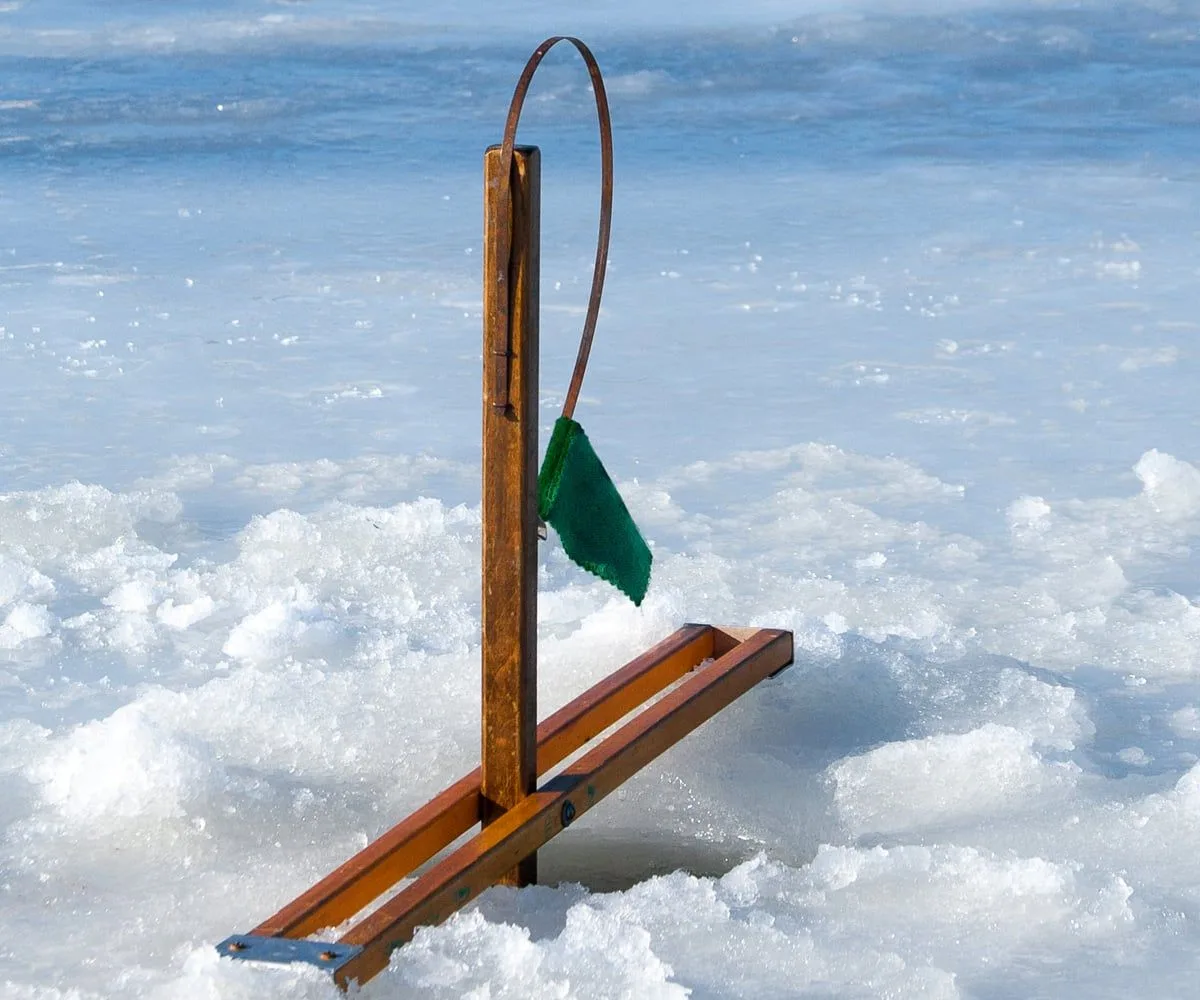
A tip-up is a spool on a stick that holds a baited line under the ice and pops up a flag when a fish takes the bait. That’s New York DEC’s description, and it’s the whole idea. The tip-up fishes the hole while you fish another. Most ice anglers set a few around an area first, says Take Me Fishing, then switch to a rod where the bites come. Our picks below rest on the makers’ own pages and prices, read November 15, 2026. Nobody fished these tip-ups for this page.
In Minnesota you may walk up to 200 feet from a tip-up. A phone alert from it doesn’t count as watching your line.
What is a tip-up, and why use one?
The classic tip-up is two crossed bars of wood. One bar lies across the hole. The other stands up through it, with the spool on the bottom end under water and the flag on the top. When a fish runs with your bait, the spool turns, a trip lets go and the flag springs up. The spool sits under water so it doesn’t freeze.
You’ll hear other names for the same thing. Maine’s law calls it an “ice fishing trap,” and Maine anglers just say trap. In Massachusetts you’ll also hear tilt or type, MassWildlife says. A tip-down is a different tool: it holds your ice rod and reel, and the rod dips toward the hole on a bite.
For pike, tip-ups are the standard. Minnesota DNR calls a tip-up rig “the best way to catch northern pike in winter.” For walleye it depends on the water. Skip Sommerfeldt of Wisconsin DNR finds tip-ups with live bait “can often catch more walleye than jig-pole fishing” on stained lakes. On clear lakes, he says, jigging may win.
So you can mix the two on a day of ice fishing. You jig one hole, and the tip-ups watch the others for you. One thing to know before you buy line: tip-ups usually come without any, Minnesota DNR says.
Which kind of tip-up do you need?
There are four kinds, and the first two do the same job. Here is what each one does, in the makers’ own words where they have them.
| Kind | What it does | Example |
|---|---|---|
| Cross-bar, wood or plastic | Arms across the hole, spool under water, flag on a spring | HT Polar: “Sealed mechanism guaranteed against freeze-up” |
| Round thermal | An insulated round base covers the whole hole, so it freezes less | Frabill Pro Thermal: covers a 10 in (25 cm) hole |
| Tip-down | Holds your rod and reel; the rod tips down and a flag pops | Clam Arctic Warrior |
| Hook-setter | A spring or a bent rod sets the hook when the fish pulls | Jaw Jacker, Clam Predator |
Start with a cross-bar or a thermal. On a cold, windy day the thermal earns its price. Frabill says its round base keeps slush and blowing snow out, and blocks out unnatural light.
The cheap plastic cross-bars have a catch. MeatEater’s Ryan Brod says the small Polar tip-ups have sensitive trippers and hold less line than the pricier traps he runs. They work well on early-season, fair-weather days for panfish and trout. In deep snow, he adds, these low traps are nearly impossible for anglers or snowmobilers to spot.
For night fishing, some tip-ups light up when the flag goes. Clam’s Watchtower raises a tower with LED lights ($129.99), and Beaver Dam’s Northern Light adds a bright LED to the flag ($95.00).
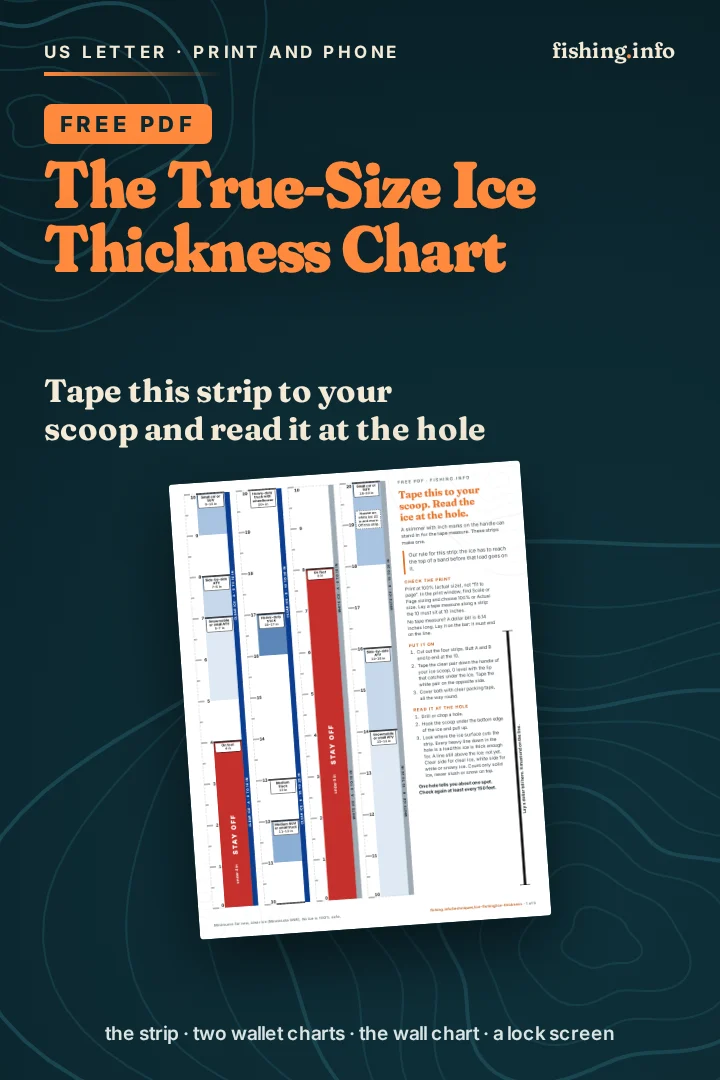
Free PDF · Ice thickness chart How thick is the ice? Read it at the hole.
Print the free chart, tape the strip to your scoop and hook it under the ice. It shows what that ice is thick enough for, clear or white. Two wallet charts and a wall chart come with it.
No card, nothing to buy, and the PDF is yours to keep. Confirm with one click and it's on its way. Then a few short emails and one a week on what's biting. Unsubscribe anytime. Privacy.
How do you set a tip-up, step by step?
First make sure the ice is thick enough to hold you. Minnesota’s guideline is 4 inches of new, clear ice for fishing on foot. These steps follow New York DEC’s and Maine IFW’s guides.
- Drill the hole and skim it. Clear the slush and ice chunks out with a skimmer, a slotted scoop.
- Find the bottom with a sounder. That’s a weight you clip to the hook for a moment. Hold the tip-up and let the line down. When it goes slack, you’ve hit bottom.
- Raise it to your depth and mark the line. Lift the weight off the bottom as far as you want your bait to hang. Put a marker on the line at the waterline: a small bobber or an old button.
- Take the weight off and bait the hook. Bring the line up, unclip the sounder, hook your minnow.
- Lower the bait to the mark. Let it down until the marker sits at the waterline again. Your bait is back at the depth you chose.
- Set the flag, and test it. Pull a little line by hand, as a fish would, and make sure the flag flies. If it doesn’t, check that the line is wound around the spool the right way, Maine says.
- Check it every half hour to hour. Minnesota DNR says every half hour or so, Maine every hour. Look at the bait and clear the slush.
- When the flag flies, walk, don’t run. Minnesota DNR’s warning is plain: ice is slippery. Pick up the tip-up gently and take the line in your hand. When to set the hook depends on the fish: see the table below.
Where does the spool go, and how do you wind it back?
One trick from MeatEater: set the tip-up against the side of the hole with the spool facing out. That leaves the whole hole in front of the spool, free of anything the line could catch on.
Tip: Test every flag before you walk away. Pull a little line by hand and watch it fly.
When the fish is in, wind the line back onto the spool by turning the tip-up’s tripper, not by hand. The tripper is the small metal or plastic nub on the spool. MeatEater’s Brod says wrapping it on by hand will twist nylon line. And if a big fish runs, two people help. One fights the fish while the other tends the loose line and the spool.
Three choices the guides don’t agree on
Button or small bobber as the marker? New York DEC says either works, and MeatEater uses a button. Sommerfeldt picks “a very small bobber.” His reason: a button “may drag along the bottom and catch on obstructions.” We’d go with his small bobber.
Where do you hook the minnow? New York DEC says through the lips or under the dorsal fin, the big fin on the back. Minnesota DNR hooks pike minnows between the dorsal fin and the tail and warns you not to hit the spine. Sommerfeldt hooks his walleye minnows lightly through the middle of the back. Our pick is just under or behind the dorsal fin, clear of the spine, where two of the three put it.
When do you set the hook? It depends on the fish. For pike, the guides split.
| Fish | When to set the hook | Who says |
|---|---|---|
| Walleye | when it stops, leave it alone, “sometimes taking four or five minutes,” then set when it pulls again | University of Wisconsin Sea Grant |
| Pike, Minnesota’s way | after 15 seconds or more, once the fish swims slowly or you feel dead weight | Minnesota DNR |
| Any fish | get there fast and give “a short, quick tug” | Maine IFW |
| Pike you’ll let go | at once, on a quick-strike rig | In-Fisherman (Rob Neumann); Wisconsin DNR for fish you release |
Why wait on a pike at all? A pike often grabs a big minnow sideways and swims with it, then turns it head-first to swallow, Minnesota DNR explains. If you’ll release the fish, Wisconsin DNR asks you to use a quick-strike rig and not let it swallow the bait. The rig carries two hooks, so you can set right away instead of letting the pike run, In-Fisherman’s Rob Neumann says.
Once it’s hooked, Maine’s advice is to bring the line in hand over hand with steady pressure. Let the fish take line if it runs.
What line goes on a tip-up?
Heavier line than on your rod. New York DEC spools 50 yards of Dacron (braided polyester) or tip-up line. Minnesota DNR uses 45–70 lb braid, line woven from many fibers, for pike. Sufix makes its Performance Tip-Up Ice Braid from polyester and calls it “the standard in tip-up ice fishing line” ($7.99 for 50 yd, in 15 to 50 lb).
At the end you add a leader, a few feet of different line between the main line and the hook. A swivel joins the two, and split shot, small weights pinched onto the line, keeps the bait down. Here’s how the agencies rig for walleye and for pike:
| Part | Walleye and most fish | Pike |
|---|---|---|
| Main line | 50 yd (46 m) of Dacron or tip-up line (New York DEC) | braid of 45–70 lb (Minnesota DNR) |
| Leader | 2–3 ft (0.6–0.9 m) of mono, with a barrel swivel (New York DEC) | 2–3 ft (0.6–0.9 m) of wire or fluorocarbon (Minnesota DNR) |
| Weight | split shot 18–24 in (46–61 cm) from the hook (New York DEC), or two small ones 7–8 in (18–20 cm) above it (Wisconsin DNR) | — |
| Hook | size 8 or 6 double hook or circle hook (Wisconsin DNR); #6 (Maine IFW) | size 1–2 (New York DEC), or a quick-strike rig if you’ll release it (Wisconsin DNR) |
Sommerfeldt skips treble hooks on walleye tip-ups, because they “can be very hard to remove from fish when your hands are wet and cold.” His double hook is a treble with one barb snipped off.
How deep do you set the bait?
Most fish are either a few feet under the ice or a few feet off the bottom, Maine IFW says. Its rule of thumb is to set a few traps “just under the ice.” That puts the bait a foot or two below the bottom of the ice. Then go by the fish:
| Fish | Where the bait hangs | Who says |
|---|---|---|
| Walleye, stained (tea-colored) lake | 4–8 in (10–20 cm) off the bottom, in 6–12 ft (1.8–3.7 m) of water | Sommerfeldt, Wisconsin DNR |
| Walleye, clear lake | 6–20 in (15–51 cm) off the bottom | Sommerfeldt, Wisconsin DNR |
| Northern pike, live minnow | 2–3 ft (0.6–0.9 m) off the bottom, above any weeds, in 5–15 ft (1.5–4.6 m) | New York DEC |
| Pike, dead bait | about 18 in (46 cm) off the bottom, 3 ft (0.9 m) or more in clear water | Paul Bailey, North Dakota Game and Fish |
| A few traps, any fish | 1–2 ft (0.3–0.6 m) under the bottom of the ice | Maine IFW |
The bait is usually a live minnow, sized to the fish. New York DEC puts 3–4 in minnows under walleye tip-ups and 4–7 in minnows under pike tip-ups. Minnesota DNR wants a pike minnow big enough that perch can’t pull the flag, but under 12 inches. Which minnows you may buy and move is a state rule of its own, so check it before you pick your ice fishing bait.
For pike through the ice, spread the tip-ups by depth. On a drop-off, Minnesota DNR suggests the 10, 12 and 15 ft contours, the depth lines on a lake map. On a point, start shallow and drill a hole every 10 or 20 yards out into deeper water. For walleye through the ice, Sommerfeldt keeps his stained-lake tip-ups in 6 to 12 ft.
How many tip-ups can you run?
Each tip-up counts as a line. Michigan says it outright: no more than 3 lines per person, “including tip-ups.” North Dakota says each tip-up “is considered one pole.” So your state’s line limit is your tip-up limit, and the rod in your hand is one of them.
The second rule is how close you have to stay. Here are the five big ice states, from their own rule books:
| State | Lines through the ice | How close you must stay |
|---|---|---|
| Minnesota | 2, and 1 on designated trout lakes | in sight of the line, or within 200 ft (61 m) of the tip-up |
| Wisconsin | 3 hooks, baits or lures | not answering a bite at once is evidence of an unattended line |
| Michigan | 3 lines, tip-ups included | “immediate control” |
| New York | 7 lines, any mix of devices | “immediate attendance” |
| North Dakota | 4 poles, each tip-up one pole | within 150 ft (46 m), and checked at least every hour |
Across twelve ice states, the limit runs from 2 lines in Minnesota to 8 in Vermont. Iowa, for one, allows one tip-up and one line, or two tip-ups, plus one more with a third-line permit. Ohio caps tip-ups at six. Some states want your name on each one: Michigan asks for the owner’s name and address “in legible English.” Check your state’s current rules before your first trip.
Minnesota adds one more line: “Receiving electronic notifications is not considered attending your fishing line.” A flag that texts your phone doesn’t stretch the 200 feet.
Are hook-setting tip-ups legal?
In Minnesota they are now. Minnesota DNR announced the change on November 17, 2025. Devices that set the hook with a spring or a bent fishing pole “are now legal for use in Minnesota while ice fishing.” The setting part can’t have a motor. The device “must not be capable of automatically reeling the fishing line or retrieving fish.” And the old rule still holds: stay within 200 feet of the tip-up, and don’t leave it unattended.
Some pages haven’t caught up. Minnesota’s online rule digest, last updated in April 2023, still lists automatic hook-setting devices as unlawful. Jaw Jacker’s site still says its device is legal everywhere except Minnesota. Go by the DNR’s release, not the box. Elsewhere, Jaw Jacker notes that some states count its device as a tip-up and others as a line. Its advice: call your local DNR. Clam’s Predator switches between a hook-setter and a plain tip-up to fit local rules. One warning from Jaw Jacker is worth keeping: careless use “may cause serious injury, particularly to the eye.”
Which tip-up should you buy?
Five picks cover it: a cheap one, a thermal, a wooden classic, a tip-down and a hook-setter. Every price is from the maker’s own page or store on November 15, 2026.
| Pick | Kind | What the maker lists | Price |
|---|---|---|---|
| HT Polar Tip-Up 500’ | plastic cross-bar | sealed trip, 500 ft spool, ruler on the frame | $21.99 |
| Frabill Pro Thermal | round thermal | covers a 10 in hole, light or heavy trip | $39.99 |
| Beaver Dam Original | wooden rail | made by hand in the USA, freezeproof grease | $64.99 |
| Clam Arctic Warrior | tip-down | for a standard rod and reel combo | $39.99 |
| Clam Predator | hook-setter | converts to a plain tip-up | $79.99 |
HT Polar Tip-Up: the cheap one
Three cost about the same as one Beaver Dam. HT lists a sealed mechanism guaranteed against freeze-up, a wind-free trip wire with a high-vis flag and a 500 ft spool. The frame has a ruler built in. Mind Brod’s catch: the low frame is hard to spot in deep snow.
Frabill Pro Thermal: the one for cold days
The round base covers the whole 10 in hole, and keeps slush and snow out. Frabill says it keeps the hole from freezing down to 25 degrees below. It has light and heavy trip settings and stacks inside a 5–6 gallon pail. Clam’s Trophy Thermal does the same job for $34.99.
Beaver Dam Original: the wooden classic
Beaver Dam says it’s still made by hand in the USA. The spool runs on freezeproof grease, and a ruler engraved along the side measures the ice and your catch. Frabill’s Classic Wood is the cheaper wooden option at $39.99.
Clam Arctic Warrior: the tip-down
Put your own ice rod and reel on it. When a fish takes, the rod tips down and the flag pops up. Clam builds it for walleye, pike, lake trout and jumbo perch. You fight the fish on a rod instead of hand over hand.
Clam Predator: the hook-setter
It sets the hook for you, and it converts to a regular tip-up where your state says no. Sensitivity and hook-setting power both adjust. It costs $79.99 alone, or $179.99 with a rod and reel. Check your state’s rule before you set it.
How we chose
We started from what anglers ask first: what a tip-up is, how to set it and which to buy. The steps come from New York DEC and Maine IFW, with Minnesota and Wisconsin DNR filling in depth, bait and the hook-set. The picks come from the makers’ own pages for HT, Frabill, Beaver Dam, Clam and Jaw Jacker. We left out brands whose specs we couldn’t read at the source. Nothing on this page was fished by us. Tip-ups are one part of the ice fishing gear for a day on the hard water.

Free PDF · 5 pages
Stop guessing the ice. Tape this strip to your scoop and read it at the hole
Ice that is 6 or 7 inches thick in one spot can be 2 inches close by. You can't tell by looking.
The True-Size Ice Thickness Chart. Print it, tape the strip to your ice scoop, hook it under the ice and read the band at the surface: on foot, sled or truck. One side for clear ice, one for white.
- A true-size strip for your scoop handle, marked from "stay off" to a truck with a wheelhouse
- Two wallet charts, one for your buddy, with five moves that get you out if you go through
- Why 8 inches of white ice counts as 4, and the ice to stay off at any thickness
Every clear-ice number is the Minnesota DNR's, set beside the 29 sources on the page, the Army Corps of Engineers among them.
No card, nothing to buy. Confirm with one click and the PDF is on its way, one version for your phone and one to print, yours to keep. Then a few short emails and one a week on what's biting, with an unsubscribe link in every one. Privacy.
Related
Section guide
Ice Fishing Gear: The Checklist and What a Starter Kit CostsThe ice fishing gear and equipment checklist, safety first, priced from makers' stores: a bare kit for about $320, a comfortable one for about $2,010.
 Ice Auger: What Size, Which Type, and How Many Holes per Charge
Most anglers need an 8 in battery ice auger. Hole sizes, electric vs. drill vs. hand, holes per charge in 12 and 24 in of ice, and 7 augers compared.
 What to Wear Ice Fishing: Layers, Bibs, Float Suits and Boots
What to wear ice fishing: three layers and no cotton, ice fishing bibs or a float suit, boots by their rating and gloves, with makers' prices.
 Ice Fishing Rod and Reel: The Length for Each Fish, and the Picks
Which ice fishing rod length and power for panfish, walleye and pike, inline or spinning reel, which line, and seven picks with the makers' prices.
 Ice Fishing Shelter: Hub or Flip-Over, and 7 Picks by Floor per Pound
Ice fishing shelter or tent: a flip-over to fish alone and move, a hub for two or three. Square feet per pound from maker specs, 7 picks, safe heat.
 Ice Fishing Sled: What Size You Need, Hitches, and 9 Sleds Compared
An ice fishing sled sized to your shelter: three-person hubs pack 52 to 65 in long. Hand-pull or ATV sleds, hitch load limits, and 9 sleds compared.
Sources (30)
- New York State DEC, How to Ice Fish
- New York State DEC, I FISH NY Guide to Ice Fishing
- New York State DEC, General Freshwater Fishing Regulations
- Maine IFW (Jake Scoville), Ice Fishing Guide
- Maine IFW, General Fishing Laws and Definitions
Show all 30 sourcesShow fewer sources
- Minnesota DNR, Ice fishing for northern pike
- Minnesota DNR, Hook-setting devices allowed starting with the 2025-26 ice fishing season (news release, November 17, 2025)
- Minnesota Statutes 97C.321, Restrictions on unattended lines
- Minnesota DNR fishing regulations, General Regulations (eRegulations)
- Minnesota DNR, General ice thickness guidelines
- Wisconsin DNR, Guide to Wisconsin Hook and Line Fishing Regulations 2026-2027
- Wisconsin DNR (Skip Sommerfeldt), Fishing walleye through the ice
- Wisconsin DNR (Dehring and Krueger), Northern Pike, PUBL-FM-707 08
- Rob Neumann, Pike Quick Strike Rigs, In-Fisherman (2014)
- Michigan DNR Fishing Guide, Lawful Fishing Methods (eRegulations)
- North Dakota Game and Fish, 2026-28 Fishing Regulations
- Iowa DNR, General Fishing Regulations (eRegulations)
- Ohio Administrative Code, Rule 1501:31-13-01
- Vermont Code of Rules 12-010-035, Fish Management, Section 4.0 Ice Fishing (Cornell LII)
- MassWildlife, Get started ice fishing
- University of Wisconsin Sea Grant (Warren Downs), Ice Fishing (revised October 2005)
- Paul Bailey, Targeting Big Pike in Winter, North Dakota Outdoors (November 2016)
- Take Me Fishing (Debbie Hanson), Ice Fishing Basics: 5 Guidelines to Get You Started
- MeatEater (Ryan Brod), Hardwater Basics: A Guide to Tip-Up Fishing
- HT Enterprises, Polar Tip-Up 500'
- Frabill, Pro Thermal Tip-Up and Classic Wood Tip-Up
- Beaver Dam, The Original Red on Red tip-up and Northern Light (Acme Tackle store)
- Clam Outdoors, Trophy Thermal, Watchtower, Arctic Warrior and Predator tip-ups
- Jaw Jacker Fishing, Things To Remember
- Sufix (Rapala US store), Performance Tip-Up Ice Braid