 By
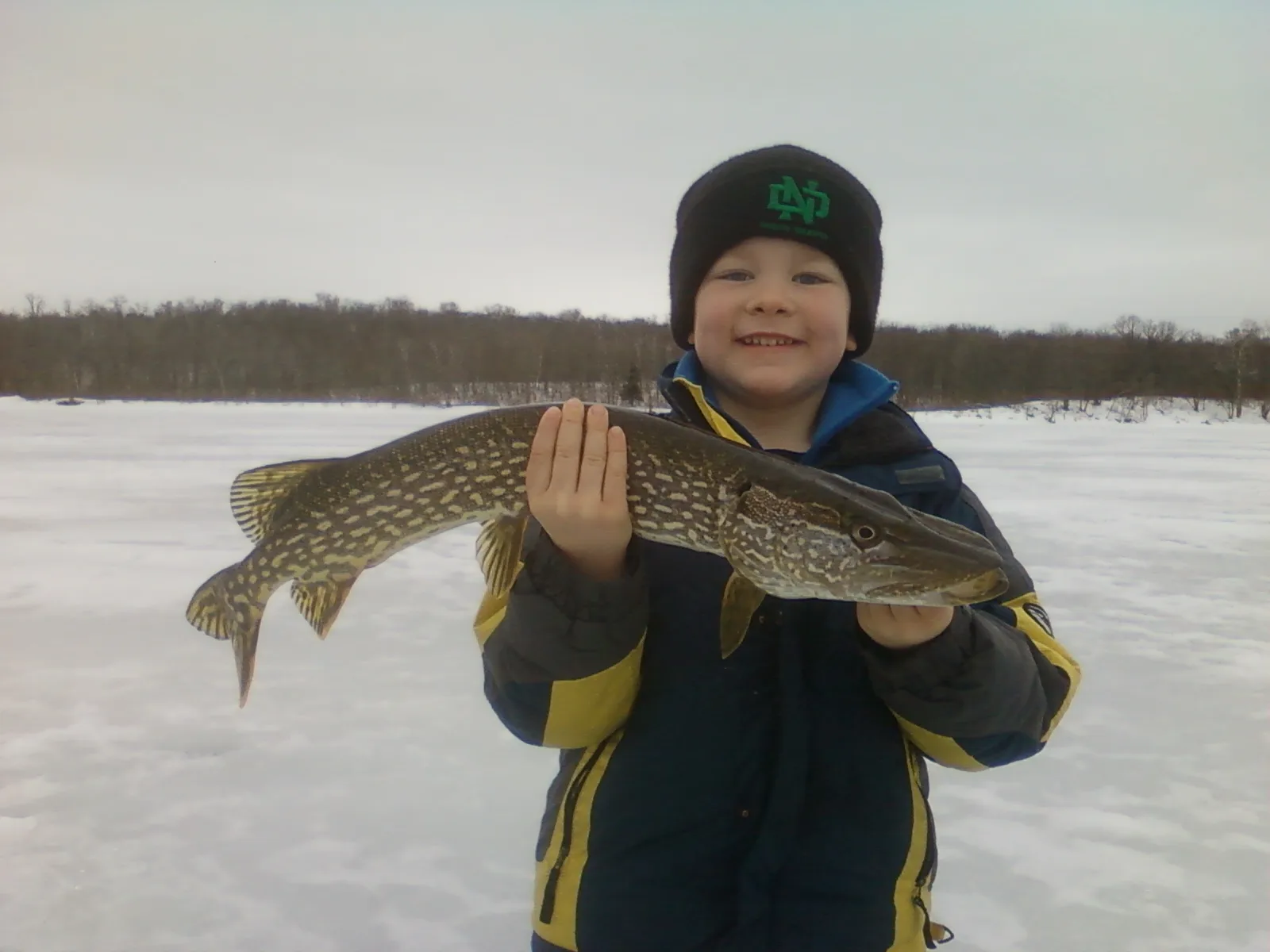
Ice fishing for pike is tip-up fishing: a sucker or shiner hung under a flag, 6 to 15 ft deep, along weedlines, points and narrows. The tip-up is “the best way to catch northern pike in winter,” Minnesota DNR says. The rest is where to drill, how high to hang the bait, and how long to stand over a flag.
Wisconsin DNR says pike are caught more easily in winter than in summer. On Michigan’s Houghton Lake, the ice fishery took 82% of the pike harvest.
Where are pike under the ice?
In winter, northern pike sit in many of the places you found them in fall, Minnesota DNR says. That means points, narrows, weedlines and other weedy spots where they wait to ambush prey. Much of that fishing happens in 6 to 15 ft of water. New York DEC puts pike tip-ups in 5 to 15 ft, around or over weed beds.
Where they sit shifts over the winter. At first ice, North Dakota Game and Fish’s Paul Bailey fishes deep, “sometimes 20 feet or more,” near the mouths of large bays. As the winter goes on, he works into the bays and shallower water.
Late ice pulls the big ones up. Maine IFW says trophy-size pike gather in shallow water as spawning nears. They spawn in shallow grassy areas starting while ice still covers the lakes, Minnesota DNR says. Late ice is “your best shot at a trophy pike,” says In-Fisherman’s Jeff Gustafson. He looks on flats of 8 to 12 ft just out from the first drop-off, where pike stage in front of the spawning bays.
One catch: in Minnesota, pike season generally runs only to the last Sunday in February. The late-March bite Gustafson fishes is in northwest Ontario, where the season is open all year. Check your own water before you plan around it.
And check the ice before you walk out. The ice thickness chart has the minimums by agency.
How do you set a tip-up spread for pike?
Spread the flags across the spot instead of bunching them. Minnesota DNR’s example: on a drop-off, set tip-ups at the 10, 12 and 15 ft contours. On a point, start shallow and drill a new hole every 10 to 20 yd out into deeper water. Here is the whole spread, with who says each part.
| Decision | First pick | Other choice | Who says it |
|---|---|---|---|
| Spot | Points, narrows, weedlines | Points and pockets on a weed edge; rock flats at the drop | Minnesota DNR; Doug Stange |
| Water depth | 6 to 15 ft (1.8–4.6 m) | 20 ft (6 m) or more near big bay mouths, early in the season | Minnesota DNR; Paul Bailey |
| Spacing | 10, 12 and 15 ft contours, or a hole every 10–20 yd (9–18 m) | Deep edge, pockets, and the crest and base of the drop | Minnesota DNR; Stange |
| Bait | Sucker or shiner under 12 in (30 cm) | Biggest dead smelt you can find | Minnesota DNR; Bailey |
| Bait height | Near bottom to a few feet under the ice, where baitfish are | About 18 in (46 cm) off bottom; 3 ft (0.9 m) or more in clear water | Minnesota DNR; Bailey |
| Line and leader | 45–70 lb braid, 2–3 ft wire or fluorocarbon leader | 40 lb braid, 100 lb fluorocarbon leader | Minnesota DNR; Bailey |
| Check the bait | Every half hour or so, and jig it now and then | — | Minnesota DNR |
| Time on a spot | 1 hour on a small spot, 2 hours on a big one | Stay while the flags keep flying | Stange |
Stange’s whole system is mobility. Pike are “lazy prowlers,” he writes, and in most cases a tip-up shouldn’t sit in one spot for more than a few hours. Give the spot its hour or two, then pull the flags and move. Twenty flags in half a day isn’t unusual, he writes.
Mind your count. Minnesota allows two lines each and Ohio up to six tip-ups, so a spread this wide takes a group. The state rules are at the bottom of the page.
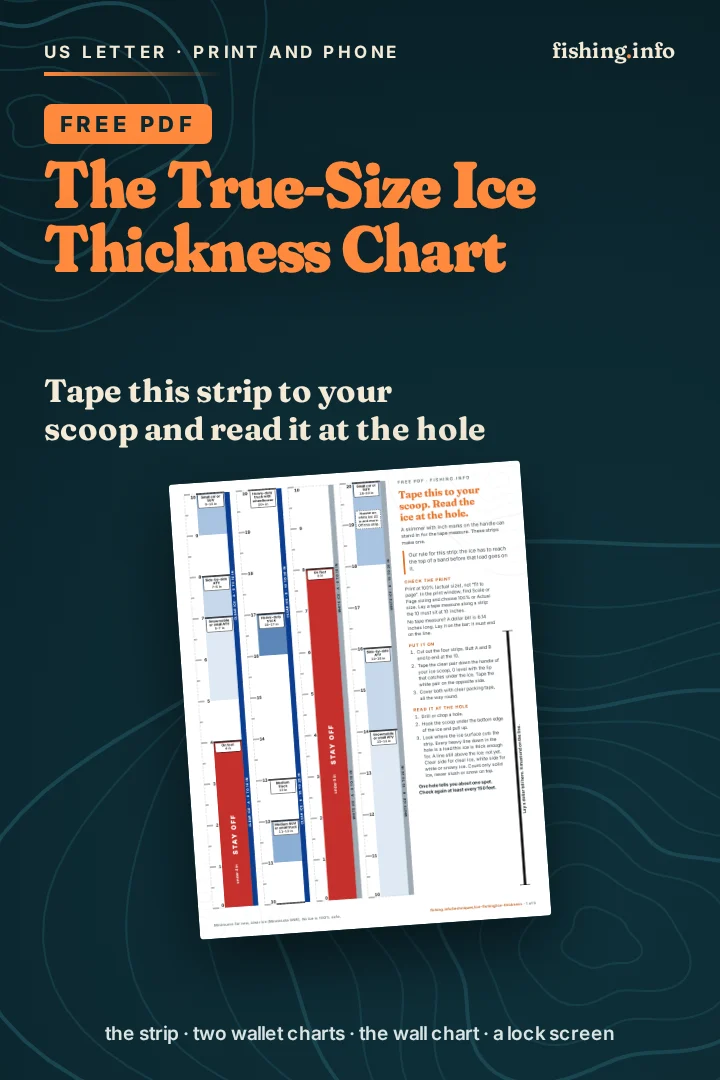
Free PDF · Ice thickness chart How thick is the ice? Read it at the hole.
Print the free chart, tape the strip to your scoop and hook it under the ice. It shows what that ice is thick enough for, clear or white. Two wallet charts and a wall chart come with it.
No card, nothing to buy, and the PDF is yours to keep. Confirm with one click and it's on its way. Then a few short emails and one a week on what's biting. Unsubscribe anytime. Privacy.
What leader do you need for pike on the ice?
Wire, or heavy fluorocarbon. Pike teeth cut through line, and New York DEC recommends a wire leader on pike tip-ups. Minnesota DNR wants 2 to 3 ft of wire or fluorocarbon between the line and the hook. Pike feed by sight, it says, but a visible leader doesn’t seem to put them off.
If you go with fluorocarbon, go heavy. Bailey builds his own leaders from 100 lb fluorocarbon, a trick he took from musky anglers.
What’s the best bait for pike through the ice?
A live sucker or shiner is the first pick. Minnesota DNR wants a minnow big enough that perch can’t trip the flag, but under 12 in. Bigger ones cost more and may not catch more. New York DEC says pike usually prefer 4 to 7 in minnows, and Wisconsin DNR names small suckers and chubs up to 8 in (20 cm). Stange runs lively 6 in shiners or chubs on quick-strike rigs, not big baits. A quick-strike rig is two small trebles on a wire leader, so you can set the hook the moment a pike takes. Sizes and kinds of bait shop minnows are on their own page.
Hook a live one between the dorsal fin and the tail so it hangs naturally, Minnesota DNR says, and miss the spine or it dies.
Dead bait is the big-fish play. Bailey wants “the largest vacuum-sealed rainbow smelt” he can find, and says 10 in smelt are fair game for pike of 40 in or more. At late ice Stange switches to bigger dead baits. Gustafson’s trophy bait is an oversized dead cisco or sucker.
Gustafson’s trick for a dead bait that floats: poke a few holes in its side with a knife and squeeze the air out. You can add weight instead, but baits that are too heavy tend to trip the flag and give false alarms, he warns.
Dead bait has rules too. Minnesota lists smelt, and cisco under 7 in, as restricted bait. Wisconsin says frozen fish can’t be used on any water but the one they came from. The exceptions: Lake Michigan and its tributaries, or fish thawed and then preserved in a way that needs no refrigeration or freezing. Check your own state’s baitfish rules before you buy a bag of smelt.
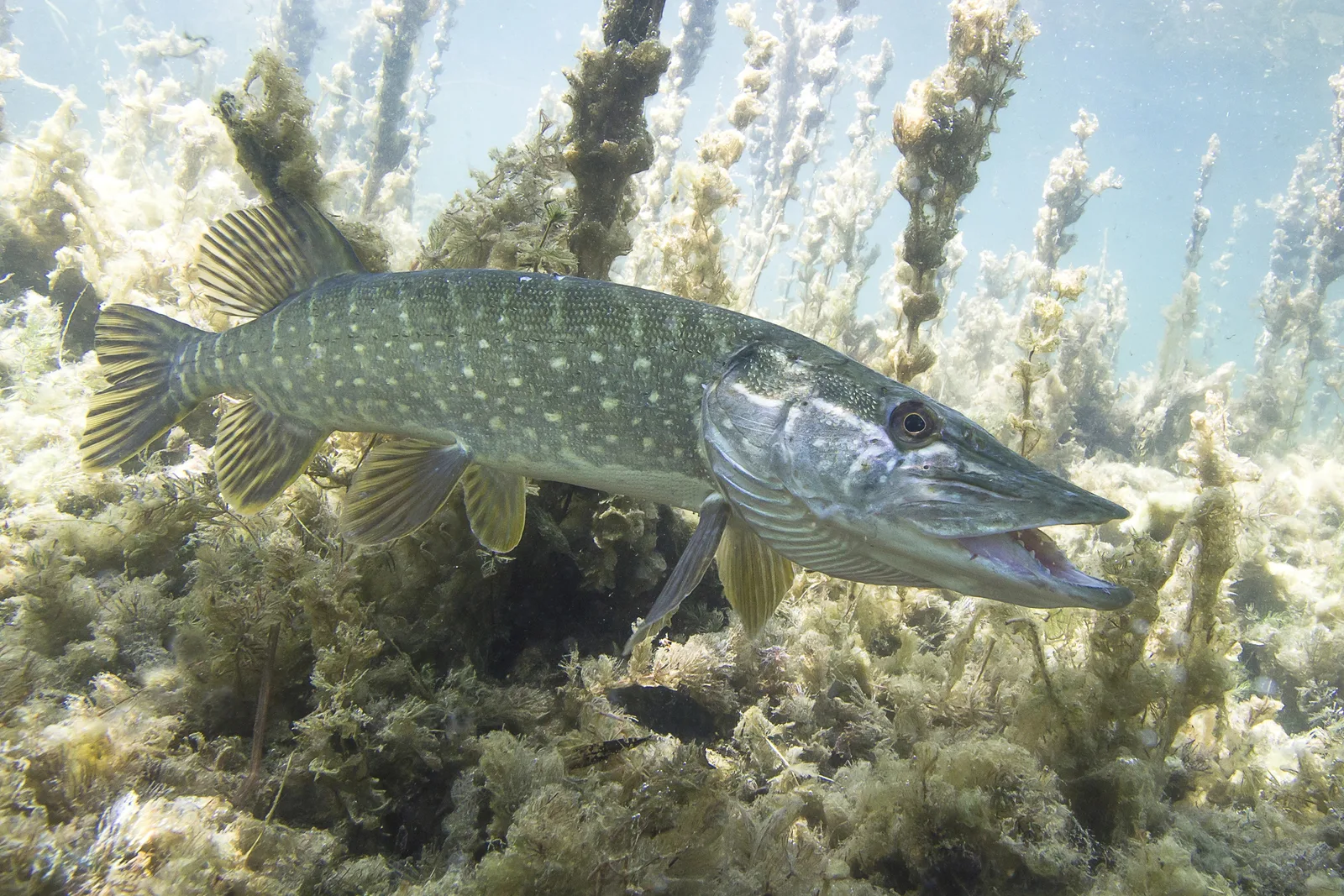
How far off the bottom should the bait hang?
There’s no single answer, and the people who fish pike hardest don’t agree. Here are four to test on your own lake.
- About 18 in (46 cm) for dead bait, Bailey says. In clear water he goes 3 ft (0.9 m) or higher, because pike are used to hitting prey above them.
- About 1 ft (30 cm) for Gustafson. He lets the bait touch bottom, then raises it a foot.
- 2 to 3 ft (0.6–0.9 m), or high enough to clear the weeds, New York DEC says.
- Wherever the baitfish are, from near bottom to a few feet under the ice, Minnesota DNR says. It tells you to experiment.
Stange adds a pattern for the day. Pike on shallow flats ride the lower fifth of the water column in the morning and rise toward mid-column as the day goes on. Past the drop-off they hold close to bottom.
To hit the same height every time, clip a depth sounder on the hook and let it find bottom, New York DEC says. Raise it to the height you want and mark the line at the water with a small bobber or a button. The marker brings the bait back to the same depth after every reset.
When do you set the hook on a pike tip-up?
Don’t run to a flag. Ice is slippery, Minnesota DNR says, and there’s no sense getting hurt. A pike often takes a big minnow sideways, swims with it, then turns it head first to swallow, so you have time. What you do when you get there is the one thing the sources disagree on.
| When to set | Who says it | Their reason |
|---|---|---|
| At once, on a quick-strike rig | In-Fisherman (Rob Neumann, Doug Stange); Wisconsin DNR for pike you’ll release | The pike is hooked in the mouth and easier to unhook |
| After 15 seconds or more, once the run slows or you feel dead weight | Minnesota DNR; Wisconsin DNR for minnows | The pike swims with the minnow, then turns it to swallow |
| After a few minutes | MeatEater (Ryan Brod) | Gives the pike time to swallow the bait |
| A short, quick tug as soon as you get there | Maine IFW (all species) | Get there as quick as possible |
Wisconsin DNR’s leaflet gives both answers. With minnows, wait for the pike to run and swallow before you set. If you’ll release the fish, use a quick-strike rig and don’t let it swallow the bait. So a pike you’ll keep can have its run, and one you’ll let go gets the hook at once.
A test published in 2020 timed this on pike through the ice. Althoff, Hasler and Louison waited set times of 0 to 7 minutes on tip-ups before setting the hook, and landed 65 pike from 142 bites. The longer the wait, the deeper the hook went. None of the pike swallowed the hook outright, and the long waits more often ended with the bait dropped. The advice that came out of it: keep the time from flag to hook-set short.
That fits the case for the quick-strike rig. Stange found #4 and #6 trebles hook and land better than larger sizes. And a pike hooked shallow is easier to unhook and more likely to live, Neumann says. Minnesota’s November 2025 change helps too. A single rig may now carry up to three hooks within 18 in of line, up from 9 inches. Minnesota says the longer limit suits larger gamefish and should mean fewer swallowed hooks.
Can you jig for pike through the ice?
Yes, and the easy way is one jigging rod beside the tip-ups. Bailey sets three rods with dead bait and jigs a fourth. His go-to presentations are large, vibrating lures and bucktail jigs with plastic trailers.
Stange jigs a dead sucker of 6 to 8 in on a quick-strike rig. He uses a sturdy rod and at least 14 lb line. He drops it just above bottom, lifts it 2 ft and lets it flutter back. Then he holds it still for one to two minutes.
Tip: Lift 2 ft, let it flutter back, then hold it still for one to two minutes. The lift calls the pike over. The pause makes it bite.
Pike often hit on the first drop or the first lift in a new hole, Stange says. Fish a hole five minutes or so, then move. When a pike takes, drop the rod tip toward it as it swims off, then set. No waiting for it to swallow.
A big ice spoon works the same lift and fall. Northland’s Buck-Shot Rattle Spoon runs up to 1 oz, and the maker names pike among its targets. Outdoor Life’s Jason Halfen puts pike rods at 40 to 48 in, the long end for ice fishing rods.
Don’t expect the giants on a jig, though. Gustafson says you can catch pike jigging lures, “but you won’t catch as many, nor the true giants” that dead bait under tip-ups brings. Open-water picks are in the best pike lures.
What time of day do pike bite through the ice?
Daylight. Wisconsin DNR says pike feed by sight and bite best in daylight hours. Stange goes further: morning is almost always better than late afternoon. In more than 25 years, he writes, fishing into sunset paid off only a time or two. That’s walleye time, he says.
Pike hunt by sight, which is why water clarity steers where Bailey drills. In clear water he also hangs the bait higher.
How do you land a big pike through the hole?
Start with a hole the fish fits through, and one that’s legal.
| Hole | Who says it |
|---|---|
| 6 in (15 cm) is plenty, unless you’re after very large fish like pike | Minnesota DNR |
| 8 in (20 cm) or more for pike | New York DEC |
| 10 in (25 cm) for larger gamefish | Jiffy, the auger maker |
| No more than 12 in (30 cm) | Wisconsin and Ohio law |
| No more than 10 in | Pennsylvania law |
| Over 10 in: mark it when you leave | North Dakota law |
So a 10 in ice auger is legal in every state on that list, and an 8 in is the smallest New York lists for pike.
Then bring the fish up by hand, slowly. Maine IFW says pull the line in hand over hand, keep steady pressure, and let the fish take line when it runs. Minnesota DNR’s heavy braid is partly for this: thicker line is easier on your hands. Gustafson warns that braid can cut your fingers if it wraps around them while a big fish runs. With two people, MeatEater’s Ryan Brod has one fight the fish while the other tends the loose line and the spool.
Bailey goes a step further. He fishes rod-and-reel versions of the tip-up, because a reel’s drag helped him land big pike he believes he’d have lost hand-lining.
How do you handle and release a pike on the ice?
Fast, and away from the teeth. Bailey’s five steps for catch and release on the ice:
- Land the fish as quickly as you can.
- It has to come up through the hole vertically. Keep that time short to protect its organs.
- Keep your hands off the gills and eyes.
- Have pliers, jaw spreaders and the camera ready before the fish is out.
- Get it back in the water quickly.
His rule of thumb: the pike stays out no longer than you can hold your breath. In freezing air, a fish’s eyes and gills are quickly damaged.
Minnesota DNR adds the rest. Never put a finger in a pike’s mouth. Use needle-nose pliers, and a second pair to hold the mouth open if you need it. Hold the fish horizontally, because hanging it straight down stresses the spine. If a hook is set deep, cut the line and leave it.
Keeping one? Minnesota DNR calls pike excellent table fare, if a little harder to fillet. Bailey keeps pike of 24 to 30 in to eat and lets the bigger ones go.
What are the rules for pike tip-ups?
Ice fishing rules change at the state line. In Michigan and North Dakota a tip-up counts as one of your lines. Ohio caps tip-ups at six.
| State | Lines through the ice | When a line counts as attended |
|---|---|---|
| Minnesota | 2 (1 on designated trout lakes) | In sight of the line, or within 200 ft (61 m) of a tip-up |
| Wisconsin | 3 hooks, baits or lures | Not responding at once to a bite counts as unattended |
| Michigan | 3 lines, tip-ups included | “Immediate control” |
| North Dakota | 4 poles; each tip-up is one | Easily visible, within 150 ft (46 m), checked at least every hour |
| Ohio | 3 rods or hand lines; no more than 6 tip-ups | “In hand or under control” |
| Pennsylvania | 5 devices | Not set in the ice fishing rule |
| New York | 7 lines | “Immediate attendance” |
Two Minnesota points catch people out. A phone alert from a tip-up doesn’t count as attending your line. And Minnesota DNR announced on November 17, 2025 that hook-setting tip-ups are legal on Minnesota ice. The hook-setter has to be non-motorized, working off a spring or a bent rod, and the device can’t reel in line or fish. You still have to stay within 200 ft. Minnesota DNR says these devices may cut down on swallowed hooks. The change came after that season’s booklet was printed, so the DNR said it would be listed in the 2026 regulations. Some copies of the rule book online still show the old ban and the old 9 in limit. Go by the DNR release.
The table is a starting point, not the law. Check your state’s current regulations and the special rules for your lake before you set a flag. In Ohio, read the current rule: a change to it was proposed in 2025.
That’s most of pike ice fishing: the right spread, the right bait, and a short wait on the flag.

Free PDF · 5 pages
Stop guessing the ice. Tape this strip to your scoop and read it at the hole
Ice that is 6 or 7 inches thick in one spot can be 2 inches close by. You can't tell by looking.
The True-Size Ice Thickness Chart. Print it, tape the strip to your ice scoop, hook it under the ice and read the band at the surface: on foot, sled or truck. One side for clear ice, one for white.
- A true-size strip for your scoop handle, marked from "stay off" to a truck with a wheelhouse
- Two wallet charts, one for your buddy, with five moves that get you out if you go through
- Why 8 inches of white ice counts as 4, and the ice to stay off at any thickness
Every clear-ice number is the Minnesota DNR's, set beside the 29 sources on the page, the Army Corps of Engineers among them.
No card, nothing to buy. Confirm with one click and the PDF is on its way, one version for your phone and one to print, yours to keep. Then a few short emails and one a week on what's biting, with an unsubscribe link in every one. Privacy.
Related
Section guide
Ice Fishing: How to Ice Fish, Step by StepHow to ice fish: wait for 4 in of clear ice, drill all your holes, fish one jigged line and one still. Gear, bait, tip-ups and line limits in 12 states.
 Crappie Ice Fishing: Where They Suspend and What to Drop
Ice fishing for crappie: where they hang under the ice in each kind of lake, the dusk and night bite, tiny jigs, two lines, and the 20 ft rule.
 Ice Thickness Chart: How Thick Ice Must Be to Walk, Ride or Drive
Ice thickness chart for walking, snowmobiles, cars and trucks, with white ice doubled, what each inch holds in pounds, and how to measure it yourself.
 Perch Ice Fishing: Where Perch Sit Under the Ice and How to Catch Them
Perch ice fishing: fish near the bottom, from weeds under 10 ft to flats at 40 ft, with 1/64 to 1/16 oz jigs and spikes. Plus 8 steps to stay on a school.
 Walleye Ice Fishing: Where, When and How to Catch Them
Walleye ice fishing peaks in the 90 minutes before and just after sunset. Where they sit, how deep by lake, spoon or Jigging Rap, tip-ups and line rules.
Sources (27)
- Minnesota DNR, Ice fishing for northern pike
- Minnesota DNR, Learn to ice fish
- Minnesota DNR, News release: Hook-setting devices allowed starting with the 2025-26 ice fishing season (November 17, 2025)
- Minnesota DNR, MinnAqua species profile: northern pike
- Minnesota DNR fishing regulations, General Regulations (eRegulations)
Show all 27 sourcesShow fewer sources
- Minnesota Statutes 97C.321, Restrictions on unattended lines
- Paul Bailey, Targeting Big Pike in Winter, North Dakota Outdoors (November 2016)
- North Dakota Game and Fish, Fishing regulations (April 1, 2026 through March 31, 2028)
- Wisconsin DNR, Northern Pike (Esox lucius), PUBL-FM-707 (2008)
- Wisconsin DNR, Guide to Wisconsin Hook and Line Fishing Regulations 2026-2027
- Wisconsin DNR, How VHS rules affect anglers (Q&A)
- Michigan DNR Fishing Guide, Lawful Fishing Methods (eRegulations)
- Smith, Kovacs and others (2016), Management Plan for Northern Pike in Michigan, Michigan DNR Fisheries Report 15
- New York State DEC, Guide to Ice Fishing (I FISH NY)
- New York State DEC, General Freshwater Fishing Regulations
- Ohio Administrative Code, Rule 1501:31-13-01 (effective June 30, 2024)
- 58 Pa. Code § 63.10, Ice fishing (Cornell LII)
- Maine IFW, Ice Fishing Guide
- Maine IFW, Northern Pike Assessment
- Althoff, Hasler and Louison (2020), Impact of retrieval time and hook type on hooking depth in ice-angled northern pike caught on tip-ups, Fisheries Research 225
- Doug Stange, Pike Fishing System, In-Fisherman (2010)
- Jeff Gustafson, How to Catch Mega Pike From the Ice, In-Fisherman (2025)
- Rob Neumann, Pike Quick Strike Rigs, In-Fisherman (2014)
- Ryan Brod, Hardwater Basics: A Guide to Tip-Up Fishing, MeatEater (2019)
- Jason Halfen, How To Rig Your Ice Fishing Rods And Reels For Any Fish, Outdoor Life (2019)
- Jiffy, 8" Model 60 ice auger
- Northland Tackle, Buck-Shot Rattle Spoon