 By
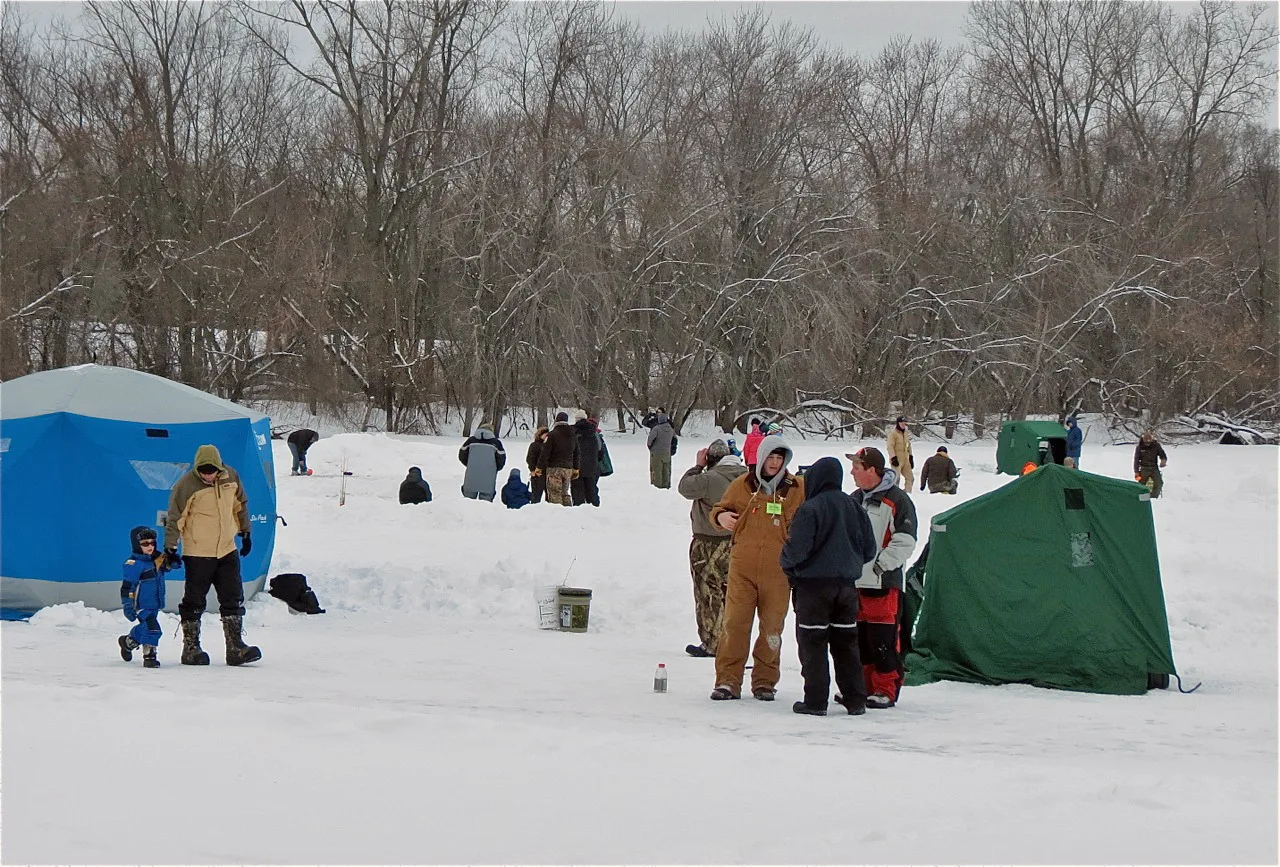
Pick a flip-over if you fish alone and move a lot, and a hub if two or three of you fish from one spot. For 50 lb, Clam’s three-person X-400 hub gives you 64 sq ft of floor. A one-person flip-over gives 11 to 15 sq ft for 50 to 65 lb, but its sled and seat come with it. Every spec and price here is from the maker’s own page, read November 15, 2026, and we didn’t test these shelters ourselves.
A hub gives you a square foot of floor or more for every pound you pull. A one-person flip-over gives you about a quarter of that.
Hub or flip-over: which ice fishing shelter is right for you?
A hub, also sold as a pop-up, is a tent whose walls pop out around a hub in each side. It folds down into a bag. Inside, you get “considerably more fishable area” than in a flip-over. That’s the word of Outdoor Life’s Jim Edlund, who has used portable shelters for over 25 years.
A flip-over is a fabric shell on poles, fixed to a plastic sled tub with a seat. You sit down, pull the shell over your head and fish. Clam built its one-person Kenai for “efficient hole hopping” and says it gets you “fishing in seconds”. The design goes back to Dave Genz and the original Fish Trap of 1980.
Two more kinds fill the gaps. Some hubs have five sides instead of four, like Otter’s Vortex Pro Cabin. And Clam’s Pack Trap 1 is a one-person shelter on a hammock base, a tough fabric sling for your gear instead of a hard plastic tub. It has built-in skis and folds flat for the off-season.
Edlund sees hubs “taking over the marketplace”, but he still finds “a time and place for flip-over shacks on the ice.” The choice comes down to two things: how many of you fish, and how you get out there.
| How you fish | Shelter | Floor and weight (maker specs) |
|---|---|---|
| Alone, moving hole to hole | One-person flip-over | 11–15 sq ft, 50–65 lb with sled |
| Two, moving together | Two-person flip-over | 26 sq ft, 99 lb with sled |
| One or two, walking far | Light hub (four or five sides) | 34–48 sq ft, 34–36 lb |
| Three, staying put | Three-person hub | 34–64 sq ft, 34–50 lb |
| Four or five, a base camp | Large hub | 75–94 sq ft, 57–68 lb |
How will you get it out there?
On foot, every pound is yours to drag. Clam says its flip-overs “can be easily pulled by hand or towed behind an ATV or snowmobile”. A three-person hub weighs no more than a one-person flip-over, but it rides in a bag on a separate sled with your auger, bucket and heater.
Your ride also sets the ice you need. Minnesota DNR says to fish on foot on 4 in of new, clear ice at the least. A snowmobile or small ATV needs 5 to 7 in. Double those numbers on white ice. Those are for moving, though, and in a shelter you sit still for hours. For a load that stays put more than two hours, Minnesota’s parked-load table asks 6 in for a person standing still and 10 in for a snowmobile and rider. Check the ice thickness chart before you load anything heavy.
Not sure you’ll stick with ice fishing? A shelter is one of the three big buys on any ice fishing gear list, with the ice auger and a sonar unit such as a flasher. Minnesota DNR says you can hold off on all three if you fish with someone who has them. Or rent a shelter at a resort first. The DNR says rental houses come with pre-drilled holes and heaters.
How many square feet do you get for the weight?
This is the trade-off behind every shelter. Floor space is where your holes, your bucket and your heater go. Weight is what you pull. Here are ten shelters, with the makers’ own figures and the floor you get per pound.
| Shelter (type) | Anglers (maker) | Floor, sq ft (m²) | Weight, lb (kg) | Sq ft per lb |
|---|---|---|---|---|
| Clam Kenai (flip-over) | 1 | 11 (1.0) | 50 (22.7) | 0.22 |
| Eskimo Wide 1 Thermal (flip-over) | 1 | 14.8 (1.4) | 65 (29.5) | 0.23 |
| Clam Pack Trap 1 (packable) | 1 | 15 (1.4) | 60 (27.2) | 0.25 |
| Clam Nanook (flip-over) | 2 | 26 (2.4) | 99 (44.9) | 0.26 |
| Eskimo QuickFish 3i (hub) | 3 | 34 (3.2) | 34 (15.4) | 1.00 |
| Eskimo QuickFish 3HD (hub) | 3 | 45 (4.2) | 41.5 (18.8) | 1.08 |
| Clam X-400 (hub) | 3 | 64 (5.9) | 50 (22.7) | 1.28 |
| Eskimo Outbreak 450XDP (hub) | 4–5 | 75 (7.0) | 57 (25.9) | 1.32 |
| Otter Vortex Pro Cabin (5-sided hub) | 2–3 | 48 (4.5) | 36 (16.3) | 1.33 |
| Clam X-600 (hub) | 5 | 94 (8.7) | 68 (30.8) | 1.38 |
Read it like this. The flip-overs sit at a quarter of a square foot per pound because their weight includes the sled or base they sit on. The hubs give a square foot or more, but you still need a sled to haul them. Otter’s own page gives two weights for the Vortex Pro Cabin, 36 lb in its feature list and 47 lb in its spec line. At 47 lb it still gives about 1 sq ft per pound.
How much floor does one angler need? Eskimo says the Wide 1’s “nearly 15 square feet” leaves room for a heater, electronics and a dead stick hole. A dead stick is a second line set in a holder beside the hole you jig. Edlund’s rule for a two-person hub is room for each angler to fish two holes, plus electronics, tackle and a heater.
So our rule of thumb is about 15 sq ft each. By that count, the 34 sq ft QuickFish 3i is snug for three. Edlund says it would be his basic hub for “just one kid and me (and probably the dog)”, and better for two adults sitting back to back. The 64 sq ft X-400 seats three with room to spare.
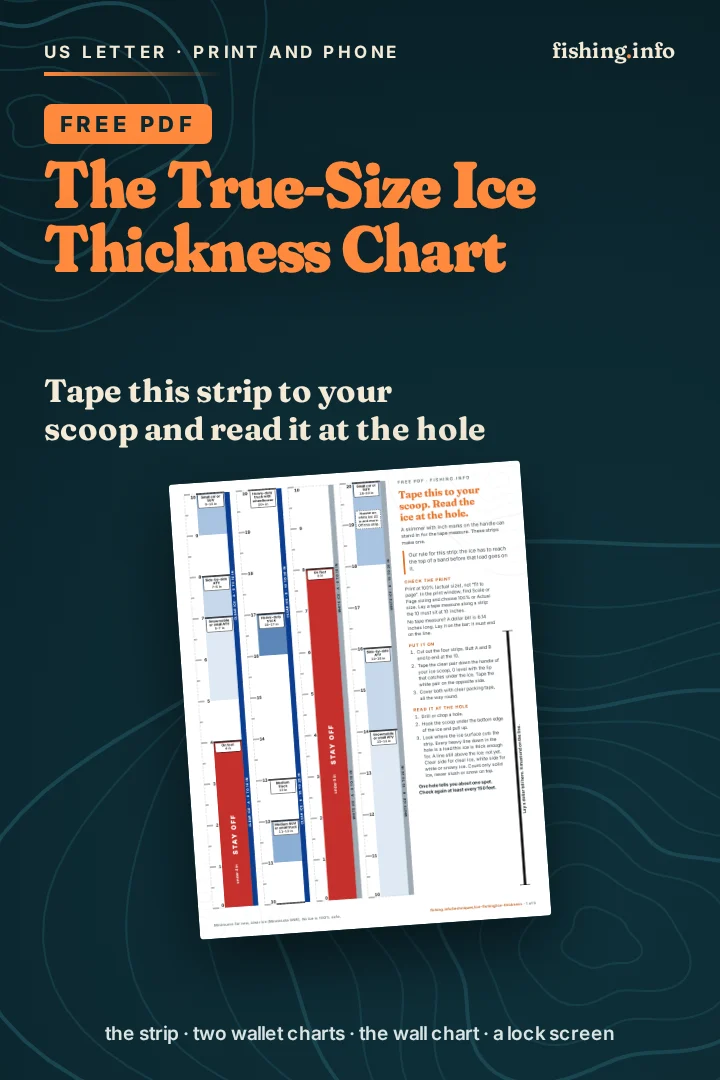
Free PDF · Ice thickness chart How thick is the ice? Read it at the hole.
Print the free chart, tape the strip to your scoop and hook it under the ice. It shows what that ice is thick enough for, clear or white. Two wallet charts and a wall chart come with it.
No card, nothing to buy, and the PDF is yours to keep. Confirm with one click and it's on its way. Then a few short emails and one a week on what's biting. Unsubscribe anytime. Privacy.
Are insulated ice fishing tents worth it?
Yes, for nearly everyone. Insulated shelters, sold as “thermal”, have a quilted lining in the walls. It holds the heater’s warmth in, and Eskimo says its insulated fabric also cuts condensation inside.
Edlund doesn’t hedge on this one: “I don’t think uninsulated shelters are worth the investment.” Non-insulated shelters, he says, “may be cheaper upfront but cost more in the long run when you consider propane usage.”
The price gap can be small. Eagle Claw sells its Shappell Wide House hub both ways. The 7 x 7 ft model costs $222.97 plain and $261.77 insulated, so the lining adds $38.80.
You’ll see a denier number on every spec sheet. Denier is the thickness of the fibers in the fabric’s threads, and Edlund says that “usually, the higher count the better.” Most shelters use 600 to 900 denier. Clam’s thermal hubs and flip-overs in the table list 900 denier with 90 grams of insulation per square meter. Its Pack Trap 1 uses 420 denier with 60 grams.
A warm shelter doesn’t replace warm clothes. You still walk out, drill and set up in the wind, so dress for that part of the day with proper ice fishing clothing.
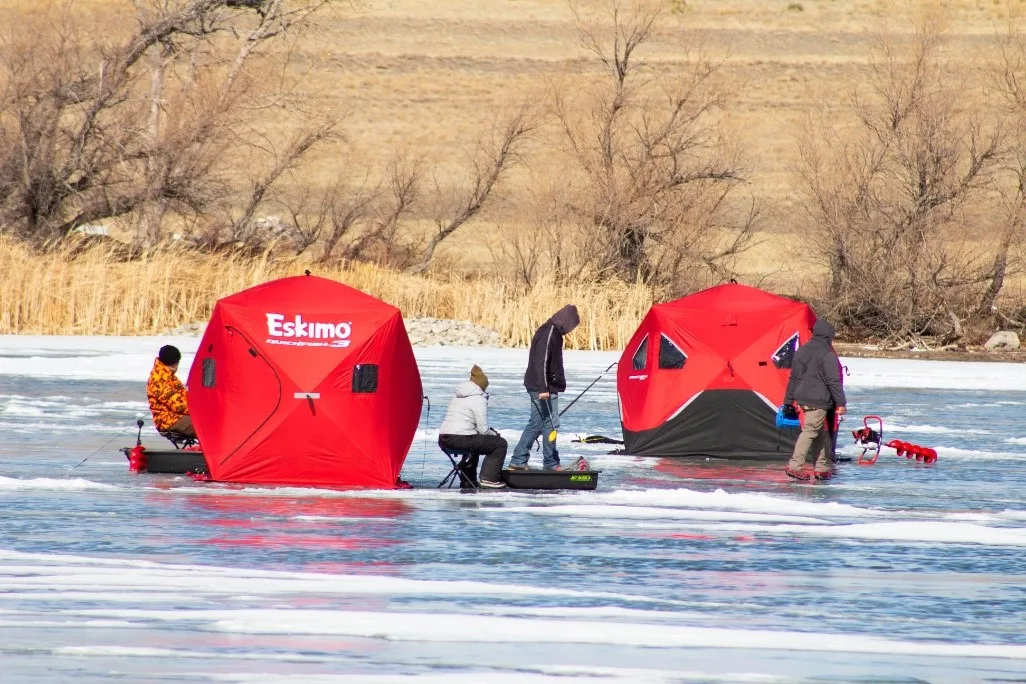
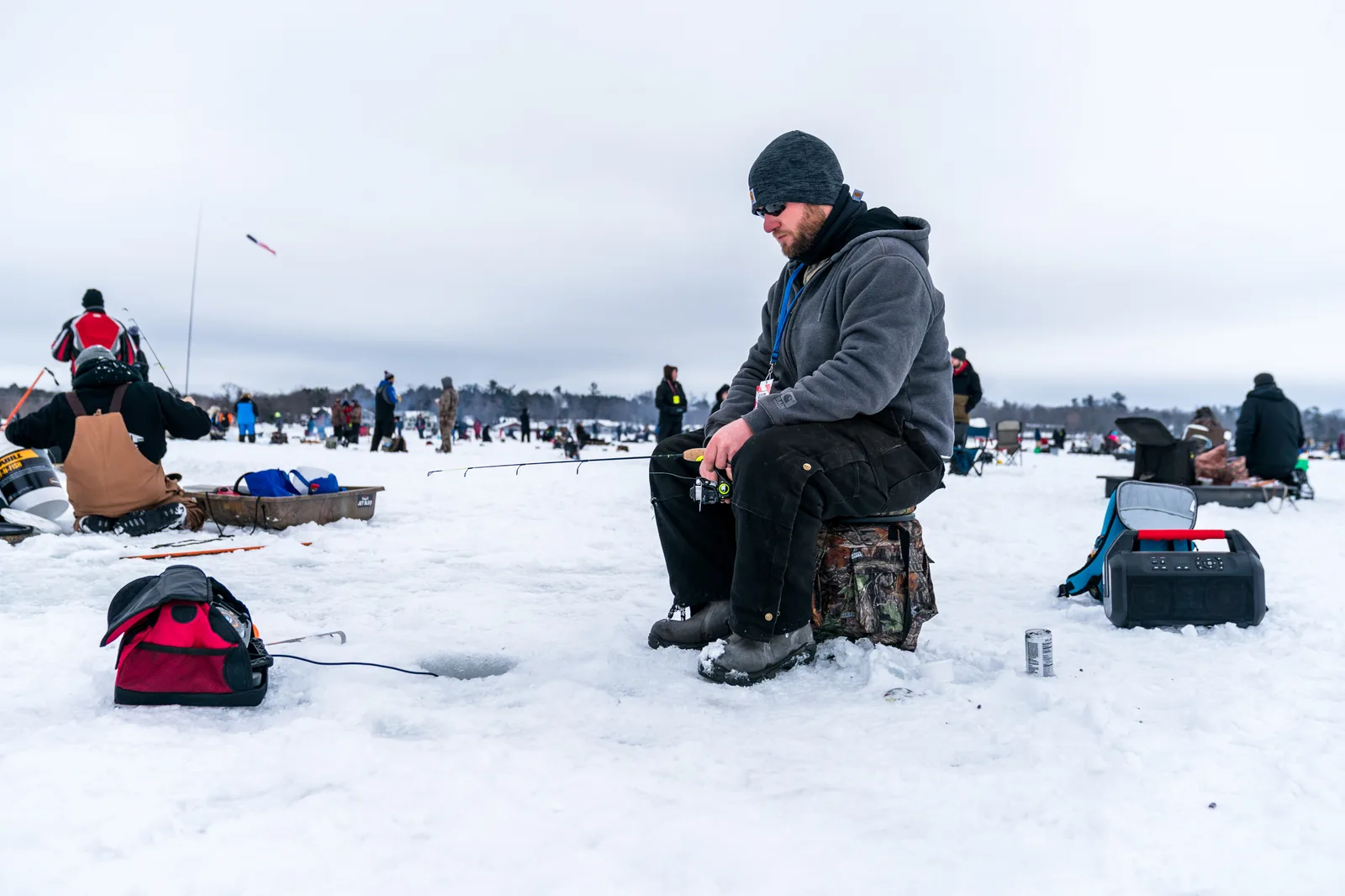
Two hub shelters on Pearson Lakes at F.E. Warren Air Force Base, Wyoming, during an ice fishing derby. Photo: F.E. Warren Outdoor Recreation Staff, via U.S. Fish and Wildlife Service (public domain).
How do you set up and anchor a hub?
A hub goes up fast. Eskimo sells its QuickFish 3i on a “60 second set up”: you pop out the hub in each wall and the shelter stands. Eskimo says takedown is just as quick.
Anchor it before anything else, because a light hub catches the wind. The big makers include ice anchors. Clam’s X-400 ships with them, Eskimo’s self-tapping anchors go in by hand, and Otter uses its own Ice-Lock system. Then bank snow, which means piling it around the base. Clam designed the X-400’s door so you can still bank snow “for wind protection”.
A flip-over needs less work. You pull the sled to your spot, drill, sit down and flip the shell over. Clam recommends fitting runners to the sled when you first put it together. Runners are strips under the sled that help it track and take the wear off the bottom.
Which sled carries which shelter?
A flip-over is its own sled. A hub needs one, and the simple rule is a sled a few inches longer than the hub’s bag. Makers list the sled’s outside length, and the floor inside is shorter where the walls slope, so a 65 in bag won’t lie flat in a 65 in sled. This table puts the makers’ packed lengths next to sleds that are longer.
| Hub | Packed length | A sled longer than that |
|---|---|---|
| Eskimo QuickFish 3i | 52 in (132 cm) | Jet Sled 1, 54 in, $59.99 (tight) |
| Otter Vortex Pro Cabin | 56 in (142 cm) | Eskimo E-Hauler XL, 64 in, $149.99 |
| Eskimo Outbreak 450XDP | 58 in (147 cm) | Eskimo E-Hauler XL, 64 in, $149.99 |
| Clam X-400 | 65 in (165 cm) | Otter Magnum Pro, 75 in, $200 |
| Clam X-600 | 75 in (191 cm) | Otter Large Pro, 85 in, $310 |
The lengths are the makers’. The matches are simple arithmetic on them, not a test. The Jet Sled 1 clears the QuickFish 3i by only 2 in, so measure the bag, and it was sold out at Eagle Claw on November 15, 2026. Otter’s 55 in Small Pro, at $95, is just as tight. A longer sled also leaves room for the auger, the bucket and a heater beside the bag. Otter sells its Pro sleds, from the Small up, for towing behind an ATV, UTV or snowmobile. To tow, plan on a hitch for your ice fishing sled, since Eskimo and Otter sell theirs separately.
How do you heat an ice shelter safely?
Use a heater made for indoor use, give it two vents and run a carbon monoxide detector. Carbon monoxide has no smell or color. Minnesota DNR says it can build up in your shelter “without you knowing and can quickly cause illness or death.”
A typical shelter heater is a small propane unit like Mr. Heater’s Portable Buddy. It runs on a 1 lb cylinder at 4,000 or 9,000 BTU, and the maker says it heats tents up to 225 square feet. Its manual is blunt about air: “This heater requires a vent area of 9 square inches (example 3” x 3” opening) minimum for adequate ventilation during operation.” The same line adds that you shouldn’t run any other fuel-burning appliance inside. If your shelter has no window or roof vent, the manual says “DO NOT USE THIS HEATER INSIDE.” It also says “NEVER OPERATE THE HEATER WHILE SLEEPING!” and to keep anything at least 24 inches from the front. Clam makes a smaller one for shelters, the CH-4200, at up to 4,200 BTU on a 1 lb cylinder for $89.99. Clam lists it as “CSA certified for indoor and outdoor use”, with an oxygen depletion sensor, which is the kind of heater the DNR rules below ask for.
The number: 9 square inches of open vent, at the least, for a Buddy heater in your shelter. That’s a 3 x 3 in opening, by its manual.
What are the carbon monoxide rules?
Minnesota DNR goes further than the box. These are its rules, word for word:
- “Every ice shelter should have a carbon monoxide detector. Be sure to test your detector regularly and keep your vents clear.”
- “Every shelter heated with propane needs a vent near the top and bottom of the shelter.” One opening goes “within one foot of the ground” for fresh air, the other “near the top of your shelter” to let the CO out.
- “Do not rely on your ventilation system or “low oxygen shut-off” sensors to work properly.”
- “Propane cylinders should remain outside your shelter at all times. The only exception being with small portable heaters – you may have a small (1lb) propane cylinder in your shelter.”
- “Never use sunflower type heaters inside your shelter. Only use heaters designated for indoor use.”
That third rule matters, because the Buddy sells on its Oxygen Depletion Sensor. Keep the detector anyway, and put it where the detector’s maker says to, as the DNR advises. The DNR adds that snow can block your vents, and that detector sensors last 5 years on average. Edlund keeps “two carbon monoxide detectors on at all times” in his big hub.
Know the signs. Minnesota lists headache, nausea, shortness of breath, fatigue, dizziness and mental confusion, and says it can feel like the flu. Get to fresh air at once.
The best ice fishing shelters: seven picks
Each pick fits one kind of trip. Prices are the makers’ own on November 15, 2026. Outdoor Life’s choices are Jim Edlund’s, in a review last updated February 1, 2024. He tested in Minnesota in temperatures from -10 °F (-23 °C) with a -30 °F wind chill down to the low -30s.
| Pick for | Shelter | Maker’s price |
|---|---|---|
| Three anglers | Clam X-400 Hub | $549.99 |
| Two anglers | Otter Vortex Pro Cabin | $425 |
| Four or five, a family | Eskimo Outbreak 450XDP | $629.99 |
| One angler on the move | Eskimo Wide 1 Thermal | $579.99 |
| Two anglers on the move | Clam Nanook | $899.99 |
| One angler, little storage room | Clam Pack Trap 1 | $699.99 |
| The tightest budget | Shappell Wide House WH5500 | $222.97, $261.77 insulated |
Clam X-400 Hub: best hub for three
It gives 64 sq ft for 50 lb, the most floor per pound of the hubs in the table rated for three. Clam rates it for “3 anglers comfortably”, with thermal fabric and ice anchors included. The bag is 65 in long, so plan on a long sled.
Otter Vortex Pro Cabin: best for two
Five sides, 48 sq ft and 36 lb by Otter’s feature list. A port for a propane hose lets a bigger tank stay outside. Edlund didn’t test it himself. It’s his Best for Two on the word of Minnesota guide Brian Brosdahl, who calls it “an incredibly high-quality hub at a reasonable price.”
Eskimo Outbreak 450XDP: best for a family
Edlund’s best overall was the Outbreak 450XD: “If I had to own just one fish house, this would be it.” Eskimo’s store no longer lists the 450XD. The 450 it sells now is the 450XDP, a newer version that packs shorter: 57 lb with 75 sq ft for 4 to 5 people. Edlund calls it right for “a couple of fishing buddies and a couple of kids.”
Eskimo Wide 1 Thermal: best one-person flip-over
It has 14.8 sq ft, an 18 in seat and insulated fabric, at 65 lb with its sled. Clam’s lighter Kenai (11 sq ft, 50 lb) was listed as out of stock for 2026, so the Wide 1 is the one in stock.
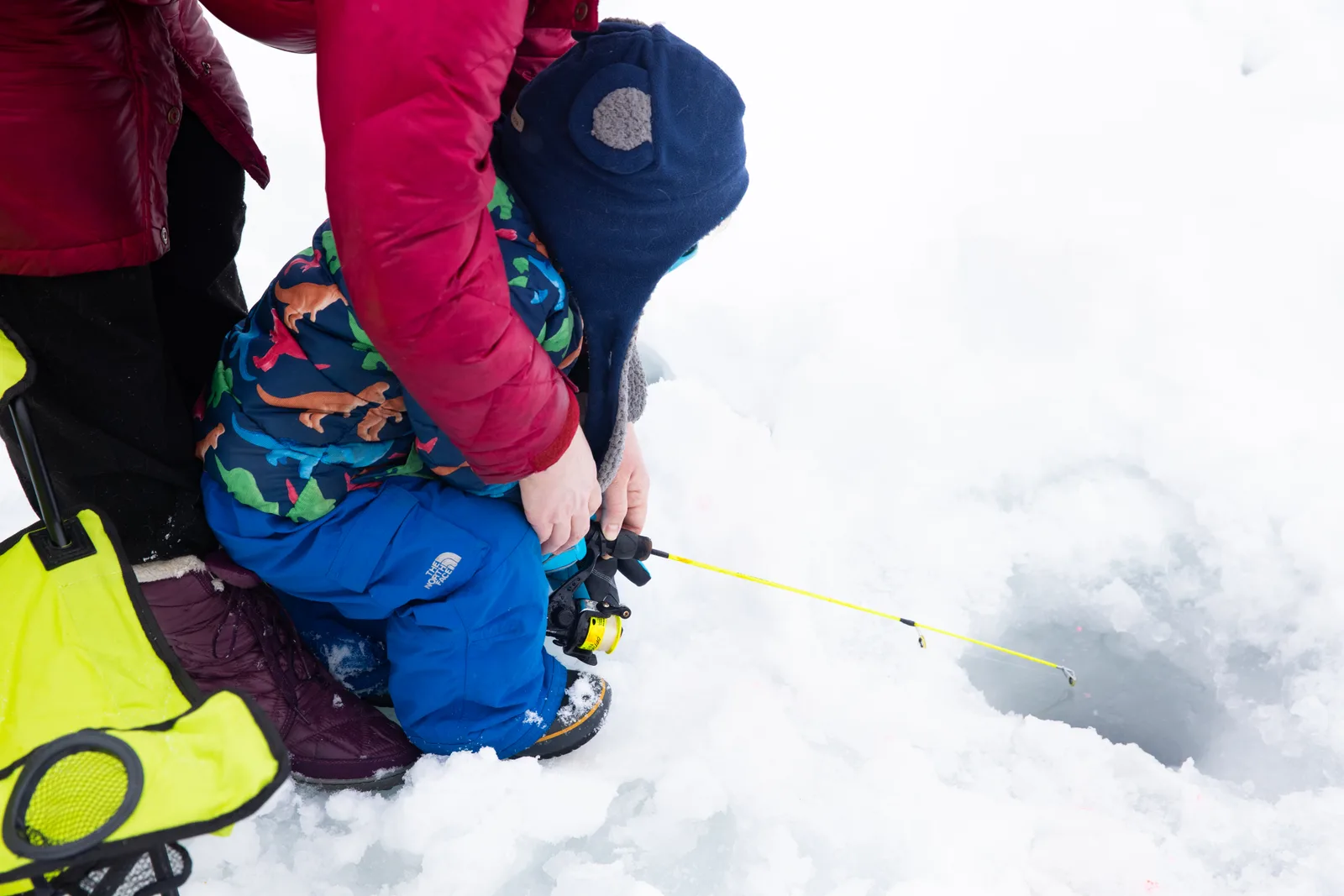
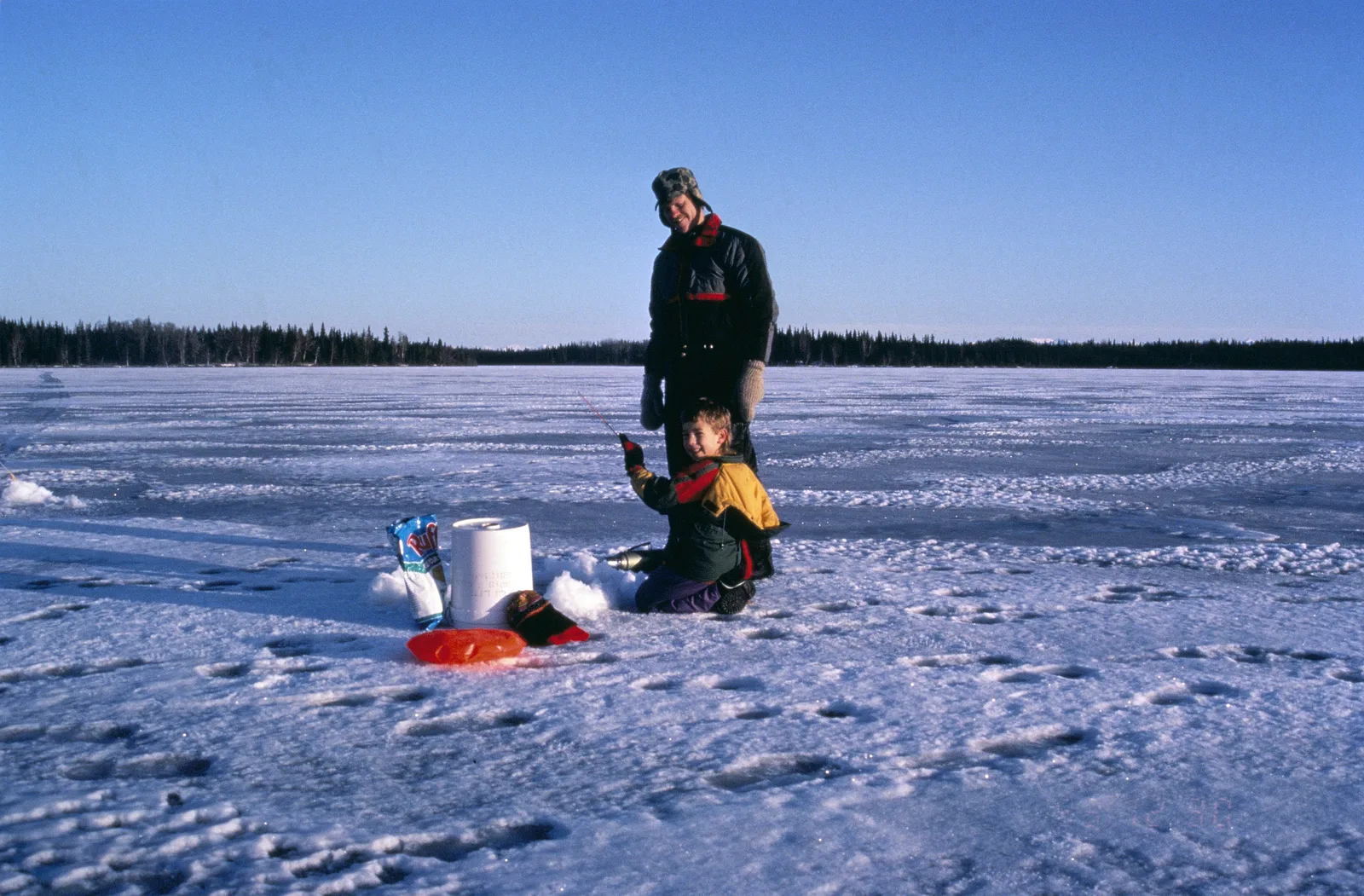
A small boy learns to ice fish with his family at Kenai National Wildlife Refuge, Alaska. Photo: Lisa Hupp, U.S. Fish and Wildlife Service (public domain).
Clam Nanook: best two-person flip-over
Clam calls it “a proven, best-selling flip-over shelter”, for two anglers for the day or one who wants extra room. You get 26 sq ft, but it weighs 99 lb, so a snowmobile or ATV makes the trip easier.
Clam Pack Trap 1: best packable one-person shelter
A one-person shelter on a hammock base with built-in skis. It gives 15 sq ft for 60 lb and folds flat to 11 in high for storage.
Shappell Wide House WH5500: the budget pick
Eagle Claw’s 7 x 7 ft hub costs about $200 less than the Vortex Pro Cabin plain. Get the insulated one, which is still about $160 less. The maker gives no weight or floor area, so you buy it on price.
Edlund’s Best Value, the Eskimo QuickFish 3i ($349.99), was out of stock at Eskimo on November 15, 2026. If it comes back, it’s the light hub to get: 34 sq ft for 34 lb.
What are ice fishing huts called?
Shanty, shack, fish house, ice house or hut: they’re all names for a shelter on the ice. Which one you hear depends on where you fish. In New Hampshire, even the state’s rules call it a bob house.
The permanent kind, a hard-sided shack or a wheelhouse on a trailer, is a different buy from the portable shelters on this page. A wheelhouse needs a lot of ice under it. Minnesota DNR lists 20 in or more for a heavy-duty truck with a wheelhouse shelter.
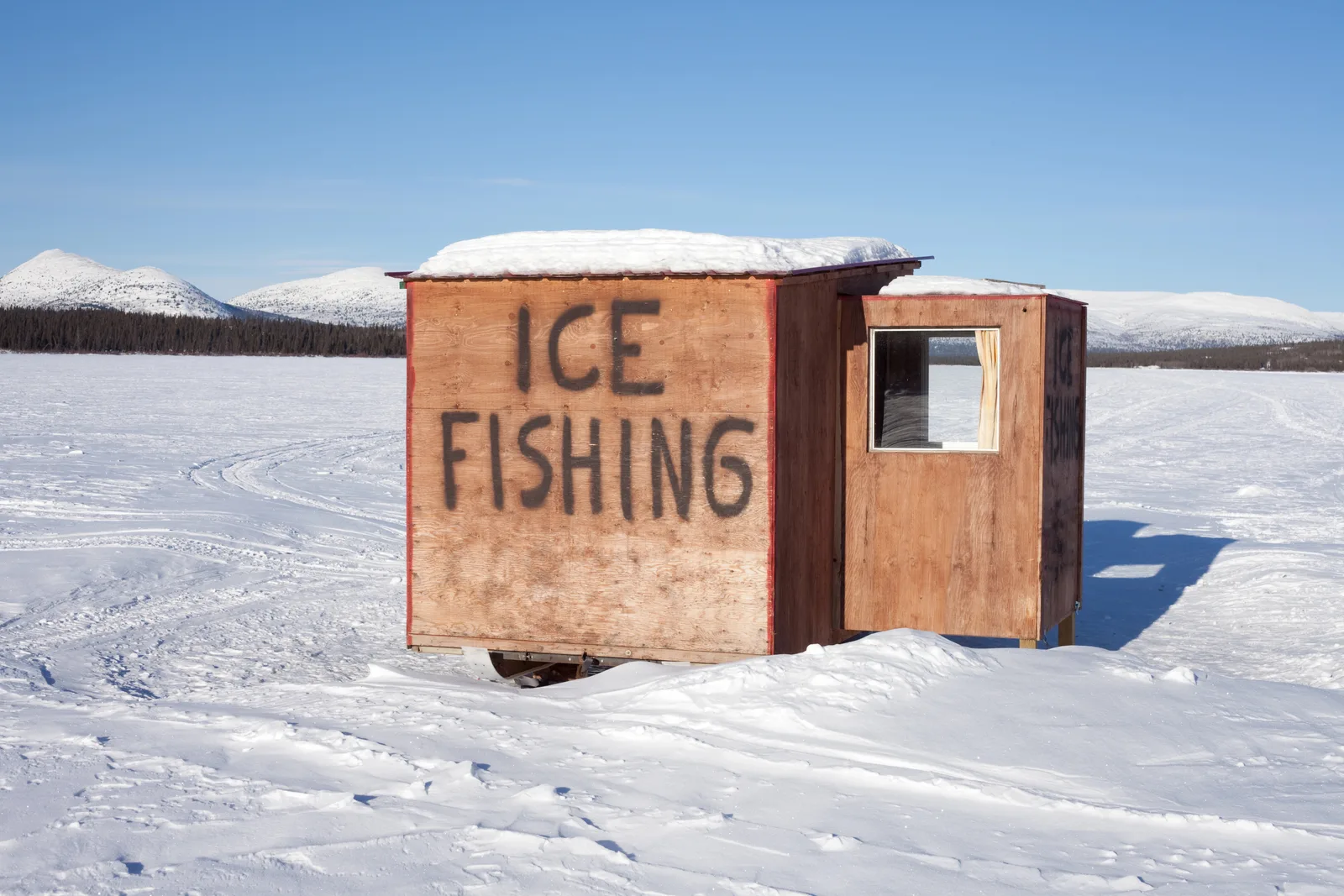
A hard-sided shack is the permanent kind of ice shelter. Photo: Depositphotos.
Do you have to mark your shelter or take it off the ice?
Leave a shelter on the ice and most states want your name on it, and a date it comes off. A hub or flip-over you take home each day is mostly exempt. Four big ice states, in their own rules:
- Minnesota: your name and address, driver’s license number or MDNR number on the outside, in characters at least 2 in high. An unmarked portable shelter is fine if you stay within 200 ft and don’t leave it between midnight and sunrise. No shelter may sit unattended overnight after the first Monday in March south of a line along U.S. 10, Highways 34 and 200 and U.S. 2. North of it, it’s the third Monday.
- Wisconsin: your name and address or DNR customer ID, in block letters at least 1 in square. A shelter that’s occupied or in use is exempt. Shelters left out come off by the first Sunday after March 1 south of Highway 64. North of it and on the Great Lakes, it’s the first Sunday after March 12.
- Michigan: your name and address, driver license number or sportcard number on each side, in characters at least 2 in high. A tent or temporary shelter you remove at the end of each day is exempt. In the DNR’s 2021 notice, shanties came off by March 1 in the southern Lower Peninsula and by March 31 in most of the Upper Peninsula.
- New York: your name and address in letters at least 3 in high, and off all waters by March 15. A portable shelter you remove daily doesn’t count as a shanty.
Border waters and other states set their own dates. Read your state’s fishing regulations before you leave a shelter out overnight.
How we chose
We started from the makers’ own spec sheets and stores, read on November 15, 2026: fishable area, weight, packed length, fabric and price, plus stock. The square feet per pound and sled matches are our arithmetic on those numbers. Opinions come from Outdoor Life’s Jim Edlund and the guide he quotes, and the safety lines from Minnesota DNR and Mr. Heater’s manual.
We didn’t set these shelters up or fish in them, and none of the links earn us anything. Prices and stock change all winter, so check the maker’s page before you buy.

Free PDF · 5 pages
Stop guessing the ice. Tape this strip to your scoop and read it at the hole
Ice that is 6 or 7 inches thick in one spot can be 2 inches close by. You can't tell by looking.
The True-Size Ice Thickness Chart. Print it, tape the strip to your ice scoop, hook it under the ice and read the band at the surface: on foot, sled or truck. One side for clear ice, one for white.
- A true-size strip for your scoop handle, marked from "stay off" to a truck with a wheelhouse
- Two wallet charts, one for your buddy, with five moves that get you out if you go through
- Why 8 inches of white ice counts as 4, and the ice to stay off at any thickness
Every clear-ice number is the Minnesota DNR's, set beside the 29 sources on the page, the Army Corps of Engineers among them.
No card, nothing to buy. Confirm with one click and the PDF is on its way, one version for your phone and one to print, yours to keep. Then a few short emails and one a week on what's biting, with an unsubscribe link in every one. Privacy.
Related
Section guide
Ice Fishing Gear: The Checklist and What a Starter Kit CostsThe ice fishing gear and equipment checklist, safety first, priced from makers' stores: a bare kit for about $320, a comfortable one for about $2,010.
 Ice Auger: What Size, Which Type, and How Many Holes per Charge
Most anglers need an 8 in battery ice auger. Hole sizes, electric vs. drill vs. hand, holes per charge in 12 and 24 in of ice, and 7 augers compared.
 What to Wear Ice Fishing: Layers, Bibs, Float Suits and Boots
What to wear ice fishing: three layers and no cotton, ice fishing bibs or a float suit, boots by their rating and gloves, with makers' prices.
 Ice Fishing Rod and Reel: The Length for Each Fish, and the Picks
Which ice fishing rod length and power for panfish, walleye and pike, inline or spinning reel, which line, and seven picks with the makers' prices.
 Ice Fishing Sled: What Size You Need, Hitches, and 9 Sleds Compared
An ice fishing sled sized to your shelter: three-person hubs pack 52 to 65 in long. Hand-pull or ATV sleds, hitch load limits, and 9 sleds compared.
 Ice Fishing Tip-Ups: How to Set One, and Which to Buy
Ice fishing tip ups: what one is, how to set it in eight steps, how many your state allows, and five to buy at the makers' own prices.
Sources (31)
- Clam Outdoors, X-400 Hub Shelter (64 sq ft, 50 lb, 3 anglers, ice anchors, snow banking door, price)
- Clam Outdoors, X-600 Hub Shelter (94 sq ft, 68 lb, 5 anglers, packed length)
- Clam Outdoors, Kenai FishTrap (11 sq ft, 50 lb, hole hopping, towing and runners, out of stock for 2026)
- Clam Outdoors, Nanook FishTrap (26 sq ft, 99 lb, two anglers, best-selling flip-over)
- Clam Outdoors, Pack Trap 1 (15 sq ft, 60 lb, integrated skis, fold-flat, 420 denier)
Show all 31 sourcesShow fewer sources
- Clam Outdoors, CH-4200 Heater (4,200 BTU, 1 lb cylinder, built for portable shelters)
- Eskimo, QuickFish 3i (34 sq ft, 34 lb, 60-second setup, self-tapping anchors, insulated fabric)
- Eskimo, QuickFish 3HD (45 sq ft, 41.5 lb)
- Eskimo, Outbreak 450XDP (75 sq ft, 57 lb, 4 to 5 people, price)
- Eskimo, Wide 1 Thermal (14.8 sq ft, 65 lb, seat height, price)
- Otter Outdoors, Vortex Pro Cabin (48 sq ft, weight, propane hose port, Ice-Lock anchors, price)
- Eagle Claw, Shappell Wide House Hub Shelters (sizes, fabric, prices)
- Eagle Claw, Jet Sled 1 (54 in long, price)
- Eskimo, E-Hauler XL Sled (64 in long, price)
- Otter Outdoors, Pro Sled Medium (65 in long, price)
- Otter Outdoors, Pro Sled Magnum (75 in long, price)
- Otter Outdoors, Pro Sled Large (85 in long, price)
- Otter Outdoors, Sleds (Pro sleds for ATV, UTV or snowmobile towing, sizes)
- Mr. Heater, Portable Buddy MH9BX operating instructions and owner's manual (vent area, sleeping, clearance, carbon monoxide)
- Mr. Heater, Portable Buddy Heater (tents up to 225 sq ft, Oxygen Depletion Sensor, price)
- Minnesota DNR, Carbon monoxide poisoning in ice shelters
- Minnesota DNR, Learn to ice fish (big-ticket items, renting a shelter)
- Minnesota DNR, General ice thickness guidelines
- Outdoor Life (Jim Edlund), The Best Ice Fishing Shelters of 2026, Tested and Reviewed (updated Feb 1, 2024)
- Minnesota Revisor of Statutes, 97C.355 Shelters on ice; dark houses and fish houses
- Wisconsin Administrative Code, NR 20.11 Fishing shelter restrictions
- Wisconsin DNR, 2026 Ice Shanty Removal Deadlines Approaching (February 19, 2026)
- Michigan Legislature, MCL 324.46502 Fishing shanty; affixing identification of owner
- Michigan DNR, ice shanty removal dates bulletin (February 19, 2021)
- New York State DEC, General Freshwater Fishing Regulations (ice shanties)
- New Hampshire Fish and Game on eRegulations, Ice Fishing (bob houses)