 By
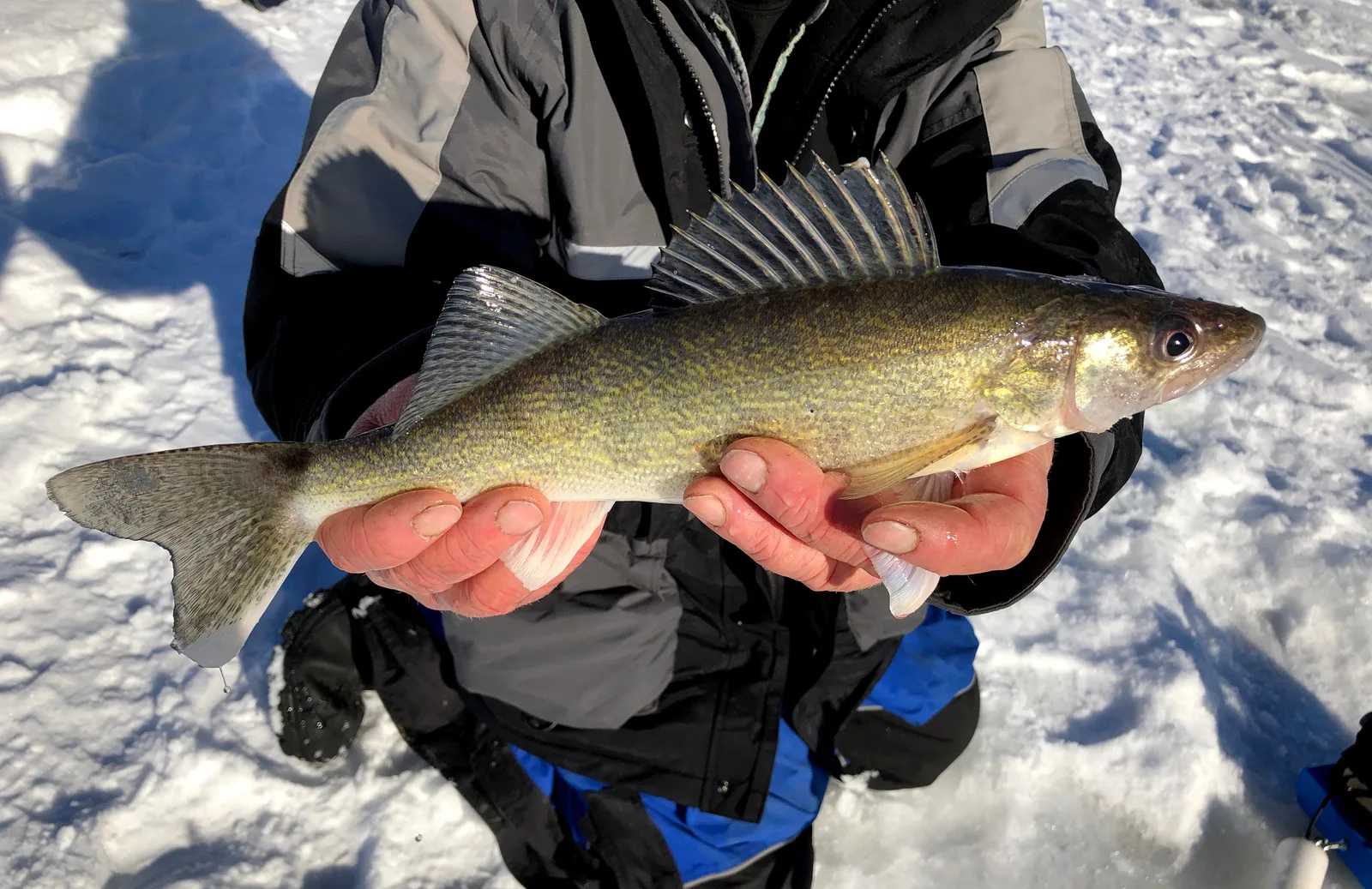
Walleye ice fishing is a low-light game: Minnesota DNR says the 90 minutes before and just after sunset are prime. Drill the same points, humps and drop-offs that held walleye in summer and fall, and fish within a few feet of the bottom. Jig a spoon tipped with a minnow head in one hole and let a live minnow sit still in the next. On a murky lake, the bite can last all day.
Same fish, different clock. On a stained lake the walleye bite often shuts down right after dark. On a clear lake you may have to stay after dark for the best catches, sometimes all night.
Where do walleye sit under the ice?
Start where you caught them in summer and fall. Minnesota DNR says walleye spend the winter on the same kind of structure: points, humps, narrows, drop-offs and saddles between humps or holes. A lake map with depth lines shows you where those are before you drill.
Skip Sommerfeldt, a Wisconsin DNR fisheries biologist who ice fishes about every day the ice is safe, adds the bottom types. He looks for gravel bars, rocky drop-offs, weed edges and mid-depth mud flats. He also likes a breakline where gravel or sand turns to soft bottom.
Depth follows the light. Many anglers sit in shallow water at dawn and dusk, perhaps 10 ft (3 m) or less, Minnesota DNR says, then move deeper when it’s bright. Sommerfeldt sets his tip-ups in 6–12 ft (1.8–3.7 m) on stained lakes and 10–20 ft (3–6 m) on clear ones. He adds that 2 ft, or more than 20, can be very good too, so treat his ranges as a start, not a fence.
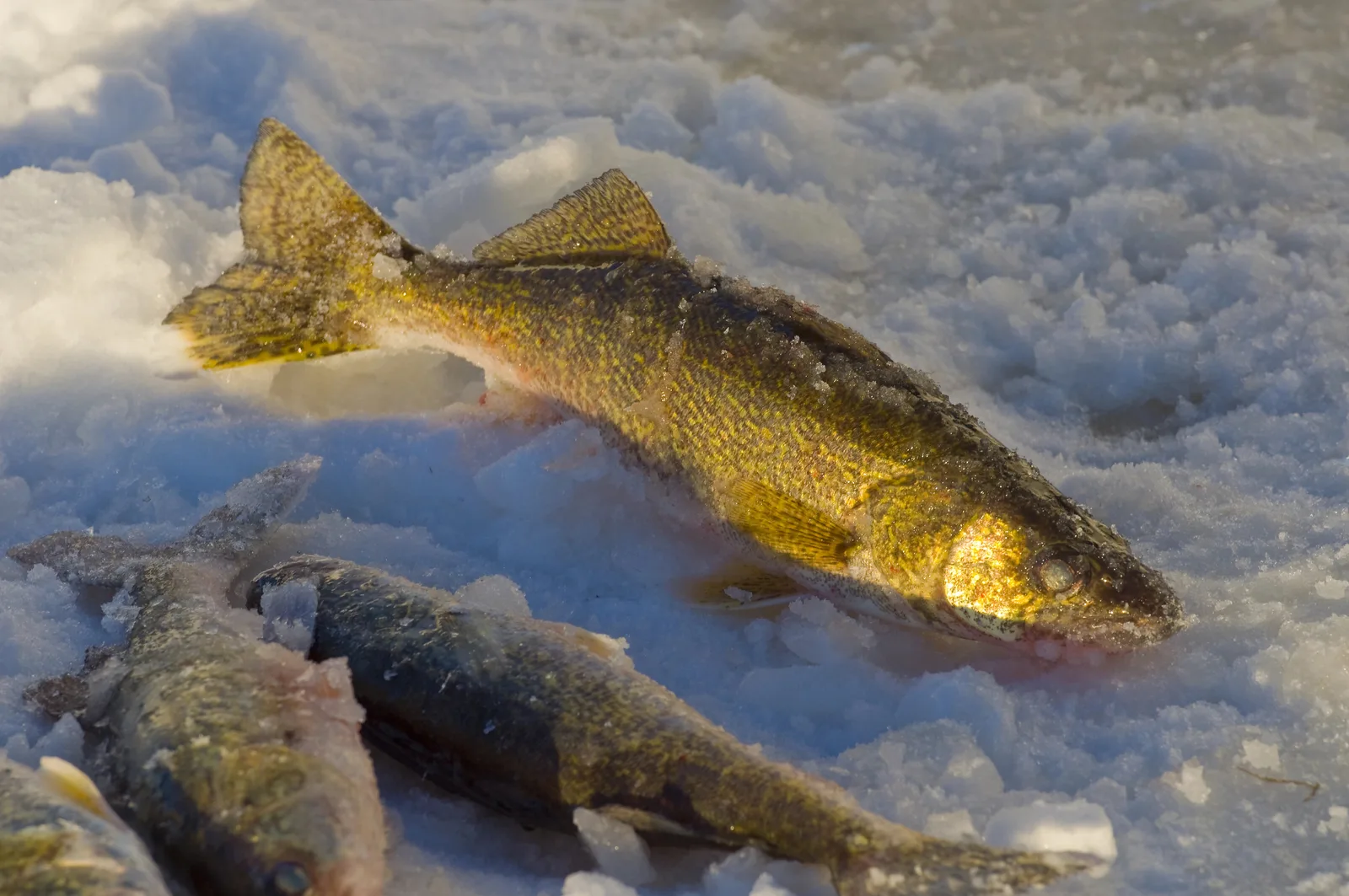
Minnesota walleyes. Photo: schlag / Depositphotos.
The season shifts things too, though no agency gives a first-ice or midwinter table. In-Fisherman reports that walleye at first ice are usually still in fall mode, from Thanksgiving to about January 1. They sit on river mouths, points, shallow flats and weeds, then leave for the main lake. Guide Brian Brosdahl fishes 6–13 ft (1.8–4 m) at early ice. In midwinter he goes to 18–23 ft (5.5–7 m), often on the deep edges of basin flats.
Which lakes, and is the ice safe?
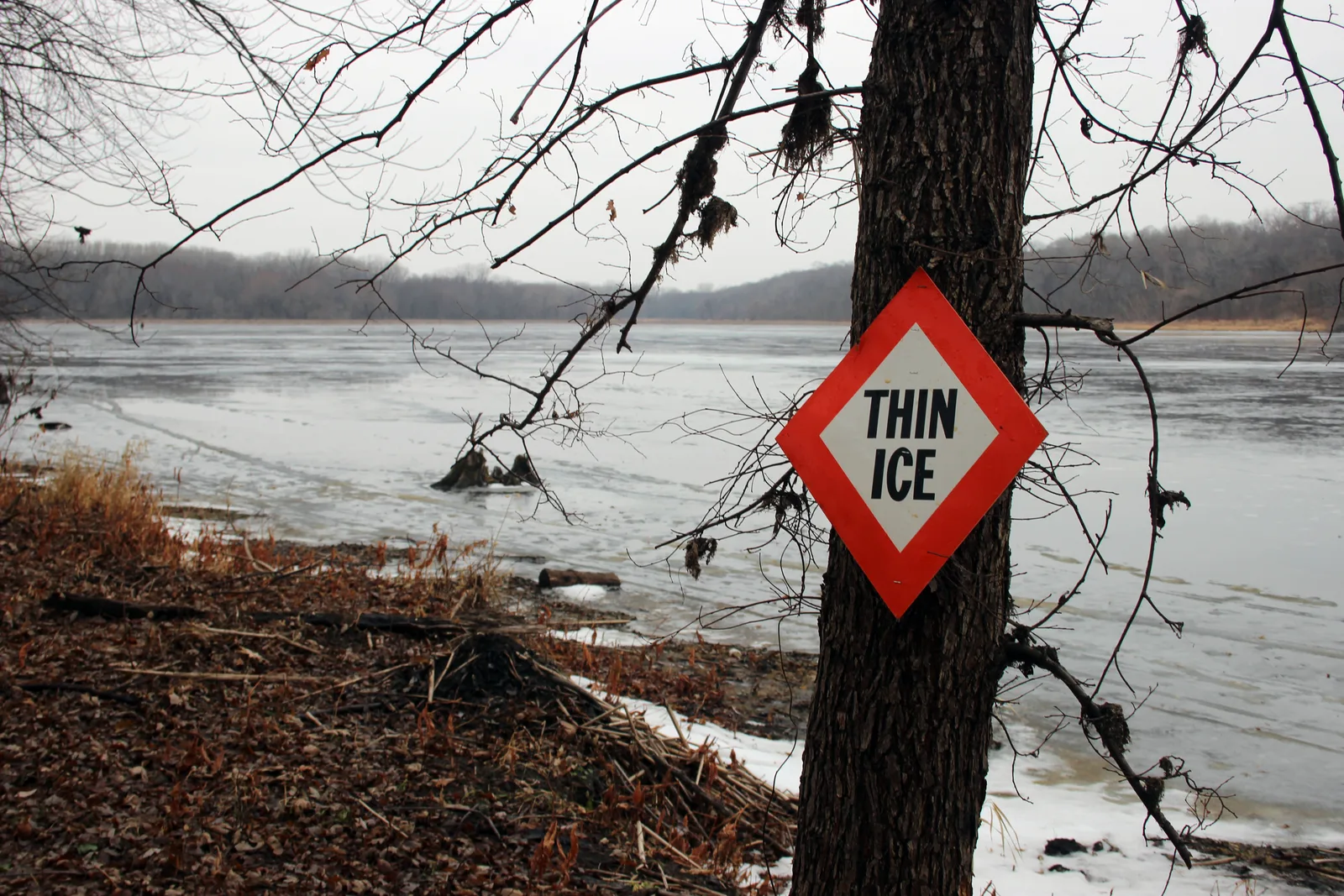
Minnesota names Upper Red, Mille Lacs, Leech and Lake of the Woods as its popular winter walleye lakes. On the big ones you often drive out on a resort’s plowed road and pay a fee. When you pay, ask which lures have been working. And check the ice before you walk on it. Minnesota DNR’s line is that no ice is ever safe, and the ice thickness chart gives the numbers.
When do walleye bite through the ice?
Dawn and dusk, and dusk most of all. Minnesota DNR calls the 90 minutes before and just after sunset prime time. Your lake’s color moves that window, and Sommerfeldt’s notes from Wisconsin show how. This table puts the two agencies together: where to sit and what to fish as the light changes.
| When | Where | Depth | What to fish |
|---|---|---|---|
| Dawn and dusk, any lake | Points, humps, saddles, drop-offs (Minnesota) | Shallow, perhaps 10 ft (3 m) or less (Minnesota) | Jig near the bottom, tipped with a minnow or minnow head (Minnesota) |
| Bright day | Same structure, deeper (Minnesota) | Deeper than at dawn (Minnesota) | Keep at it on a murky lake: turbid lakes can bite all day (Minnesota) |
| Stained lake, last 90 minutes of light | Gravel bars, rocky drop-offs, weed edges, mid-depth mud flats (Wisconsin) | Tip-ups in 6–12 ft (1.8–3.7 m) (Wisconsin) | Tip-ups with live bait, minnow 4–8 in (10–20 cm) off the bottom (Wisconsin) |
| Stained lake, after dark | Same spots | Same | The bite often shuts down right after dark (Wisconsin) |
| Clear lake, after dark | Gravel bars, rocky drop-offs, weed edges, mid-depth mud flats (Wisconsin) | 10–20 ft (3–6 m) (Wisconsin) | Jigging may beat tip-ups. Minnow 6–20 in (15–51 cm) off the bottom (Wisconsin) |
On a stained lake, Sommerfeldt rates the hour and a half before dark above the early morning. On a clear lake you may have to fish after dark for the best catches, and the bait goes higher. In clear water, he says, walleye see a bait above them better and come up to get it.
Stained water has a tea or coffee tint and lets you see only 1 to 3 ft (30–91 cm) down. The walleye fishing guide has the same low-light rule for open water. The walleye water temperature guide shows where they go once the ice is off.
Free PDF · Ice thickness chart How thick is the ice? Read it at the hole.
Print the free chart, tape the strip to your scoop and hook it under the ice. It shows what that ice is thick enough for, clear or white. Two wallet charts and a wall chart come with it.
No card, nothing to buy, and the PDF is yours to keep. Confirm with one click and it's on its way. Then a few short emails and one a week on what's biting. Unsubscribe anytime. Privacy.
What’s the best ice fishing setup for walleye?
Two lines: one you jig, one that sits still. Minnesota allows two through the ice and tells walleye anglers to use them. Hang live bait under the second line in the hole next to you, or set a tip-up no more than 200 ft (61 m) away. In a fish house with rattle reels on the wall, jig one rod and let the rattle reel be your second line.
| The jigging rod | The second line | |
|---|---|---|
| Rod and line | 2–3 ft (61–91 cm) semi-stiff rod, open-faced spinning reel, 6 lb line (Minnesota) | A still rod in the next hole, or a tip-up (Minnesota) |
| Hook or lure | Jigging spoon tipped with a minnow (New York) | Size 8 or 6 double hook or circle hook (Wisconsin) |
| Bait | Minnow, minnow head or minnow tail (Minnesota) | Medium suckers or extra-large fatheads; golden shiners work too (Wisconsin) |
New York DEC’s walleye row says hooks size 4 to 6, 6–10 lb line, a 6–8 in auger and a medium-power ice rod. Minnesota’s 6 lb sits at the light end of that range.
Bait size is a trade-off. Sommerfeldt says the old line about bigger bait and bigger fish is often true. Smaller bait gets more action, which is often the goal with kids along. His three minnows are the usual walleye baits through the ice.
How do you jig for walleye through the ice?
Keep it near the bottom and let the bait do half the work. Most walleye are caught within a few feet of the bottom, Minnesota DNR says, though some hang higher. Now and then, drop your lure onto the bottom. The small puff of mud it kicks up may bring a walleye over.
Then lift, drop and stop. New York DEC’s rule for any ice fish fits here: jig a few times, then pause for a few seconds. Fish usually hit during the pause. When you feel a hit, snap the rod up. Most walleye anglers skip the bobber and set the hook the moment the fish strikes, Minnesota says. Some walleye charge the lure. Others swim up slowly, look it over, then bite or leave.
Bring a few styles. Minnesota DNR says some days walleye want small spoons and jigs, other days bigger lures. Sometimes a thin, flashy fluttering spoon wins. Sometimes it’s a jig shaped like a minnow, hardly moving. Tip the hook with a minnow, a minnow head or a tail. Some anglers hook a live minnow through the tail so it tugs the lure this way and that.
Spoon or Jigging Rap?
If you buy one, make it a jigging spoon: Minnesota, New York and Iowa all name spoons for walleye. Then add a Jigging Rap. Small metal jigging spoons are common ice fishing lures for walleye, Iowa DNR says. Outdoor Life’s Ross Robertson says the #5, #7 and #9 Jigging Raps work great for walleye, and the #2 and #3 suit perch. Here are those three sizes on Rapala’s own chart:
| Jigging Rap | Length | Weight | Price (Rapala, Nov 2026) |
|---|---|---|---|
| W5 (#5) | 2 in (5 cm) | 5/16 oz | $9.99 |
| W7 (#7) | 2¾ in (7 cm) | 5/8 oz | $10.99 |
| W9 (#9) | 3½ in (9 cm) | 7/8 oz | $11.99 |
For a spoon, Northland lists walleye among the fish for its Buck-Shot Rattle Spoon. The maker says to jig it hard in a lift-fall motion and tip it with minnow heads. Robertson calls Clam’s Leech Flutter Spoon one of the best walleye lures for the ice. Brosdahl fishes a slow-falling Thumper Spoon by day and switches to fast-falling tungsten Buck-Shot spoons for the “power hour,” the last light before sundown. In midwinter, In-Fisherman adds, panfish-size tungsten jigs with Eurolarvae (dyed blowfly maggots) on light line can produce 14–17 in (36–43 cm) eaters.
Should you deadstick a minnow for walleye?
Yes. Minnesota DNR tells walleye anglers to hang live bait on the second line in the hole next to them. That still rod is the deadstick. On its crappie page, Minnesota calls the jigging rod a “calling rod.” It draws fish to your hole, and they bite the still minnow on the second line.
Hook the minnow lightly through the middle of the back, Sommerfeldt says, so it hangs level and stays lively. Use his heights: 4–8 in off the bottom on a stained lake, 6–20 in on a clear one.
Then watch which rod gets bit. Minnesota DNR gives perch anglers a test worth borrowing. If the rod you’re not jigging catches most of the fish, you may be jigging too hard. Slow down.
How do you set a tip-up for walleye?
A tip-up is a spool of line on a frame over the hole, with a flag that pops up when a fish takes the bait. Sommerfeldt fishes mostly stained lakes, and there he finds tip-ups with live bait often catch more walleye than jigging. Minnesota likes them for covering a couple of depths on one big piece of structure.
Sommerfeldt and New York DEC rig them a little differently. Both work.
| Sommerfeldt (Wisconsin) | New York DEC | |
|---|---|---|
| Main line | Nylon tip-up line | 50 yards of Dacron or ice-line backing |
| Leader | 2–3 ft mono or fluorocarbon, small snap swivel | 2–3 ft mono, barrel swivel |
| Weight | Two small split shot 7–8 in (18–20 cm) above the hook | One split shot 18–24 in (46–61 cm) from the hook |
| Line marker | A very small bobber | A small bobber or an old button |
| Hook | Double or circle hook, size 8 or 6 | Size 4 to 6 for walleye |
Sommerfeldt picks the bobber because a button can drag on the bottom and snag when a fish runs. He skips trebles because walleye often swallow the bait, and a treble is hard to get out with wet, cold hands. Double and single hooks usually come out without much harm to the fish. On leaders, he finds fluorocarbon knots wear out faster, so you re-tie more often than with mono.
To set the depth, New York DEC clips a weight called a depth sounder to the hook and lowers it to the bottom. Raise it the distance you want off the bottom and put your marker on the line at the water line. Take the weight off, bait up and lower the minnow to the mark.
When the flag goes up, don’t run in and yank. The University of Wisconsin’s old ice fishing guide says to leave a walleye alone when it stops, “while it scales the bait.” Scaling means turning the minnow to swallow it head first, and it can take four or five minutes. When the line moves again, pick up the tip-up and set the hook in one motion. Maine’s guide says the opposite for traps in general: get there fast and give a short, quick tug. For walleye, the wait is the advice written for the fish. It also means a swallowed bait, so skip trebles.
How far off the bottom should you fish for walleye?
Close to it. New York DEC says fish within a foot of the bottom. Minnesota DNR says most walleye come from within a few feet of it, with some hanging higher.
For a minnow on a tip-up or a deadstick, use Sommerfeldt’s numbers. On stained lakes he hangs it about 4–8 in (10–20 cm) off the bottom. On clear lakes it can go 6–20 in (15–51 cm) up.
No flasher? On its perch page, Minnesota DNR says anglers without one start near the bottom, then try higher until they find fish or move on. So jig near the bottom first, then work higher.
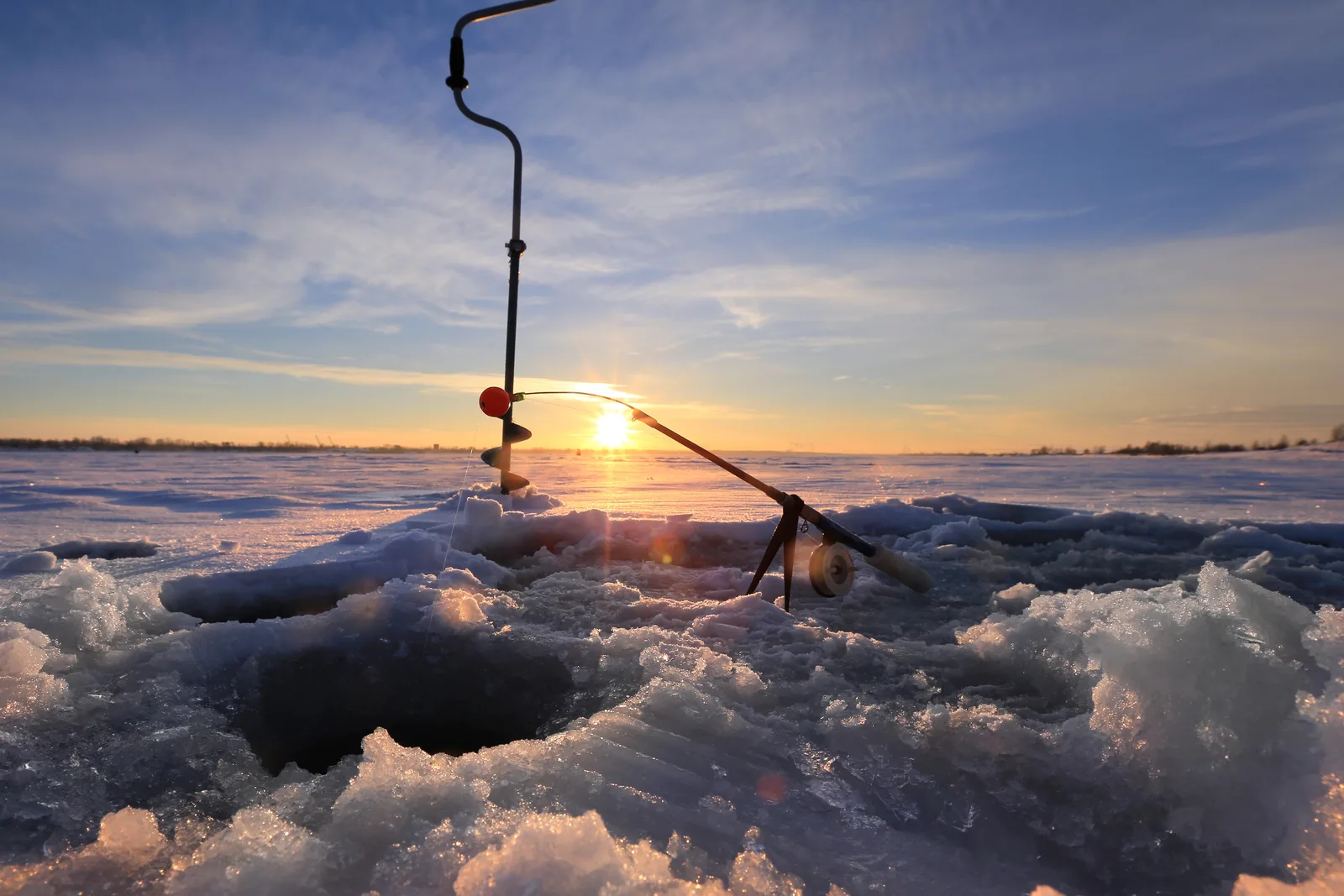
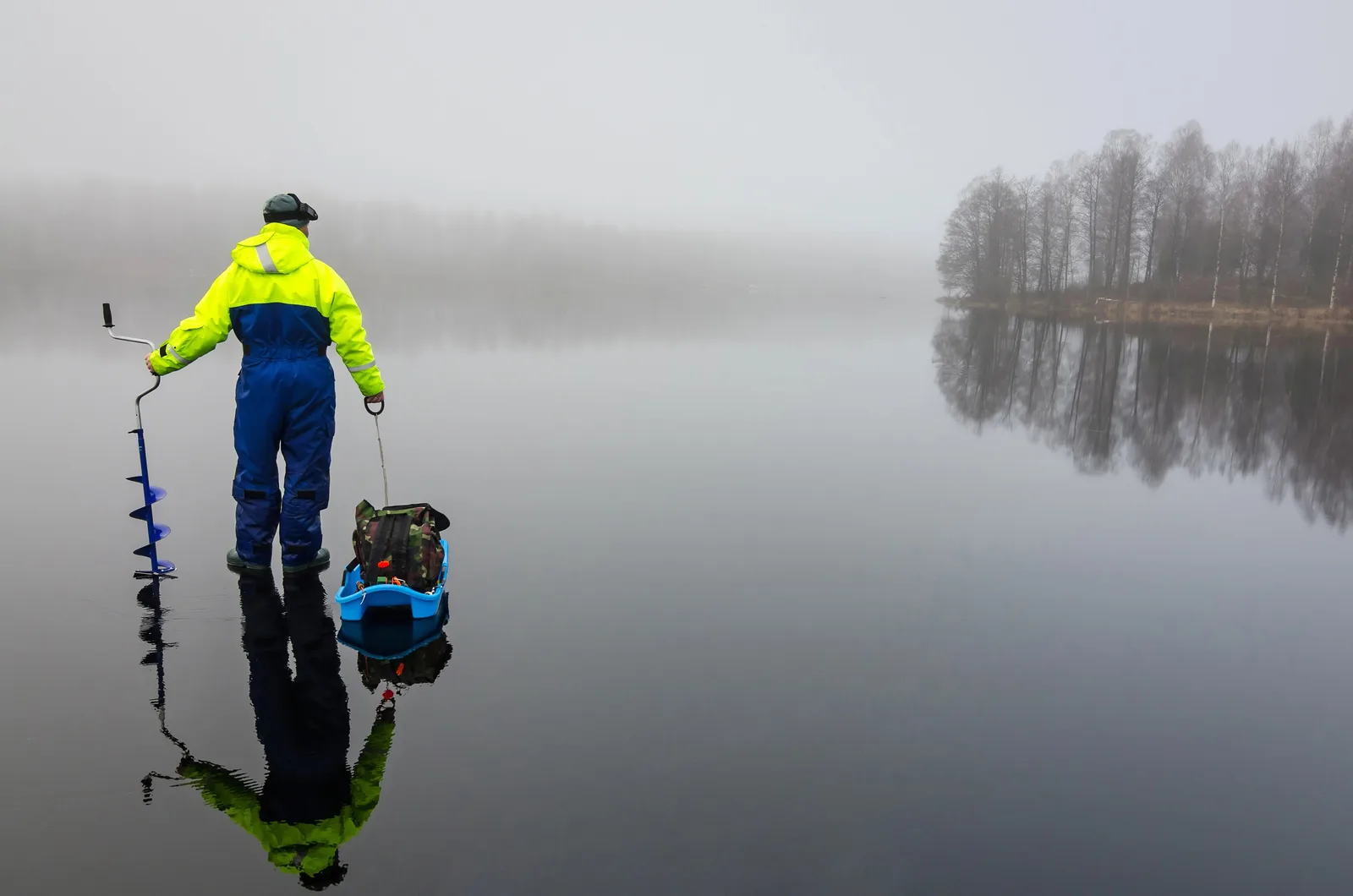
Holes drilled, rod set, sun going down. Photo: salman2 / Depositphotos.
How do you fish an evening for walleye, step by step?
Here’s a plan for the prime window, every step from an agency.
- Get there in daylight. Pick a point, hump, saddle or drop-off from the lake map. Check the ice as you go.
- Drill all your holes at once. Minnesota DNR says to drill them in one go, not drill-fish-drill-fish. A gas auger’s roar can scare fish for a while, so finish before the bite.
- Set the still line. A tip-up or a deadstick, the minnow hooked through the back, at the height your lake calls for.
- Jig the shallow holes as the sun drops. Perhaps ten feet or less at dusk, Minnesota says. Jig, pause, and tap the bottom now and then.
- Give each hole 5 to 10 minutes. Treat it like a cast, Minnesota says, then move. The exception is a hump or breakline as sunset nears: stay put and let the fish come to you.
- Fish hardest through the 90 minutes before and just after sunset. That’s Minnesota’s prime time for walleye.
- Read the lake after dark. On a stained lake, Sommerfeldt says the bite often shuts down right after dark. On a clear lake it can run all night.
- Bring a headlamp and ice picks. Both are on Minnesota DNR’s gear list for walleye.
Do you need a flasher for walleye?
You don’t need one, but Minnesota DNR calls a sonar unit particularly helpful for finding and catching walleye. It says most ice anglers now use some kind of fish finder. New York DEC agrees it helps but isn’t needed.
A flasher shows the bottom, your lure and any fish under the hole on a round dial, as it happens. So you can watch a walleye come up to your spoon. An underwater camera shows what the bottom looks like and whether baitfish are around, Minnesota says.
Live sonar goes further. Brosdahl uses forward-facing sonar to spot fish more than 100 ft (30 m) away while he scouts, In-Fisherman reports. Rapala even makes a Jigging Rap Magnum for picking off single fish on forward-facing sonar. You don’t need that to catch walleye.
How many lines can you fish for walleye through the ice?
It depends on the state, and so does what “attended” means. Here are six walleye states.
| State | Lines through the ice | How close you must stay |
|---|---|---|
| Minnesota | 2 (1 on designated trout lakes) | In sight of the line, or within 200 ft (61 m) of a tip-up |
| Wisconsin | 3 hooks, baits or lures | Respond at once to any bite |
| Michigan | 3 lines, tip-ups included | Under immediate control |
| North Dakota | 4 poles, a tip-up counts as one | Visible, within 150 ft (46 m), checked every hour |
| South Dakota (2023 handbook) | 4 (2 on the Minnesota border waters) | Within unaided sight |
| New York | 7 | Immediate attendance |
Minnesota adds two newer rules. A phone alert doesn’t count as attending your line. And from the 2025–26 season, non-motorized hook-setting devices are legal there, with the same 200 ft rule as a tip-up.
Check the lake, too. Minnesota DNR says walleye are generally open from the May opener through the last Sunday in February. It also says limits, dates and size rules can differ from place to place, and a lake can be closed. Your state’s current regulations have the last word.
Keep a couple for the pan if the rules allow. Sommerfeldt says the best eaters run 12 to 15 inches (30–38 cm). A 20-inch (51 cm) fish you let go today may be a 28-inch (71 cm) fish a few years on.

Free PDF · 5 pages
Stop guessing the ice. Tape this strip to your scoop and read it at the hole
Ice that is 6 or 7 inches thick in one spot can be 2 inches close by. You can't tell by looking.
The True-Size Ice Thickness Chart. Print it, tape the strip to your ice scoop, hook it under the ice and read the band at the surface: on foot, sled or truck. One side for clear ice, one for white.
- A true-size strip for your scoop handle, marked from "stay off" to a truck with a wheelhouse
- Two wallet charts, one for your buddy, with five moves that get you out if you go through
- Why 8 inches of white ice counts as 4, and the ice to stay off at any thickness
Every clear-ice number is the Minnesota DNR's, set beside the 29 sources on the page, the Army Corps of Engineers among them.
No card, nothing to buy. Confirm with one click and the PDF is on its way, one version for your phone and one to print, yours to keep. Then a few short emails and one a week on what's biting, with an unsubscribe link in every one. Privacy.
Related
Section guide
Ice Fishing: How to Ice Fish, Step by StepHow to ice fish: wait for 4 in of clear ice, drill all your holes, fish one jigged line and one still. Gear, bait, tip-ups and line limits in 12 states.
 Crappie Ice Fishing: Where They Suspend and What to Drop
Ice fishing for crappie: where they hang under the ice in each kind of lake, the dusk and night bite, tiny jigs, two lines, and the 20 ft rule.
 Ice Thickness Chart: How Thick Ice Must Be to Walk, Ride or Drive
Ice thickness chart for walking, snowmobiles, cars and trucks, with white ice doubled, what each inch holds in pounds, and how to measure it yourself.
 Perch Ice Fishing: Where Perch Sit Under the Ice and How to Catch Them
Perch ice fishing: fish near the bottom, from weeds under 10 ft to flats at 40 ft, with 1/64 to 1/16 oz jigs and spikes. Plus 8 steps to stay on a school.
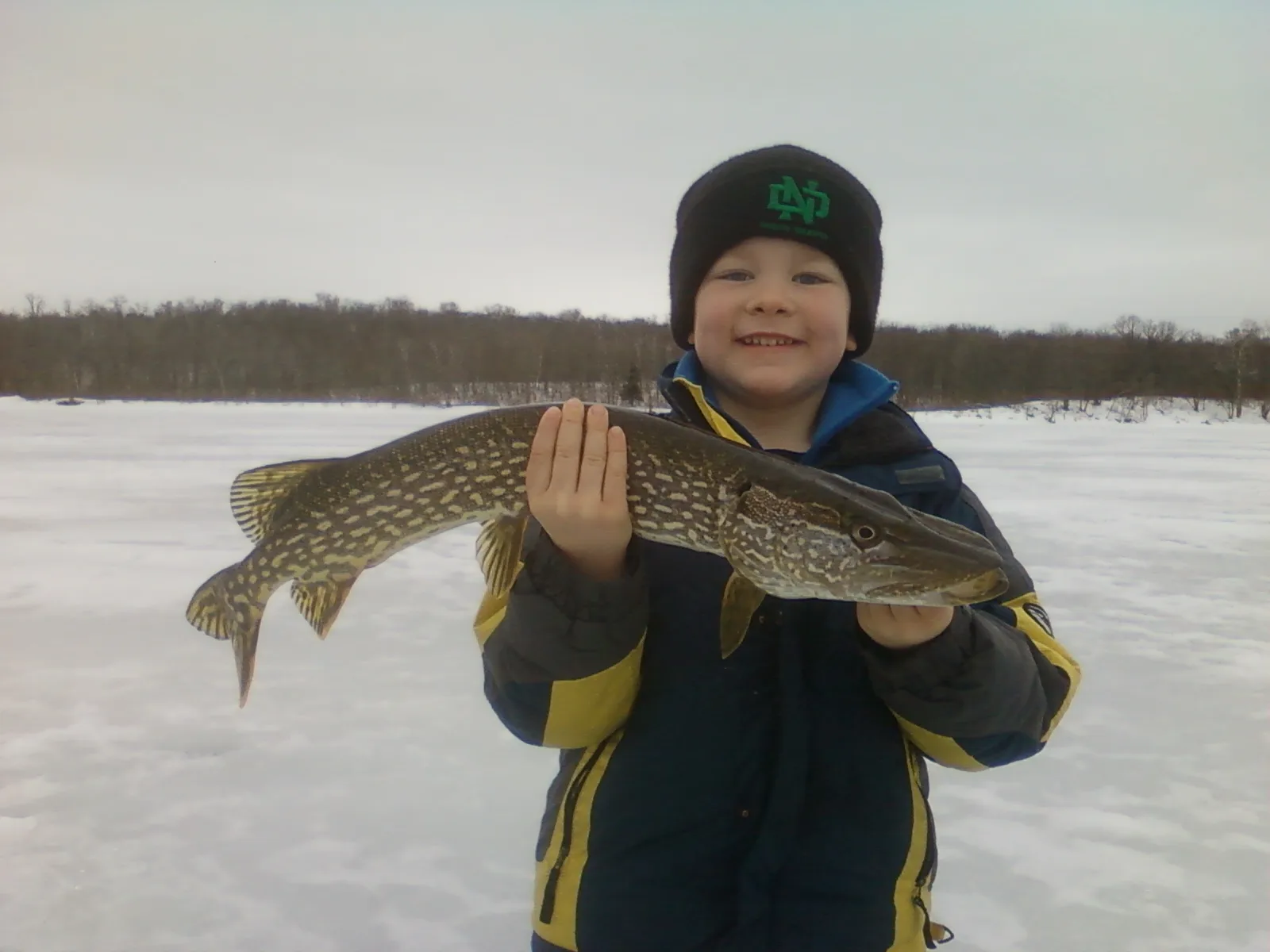 Ice Fishing for Pike: Tip-Ups, Bait, Depth and When to Set the Hook
Ice fishing for pike: where they sit under the ice, the tip-up spread, live or dead bait, how far off bottom, when to set the hook, and the state rules.
Sources (22)
- Minnesota DNR, Ice fishing for walleye
- Wisconsin DNR, Fishing walleye through the ice (Skip Sommerfeldt)
- New York State DEC, I FISH NY Guide to Ice Fishing
- Minnesota DNR, Learn to ice fish
- Minnesota DNR, Ice fishing for perch
Show all 22 sourcesShow fewer sources
- Minnesota DNR, Ice fishing for crappie
- University of Wisconsin Sea Grant Institute, Ice Fishing (Warren Downs; revised October 2005)
- Maine IFW, Ice Fishing Guide (Jake Scoville)
- Iowa DNR, The 9 Things You Need For Ice Fishing (February 6, 2015)
- Rapala, Jigging Rap
- Rapala, Jigging Rap Magnum
- Outdoor Life (Ross Robertson), The Best Walleye Ice Fishing Lures (updated December 20, 2023)
- Northland Fishing Tackle, Buck-Shot Rattle Spoon
- In-Fisherman (Jim Edlund), Walleyes in Transition: Early to Mid-Ice Season (January 24, 2025)
- Minnesota DNR, General Regulations (fishing, on eRegulations)
- Minnesota Revisor of Statutes, 97C.321 Restrictions on unattended lines
- Minnesota DNR, Hook-setting devices allowed starting with the 2025-26 ice fishing season (November 17, 2025)
- Wisconsin DNR, Guide to Wisconsin Hook and Line Fishing Regulations 2026-2027
- Michigan DNR Fishing Guide, Lawful Fishing Methods
- North Dakota Game and Fish, Fishing regulations (April 1, 2026, through March 31, 2028)
- South Dakota GFP, 2023 South Dakota Fishing Handbook
- New York State DEC, General Freshwater Fishing Regulations