 By
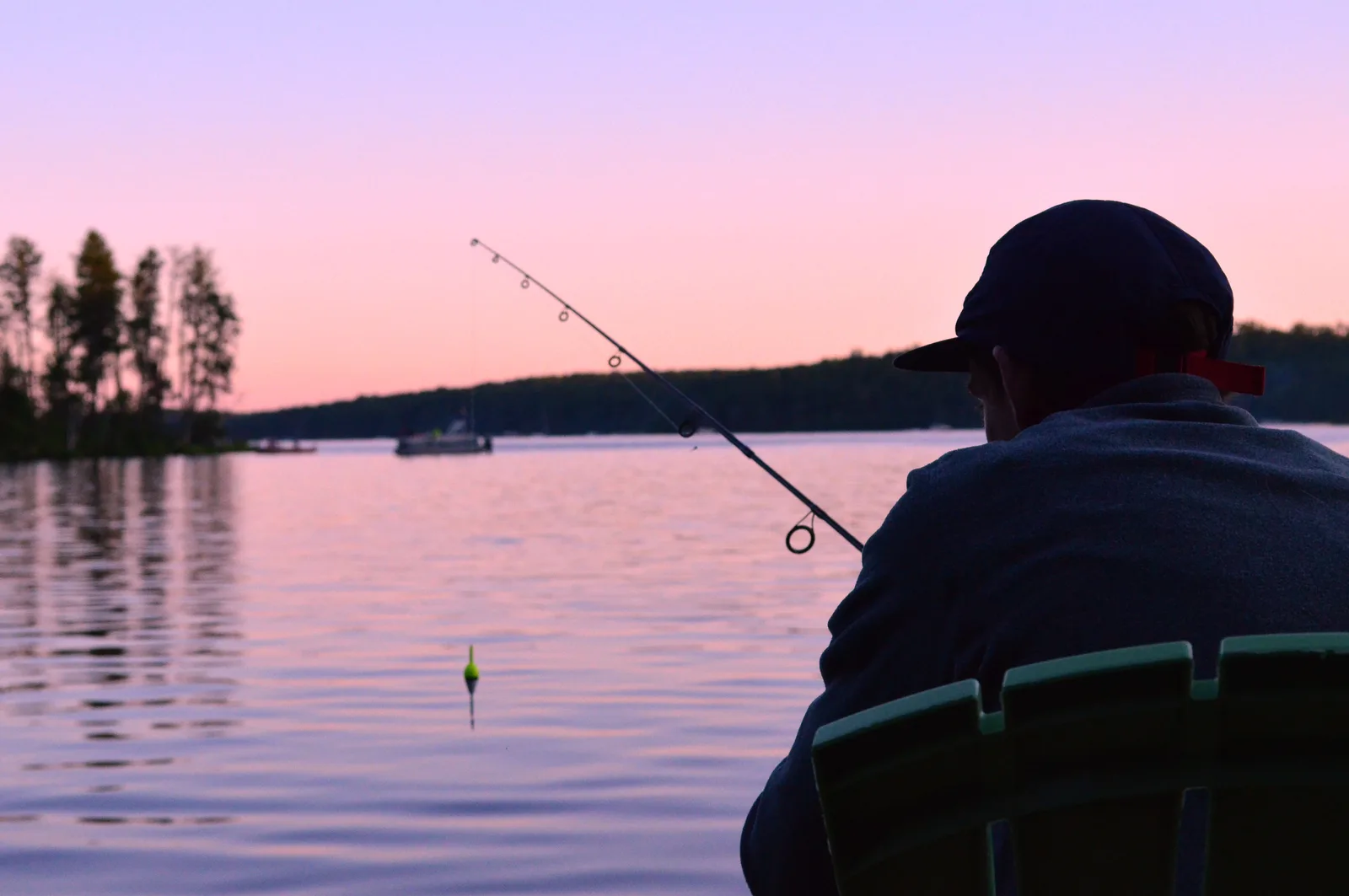
Walleye fishing comes down to three things: stay near the bottom, go slow, and fish when the light is low. A 1/8 oz jig and minnow at dusk does all three. Where you look changes with the season, and so does what you tie on.
If you don’t catch a walleye in 20 minutes, move. That’s Iowa DNR’s rule for summer and early fall, when the fish spread out.
What’s the best way to catch walleye?
There’s no single best way. Minnesota DNR names four that work, and its advice is simple: try them, then get good at the one you like.
| Method | When it shines | Why you’d pick it |
|---|---|---|
| Jig and minnow | Early season, cold water | You feel the bottom and the bite |
| Slip-sinker rig | Midsummer | Live bait right on the bottom |
| Crankbaits, cast or trolled | Fall, or any time you need to cover water | Finds fish that are spread out |
| Slip bobber | All year, over rock and humps | Easy, and lazy walleye take it |
If you can only bring one thing, bring jigs. Minnesota calls them an excellent lure choice, and they work from a boat, a bank or a hole in the ice.
When do walleye bite best?
Go at dawn and dusk. Minnesota DNR says that’s often the best time, because walleye swim up from deep water onto shallow flats to eat. Many anglers wait for the sun to start dropping, since that can be the best fishing of the day.
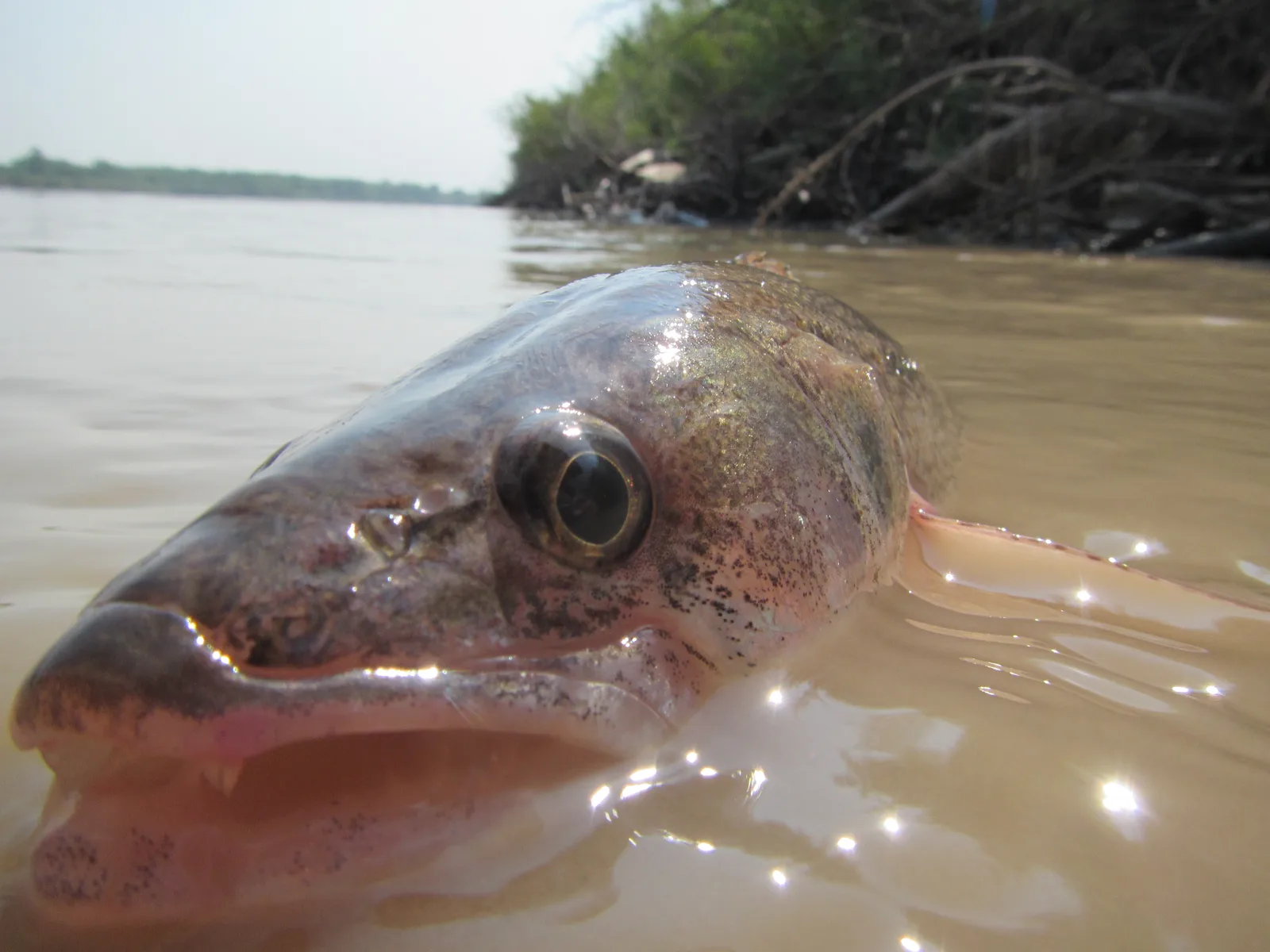
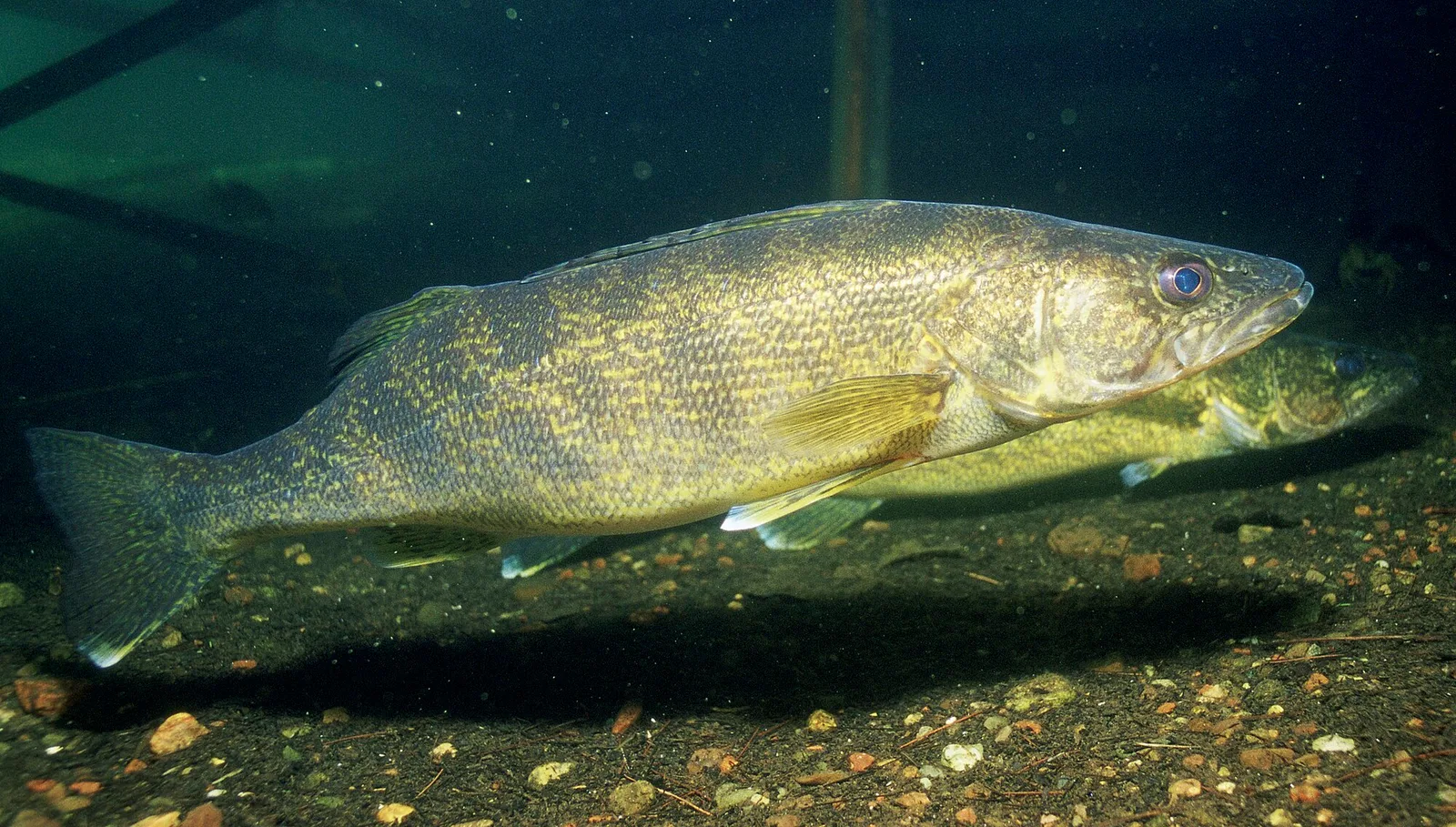
That eye is why low light works. A walleye at the surface of the Missouri River. Photo: U.S. Fish and Wildlife Service (public domain).
The eye explains it. A shiny layer inside it lets a walleye see and eat at night and in murky water. Bright sun is the opposite. In daylight they slide into the shade of boulders, logs and heavy weeds, Minnesota DNR says. With no shade around, they drop deeper.
So you can fish all day when something dims the light. Clouds do it. So does stained water, and so does wind. Anglers call those waves a walleye chop. The wind stirs up the bottom and the water turns murky, which suits a fish that hunts well in murk. Wired2Fish says to work the windblown banks, points and flats, since the baitfish end up there too.
Water clarity changes your hours. In clear water, Wisconsin DNR says, walleye usually stay deep by day and move shallow at night. In murkier water you can catch them all day. Other fish keep other hours, and the best time of day guide compares them.

Free PDF · Water temperature chart Which fish are biting at today's water temperature?
One reading, and the 16-page chart shows which of 26 fish are spawning, feeding hard or slowing down; for bass, crappie, bluegill and walleye, where they sit and what to throw. Every number sourced.
It costs you one email address. No card, nothing to buy, and the PDF is yours to keep. Confirm with one click and it's on its way. Then a few short emails and one a week on what's biting. Unsubscribe anytime. Privacy.
Where are walleye in each season?
Walleye move with the water. Use this table to pick your first spot, and check the walleye temperature guide for the water temperature that goes with each row. The state in brackets is the agency that says it.
| When | Where to look | What to fish |
|---|---|---|
| Ice-out, before the spawn | Below dams, river pools just downstream, riffles, rock (Iowa) | 1/8 oz jig with a twister tail or minnow. Slip bobber near spawning spots. Try at night (Iowa) |
| Spawn | Shallow rock and gravel. Closed in some states, open with special rules in others | Check your season first. They aren’t really eating, and most you catch are males (Iowa) |
| Just after, May and June | Big sand flats near shore (Minnesota). Males linger on spawning rock (New York) | Jig and minnow, 1/8 to 3/8 oz (Minnesota). Stickbaits at night in 8–12 ft (2.4–3.7 m) (New York) |
| Summer | Humps, saddles, points (Minnesota). Weed edges, drop-offs, riprap, wing dams, hard flats in reservoirs (Iowa) | Slip-sinker rig with a minnow, crawler or leech (Minnesota). Trolled crankbaits and 3-way rigs (Iowa) |
| Fall | Weedlines, gravel bars, points (Minnesota). Rocky shores, reefs, riffles (Iowa) | Hard baits trolled at about 1 mph (1.6 km/h) (Minnesota) |
| Late fall to ice-up | Deep spots with little current, water below dams (Iowa) | Jig or 3-way rig with a fathead minnow, slow. A real shot at a fish over 10 lb (Iowa) |
| Under the ice | Points, humps, narrows, saddles (Minnesota) | Jig near bottom with a minnow or minnow head (Minnesota). Tip-ups on stained lakes (Wisconsin) |
Minnesota says May and June are the easy months, because the fish sit shallow near shore. Iowa says late fall until ice-up offers some of its best walleye fishing.
What’s the best depth for walleye?
There isn’t one. It depends on the month. New York DEC’s Lake Erie numbers show how far the fish can move in a year.
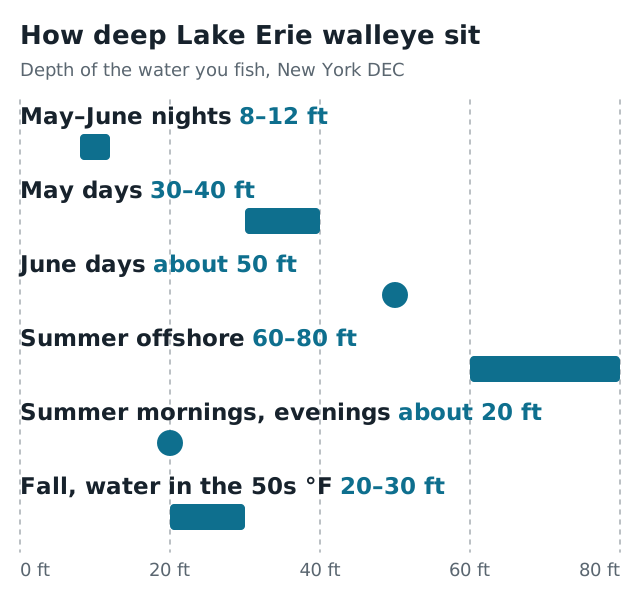
Your lake won’t match those numbers, because Lake Erie is huge. The pattern is what carries over: shallow rock in spring, deeper as it warms, back to the rock as it cools. Walleye aren’t always on the bottom either, so try a few depths until you hit fish.
Rivers are simpler. Iowa DNR says to fish outside bends, which usually hold the deepest water. Then look for a break in the current behind fallen trees, rocks or bridge supports. As summer comes on, Iowa says to try 4 to 6 ft of water next to one.
What rod, reel and line do you need?
You don’t need much. One light spinning outfit covers jigs, rigs and bobbers.
| Fishing | Rod | Line |
|---|---|---|
| Jigs, rigs, bobbers (Iowa) | 6 or 6½ ft (1.8–2 m) medium or medium-light spinning rod | 6–8 lb mono or braid |
| Trolling bigger crankbaits, 3-way rigs (Iowa) | 6 or 6½ ft (1.8–2 m) medium or medium-heavy casting rod | 8–10 lb |
| Lead-core trolling (New York) | 8 to 10½ ft (2.4–3.2 m) downrigger rod, level-wind reel | Lead core, 30 lb braid backing, 30–50 ft (9–15 m) fluorocarbon leader |
| Ice (Minnesota) | 2 to 3 ft (0.6–0.9 m) semi-stiff rod, spinning reel | 6 lb |
Minnesota DNR goes a little heavier and says 6 to 10 lb works fine on a medium spinning rod. Wired2Fish suggests a 2500 or 3000 size spinning reel. It also likes braid of 10 lb or less, with a 4 to 8 lb fluorocarbon leader for jigs and plastics. Tie the lure on with a Palomar or a loop knot, as onX suggests.
Can walleye teeth cut your line? They can, but it’s far less likely than with pike, onX says. If northern pike share your water, Wired2Fish adds 4 to 6 in of 10 lb tie-on wire ahead of hard baits.
Those teeth are still sharp, so don’t lip a walleye. Pack a net, pliers and a few first aid items, as Minnesota DNR suggests.
How do you jig for walleye?
Use the lightest jig that still reaches bottom. Iowa DNR says a jig that’s too heavy makes bites hard to notice. It calls 1/8 oz perfect for most lake and river days. Go to 1/4 oz or more in fast current, deep water or high wind.
Wired2Fish gives a handy starting point for ball-head jigs:
| Water depth | Jig weight |
|---|---|
| Up to 7 ft (2.1 m) | 1/8 oz |
| Up to 15 ft (4.6 m) | 1/4 oz |
| Deeper | 3/8 oz |
| In current | Heavier |
Then work it like this:
- Tip the jig. Use a minnow, a leech, a nightcrawler or a twister tail. Hook a minnow through both lips.
- Get over the fish. Drift on a light wind, or anchor (or hold with the trolling motor) over the edge of a rocky point or reef.
- Fish it straight down. Ball-style jigs work best for this, Minnesota DNR says.
- Or cast it out and jig it back. New York DEC says that covers more water.
- Feel for the bottom on every drop. If you can’t feel it, go a touch heavier.
- Change colors. Try dark and bright. Minnesota says one color usually beats the others.
- Move if nothing happens. Twenty minutes is plenty in summer and early fall.
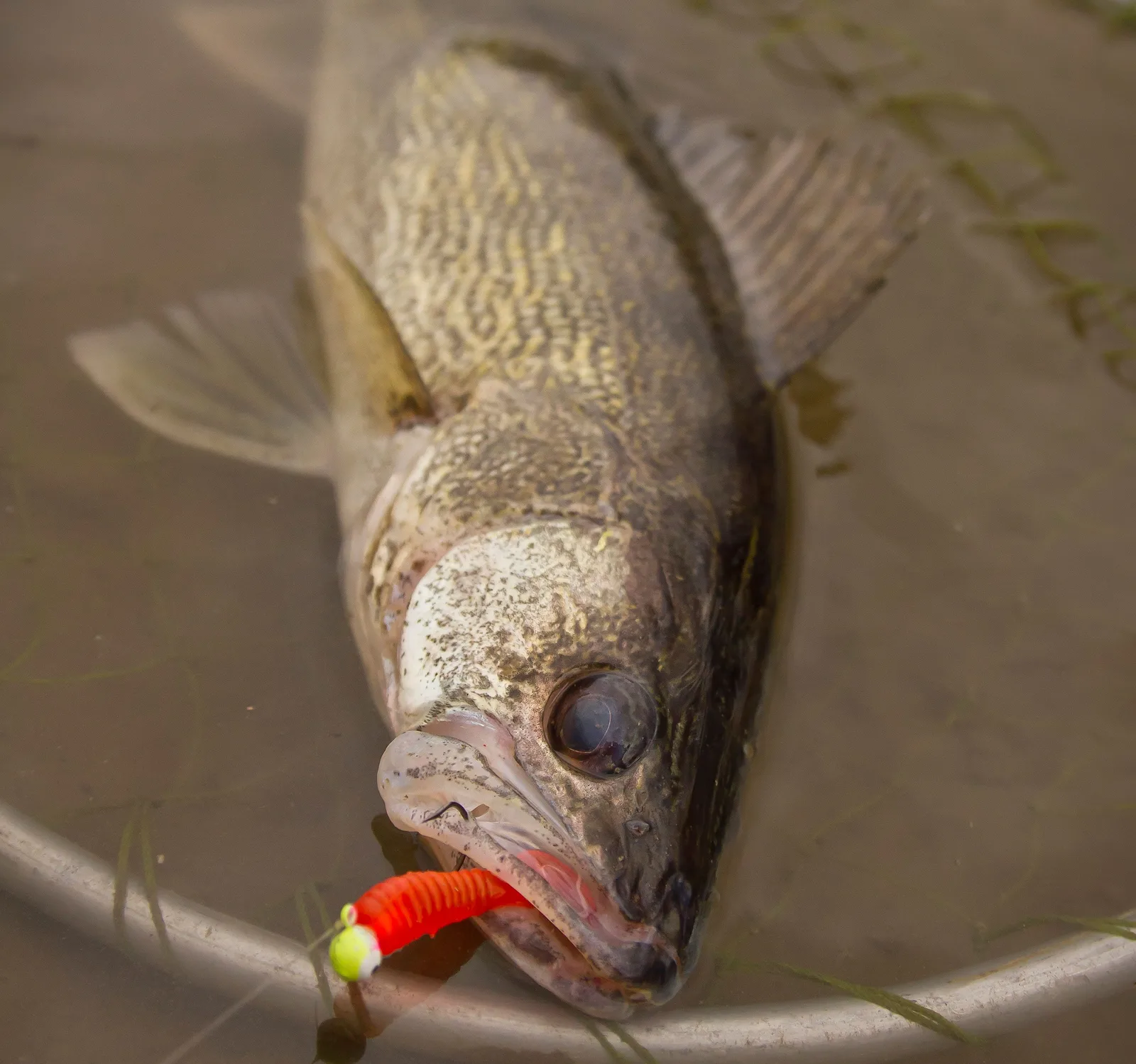
A Missouri River walleye on a jig and a soft-plastic tail. Photo: Sam Stukel, U.S. Fish and Wildlife Service (public domain).
Expect a light bite. Minnesota DNR describes it as a very light bite, a tap, tap, tap. On Lake Erie the jigging lures also include lipless crankbaits, jigging minnows and blade baits. Jigging there is most common in May, but it can work all season if you find a school on rock.
Which walleye rigs should you use?
Use a rig when you want live bait near the bottom and a jig isn’t doing it. These are the three to know.
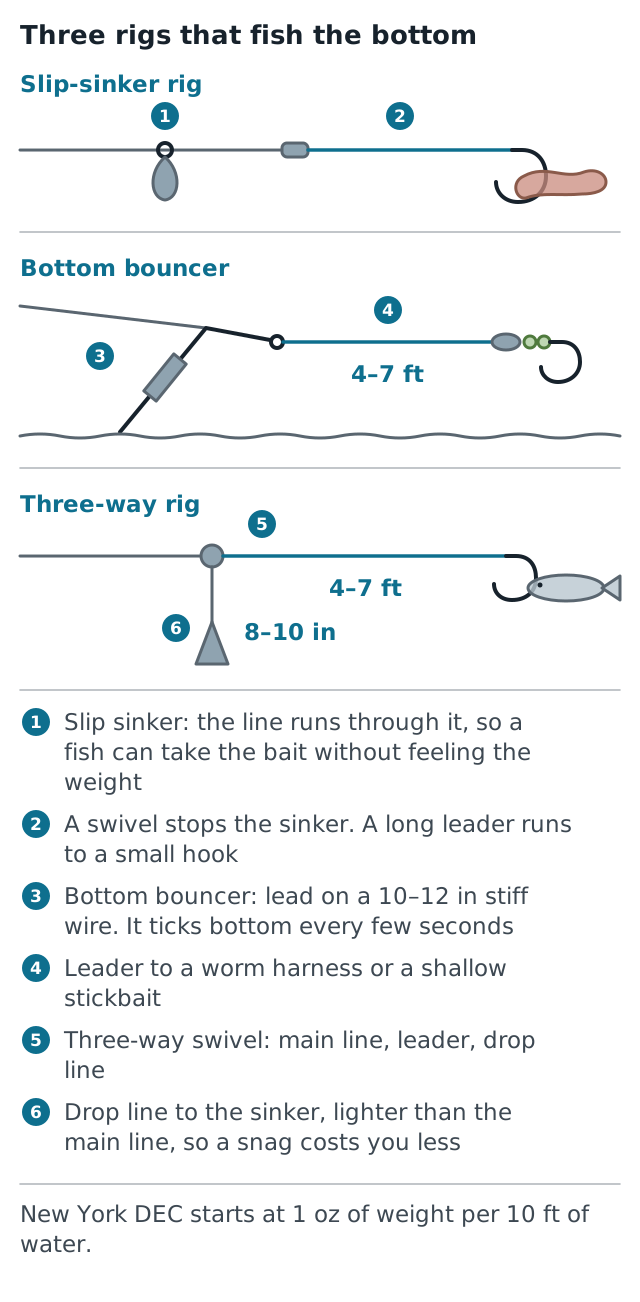
Slip-sinker rig. This is the Lindy rig, Minnesota’s midsummer pick. When you feel the tap, don’t set the hook. Let line run free off the reel for several seconds. Reel in slowly until you feel tension. Then set it.
Bottom bouncer. Use it when fish hold close to the bottom, which is May and early June on Lake Erie. Start with 1 oz of weight per 10 ft of water, then lower the rig under light tension. Reel in or let out line until the weight ticks bottom every few seconds. It shouldn’t drag. Keep your speed under 1.2 mph (1.9 km/h). Worm harnesses are the go-to lure here, New York DEC says.
Three-way rig. Iowa DNR says it works with live bait when walleye are inactive. Try a colored hook with a couple of red or chartreuse beads ahead of it. You can troll it to find a school. On the Mississippi, fish one on the upstream side of a wing dam. Keep the leader and drop line lighter than your main line, so a snag doesn’t cost you the whole rig.
Don’t forget the slip bobber. Set it so your bait hangs within a foot of the bottom, Iowa DNR says. It lets you cast easily even with the bait set 20 ft (6 m) deep. Hover a leech, crawler or minnow just above a reef or hump.
How fast should you troll for walleye?
Start slow, then let the lure tell you. Minnesota says to go about 1 mph, or just fast enough to make the lure work. Lake Erie anglers often go quicker.
| What you’re pulling | Speed | How it gets down |
|---|---|---|
| Hard baits in a lake, fall (Minnesota) | About 1 mph (1.6 km/h) | The lure itself |
| Bottom bouncer (New York) | Under 1.2 mph (1.9 km/h) | 1 oz per 10 ft (3 m) of water |
| Worm harness on lead core (New York) | 0.8–2.0 mph (1.3–3.2 km/h) | About 5 ft (1.5 m) per color |
| Stickbait on lead core (New York) | 1.5–2.5 mph (2.4–4 km/h) | About 5 ft (1.5 m) per color |
Lead core is heavy line that sinks on its own. It changes color every 10 yards. Five colors out, or 50 yards, puts your lure about 25 ft down. Need more? Divers are plastic planers tied in ahead of the lure to pull it down. Jet Divers run 10 to 50 ft (3–15 m) by size, and Dipsy Divers reach 20 to 100 ft (6–30 m) by size. Each one comes with a chart that says how much line to let out.
For inland lakes, keep it simple. Pick a crankbait or stickbait that looks like a perch or other small fish. Sizes No. 5 and No. 7 are popular, Minnesota DNR says. Read the package for the depth it runs. Then play with your boat speed until you get bit, as Iowa suggests. A good fish finder helps you find the fish, but New York DEC says it isn’t essential.
What’s the best bait for walleye?
Live bait depends on the calendar. These are Iowa DNR’s rules.
| Bait | When | How to hook it |
|---|---|---|
| Minnow | Late fall to early spring | Through both lips on a jig or 3-way rig. Just below the back fin under a bobber |
| Nightcrawler | Late spring to early fall | Thread it on. Half a crawler can help you hook the fish |
| Leech | Late spring to early fall | Through the sucker disk |
For lure color, match the water. Iowa says silver, gold, blue and black are good in clear water. Bright colors work best in dark, stained water. Around rock, try baits that look like crayfish.
Keep lures small. Wired2Fish says walleye generally like a small profile. It suggests 3 to 4 in swimbaits and grubs, plus small balsa crankbaits. In low light it says wild colors often work too: chartreuse, hot pink and fluorescent orange.
How do you catch walleye from shore or at night?
Cast crankbaits after dark in spring or fall, when the water is in the 50s °F. New York DEC calls that the best time to try Lake Erie from shore. Breakwalls and jetties produce best.
Rivers give you a second shot. Iowa DNR likes riffles, the shallow rocky stretches, in April and October. Walleye slip in there early and late in the day to hunt. Use a 1/8 oz jig with a twister tail, or a shallow-running minnow crankbait. Boulders and riprap are worth a few casts as well.
From any bank, go where the fish get squeezed together. onX says to look at current seams, narrow spots, dams and windblown areas, and to use a longer rod to reach them.
Fishing at night from a boat? New York’s spring night bite happens on calm nights in May and early June. Males hang around the spawning rock, and it gets good once the water reaches the 50s. Troll stickbaits on a flat line in 8 to 12 ft, or cast them from an anchored boat. Get there early and find any hazards while it’s still light. You may have company in the dark.
How do you catch walleye through the ice?
Drill where walleye usually feed, then jig near the bottom with a lure tipped with a minnow or minnow head. Minnesota DNR says you’ll find them in many of the same places you found them in summer and fall. Those are points, humps, narrows, drop-offs and saddles.
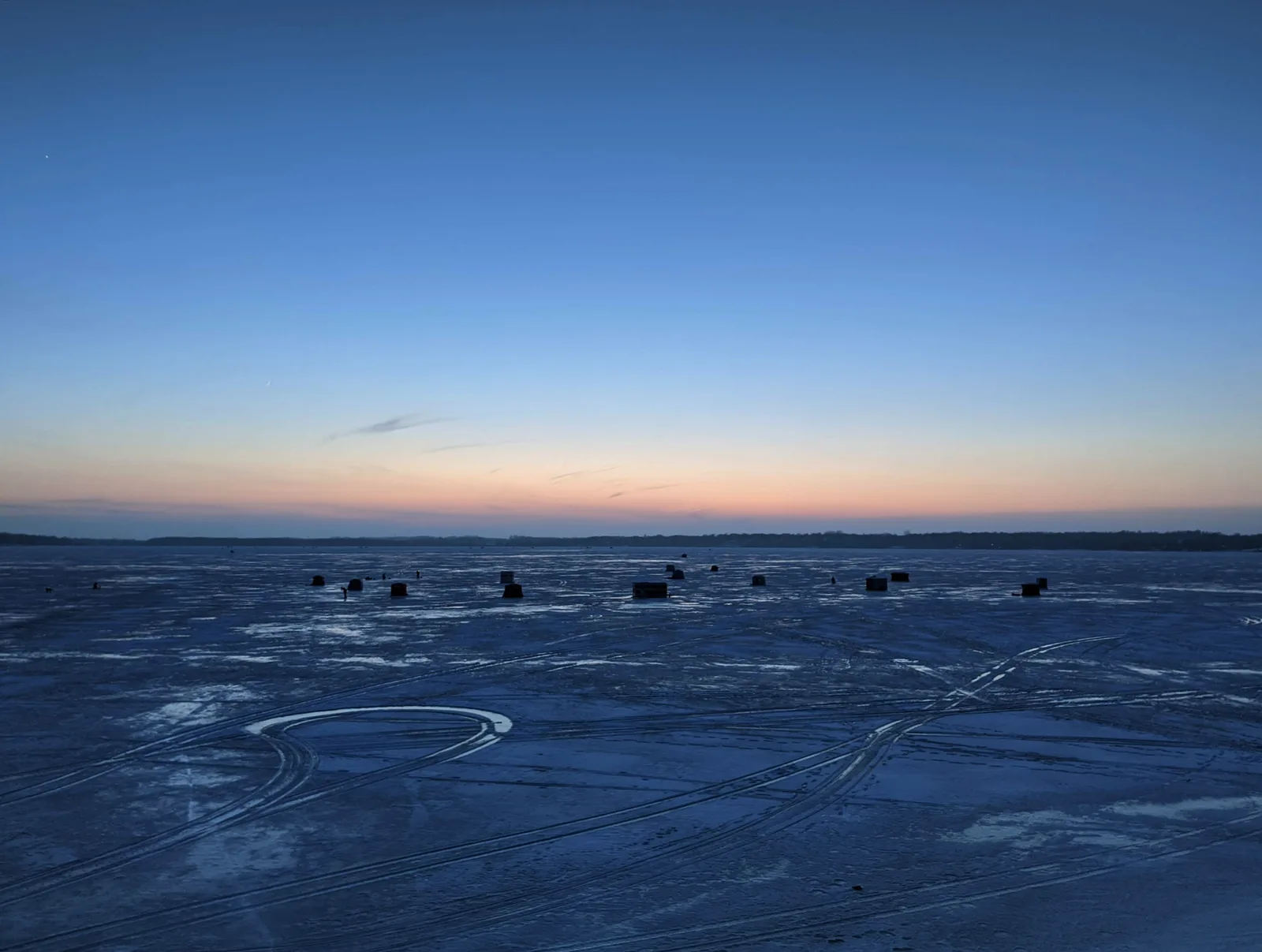
Ice houses on Buffalo Lake in low light, the time walleye anglers wait for. Photo: Courtney Celley, U.S. Fish and Wildlife Service (public domain).
Timing matters most. Minnesota says the 90 minutes before and after sunset are prime. Many anglers sit in 10 ft (3 m) or less at dawn and dusk, then move deeper when it’s bright. Now and then, tap your lure on the bottom. That kicks up a small puff of mud that may draw a walleye over. Set the hook the moment you feel a hit.
Your water clarity decides the rest. This comes from a Wisconsin DNR fish biologist who’s on the ice about every day it’s safe.
| Stained lake | Clear lake | |
|---|---|---|
| Better method | Tip-ups with live bait | Jigging may win |
| Best time | The hour and a half before dark | Often after dark, sometimes all night |
| Tip-up depth | 6–12 ft (1.8–3.7 m) | 10–20 ft (3–6 m) |
| Minnow above bottom | 4–8 in (10–20 cm) | 6–20 in (15–51 cm) |
He hooks the minnow lightly through the middle of the back, so it hangs level and stays lively. On a stained lake, he warns, the bite often shuts down right after dark. Check how many lines you can run, too. Minnesota allows two, with a tip-up no more than 200 ft from you.
Where’s the best walleye fishing?
A few waters stand out, and each one for a different reason.
| Water | Why anglers go |
|---|---|
| Lake Erie | About 60% of the fishing in New York’s part of the lake is for walleye. Most run 18–28 in (46–71 cm) and 4–8 lb. Ohio says anglers kept fish at a record rate in 2025 |
| Minnesota’s big lakes | Upper Red, Mille Lacs, Leech and Lake of the Woods are popular winter spots |
| Mississippi River | Fish gather below the locks and dams in late fall, and Iowa DNR calls it a great time for a trophy |
| Missouri River, North Dakota | The state says it’s consistently seeing walleye of 10 to 14 lb there, thanks to all the food |
The heaviest walleye on record didn’t come from any of those. The walleye guide has that story, plus how to tell a walleye from a sauger and how good they are to eat.
What rules trip up walleye anglers?
Check your season before anything else. Minnesota’s inland water is closed until mid-May and New York’s Lake Erie until May 1, while Ohio’s rivers stay open through the run with their own rules. Rules change every year. Here are a few examples, and your state’s current booklet has the last word.
- Minnesota inland: the season opens in mid-May and closes in mid-February. Some waters have their own rules.
- Lake Erie, New York: May 1 to March 15, six fish a day, 15 in minimum.
- Lake Erie, Ohio: six fish a day, 15 in minimum, through April 30, 2027.
- Ohio’s spring river runs: from March 1 to April 30, 2026, Ohio limits set stretches of the Maumee, Sandusky, Portage and Mahoning rivers to one single hook. It can’t be larger than ½ in from shank to point. Double and treble hooks are banned. Parts of those stretches are open from sunrise to sunset only.
If you’re letting a fish go, the catch and release guide covers how to handle it.
What mistakes cost you walleye?
Each of these has an easy fix.
- Your jig’s too heavy. You won’t notice the bite. Go lighter, but keep feeling the bottom.
- You set the hook too soon on a slip-sinker rig. Give the fish several seconds of free line first.
- Your bottom bouncer’s dragging. Reel up until it ticks every few seconds.
- You’re trolling too fast. Slow down to where the lure just starts to work.
- You’re staying too long. Give it 20 minutes in summer, then go.
What if the walleye just won’t bite?
Sometimes it isn’t you. Fishing can be hard for a couple of weeks right after the spawn, Iowa DNR says, while the fish recover.
Too much food does it too. When small perch are everywhere, walleye stay full. “Fishing may be poor when forage-size perch are abundant, simply because walleye are well fed,” Minnesota DNR says. Wired2Fish says the same about mayflies after the spawn, and suggests a lure that triggers a reaction bite, as you’d use for bass.
On days like that, go shallow around dusk and take what comes. New York DEC says bass, catfish, white bass and drum share those rocky spots with walleye. Then check the water before your next trip, because the walleye temperature guide tells you where they’ll be.
Free PDF · 16 pages
Stop guessing. Know what's biting before your first cast
A whole Saturday on the water with nothing to show for it. That is what guessing costs you.
The Water Temperature Fishing Chart. Take one water temperature reading, find it on the chart, and see which of 26 freshwater fish are spawning, feeding hard or slowing down. Six pages go deeper: bass, crappie, bluegill, walleye, catfish and trout. For your phone and the tackle box.
- Where they sit and what to throw at every temperature: bass, crappie, bluegill and walleye. Catfish, one by one. Trout: the 68 °F line where you stop, and where they hide
- A bass that drops 3 ft feels more pressure change than the biggest cold front: the front day by day, and what to throw on each
- The three thermometer mistakes that make a reading lie (the first one is the surface)
- The 26-fish chart: who's spawning, feeding hard or slowing down at your reading
What it costs you: one email address. No card, nothing to buy. You get a version for your phone and one to print, and they're yours to keep. Then a few short emails to help you use it and one a week on what's biting, with an unsubscribe link in every one.
The chart's numbers come from state fish and wildlife agencies and fisheries research: 61 sources, each listed on the site.
Enter your email, confirm it with one click, and the PDF is on its way. Privacy.
Related
Section guide
Walleye: The Fish, Its Look-Alikes, the Record and How to Catch OneThe walleye: how to tell it from sauger and saugeye, where it lives, when it spawns, how fast it grows, the 25 lb record and the rules anglers ask about.
Sources
- Minnesota DNR, How to catch a walleye
- Minnesota DNR, Ice fishing for walleye
- Minnesota DNR, Walleye biology and identification
- Iowa DNR, Walleye
- New York DEC, Walleye Fishing On Lake Erie
- Wisconsin DNR, Fishes of Wisconsin: walleye
- Wisconsin DNR, Fishing walleye through the ice (Skip Sommerfeldt)
- Ohio DNR, Ohio Fishing Regulations 2026-27
- Ohio DNR, Lake Erie Daily Limits Announced For 2026 Fishing Season
- North Dakota Game and Fish, Weighing in on the Record Walleye (July 2018)
- U.S. Fish & Wildlife Service, Walleye (Sander vitreus)
- Wired2Fish, Bass Tactics for Walleyes (Pete M. Anderson)
- onX Fish, A Guide to Walleye Fishing