 By
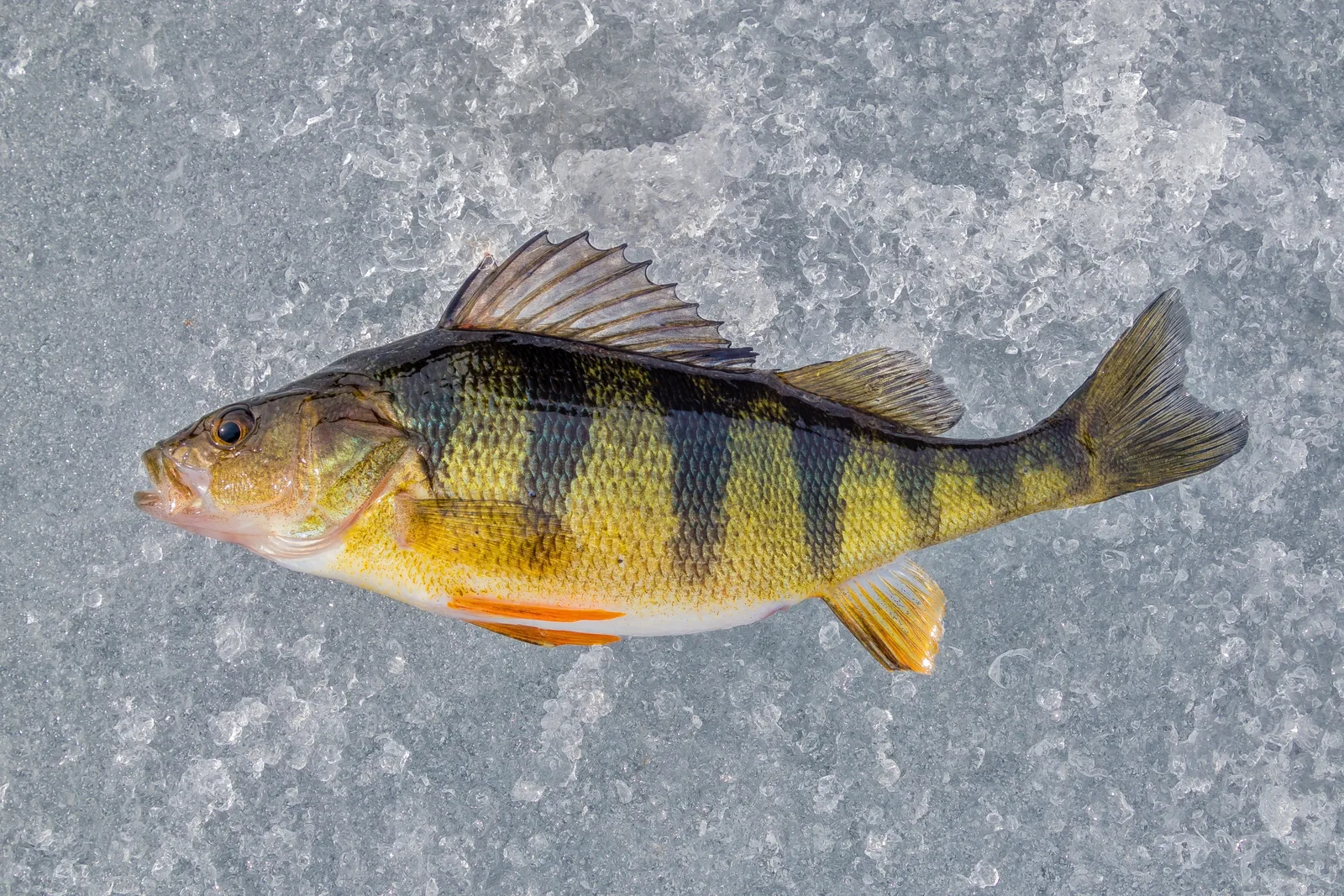
Under the ice, perch feed on or near the bottom. At first ice they sit in green weeds, then move to drop-offs and flats down to 40 ft as winter goes on. On some Wisconsin lakes, anglers fish 40 to 60 ft down. Catch them on a small jig tipped with a spike or wax worm, or a spoon with a minnow head. Hold it just off the bottom on 2 to 4 lb line. The hard part isn’t the bite. It’s finding the school and staying on it.
No strike in 10 minutes? Move a few yards left or right and drill at the same depth. A feeding school of perch tends to hold one depth for a long time.
Where are perch under the ice?
Minnesota’s DNR gives the season in three lines. In early winter, perch sit in shallow water around healthy green weeds. As winter goes on, they move to deeper water, drop-offs and other structure. At the end of winter, they head back shallow to spawn.
Size matters as much as season. Perch school by size, Outdoor Life’s Kubie Brown writes. The small ones stay in the shallows near weed beds. The big ones roam, moving from shallow to deeper water after baitfish. So a hole full of 6-inch fish tells you where the small school is, not the big one.
Here’s where the agency guides and Brown put them, and what each one fishes there:
| When | Where | How deep | What to fish |
|---|---|---|---|
| Early winter (Minnesota) | Healthy green weeds. Fish over the tops or along the edges, not in them | Shallow | Small ice jigs with Minnesota’s usual perch baits: wigglers/Eurolarvae, mealworms or wax worms |
| As winter goes on (Minnesota) | Drop-offs and other structure | Deeper | Minnesota’s method: drop the jig to bottom, lift it a few feet |
| Winter, some lakes (Wisconsin) | The lake depths, feeding only off the bottom | 40–60 ft (12–18 m) | Small, colorful teardrop jigs with wax worms or mousies |
| Winter (New York) | Close to the bottom, from weed beds to flats | Under 10 ft to 40 ft (3–12 m) | Small jigs tipped with spikes; tip-ups with small minnows |
| Big perch (Outdoor Life) | Inside edges of depth contours, the lines on a lake map, where long flats slowly drop off | 7–25 ft (2–7.6 m) | Spoons tipped with a minnow head. #6–#10 jigs with worm, maggots or a live minnow |
| End of winter (Minnesota, Idaho) | Back toward shallow water to spawn. On Idaho’s Lake Cascade, the largest perch seem to be caught in February and March | Shallow | Be sparing with the big females you keep: they carry the eggs (Outdoor Life) |
The pattern you can count on is simple. Weeds early, deeper structure in midwinter, shallow again at the end, and the bottom almost all the time. New York’s guide adds the obvious, which is still worth hearing. Fish the same places you’d fish in other seasons: weed lines, humps, depth changes and points.
How deep should you fish for perch?
Start at the bottom. Minnesota’s method without a bobber goes like this. Drop the lure until the line goes slack, which means it hit bottom. Lift it a few feet. Then watch the line and the rod tip. Set the hook if the tip twitches, the line goes slack or it moves in a way it shouldn’t.
Without a flasher, Minnesota says anglers start near the bottom and work higher until they find fish or decide to move. With one, you can see where the fish are and fish that depth.
There’s one exception worth knowing. Big perch don’t always feed on the bottom, Brown writes. Sometimes they’re a few feet under the ice, chasing suspended baitfish. So when he searches a new spot for jumbos, he starts shallow and drops the bait deeper every couple of minutes. My pick for a normal day is bottom first, because three state agencies put perch there. Try Brown’s way when the bottom is quiet and you know big perch live in the lake.
In deep water a slip bobber holds the depth for you. Minnesota’s steps: thread a bobber stop and then the slip bobber onto the line, tie on the lure and clip a heavy weight to it. Drop the weight to find bottom, pull the line back up, take the weight off and slide the stop to the depth you want. Set the hook when the bobber jiggles, sinks or acts oddly.
Free PDF · Ice thickness chart How thick is the ice? Read it at the hole.
Print the free chart, tape the strip to your scoop and hook it under the ice. It shows what that ice is thick enough for, clear or white. Two wallet charts and a wall chart come with it.
No card, nothing to buy, and the PDF is yours to keep. Confirm with one click and it's on its way. Then a few short emails and one a week on what's biting. Unsubscribe anytime. Privacy.
How do you find a school of perch and stay on it?
Perch through the ice is a search: find the fish, then don’t lose them. The plan, in order:
- Pick a lake with big perch. Few lakes have a lot of big ones. Much of Minnesota’s best perch fishing is in large walleye lakes: Winnibigoshish, Leech, Cass, Lake of the Woods, Big Stone and Mille Lacs.
- Read a lake map first. Brown calls a bathymetric map, a depth-contour map or app, one of the best perch tools. Look for the inside edges of contours where long, shallow flats slowly drop off.
- Drill a line of holes, all at once. Brown starts at 6 to 8 ft and goes out to 20 ft or more. Minnesota says drill them in one session, not drill, fish, drill, fish.
- Give each hole 5 to 10 minutes. Minnesota treats each hole like a cast: 5 to 10 minutes, then move. Brown’s limit is 10 minutes without a strike.
- No electronics? Spread tip-ups. Brown sets several tip-ups down the drop at different depths and lets the flags find the school. Or look where fish houses are bunched: Minnesota says that’s likely fish-holding structure, though not a promise of perch.
- Once you catch two, stay put. The struggling fish often pull the rest of the school in, Brown writes. Now the second rod goes down.
- When it dies, slide sideways. Move a few yards left or right and drill at the same depth. A feeding school tends to hold one depth, so it’s probably close. Only after a few sideways tries do you go deeper or shallower.
- Only small perch? Leave them. Most perch caught while fishing for bluegill are too small to clean, Minnesota says. The big ones school apart.
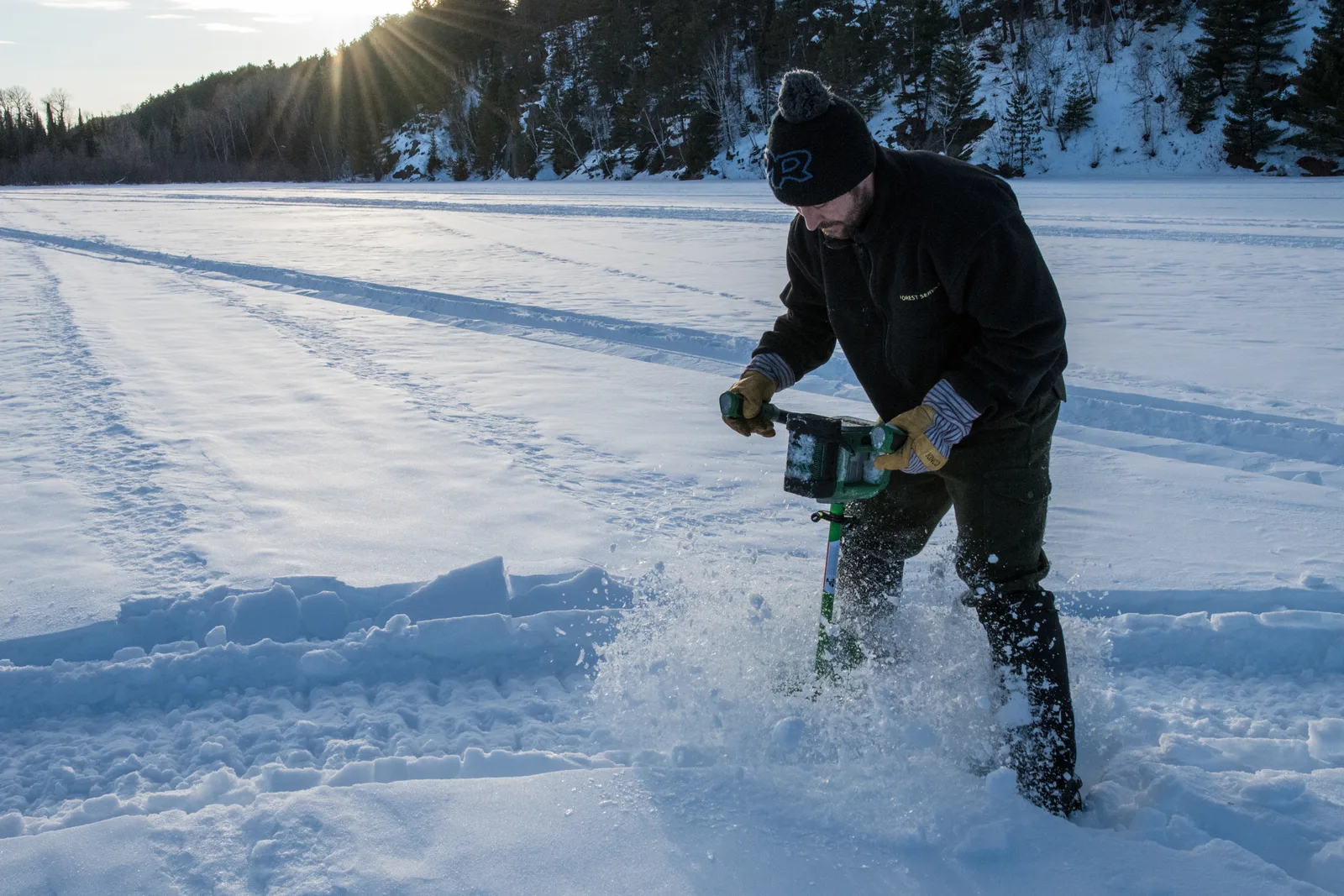
Drill the whole line of holes before you fish. Bass Lake, Superior National Forest, Minnesota. USDA photo by Lance Cheung, public domain.
Jig one line, deadstick the other
Minnesota allows two lines through the ice, and its DNR says perch anglers commonly jig one rod and leave the other alone. The jigged rod draws fish in. The still one, a deadstick, hangs a motionless bait. Some days the jigged rod catches most of the fish. Other days the still one does.
That still rod is also your gauge. If it catches most of the fish, Minnesota says, you may be jigging too hard. You can over-jig and scare perch off instead of pulling them in.
Minnesota’s rule for jigging: big motions draw fish from a distance, small ones work on fish already near the lure. New York’s version is shorter. Jig the bait a few times, then pause for a few seconds, because fish usually hit during the pause.
The perch bite is light. Ohio calls it “soft taps”. A spring bobber, a fine wire on the rod tip, shows what you’d miss by feel. Clam sells one built for jigs and spoons up to 1/16 oz on 1 to 4 lb line.
What are the best jigs and spoons for perch through the ice?
Your perch ice fishing lures should be small, but heavy enough. Minnesota’s common perch sizes are 1/16, 1/32 and 1/64 of an ounce. The lure should be heavy enough to take the kinks out of the line, but small enough for a perch to inhale. Want it down faster? Add a split shot or two about a foot above it.
The number: 1/16, 1/32 or 1/64 oz. Those are Minnesota’s common perch jig sizes, on 2 to 4 lb line.
Tungsten jigs sink faster than lead jigs of the same size, Minnesota says, because tungsten is denser. The Royal Society of Chemistry puts tungsten at 19.3 grams per cubic centimeter and lead at 11.3. So a tungsten jig takes up about 41 percent less space than a lead one of the same weight. But sometimes a very light jig, one that seems to take forever to fall, works better, Minnesota says. So try both.
Wisconsin’s classic is a small, colorful teardrop jig with a wax worm or mousie. It’s the bait of choice for many anglers there.
For jumbos, go bigger, the way Brown does. Small panfish jigs still catch them. But he does better on walleye-size jigs, such as the Clam Drop and Northland Forest Minnow in #6, #8 and #10. He tips them with worm, maggots or a lip-hooked live minnow.
Jigging spoons are the other jumbo tool. Brown’s picks are the Swedish Pimple, the Buck-Shot Rattle and the Clam Speed Spoon, tipped with worms, maggots or a minnow head. Northland names perch first among the fish for its Buck-Shot Rattle Spoon. It comes as small as 1/16 oz with a #10 hook, and Northland says to tip it with minnow heads and wax worms. Body baits such as a Jigging Rap or Rippin’ Rap can pull big perch out of deeper water, Brown adds.
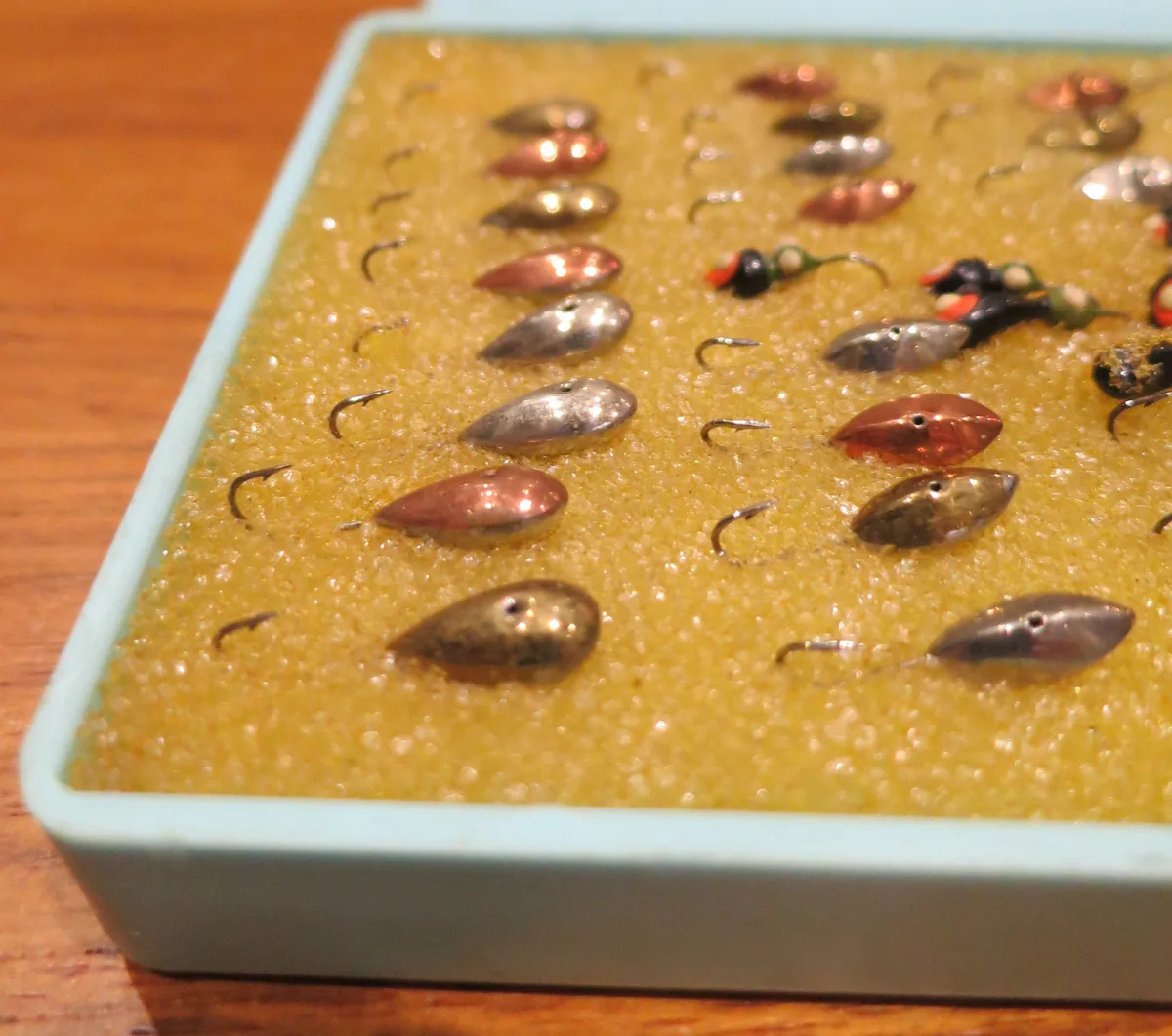
Small teardrop ice jigs. Wisconsin’s perch anglers bait this shape with a wax worm or a mousie. Photo: R. Henrik Nilsson, Wikimedia Commons (CC BY 4.0).
What is the best bait for perch through the ice?
The best ice fishing bait for perch is insect larvae on the small jigs, and minnows or minnow heads on the big ones. Minnesota lists wigglers/Eurolarvae, mealworms and wax worms. New York tips its small jigs with spikes. Each bait word means something:
- Spikes: housefly or blowfly maggots. Their skin is tougher, so they stay on the hook better.
- Wax worms: bee moth larvae, ½ to 1 inch long, cream-colored with a brown head. Take Me Fishing calls them one of the best natural ice baits for panfish.
- Mousies: rat-tailed maggots with a long tail, a favorite perch bait. Some anglers put two or three on one hook.
- Eurolarvae: European blowfly maggots fed dyed food, so they come in colors. Anglers often put three or four on a hook.
- Wigglers: the word changes from state to state. Iowa’s DNR means mayfly larvae. Minnesota writes “wigglers/Eurolarvae” as one bait.
- Mealworms: beetle larvae, yellowish to brown with a smooth, shiny body, usually 1 to 1¼ inches long.
- Minnow heads: a tip for a spoon, say Brown and Northland.
Outdoor Life’s bait guide says the larvae can go on a plain size 8 or 10 hook. Most anglers tip a tiny teardrop jig or spoon with them instead. Live minnows come with state rules on moving them between lakes. The bait shop near the lake is worth the stop anyway. Its owners tend to know which lure sizes, colors and styles are working, Minnesota says.
Watch out: Don’t let the bait freeze. Iowa’s DNR says to keep wigglers in an insulated container next to your body.
Can you catch perch on a tip-up?
Yes, and without electronics it’s how Brown finds them. The trick is a rig that keeps small perch from tripping the flag all day. Here’s his:
- Tie a small barrel swivel to the tip-up line.
- Add 2 to 3 ft of 4 to 6 lb monofilament or fluorocarbon below it.
- Tie on a #6 bait hook, with a small split shot 6 to 8 in above.
- Hook a 2 to 3 in shiner through the base of the tail, just behind the dorsal fin.
The minnow hangs head down, so a big perch takes it head first and the hookset is clean. New York’s simpler advice is tip-ups baited with small minnows. In Minnesota a tip-up is one of your two lines, and you have to stay within sight of it or within 200 ft.
What rod, reel and line for perch?
A short, light rod and thin line. New York’s gear table puts perch with sunfish and crappie. It lists an ultralight rod, 4 to 6 lb line, size 6 to 8 hooks and a 4 to 6 in auger. Minnesota goes lighter on line, 2 to 4 lb, because perch often look a bait over before they bite and thin line shows less. On a normal lake, I’d spool 4 lb: it fits both agencies.
Minnesota’s kit list is short. You need a short, flexible rod, a reel, small ice lures, a bobber and stop, a clip-on weight, split shot and live bait. An entry-level combo costs about $25. Rod makers name models for this: St. Croix sells a 32 in medium-light ice fishing rod called the Perch Seeker.
Deep perch need line on your spool. Wisconsin perch anglers use short jig poles, some with spools big enough for 50 to 60 ft of line.
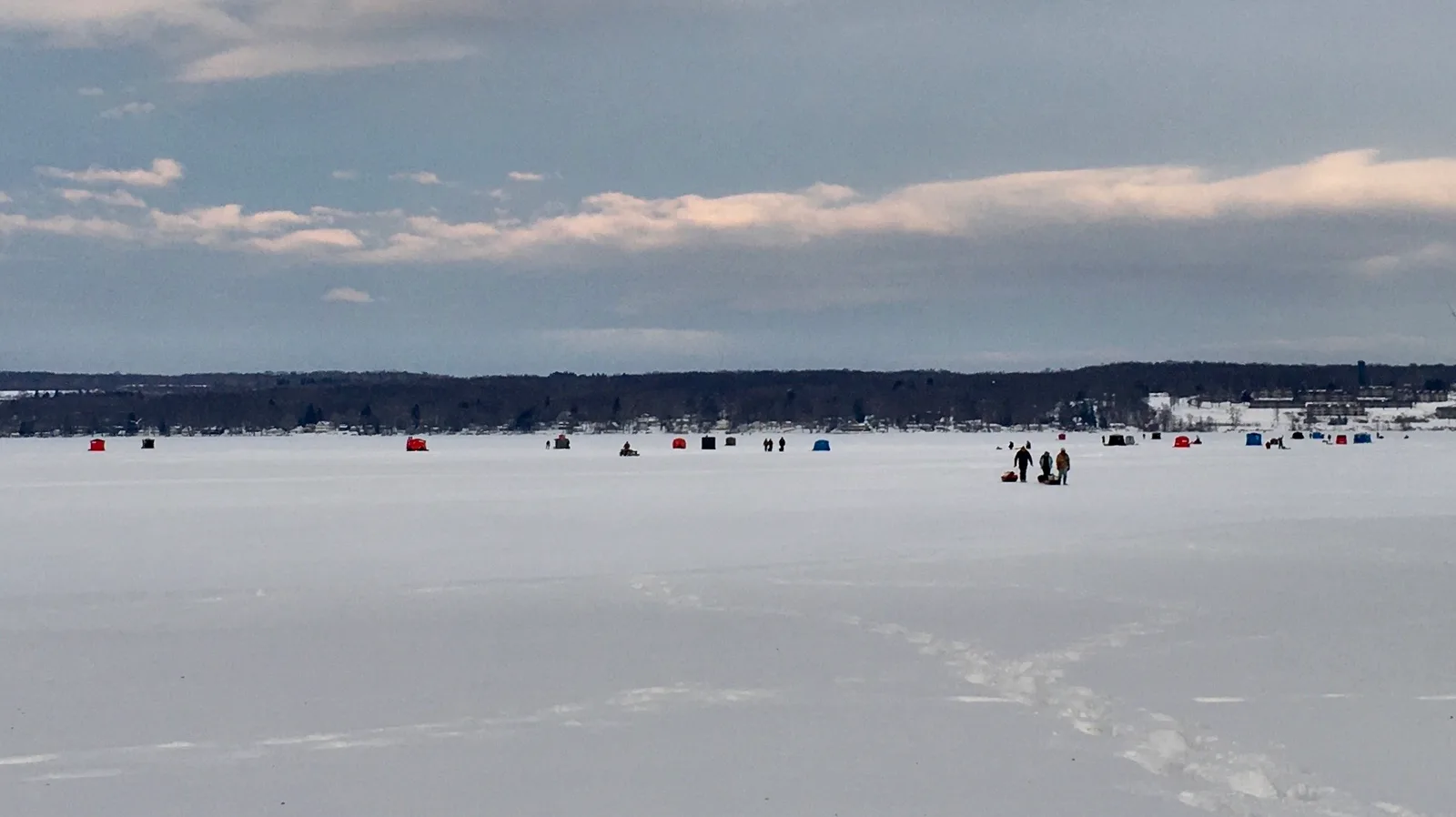
Shelters bunched on Chautauqua Lake, New York, on a January evening. A crowd like this often marks fish-holding structure. Photo by Andre Carrotflower, Wikimedia Commons (CC BY-SA 4.0).
Do you need a flasher for perch?
No, but it helps a lot. Minnesota says anglers with a camera or sonar “clearly have an advantage” in finding where perch are or aren’t. New York says electronics aren’t needed for success, but they help with depth, structure and fish movement.
On a flasher, the depth is the leading edge of the bottom mark. Fish, baitfish and your lure all show between the zero mark and the bottom. Vexilar’s manual says to set the gain so your lure shows as a green signal. Then drop the lure to the depth where you’re marking fish, as Minnesota’s anglers do.
What time of day do perch bite through the ice?
Dawn and dusk. Minnesota says perch fishing is often best then, when fish are most active. Perch are daytime fish: after dark, Michigan’s DNR says, they rest on the bottom and stop feeding. A night trip for perch is a long, cold wait.
Late ice can bring the biggest fish of the year. On Idaho’s Lake Cascade, the largest perch seem to be caught in February and March, just before ice-out. Idaho’s state record came from there through the ice on March 9, 2021, at 3.22 lb and 16.25 inches. Most of those big fish are females full of eggs, as the yellow perch page explains. Be sparing with the big ones you keep, even on lakes with generous limits, Brown asks.
How many lines can you use for perch through the ice?
It depends on the state. Here are the rules for six perch states, with the detail a perch angler trips on:
| State | Lines through the ice | Worth knowing |
|---|---|---|
| Minnesota | 2 (1 on designated trout lakes) | Up to 3 hooks on one line, within 18 in. Stay in sight of a tip-up or within 200 ft |
| Wisconsin | 3 hooks, baits or lures | Holes no more than 12 in across |
| Michigan | 3 lines, tip-ups included, and 6 hooks or lures | Each hook on a perch rig counts on its own |
| New York | 7 lines | You must be in immediate attendance |
| North Dakota | 4 poles | Each tip-up counts as one pole |
| Pennsylvania | 5 devices, one line each | Holes no more than 10 in across |
Limits can vary from lake to lake, size limits may apply, and a lake can be closed, Minnesota says. Check the rules for your water before you go. Lake Erie’s limits and the open-water side of perch are on the perch fishing page.
One safety line before any of it. Minnesota’s minimum for anything on foot is 4 in of new, clear ice, and its DNR adds that no ice is ever safe. Check it with the ice thickness chart every trip.
Quick answers about perch ice fishing
What is the best bait for perch through the ice? Spikes, wax worms or mousies on a small jig, and a minnow head on a spoon. Small minnows go on tip-ups.
What is the best jig for perch ice fishing? A 1/64 to 1/16 oz jig, the sizes Minnesota names. Tungsten gets down faster in deep water. For jumbos, a #6 to #10 jig or a jigging spoon.
How deep do you ice fish for perch? On or near the bottom. That’s under 10 ft in early weeds, out to 40 ft on New York flats and 40 to 60 ft on some Wisconsin lakes.
Why am I only catching small perch? Perch school by size. Move to the contour edges, 7 to 25 ft, where Brown finds the big ones, and try a bigger jig or spoon.
Perch are one fish of many through the ice. The same holes, rules and safety apply to all of ice fishing, from walleye to crappie.

Free PDF · 5 pages
Stop guessing the ice. Tape this strip to your scoop and read it at the hole
Ice that is 6 or 7 inches thick in one spot can be 2 inches close by. You can't tell by looking.
The True-Size Ice Thickness Chart. Print it, tape the strip to your ice scoop, hook it under the ice and read the band at the surface: on foot, sled or truck. One side for clear ice, one for white.
- A true-size strip for your scoop handle, marked from "stay off" to a truck with a wheelhouse
- Two wallet charts, one for your buddy, with five moves that get you out if you go through
- Why 8 inches of white ice counts as 4, and the ice to stay off at any thickness
Every clear-ice number is the Minnesota DNR's, set beside the 29 sources on the page, the Army Corps of Engineers among them.
No card, nothing to buy. Confirm with one click and the PDF is on its way, one version for your phone and one to print, yours to keep. Then a few short emails and one a week on what's biting, with an unsubscribe link in every one. Privacy.
Related
Section guide
Ice Fishing: How to Ice Fish, Step by StepHow to ice fish: wait for 4 in of clear ice, drill all your holes, fish one jigged line and one still. Gear, bait, tip-ups and line limits in 12 states.
 Crappie Ice Fishing: Where They Suspend and What to Drop
Ice fishing for crappie: where they hang under the ice in each kind of lake, the dusk and night bite, tiny jigs, two lines, and the 20 ft rule.
 Ice Thickness Chart: How Thick Ice Must Be to Walk, Ride or Drive
Ice thickness chart for walking, snowmobiles, cars and trucks, with white ice doubled, what each inch holds in pounds, and how to measure it yourself.
 Ice Fishing for Pike: Tip-Ups, Bait, Depth and When to Set the Hook
Ice fishing for pike: where they sit under the ice, the tip-up spread, live or dead bait, how far off bottom, when to set the hook, and the state rules.
 Walleye Ice Fishing: Where, When and How to Catch Them
Walleye ice fishing peaks in the 90 minutes before and just after sunset. Where they sit, how deep by lake, spoon or Jigging Rap, tip-ups and line rules.
Sources (29)
- Minnesota DNR, Ice fishing for perch
- Minnesota DNR, Learn to ice fish
- Minnesota DNR, General ice thickness guidelines
- Minnesota DNR, General Regulations (eRegulations)
- Minnesota Statutes 97C.321, Restrictions on unattended lines
Show all 29 sourcesShow fewer sources
- Minnesota DNR, Hook-setting devices allowed starting with the 2025-26 ice fishing season (Nov 17, 2025)
- Wisconsin DNR, Yellow Perch (PUBL-FM-710 08)
- Wisconsin DNR, Guide to Wisconsin Hook and Line Fishing Regulations 2026-2027
- New York State DEC, I FISH NY Guide to Ice Fishing
- New York State DEC, How to Ice Fish
- New York State DEC, General Freshwater Fishing Regulations
- Michigan DNR, Lawful Fishing Methods (eRegulations)
- North Dakota Game and Fish, Fishing regulations 2026-2028
- 58 Pa. Code § 63.10, Ice fishing
- Michigan DNR, Yellow perch
- Ohio DNR, Lake Erie Fishing Guide
- Idaho Fish and Game, Lake Cascade produces another state record perch
- Iowa DNR, Ice Fishing
- Take Me Fishing, Ice Fishing Basics: 5 Guidelines to Get You Started (Debbie Hanson, December 14, 2022)
- University of Maine Cooperative Extension, Mealworms (Pest Management Fact Sheet #5044, James F. Dill and Clay A. Kirby)
- Outdoor Life, Tips for Catching Jumbo Yellow Perch Through the Ice (Kubie Brown, 2025)
- Outdoor Life, Icefishing Tips: Guide to Live Bait (Dick Sternberg)
- Mississippi State University Extension, Rat-tailed Maggot (Blake Layton)
- Northland Tackle, Buck-Shot Rattle Spoon
- Clam Outdoors, Drop Jig
- St. Croix Rod, Croix Custom Ice
- Clam Outdoors, TS Series Spring Bobber Rod
- Royal Society of Chemistry, Periodic Table: tungsten and lead
- Vexilar, FLX-12 flasher instruction manual