 By
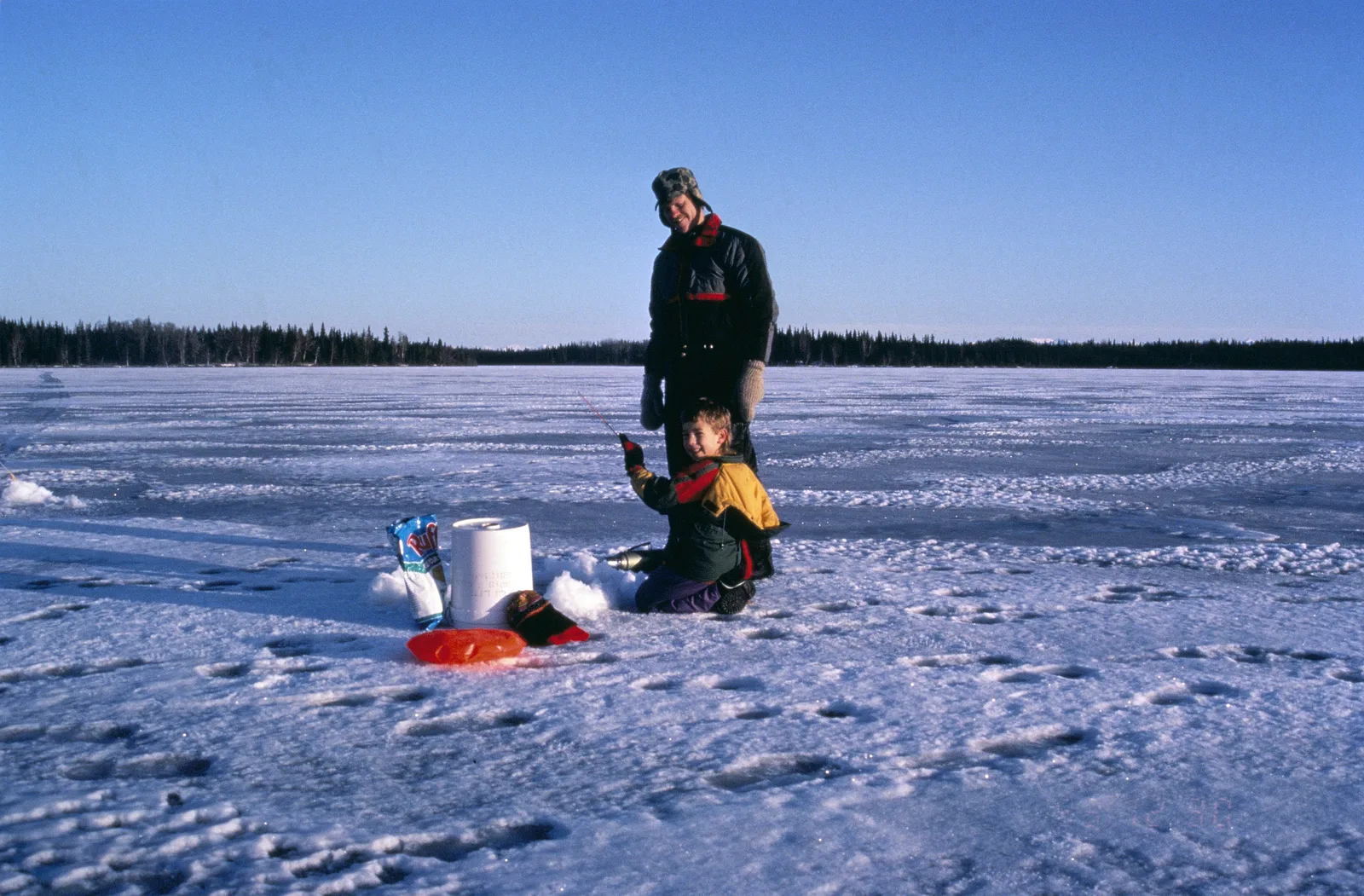
Wear three loose layers with no cotton, and make the outside one a float suit. Cotton loses its warmth once it gets wet, OSHA says, while wool, silk and most synthetics keep theirs. The float suit is there because most people who fall through the ice drown, Minnesota DNR says. Every spec and price below is from the maker’s own page, read on November 15, 2026, and nobody wore these clothes for this page.
Of 269 ice deaths in Minnesota since 1976, only 5 were from hypothermia. Most people who fall through the ice drown.
What do you wear ice fishing, head to toe?
The whole outfit fits in two short tables. Most of it comes from OSHA’s cold stress guide. That guide is written for people who work outside in winter. Ice fishing means sitting still on a frozen lake all day, which is the same problem. State agencies add the safety items, and the National Weather Service adds the face.
Your body: layers, bibs and flotation
| Wear | Why | Skip |
|---|---|---|
| Skin: wool, silk or synthetic long underwear | Pulls sweat off your body (OSHA) | Cotton: it loses its warmth when wet |
| Middle: fleece, wool or synthetic | Stays warm even when wet (OSHA) | A tight fit: it cuts blood flow to hands and feet |
| Jacket: a wind- and waterproof shell with vents, or a float parka | Blocks wind and wet, lets heat out before you sweat (OSHA) | A shell that doesn’t vent |
| Legs: insulated, waterproof bibs, or float bibs | They go on early and stay on all day (Striker) | Jeans and cotton sweatpants |
| Flotation: a float suit, or a foam life jacket over your layers | Most people who fall through drown (Minnesota DNR) | An inflatable: it may not inflate in the cold |
Feet, hands and head
| Wear | Why | Skip |
|---|---|---|
| Feet: wool or synthetic socks, plus a dry spare pair | Wet feet lose heat 25 times faster than dry feet (OSHA) | Cotton socks |
| Boots: insulated and waterproof | OSHA and NIOSH both ask for it | Hip boots and waders: they fill with water (US Army CRREL) |
| Under the boots: ice cleats | They help prevent falls (New York DEC, Iowa DNR) | Bare soles on bare ice |
| Hands: insulated gloves, waterproof for wet line | OSHA asks for insulated gloves, water resistant if needed | One pair only: pack a dry spare |
| Head: a hat or a hood | Keeps your whole body warmer (OSHA) | Going bareheaded |
| Face: a cover for face and neck in the wind | At 0 °F (-18 °C) and 15 mph, skin can freeze in 30 minutes (NWS) | Bare skin in a wind |
| In the sled: spare socks, gloves, a hat and a change of clothes | OSHA’s own packing list | Nothing |
The rest of this page goes through the rows that cost money and need a choice: bibs, the float suit, boots and gloves.
How do you layer for ice fishing?
Three layers, loose, and the right fabric in each. That’s OSHA’s rule for the cold, and NIOSH, the federal institute for worker safety, says the same: several loose layers. Each layer has one job.
The inner layer keeps moisture off your skin. Wool, silk or a synthetic does that, and cotton doesn’t. A cotton T-shirt soaks up the sweat from the walk out and then sits cold against you all day.
The middle layer is the warmth. Fleece, wool or a synthetic stays warm even when it gets damp, which is exactly when you need it.
The outer layer stops wind and wet, and it has to breathe. OSHA wants “some ventilation to prevent overheating.” That’s what the pit zips on ice jackets like Striker’s are for, the zippers under the arms.
Keep all three loose. Tight clothes squeeze the blood flow to your hands and feet, OSHA says. Makers size for this. Striker cuts its Rambler jacket to fit over a base layer, a hoodie and bibs.
Layers also let you change with the day. You’ll be warm walking out with a sled and drilling holes, and cold once you sit still. You can’t add warmth you left at home, so pack one more layer than you think you need.
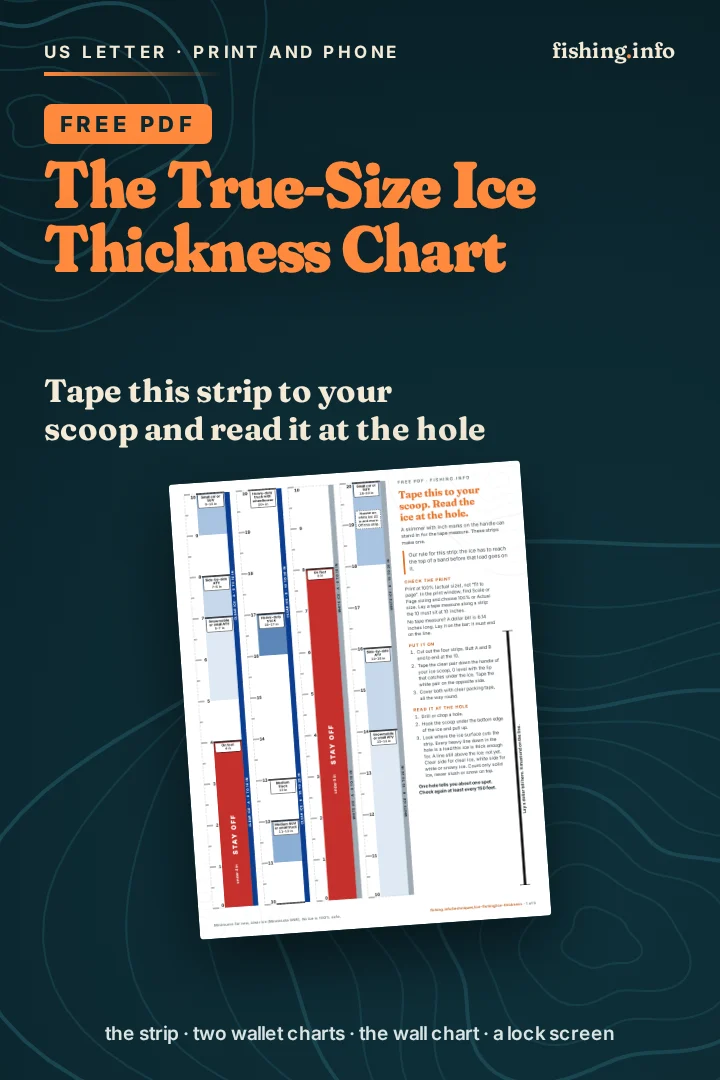
Free PDF · Ice thickness chart How thick is the ice? Read it at the hole.
Print the free chart, tape the strip to your scoop and hook it under the ice. It shows what that ice is thick enough for, clear or white. Two wallet charts and a wall chart come with it.
No card, nothing to buy, and the PDF is yours to keep. Confirm with one click and it's on its way. Then a few short emails and one a week on what's biting. Unsubscribe anytime. Privacy.
Bibs, or a jacket and pants?
Bibs. They cover your back when you bend over a hole, and they don’t slide down when you kneel. Striker puts it well: “Jackets are easy enough to remove, but your bibs go on early and do not come off until the job is done.”
That’s why the warmth in your bibs matters more than in your jacket. You can open or shed a jacket. Your bibs stay on, so pick a pair that’s warm enough to sit in but vents when you walk.
Look for three things in ice fishing bibs:
- Waterproof and insulated. You’ll sit on buckets, kneel in slush and lean on snow.
- Tough knees. Striker’s Rambler bib has heavy-duty knee panels and pockets for removable knee pads.
- Flotation, if you can. Clam and Striker both sell float bibs, the bottom half of a float suit.
Here are three float bibs, at the makers’ prices on November 15, 2026. The K number is the shell’s waterproof rating: the higher it is, the more water it keeps out.
| Bib | What the maker lists | Price |
|---|---|---|
| Clam Sub-Zero Float Bib | 5K shell, 80g insulation, 200g fleece, removable knee pads | $229.99 |
| Striker Rambler Bib | 5K (5,000 mm) shell, 100g insulation, 150g Sureflote foam, knee pads | $299.99, $329.99 in larger and tall sizes |
| Clam Vertex Float Bib | 10K shell, 60g PrimaLoft Silver insulation, removable knee pads | $329.99 |
Start with the Sub-Zero if you fish outside. It’s the cheapest of the three and has a fleece lining on top of its insulation. Clam’s store had only a few sizes left on November 15, so check yours. If you walk and drill all day, the Rambler fits better: Striker built it for anglers who roam the ice, with heavy-duty knee panels. Clam builds the Vertex for anglers who hole-hop and walk the ice, and at 60g it has the least insulation of the three.
A float bib with a matching float jacket is a float suit. Of everything you wear on the ice, it’s the one piece that does more than keep you warm.
Do float suits really float you?
They help, and that’s the word the makers use. A float suit is an insulated jacket and bib with foam built in. Clam calls its foam “MotionFloat™ flotation-assist technology.” Striker calls its own “Sureflote® Flotation Assist Technology permanently built-in.” Neither maker claims Coast Guard approval. Clam goes further on its Rise V3 page: “Not Coast Guard Approved PFD.” Striker’s pages don’t use the words life jacket or PFD at all.
Neither gives a buoyancy figure either. Striker lists “150g” of Sureflote foam, but that’s the weight of the foam, not how much it holds up.
| Suit | Flotation, in the maker’s words | Coast Guard | Price |
|---|---|---|---|
| Clam Rise V3 Float Parka | “internal buoyancy assist” | “Not Coast Guard Approved PFD” | $99.99 to $119.99 |
| Clam Sub-Zero parka and bib | “flotation-assist technology” | none claimed | $229.99 each |
| Clam Vertex parka and bib | foam “designed to aid in flotation” | none claimed | $329.99 each |
| Striker Rambler jacket and bib | “Flotation Assist Technology” | none claimed | $299.99 each |
| Striker Climate Jacket | “Flotation Assist: Yes” | none claimed | $429.99 |
| Onyx foam life jacket | “flotation foam” | “U.S. Coast Guard approved” | $29.99 |
Why wear flotation at all?
Because most people who fall through drown. They don’t freeze. Minnesota DNR says a foam life jacket or flotation suit “may be the No. 1 item that will keep you alive if you fall through the ice.” Of 269 ice deaths in Minnesota since 1976, only 5 were from hypothermia.
Minnesota counts insulated coats, pants and full-body suits as flotation, as well as foam life jackets. It also says three things you’ll want to know:
- Skip the inflatable. Inflatable life jackets may not inflate properly in low temperatures, Minnesota says, and it doesn’t recommend them for cold water. Foam also keeps you warmer, which buys you time to climb out.
- Take it off to drive. Never wear a life jacket or float suit while driving inside an enclosed vehicle on the ice, Minnesota says.
- Keep your clothes on if you go in. “Heavy clothes won’t drag you down,” Minnesota says, “but instead can trap air to provide warmth and flotation.”
Want approval you can read on the label? Wear a Coast Guard-approved foam vest over your winter clothes. If you don’t own a buoyant suit, the Lifesaving Society says to wear a brightly colored life jacket over your snowmobile suit or winter layers. Then carry ice picks, which Minnesota calls the second most important item, and check the ice thickness before every step out. A float suit helps you after the ice fails. Thick ice is how it doesn’t.
What boots do you need for ice fishing?
Insulated and waterproof, with a temperature rating for your coldest day. OSHA and NIOSH both ask for insulated, waterproof boots in the cold. Wet feet lose heat 25 times faster than dry feet, OSHA says, so waterproof matters as much as warm.
The rating on the box is the maker’s own number. Here’s how four makers print it:
| Boot | Rating, as the maker prints it | Price |
|---|---|---|
| Kamik Greenbay 4 | “–40°C proof” (-40 °F) | $119.99 |
| Clam IceArmor Sub-Zero | “Rated to an impressive -40°F” (-40 °C) | $199.99 |
| Muck Arctic Ice 16” + Vibram Arctic Grip A.T. | “Comfort Range: -60°F to 30°F” (-50 °C to -1 °C) | $210 |
| Baffin Impact | Polar Rated: -49 °F to -76 °F (-45 °C to -60 °C), “during moderate activity” | $290 |
Only Baffin says what its rating means. Its Polar Rated boots “offer comfort during moderate activity where temperatures from -45°C to -60°C / -49°F to -76°F have been experienced.” The other three are bare numbers. None of them is a lab standard you can compare across brands.
Read every rating with that word “activity” in mind. Ice fishing is mostly sitting still over a hole, which is less than the moderate activity Baffin’s rating assumes. Baffin rates its Impact for long days in extreme cold “where activity level may be low to moderate.” For a full day outside in deep cold, buy a boot rated well past the coldest temperature you expect.
Two more things count on the ice. Pick a boot with a removable liner, like the Kamik and Clam boots. You can dry the liner overnight or swap in a dry one. And skip hip boots and waders. They can fill with water and add weight, the US Army’s cold regions lab warns, so they should never be worn on ice.
Which gloves let you fish?
Two pairs: a warm, waterproof pair for the walk and the drilling, and a dry spare in your pocket. OSHA asks for insulated gloves, water resistant if needed. You’ll need that, because every fish and every hole puts water on your hands. Iowa DNR’s ice list includes extra dry clothes, a pair of gloves among them.
The makers sell gloves by how much insulation is in them and whether they keep water out:
| Glove | What the maker lists | Price |
|---|---|---|
| Clam Insulated Latex Glove | an insulated latex glove | $14.99 |
| Striker Trekker | 200g insulation on the back, 150g on the palm, “Immersion Proof” | $29.99 |
| Clam Extreme | heavy 600D polyester shell, leather palm patches, PrimaLoft insulation, fleece lining | $69.99 |
| Striker Apex | 100g and 170g PrimaLoft Silver insulation, “Immersion Proof” | $129.99 |
Bulky gloves make it hard to tie a knot or bait a tiny jig. You’ll take one off for that, and the hand comes back wet. That’s what the spare pair is for.
What about your head and face?
Wear a hat or a hood. OSHA says it helps keep your whole body warmer, not only your head.
Your face is what the wind finds. At 0 °F in a 15 mph wind, bare skin can freeze in 30 minutes, the National Weather Service says. Frostbite needs air below freezing, so 40 degrees isn’t too cold to fish if you dress for it. A big open lake has nothing to stop the wind. On the coldest days, cover your face and neck before it starts blowing. When the weather turns, a cold front and its wind change the fishing too.
Do you need ice cleats?
Yes, on bare ice. A fall on thick ice can break your tailbone or a wrist, Minnesota DNR warns. On thin ice it can put you through. New York’s DEC says to add cleats to your boots to help prevent falls, and Iowa lists ice cleats among the gear to bring.
Cleats are spiked soles that strap over your boots. Muck builds its Arctic Grip A.T. sole for “wet ice.” A strap-on cleat adds grip to any boot you own.
How do you stay dry on the ice?
Stop the sweat before it starts. OSHA says dampness, sweat included, can raise how fast your body loses heat. On the ice the sweat comes from the walk out, the auger and pulling a loaded sled. An hour later you sit down in it.
So open up while you work. Unzip the jacket and open the pit zips on the way out. Striker builds its Rambler jacket with a venting system that “helps prevent sweat build-up.” Zip up again once you’re sitting still.
Then keep the outside water out. Kneel on a pad, not in slush. Swap wet gloves for your dry pair. If anything gets soaked, change it. A heated ice fishing shelter is the other way to dry out. The rest of what goes on the ice is on the ice fishing gear checklist, and the open-water basics are on the fishing gear list.
The picks in detail
These are the makers’ prices on November 15, 2026. Check before you buy.
| Pick | Best for | Price |
|---|---|---|
| Clam IceArmor Rise V3 Float Parka | the cheapest float jacket | $99.99 to $119.99 |
| Clam IceArmor Sub-Zero Float Parka and Bib | a full float suit for less | $229.99 each |
| Striker Rambler Jacket and Bib | drilling and moving all day | $299.99 each |
| Striker Climate Jacket | one jacket for cold and warmer days | $429.99 |
| Kamik Greenbay 4 | a rated boot on a budget | $119.99 |
| Muck Arctic Ice 16” + Arctic Grip A.T. | bare, wet ice | $210 |
| Baffin Impact | the coldest days, low activity | $290 |
| Striker Trekker Glove | warm, waterproof gloves for less | $29.99 |
The float suits
The Rise V3 is the cheapest way to put flotation in your outer layer. It’s $99.99 in blue and $119.99 in charcoal and black, down from $199.99. Wear it over any waterproof bibs.
The Sub-Zero is a full suit with a 5K shell, 80g insulation, a 200g fleece lining and reflective piping. For most anglers who fish outside, it’s where we’d start.
Striker’s Rambler has 100g of insulation, pit zips and venting against sweat, so it suits anglers who drill and move. The Climate is a 3-in-1: its insulated inner jacket comes out for warmer days. Striker perforates the foam in the shell so it breathes better.
The boots and gloves
The Kamik Greenbay 4 is the cheapest rated boot here. The Muck is tall and fully waterproof, with a sole made for wet ice. Baffin builds the Impact for long days in extreme cold at a low to moderate activity level. That’s a day watching a line of tip-ups.
The Striker Trekker is an insulated, immersion-proof glove Striker calls a workhorse for early and late ice. At $29.99, two pairs still cost less than one pair of Striker’s Apex.
How we chose
We picked these from the makers’ own pages. The flotation wording, insulation, waterproof ratings and boot ratings are as printed, and the prices are those of November 15, 2026. The safety advice comes from OSHA, NIOSH and the National Weather Service, the Minnesota, New York and Iowa agencies, the US Army’s cold regions lab and the Lifesaving Society. Nobody tested this clothing on the ice for this page.
What decides a pick is flotation first, then staying dry, then warmth for the hours you sit still. Minnesota puts flotation first too.

Free PDF · 5 pages
Stop guessing the ice. Tape this strip to your scoop and read it at the hole
Ice that is 6 or 7 inches thick in one spot can be 2 inches close by. You can't tell by looking.
The True-Size Ice Thickness Chart. Print it, tape the strip to your ice scoop, hook it under the ice and read the band at the surface: on foot, sled or truck. One side for clear ice, one for white.
- A true-size strip for your scoop handle, marked from "stay off" to a truck with a wheelhouse
- Two wallet charts, one for your buddy, with five moves that get you out if you go through
- Why 8 inches of white ice counts as 4, and the ice to stay off at any thickness
Every clear-ice number is the Minnesota DNR's, set beside the 29 sources on the page, the Army Corps of Engineers among them.
No card, nothing to buy. Confirm with one click and the PDF is on its way, one version for your phone and one to print, yours to keep. Then a few short emails and one a week on what's biting, with an unsubscribe link in every one. Privacy.
Related
Section guide
Ice Fishing Gear: The Checklist and What a Starter Kit CostsThe ice fishing gear and equipment checklist, safety first, priced from makers' stores: a bare kit for about $320, a comfortable one for about $2,010.
 Ice Auger: What Size, Which Type, and How Many Holes per Charge
Most anglers need an 8 in battery ice auger. Hole sizes, electric vs. drill vs. hand, holes per charge in 12 and 24 in of ice, and 7 augers compared.
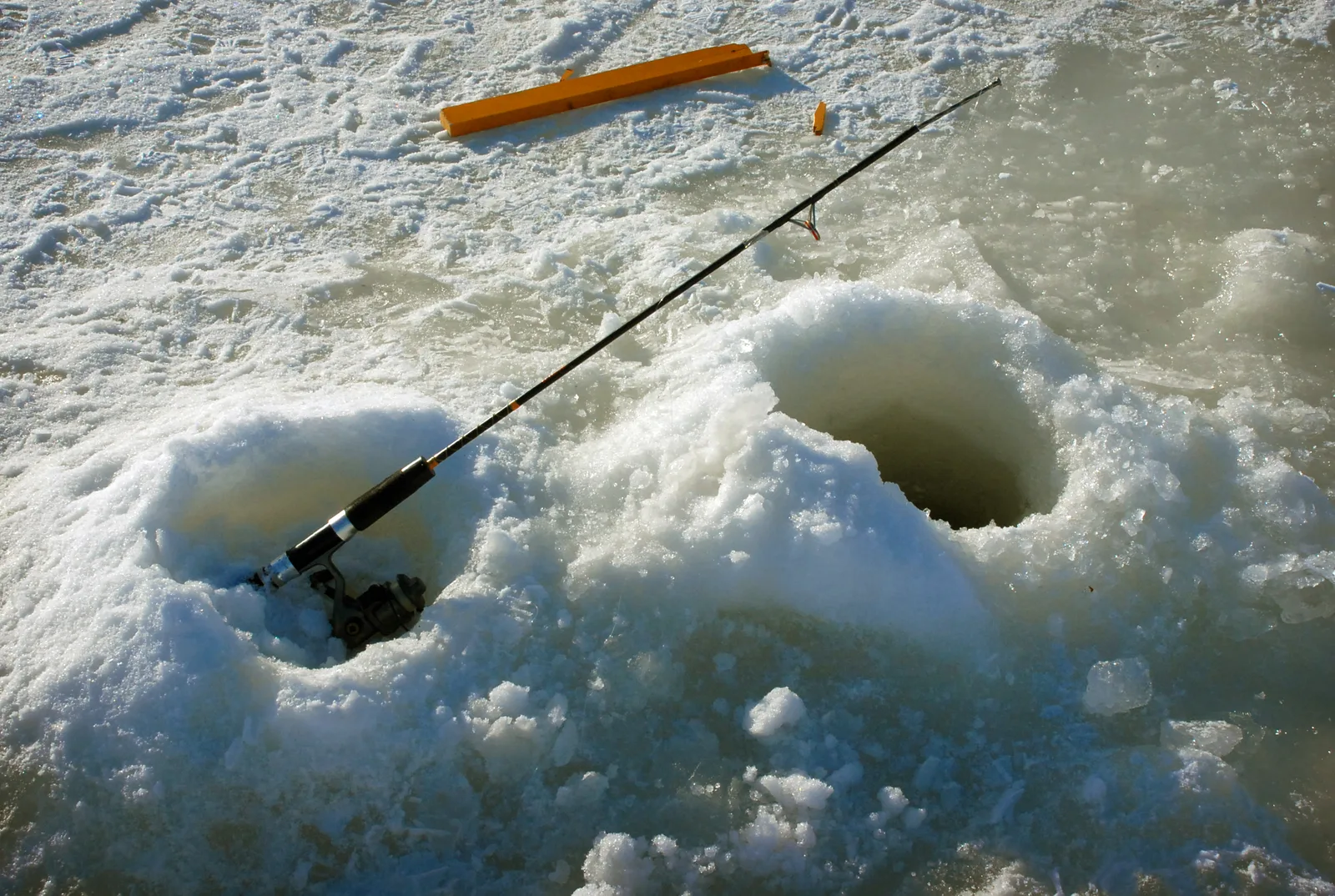 Ice Fishing Rod and Reel: The Length for Each Fish, and the Picks
Which ice fishing rod length and power for panfish, walleye and pike, inline or spinning reel, which line, and seven picks with the makers' prices.
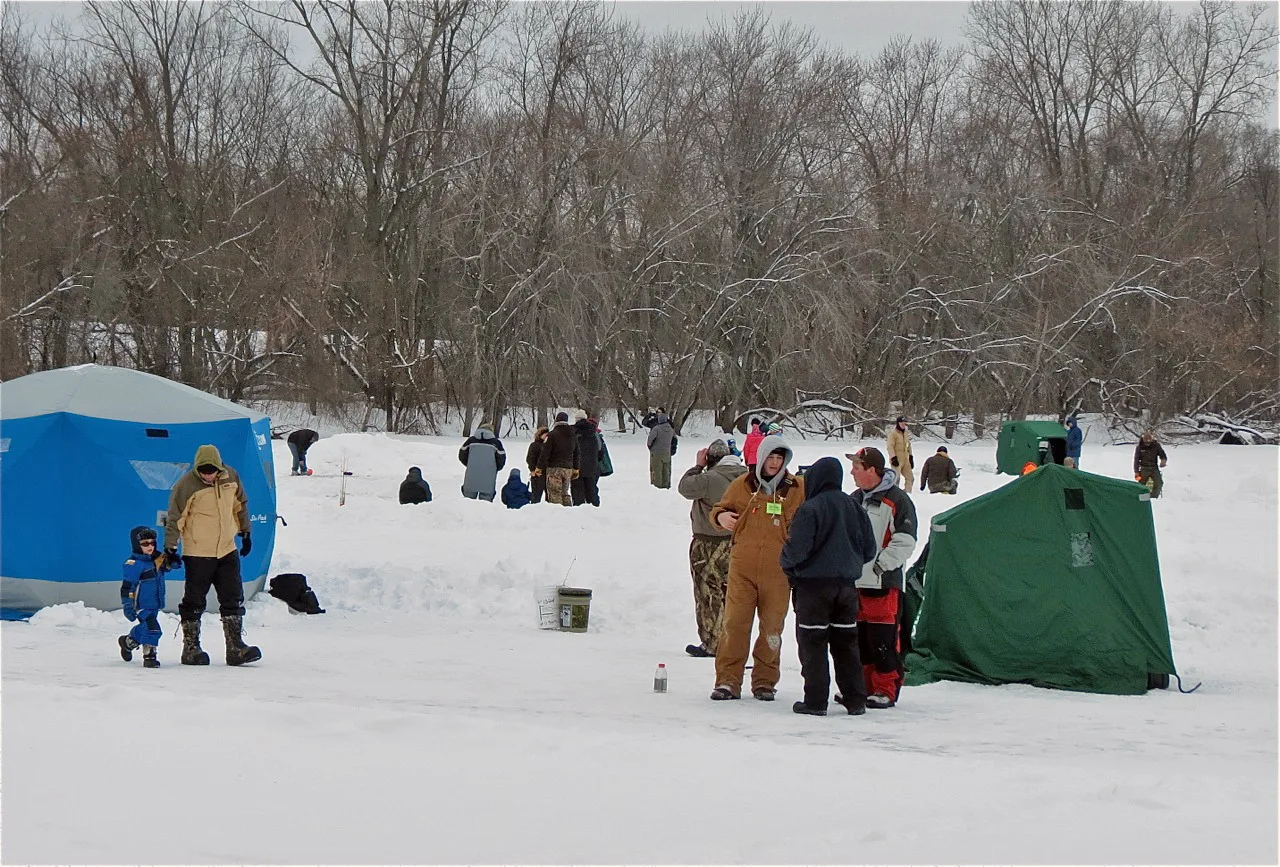 Ice Fishing Shelter: Hub or Flip-Over, and 7 Picks by Floor per Pound
Ice fishing shelter or tent: a flip-over to fish alone and move, a hub for two or three. Square feet per pound from maker specs, 7 picks, safe heat.
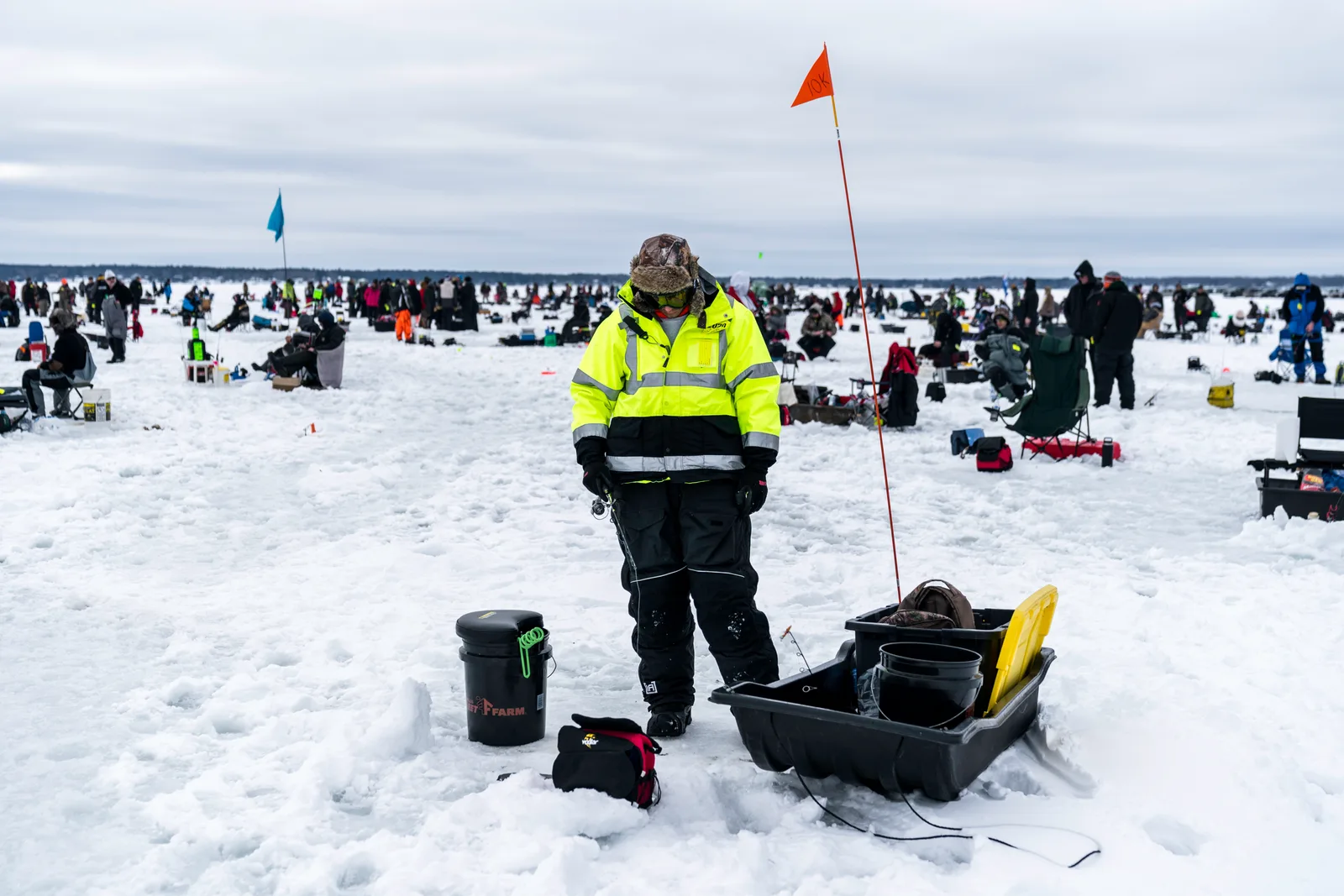 Ice Fishing Sled: What Size You Need, Hitches, and 9 Sleds Compared
An ice fishing sled sized to your shelter: three-person hubs pack 52 to 65 in long. Hand-pull or ATV sleds, hitch load limits, and 9 sleds compared.
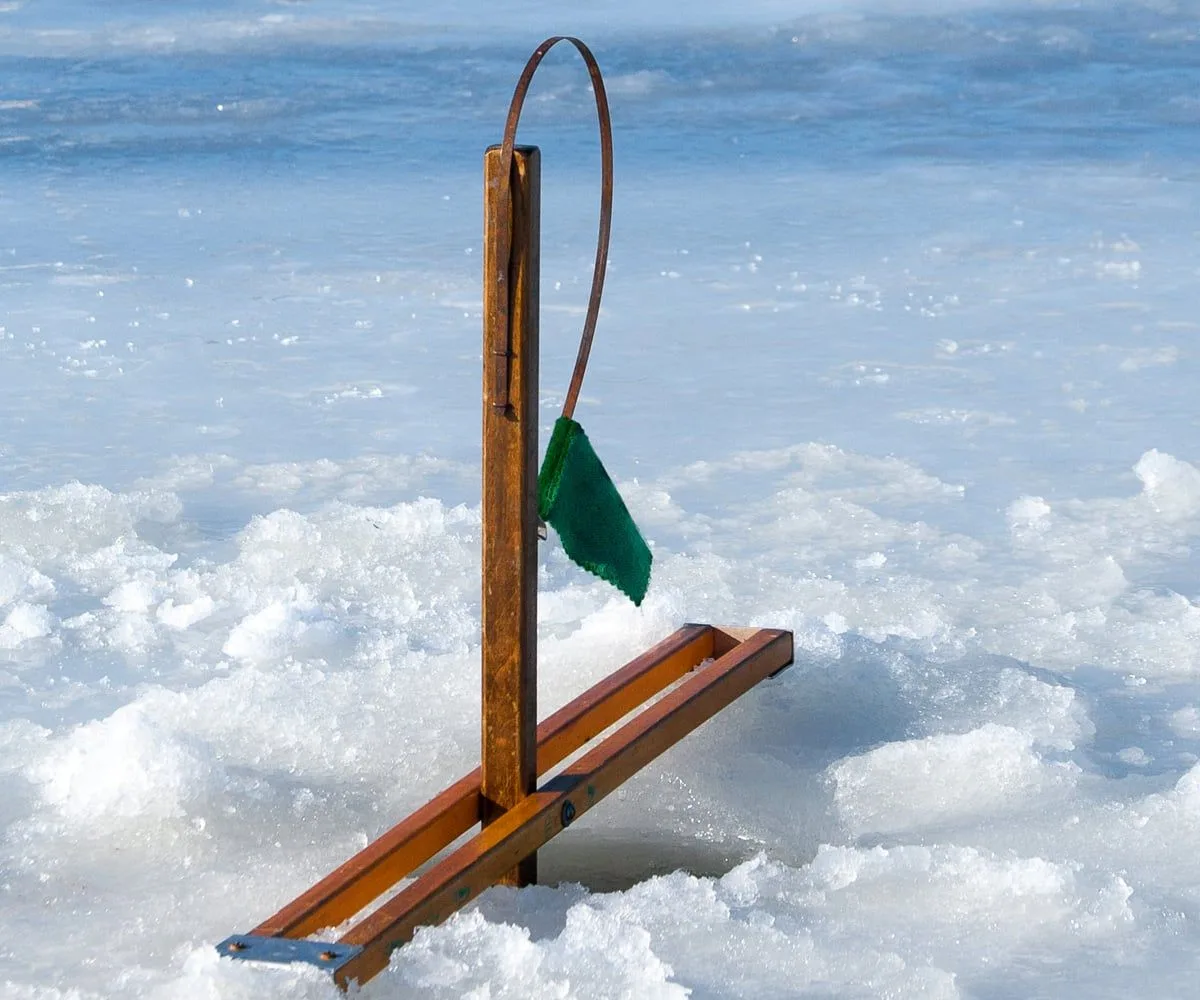 Ice Fishing Tip-Ups: How to Set One, and Which to Buy
Ice fishing tip ups: what one is, how to set it in eight steps, how many your state allows, and five to buy at the makers' own prices.
Sources (19)
- OSHA, Cold Stress Guide (layers, cotton, boots, gloves, wet feet)
- CDC NIOSH, About cold stress
- National Weather Service, Understanding Wind Chill
- Minnesota DNR, Ice safety gear
- Minnesota DNR, What if you fall in?
Show all 19 sourcesShow fewer sources
- Lifesaving Society, Cold Water and Ice
- Minnesota DNR, Ice fatality statistics 1976-2025
- New York State DEC, Learn how to ice fish
- Iowa DNR, Stay safe on the ice this winter (December 9, 2025)
- US Army Cold Regions Research and Engineering Laboratory, Safety on floating ice sheets
- Clam Outdoors, IceArmor float parkas and bibs (Rise V3, Sub-Zero, Vertex)
- Clam Outdoors, IceArmor Sub-Zero boots and Extreme gloves
- Striker, Rambler jacket and bib
- Striker, Climate jacket and bib
- Striker, Trekker and Apex gloves
- Onyx, Adult General Purpose Life Jacket
- Baffin, Impact men's boot and Polar Rated definition
- Muck Boot Company, Men's Arctic Ice 16" Insulated Boot + Vibram Arctic Grip A.T.
- Kamik, Greenbay 4 men's winter boots