 By
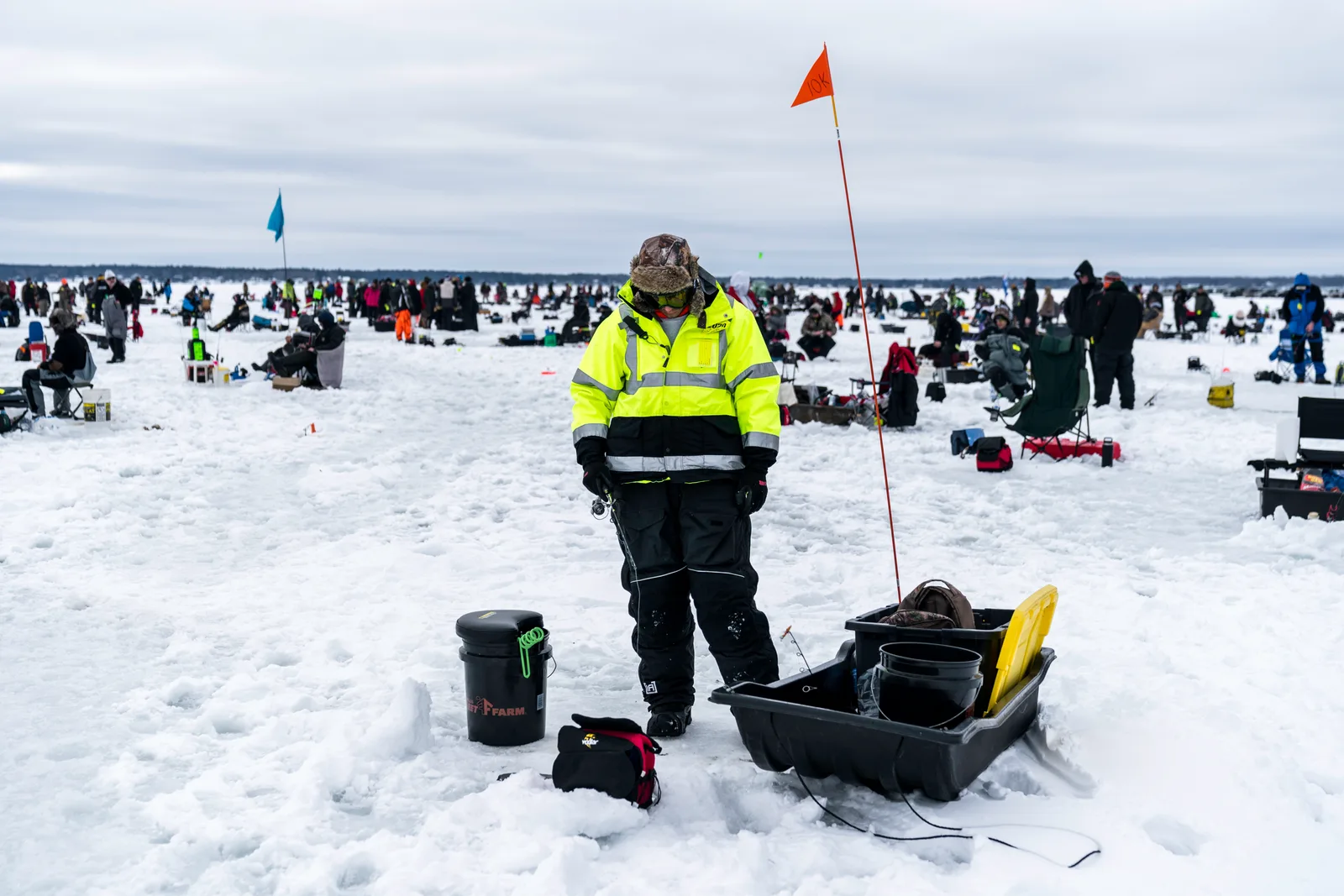
Buy an ice fishing sled a few inches longer than your packed shelter. Three-person hubs pack 52 to 65 in (132 to 165 cm) long, so that’s a 54 in sled for Eskimo’s QuickFish 3i and a 75 in sled for Clam’s X-400. Pulling by hand, the $59.99 Jet Sled 1 is the default. Towing behind an ATV or snowmobile, get a roto-molded Otter Pro, molded in one seamless piece, on a steel hitch. Every size, weight and price below is the maker’s own, read on November 15, 2026. We haven’t pulled these sleds ourselves.
On a long rope behind a snowmobile or ATV, your gear becomes a projectile the moment you stop short or hit glare ice. A steel bar hitch stops that, Joel Nelson writes.
What size sled do you need for ice fishing?
Start with the biggest thing you haul. For most anglers that’s the shelter. A hub packs into a long bag, and the bag has to lie flat in the sled, inside the raised back. Otter raises the back of its sleds to keep the load from falling out on the move.
So read the shelter’s packed length before you buy the sled. Eskimo’s QuickFish 3i packs to 52 in and Otter’s Vortex Pro Cabin to 56. Eskimo’s Outbreak 450XDP packs to 58, Clam’s X-400 to 65 and Clam’s X-600 to 75. Then pick a sled longer than that. Makers print one length, and as far as we can tell it’s the outside. The floor inside is shorter where the walls slope and the back rises. Measure both when it’s close.
No shelter yet? For a first winter of ice fishing, a bucket, a rod and a hand auger fit in the small sleds.
The fit column is our arithmetic on the makers’ numbers, not a test. “Tight” means the packed hub is within a few inches of the sled’s outside length, so measure it.
| Sled | Length × width (maker) | Weight | What fits, by packed length | Price |
|---|---|---|---|---|
| Jet Sled Jr | 43 × 21 in (109 × 53 cm) | not listed | Bucket, rods, hand auger. No hub | $39.99 |
| Otter Sport Medium | 53 × 25 in (135 × 64 cm) | 12 lb (5.4 kg) | Gear only. A 52 in hub is too tight | $90.00 |
| Jet Sled 1 | 54 × 25 in (137 × 64 cm) | not listed | QuickFish 3i (52 in), tight | $59.99 (sold out Nov 15) |
| Otter Small Pro | 55 × 27 in (140 × 69 cm) | 17 lb (7.7 kg) | QuickFish 3i (52 in), tight | $95.00 |
| Eskimo E-Hauler XL | 64 × 36 in (163 × 91 cm) | not listed | Vortex Pro Cabin (56 in), Outbreak 450XDP (58 in) | $149.99 |
| Otter Medium Pro | 65 × 32 in (165 × 81 cm) | 27 lb (12.2 kg) | The same two. X-400 (65 in) too tight | $155.00 |
| Otter Magnum Pro | 75 × 38 in (191 × 97 cm) | 37 lb (16.8 kg) | X-400 (65 in). X-600 (75 in) too tight | $200.00 |
| Otter Large Pro | 85 × 44 in (216 × 112 cm) | 61 lb (27.7 kg) | X-600 (75 in) | $310.00 |
| Clam Pack Sled | 36 × 34 in (91 × 86 cm), packed | 36 lb (16.3 kg) | Packs to 11 in high, with a seat. Gear, not a hub | $349.99 |
Width rarely decides it. Otter’s and Clam’s packed hubs measure 11 to 14 in across, and every sled in the table is over 20 in wide. Width matters for the rest of the load: the bucket, the ice auger, the flasher (your sonar) and the rod case. Measure your truck bed or trunk too. Joel Nelson’s tip: check the space in the truck or on the trailer before you pick a size.
Pulling by hand or behind a machine?
That’s the first fork, and it decides the kind of sled. Nelson puts Otter’s line simply. Hand-towing, you want a Sport Sled. Towing by machine, you want a Pro Sled. The same goes for every brand.
By hand
Go light. The Otter Sport Medium weighs 12 lb and comes with a tow rope. The Jet Sled 1 is what Eagle Claw calls thermoformed polyethylene, with runners, and costs $59.99. Nelson says sleds like these are almost always under $100, and they’re the ones he thinks everyone should own.
Look for high sides and a lip all the way around, so a bungee or strap can hold the load over rough ice. Then fix the rope. Nelson’s upgrade is a longer lead that’s kinder to bare hands, or better, a strap that goes around your waist. Clam sells a sled pulling harness for $49.99, and Shappell one for $32.99.
The red kids’ sled from the garage works on flat ice with little snow. Nelson’s rules for those: no slopes, no speed, no machines and no expensive gear.
Behind an ATV or snowmobile
Now the sled takes speed, jolts and heavier loads. Nelson calls roto-molding the only way to go here, because it keeps the plastic the same thickness in the corners and pockets, where other sleds are thinner. Otter’s Pro sleds are built that way, with a 5/16 in bottom and hitch pockets molded into the front.
Check the ice before you take a machine out. Minnesota DNR says 4 in of new, clear ice to walk on. A snowmobile or small ATV needs 5 to 7 in, and a side-by-side 7 to 8. Double those numbers on white ice. Minnesota’s ice thickness chart goes on up to heavy-duty trucks.
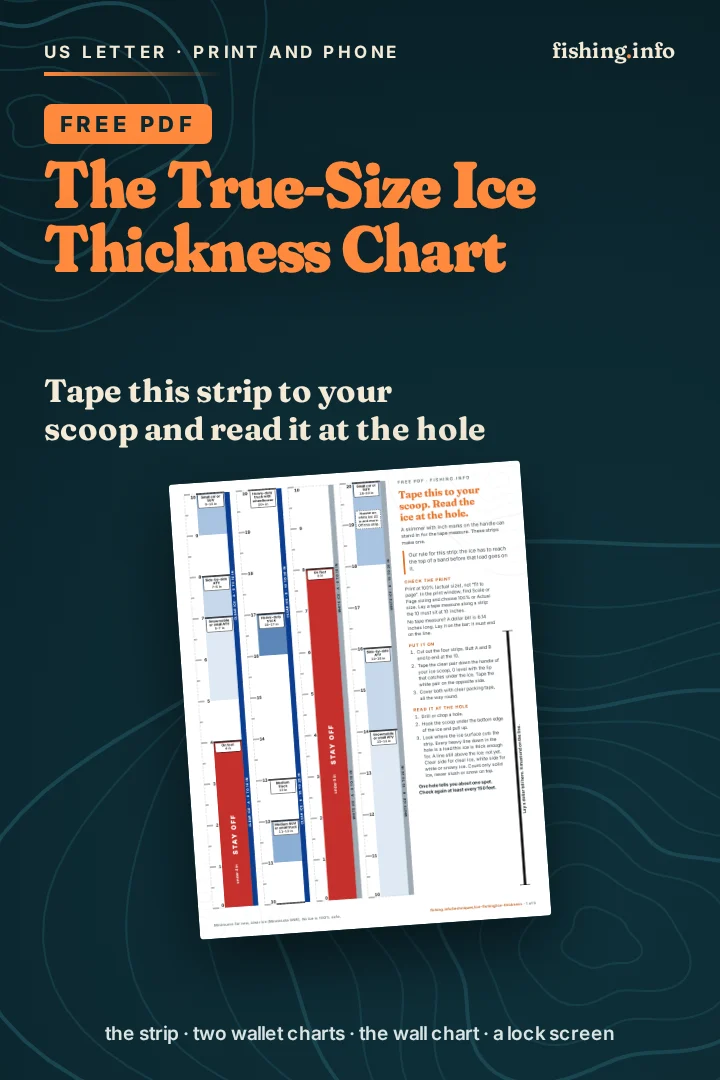
Free PDF · Ice thickness chart How thick is the ice? Read it at the hole.
Print the free chart, tape the strip to your scoop and hook it under the ice. It shows what that ice is thick enough for, clear or white. Two wallet charts and a wall chart come with it.
No card, nothing to buy, and the PDF is yours to keep. Confirm with one click and it's on its way. Then a few short emails and one a week on what's biting. Unsubscribe anytime. Privacy.
What is an Otter sled?
It’s a sled from Otter Outdoors, and Otter builds every one by roto-molding. Nelson explains the process: plastic powder goes into a hollow mold, and the mold spins in several directions while it’s heated. The plastic coats the walls evenly, with no seams or weld lines.
Otter makes two lines. The Sport sleds are for pulling by hand and come with a tow rope. The Pro sleds are for towing, with molded-in hitch and hyfax runner pockets. Nelson says the Sport saves nearly half the weight of a Pro of similar size. Otter’s own numbers agree: the 64 in Sport Large weighs 16 lb, the 65 in Pro Medium 27 lb.
Watch the names. A Medium Sport is 53 in long and a Medium Pro 65 in long. Nelson’s advice is the same as ours: the tape measure decides, not the size label.
The smallest Pro, the 43 in Mini Pro, is made for hand pulling and has no hitch pocket. Otter’s Sport Large was out of stock on Otter’s site on November 15, 2026, with a note to check your local dealer.
What do a hitch and runners add?
A hitch is a rigid steel bar from the sled to the machine. Nelson’s case for it: on a rope, the sled runs into the back of the machine when you stop. On glare ice, bare and slick, it can catch an edge and flip. A rigid bar prevents both.
How the hitch meets the sled matters too. Bolting it through the front loads two small spots, and Nelson says that often ends in failure. A pocket molded into the sled, with a pin through sled, hitch and sled again, spreads the pull over the whole front. At the machine end, use a pin and key that fit. In Nelson’s words, looking for pins in the snow is the worst.
Jet Sled prints a load limit on its hitches. Otter’s hitch page gives none, and we found none for Eskimo’s or Clam’s.
| Hitch | Load limit (maker) | Price |
|---|---|---|
| Jet Sled Hitch JSH | 125 lb max load | $34.99 |
| Jet Sled Hitch JSH-HD | 250 lb max load | $49.99 |
| Jet Sled Hitch JSH-HD2 | 300 lb max load | $74.99 |
| Otter Tow Hitch – Standard | none given | $85.00 |
| Eskimo Universal Tow Hitch | none found | $69.99 |
| Clam Pro Series Hitch | none found | $119.99 |
Otter’s standard hitch is steel tubing with a spring-loaded coupler, and it fits the Small, Medium and Magnum Pro. Eskimo also sells a pivoting EZ-Stow hitch for $119.99, and Clam a Cinch Hitch for $89.99.
Runners are the strips bolted under the sled. Otter calls them hyfax. They wear out instead of the bottom of the sled. Nelson says they pay for themselves if you cross gravel, concrete or rough spots often, and they help the sled track straight in snow. Otter’s hyfax kits run $36.99 to $79.99. Jet Sled’s wear bars cost $44.99 to $59.99, Eskimo’s tracking kits $94.99 to $129.99, and Clam’s runner kits $79.99 to $119.99.
What is a Smitty sled?
A Smitty sled is a regular ice sled mounted on a pair of skis. A loaded sled plows through snow. On skis, the tub rides above it. Chris Fonos fishes out of Edmonton, Alberta. In Hooked Magazine he wrote that the skis cut the effort by at least half, and by much more in his own use.
You can build one. Fonos lists a few hand tools, some scrap wood, a pair of used downhill or cross-country skis and the sled. Pick skis about as long as the sled, but no longer than your truck bed or SUV can take. A simple wooden frame takes a few hours. Fonos also names two shops that sell them ready-made.
It pays off in deep snow. Fonos says that before he built one, he’d often stop at the first spot he found. Now he moves spots and walks a few kilometers a day.
Rule of thumb: Skis as long as the sled, but short enough to fit your truck bed or SUV.
How do you rig and pack a sled?
Most broken gear comes from things bouncing around in the sled, MeatEater’s Sam Lungren says. His fixes cost under $50 and took under half an hour:
- Eye bolts down both sides. Eight bolts with 1½ in of thread, nyloc nuts and fender washers. Space them at the sled’s length divided by four. The washer keeps the bolt from pulling through the plastic.
- Bungees shorter than the sled is wide. He used 24 in cords on a 30 in wide sled. They also hold a tarp over the load against the snow a snowmobile throws.
- The auger low and strapped. Put the blade cover on whenever you travel. Behind a machine, keep the auger down low under the bungees. On foot, don’t lay it on top of the rest either, slush and all. Lungren added shovel brackets to the front to keep the auger in reach while he moves between holes.
- Rod holders from PVC. He cut a 6 ft pipe into 1 ft pieces and bolted them across the back. Rigged ice rods stay apart and don’t tangle.
- A plywood base for buckets and propane. Ross Robertson, also writing for MeatEater, cuts a board from a cardboard template. Make it at least 1/2 in thick, 3/4 in for heavy items. Drill only where the sled doesn’t touch the ice, between the runners.
Two more from Nelson. A travel cover keeps the load dry. A small drain hole at the back of each groove lets trapped water out at home. Skip the holes if you ever float the sled.
Sled shelter or a separate sled?
A flip-over shelter is already a sled. The fabric and poles sit on a plastic tub with a seat, and you pull the whole thing. Clam’s Kenai, for one person, packs to 49 in and weighs 50 lb.
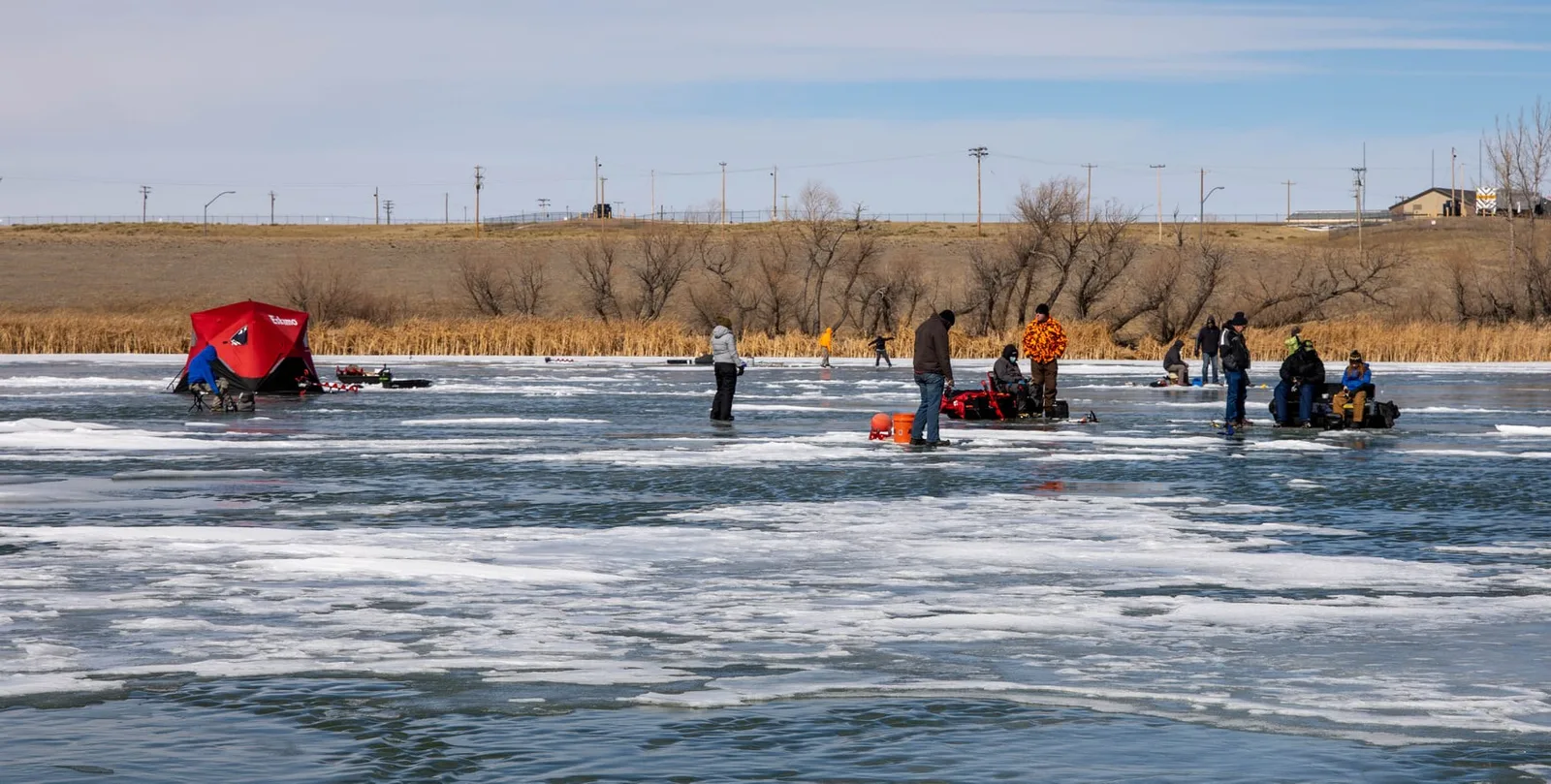
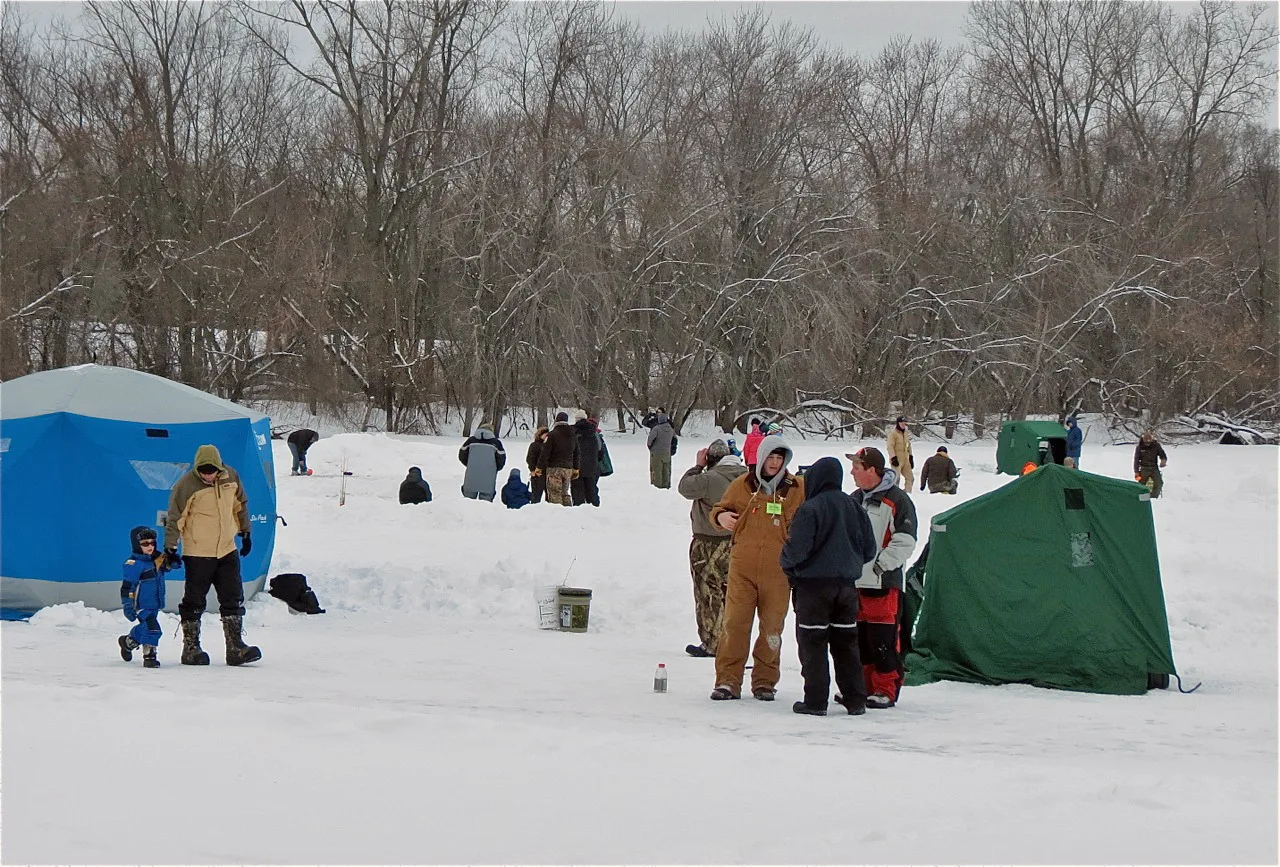
A hub on the left, gear sleds and a sled shelter beside the anglers, at an ice fishing derby on Pearson Lakes at F.E. Warren Air Force Base. Photo: F.E. Warren Outdoor Recreation Staff, U.S. Fish and Wildlife Service (public domain).
Clam says its flip-overs pull by hand or tow behind an ATV or snowmobile, and recommends adding runners when you put one together.
That makes the choice simple. With a flip-over, your gear rides inside it and you may not need a second sled. With a hub, you need a sled long enough for the bag. That’s where the table at the top earns its keep.
Clam’s Pack Trap 1 sits between the two: a one-angler sled shelter that packs to 11 in high. Clam’s Pack Sled has the same idea without the shelter. It packs down to 36 × 34 × 11 in, with skis that fold flat, a padded seat and a tow strap.
Picking the ice fishing shelter comes down to room against weight, and the sled follows from it. Of all the ice fishing gear you buy, it’s the piece that carries the rest.
The picks in detail
Jet Sled 1: the hand-pull default
At $59.99 it’s the cheapest sled here long enough, on paper, for a packed 52 in hub. Eagle Claw’s store showed it sold out in all three colors on November 15, 2026, so check stock first. Only just, so measure the bag. It’s 54 in long, with runners. Pick it if you walk out. Jet Sled sells hitches for it, but for towing every trip Nelson would take a roto-molded sled. The Heavy Duty KD1 is the same size in thicker plastic for $69.99.
Otter Pro Sled Medium: the towing sled
The 65 in Medium takes a 56 or 58 in hub and has the hitch pockets Nelson calls the best way to connect a sled. Budget $85 for Otter’s hitch, or take the $319.99 combo with hitch, hyfax and cover. It weighs 27 lb, more than twice the 12 lb Sport Medium, so it’s a sled for towing.
The number: 27 lb for the Pro Medium, 12 lb for the Sport Medium. By hand, you drag every one of those pounds.
Otter Pro Sled Magnum: for the big hubs
At 75 in it’s the first Otter that takes a 65 in X-400 bag with room to spare. It weighs 37 lb and costs $200. For Clam’s 75 in X-600, go up to the 85 in Large Pro at $310.
Eskimo E-Hauler XL: the wide one
At 36 in wide it’s the widest sled here under $200, at $149.99. It’s 64 in long, so it takes a 56 or 58 in hub. It connects to Eskimo’s tow hitch accessories, sold separately.
Clam Pack Sled: for the trunk
At $349.99 it’s the priciest here, and you pay for the pack size. Pick it if a 5 ft tub won’t fit your car. Skip it if you pull a hub.
How we chose
We started from the shelters. A sled’s job is to carry the biggest thing you own. So we set each sled’s length against the packed lengths of five hubs, all from the makers’ pages. Then we split the picks by how you pull: by hand or behind a machine.
Every spec and price is the maker’s, read on November 15, 2026, and prices change through the season. The opinions on hitches, runners and roto-molding are Joel Nelson’s, and the rigging tips are MeatEater’s, named where they appear. We didn’t pull these sleds or test them on the ice, and this page has no affiliate links.

Free PDF · 5 pages
Stop guessing the ice. Tape this strip to your scoop and read it at the hole
Ice that is 6 or 7 inches thick in one spot can be 2 inches close by. You can't tell by looking.
The True-Size Ice Thickness Chart. Print it, tape the strip to your ice scoop, hook it under the ice and read the band at the surface: on foot, sled or truck. One side for clear ice, one for white.
- A true-size strip for your scoop handle, marked from "stay off" to a truck with a wheelhouse
- Two wallet charts, one for your buddy, with five moves that get you out if you go through
- Why 8 inches of white ice counts as 4, and the ice to stay off at any thickness
Every clear-ice number is the Minnesota DNR's, set beside the 29 sources on the page, the Army Corps of Engineers among them.
No card, nothing to buy. Confirm with one click and the PDF is on its way, one version for your phone and one to print, yours to keep. Then a few short emails and one a week on what's biting, with an unsubscribe link in every one. Privacy.
Related
Section guide
Ice Fishing Gear: The Checklist and What a Starter Kit CostsThe ice fishing gear and equipment checklist, safety first, priced from makers' stores: a bare kit for about $320, a comfortable one for about $2,010.
 Ice Auger: What Size, Which Type, and How Many Holes per Charge
Most anglers need an 8 in battery ice auger. Hole sizes, electric vs. drill vs. hand, holes per charge in 12 and 24 in of ice, and 7 augers compared.
 What to Wear Ice Fishing: Layers, Bibs, Float Suits and Boots
What to wear ice fishing: three layers and no cotton, ice fishing bibs or a float suit, boots by their rating and gloves, with makers' prices.
 Ice Fishing Rod and Reel: The Length for Each Fish, and the Picks
Which ice fishing rod length and power for panfish, walleye and pike, inline or spinning reel, which line, and seven picks with the makers' prices.
 Ice Fishing Shelter: Hub or Flip-Over, and 7 Picks by Floor per Pound
Ice fishing shelter or tent: a flip-over to fish alone and move, a hub for two or three. Square feet per pound from maker specs, 7 picks, safe heat.
 Ice Fishing Tip-Ups: How to Set One, and Which to Buy
Ice fishing tip ups: what one is, how to set it in eight steps, how many your state allows, and five to buy at the makers' own prices.
Sources (19)
- Otter Outdoors, Sleds (sizes and features)
- Otter Outdoors, Pro Sled Medium
- Otter Outdoors, Pro Sled Magnum
- Otter Outdoors, Sport Sled Medium
- Otter Outdoors, Pro Medium Sled Combo
Show all 19 sourcesShow fewer sources
- Otter Outdoors, Tow Hitch – Standard
- Eagle Claw, Shappell Jet Sled 1
- Eskimo, E-Hauler XL Sled
- Clam Outdoors, Pack Sled
- Clam Outdoors, Kenai flip-over shelter (towing and runners)
- Clam Outdoors, X-400 Hub Shelter (packed size)
- Eskimo, QuickFish 3i (packdown length)
- Otter Outdoors, Vortex Pro Cabin (collapsed size)
- Joel Nelson Outdoors, Choosing the Right Ice Fishing Sled
- Joel Nelson Outdoors, Which Otter Sled to Buy? Pro Sled or Sport Sled?
- Hooked Magazine (Chris Fonos), Smitty Sled Build Guide
- MeatEater (Sam Lungren), Video: How to Trick Out Your Ice Fishing Sled
- MeatEater (Ross Robertson), Five Easy DIY Ice Fishing Projects Your Gear Needs
- Minnesota DNR, Ice thickness guidelines