 By
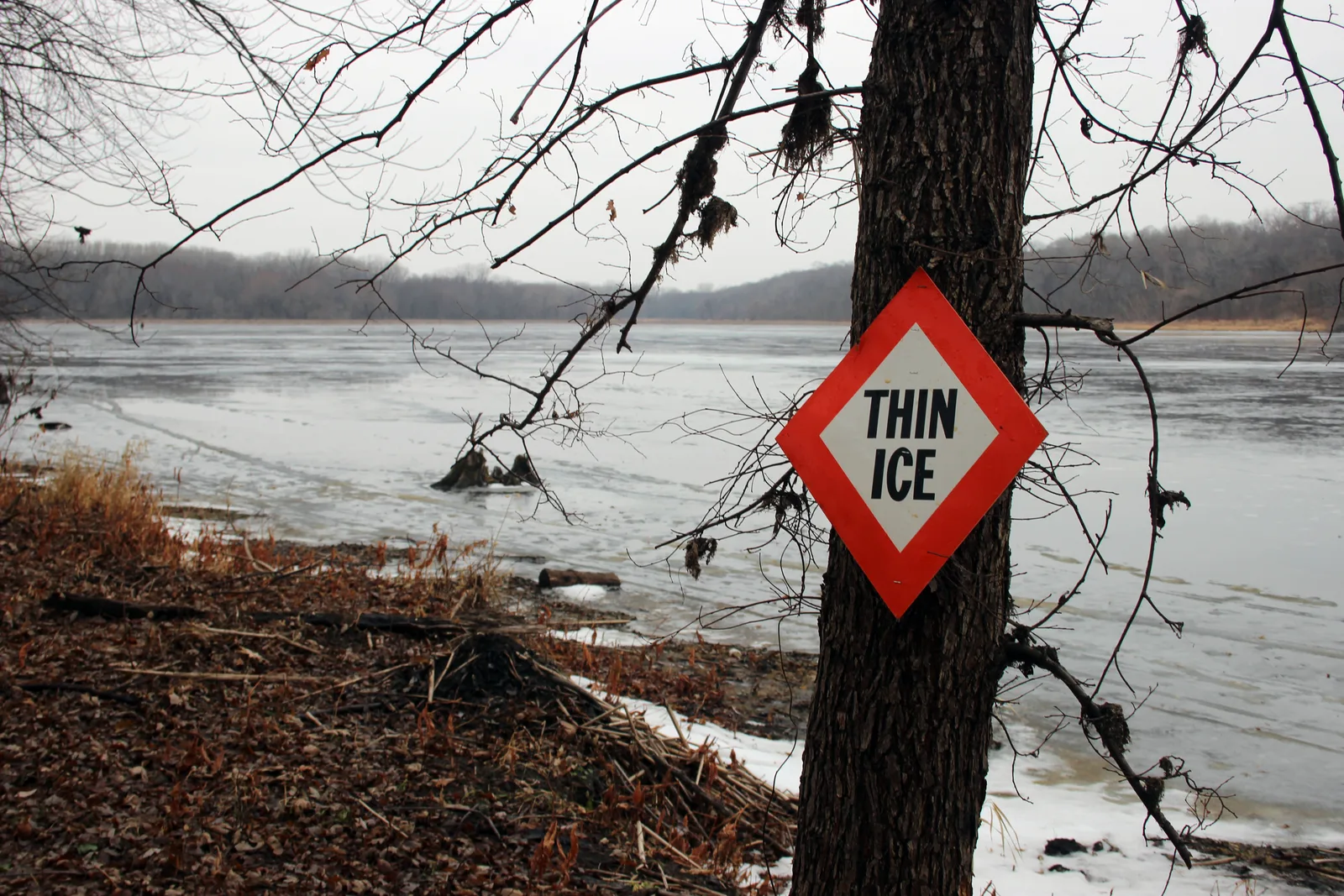
Check your ice
What does the ice look like?
4 in of clear ice: thick enough for you on foot.
3 more inches for a snowmobile or small ATV.
- Ice fishing or anything else on foot4 inReached
- Snowmobile or small ATV5–7 inNot yet
- Side-by-side ATV7–8 inNot yet
- Small car or SUV9–10 inNot yet
- Medium SUV or small truck11–12 inNot yet
- Medium truck13 inNot yet
- Heavy-duty truck16–17 inNot yet
- Heavy-duty truck with wheelhouse shelter20+ inNot yet
Our rule for a range: wait for the higher number. 5–7 means 7.
Minnesota DNR's minimums for new, clear ice. Michigan and Wisconsin give no number at all. No ice is 100 percent safe: check again as you go.
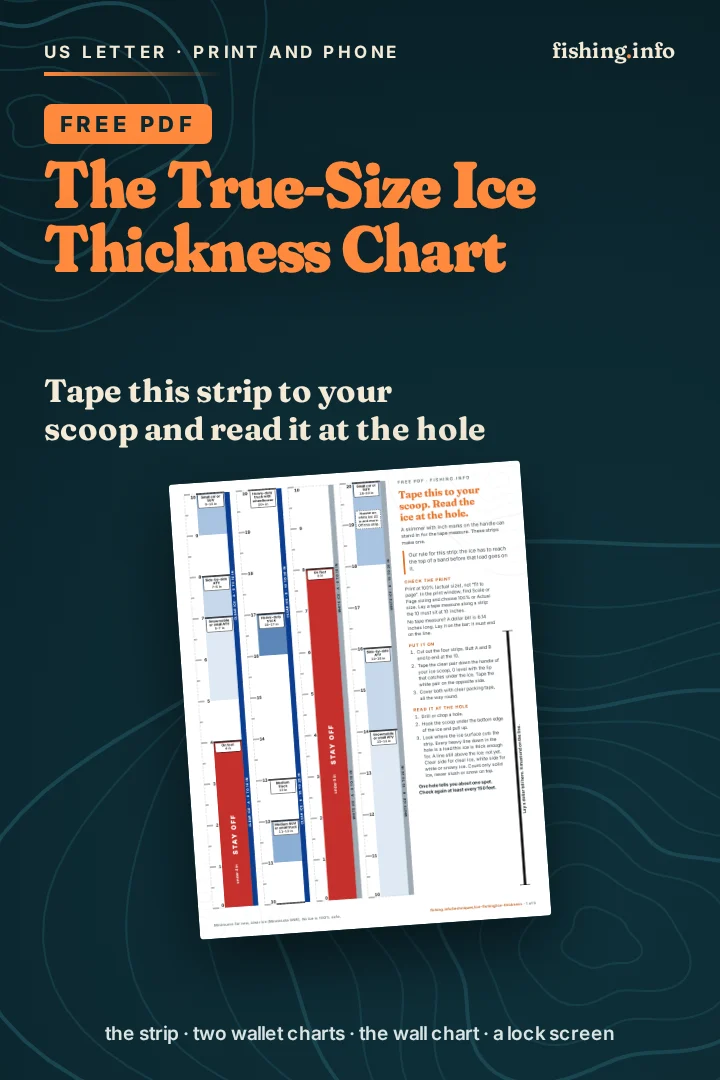
Free PDF · Ice thickness chart Take this chart onto the ice.
Print the free chart, tape the strip to your scoop and hook it under the ice. It shows what that ice is thick enough for, clear or white. Two wallet charts and a wall chart come with it.
No card, nothing to buy, and the PDF is yours to keep. Confirm with one click and it's on its way. Then a few short emails and one a week on what's biting. Unsubscribe anytime. Privacy.
Walk on 4 inches of new, clear ice at the least. That’s the floor on Minnesota DNR’s ice thickness chart, the one most anglers quote. It climbs to 5 to 7 inches for a snowmobile and 9 to 10 for a small car. No thickness is a guarantee, though. Those numbers count only for solid, clear ice, and Minnesota itself says there’s no such thing as 100 percent safe ice.
Most people who go through the ice drown. They don’t freeze. Of 269 ice deaths in Minnesota since 1976, only 5 were from hypothermia.
How thick does ice need to be to walk on?
Four inches of new, clear ice. Minnesota, New York, Maine, Ohio and Iowa all start walking there. Minnesota puts it plainly: “Wait for at least 4 inches of new, clear ice before you consider walking out.” Under 4 inches, stay off.
That’s a floor, not a promise. Ice is rarely one thickness across a lake. Minnesota says it can be two feet thick in one place and one inch thick a few yards away. A Michigan DNR lieutenant put it in anglers’ terms: ice “6 or 7 inches thick in one spot can be only 2 inches thick close by.”
Some agencies won’t give you a number at all. Michigan says there’s no reliable “inch-thickness” to tell if ice is safe. Wisconsin says you can’t judge ice strength by one factor, “like its appearance, age, thickness, temperature or whether the ice is covered with snow.” Take that as a warning, not a dodge. The chart is where your checking starts, not where it ends.
So use the chart, then check the ice yourself, all the way out. New York adds a line worth knowing. Many ice anglers don’t like to fish on less than 5 inches. And they don’t like to drive a pickup on less than 15. That’s the margin many regulars give themselves.
Ice thickness chart for clear and white ice
We use Minnesota’s rows because they’re the most detailed of the agency charts we read. That’s nine steps, from stay-off to a heavy truck with a wheelhouse. They’re also among the most careful for vehicles. Minnesota’s own rule fills the white-ice column: “Double the above thickness guidelines when traveling on white ice.” The doubling is our arithmetic on its numbers.
| What goes on the ice | New, clear ice | White (snow) ice: doubled by us, per Minnesota’s rule |
|---|---|---|
| Stay off | under 4 in (10 cm) | under 8 in (20 cm) |
| Ice fishing or anything else on foot | 4 in (10 cm) | 8 in (20 cm) |
| Snowmobile or small ATV | 5–7 in (13–18 cm) | 10–14 in (25–36 cm) |
| Side-by-side ATV | 7–8 in (18–20 cm) | 14–16 in (36–41 cm) |
| Small car or SUV | 9–10 in (23–25 cm) | 18–20 in (46–51 cm) |
| Medium SUV or small truck | 11–12 in (28–30 cm) | 22–24 in (56–61 cm) |
| Medium truck | 13 in (33 cm) | 26 in (66 cm) |
| Heavy-duty truck | 16–17 in (41–43 cm) | 32–34 in (81–86 cm) |
| Heavy-duty truck with wheelhouse shelter | 20+ in (51+ cm) | 40+ in (102+ cm) |
White ice forms when snow melts and refreezes on top of the lake ice. Minnesota calls it only about half as strong as new, clear ice, because it’s full of air bubbles and made of smaller crystals. That’s why the right column is double the left.
Minnesota bases its rows on average equipment weight. Its own words: “You are responsible for knowing the weight of your vehicle, equipment, and bodies.” A loaded truck with a sled, two anglers and a shelter is not an average truck.
Parking is its own problem. Minnesota says cars, pickups and SUVs should park at least 50 feet apart and move every two hours, so they don’t sink. Anything parked longer than two hours needs thicker ice than the chart. Minnesota’s parked-load table comes from the government of Alberta. It asks 6 inches for a person standing still and 10 for a snowmobile and rider under 1,100 lb. A ¾-ton 4x4 needs 22. Its tip for a parked car: drill a hole next to it. If water starts to flow over the top of the hole, the ice is sinking. Move the vehicle.
How much weight can ice hold?
Minnesota publishes a second chart, by pounds, built on Gold’s formula: square the thickness in inches, then multiply by 50, and you have the load in pounds. It calls the formula “a starting point,” and adds that ice is never 100 percent safe. Here’s what it gives for new, clear ice.
| Clear ice | Most weight it holds | That covers |
|---|---|---|
| 4 in (10 cm) | 800 lb (363 kg) | one 200 lb person on foot |
| 5 in (13 cm) | 1,250 lb (567 kg) | a 1,000 lb snowmobile and rider |
| 6 in (15 cm) | 1,800 lb (816 kg) | |
| 8 in (20 cm) | 3,200 lb (1,451 kg) | |
| 10 in (25 cm) | 5,000 lb (2,268 kg) | a 5,000 lb load |
| 12 in (30 cm) | 7,200 lb (3,266 kg) | |
| 15 in (38 cm) | 11,250 lb (5,103 kg) | a 10,000 lb truck |
| 20 in (51 cm) | 20,000 lb (9,072 kg) |
The right column is us reading Minnesota’s table for the questions people ask most. A 200 lb person needs 4 inches. A 1,000 lb snowmobile with its rider needs 5. A truck that weighs 10,000 lb loaded needs 15, because 14 inches tops out at 9,800 lb.
Count the whole load, not the empty weight. The truck, the fuel, the people in it, the shelter on the trailer: it all presses on the same ice. And this table has the same catch as the other one. It’s for clear ice only. Double the thickness for white ice, and treat a parked load as heavier than a moving one.
Why do ice thickness charts disagree?
Look up the same question on four agency pages and you’ll get four answers. Here are the minimums side by side, in inches of new, clear ice. The Red Cross figures are converted from centimeters.
| Load | Minnesota DNR | New York DEC | Army Corps, St. Paul | Canadian Red Cross |
|---|---|---|---|---|
| One person on foot | 4 | 4 | 2 | about 6 (15 cm) |
| A group | – | – | 3, single file | about 8 (20 cm), group skating |
| Snowmobile or ATV | 5–7 | 5 | 3, snowmobile | about 10 (25 cm), snowmobile |
| Car or small SUV | 9–10 | 8–12, car or small pickup | 7, passenger car | – |
| Small truck | 11–12 | 8–12 | 8, 2½-ton truck | – |
| Medium truck | 13 | 12–15 | 9, 3½-ton truck | – |
| Heavy truck | 16–17 | – | 10, 7–8 ton truck | – |
The Army Corps numbers look thin next to the others, and there’s a reason. The Corps uses a formula from ice engineering: the load in tons equals the thickness in inches squared, divided by 16. Turn that into pounds and it’s 125 times the thickness squared. Minnesota uses 50. So at any thickness, the Corps formula allows two and a half times the load Minnesota does. At 12 inches that’s 18,000 lb against 7,200. That’s our arithmetic, from both agencies’ own formulas.
The Corps also says when its numbers hold. Its formulas are for black ice below 32 °F (0 °C). Its St. Paul table is “valid ONLY for ice that is clear and sound, with no flowing water underneath.” It’s “not reliable for stationary loads,” either. That’s a sheet you know is sound all the way across. A lake you measured once near the ramp isn’t.
The Red Cross sits at the other end, with 15 cm (about 6 inches) to walk alone. Canada’s Lifesaving Society, on the other hand, starts at 10 cm, the same 4 inches as Minnesota.
What to take from it: 4 inches of clear ice is the common floor for one person. The thinner Corps numbers need engineering conditions you can’t check from a bucket. Some go further for vehicles. Maine does not recommend driving cars or trucks on the ice at all.
Is white ice, gray ice or slush safe?
Color tells you a lot before you drill. Clear ice, sometimes called blue ice, is the strongest, Minnesota says. It usually forms at the start of the season on calm water. Everything else is weaker, and some of it is off-limits at any thickness.
| Ice | How strong | What to do |
|---|---|---|
| Clear or blue | the strongest | use the chart as written |
| White, snow ice | about half as strong | double the chart |
| Slush on top | about half as strong | stay off (Michigan) |
| Gray | holds water, not safe | stay off |
| Honeycombed | the chart doesn’t apply | stay off |
| Clear ice over running water | about 20% weaker (New York) | go thicker than the chart |
| River ice | 15% weaker than lake ice (Iowa) | go thicker than the chart |
Gray ice gets its color from water inside it, the Red Cross says. Maine calls light gray to dark black ice melting ice, even when the air is below freezing, and says stay off. Slush on top means the ice isn’t freezing from the bottom, Michigan says. Honeycombed ice shows up late in the season, when the ice turns dark, Michigan says. It’s thawing ice that has split into columns standing on end, and Minnesota says it takes little or no effort to shatter. Minnesota is blunt: “If ice is honeycombed, stay off.”
Snow doesn’t help. It insulates the ice, which slows the freezing, and its weight cuts how much the sheet can carry.
Weak spots in good ice
Even good ice has weak spots. Current thins it, so watch streams, inlets, bridges and culverts. On a river, Minnesota says the ice on the outside of a bend is usually weaker, because the faster current eats at it. Vermont adds springs, old ice holes and the mouths of rivers and streams.
Pressure ridges are “always dangerous,” Minnesota says. They can be a few inches high or over 10 feet, and they can form in hours. Gas holes show up near stream inlets and in shallow, weedy water. One can be several feet wide under an opening of a few inches. Ice is weaker near logs, rocks and docks, which soak up the sun’s heat. A flock of geese sitting on the ice can leave thin patches too. Michigan adds that ice near dock bubblers is unsafe.
Booming and cracking, on the other hand, isn’t necessarily dangerous, Minnesota says.
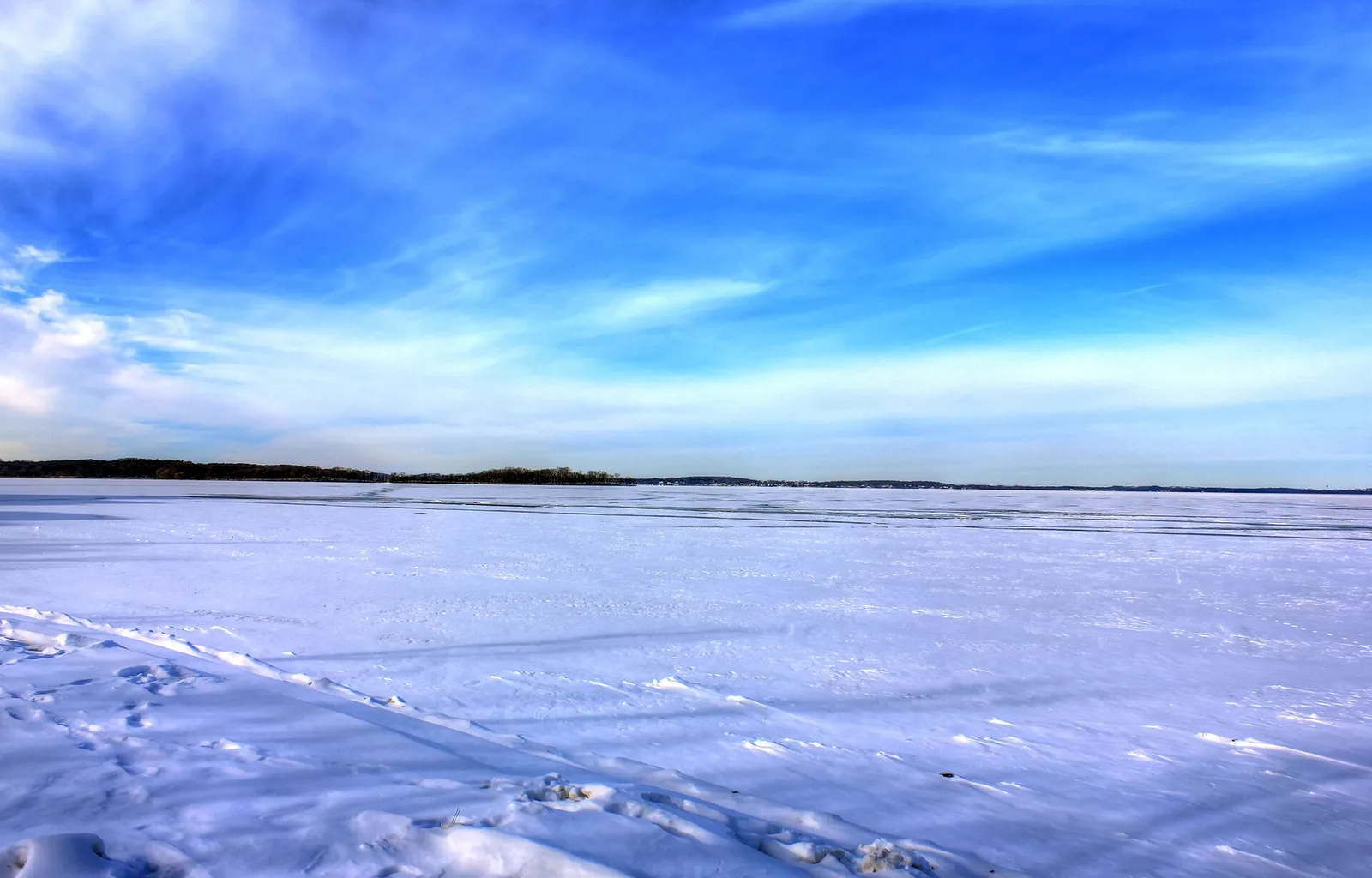
Snow on the ice slows its growth, adds weight and hides weak spots. Lake Mendota in Madison, Wisconsin. Photo: Yinan Chen, Wikimedia Commons (public domain).
When is the ice most dangerous?
Early and late in the season. That’s when the ice isn’t as thick as in midwinter, Minnesota says.
North Dakota says it’s a good idea to double the chart early in the winter. Edges firm up faster than the ice farther out, so the ice by the ramp can fool you. Minnesota warns that if you walk on 4 to 6 inches, you’ll likely find spots under 4 on the same lake. And if strong winds blow early in the season, don’t go on at all. If the wind picks up or turns while you’re out on early ice, head back.
Late ice turns the other way. Minnesota says ice melts fastest near shore in spring, and new ice is usually stronger than old ice. Four inches of clear, new ice may hold a person. A foot or more of old, half-thawed ice may not. Michigan’s rule for the end of the season: when the ice turns dark and gets honeycombed, it’s time to quit for the season.
Weather swings matter at any time. A sudden, big drop in air temperature makes ice brittle, the Army Corps’ cold regions lab says. It may not be safe for 24 hours or more. If the air stays above freezing for 24 hours or more, the ice starts losing strength. Then the chart no longer counts, and the advice is to stay off. Across ten northern countries, the most winter drownings came in winters that averaged between 23 and 32 °F (−5 and 0 °C). Late in the season was worst, as the ice gets less stable. Keep an eye on the fishing weather forecast for that reason, not only for the bite.
Watch out: If the air stays above freezing for 24 hours or more, the ice starts losing strength. The chart no longer counts. Stay off.
How do you check ice thickness?
Measure it. Don’t trust the look of it, and don’t trust the guy who went out yesterday. “Never assume ice is safe because someone else was out before you,” Minnesota says. Local bait shops are still worth a call: Wisconsin says they often have the newest word on how thick the ice is and where it’s bad.
- Put your safety gear on before you step out. Float suit or foam life jacket, ice picks around your neck as Iowa advises, a rope in your pocket.
- Start at the shore. Drill or chop your first hole right there, then stop and check again often as you go, Minnesota says.
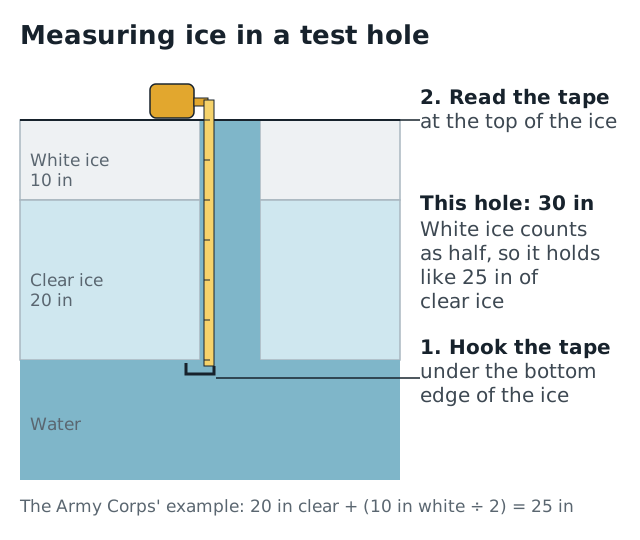
- Measure each hole. Put a tape measure into the hole, hook the bottom edge of the ice, and read it at the surface. An ice skimmer with inch marks on the handle can stand in for the tape, Minnesota says.
- Count white ice at half. Say the hole shows 10 inches of white ice over 20 of clear. The Army Corps counts that as 25 inches of clear ice. Then read the chart.
- Check again at least every 150 feet. That’s Minnesota’s spacing. For a vehicle route, the Corps says “every 150 feet or so along the intended path,” and more often where the thickness changes a lot.
- On early and late ice, test every step. Stab the ice ahead of you with a spud bar, a heavy steel chisel on a long handle. It’s no substitute for the tape, though.
- Turn back if the chisel goes through. Retrace your steps to shore and try another day, the Corps says. In a group, follow the leader’s steps but stay at least 10 feet apart.
What do you drill the test hole with?
Don’t judge thickness by how easily the chisel or drill breaks through. It happens so fast that it’s easy to think the ice is thicker than it is.
Any ice auger cuts a test hole. For checking alone, Minnesota suggests a cordless drill with a long 5/8-inch wood auger bit. It goes through 8 inches of ice in under 30 seconds. A wood bit has the spiral that pulls the chips out of the hole.
What safety gear do you need on the ice?
Flotation first, ice picks second. That’s Minnesota’s order, and the numbers behind it are stark. Most people who fall through drown, Minnesota says. They don’t die of the cold.
- A float suit or foam life jacket. Minnesota says it “may be the No. 1 item that will keep you alive if you fall through the ice.” It recommends foam over an inflatable, which may not inflate in the cold. Flotation coats, pants and full suits all count, Minnesota says. Never wear one inside a closed vehicle on the ice. Buy it as part of your ice fishing clothing, not as an extra that stays in the sled.
- Ice picks, worn around your neck, Iowa says. Pulling yourself onto smooth, wet ice with numb fingers is extremely hard without them.
- A rope that floats, to throw to someone else.
- Ice cleats. A fall on thick ice can break a wrist or a tailbone, Minnesota says. On thin ice it can put you through.
- A whistle. Yelling wears you out fast.
- A phone in a waterproof case, and someone at home who knows where you are and when you’ll be back. Phones don’t always have service, so Minnesota suggests a personal locator beacon if you go out alone.
Skip hip boots and waders. The Corps says they fill with water, weigh you down and make it hard to move. Everything else on your ice fishing gear list comes after these.
Minnesota has counted 272 ice deaths since January 1976, about three a season over the last ten years. Its case-by-case list, where the 5 hypothermia deaths come from, counts 269. Most were riding something, not walking.
| How they were traveling | Deaths | Share |
|---|---|---|
| Snowmobile or ATV/UTV | 119 | 43.8% |
| On foot | 79 | 29% |
| Motor vehicle | 59 | 21.7% |
| Other | 15 | 5.5% |
In Canada, half of those killed on the ice were alone, the Lifesaving Society says, and alcohol played a part in about 1 in 3.
Make your own ice claws
Wisconsin DNR shows how to make a pair.
- Cut two 4-inch pieces of wooden dowel, broom-handle thick or a bit more. Use something that floats, in case you drop one.
- Drive a hardened 16-penny or larger concrete nail into one end of each.
- File the nail heads to a point.
- Drill a hole in the other end of each dowel and tie a strong cord between them, jump-rope style.
- If you like, drill a second hole beside each nail, so one point nests in the other dowel and both stay covered.
Wisconsin says to keep them in a pocket, where you can grab them fast.
What do you do if you fall through the ice?
First, get your breathing under control. Cold water makes you gasp and pant, and without a life jacket that’s when people drown, Minnesota says. Then work your way out the way Minnesota DNR teaches it:
- Keep your winter clothes on. They trap air, which keeps you warm and helps you float.
- Turn back toward the way you came. That’s probably the strongest ice.
- Put your hands and arms on the unbroken ice.
- Kick your feet and dig in your ice picks to work your way onto solid ice. If your clothes hold a lot of water, lift yourself onto your elbows first and let it drain.
- Once you’re out, lie flat and roll away from the hole. Don’t stand up until you’re on solid ice, Wisconsin and Ohio add.
Then get to shelter, heat and dry clothes, and drink something warm without alcohol or caffeine. Michigan says call 911 and get to a doctor if you feel confused or can’t stop shivering.
If the ice only cracks under you, don’t run. Ohio says lie on your stomach, spread your arms and legs, and roll away from the crack.
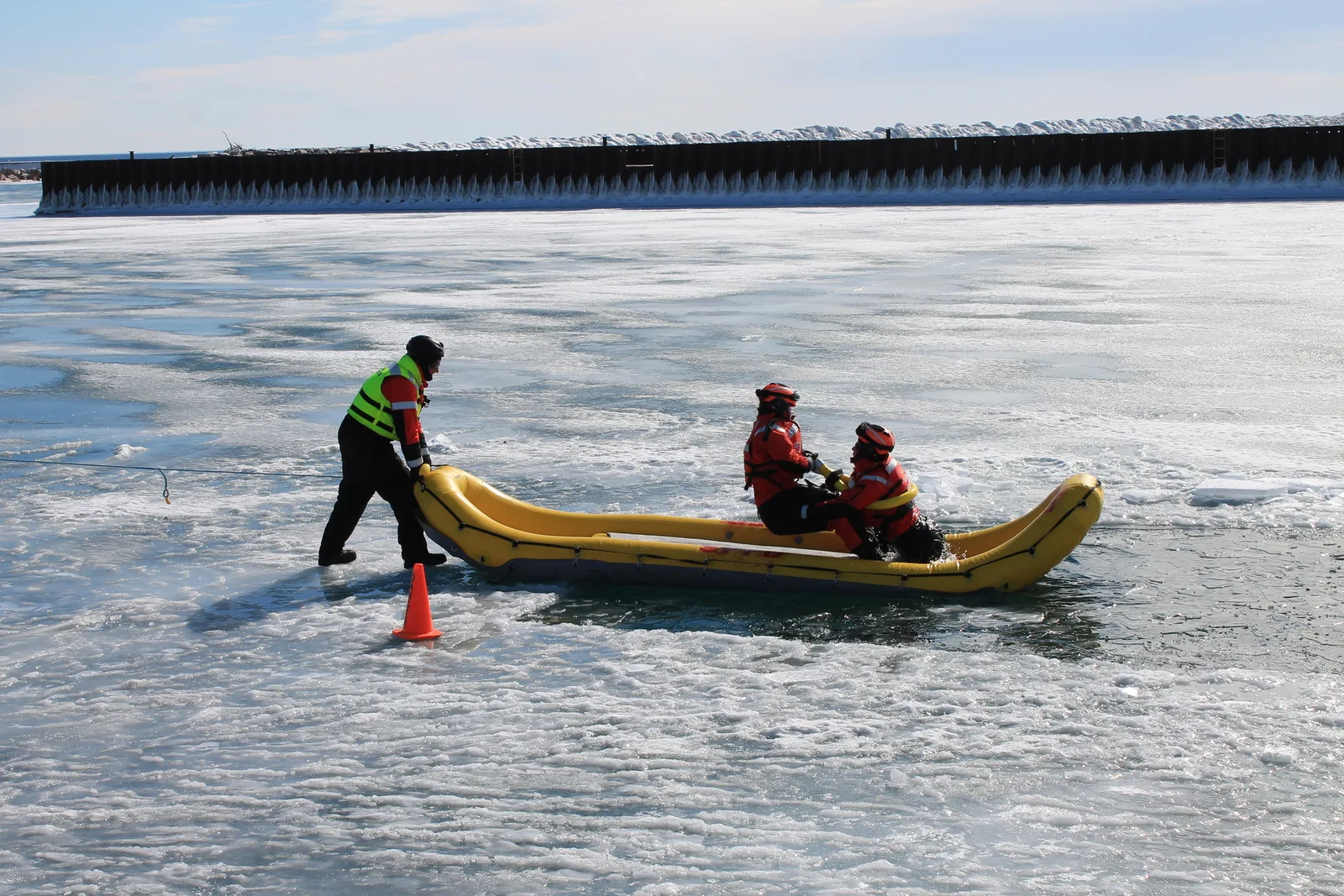
Rescue crews practice on Lake Michigan in Milwaukee. Photo: Ensign Thomas Morrell, U.S. Coast Guard (public domain).
Is the 1-10-1 rule right?
You’ll hear the 1-10-1 rule, from Dr. Gordon Giesbrecht’s Cold Water Boot Camp. The Lifesaving Society puts it this way. You have 1 minute to control your breathing and 10 minutes to get out before you lose the use of your body. In the right conditions and with a life jacket on, you could have up to an hour before hypothermia. Minnesota teaches it next to its own times. The gasping comes in the first 2 to 3 minutes, and your arms and legs can give out within 30. The National Center for Cold Water Safety calls 1-10-1 a myth. It says the rule “undermines safety by understating the danger of cold water immersion.” Where they agree: cold water drowns people long before hypothermia, and you get weaker every minute you’re in. So wear flotation and get out as fast as you can.
How do you help someone who falls through?
Call 911 first. Don’t run to the edge of the hole. Minnesota says that usually makes two people in the water. Reach for them from shore with a rope, a ladder or jumper cables. If they start pulling you in, let go and start over. If you can’t reach, throw a rope or anything that floats, and have them tie it around themselves before the cold takes their grip. A light boat pushed across the ice ahead of you comes next. Going out to them yourself is the last thing on the list.
Remember: Call 911, then reach or throw. Never run to the edge of the hole.
Quick answers about ice thickness
Is 2 inches of ice safe to walk on? No. New York’s chart says stay off at 2 inches or less, and Minnesota says stay off under 4.
Can you drive on 10 inches of ice? Minnesota’s chart puts a small car or SUV at 9 to 10 inches of new, clear ice. Maine doesn’t recommend driving on the ice at all, and a Michigan DNR lieutenant said he’d never recommend it.
How thick should ice be for a truck? On clear ice, Minnesota says 11 to 12 inches for a small truck and 13 for a medium one. A heavy-duty truck needs 16 to 17.
Does snow make ice stronger? No. Snow insulates, so the ice grows more slowly, and its weight cuts what the sheet can hold.
How do you work out what ice will hold? Minnesota uses Gold’s formula: square the thickness in inches, then multiply by 50. Four inches: 4 × 4 × 50 = 800 lb.
Is ice fishing safe? No ice is 100 percent safe. What you control: wait for 4 inches of clear ice, wear flotation, carry picks and don’t go alone. That goes for your first day of ice fishing and your hundredth. Every lake, the Madison chain included, needs its own check every trip.

Free PDF · 5 pages
Stop guessing the ice. Tape this strip to your scoop and read it at the hole
Ice that is 6 or 7 inches thick in one spot can be 2 inches close by. You can't tell by looking.
The True-Size Ice Thickness Chart. Print it, tape the strip to your ice scoop, hook it under the ice and read the band at the surface: on foot, sled or truck. One side for clear ice, one for white.
- A true-size strip for your scoop handle, marked from "stay off" to a truck with a wheelhouse
- Two wallet charts, one for your buddy, with five moves that get you out if you go through
- Why 8 inches of white ice counts as 4, and the ice to stay off at any thickness
Every clear-ice number is the Minnesota DNR's, set beside the 29 sources on the page, the Army Corps of Engineers among them.
No card, nothing to buy. Confirm with one click and the PDF is on its way, one version for your phone and one to print, yours to keep. Then a few short emails and one a week on what's biting, with an unsubscribe link in every one. Privacy.
Related
Section guide
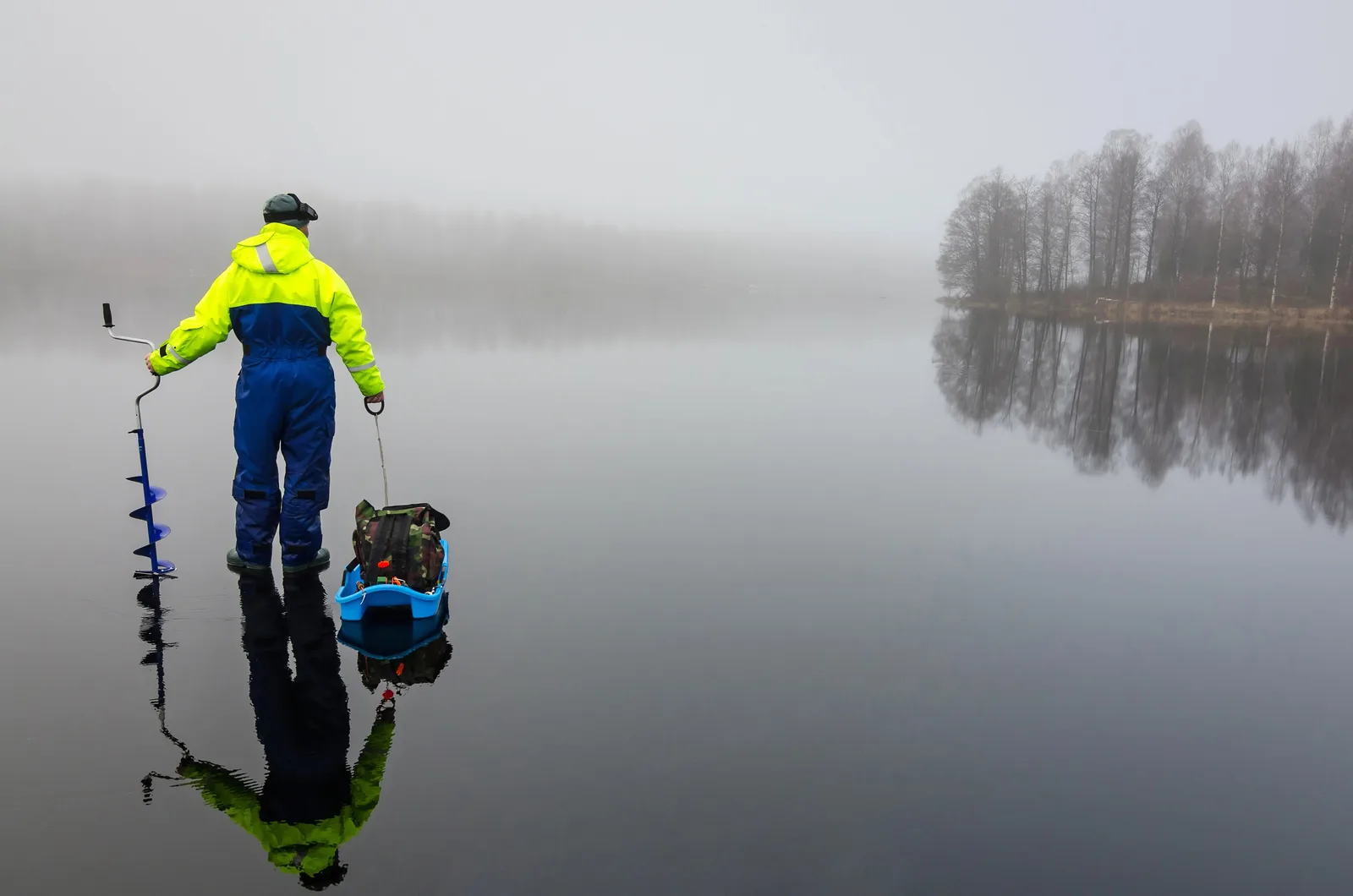
Ice Fishing: How to Ice Fish, Step by StepHow to ice fish: wait for 4 in of clear ice, drill all your holes, fish one jigged line and one still. Gear, bait, tip-ups and line limits in 12 states.
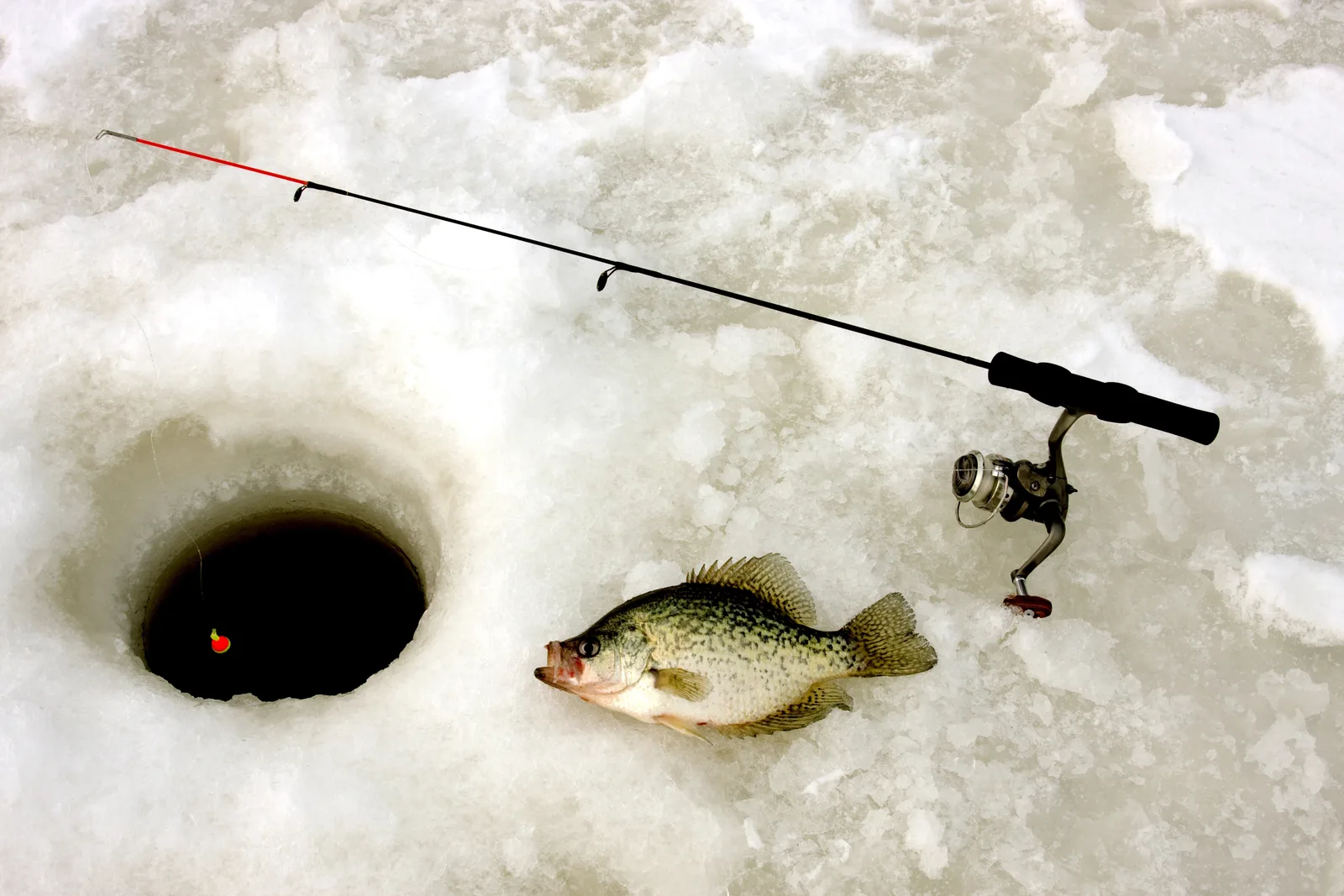 Crappie Ice Fishing: Where They Suspend and What to Drop
Ice fishing for crappie: where they hang under the ice in each kind of lake, the dusk and night bite, tiny jigs, two lines, and the 20 ft rule.
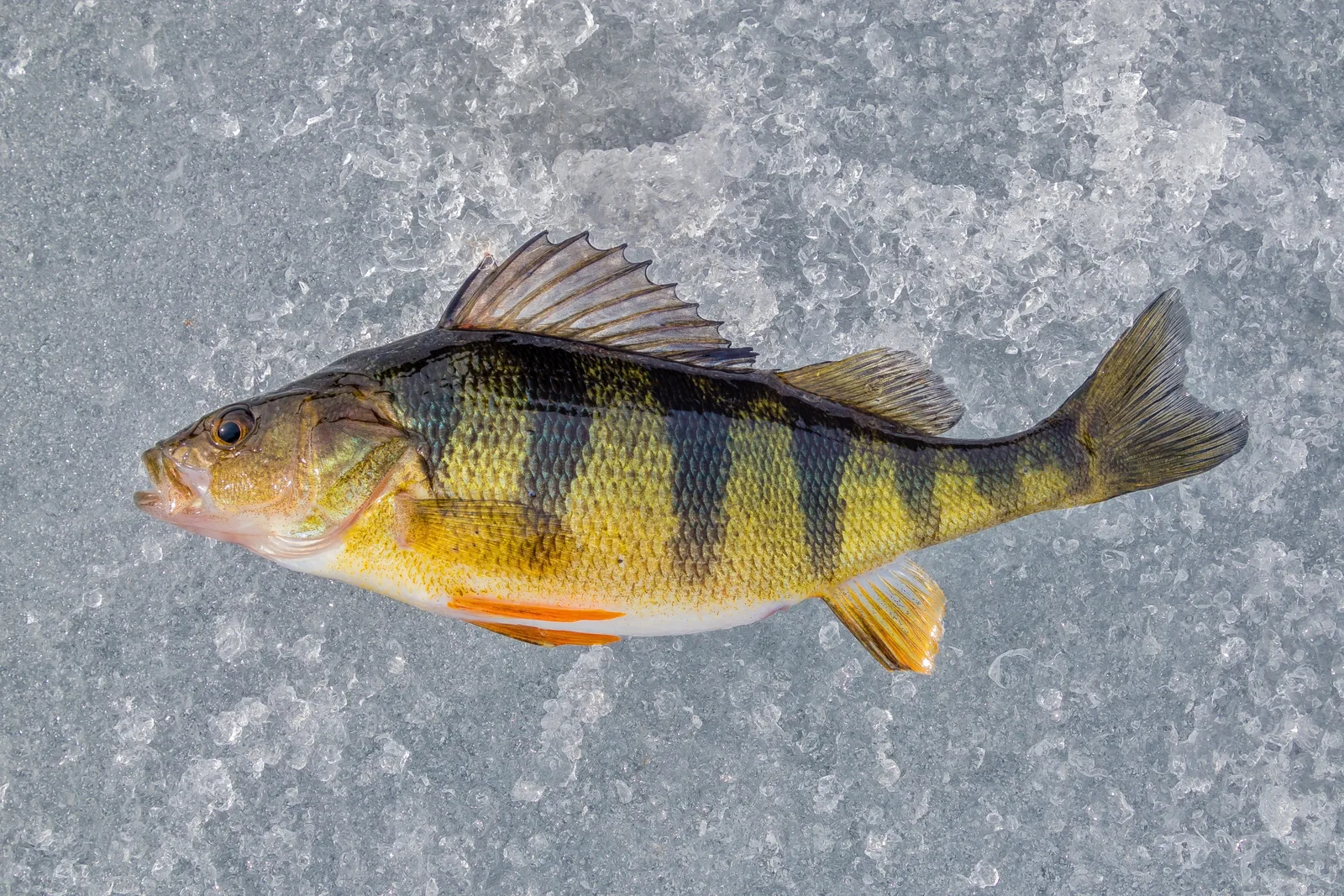 Perch Ice Fishing: Where Perch Sit Under the Ice and How to Catch Them
Perch ice fishing: fish near the bottom, from weeds under 10 ft to flats at 40 ft, with 1/64 to 1/16 oz jigs and spikes. Plus 8 steps to stay on a school.
 Ice Fishing for Pike: Tip-Ups, Bait, Depth and When to Set the Hook
Ice fishing for pike: where they sit under the ice, the tip-up spread, live or dead bait, how far off bottom, when to set the hook, and the state rules.
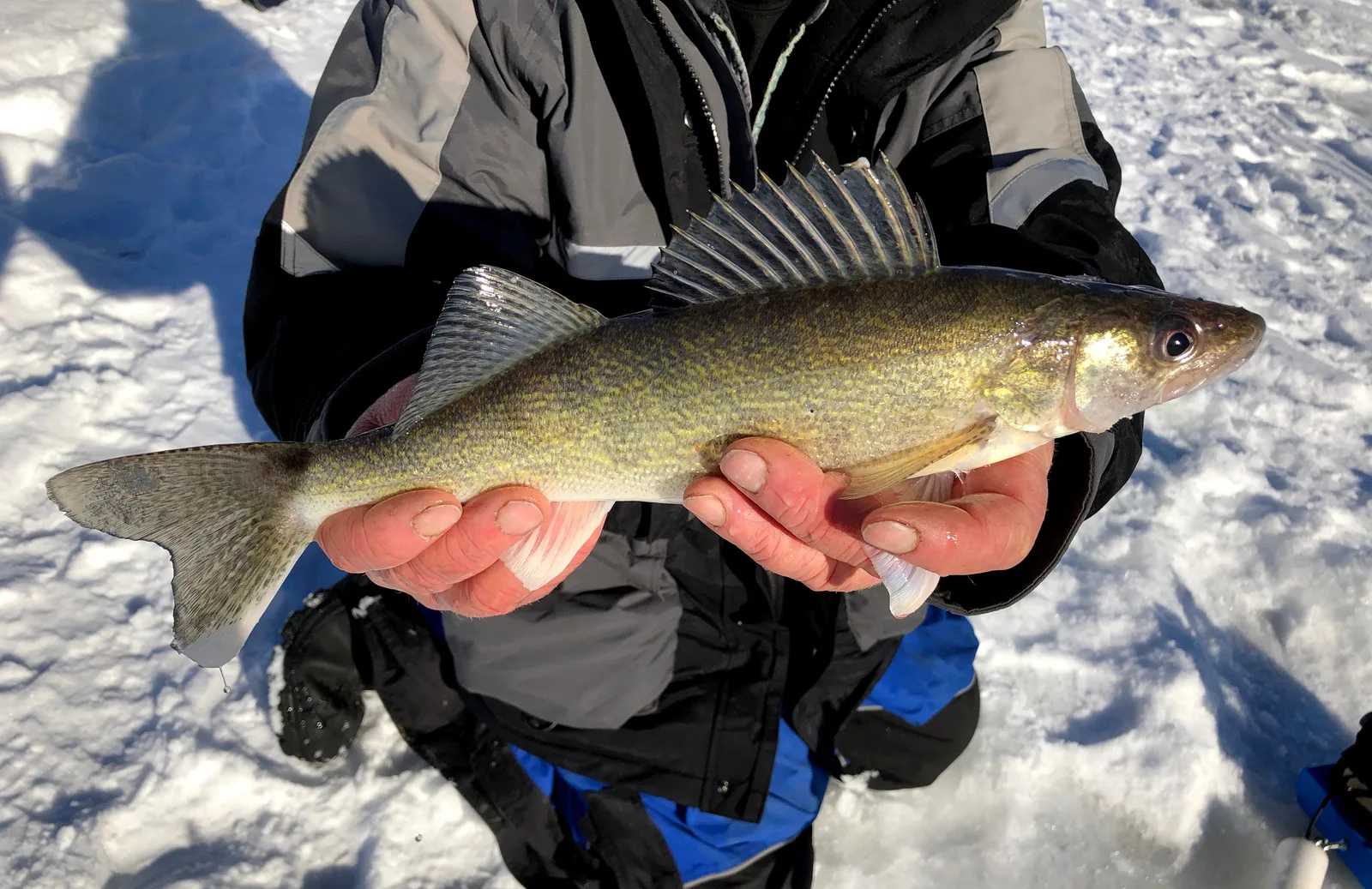 Walleye Ice Fishing: Where, When and How to Catch Them
Walleye ice fishing peaks in the 90 minutes before and just after sunset. Where they sit, how deep by lake, spoon or Jigging Rap, tip-ups and line rules.
Sources (29)
- Minnesota DNR, General ice thickness guidelines
- Minnesota DNR, Ice thickness guidelines by weight
- Minnesota DNR, How to check ice thickness
- Minnesota DNR, Ice formations and conditions
- Minnesota DNR, Ice safety
Show all 29 sourcesShow fewer sources
- Minnesota DNR, Ice Safety Gear
- Minnesota DNR, Traveling on ice
- Minnesota DNR, What if you fall in?
- Minnesota DNR, What if someone else falls in?
- Minnesota DNR, Ice fatality statistics 1976-2025
- Minnesota DNR, Cold water dangers
- Minnesota DNR, Minnesota Lake Ice Out Dates
- New York State DEC, Learn How To Ice Fish
- US Army Corps of Engineers, St. Paul District, Ice Thickness and Strength for Various Loads
- US Army Corps of Engineers, Engineering and Design: Ice Engineering, EM 1110-2-1612
- US Army ERDC Cold Regions Research and Engineering Laboratory, Safety on Floating Ice Sheets
- Canadian Red Cross, Is that ice safe?
- Michigan DNR, Ice Safety
- Michigan DNR, Showcasing the DNR: Stay safe when venturing on ice
- Wisconsin DNR, Ice safety
- Maine Department of Inland Fisheries and Wildlife, Winter Ice Safety Tips
- Iowa DNR, Stay safe on the ice this winter
- North Dakota Game and Fish Department, Ice Awareness for Anglers
- Vermont Fish and Wildlife Department, Ice Fishing Basics
- Ohio DNR, Ice Thickness Guidelines
- Lifesaving Society, Cold Water and Ice
- McGill University Office for Science and Society, Professor Popsicle's Physiological Proof
- National Center for Cold Water Safety, The 1-10-1 Myth
- Sharma S, et al. (2020), Increased winter drownings in ice-covered regions with warmer winters, PLOS ONE 15(11): e0241222