 By
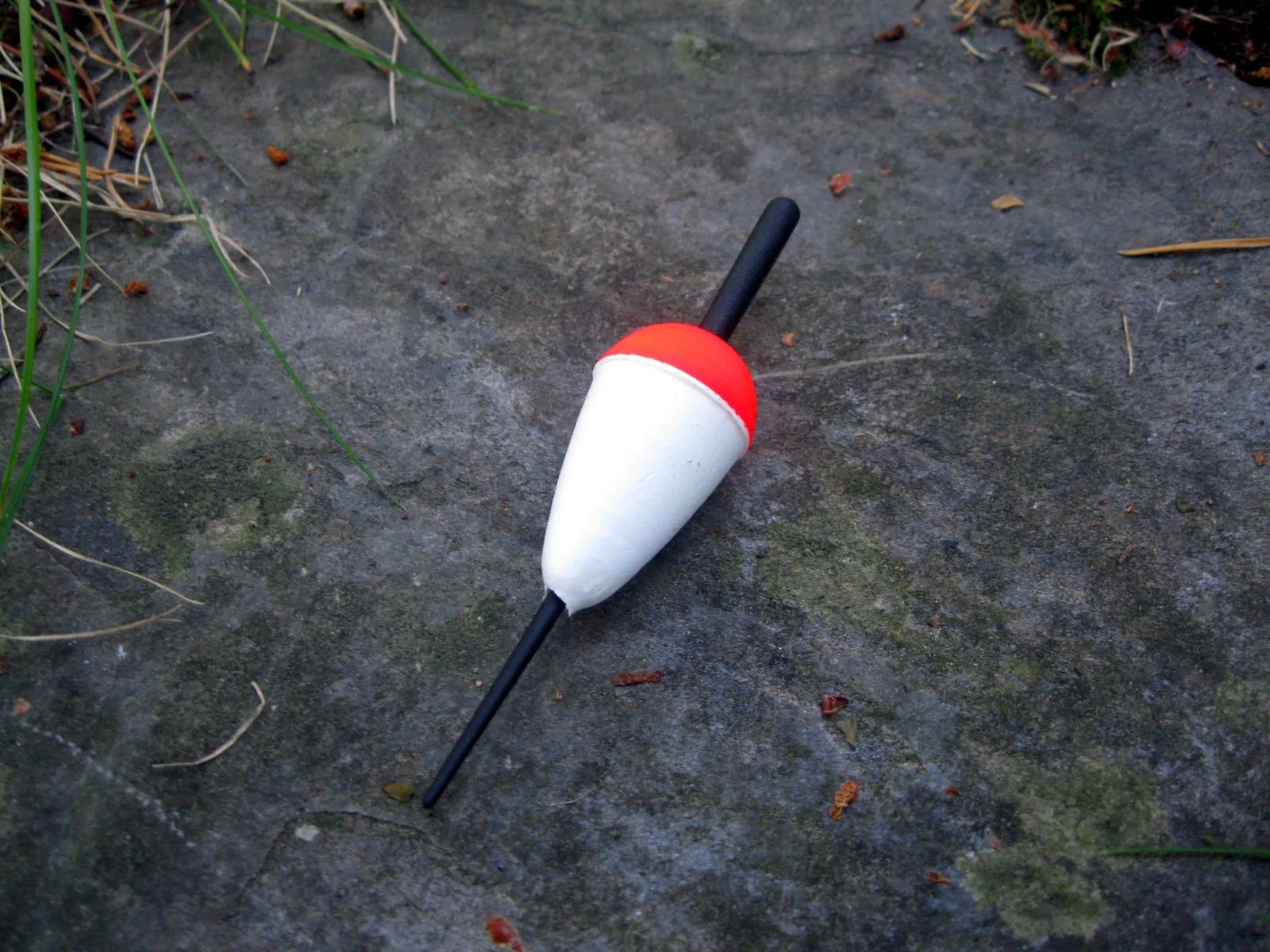
A fishing bobber holds your bait at one depth and goes under, or lies flat, when a fish takes it. For bluegill and other small panfish, a ¾ to 1 in (2–2.5 cm) bobber is the size Illinois’s wildlife journal tells beginners to start with. For anything deeper than about 4 ft (1.2 m), switch to a slip bobber: it slides on the line until it meets a bobber stop. The picks below come from the makers’ own specifications and October 2026 prices; none was tested for this page.
“With most rods, it is difficult or even impossible to cast a set float if the float is set more than about 4 feet deep.” That limit, from Jeff Samsel’s slip-bobber guide for Thill, is why the slip bobber exists.
Which bobber for your fishing?
Pick by how deep the fish are and how they bite.
- Bluegill and pond panfish, shallow: a small round or spring bobber, ¾–1 in. “A bobber that is too big will mask the strike of a bluegill,” Steven Beltran writes in Outdoor Illinois. Pair it with a size 8 to 10 hook and 4–6 lb line.
- Crappie: a stick or pencil bobber shallow, a slip float when they hold deeper. Oklahoma’s crappie guide says crappie “rarely submerge the bobber” because they bite upward; the bobber falls flat instead.
- Walleye on a break, or any fish deeper than 4 ft: a slip bobber with a bobber stop.
- A first trip with a child: a pre-tied round bobber rig, with an adult setting the depth. Our kids’ fishing pole guide has the whole first rig.
- Redfish and seatrout: a weighted popping cork over live shrimp, a float with a cupped top that pops and splashes when you snap the rod.
- Night fishing: a lighted float, such as Thill’s Nite Brite at $7.99.
Kentucky’s wildlife department, in a 2012 starter list, set beginners at urban lakes up with 1¼ in (3.2 cm) bobbers and size 6 hooks. Its aquatic education coordinator, Marc Johnson, picked size 6 because it is big enough for the catfish often caught there.
The six kinds of bobber
| Kind | How it goes on | Depth it fishes | Best for |
|---|---|---|---|
| Round (push-button) | Wire clip snaps onto the line | Fixed; shallow | Bluegill, kids, ponds |
| Spring (oval or pear on a stem) | Spring on the stem grips the line | Fixed; shallow | Panfish; a jig under a float |
| Pencil or stick | Spring, or line through as a slip | Fixed or slip | Crappie, calm water, light bites |
| Peg or slit foam | Line through a slit or hole, pinched with a peg | Fixed; shallow | Ultralight jigs, trout, ponds |
| Slip | Line runs through; a stop sets depth | Any depth | Walleye, crappie deep, bank fishing |
| Popping cork | Bait hangs under it; the cupped top pops | Fixed | Redfish, seatrout |
Round versus slip. A round bobber is quick to clip on and easy to see. Outdoor Life’s Joe Cermele notes that a clipped float can kink the line, while a slip float “rides freely.” The slip float also lets you reel the stop through the guides, Mike Frisch writes, so only a short length of line hangs at the cast: safer for kids and easier in deep water.
Balsa, foam or plastic. Balsa and foam outlast the hollow plastic bobber. Plastic “tends to eventually crack or wear out and let water in,” Wired2Fish’s Jason Sealock writes, and Cermele says a red-and-white plastic bobber that “just kisses a rock or branch” is likely to crack.
Pencil versus oval. Northland says its slim pencil “slides below the surface easier, offering less resistance to the fish,” while its ovals “ride the waves better and are easier to control in wind.” In real wind, In-Fisherman’s Matt Straw switches to a waggler, a long float attached only at the bottom so the line stays under the surface: “The longer the float, the less wind affects it.”
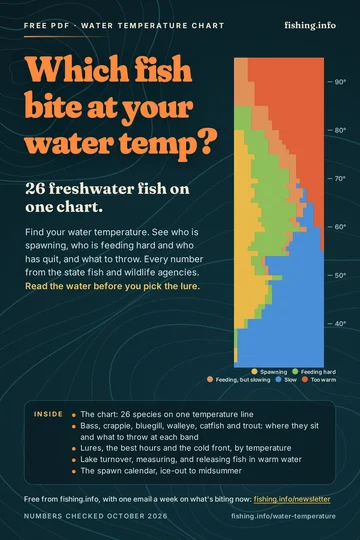
Free PDF · Water temperature chart Which fish are biting at today's water temperature?
One water temperature reading, and the 16-page chart tells you who's spawning, who's feeding hard, where they sit and what to throw. 26 fish, every number sourced.
Enter your email, confirm it with one click, and the PDF is in your inbox. Plus one email a week on what's biting. Unsubscribe anytime. Privacy.
What size bobber, and how much weight?
Use the smallest float that holds up your bait and shot. Slip floats are rated for a weight; Thill lists it for each size and prints it on the Crappie Cork:
| Float | Size | Maker’s weight rating |
|---|---|---|
| Thill Pro Series Slip | ½ in (13 mm) | 1/32 oz (0.9 g) |
| Thill Pro Series Slip | ⅝ in (16 mm) | 1/16 oz (1.8 g) |
| Thill Pro Series Slip | ¾ in (19 mm) | 3/32 oz (2.7 g) |
| Thill Pro Series Slip | ⅞ in (22 mm) | 1/8 oz (3.5 g) |
| Thill Pro Series Slip | 1 in (25 mm) | 1/4 oz (7 g) |
| Thill Crappie Cork | three sizes | 1/16, 1/8 and 1/4 oz (1.8, 3.5, 7 g) |
Balance the float until it rides low. Split shot “keep the bobber riding low in the water column,” Frisch writes, so wind cannot push it around, and “a barely buoyant bobber easily slides under the water” when a fish bites. The opposite mistake is a float so small that its tip disappears at a distance. Jason Mitchell of Northland uses “the largest slip bobbers I can get away with” for walleye, because a bigger float carries more weight and sinks the bait faster.
If your jig or shot already gives the weight, buy the unweighted version of a float. A Tackle Warehouse owner of the Lite-Bite says the same: “Buy non-weighted if you are already using a split shot weight on your setup.”
How do you set a slip bobber’s depth?
The rig goes on the line in this order, from the rod: bobber stop, small bead, slip bobber, split shot, hook or jig.
- Slide on the bobber stop. A thread stop comes on a small sleeve: run the line through the sleeve, slide the knot onto the line and pull it tight. Thill’s thread stops are made to grip monofilament. On braid, stops slide; Mitchell uses 14 lb braid so the stop holds. A uni knot tied with a short piece of line works as a stop too.
- Add the bead. It keeps the stop from pulling through the float’s hole, the job Frisch calls “a cushion between the stop and bobber.” Thill’s Crappie Cork needs no bead: its stop comes tied on the top stem, and a narrow insert there does the bead’s job.
- Thread the slip bobber, then pinch a split shot or two about a foot above the hook or jig, as Frisch rigs it. His baits are a leech, a minnow or a piece of nightcrawler.
- Set the stop. The distance from the stop to the hook is the depth the bait fishes. Under about 5 ft, Thill’s guide says, just measure it by eye. With the stop at the rod tip, the bait hangs one rod length down. Deeper, start with the stop one rod length from the bait, open the bail, pinch the stop and pull line through it in “pulls” of two feet.
- Find the bottom. Wisconsin walleye guide Greg Bohn, profiled in Outdoor Life, clips an ice-fishing weight to the hook and drops the rig straight down. He reels up the slack with the rod tip on the water, lifts the tip 1 ft (30 cm) and sets the stop 1 ft below it. If you cast to a spot deeper or shallower than under the boat, cast the weighted rig there and adjust the stop after each cast until the bobber sits 1 ft under the surface with the weight on the bottom. Take the weight off and the bait hangs 1 ft above the bottom.
- Move it without retying. Slide the stop up the line to fish deeper, down to fish shallower. Mitchell marks his rod blank with a white dot every foot, so the rod is a ruler.
Before the cast, the float rests on the shot or hook. In the water it slides up to the bead and stop, and it should stand upright once the bait hangs at depth. If it still lies on its side after the cast settles, add a little weight.
How do you know a fish has bitten?
A bobber that goes under and stays under is a fish; lift the rod smoothly. A bluegill pulls it down, which is why a small bobber matters: a big one hides the strike. Crappie bite upward, so a stick bobber often falls flat instead, Oklahoma’s guide says: that is your cue to set the hook. A bobber that dips, bobs or slides sideways is worth watching too. The step-by-step for a first day, bite and all, is in fishing for beginners.
Do you need a bobber at all?
No. A bobber does two jobs: it holds the bait at a depth and it shows the bite. Bottom rigs and plain free-lined bait catch plenty of fish without one; our catfish rigs page has the float and no-float versions side by side. For panfish over weeds or crappie suspended off the bottom, though, nothing presents bait at an exact depth as simply.
“Bobber,” “float” and “cork” are the same thing. Thill’s guide uses all three for a slip float, and “cork” is the usual word for the saltwater popping float in the South. The rest of the box (hooks, split shot, swivels) is on the fishing tackle page, and the crappie fishing guide has the depth chart for each season.
How we chose
Each pick fills one use: slip, easiest slip, pencil or oval, spring, and a ready-made round rig. Specifications and prices are from the makers’ and retailers’ pages in late October 2026, and we read every owner review on them. No float was fished for this page. Thill’s own pages carry few reviews: the Pro Series slip float 4.3/5 from 6, the Premium Weighted 5.0 from 3, the Crappie Cork 2.7 from 3. Two Crappie Cork owners say its fixed-float spring loses the line on the cast, which is why we pick it as a slip float only.
Free PDF · 16 pages
Know what's biting before your first cast
The Water Temperature Fishing Chart. Take one water temperature reading, find it on the chart, and you know which of 26 freshwater fish are feeding today, where they are and what to throw. For your phone and the tackle box.
- The 26-fish chart: who's spawning, feeding hard or shut down at your reading
- Where they sit and what to throw at every band: bass, crappie, bluegill, walleye, catfish and trout
- The best hours at your reading, the cold front day by day, and the spawn calendar from ice-out to midsummer
- The three thermometer mistakes that make a reading lie (the first one is the surface)
Every number from state fish and wildlife agencies and fisheries research: 61 sources, all on the site.
Enter your email, confirm it with one click, and the PDF is in your inbox. Plus one email a week on what's biting. Unsubscribe anytime. Privacy.
Related
Section guide
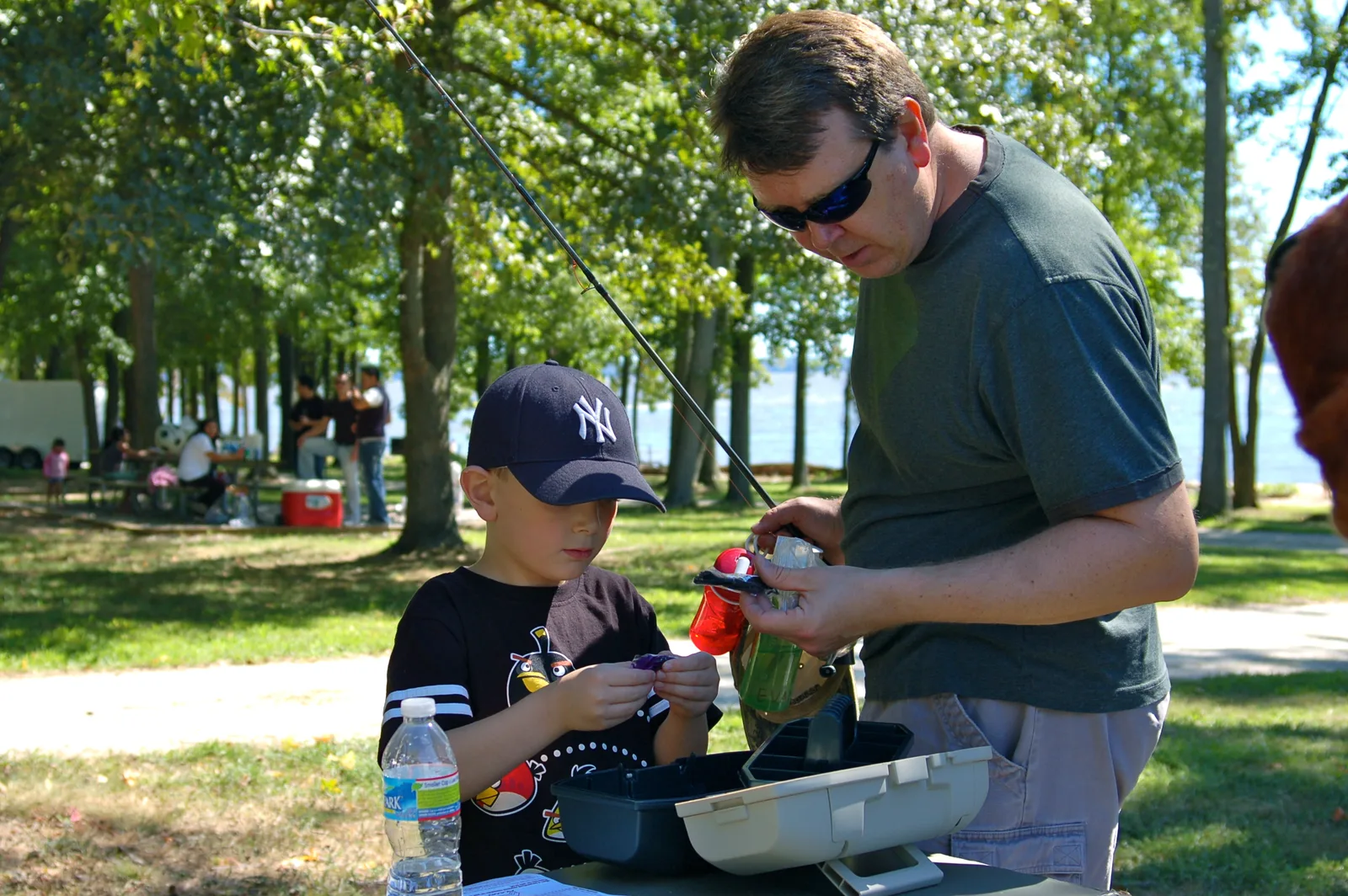
Fishing Tackle: The Types, What a First Box Holds, and the Lead LawsFishing tackle explained: hooks, sinkers, swivels and floats, a first box for panfish, bass, catfish or the surf, what it costs, and where lead is banned.
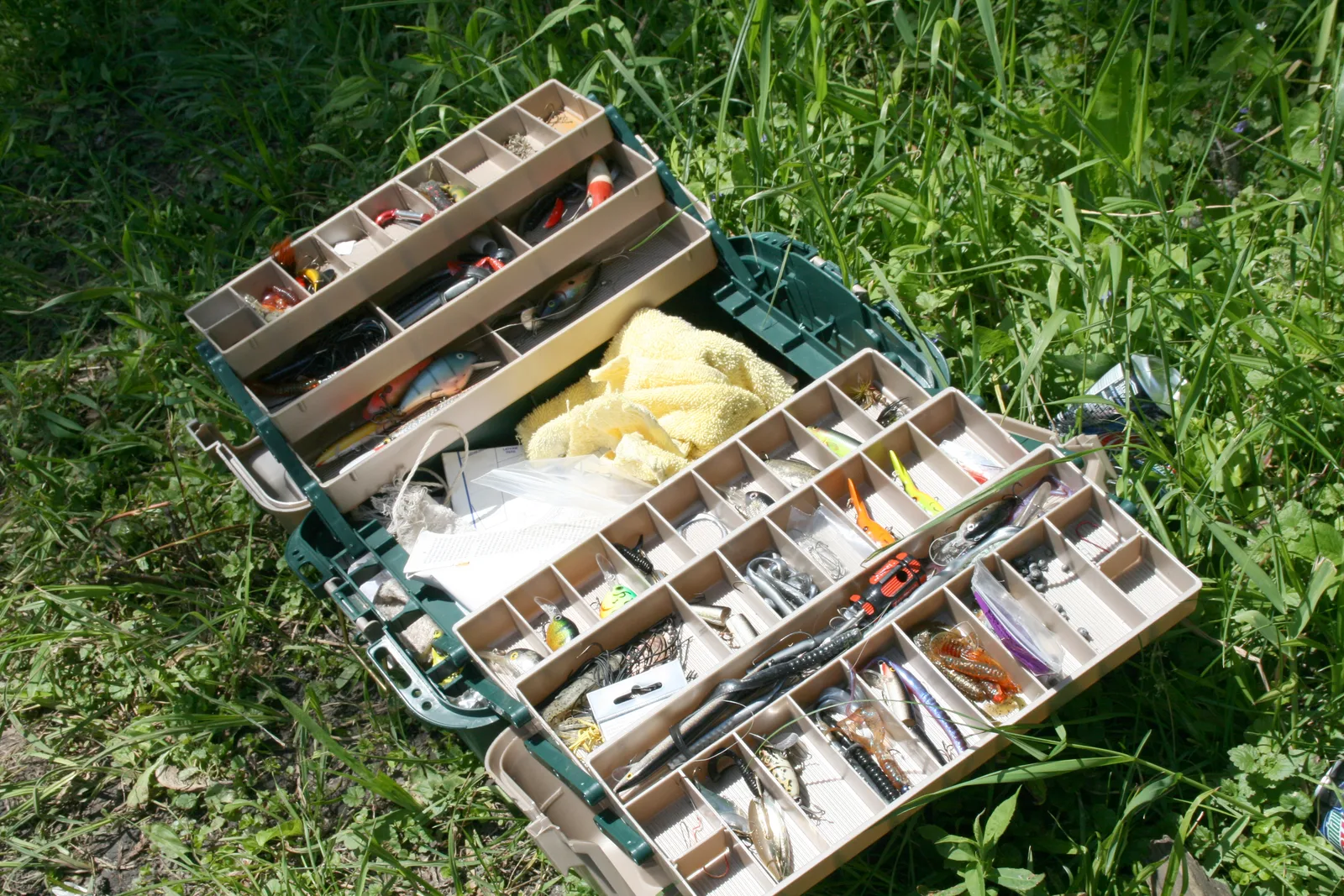 Plano Tackle Box: Every Series, Size and Model Number Decoded
Every Plano tackle box series and size: StowAway, ProLatch and EDGE trays, racks, bags and kits, with Plano's own prices and what each model number means.
 Tackle Box: The Best Boxes, Trays and Bags, and What 3700 Means
The best tackle box for bank, boat, kayak, kid or musky: eight picks with owner-complaint counts, and the 3600 and 3700 tray sizes explained.
Sources
- Outdoor Illinois Journal (Steven Beltran), Bluegill fishing in Illinois: the perfect fish to introduce youngsters to angling, May 2025
- Oklahoma Department of Wildlife Conservation (Skylar St. Yves), Crappie angler guide: top tips and area highlights, March 2023
- Game & Fish (Hayley Lynch, Kentucky Department of Fish and Wildlife Resources), Stocking your first fishing tackle box, December 2012
- Lurenet (Jeff Samsel), When and how to fish with a slip bobber, March 2025
- The Fishing Wire (Mike Frisch), Slip bobbers are simply effective, August 2022; first published on Fishing the Midwest, July 2022
- Outdoor Life (Charles Cleveland), Floating temptations, April 2005
- Northland Fishing Tackle (Jason Mitchell), Slip bobber nuances for walleyes
- Outdoor Life (Joe Cermele), The best bobbers for catching more fish, August 2022
- In-Fisherman (Matt Straw), The best fishing bobbers for every situation, February 2015
- Lurenet, Thill Pro Series Slip Floats (sizes, optimal weights, price)
- Lurenet, Thill Crappie Cork
- Lurenet, Thill Premium Weighted Float
- Lurenet, Thill Premium Bobber Stops
- Lurenet, Thill Floats brand page (Nite Brite lighted float price)
- Northland Fishing Tackle, Lite-Bite Slip Bobbers (sizes, pencil and oval, owner reviews)
- Tackle Warehouse, Northland Tackle Lite-Bite Slip Bobbers 2pk (prices)
- Wired2Fish (Jason Sealock), Best fishing bobbers and floats, August 2024 (peg floats, materials)
- Omnia Fishing, Ultimate guide to bobber fishing, November 2023 (the bobber should stand upright)
- Rod-N-Bobb's, The Original Fishin' Rig