 By
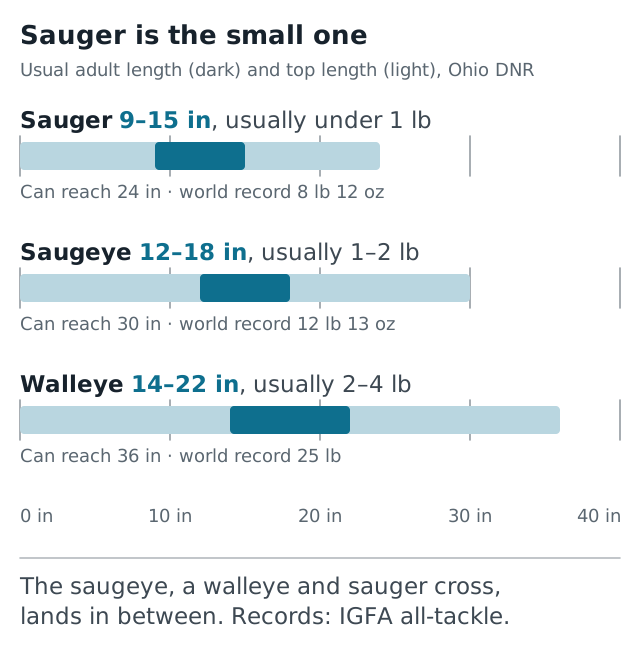
A sauger is the walleye’s smaller cousin of big, murky rivers. In Ohio most run 9 to 15 in and weigh under a pound. Look for rows of black spots on the first dorsal fin and no white tip on the tail. Fish for one the way you’d fish for a walleye, only deeper, darker and closer to a dam.
The world-record sauger weighed 8 lb 12 oz. Mike Fischer caught it in Lake Sakakawea, North Dakota, on October 6, 1971. No state record listed below comes within a pound of it.
How do you tell a sauger from a walleye?
Look at two places: the spiny first dorsal fin and the lower tip of the tail. A sauger has rows of dark spots on that fin and no white tip on the tail. A walleye has a plain fin with a dark blotch at the back, and a big white tip on the lower tail. Minnesota DNR says telling them apart “can stump even experienced anglers”, so check both marks every time.
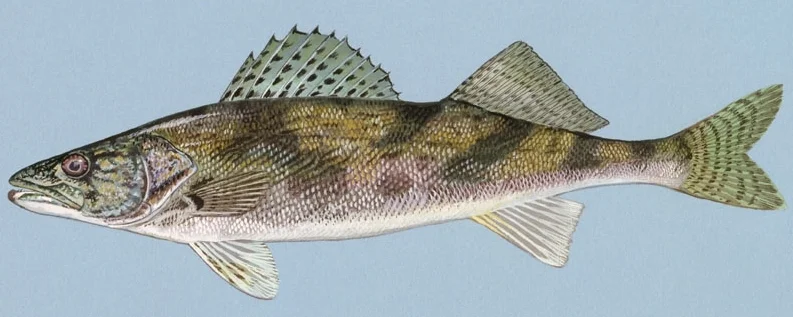
A sauger. Note the spotted first dorsal fin and the plain tail. Painting: Duane Raver, U.S. Fish and Wildlife Service (public domain).
The saugeye is the third fish in the mix, and it sits in between. This table puts all three side by side, with the agency that says it on each row.
| Mark | Sauger | Saugeye | Walleye |
|---|---|---|---|
| First dorsal fin | Rows of dark spots, clear between them (Ohio) | Dark bars or smeared, oblong spots between the spines (Ohio, West Virginia) | No spots (Minnesota, Oklahoma) |
| Blotch at the back of that fin | None (Ohio, Missouri) | Usually there, but not as sharp (Ohio) | Large and dark, at the base of the last three spines (West Virginia, Ohio) |
| Lower tail tip | No white tip, or a thin, often yellow edge (Ohio) | A white tip, smaller than a walleye’s (Ohio). Colorado says none | Big white tip (Ohio, West Virginia) |
| Body color | Bronze or brown, big dark blotches on the sides (Ohio) | In between the two (Ohio) | Olive, gray or silver (Ohio) |
| Usual size (Ohio) | 9–15 in (23–38 cm), under 1 lb | 12–18 in (30–46 cm), 1–2 lb | 14–22 in (36–56 cm), 2–4 lb |
Iowa DNR adds a small detail for the tail. On a sauger the white of the belly runs out to the tip. It just doesn’t spread into a white patch, the way it does on a walleye. Some sauger also carry a black spot where the pectoral fin meets the body, Minnesota DNR says. Iowa calls it a large black blotch at the base of that fin.
Still not sure? Count the rays in the soft second dorsal fin. Alabama gives the sauger 17 to 20 and the walleye 19 to 22, so a fish with 17 or 18 is a sauger. The walleye guide has a painting of both fish together.
What is a saugeye?
A saugeye is a hybrid. Hatcheries cross walleye eggs with sauger milt, a female walleye with a male sauger, and stock the young into reservoirs. Ohio DNR says the result is fast growing, with “excellent survival abilities”. That makes it ideal for stocking, Ohio says.
Oklahoma first stocked saugeye in Lake Thunderbird in May 1985. Colorado has put them in eastern plains reservoirs since the 1980s. Virginia stocked them into several walleye lakes between 2013 and 2022, and saugeye outdid the walleye in many of them. Ohio says many are caught in the tailwater, the river right below the dam, downstream of the lakes where they were stocked.
Two things people get wrong about saugeye:
- They aren’t sterile. Ohio says “a small percentage” can breed, with each other or with either parent. Oklahoma agrees, and still has to stock them routinely to keep the fishing going.
- They don’t always have a white tail tip. Ohio says they have one, and West Virginia says they often do. Colorado describes saugeye with “tails that do not have a white tip”, though the same page says some show white on the lower edge. Go by the dorsal fin first.
Saugeye vs walleye comes down to size and water. In Ohio a saugeye usually runs 1 to 2 lb and 12 to 18 inches long. A walleye runs 2 to 4 lb and 14 to 22 inches. Saugeye handle murky water better than either parent, Virginia DWR says. In Ohio they eat mostly small fish.

Free PDF · Water temperature chart Which fish are biting at today's water temperature?
One reading, and the 16-page chart shows which of 26 fish are spawning, feeding hard or slowing down; for bass, crappie, bluegill and walleye, where they sit and what to throw. Every number sourced.
No card, nothing to buy, and the PDF is yours to keep. Confirm with one click and it's on its way. Then a few short emails and one a week on what's biting. Unsubscribe anytime. Privacy.
Where do sauger live?
Sauger live in big rivers. Ohio DNR says they like large murky rivers or large shallow lakes, and water less clear and shallower than walleye water. Their eyes explain it. Minnesota says the reflective layer that helps a walleye see at night is even more developed in a sauger.
Here’s where the agencies point you:
- Minnesota: the Mississippi, Rainy, Minnesota and Red rivers, plus big northern lakes such as Rainy and Lac la Croix.
- Missouri: the Mississippi and Missouri rivers, where sauger outnumber walleye, and the Eleven Point River. In Missouri they live only in flowing water.
- Ohio: the Ohio River, Lake Erie and their tributaries. The tailwaters below dams on the Ohio River and its major tributaries fish best, in late fall and early spring.
- Iowa: mostly the Mississippi and Missouri rivers and the lower ends of their tributaries.
- Virginia: native only to the Powell and Clinch rivers, where they usually stay under 18 in.
Dams cut both ways. Sauger stack up below them, but dams also block the long spawning runs. Montana says its sauger now occupy 53% less of their old range. It blames lost habitat and barriers such as dams and diversions. Minnesota says sauger are thought to be declining over much of their native range.
When and where do sauger bite?
Late winter and early spring is the big time, below the dams. West Virginia says anglers do best in the early months of the year and in late fall. This calendar pulls together what six agencies say.
| When | Where to look | What to fish |
|---|---|---|
| Late winter to early spring | Tailwaters of dams on navigable rivers (West Virginia). Below Mississippi River dams as fish try to run upstream (Minnesota) | Jig tipped with a minnow, on or near the bottom (Minnesota) |
| Spawn, April to early May (Iowa) | Riffles and gravel in rivers (Montana). Tributaries and backwaters (Iowa) | Spawning starts in the upper 40s °F (Ohio), and in Montana at 50 °F |
| Summer | Lake Pepin on the Mississippi, where sauger numbers stay strong (Minnesota) | Live-bait rigs and jigs near the bottom (Minnesota) |
| Labor Day to freeze-up | Upper Mississippi, just below the navigation dams (Missouri) | Minnows trolled slowly over the bottom in swift, rocky water (Missouri) |
| Under the ice | Lake of the Woods, where a mixed bag of sauger and walleye is “more likely than not” (Minnesota) | Live minnows or bright, shiny jigging spoons. The bite lasts all day (Minnesota) |
Time of day matters too. West Virginia says sauger feed by sight, see well in low light and are most active at dawn and dusk. Missouri adds that they bite by day when the water is very muddy. The walleye water temperature guide shows how the water moves their cousin through the year.
How do you catch sauger?
Sauger fishing is walleye fishing, a little deeper. Minnesota DNR says walleye tackle and methods work, but sauger often sit in deeper, darker spots in rivers and lakes. Most sauger are caught near the bottom below a dam, Iowa says. So you look for anything big in the current that pushes the flow aside.
Here’s what to tie on, in order:
- A jig and minnow. One of Minnesota’s two picks for the whole open-water season, fished at or near the bottom. The jig head guide covers the shapes and weights.
- A live-bait rig. Minnesota names it right beside the jig. A Lindy rig with a minnow does the job.
- Minnows trolled slowly over the bottom. That’s how most of the upper Mississippi gets fished, Missouri says. You work swift, rocky water just below the navigation dams.
- Silver spoons and light-colored jigs. West Virginia names them, along with any lure that looks like the small fish sauger eat.
- Bright, shiny jigging spoons through the ice. Minnesota’s pick for the bog-stained water of Lake of the Woods.
What’s the best bait for sauger?
A live minnow. It’s on Minnesota’s jig in open water and under the ice, and it’s what Missouri’s upper Mississippi anglers troll. That matches the menu. Ohio’s field guide says sauger eat aquatic insects, crayfish and small fish, mostly at dawn and dusk. In West Virginia it’s gizzard shad, emerald shiners and other minnows.
Mind the mouth when you unhook one. Montana describes large canine teeth on the jaws and the roof of the mouth, so use pliers. The fish teeth page explains which fish you can lip.
How do you catch saugeye?
Fish saugeye near the bottom. Oklahoma says they gather on sand bars, ledges and drop-offs. Colorado says to troll live bait or slowly work jigs over humps and points. At Lake Thunderbird in winter, Oklahoma says to fish from dusk until about two hours after sunset. Use a shallow-running minnow bait, reeled in very slowly. That’s a minnow-shaped crankbait, crawled back.
Saugeye also help other fishing. Oklahoma stocks them in lakes with stunted crappie, because once a saugeye reaches 16 in it starts eating them.
How big do sauger get?
Not very. Ohio DNR puts most adults at 9 to 15 in and under a pound, with a top end of 7 lb and 24 inches. Minnesota calls a sauger over 20 in large. Iowa says most fish anglers take are under 15 in, and that sauger grow slower than walleye.
The records show the gap. The saugeye’s world record is heavier than any sauger’s, and a walleye’s is heavier than both.
| Record | Sauger | Saugeye |
|---|---|---|
| World, IGFA all-tackle | 8 lb 12 oz (3.96 kg), Lake Sakakawea, ND, 1971 | 12 lb 13 oz (5.81 kg), Clendening Reservoir, OH, 2001 |
| Tennessee | 7 lb 6 oz, Kentucky Reservoir (Pickwick tailwater), 1973 | 10 lb 12 oz, Melton Hill Reservoir, 1998 |
| Iowa | 6.50 lb, Missouri River, 1976 | 12.25 lb, Des Moines River, 2000 |
| Minnesota | 6 lb 2 oz, 23⅞ in, Mississippi River near Red Wing, 1988 | 9 lb 13 oz, 27 in, Mississippi River near Red Wing, 1999 |
| West Virginia | 5.06 lb, Ohio River, 2012 | Not listed |
Tennessee takes only two hybrids for its record book, and the saugeye is one. The agency gets the final say on whether your fish really is one. For a sauger you plan to let go, measure it and see the catch and release guide for handling.
Is sauger good to eat?
Yes. Minnesota DNR calls the sauger “every bit as tasty” as the walleye. Oklahoma calls saugeye “first-class table fare”, and Colorado says saugeye are “just as tasty” as walleye. Outdoor writer Mike Yurk goes further. With walleye and sauger fillets side by side, he says, “it is impossible to taste the difference.”
The fillet knife guide covers which blade suits a fish this size. Then check your state’s fish consumption advice before you keep a bag of big river fish.
What rules apply to sauger?
Many states count sauger with walleye. Ohio’s 2026–27 rules lump walleye, sauger and saugeye together. That’s six a day with a 15 in minimum on Lake Erie through April 30, 2027, and six with no minimum on inland waters. On the Ohio River the six are combined with a 14 in minimum. Virginia treats saugeye as walleye in its rules and won’t stock them where walleye breed on their own.
Rules change every season and differ by water. Check your state’s current booklet before a sauger goes in the cooler. The walleye fishing guide lists a few walleye seasons and limits as examples.
The biology behind the fishing
If you fish the spring run, know the order. Sauger spawn usually just after the walleye and in slightly deeper water, Minnesota says. Ohio says they start in the upper 40s °F. In Montana they make long runs up the Yellowstone and Missouri rivers first. A female scatters 10,000 to 50,000 sticky eggs over gravel or rock, and they hatch in about 10 days, Ohio says. In Iowa the young reach 2 to 4 in their first year and mature in their third or fourth.
The eye drives everything. Missouri says the sauger’s eye is apparently even better suited to low light than the walleye’s. That may be why sauger handle muddy water that blocks out the sun. Like the walleye, the sauger belongs to the perch family, with yellow perch and the darters.
The sauger has nicknames too. Ohio lists jacks, and Minnesota sand pike. Is a zander a walleye? No. It’s the walleye’s European cousin, and in the US it lives in one water, Spiritwood Lake in North Dakota. Every fish checked there was pure zander, with no walleye mixed in.

Free PDF · 16 pages
Stop guessing. Know what's biting before your first cast
A whole Saturday on the water with nothing to show for it. One reading tells you who's feeding.
The Water Temperature Fishing Chart. Take one water temperature reading, find it on the chart, and see which of 26 freshwater fish are spawning, feeding hard or slowing down.
- Where bass, crappie, bluegill and walleye sit, and what to throw. Trout: the reading where you stop.
- Why a 3 ft drop beats a cold front, and what to throw each day of the front
- The three thermometer mistakes that make a reading lie
The chart's numbers come from state fish and wildlife agencies and fisheries research: 61 sources, each listed on the site.
No card, nothing to buy. Confirm with one click and the PDF is on its way, one version for your phone and one to print, yours to keep. Then a few short emails and one a week on what's biting, with an unsubscribe link in every one. Privacy.
Related
Section guide
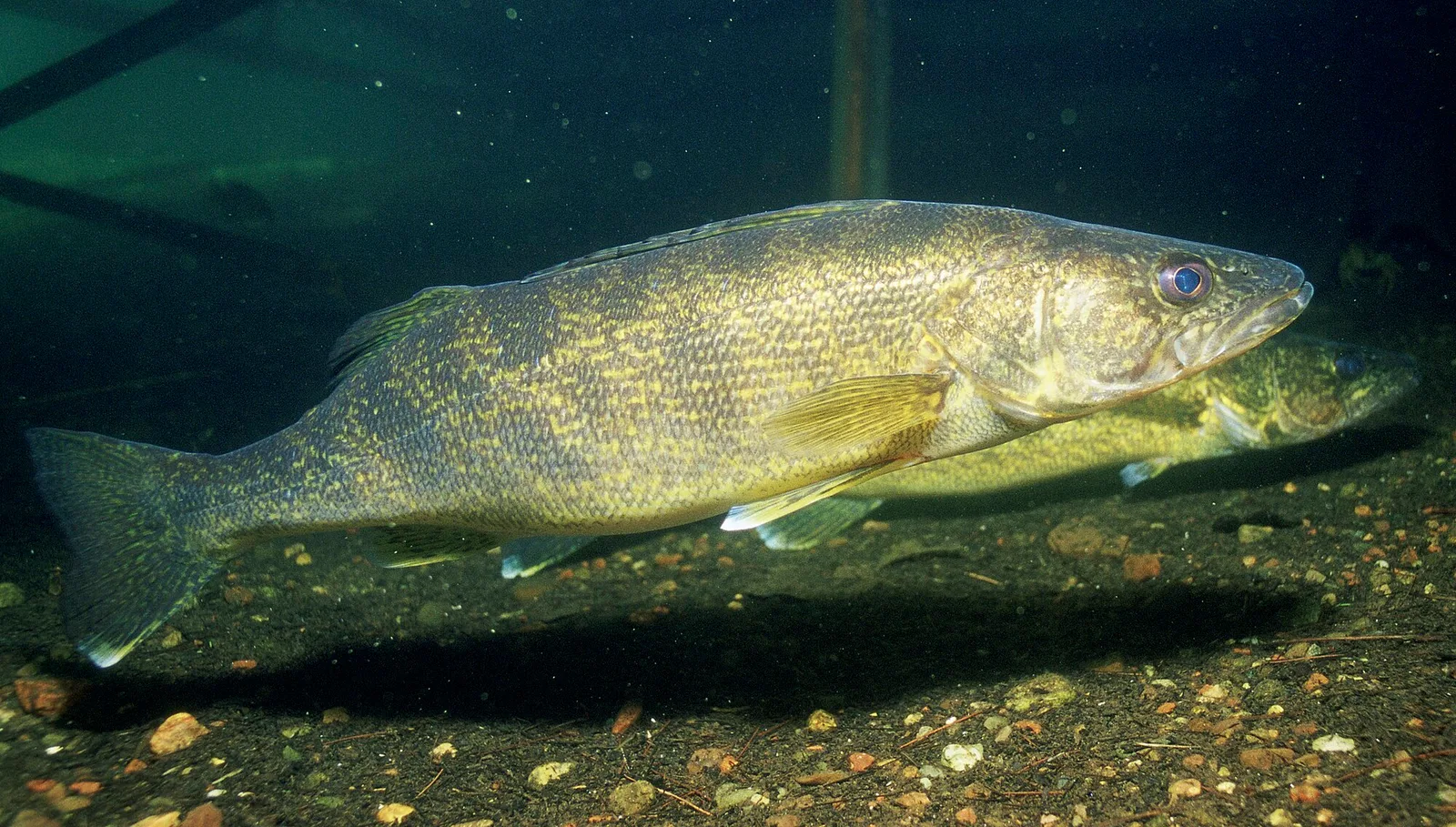
Walleye: The Fish, Its Look-Alikes, the Record and How to Catch OneThe walleye: how to tell it from sauger and saugeye, where it lives, when it spawns, how fast it grows, the 25 lb record and the rules anglers ask about.
 Walleye Fishing: How to Catch Walleye in Every Season
Walleye fishing by season: where they sit, which jig, rig or crankbait to use, how deep and how fast, plus night, shore and ice.
Sources (23)
- Minnesota DNR, Minnesota Profile: Sauger (Sander canadensis), Minnesota Conservation Volunteer, May–June 2022
- Minnesota DNR, Sauger: The walleye's cousin
- Ohio DNR, Sauger
- Ohio DNR, Saugeye
- Ohio DNR, Walleye
Show all 23 sourcesShow fewer sources
- Ohio DNR, Sport Fish of Ohio Field Guide (Publication 334)
- Ohio DNR, Ohio Fishing Regulations 2026–27
- Ohio DNR, Lake Erie Walleye and Yellow Perch 2026–2027 Daily Bag Limits
- West Virginia DNR, Sauger: Fish Description & Facts
- Missouri Department of Conservation, Sauger
- Iowa DNR, Fish Iowa: Sauger
- Montana Field Guide, Sauger (Montana Natural Heritage Program and Montana Fish, Wildlife and Parks)
- Outdoor Alabama, Sauger
- Virginia DWR, Sauger
- Virginia DWR, Saugeye
- Oklahoma Department of Wildlife Conservation, Saugeye
- Colorado Parks and Wildlife, Saugeye
- IGFA world records: sauger and saugeye (member portal, read November 8, 2026)
- Tennessee Wildlife Resources Agency, Tennessee State Fishing Records & Awards
- Iowa DNR, State Record Fish
- Minnesota DNR, State record fish: Certified weight
- USGS Nonindigenous Aquatic Species, Zander (Sander lucioperca) species profile
- Mike Yurk, Sauger: The Walleye's Smaller Cousin, MidWest Outdoors