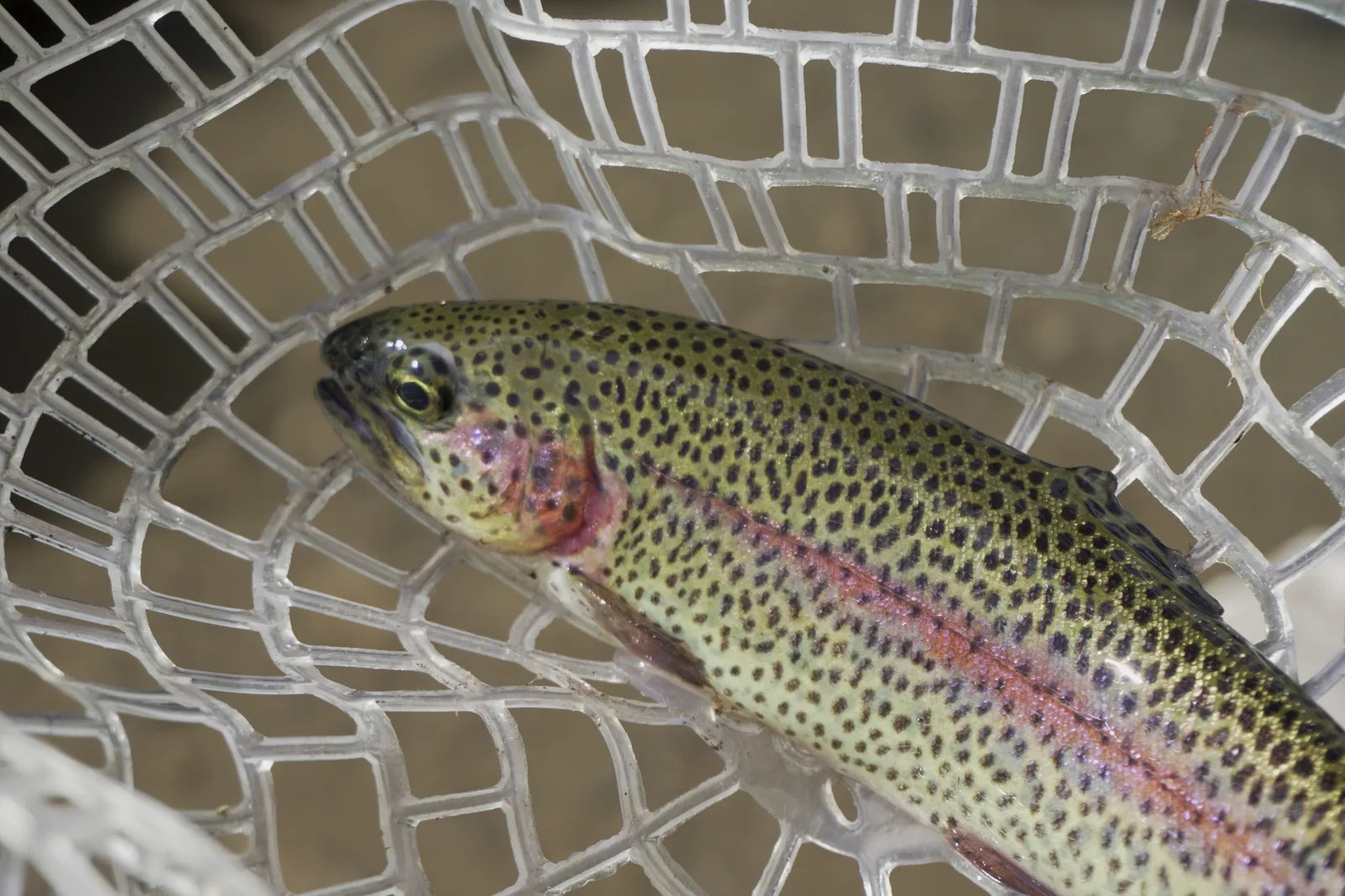
The fishing net most anglers need is a landing net with a rubber bag, sized to the fish: about 20 × 23 in for bass, walleye and crappie, smaller for stream trout, 24 × 27 in for catfish. The EGO S2 Slider with a rubber head is the pick for a boat; the EGO S1 Genesis carries the same head for $41 less. The picks come from the makers’ own specifications and the owner reviews on their pages, read on October 25, 2026. None was tested by this site.
In a 2003 study, bluegill held 30 seconds in a knotted net died at up to 14% within a week. In rubber mesh, 4% died. Fish landed without a net: none.
The best fishing nets for each kind of fishing
- Bass, walleye or trout from a boat: the EGO S2 Slider-Large Rubber Net, $129.99, with a handle that slides from 29 to 60 in.
- The same net for less: the EGO S1 Genesis-Large Rubber Net, $88.99, on a fixed 31 in handle.
- Under $70: the Frabill Collapsible Conservation Net, from $59.99. Its mesh is knotless and coated, not rubber.
- Wading or a kayak: the EGO Wade-Medium Rubber Net, $76.99, short and floating.
- Catfish and stripers: the EGO Big Game-XLarge Rubber Net, $102.99, with a 24 × 27 in hoop.
- Crappie from a pontoon or a spider rig: the EGO Reach-Rubber Net, $72.99, reaching 8.5 ft.
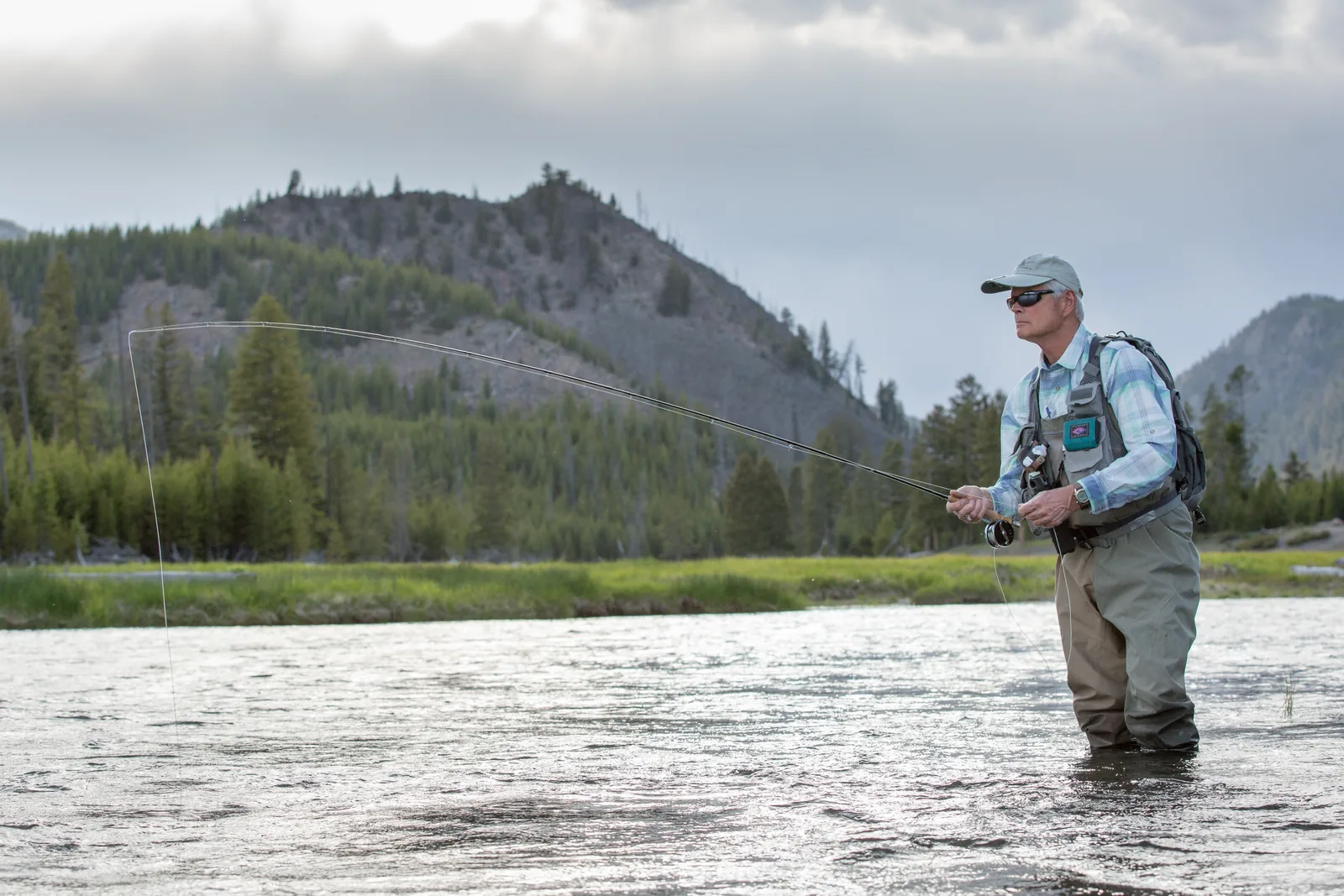
- Fly fishing for trout: the Fishpond Nomad Emerger, $179.95, at 0.88 lb.
- Muskie and trophy pike: a net of about 32 × 41 in or a cradle, the long sling that keeps the fish flat in the water. The muskie page says how big the fish get.
Rubber, coated or nylon mesh: what the studies found
Mesh is the one choice that changes what happens to the fish. Two field studies compared landing-net meshes on angled fish side by side, and both point the same way: knots hurt, and large rubber mesh hurts least.
| Mesh | Bluegill at 79 °F (26 °C): dead within a week | Brook trout at 57 °F (14 °C): what the mesh did |
|---|---|---|
| Rubber | 4% (10 mm mesh) | Least slime lost: 7% of fish (25 mm mesh) |
| Rubber-coated nylon | not tested | Scales lost on 15% of fish (6 mm mesh) |
| Knotless nylon | 6% (4 mm mesh) | 2 mm “trout net”: slime off 32%, hooks tangled on 68%, longest handling at 52.6 s |
| Knotted | 14% (10 mm), 10% (20 mm) | The only mesh that raised fin damage: about five times the odds of bare hands (40 mm) |
| No net | 0% (held 30 s in air) | Bare wet hands dropped 24% of fish; the nets 5% on average |
The bluegill numbers come from Barthel and colleagues at the University of Illinois. They netted 50 fish per mesh at 79 °F (26 °C) and held each one 30 seconds in the air. Every fish that died had badly frayed tail fins, most worn down to the base, and a fungus had set in. The slime coat is the fish’s skin defense, and the knotted meshes scraped off most of it.
The trout numbers come from 146 stocked brook trout in Quebec, caught on treble hooks. Two findings matter for buying. First, the fine nylon “trout net” was the worst for the fish’s slime and kept fish out of the water longest, because the trebles caught in it. Second, the authors write that “large rubber mesh—rather than just rubber-coated mesh” was the best of the four.
That is why the word on the label matters. “Conservation” and “tangle-free” do not mean rubber. A knotless bag beat the knotted ones on bluegill, but a coated bag is not the rubber the trout study favored. The Frabill Conservation Series is a coated knotless net: “100% knotless mesh netting” with a “tangle-free coating”, in Frabill’s words. EGO sells most of its heads in four bags, rubber, clear rubber, PVC-coated and nylon, so read which one you are buying.
Scotland went furthest. Its 2007 fisheries act made a knotless, non-metallic landing net the only landing aid allowed with rod and line there, and banned the gaff and the tailer.
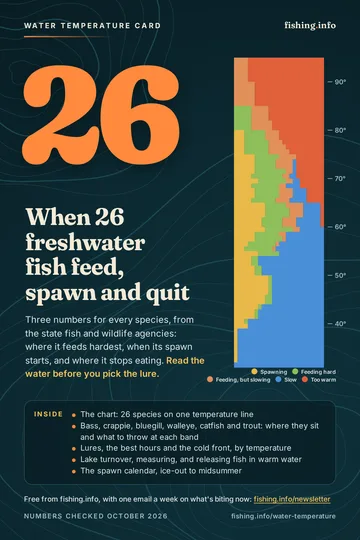
Free card: what 26 species do at your water temperature
Plus one email a week on what's biting now. No sales pitches. Privacy.
What size landing net do you need?
Size the hoop to the fish you catch most. Tim Allard, writing for Bass Pro Shops, puts it plainly: “The size of net hoop you choose is influenced by the length of fish you regularly catch.” The table pairs each fishing with a hoop and handle from his guide and the makers’ size ladders.
| Fishing | Hoop | Handle | Where the number comes from |
|---|---|---|---|
| Stream trout, fly | 11 × 15 in (28 × 38 cm) | 11–13 in (28–33 cm) | Allard’s trout net and EGO Blackwater (hoop); Blackwater and Fishpond Emerger (handle) |
| Wading, kayak | 17 × 19 in (43 × 48 cm) | 11 in (28 cm), floating | EGO Wade-Medium |
| Crappie, long reach | 14 × 18 in (36 × 46 cm) | up to 8.5 ft (2.6 m) | EGO Reach |
| Bass, walleye, crappie from a boat | 20 × 23 in (51 × 58 cm) | 29–60 in (74–152 cm) | Allard’s bass net; EGO S2 |
| Catfish, stripers | 24 × 27 in (61 × 69 cm) | 48 in (122 cm) | EGO Big Game-XLarge |
| Muskie, trophy catfish | 32 × 41 in (81 × 104 cm) | long, or a cradle | Allard’s muskie net |
The best landing net for catfish is the biggest rubber hoop you can stow, on a long, stiff handle: EGO built its 24 × 27 in Big Game for catfish and stripers. Read the load rating too. EGO rates the S2 at 30 lb retracted and 20 lb fully extended, and tells owners to lift heavy fish more vertically. Once the fish is in, the catfish handling page covers the spines.
A bass boat has to stow the net. One owner of the EGO S2 Large wrote that it is too big for his Ranger 521 and suggests the medium.
How long should a fishing net handle be?
As short as your fishing allows. “Short handles make for compact, easy-to-maneuver nets,” Allard writes; with a short handle you bring the fish close before you net it. A long one earns its place on big water, piers and high-sided boats.
- Wading and kayaks: 11–13 in, on a tether. EGO’s wade and Big Game nets float, so a dropped net can be picked up.
- Bass and walleye boats: an extendable, telescoping handle that stows short and reaches out when you need it.
- Crappie: long. One crappie angler’s review says he needed reach for big fish he could not swing aboard without tearing their mouths. Crappie fishing covers the long-rod rigs that put the fish out there.
- Catfish: long and stiff, rated for the weight.
How do you net a fish?
Wait until the fish is tired, put the net in the water, and guide the fish into it; in still water, head first. Destination Northern Ontario, the region’s tourism agency, gives the routine in a few lines:
- “Don’t try to ‘scoop’ fish into a net. Place the net in the water and guide the fish into it.”
- “In still waters, net your fish head-first. In rivers, hold the net behind the fish and slowly drop the fish back into it.”
- “Don’t rush. Wait until the fish has tired before trying to net it.”
- If you plan to release it, keep it in the water and “use the net to hold the fish while you remove the hooks.”
- For pike and muskie, use a net big enough for the biggest fish you expect, or a cradle.
The trout study adds a reason to use a net at all. Of the trout landed by bare wet hands, 24% were dropped; with a net, 5% on average.
What are the different types of fishing nets?
A handheld fish net for landing a hooked fish is a landing net; Texas law calls the same tool a dip net. The other kinds catch fish without a hook, and the law treats them differently.
- Landing net (dip net): a mesh bag on a hoop and handle, used to lift a hooked fish. This page is about these.
- Cast net: a round net weighted at the edge and thrown by hand. A bait tool, for shad, shrimp and other nongame fish.
- Seine: a wall of net pulled through shallow water, mostly for minnows.
- Gill and trammel nets: commercial and survey nets that hold fish by the gills.
Can you use a cast net to catch fish?
For bait and nongame fish, where your state allows it; for game fish, not in the two states quoted here. Texas says it outright: “Game fish may be taken only by pole and line (which includes rod and reel).” A cast net there is “legal only for taking nongame fish” and crabs, crayfish and shrimp, and “may not be greater than 14 feet in diameter”. The dip net, Texas adds, “may be used to aid in the landing of fish caught by other legal devices”.
Minnesota is stricter. Cast nets are allowed “only to take gizzard shad for use as bait”, from July 1 to November 30, no more than 5 ft in radius. The same law exempts “nets used to land game fish taken by angling” from its net bans. Other states draw the line elsewhere, so read your own state’s rules before you throw a net.
The comparison
| Net | Hoop | Handle | Mesh | Price |
|---|---|---|---|---|
| EGO S2 Slider-Large Rubber | 19 × 21 in (48 × 53 cm) | 29–60 in | rubber | $129.99 |
| EGO S1 Genesis-Large Rubber | 19 × 21 in (48 × 53 cm) | 31 in | rubber | $88.99 |
| Frabill Collapsible Conservation | 17 × 19 to 21 × 24 in | collapsible | coated knotless | $59.99–$89.99 |
| EGO Wade-Medium Rubber | 17 × 19 in (43 × 48 cm) | 11 in | rubber | $76.99 |
| EGO Big Game-XLarge Rubber | 24 × 27 in (61 × 69 cm) | 48 in | rubber | $102.99 |
| EGO Reach-Rubber | 14 × 18 in (36 × 46 cm) | to 8.5 ft | rubber | $72.99 |
| Fishpond Nomad Emerger | 9.8 × 18.8 in (25 × 48 cm) | 13 in | TPU | $179.95 |
The picks in detail
EGO S2 Slider-Large Rubber Net
For the angler who nets bass, walleye and trout from a boat and wants one net for all of it. The rubber bag is 20 in deep with a flat bottom, and the handle locks anywhere from 29 to 60 in. It weighs 3.35 lb, heavy next to the S1. Of 28 owner reviews on EGO’s page, 27 give five stars; one guide bought two after a client threw his old net into the lake and it sank. Skip it if your boat locker is short: buy the medium.
EGO S1 Genesis-Large Rubber Net
The same head as the S2 Large on a fixed 31 in handle, at 1.75 lb and $41 less. Owners mention kayaks and one-handed netting while holding the rod. Only five reviews, all positive. Skip it if you fish from a high deck and need reach.
Frabill Collapsible Conservation Net
The cheapest net here with a knotless, coated bag, in three hoop sizes. It is not rubber: in the trout study, a small coated knotless mesh took scales off 15% of fish, and the authors judged large rubber gentler. Owners praise the build. One said it broke within a month, and one received coated mesh where he expected clear. Buy it when the budget is fixed.
EGO Wade-Medium Rubber Net
An 11 in handle, a 17 × 19 in rubber hoop and a tether, and it floats. Kayak owners land redfish, trout and flounder in it, and one wrote that his hooks stopped tangling once he left cord netting. One wader wants the handle 3 to 4 in shorter. For a kayak it pairs with a fishing stringer only while you sit still.
EGO Big Game-XLarge Rubber Net
A 24 × 27 in hoop on a 48 in handle, built for catfish and stripers, with a rubber bag that stretches to 1.5 times its 16 in depth under load. It floats. There are only two reviews: a guide netting big walleye likes it, and the other owner found the fixed handle too short and fitted his own. If you fish from a tall boat, check the reach first.
EGO Reach-Rubber Net
A small 14 × 18 in rubber hoop on a three-section handle that reaches 8.5 ft. Crappie anglers write about pontoons, long poles and spider rigs, and one uses it for kokanee. It is the official net of Crappie USA. The 14 × 18 in hoop is crappie-sized: for bass or catfish, pick a larger head.
Fishpond Nomad Emerger Net 2.0
The fly angler’s net: 0.88 lb, carbon and fiberglass, a 13 in handle that rides in the net slot of a hip pack, sling or vest. Fishpond says its TPU bag is harder to break and stretches farther before failing than comparable nets. The maker pitches it for anything from pocketwater brook trout to a personal-best brown. At $179.95 it is the most expensive net here, and Fishpond’s page carries no owner reviews to weigh.
How we chose
Mesh came first. We kept the nets with a rubber or rubber-like bag, because large rubber mesh did the least harm in the trout study, and one coated knotless net for a lower budget. EGO sells a rubber bag on hoops from 14 × 16 to 24 × 27 in, which is why five picks come from one maker. Specifications and prices are the makers’ own, read on October 25, 2026. The reviews are those on the makers’ own pages, so weigh the complaints more than the praise. Nothing here was tested by this site.
Then the net itself is only half the job. Wet it, keep the fish in it in the water while you unhook, and get it back fast: the catch-and-release page has the routine. The accessories hub covers the pliers, grips and scales that go with it.
Free download
The water temperature card
Read your water temperature and the card tells you who is spawning, who is feeding and what to throw. 26 species, 16 pages, for your phone and the tackle box.
Plus one email a week on what's biting now. No sales pitches. Privacy.
Related
Section guide
Fishing Accessories: The Small Gear That Decides the DayThe fishing accessories worth carrying: net, pliers, scale, thermometer, tackle box and the rest, with the one spec that matters on each and what it is for.
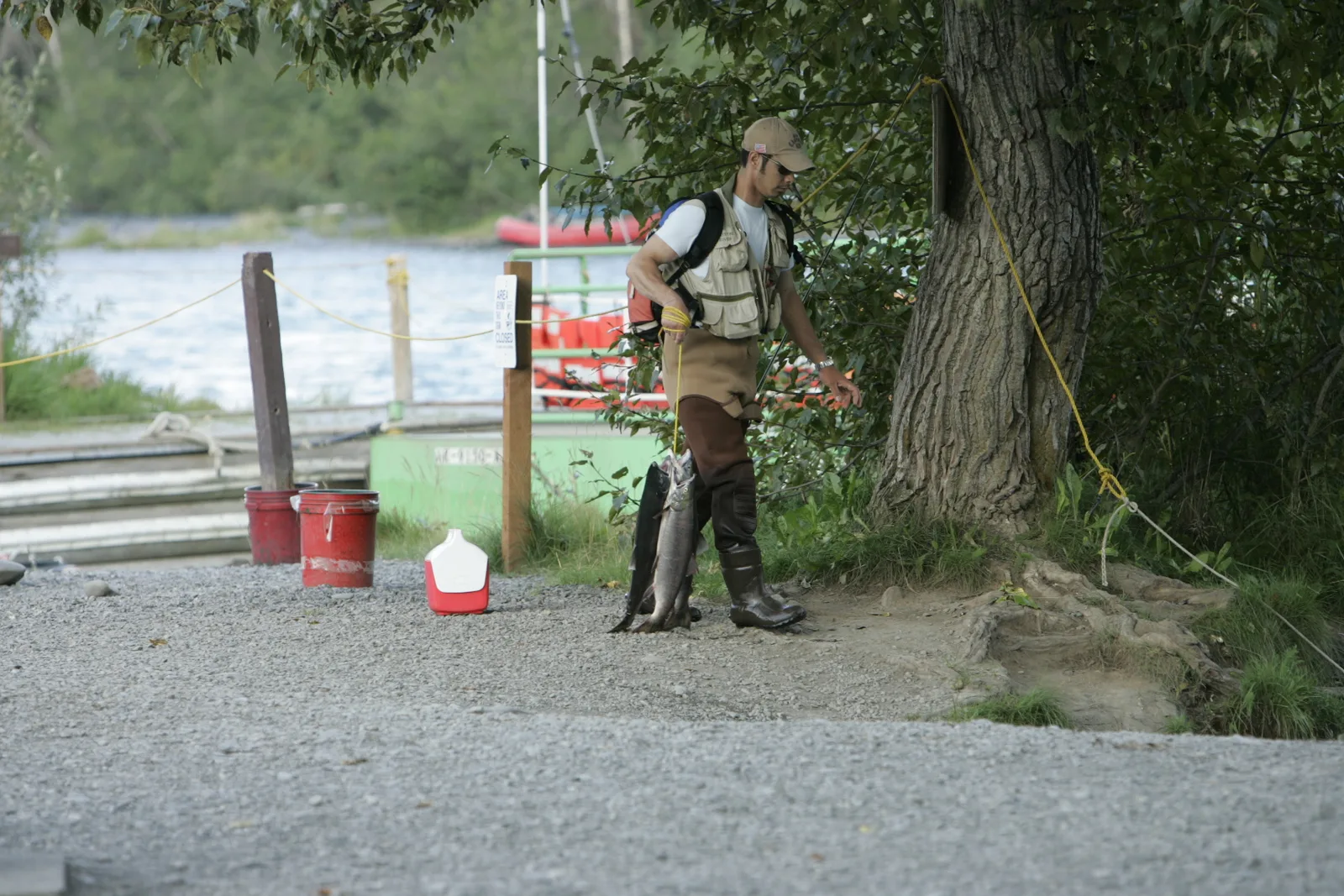 Fishing Stringer: The Right One for Bank, Boat and Wading, and How to Use It
A $3 chain fishing stringer through the lower jaw suits most anglers. Pike lived two hours on one, but a quarter died later. Picks and how to use it.
 Best Fishing Thermometers: From a $14 Stream Tube to the Fish Hawk TD
A $14 encased stream thermometer serves most anglers; only a depth probe reads where summer bass and walleye sit. Five types compared, with picks.
Sources
- Barthel, Cooke, Suski and Philipp (2003), Effects of landing net mesh type on injury and mortality in a freshwater recreational fishery, Fisheries Research 63:275–282
- Lizée, Lennox, Ward, Brownscombe, Chapman, Danylchuk, Nowell and Cooke (2018), Influence of landing net mesh type on handling time and tissue damage of angled Brook Trout, North American Journal of Fisheries Management 38:76–83
- Tim Allard, Fishing net buyer's guide, Bass Pro Shops 1Source
- Texas Parks and Wildlife, Outdoor Annual: legal devices, methods and restrictions (dip net, cast net, pole and line)
- Minnesota Statutes 97C.345, Restrictions on using and possessing nets and spears
- Aquaculture and Fisheries (Scotland) Act 2007, explanatory notes (knotless non-metallic landing nets)
- EGO Fishing, S2 Slider-Large Rubber Net (specifications and owner reviews)
- EGO Fishing, S1 Genesis-Large Rubber Net (specifications and owner reviews)
- EGO Fishing, Wade-Medium Rubber Net (specifications and owner reviews)
- EGO Fishing, Big Game-XLarge Rubber Net (specifications and owner reviews)
- EGO Fishing, Reach-Rubber Net (specifications and owner reviews)
- Frabill, Collapsible Conservation Net (sizes, prices and owner reviews)
- Frabill, Telescoping Conservation Net (Conservation Series mesh description)
- Destination Northern Ontario, 7 ways to land your catch (netting tips)
- EGO Fishing, Blackwater Trout Net (10.5 × 15 in hoop, 11 in handle)
- Fishpond, Nomad Emerger Net 2.0 (specifications)