 By
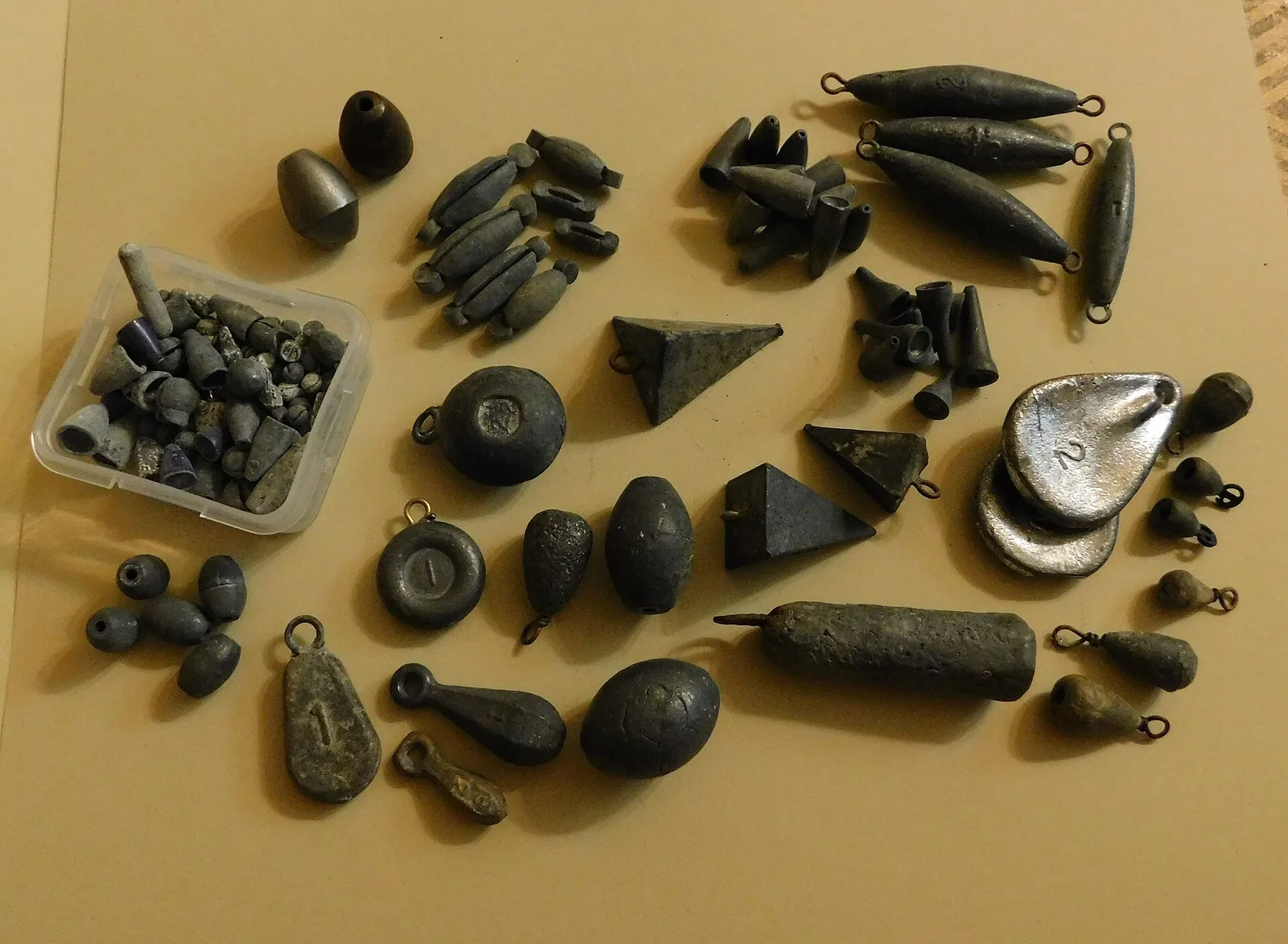
Fishing weights, also called fishing sinkers, come in about ten common shapes, from a .015 oz split shot to a 24 oz surf pyramid. The shape decides the job: some slide on the line so a fish can run without feeling them, some dig into sand, some lie flat in current. Pick the shape for the rig and the bottom, then the lightest weight that holds. And check your state before you buy lead.
Lead fishing tackle killed 49% of the adult loons the Loon Preservation Committee collected dead in New Hampshire from 1989 to 2011.
Which fishing weight do you need?
Start from what you fish for. Each line below is one sinker type for one kind of fishing; the sizes and the reasons follow further down.
- Bluegill and other panfish from the bank: removable split shot, pinched on above the hook or under a bobber. Kentucky’s wildlife agency lists removable split shot in its starter box.
- Bass in weeds and wood: a bullet weight on a Texas rig, in tungsten if you fish heavy cover often.
- Bass on open bottom: an egg or cylinder sinker on a Carolina rig, or a drop-shot weight below the hook on a drop-shot rig.
- Walleye: a walking sinker on a Lindy rig, built to ride over the bottom without snagging.
- Catfish in rivers: an egg or a flat no-roll sinker on a slip-sinker rig; a bell or bank sinker on a three-way rig.
- Surf: a pyramid on sand, or a Sputnik with wire arms when the surf is heavy, often on a fish finder rig.
The types of fishing sinkers and what each is for
Wired2Fish’s Jason Sealock sorts every sinker into three groups: slip sinkers the line runs through, weights tied to the end of the line, and add-ons that pinch or clip on, like split shot. The sizes below are what one maker, Bullet Weights, casts in lead, unless the row names another.
| Sinker | How it rides | What it is for | Sizes sold |
|---|---|---|---|
| Split shot | Pinched on the line | A little weight on light line; drifting a worm; balancing a float | B .015 oz to 3 .105 oz (0.4–3 g) |
| Egg | Slides; line through the middle | Carolina and catfish slip-sinker rigs; slips past rock | 1/8–16 oz (4–454 g) |
| Bullet (worm weight) | Slides, nose first, ahead of the bait | Texas rig through weeds and wood | 1/64–1 oz (0.4–28 g) |
| Bank | Tied on; teardrop | Long casts onto mud, silt or sand; calm surf | 1/2–20 oz (14–567 g) |
| Pyramid | Tied on; four flat sides | Holds in sand and mud and in the surf; wedges in rock | 1–24 oz (28–680 g) |
| No-roll | Slides; flat sides | River current over hard bottom; catfish | 1–6 oz (28–170 g) |
| Walking | Slides; rides on its heel | Lindy rig for walleye over rock | 1/8–3/4 oz (4–21 g), Lindy |
| Drop-shot | Tied or clipped below the hook | Drop-shot rig for bass | 1/8–1/2 oz (4–14 g) |
| Bell (bass casting) | Tied on; swivel in the eye | Three-way and bottom rigs; the swivel stops line twist | 1/8–20 oz (4–567 g); #10 is 1/8 oz |
| Sputnik (storm) | Tied on; wire arms | Anchors in heavy surf; the arms release and swing back on the retrieve | Surf weights |
Outdoor Life’s Joe Cermele explains why the shapes matter once they land. A bank sinker casts “a mile” and moves a little in moderate current, which rolls the bait around to cover water. The pyramid is “specifically designed to anchor your bait in soft bottoms,” but is “a poor choice for rocky bottoms” because it wedges in the cracks. The egg sinker lets a fish “pick up your bait and swim away with it without immediately feeling resistance.” Flat sinkers suit catfish, sturgeon and carp on hard bottom, because current cannot push them easily and they rarely wedge between rocks.
A few weights do not fit the table. Nail weights are thin, pointed weights you push into a soft plastic, such as a swimbait or a stick bait. Board weights stick to the belly of a hard bait, Sealock notes, to make a floating jerkbait sink or suspend. Neither does anything on its own: it changes how a lure falls.

Free PDF · Water temperature chart Which fish are biting at today's water temperature?
One reading, and the 16-page chart shows which of 26 fish are spawning, feeding hard or slowing down; for bass, crappie, bluegill and walleye, where they sit and what to throw. Every number sourced.
Enter your email, confirm it with one click, and the PDF is in your inbox. Plus one email a week on what's biting. Unsubscribe anytime. Privacy.
Split shot sizes: what B, BB and 3/0 weigh
Split shot sizes look backward until you see the weights. The letter sizes and 3/0 are the light ones; among the plain numbers a higher number is lighter, so a 7 is lighter than a 3. This is Bullet Weights’ own table:
| Size | Weight | Pieces per pack |
|---|---|---|
| B | .015 oz (0.43 g) | 60 |
| BB | .020 oz (0.57 g) | 60 |
| 3/0 | .025 oz (0.71 g) | 40 |
| 7 | .040 oz (1.13 g) | 30 |
| 6 (round only) | .050 oz (1.42 g) | 24 |
| 5 | .080 oz (2.27 g) | 22 |
| 4 | .085 oz (2.41 g) | 20 |
| 3 | .105 oz (2.98 g) | 15 |
So a size 3 weighs seven times a B. Bullet Weights also casts sizes 1, 0, 00 and 000 in its reusable shot, in packs of 10, 7, 5 and 3, but publishes no weights for them. This is one maker’s table: read the packet when you switch brands.
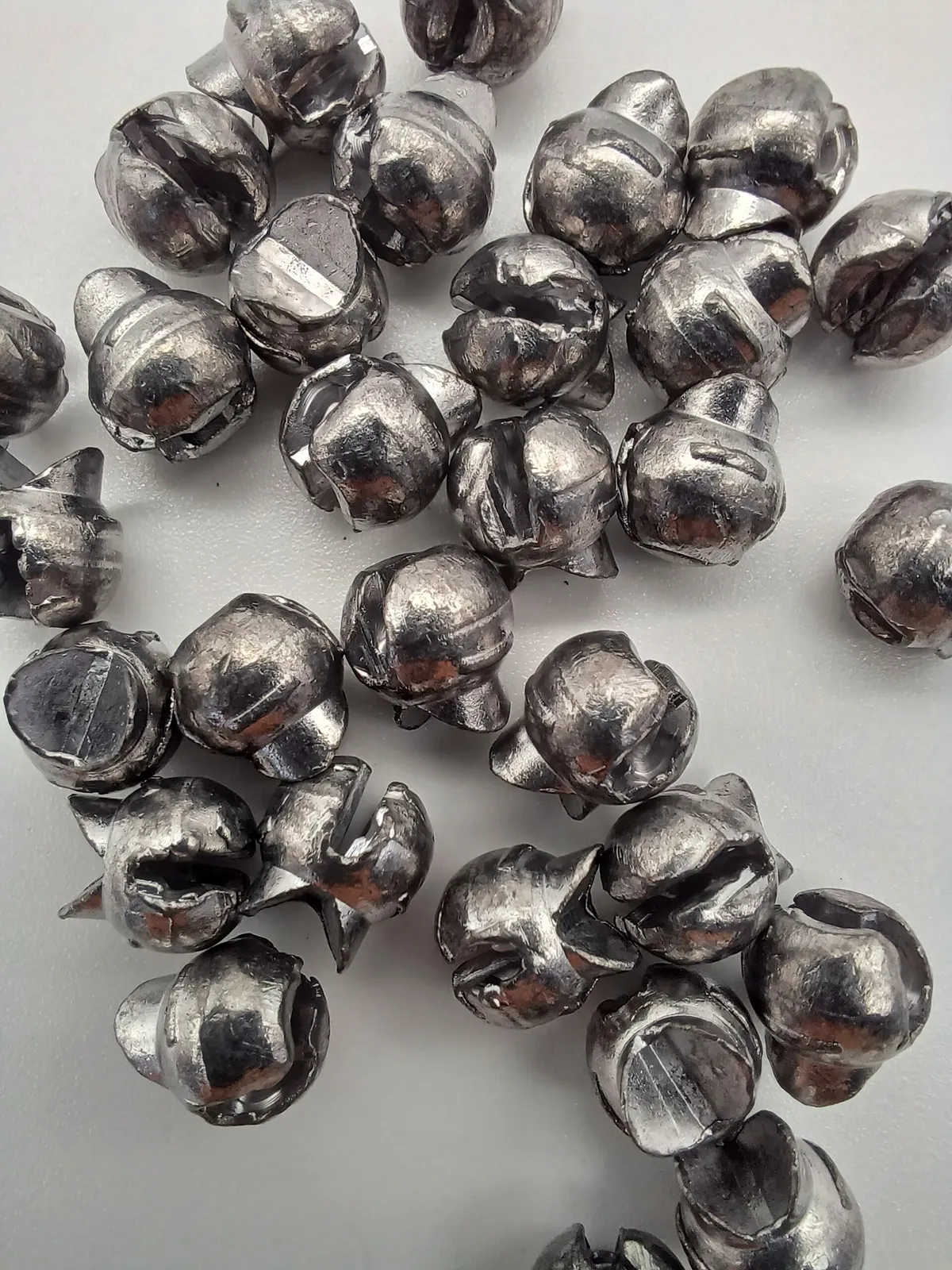
Removable split shot by Water Gremlin, size PSS-7, about 6 mm across. Photo: Mx. Granger, Wikimedia Commons (CC0).
Removable shot has two ears on the back: pinch them and the shot opens. Use it where you change weight often, as when a drifting worm should barely tick over the bottom of a pool. Cermele keeps split shot for “shallow water, small moving waters, and ponds”, where a light line needs just a little weight. Pinch it closed with pliers rather than your teeth; the EPA says never to “bite down on slip shot”.
How heavy should a fishing weight be?
Use the lightest weight that holds the bottom, or reaches the fish, in the current and wind you have. Add weight only when depth, current or wind takes away the feel of the bottom. The numbers below are from the anglers and editors named in the sources.
| Fishing | Sinker | Weight |
|---|---|---|
| Texas rig, stick bait on a slow fall | Bullet | 1/32–1/8 oz (0.9–4 g) |
| Texas rig, 5 ft (1.5 m) or less | Bullet | 1/8 oz (4 g) |
| Texas rig, about 20 ft (6 m) | Bullet | 1/4–3/8 oz (7–11 g) |
| Texas rig, punching matted grass | Bullet | 1–2 oz (28–57 g) |
| Carolina rig, by depth (Greg Vinson) | Cylinder | 1/2–1 oz (14–28 g) |
| Catfish, by current and depth (Steve Quinn) | Bank, bell, no-roll | 1/2–10 oz (14–283 g) |
| Light surf, whiting, 10 lb spinning outfit | Shape not named | 1 oz (28 g) |
| Surf, 12 lb outfit, placid surf | Bank | 2–3 oz (57–85 g) |
| Surf, 11–13 ft (3.4–4 m) rods | Pyramid, bank | 4–6 oz (113–170 g) |
The Texas rig rows follow Bassmaster’s weight guide, which names four things that decide: the rate of fall, the depth of the fish, the density of the cover and, “most importantly,” the wind. For bass in thick grass, it is cover that sets the number. Florida Sportsman sets surf weights at “as little as 2 ounces to as much as 8.” A light spinning rod rated for 1 oz lures “mustn’t be overloaded with 3 ounces of lead,” it warns: the tip collapses on the cast.
For catfish, Quinn’s range runs from half an ounce to 10 oz, set by the current and depth of the water. In small creeks, he writes, “weights up to an ounce or so are all you need.”
Lead, tungsten, steel, bismuth or tin?
Lead is the cheap, soft standard, and in Cermele’s words it “remains the most common.” The alternatives differ in one number that decides how big the sinker is: density.
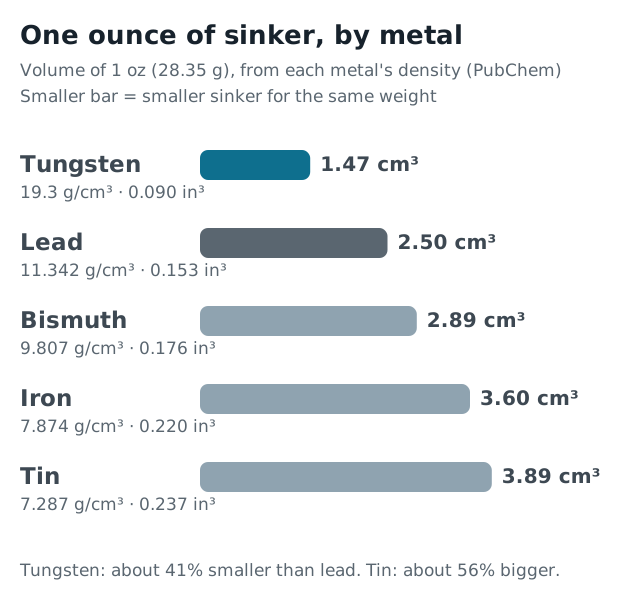
Tungsten is 19.3 g/cm³ against lead’s 11.342, so the same weight takes about 41% less space. A smaller weight slips through grass and wood more easily, and tungsten does not chip or deform the way soft lead does. The cost is price, and many common sinker shapes are not sold in tungsten at all. Greg Vinson finds tungsten “has a better feel than lead,” but on a Carolina rig in brush and rock “you’ll lose a ton of them,” and that “can turn expensive in a hurry.”
How much do fishing weights cost? Lead is cheap: a pack of Bullet Weights split shot is $1.99 and a pack of its egg sinkers starts at $2.29 at Tackle Warehouse. Tungsten costs more: WOO! Tungsten’s flipping weights run $10.79 to $26.99 a pack, by size, and a pack holds one to five weights.
Tin is cheaper than tungsten and softer than other non-lead metals, which is why Bullet Weights casts its lead-free removable shot from it. But it is light: expect to need more or bigger tin split shot to reach the depth that fewer lead shot reached, Cermele writes. Steel sinkers take room too: steel is an iron alloy, and one ounce of iron takes 44% more space than one of lead. Bismuth sits closest to lead, about 16% bigger for the same weight, and Yellowstone National Park names bismuth-tin, molybdenum and tungsten as the lead-free sinker metals it allows.
Where are lead fishing sinkers banned?
Five states restrict small lead sinkers by weight, and Washington restricts them by length on its loon lakes. The rules cover sinkers and, in most states, jigs; check the current regulations of the state you fish.
| State | What the rule covers | Size | Where |
|---|---|---|---|
| New Hampshire | Using and selling lead sinkers and jigs (jigs painted or not) | 1 oz (28 g) or less | Sale statewide; use in all fresh water |
| Maine | Selling lead sinkers and jigs; using them | 1 oz (28 g) or less, or 2.5 in (6.4 cm) or less | Sale statewide; use on inland waters |
| Massachusetts | Using lead sinkers, weights and jigs | Under 1 oz (28 g) | Inland waters |
| Vermont | Selling and using lead sinkers (not jig heads or lures) | ½ oz (14 g) or less | Statewide |
| New York | Retail sale of lead sinkers (not jig heads or lures) | ½ oz (14 g) or less | Statewide; sale only |
| Washington | Using lead weights and jigs | 1.5 in (3.8 cm) or less along the longest axis | 12 named loon lakes |
Since Sept. 1, 2026, Maine’s use ban covers painted lead jigs as well. Washington also bans flies that contain lead at Long Lake in Ferry County. In Yellowstone National Park, “terminal tackle must be lead-free,” and the park names “leaded split-shot sinkers” among the banned items. California’s best-known lead law, AB 711, requires nonlead ammunition “when taking any wildlife with a firearm”; the state wildlife department’s page on it names no fishing tackle.
Why the loon? Loons swallow lead by taking a fish with tackle still attached, by striking at a lure or a hooked fish, or by mistaking a lead pellet for the grit they swallow. In the Loon Preservation Committee’s New Hampshire study, the deaths peaked in July and August, with the fishing season, which points at current fishing rather than old lead on the lake bottom.
Are fishing weights toxic to you? Lead is. The EPA’s advice is short: wash your hands after handling lead sinkers or cleaning out a tackle box, and do not pour your own. Melted lead throws off particles that spread through a house, and the agency “strongly advises against home manufacturing of lead sinkers and jigs.” It names tin, bismuth and tungsten as the less toxic alternatives.
The picks in detail
These five cover the shapes most anglers use, from a pond to a river. Each comes from a maker that publishes its sizes.
Reusable Split Shot (Bullet Weights)
For bank anglers, beginners and anyone who fishes under a float. Its letter and number sizes come with a published weight each, which is where the split shot table above comes from. Its limits: the larger sizes, 1 to 000, have no published weights, and there are no owner reviews on Tackle Warehouse yet.
Egg Sinkers (Bullet Weights)
For bass anglers with a Carolina rig and catfish anglers with a slip-sinker rig. The maker calls it “ideal for catfish” and points to its “weedless performance.” Skip it where you must hold soft bottom in current: there, Cermele writes, egg sinkers “don’t hold quite as well.”
Never Chip Flipping Weights (WOO! Tungsten)
For bass anglers who flip and pitch into cover all season and will pay for a small, hard weight. Wired2Fish picks it as its best tungsten bullet sinker. The two owner reviews split: one calls them “best in the game,” the other found them inconsistent and moved to a cheaper tungsten brand.
Walking Sinker (Lindy)
For walleye anglers dragging live bait along the bottom. The line runs through an oversized hole, and the sinker rides on its heel. Lindy’s own words are the only snag claim, and the page has no reviews.
Ultra Steel Bullet Weights (Bullet Weights)
For bass anglers in New Hampshire, Vermont, Maine, Massachusetts, or anywhere you want to drop lead. The maker lists “retains its shape better” and “less oxidized buildup” among its points. Expect a bigger weight than the lead one you replace.
How we chose
The picks come from the makers’ own size tables, the retailers’ prices and every owner review those pages carry, which is few: two reviews in total across the five. Wired2Fish’s buyer’s guide, Outdoor Life’s terminal tackle guide and the authors named in the weight table set what each shape is for. No sinker was tested by hand for this page.
The size and weight numbers are the makers’; the space each metal takes is worked out from its density. For the rest of the end of your line, the fishing tackle guide covers hooks, swivels, floats and a first tackle box.
Free PDF · 16 pages
Know what's biting before your first cast
The Water Temperature Fishing Chart. Take one water temperature reading, find it on the chart, and see which of 26 freshwater fish are spawning, feeding hard or slowing down. Six pages go deeper: bass, crappie, bluegill, walleye, catfish and trout. For your phone and the tackle box.
- Where they sit and what to throw at every temperature: bass, crappie, bluegill and walleye. Catfish, one by one. Trout: the 68 °F line where you stop, and where they hide
- A bass that drops 3 ft feels more pressure change than the biggest cold front: the front day by day, and what to throw on each
- The three thermometer mistakes that make a reading lie (the first one is the surface)
- The 26-fish chart: who's spawning, feeding hard or slowing down at your reading
The chart's numbers come from state fish and wildlife agencies and fisheries research: 61 sources, each listed on the site.
Enter your email, confirm it with one click, and the PDF is in your inbox. Plus one email a week on what's biting. Unsubscribe anytime. Privacy.
Related
Section guide
Fishing Tackle: The Types, What a First Box Holds, and the Lead LawsFishing tackle explained: hooks, sinkers, swivels and floats, a first box for panfish, bass, catfish or the surf, what it costs, and where lead is banned.
 Fishing Bobbers: Which Float to Buy, and How to Set a Slip Bobber's Depth
Which fishing bobber to buy: round, spring, pencil or slip, the size for bluegill and crappie, five picks from $2.74, and how to set a slip bobber's depth.
 Plano Tackle Box: Every Series, Size and Model Number Decoded
Every Plano tackle box series and size: StowAway, ProLatch and EDGE trays, racks, bags and kits, with Plano's own prices and what each model number means.
 Tackle Box: The Best Boxes, Trays and Bags, and What 3700 Means
The best tackle box for bank, boat, kayak, kid or musky: eight picks with owner-complaint counts, and the 3600 and 3700 tray sizes explained.
Sources
- Wired2Fish (Jason Sealock), Best fishing weights and sinker types, July 2023
- Outdoor Life (Joe Cermele), Terminal tackle: what you need to know for better rigs (sinker shapes and materials)
- Florida Sportsman, Choosing the right sinker (surf sinker weights, pyramids and Sputniks), November 2019
- Bassmaster (Gettys Brannon, 2018), The Texas rig: part 3, weight selection
- Bassmaster (Greg Vinson), How to build a Carolina rig, January 2018
- Wired2Fish (Steve Quinn), How to catch a catfish (weights from 1/2 to 10 ounces)
- Game & Fish (Kentucky Department of Fish and Wildlife Resources), Stocking your first fishing tackle box (removable split shot)
- Tackle Warehouse, Bullet Weights Reusable Split Shot (size and weight table, price)
- Tackle Warehouse, Bullet Weights Round Split Shots (size and weight table, incl. size 6)
- Bullet Weights, Split Shot - Reusable (sizes B to 000)
- Bullet Weights, Egg Sinkers (1/8 to 8 oz)
- Bullet Weights, Bullet Weights - Slip Sinkers (1/64 to 1 oz)
- Bullet Weights, Bank Sinkers (1/2 to 10 oz)
- Bullet Weights, Pyramid Sinkers (1 to 24 oz)
- Bullet Weights, No Roll Sinkers (1 to 6 oz)
- Bullet Weights, Bass Casting Sinkers (#10 1/8 oz to #3 1 1/2 oz)
- Bullet Weights, Drop Shot (lead drop-shot weights 1/8 to 1/2 oz)
- Bullet Weights, Tungsten Bullet Weights (approximately fifty percent smaller than lead)
- Bullet Weights, Ultra Steel Bullet Weights
- Bullet Weights, Ultra Tin Reusable Split Shot
- Lurenet, Lindy Walking Sinker (1/8 to 3/4 oz)
- Tackle Warehouse, WOO! Tungsten Never Chip Flipping Weights (sizes, price, reviews)
- Tackle Warehouse, Bullet Weights Egg Sinkers (price)
- PubChem (NIH), Tungsten: density
- PubChem (NIH), Lead: density
- PubChem (NIH), Bismuth: density
- PubChem (NIH), Tin: density
- PubChem (NIH), Iron: density
- Loon Preservation Committee, Effects of lead fishing tackle on loons in New Hampshire (1989–2011)
- U.S. EPA, Humans and lead fishing sinkers
- New Hampshire RSA 211:13-b, Use of lead sinkers and jigs prohibited
- Maine Inland Fisheries and Wildlife, Maine's lead jig and sinker laws (card, updated 2025-10-01)
- Maine 12 MRS §12664 (lead sinker and jig use ban; painted jigs covered from Sept. 1, 2026)
- Massachusetts 321 CMR 4.01 (lead sinkers and jigs, inland waters)
- New York ECL 11-0308 (retail sale of lead sinkers)
- Vermont 10 V.S.A. 4615 (sale of lead sinkers)
- Vermont 10 V.S.A. 4606 (use of lead sinkers prohibited)
- Connecticut OLR, Lead sinker laws in select states, 2020-R-0162 (sale and use rules compared, incl. NH RSA 339:77)
- Washington Department of Fish and Wildlife, Common loon (lead rules on 12 lakes)
- National Park Service, Yellowstone fishing regulations (lead-free terminal tackle)
- California Department of Fish and Wildlife, Nonlead ammunition in California (AB 711)