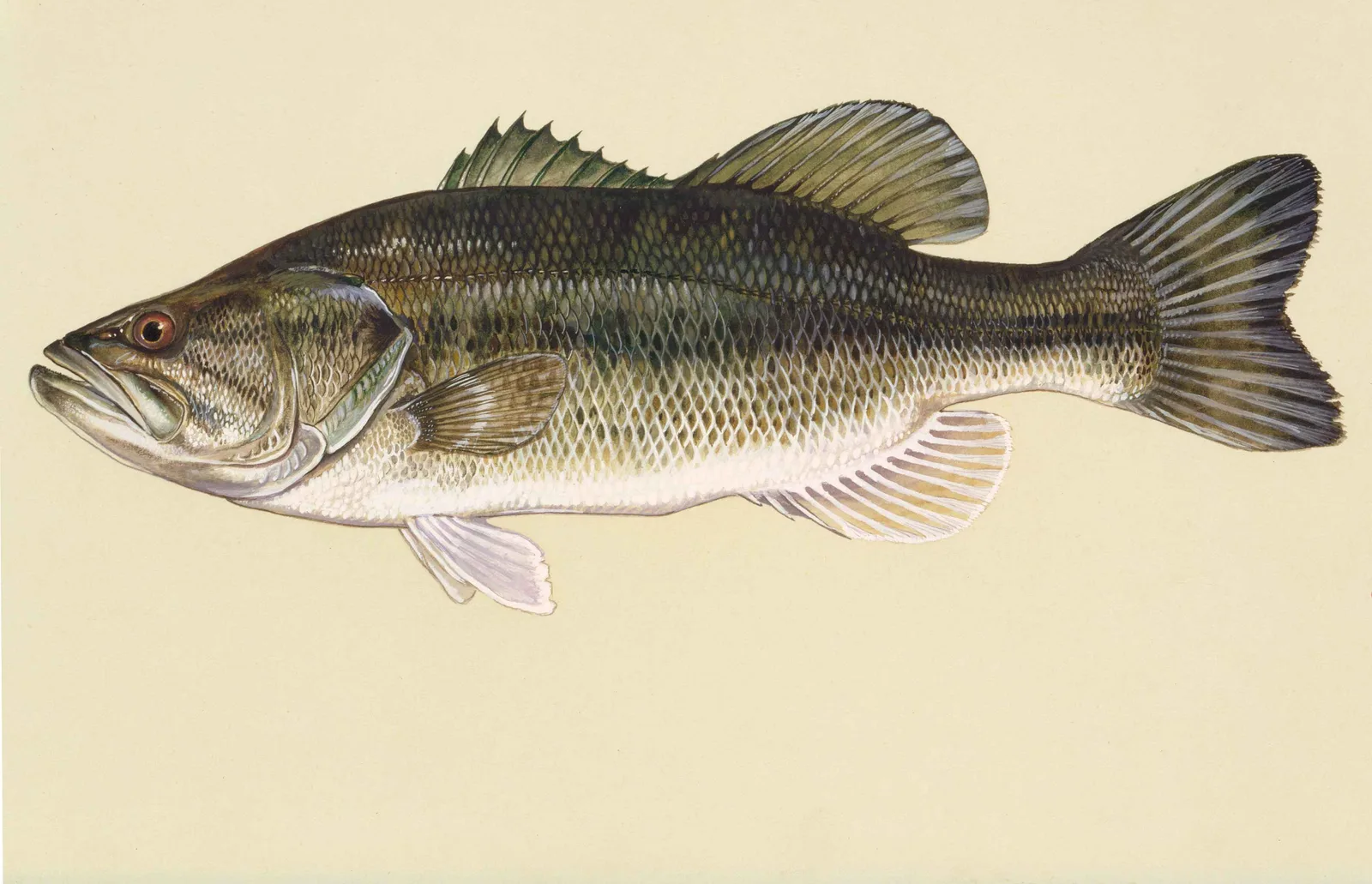
There are 19 species of black bass, a handful of temperate basses such as the striper and more than a dozen saltwater fish called bass, but most anglers meet three: the largemouth, the smallmouth and the spotted bass. Two looks sort nearly every bass you catch. Stripes along a silver side mean a temperate bass such as the striper. A dark band or bars on a green or bronze fish mean a black bass, and the jaw tells you which one.
More than 20 different fish may be sold as “sea bass” in the United States. The most famous of them, Chilean sea bass, is not a bass at all: it is a toothfish from the Southern Ocean.
How many types of bass are there?
Science counts 19 black basses, the genus Micropterus. Sixteen have a valid scientific name, the last two since August 2025, and three still lack a formal description. Add the striped, white and yellow bass, the rock basses and the saltwater fish that carry the name, and the list passes 30. The table holds the ones an angler is likely to meet, each with its all-tackle record from the International Game Fish Association (IGFA).
| Fish | Family | Where it lives | All-tackle record |
|---|---|---|---|
| Largemouth bass | Black bass (sunfish) | Native east of the Rockies; stocked in every state but Alaska | 22 lb 4 oz (10.1 kg), Georgia, 1932 |
| Florida bass | Black bass | Peninsular Florida north to the Carolinas; stocked in Texas and California | 22 lb 4 oz (10.1 kg), Japan, 2009 |
| Smallmouth bass | Black bass | Great Lakes and Mississippi basin; cool, rocky water | 11 lb 15 oz (5.4 kg), Tennessee, 1955 |
| Spotted bass | Black bass | Ohio and Mississippi basins to the Gulf | 2 lb 8 oz (1.1 kg), Texas, 2025 |
| Alabama bass | Black bass | Mobile basin; spread into the Southeast and California | 11 lb 4 oz (5.1 kg), California, 2017 |
| Guadalupe bass | Black bass | Central Texas rivers only | 3 lb 11 oz (1.7 kg), Texas, 1983 |
| Shoal bass | Black bass | Apalachicola, Chattahoochee and Flint rivers | 4 lb 13 oz (2.2 kg), Georgia, 2026 |
| Suwannee bass | Black bass | Suwannee and nearby rivers of north Florida and south Georgia | 3 lb 14 oz (1.8 kg), Florida, 1985 |
| Striped bass | Temperate bass | Atlantic and Gulf coasts; reservoirs | 81 lb 14 oz (37.1 kg), Connecticut, 2011 |
| White bass | Temperate bass | Great Lakes and Mississippi basin; reservoirs | 6 lb 13 oz (3.1 kg), a tie, 1989 and 2010 |
| Yellow bass | Temperate bass | Mississippi basin and Gulf rivers | 2 lb 9 oz (1.2 kg), Tennessee, 1998 |
| Hybrid striped bass | Temperate bass (cross) | Stocked reservoirs | 27 lb 5 oz (12.4 kg), Arkansas, 1997 |
| Rock bass | Sunfish | Eastern and central rivers and lakes | 3 lb 0 oz (1.4 kg), a tie, 1974 and 1998 |
| Black sea bass | Sea bass (grouper family) | Cape Cod to the Gulf | 10 lb 4 oz (4.7 kg), Virginia, 2000 |
| Kelp (calico) bass | Sea bass | Southern California kelp beds | 14 lb 7 oz (6.5 kg), California, 1993 |
| Giant sea bass | Wreckfish family (IGFA) | California and Mexico | 563 lb 8 oz (255.6 kg), California, 1968 |
| European sea bass | Temperate bass | Northeast Atlantic and Mediterranean | 24 lb 0 oz (10.9 kg), Ireland, 2025 |
The largemouth and the Florida bass share a record weight but not a species. Since a 2022 genetic study the largemouth is Micropterus nigricans, and M. salmoides, its old name, belongs to the Florida bass. The IGFA now files Manabu Kurita’s fish from Japan under Florida bass; the world record largemouth page tells both stories.
How do you tell the different types of bass apart?
Work through the fish in this order; each step uses a mark you can see on a fish in your hand. The fishing terms page explains the dorsal fin, the anal fin and the tooth patch if the words are new.
- Look at the sides. Silver or yellowish with dark horizontal stripes: a temperate bass, go to step 6. Green, olive or bronze with a dark band, blotches or vertical bars: a black bass, go to step 2. Thick and sunfish-shaped, with a big eye and rows of dark spots: go to step 5.
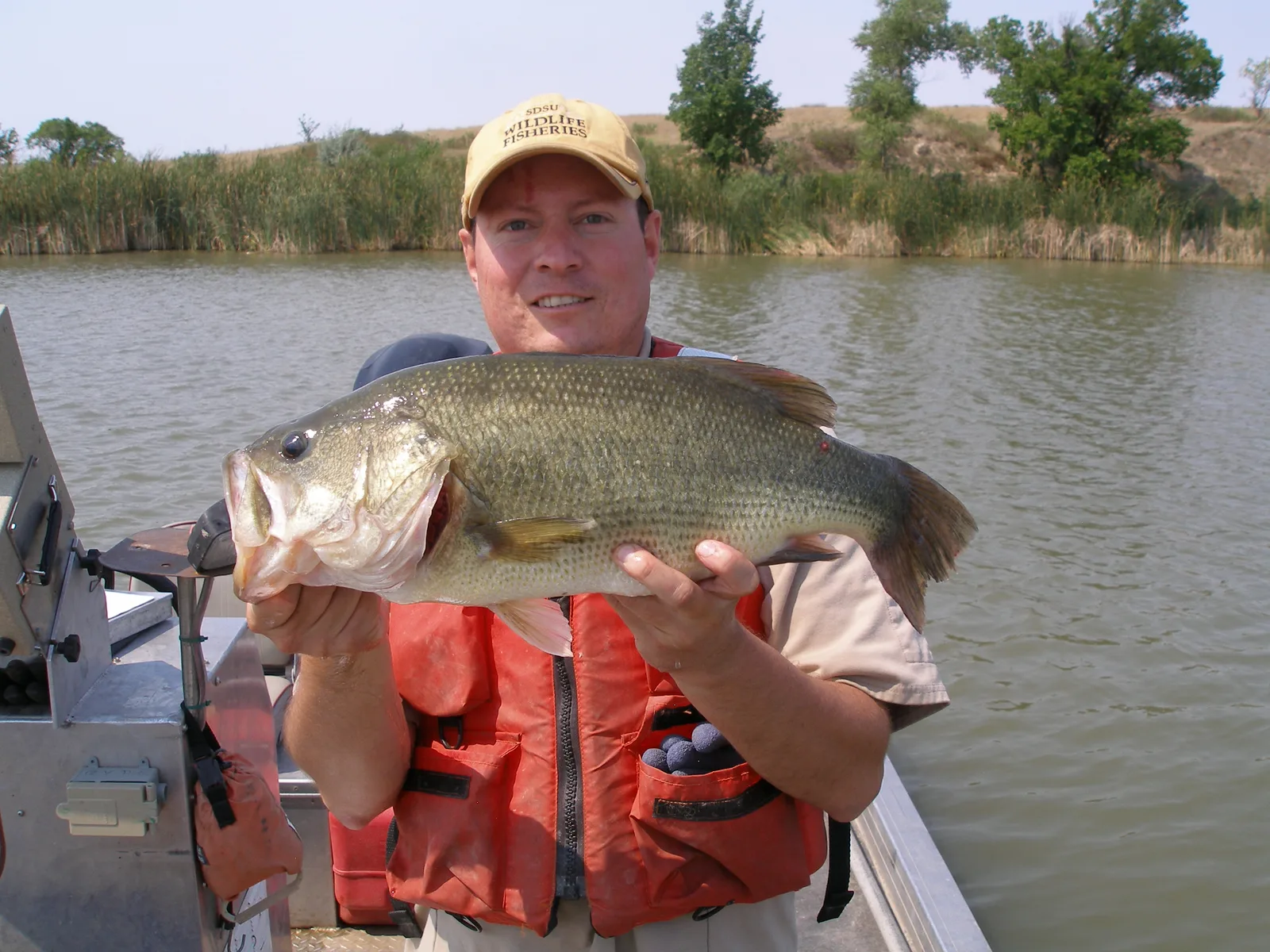
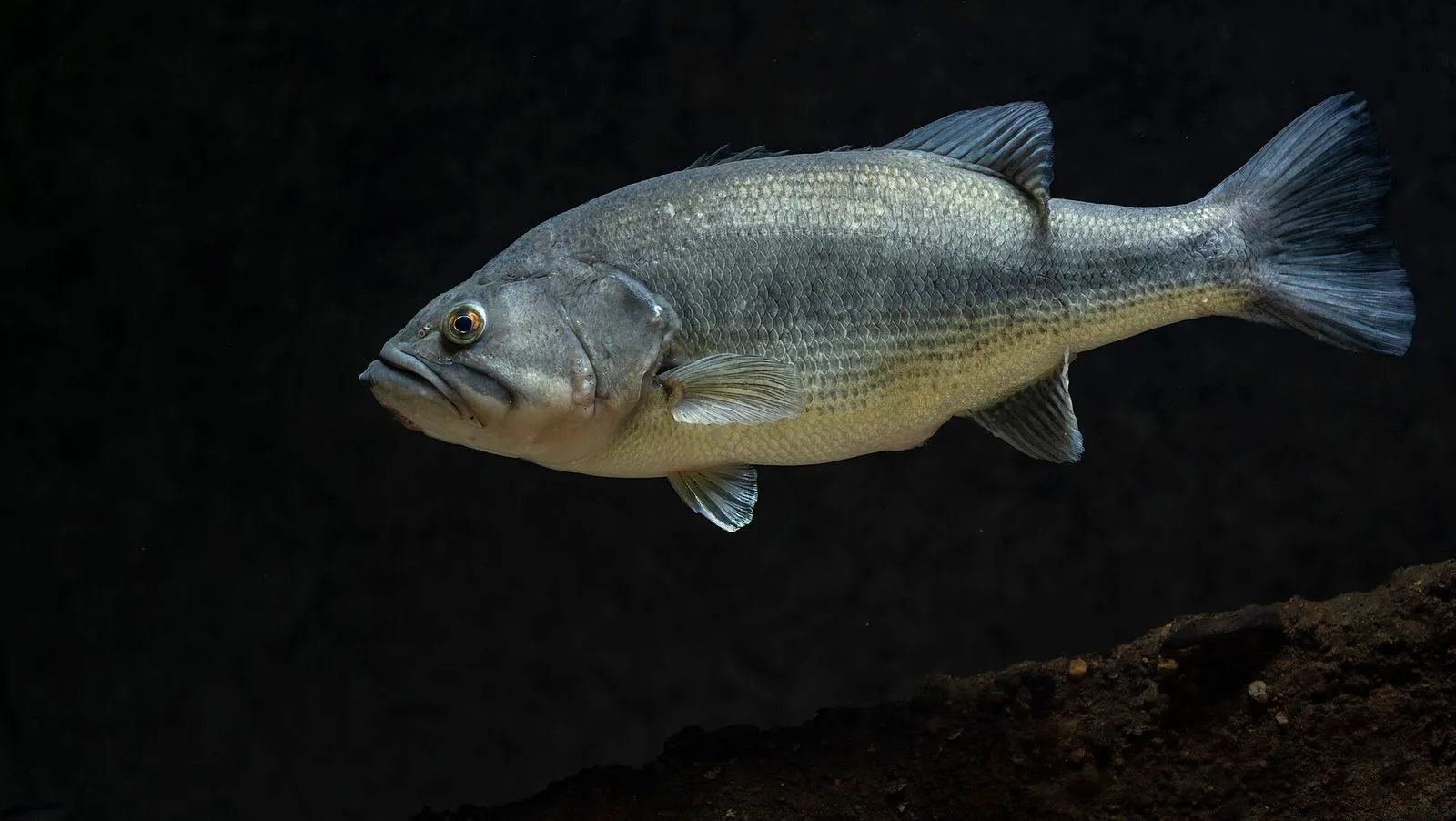
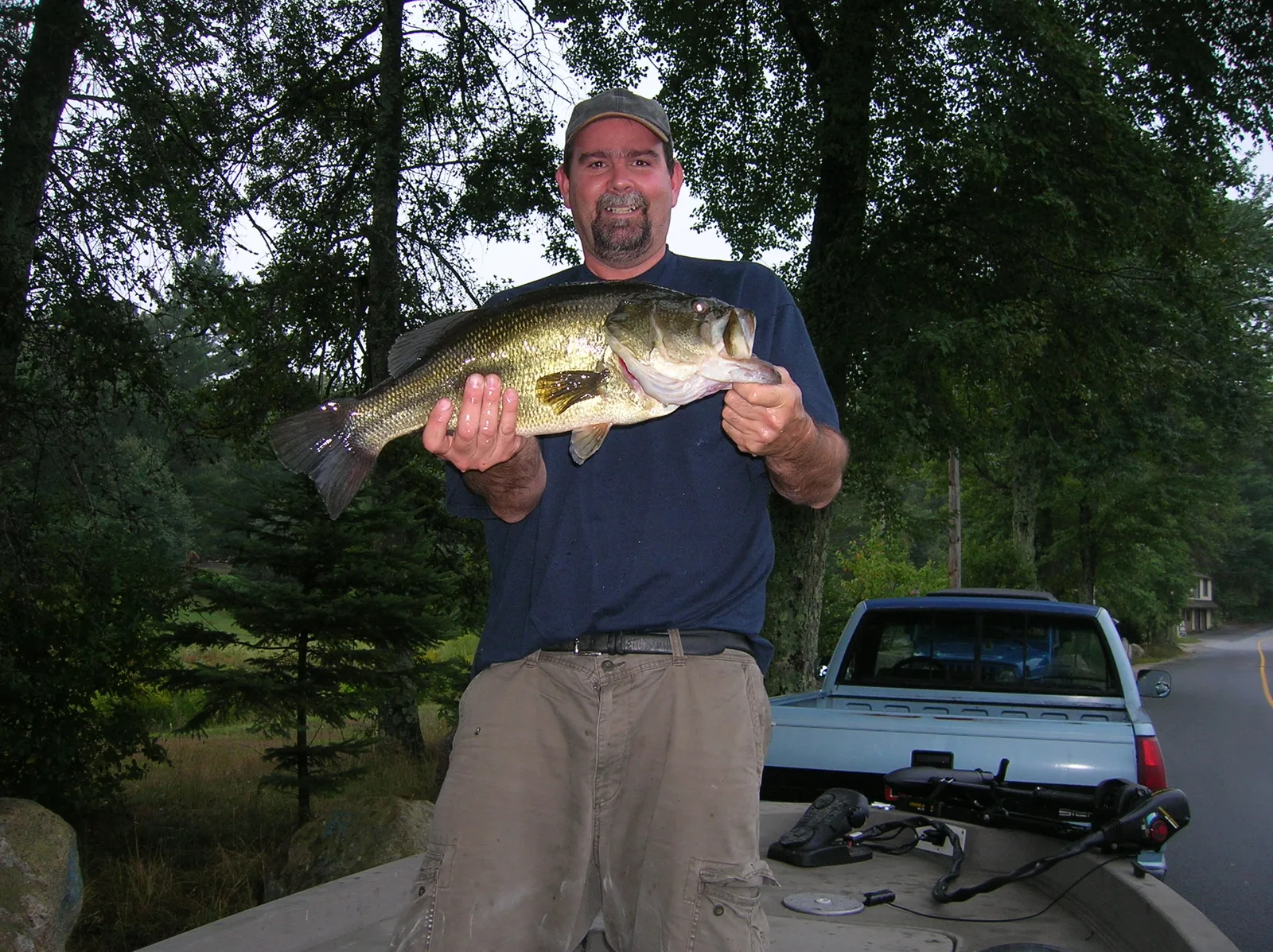
- Close the mouth and check the jaw. If the upper jaw reaches past the rear edge of the eye, and the notch between the two dorsal fins is deep, it is a largemouth. Where Florida bass live or were stocked, it may be a Florida bass instead: Florida’s wildlife agency calls the two visually indistinguishable. If the jaw stops at or before the rear of the eye, go to step 3.
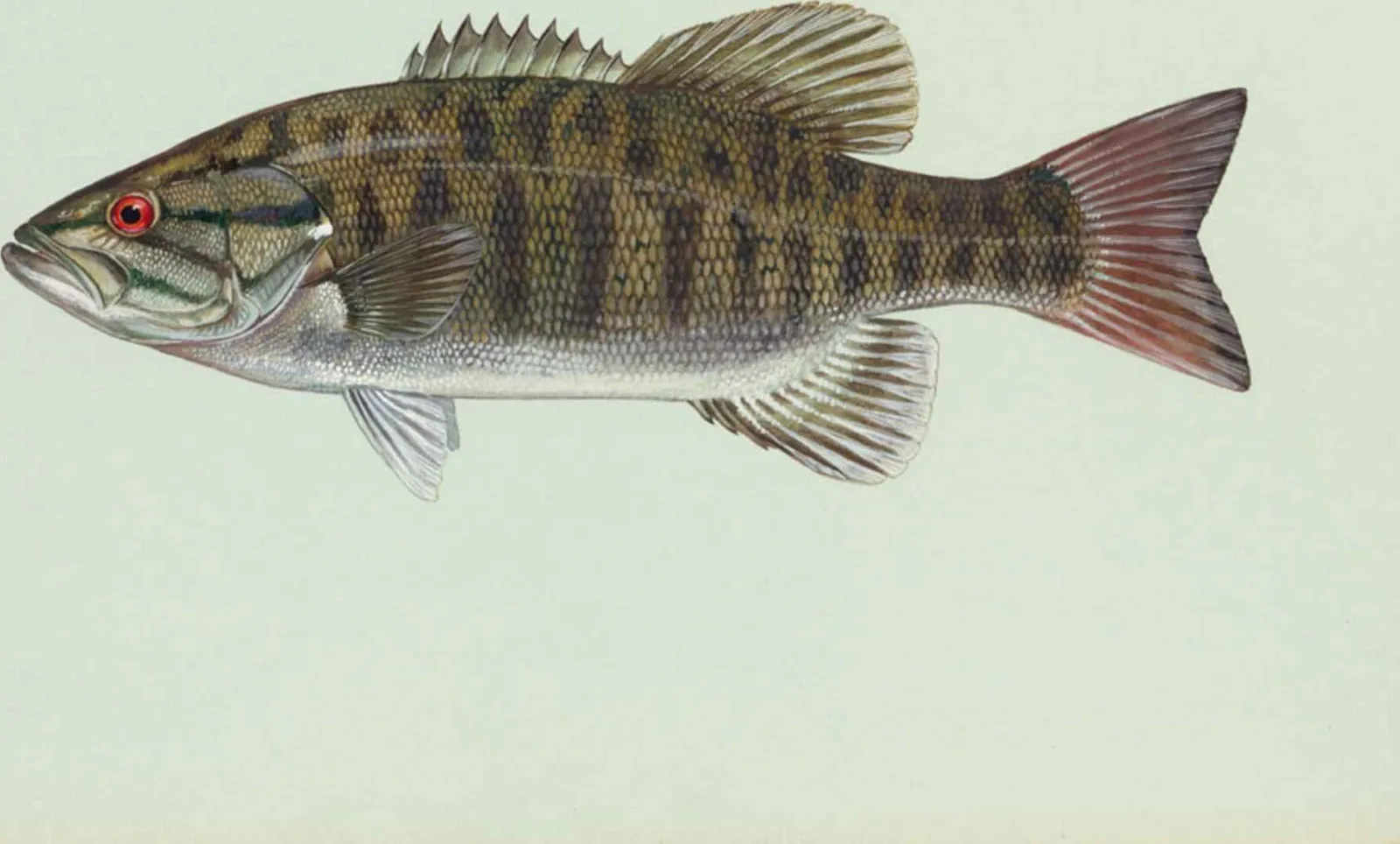
- Bars or a band? Dark vertical bars on a bronze-brown body, with no band along the side: a smallmouth. In the Apalachicola, Chattahoochee or Flint drainages, bars like tiger stripes and no band mean a shoal bass. A band of dark blotches along the side: go to step 4.
- Check the tongue and the lower sides. A rough tooth patch on the tongue and rows of small dark spots below the band mean a spotted bass or its near twin, the Alabama bass. On an Alabama bass the band breaks into blotches toward the tail; on a spotted it runs more solid there. Only a scale count or DNA settles it. Where you caught it narrows the rest: a central Texas stream suggests a Guadalupe bass; turquoise cheeks on a north Florida river fish, a Suwannee bass.
- Count the anal spines. Six spines and dark spots in neat lines along the sides make a rock bass. Three spines and four or five reddish-brown streaks fanning back from a red eye make a warmouth. Both go by goggle-eye.
- Look at the dorsal fins on a striped fish. Joined at the base, with stripes that break above the anal fin and a silvery-yellow body: a yellow bass. Two separate fins: go to step 7.
- Count the stripes that reach the tail. Faint stripes, only one reaching the tail, on a deep body (more than a third as tall as it is long): a white bass. Several stripes to the tail: go to step 8.
- Check the body and the tongue. A slender body, less than a third as tall as it is long, distinct stripes and two separate tooth patches at the back of the tongue: a striped bass. A deep body, stripes that are usually broken, and two tooth patches that may sit close together: a hybrid striped bass.
No single mark is certain. On a possible hybrid, Texas Parks and Wildlife says to weigh all the marks together. The USGS adds that broken stripes alone do not identify one; tooth patches and body depth do better. For the most common mix-up of all, smallmouth vs largemouth walks through the jaw, the fins and the color side by side.
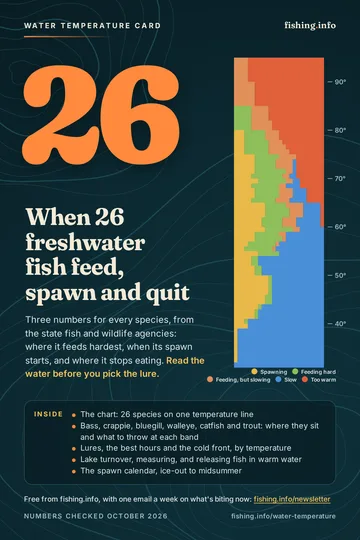
Free card: what 26 species do at your water temperature
Plus one email a week on what's biting now. No sales pitches. Privacy.
What are the black bass species?
The black basses are the genus Micropterus, members of the sunfish family with the bluegill and the crappie, and they are what most anglers mean by “bass.” The largemouth has been stocked into every state but Alaska, so a bass you cannot place is most often a largemouth. The smallmouth wants cooler, clearer water over rock, and the spotted bass is a river fish that took to reservoirs. The bass hub covers where those three sit in every season and what to throw, and the black bass page lists all 19 with their ranges.
The Alabama bass is the one that changed the record book. A 2008 study split it from the spotted bass, and in 2024 the IGFA found that many “spotted bass” records were Alabama bass. The spotted category started over, which is why its record is a fish of only 2 lb 8 oz from 2025. Its native Mobile basin reaches into Georgia, Mississippi and Tennessee; carried beyond it by anglers and stockings, it now lives in reservoirs across Georgia, the Carolinas, Virginia and California. North Carolina asks anglers to keep every one they catch.
The rest live in small ranges, and most are river fish:
- Guadalupe bass: the state fish of Texas, found nowhere else, mostly in the streams of the Edwards Plateau.
- Shoal bass: shallow, fast riffles over limestone in the Apalachicola system of Alabama, Florida and Georgia.
- Suwannee bass: the Suwannee and nearby rivers of north Florida and south Georgia; it seldom passes 12 in (30 cm).
- The redeye basses: seven species, each tied to its own rivers from Alabama to the Carolinas. Bartram’s bass, usually under a pound, and the Altamaha bass were named in 2025.
- Neosho bass: a smallmouth relative of the Arkansas River system, with two undescribed cousins, the Little River bass and the Ouachita bass, in neighboring rivers.
- Choctaw bass: a spotted bass relative of the Florida Panhandle and coastal Alabama, still without a valid scientific name.
What are the striped, white and yellow bass?
The temperate basses are the family Moronidae, a different line of fish from the black basses. They are silver, schooling, open-water fish with dark stripes that chase baitfish rather than hold in cover. The striped bass hub covers how to fish for all of them.
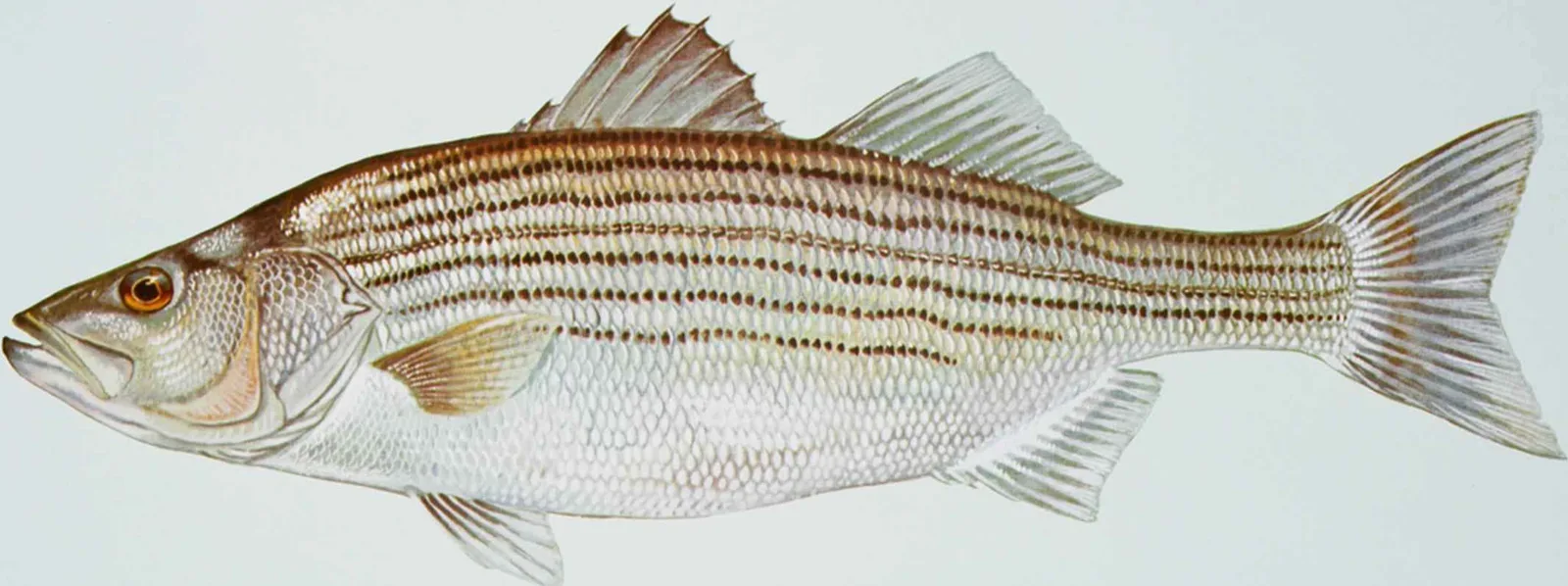 Striped bass. Illustration: Duane Raver, U.S. Fish and Wildlife Service (public domain)
The striped bass is the giant of the group: it runs from salt water up Atlantic coast rivers to spawn and has been stocked in reservoirs across the South and West. The white bass is its small freshwater cousin, and the yellow bass is smaller still.
The hybrid striped bass is mostly a hatchery fish: stocking keeps it going, though the cross does occur in the wild. It comes in two crosses. The palmetto bass, often called a wiper, is a striped bass female crossed with a white bass male, first raised in 1965; the IGFA files its record as whiterock bass. The sunshine bass, stocked in Florida, is the reverse cross. White bass vs striped bass compares the parents.
The white perch shares the striper’s genus but, as an adult, has no stripes.
Which sunfish are called bass?
The rock bass and its close relatives, the Roanoke, shadow and Ozark basses, are the genus Ambloplites: thick-bodied fish of streams and lakes with big eyes and six anal spines. A rock bass of a pound is a good one.
Black crappie also go by calico bass and strawberry bass, and white crappie by silver bass, so a “calico bass” from a farm pond and one from a California kelp bed are different fish. The crappie page sorts out the crappie nicknames.
Which saltwater fish are called bass?
In salt water the name belongs mostly to the sea bass family, which also holds the groupers. The Atlantic’s black sea bass is the best known. It is a protogynous hermaphrodite: most black sea bass start life as females and turn into males as they grow.
Southern California anglers fish three of their own: the kelp bass, which they call calico bass, the barred sand bass and the spotted sand bass. The giant sea bass belongs to a different family, and its 563 lb 8 oz record from 1968 is the heaviest fish in this article.
The European sea bass, the branzino of restaurant menus, is a temperate bass and a close cousin of the striper. Its all-tackle record is new: a 24 lb 0 oz fish from Irish waters on the last day of 2025.
Which “bass” are not bass at all?
Some famous “bass” belong to no bass family:
- Peacock bass are cichlids from South America. Florida stocked butterfly peacock bass in the canals of the southeast in 1984, and because they tolerate neither water below 60 °F (16 °C) nor salt water, they are common only in coastal Miami-Dade and Broward counties.
- Chilean sea bass is a market name for the Patagonian and Antarctic toothfish, deep-water fish of the Southern Ocean.
- White seabass is a croaker, a cousin of the red drum, caught off California and Mexico. Its record, 83 lb 12 oz, has stood since 1953.
- Barramundi, called Asian sea bass, is a latid from the Indo-Pacific; its record is 98 lb 6 oz from Queensland.
- Channel bass is an old name for the red drum, and the Papuan black bass of New Guinea is a snapper.
Which type of bass will you catch?
Where you fish decides most of it. In a pond or a weedy lake almost anywhere, the bass is a largemouth. In a clear, rocky northern lake or a cool river, it is a smallmouth. In a southern reservoir with current, check the tongue for the spotted bass’s tooth patch. A silver fish with stripes chasing shad on the surface is a white bass, a hybrid or a striper. On a Virginia wreck or a California kelp bed, it is a sea bass. Once you know which one you have, best bass lures shows what the black basses bite season by season.
Gear for bass
Gear guide
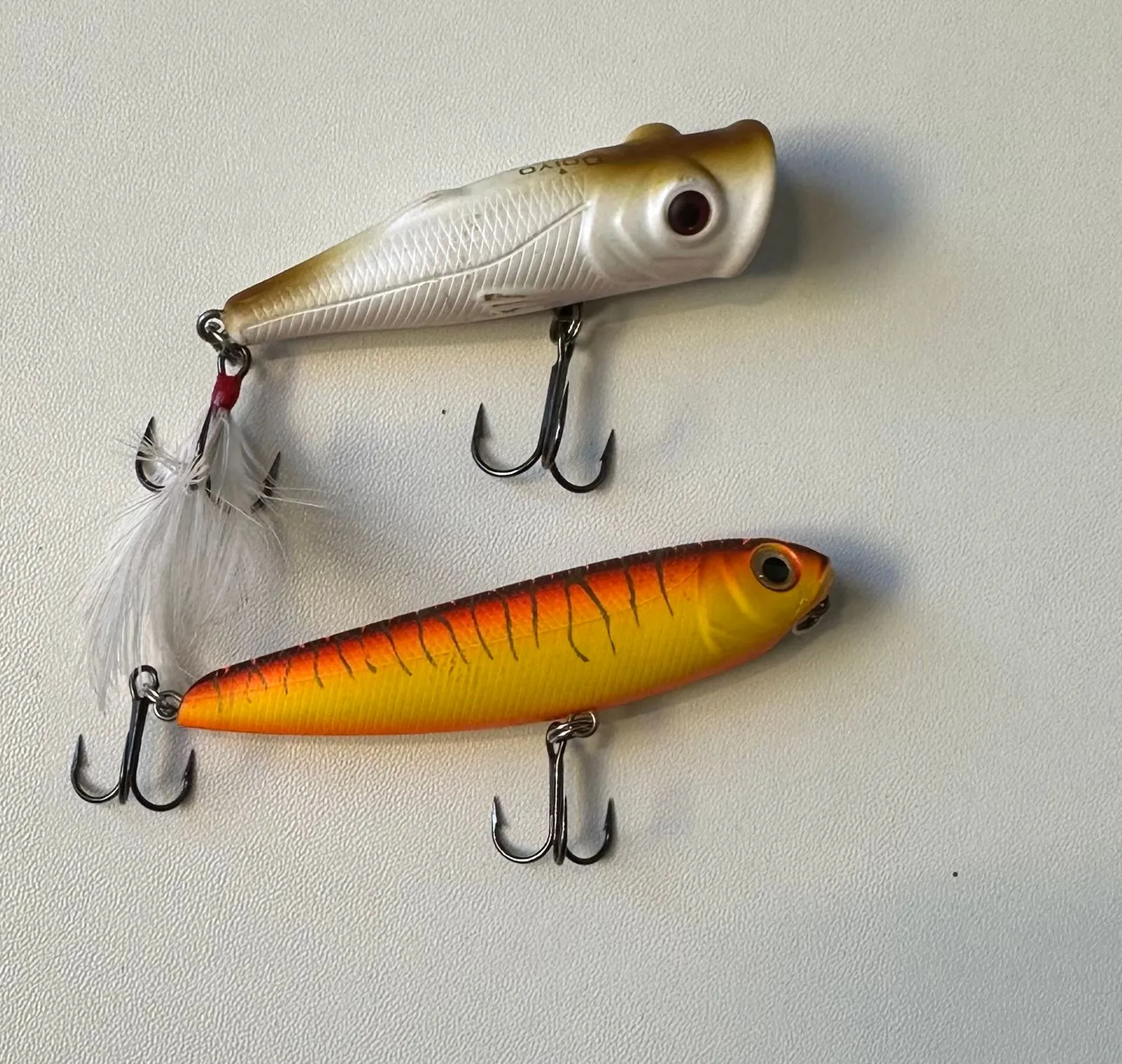
Best Bass Lures: What Won the 2025 and 2026 Elite Series, Season by SeasonBest bass lures from two seasons of Elite Series winning baits: a lure for each water color, depth, cover and season, with smallmouth and spotted bass picks.
Free download
The water temperature card
Read your water temperature and the card tells you who is spawning, who is feeding and what to throw. 26 species, 16 pages, for your phone and the tackle box.
Plus one email a week on what's biting now. No sales pitches. Privacy.
Related
Section guide
Bass Fishing: Where the Bass Are, What to Throw, and the Three Bass You Will MeetBass fishing from the angler's side: where largemouth, smallmouth and spotted bass are at each water temperature, what to throw first, how to tell them apart.
 What Do Bass Eat? The Diet by Size, Season and Species
Adult bass eat mostly fish and crayfish: 59% and 38% by weight in an Arkansas study. The diet by size, season and species, from six studies.
 Is Bass Good to Eat? Yes, If You Keep the Small Ones and Check the Water
Yes, bass is good to eat: mild, white and firm. Which bass to keep, what mercury advice says about bass against panfish, and why most go back.
 World Record Smallmouth Bass: The Hayes Fish and the False Affidavit
The world record smallmouth bass weighs 11 lb 15 oz, caught at Dale Hollow in 1955. How it was struck off and restored, the IGFA records, the state records.
 Bass Bait: The Best Live Bait and Lures, Matched to What Bass Eat
The best bass bait is whatever your bass already eat: shiners, crawfish, shad or bluegill, live or as a lure. What works, what size, and where it's legal.
- Black Bass: What the Name Means, and All 19 Species
Black bass are the genus Micropterus: 19 species, from largemouth to Bartram's bass. What the name means in science, law and the record book.
 Best Time to Fish for Bass: Season, Time of Day and Weather
The best time to fish for bass is the pre-spawn at 48–55 °F and the fall feed, at dawn and dusk. Season table, hours, night and weather.
Sources
- Kim, Taylor & Near 2022, Phylogenomics and species delimitation of the black basses (Micropterus), Scientific Reports 12:9113
- Eschmeyer's Catalog of Fishes, species of Micropterus (online version of Sept. 21, 2026)
- Freeman et al. 2025, Two new species of Micropterus endemic to Atlantic Slope river drainages in Georgia, South Carolina and North Carolina, Zootaxa 5683(1):67–89
- International Game Fish Association, world record search (all-tackle records queried Oct. 19, 2026)
- International Game Fish Association, Changes to bass records following newly published findings (June 13, 2024)
- Texas Parks and Wildlife, Bass comparison and identification
- Texas Parks and Wildlife, largemouth bass species profile
- Texas Parks and Wildlife, Guadalupe bass species profile
- North Carolina Wildlife Resources Commission, Black bass identification tips (chart)
- North Carolina Wildlife Resources Commission, Black bass in North Carolina
- North Carolina Wildlife Resources Commission, Alabama bass
- Florida FWC, Florida bass and largemouth bass profile
- Florida FWC, Suwannee bass profile
- Florida FWC, Shoal bass profile
- Florida FWC, Sunshine bass profile
- Florida FWC, Butterfly peacock bass profile
- U.S. Geological Survey, Nonindigenous Aquatic Species: Florida bass
- U.S. Geological Survey, Nonindigenous Aquatic Species: largemouth bass
- Virginia Department of Wildlife Resources, Alabama bass
- U.S. Geological Survey, Nonindigenous Aquatic Species: wiper (hybrid striped bass)
- Missouri Department of Conservation, Northern rock bass
- Missouri Department of Conservation, Warmouth
- NOAA Fisheries, Black sea bass
- U.S. Food and Drug Administration, The Seafood List (search: bass)