 By
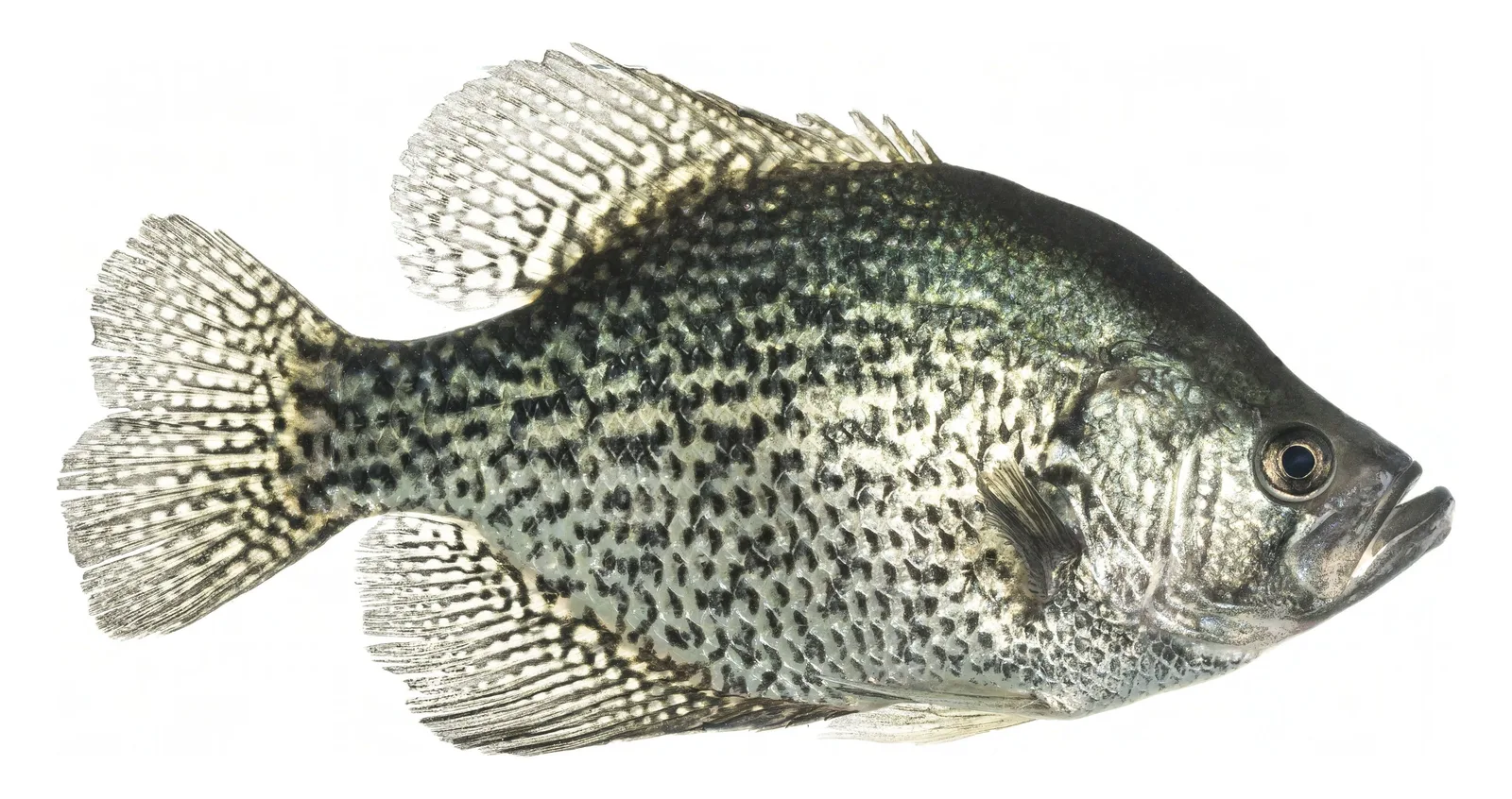
The black crappie is the speckled crappie: a flat, silver panfish covered in black blotches, with seven or eight spines at the front of its dorsal fin. It is the crappie of clear, weedy lakes, and Texas Parks and Wildlife counts populations in all 48 contiguous states. Most run 9–10 in (23–25 cm). A small minnow or a 1/16 oz jig near submerged weeds or brush catches them all year.
In Minnesota, black crappie grow faster in lakes full of walleye: a five-year-old averages 10.5 in (266 mm) where walleye are plentiful and 8.9 in (225 mm) where they are scarce. The likely reason is that walleye eat the surplus young crappie.
How do you tell a black crappie from a white crappie?
Count the dorsal spines, the stiff rays at the front of the fin on the back. Seven or eight is a black crappie; five or six is a white. The pattern backs it up: a black crappie carries irregular speckles and blotches from head to tail, while a white crappie shows 5–10 faint vertical bars. Do not trust color alone. A spawning white crappie male darkens on the throat and head, and in deep or stained water its bars can fade.
Jerald Horst, a retired Louisiana State University fisheries professor, prefers a second check on the boat. On a black crappie the base of the dorsal fin is as long as the distance from the front of that fin to the tip of the mouth; on a white crappie it is clearly shorter.
| Mark | Black crappie | White crappie | Bluegill |
|---|---|---|---|
| Dorsal spines | 7 or 8 | 5 or 6 | 10 |
| Pattern | Speckles and blotches, no bars | 5–10 faint vertical bars | Faint bars; solid black ear flap; black blotch at the rear of the soft dorsal |
| Mouth | Large; jaw past the middle of the eye | Same | Small; jaw short of the front of the eye |
| Body at the same length | Heavier, deeper | Lighter, longer | Round, usually under 12 oz (340 g) |
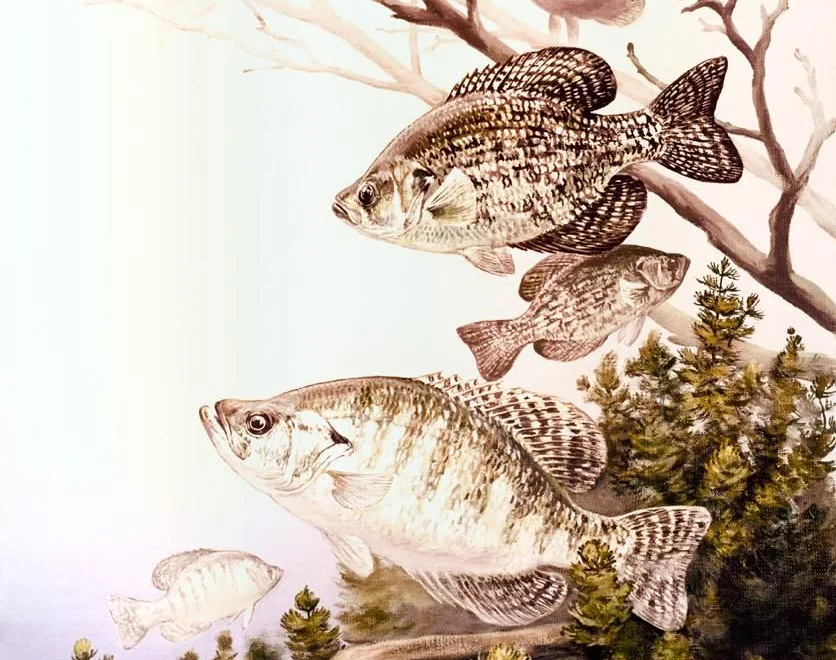 The black crappie (speckled all over) and the white crappie (faint vertical bars). Painting: Robert W. (Bob) Hines, U.S. Fish and Wildlife Service (public domain)
The crappie hub has the full black-versus-white table. The two also split by water: a white crappie handles the murky water that a black crappie avoids.
What is a blacknose crappie?
A blacknose crappie is a black crappie with a dark stripe from the dorsal fin down the forehead to the chin. Mississippi’s wildlife department calls it “a genetic color variation”, not a hybrid or a subspecies. It is the rare one: the state’s hatchery staff estimate that “10 percent or less” of the black crappie they net at Grenada and Sardis carry the stripe, Justin Wilkens, then hatchery manager, told Mississippi Sportsman. Mississippi crosses blacknose males with white crappie females to make the Magnolia crappie, a sterile hybrid; about 60 percent of the stocked fish show the stripe, MDWFP fisheries biologist Larry Bull says.
Where do black crappie live?
The native range runs from Virginia to Florida along the Atlantic, west along the Gulf to Texas, and up through the Mississippi, Great Lakes and St. Lawrence basins. Stocking carried it nearly everywhere else.
What the fish wants is the same everywhere: clear, still water with plants or wood. The U.S. Fish and Wildlife Service describes quiet, warm water with abundant aquatic vegetation over sand or mud. The Iowa DNR calls black crappie “intolerant of turbid waters”; there they are almost always found in clearer lakes and streams. Missouri’s field guide adds that they handle silt worse than white crappie do. In Wisconsin, black crappie are common in the clear, cool lakes of the North Woods, where white crappie are not found at all.
A 2026 study of 70 waters holding both species points at the plants rather than the mud: black crappie were more abundant where submerged vegetation was dense, white crappie where it was sparse or absent. In Louisiana, Horst finds black crappie almost always in the tea-colored blackwater swamps and marshes. Where both live, black crappie hold the still, weedy water.
Size of water matters too. Oklahoma’s biologists find that both crappies do well in lakes of at least 500 acres, and that neither suits a farm pond, where they tend to overpopulate.

Free PDF · Water temperature chart When do crappie bite?
One water temperature reading, and the 16-page chart tells you who's spawning, who's feeding hard, where they sit and what to throw. 26 fish, every number sourced.
Enter your email, confirm it with one click, and the PDF is in your inbox. Plus one email a week on what's biting. Unsubscribe anytime. Privacy.
Where are black crappie through the year, and when do they bite?
Wisconsin’s DNR gives the short version: shallow near emergent weeds in spring, deep holes and channels in summer. Black crappie feed all day, with peaks in the evening and early morning. They travel in loose schools, and Oklahoma’s biologists note that where you find one school, others are often close by.
| Season | Water | Where they are | What to throw |
|---|---|---|---|
| Winter | Below 50 °F (10 °C) | Suspended schools over the basin and channels | A small jig held still on marked fish |
| Pre-spawn | 50–55 °F (10–13 °C) | The first drop outside the spawning coves | Jig or minnow under a float, moved slowly |
| Spawn | 58–68 °F (14–20 °C) | Nests in 3–8 ft (1–2.4 m) near weeds, reeds and brush | Jig under a float set just above the bed |
| Early summer | Above 70 °F (21 °C) | Still shallow; black crappie stay into early summer, longer than white | Cast to weed edges and docks |
| Summer | Warmest | Brush in 15–20 ft (4.6–6 m), the fish 10–15 ft (3–4.6 m) down; deep holes and channel edges | Vertical jig or slip-bobber minnow at the school’s depth |
| Fall | Cooling through the 60s (16–21 °C) | Back up the creek arms on mid-depth cover | Swim a jig and cover water |
Winter does not shut them down. Wisconsin’s DNR notes that crappie remain active all winter, which makes ice fishing for them very popular on some lakes, and Oklahoma calls crappie a favorite winter fish. In summer Wisconsin’s guide often finds them in the thermocline, the layer where the temperature drops quickly: the water there is cooler but still holds oxygen.
The crappie spawn temperature page breaks the spring rows down by water clarity and state.
How do you catch black crappie?
Think small. Pennsylvania’s Fish and Boat Commission sets black crappie tackle at 4–8 lb line and size 4–8 hooks. Its lures run 1/32–1/8 oz. Black crappie eat more insects and crustaceans and fewer fish than white crappie, which is one more reason the small bait wins.
Minnows. David Schlake’s choice in Wired2Fish is a live minnow, the classic crappie bait: 1–2 in long in spring, up to 3 in in fall. He hooks them on a No. 2–4 thin-wire Aberdeen under a slip bobber, on 4–6 lb line with as little split shot as will hold the bait down. Set the float so the minnow rides just above the fish; in Schlake’s words, crappie don’t like to feed down.
Jigs. Jason Sealock jigs and casts with 1/16 and 1/8 oz heads, and goes to 1/4 oz for big crappie over deep open water, especially in wind. A tube, a curly tail or a 2-in shad body on a jig head covers the black crappie’s year. His core colors are chartreuse, white, black, junebug and pink, with smoke and silver glitter as the water clears, which suits a clear-water fish.
Line. A 4–6 lb monofilament shows the light bite. A crappie can inhale a jig and spit it in a second. Wisconsin’s DNR explains the light tackle too: crappie do not strike hard but gently suck the bait in, and the paper-thin membrane around the mouth tears if you set the hook with too much force.
At night. Keith Sutton, writing for Bass Pro, explains why lights work: a green light draws plankton, the plankton draws baitfish and the baitfish draws crappie. Sutton’s starting depths by water clarity: crappie sit 20–30 ft (6–9 m) down in clear water, 10–20 ft in stained and 5–10 ft in muddy; the lights then draw them up toward the surface. Black crappie water is usually the first of those.
Dock shooting reaches the fish in a dock’s shade: a short, light rod bent like a slingshot fires a small jig far under the boards. Bassmaster pro Scott Canterbury uses a 5 ft 6 in light rod and a 1/16 oz head, and drops to 1/32 oz when the water is calm, clear or cold.
How big do black crappie get, and how old is a 13-inch fish?
In Iowa most black crappie caught are 8–12 in (20–30 cm). Missouri gives 9–10 in as typical and seldom over 14 in (36 cm). The U.S. Fish and Wildlife Service puts the common length at 10.8 in (27 cm) and the maximum at 19.3 in (49 cm). Black crappie grow more slowly in length than white crappie, but weigh more at any length.
Pennsylvania’s biologists aged their samples from March to June and published the average age and weight at each length. Set next to the standard weight, the weight of a black crappie in good condition, it answers the question every angler asks at the cleaning table.
| Length | Average age (Pennsylvania) | Average weight (Pennsylvania) | Standard weight |
|---|---|---|---|
| 8 in (20 cm) | 3.4 years | 0.3 lb (140 g) | 0.28 lb (126 g) |
| 9 in (23 cm) | 4.2 years | 0.4 lb (180 g) | 0.41 lb (187 g) |
| 10 in (25 cm) | 5.2 years | 0.5 lb (230 g) | 0.59 lb (266 g) |
| 12 in (30 cm) | 8.0 years | 1.0 lb (450 g) | 1.08 lb (490 g) |
| 13 in (33 cm) | 10.3 years | 1.3 lb (590 g) | 1.41 lb (641 g) |
| 14 in (36 cm) | 14.3 years | 1.7 lb (770 g) | 1.81 lb (822 g) |
| 15 in (38 cm) | over 18.8 years | 2.1 lb (950 g) | 2.28 lb (1.03 kg) |
So a 13-inch black crappie from a northern lake is about ten years old, and an average 12-incher weighs about a pound. The standard weight is the 75th percentile, a well-fed fish rather than an average one; the fish weight calculator runs the same equation for any length.
The South grows them faster. Steven Bardin, who holds a master’s in fisheries science and writes for Wired2Fish, gives southern black crappie about 5 in (13 cm) in their first year, 3 in in the second and 2 in in each of the next two. Even there, a 10-inch fish is at least three or four years old.
In Minnesota the lake decides. Across 964 waters, reservoirs and the walleye-rich natural lakes grew the longest black crappie: about 8.0 in (202 mm) at age three and 10.3–10.5 in (262–266 mm) at age five. Lakes with few walleye fell more than an inch behind by age five. In lakes, four- and five-year-olds ran shorter where summer angling pressure was heavier.
Old fish are rare. Missouri’s field guide says a black crappie usually lives 4 years and occasionally 8 or more. The Fish and Wildlife Service gives about 7 as a normal age and 15 as the oldest reported, so a ten-year-old 13-incher is one of the few.
What is the black crappie record, and what are the rules?
The IGFA all-tackle world record is 5 lb 7 oz (2.47 kg), caught by Lionel “Jam” Ferguson on May 15, 2018, in Richeison Pond, a private pond in Philadelphia, Tennessee. It measured 19.25 in (49 cm) with a 17.75 in girth and took a jig and grub on 6 lb line after about five minutes. The Tennessee Wildlife Resources Agency granted the state record only after a DNA test confirmed a black crappie. It replaced a 5 lb 0 oz fish from a private Missouri lake that had stood since 2006.
By the standard-weight equation, Ferguson’s fish was heavy for its length: about 103 percent of the weight a well-fed 19.25-incher carries, by our arithmetic. The IGFA’s length record is now shared by three fish of 44 cm (17.3 in), two from lakes near Faribault, Minnesota, in 2025 and 2026 and one from Virginia’s Lake Chesdin in 2025.
State records are smaller. Iowa’s stands at 3.95 lb (1.79 kg), caught in February 2026 at Lake of Three Fires. Minnesota’s record is David Selle’s black crappie from Cedar Lake in Rice County, certified by the DNR at 4 lb 1 oz (1.84 kg). He caught it on May 3, 2026, and it beat the previous record by a little more than an ounce.
Daily limits vary widely by state, and some lakes add a minimum length. The state pages carry the current rules.
Are black crappie good to eat?
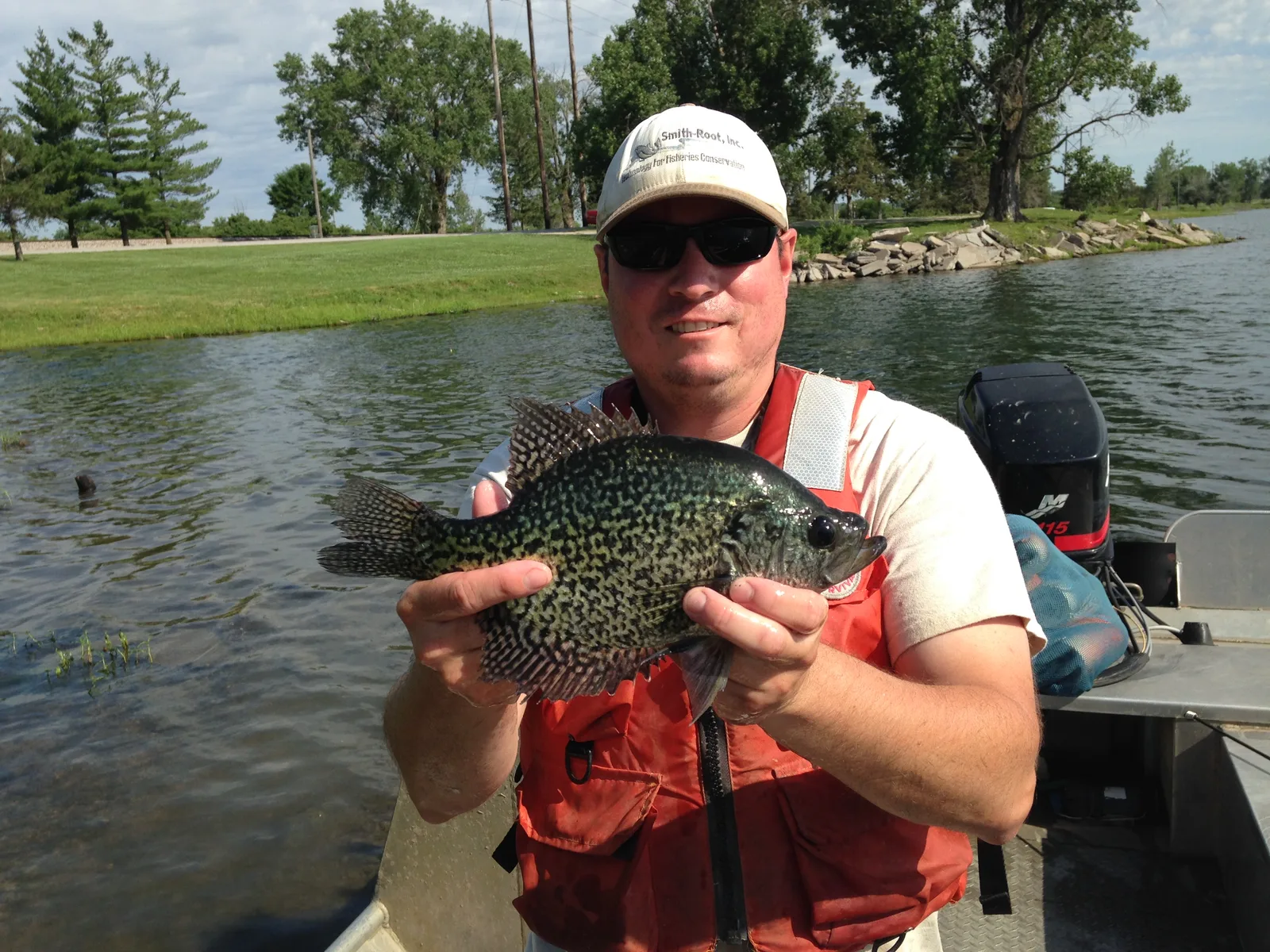
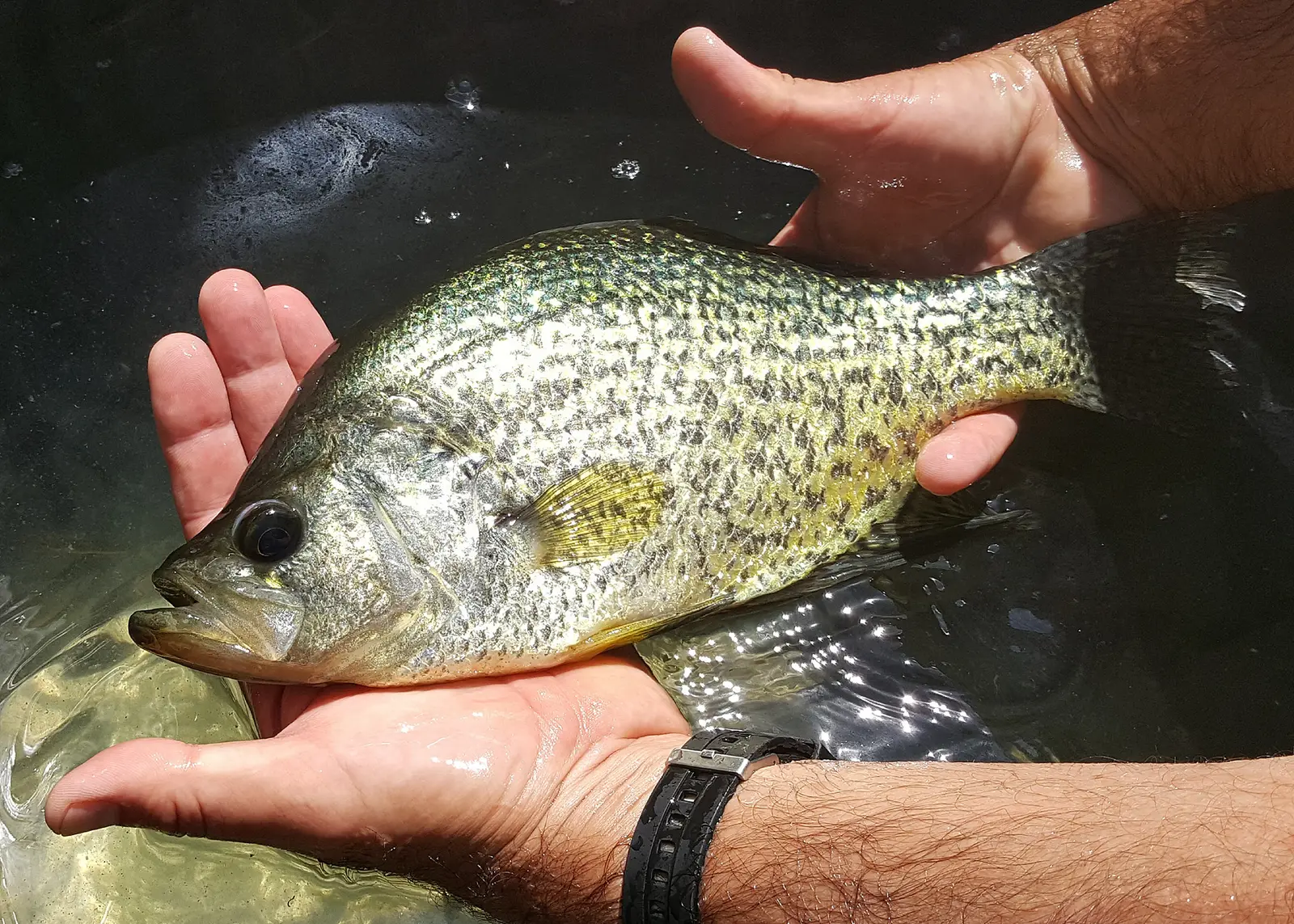 A black crappie in the hand: dense speckles, no bars, and the long dorsal fin with seven or eight spines. Photo: Oregon Department of Fish and Wildlife, Wikimedia Commons (CC BY-SA 2.0)
Yes. The Missouri Department of Conservation calls crappie “feisty, tasty, and a favorite of anglers”, and Oklahoma’s wildlife department says their sweet meat makes exquisite table fare. They are also among the safer fish to keep. Minnesota’s Department of Health notes that “predator species like northern pike or walleye tend to have higher mercury concentrations than prey species like black crappie or bluegill”. Its August 2026 guidelines put crappie with bluegill and yellow perch in the safest statewide group. Adults not planning a pregnancy may eat up to four servings a week; children and anyone who is or may become pregnant, one. Penn State Extension’s handling advice: cool the fish to 35–40 °F (2–4 °C) at once and cook it within two days, or freeze it.
How do black crappie spawn?
Black crappie spawn first, a few degrees before white crappie. Iowa’s DNR puts the black crappie spawn at 58–64 °F (14–18 °C). Wisconsin’s DNR sees crappie spawning peak in May and June at 61–68 °F (16–20 °C). Oklahoma’s has it starting as low as 55 °F (13 °C), so 58–68 °F is the working window. The nests sit in 3–8 ft of water. Oklahoma’s agency says black crappie nest deeper than white crappie; Iowa’s says slightly shallower.
The male fans a round nest in sand or gravel near cover, often in a colony with other males. Females spawn with several males and release eggs several times during the season. A female may carry up to 150,000 eggs, though 20,000–60,000 is more common. The male guards the nest for about five days, until the young begin to swim and feed.
The young eat plankton. Up to about 6.3 in (16 cm) a black crappie lives on planktonic crustaceans and insect larvae; bigger fish turn mostly to small fish. Insects stay on the menu for life. Young black crappie reach 2–3 in (5–8 cm) in their first year in Iowa and mature in their second or third.
The names, if you want them
The black crappie is Pomoxis nigromaculatus, Latin for “black-spotted”, described by Lesueur in 1829. The IGFA lists calico bass, papermouth and bachelor perch as other names. Floridians say specks or speckled perch, and Horst adds strawberry bass and Oswego bass. A big one anywhere is a slab.
Free PDF · 16 pages
Know what's biting before your first cast
The Water Temperature Fishing Chart. Take one water temperature reading, find it on the chart, and you know which of 26 freshwater fish are feeding today, where they are and what to throw. For your phone and the tackle box.
- The 26-fish chart: who's spawning, feeding hard or shut down at your reading
- Where they sit and what to throw at every band: bass, crappie, bluegill, walleye, catfish and trout
- The best hours at your reading, the cold front day by day, and the spawn calendar from ice-out to midsummer
- The three thermometer mistakes that make a reading lie (the first one is the surface)
Every number from state fish and wildlife agencies and fisheries research: 61 sources, all on the site.
Enter your email, confirm it with one click, and the PDF is in your inbox. Plus one email a week on what's biting. Unsubscribe anytime. Privacy.
Related
Section guide
Crappie: Black or White, Where They Are Each Season, How to Catch ThemCrappie fish, black and white: how to tell them apart, where they hold each season, the spawn by water temperature, how to catch them, the limits.
 Crappie Fishing: Where They Are Each Season and How to Catch Them
Crappie fishing season by season: how deep the fish sit, what to throw, the light tackle that works, and why a jig a foot too low gets ignored.
Sources
- Missouri Department of Conservation, black crappie
- Iowa DNR, black crappie (habitat, spawning, eggs, growth, state record)
- U.S. Fish & Wildlife Service, black crappie (size, age, diet, range)
- Texas Parks and Wildlife, black crappie
- Wisconsin DNR, crappie (PUBL-FH-712): seasons, spawning, feeding times
- Oklahoma Department of Wildlife Conservation, black crappie (spawning temperature, lake size, table fare)
- Mississippi DWFP, black crappie (blacknose crappie) and Magnolia crappie
- Mississippi Sportsman, In search of the Magnolia crappie (hatchery estimates for blacknose crappie)
- Missouri Department of Conservation, bluegill (dorsal spines, mouth)
- Louisiana Sportsman, Jerald Horst, It's as clear as black and white
- Dannis et al. (2026), Morphological variation between black crappie and white crappie and its influence on species distribution, Environmental Biology of Fishes
- McInerny and Cross (2008), Length at age of black crappie and white crappie in Minnesota, Minnesota DNR Investigational Report 551
- Pennsylvania Fish and Boat Commission, crappie management plan (Table 1, age and weight at length)
- Pennsylvania Fish and Boat Commission, crappie (line, hooks and lure sizes)
- Neumann and Murphy (1991), Evaluation of the relative weight index for assessment of white crappie and black crappie populations, North American Journal of Fisheries Management 11:543
- Wired2Fish, Steven Bardin, Crappie: a comprehensive species guide (southern growth)
- Wired2Fish, David Schlake, Best crappie rigs (minnow hooks, line, minnow sizes)
- Wired2Fish, Jason Sealock, Best crappie jigs (jig weights, colors)
- Missouri Department of Conservation, crappie: tips for fishing (summer depths)
- Wired2Fish, Shaye Baker, How and why to shoot boat docks for big crappie (Scott Canterbury)
- Bass Pro 1Source, Keith Sutton, Crappie fishing after dark
- IGFA world records, black crappie (all-tackle and length records)
- Chicago Sun-Times (IGFA release), Lionel Ferguson's 5 lb 7 oz black crappie approved as world record
- Outdoor Life, the biggest crappies ever caught
- Minnesota DNR, Record rundown: anglers catch state-record fish (June 15, 2026; Cedar Lake black crappie)
- Minnesota Department of Health, mercury in fish (predator and prey species)
- Minnesota Department of Health, fish consumption guidelines (updated August 2026)
- Penn State Extension, proper care and handling of fish from stream to table