 By
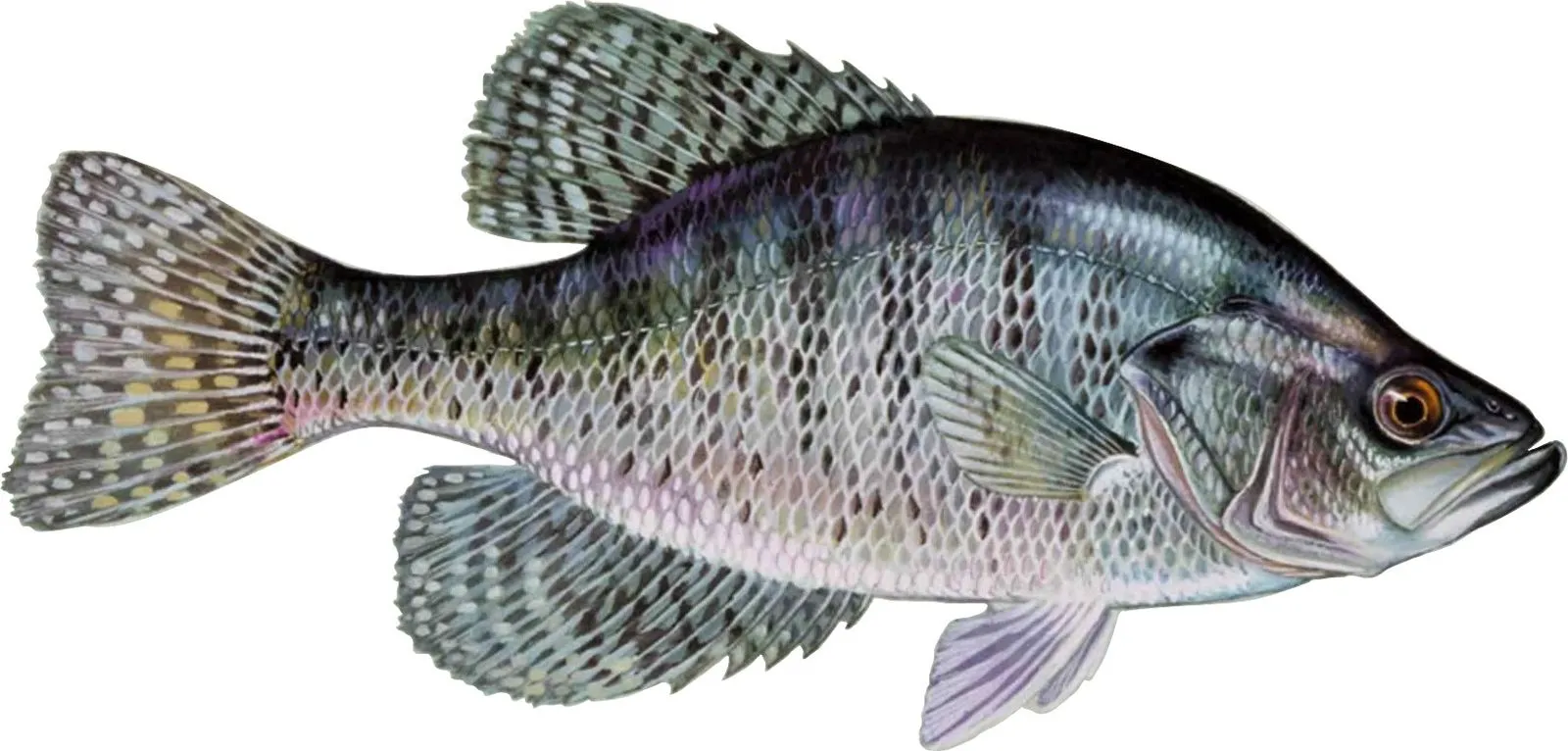
The white crappie is the barred crappie: a silver, slab-sided panfish with 5–10 faint vertical bars. It has five or six spines at the front of its dorsal fin. Look for it in big, muddy reservoirs and rivers. In Missouri it’s more abundant and widespread than the black crappie. Most run 9–10 in (23–25 cm). To catch one, still-fish or slow-troll a small minnow past flooded trees. Missouri’s field guide calls that one of the most effective ways there is.
The white crappie world record, 5 lb 3 oz from Enid Dam, Mississippi, has stood since July 31, 1957. It was reported at 21 in, long for its weight. By our standard-weight math, that’s about 85 percent of what a well-fed 21-incher weighs.
How do you tell a white crappie from a black crappie?
Count the dorsal spines, the stiff rays at the front of the fin on the back. A white crappie has five or six, usually six. A black crappie has seven or eight. Then look at the sides. A white crappie wears 5–10 faint vertical bars, often 7 to 9 in Iowa’s count. A black crappie is speckled all over.
When you can’t make out the spines, two shape marks help. Measure the base of the dorsal fin, then measure from the front of that fin to the tip of the mouth. On a white crappie the fin base is much shorter. On a black crappie the two are about equal. You’ll also see the white crappie’s head slope down from the dorsal fin like a ski jump.
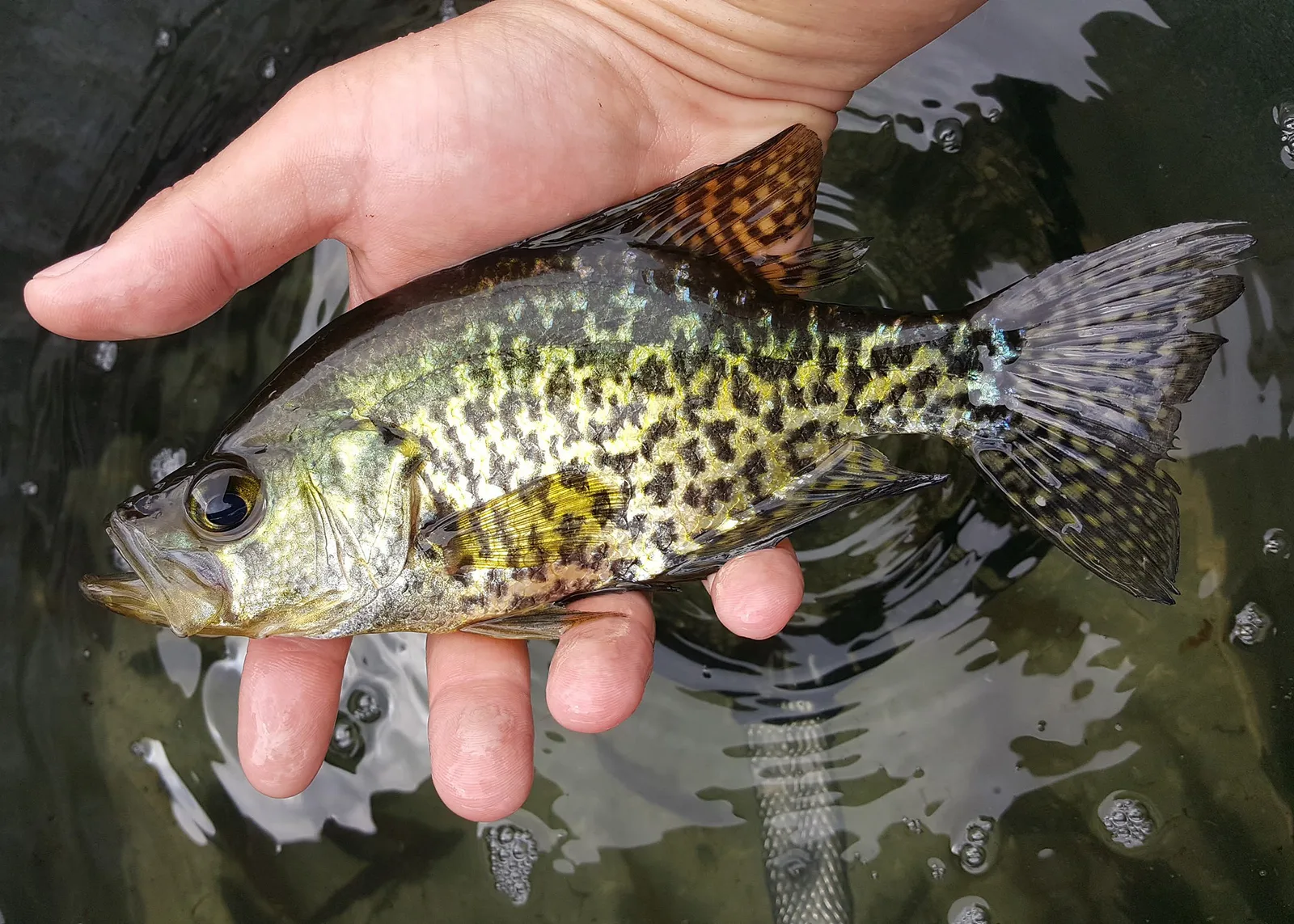
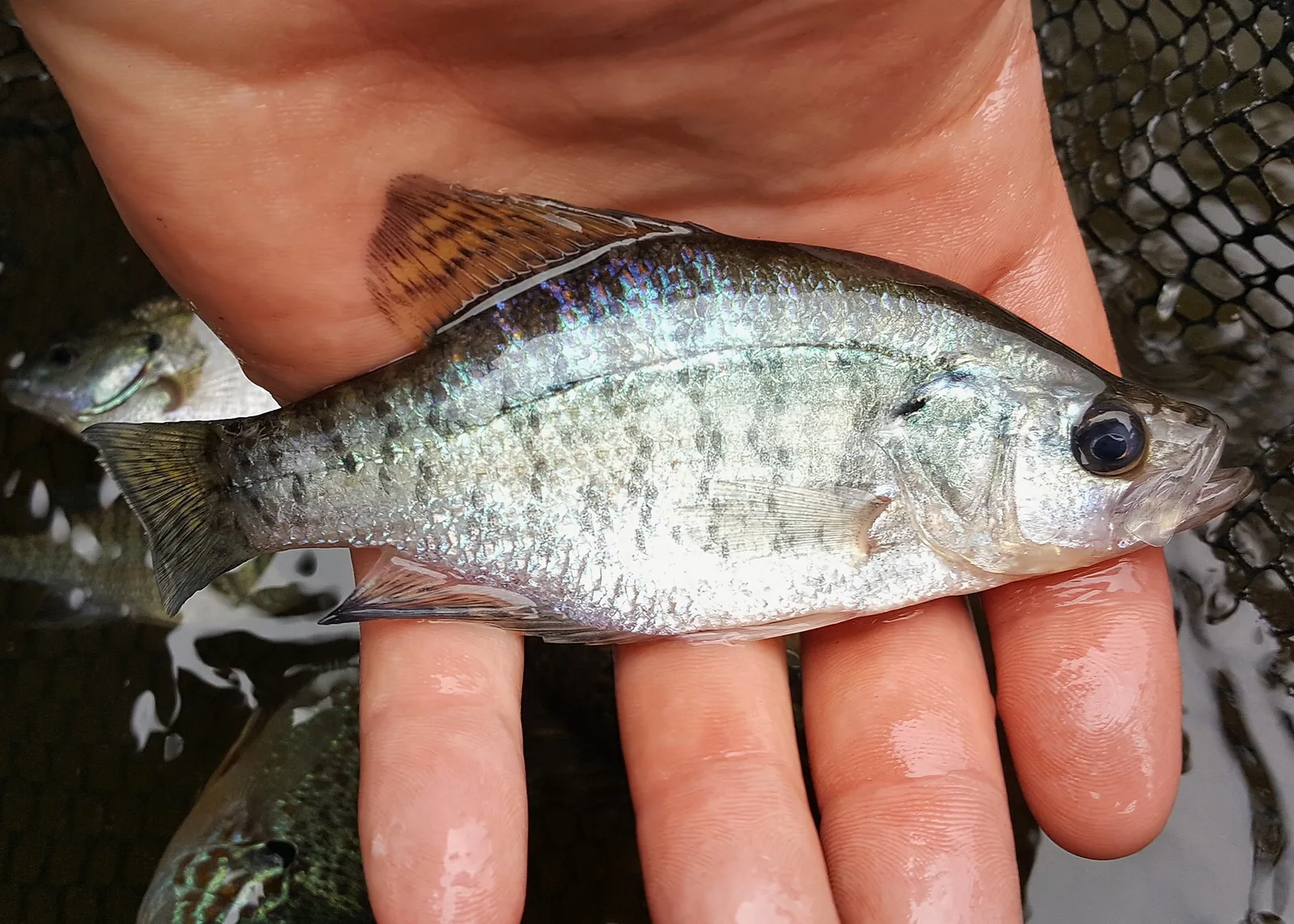 A young white crappie: pale sides, faint broken bars, the ski-jump forehead. Photo: Oregon Department of Fish and Wildlife, Wikimedia Commons (CC BY-SA 2.0)
Don’t go by color alone. A spawning male may go dark in the throat, Texas Parks and Wildlife says. Mississippi’s agency warns you can mistake him for a black crappie. The bars can fade in deep or stained water too.
| Mark | White crappie | Black crappie | White bass |
|---|---|---|---|
| Dorsal fin | One fin, 5 or 6 spines | One fin, 7 or 8 spines | Spiny and soft dorsal fins, not joined |
| Pattern | 5–10 faint vertical bars | Speckles and blotches | Thin horizontal streaks |
| Dorsal-fin base | Much shorter than fin to mouth | About equal to fin to mouth | – |
| Profile | Concave, a ski-jump forehead | Less concave | – |
| Build | Longer at the same age, lighter at the same length | More robust, heavier at the same length | – |
The speckled fish is the black crappie, and the crappie hub sets black crappie vs white crappie side by side. The other silver schooling fish in big reservoirs is the white bass, a temperate bass with streaks instead of bars. Unlike the white crappie, it tends to avoid water that stays muddy, Missouri’s field guide says. Look for it over firm sand or rock.
Do white and black crappie cross-breed?
Yes. Where both live, they cross. In one water, 17 percent of the crappie were hybrids, Don Orth of Virginia Tech points out. Expect it most where spawning spots are few, crappie are scarce or the water is small, Wired2Fish’s Steven Bardin says. A first-generation hybrid breeds poorly, so second-generation fish are rare. A hybrid can carry a white crappie’s six spines, so give the fin base and the forehead a second look. The crappie hub covers natural hybrids and Mississippi’s sterile hatchery cross.
Where do white crappie live?
You can find white crappie across most of the country now, because stocking has spread them. They’re native to the eastern half of the United States and southern Ontario, west of the Appalachians, the IGFA says. Most of peninsular Florida still has none.
What sets it apart is the water it puts up with. White crappie handle mud better than black crappie and are more plentiful where there’s a lot of silt, Iowa’s DNR says. Don’t pass up muddy water. In Iowa they’re plentiful in every reach of the Mississippi River. In Louisiana the big muddy rivers almost always hold them, says Jerald Horst, a retired Louisiana State University fisheries professor. Where the two mix, you’ll find more white crappie than black crappie in moving water, and more so when it’s muddy.
The deeper reason may be the plants. Across 70 reservoirs that hold both crappie, a 2026 paper found white crappie more common where underwater weeds were thin or missing. Their body is built for open water. That, not the mud itself, seems to be what decides it. So a weedy lake leans black crappie, and an open, weed-poor one leans white.
Both crappie do well in lakes of at least 500 acres, Oklahoma’s wildlife department says. Keep them out of a farm pond, where they overpopulate. Iowa agrees: white crappie stocked in a farm pond seldom do well.
Free PDF · Water temperature chart When do crappie bite?
One reading, and the 16-page chart shows which of 26 fish are spawning, feeding hard or slowing down; for bass, crappie, bluegill and walleye, where they sit and what to throw. Every number sourced.
No card, nothing to buy, and the PDF is yours to keep. Confirm with one click and it's on its way. Then a few short emails and one a week on what's biting. Unsubscribe anytime. Privacy.
Where are white crappie through the year?
Shallow coves in spring, deep open water in summer, the creek arms in fall. White crappie form loose schools, Oklahoma’s wildlife department says, and Texas finds big schools of young fish in the middle of lakes. So when you catch one, fish that spot again. Go in the evening or at night. That’s when they’re most active, Missouri’s field guide says, though they’re out at any hour.
| Season | Water | Where they are | What to throw |
|---|---|---|---|
| Winter | Below 50 °F (10 °C) | Schools suspended 20–30 ft (6–9 m) or deeper over ridges and river channels | A small jig or minnow held at the school’s depth |
| Pre-spawn | 50–60 °F (10–16 °C) | Moving toward the coves along submerged creek channels, in less than 15 ft (4.6 m) | Jig or minnow under a float, moved slowly |
| Spawn | 60–70 °F (16–21 °C), the first beds from 56 °F (13 °C) | Nests in 3–10 ft (1–3 m) in protected coves, near brush and plants | Jig under a float set just above the bed |
| Post-spawn | Above 70 °F (21 °C) | Back to deep water, sooner than black crappie, which stay shallow into early summer (Wired2Fish) | Vertical jig over brush on the drop |
| Summer | Warmest | Deep and spread out, often 15 ft (4.6 m) and more | Trolled crankbaits; spider rigs |
| Fall | Cooling through the 60s (16–21 °C) | Back toward shallower water, but seldom shallower than 10 ft (3 m), after shad | Swim a jig and cover water |
Missouri’s rule of thumb: fish shallow in spring and fall, deep in summer and winter. The winter, spring and fall depths come from Texas Parks and Wildlife’s crappie guide. Juvenile and adult crappie there eat mainly small threadfin and gizzard shad and insect larvae, so shad are what you’re matching. Check the crappie spawn temperature page for spawn timing by state and by water clarity, and crappie fishing for the tactics in each season.
How do you catch white crappie?
Feed them fish. Adult white crappie eat more fish than black crappie, Texas Parks and Wildlife says, so a minnow or a shad-shaped plastic is the natural crappie bait. Use the same light tackle as for any crappie. Fish jigs on 1/16 and 1/8 oz jig heads, cast or dropped straight down. Go to 1/4 oz for big crappie in deep open water, especially in wind. That’s how Jason Sealock of Wired2Fish does it. The crappie jigs page matches head weight to depth.
Four ways work. Start with the minnow, because you can still-fish it from the bank, no boat needed.
Minnows near timber. Still-fish or slow-troll a small minnow on a light wire hook past flooded trees. That’s the method Missouri’s agency singles out. Set it at or just above the depth of the fish.
Trolling in summer. When the fish go deep and spread out, troll 2-in crankbaits that run about 10–12 ft deep. They reach 20 ft on long lines. It’s a staple on the Tennessee River and Mississippi lakes such as Grenada, Jason Sealock of Wired2Fish says. Pick bright, contrasting colors. They usually beat lifelike shad patterns.
Spider rigging. You fan long rods off the bow of a boat and slow-troll them, each with a minnow or jig at a set depth. The fishing terms page explains spider rigging and the other crappie methods.
At night. Hang a light. Lanterns draw insects, insects draw baitfish and baitfish draw crappie. A green underwater light draws plankton to the same end, Keith Sutton says in Bass Pro’s night-fishing guide. Start your baits by water clarity: 20–30 ft (6–9 m) in clear water and 10–20 ft (3–6 m) in stained water. In muddy water, the white crappie’s kind, start at 5–10 ft (1.5–3 m). The light then pulls the fish up toward the surface.
How big do white crappie get, and how old is a 14-inch fish?
A typical white crappie is 9–10 in, and one over 15 in (38 cm) is rare, Missouri says. In Iowa they seldom pass 2 lb (0.9 kg). In Pennsylvania a 14-inch white crappie is about nine years old, and in the South they grow years ahead of that pace.
Pennsylvania has the average age and weight of a white crappie at each length, from fish caught in spring. The last column is the standard weight, what a well-fed white crappie of that length weighs. Find your fish’s length and read across. That answers the cleaning-table question: how old is this one?
| Length | Average age (Pennsylvania) | Average weight (Pennsylvania) | Standard weight |
|---|---|---|---|
| 9 in (23 cm) | 3.8 years | 0.3 lb (140 g) | 0.36 lb (165 g) |
| 10 in (25 cm) | 4.6 years | 0.4 lb (180 g) | 0.52 lb (234 g) |
| 12 in (30 cm) | 6.5 years | 0.8 lb (360 g) | 0.95 lb (431 g) |
| 13 in (33 cm) | 7.7 years | 1.1 lb (500 g) | 1.24 lb (563 g) |
| 14 in (36 cm) | 9.1 years | 1.4 lb (640 g) | 1.59 lb (720 g) |
| 15 in (38 cm) | 11 years | 1.7 lb (770 g) | 2.00 lb (907 g) |
A pound needs a fat 12-incher or an ordinary 13-incher. Put any length into the fish weight calculator and it runs the standard-weight equation for you.
Most white crappie live three or four years, Missouri says, and a few reach eight or more. The 14- and 15-inchers in Pennsylvania’s table are those few.
White crappie grow longer faster than black crappie but weigh less at the same length. Across Minnesota, wherever the two differed at the same age, the white crappie was the longer fish.
The water decides how fast a white crappie gets there, and in good water the same lengths come years sooner than in Pennsylvania. In Tennessee and Kentucky, a white crappie takes about three years to reach the 10-in (25 cm) limit, Steve McCadams says in CrappieNOW.
| Age | Minnesota reservoirs | Iowa | Texas |
|---|---|---|---|
| 1 | 3.2 in (81 mm) | 2–3 in (5–8 cm) | 3–5 in (8–13 cm) |
| 2 | 7.6 in (193 mm) | – | 7–8 in (18–20 cm) |
| 3 | 10.0 in (254 mm) | – | – |
| 4 | 11.5 in (292 mm) | 10–12 in (25–30 cm) | – |
| 5 | 12.4 in (316 mm) | – | – |
What is the white crappie record, and what are the rules?
The IGFA all-tackle world record is 5 lb 3 oz (2.35 kg). Fred Bright caught it on July 31, 1957, at Enid Dam, Mississippi. It measured 21 in, Outdoor Life and Mississippi’s wildlife department both report. Outdoor Life adds a reported 19 in girth, a Denison-Johnson reel and Ashaway line, and knows of no photo. By the standard-weight equation, a well-fed fish that long weighs 6.14 lb. The record fish was about 85 percent of that: long for its weight. A 19 in girth doesn’t fit a 5-pounder either, so take that girth as reported, not checked.
The IGFA’s length record is 40 cm (15.7 in), caught by Arthur Weston at Waseca County Lake, Minnesota, on April 20, 2025. The fly-fishing length record, 39 cm (15.4 in), came from Grenada Lake, one of Enid’s neighbors, in March 2024. Iowa’s state record, a 4.56 lb (2.07 kg) fish of 21.25 in, came from Green Castle Lake in 1981.
Mississippi sets its own crappie rules on its four flood-control lakes, Grenada, Enid, Sardis and Arkabutla. The daily limit there is 10 crappie per angler and 25 per boat with three or more aboard, with a 12-in (30 cm) minimum. Texas allows 25 crappie a day of 10 in (25 cm) or more. Rules change by lake, so check the state rules before you keep fish.
Are white crappie good to eat, and is black or white better?
Yes, and no agency we read ranks one crappie above the other at the table, so don’t sweat which one you’ve got. The meat is sweet, and Oklahoma’s wildlife department calls it “exquisite table fare.” The fillets are white, flaky, mild and sweet, and crappie is likely the most popular food fish in Louisiana, Horst says.
They are also among the safer fish to eat. Minnesota’s Department of Health puts crappie in its most generous statewide group. Adults not planning a pregnancy may eat up to four servings a week. Children and anyone who is or may become pregnant, one serving a week.
How do white crappie spawn?
In most lakes white crappie spawn a few degrees after black crappie. Texas puts the usual spawn at 65–70 °F (18–21 °C) and has seen it as low as 56 °F (13 °C). Iowa’s white crappie start in late April or early May, at about 56 °F.
Look for the beds in a cove sheltered from waves, where the male fans a shallow dish. The nests cluster like bluegill beds. In Iowa they sit anywhere from 1 to 20 ft (0.3–6 m) deep, usually in 3–10 ft of water. Missouri’s field guide reports as many as 35 nests in one colony. A nest can hold up to 20,000 eggs. The eggs hatch in about three days, and the fry leave the nest only at night.
That spawning power is the white crappie’s problem in small water. They breed so fast that a small lake often ends up overrun with stunted fish, Texas warns.
Predators keep the balance. Largemouth bass, pike, hybrid striped bass and other crappie all eat crappie, Bardin says. Bass and crappie eat each other, Texas says. A lot of yearling bass can keep a strong year’s crop of young crappie from forming. In a lake with few bass, crappie often overpopulate and stunt.
The young eat zooplankton through their first summer and add aquatic insects late in it. From the second year on they eat small fish, and as adults fish are the main meal.
The names, if you want them
The white crappie is Pomoxis annularis, “having rings”, for its bars. Rafinesque described it in 1818. You may also hear white perch or sac-a-lait, the other names Texas lists. Missouri and the IGFA add papermouth and bachelor perch. Is a speckled perch a crappie? Yes. Horst lists specks and speckled perch among the local names for crappie, along with calico bass and strawberry bass. The “white perch” of north Louisiana is a crappie, not the white perch of the Atlantic coast, which is a temperate bass.
Gear for crappie
Gear guide
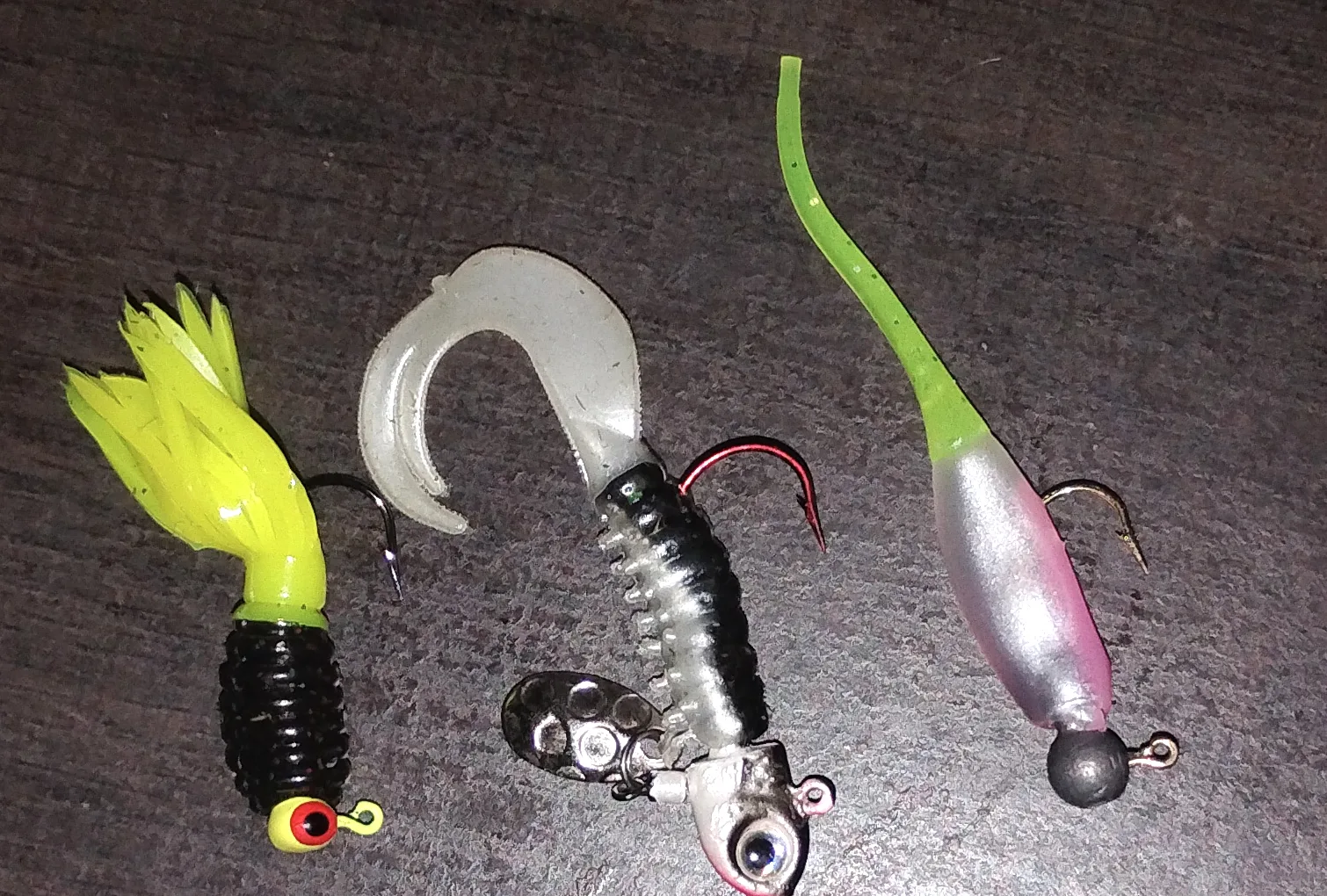
Best Crappie Lures: Six Picks Beyond the Plain Jig, and When Each One WinsBest crappie lures by season: a 1/32–1/8 oz jig all year, a Road Runner or Beetle Spin in stained water, a Bandit 300 trolled in summer. Sizes and prices.

Free PDF · 16 pages
Stop guessing. Know what's biting before your first cast
A whole Saturday on the water with nothing to show for it. One reading tells you who's feeding.
The Water Temperature Fishing Chart. Take one water temperature reading, find it on the chart, and see which of 26 freshwater fish are spawning, feeding hard or slowing down.
- Where bass, crappie, bluegill and walleye sit, and what to throw. Trout: the reading where you stop.
- Why a 3 ft drop beats a cold front, and what to throw each day of the front
- The three thermometer mistakes that make a reading lie
The chart's numbers come from state fish and wildlife agencies and fisheries research: 61 sources, each listed on the site.
No card, nothing to buy. Confirm with one click and the PDF is on its way, one version for your phone and one to print, yours to keep. Then a few short emails and one a week on what's biting, with an unsubscribe link in every one. Privacy.
Related
Section guide
Crappie: Black or White, Where They Are Each Season, How to Catch ThemCrappie fish, black and white: how to tell them apart, where they hold each season, the spawn by water temperature, how to catch them, the limits.
- Best Crappie Lures: Six Picks Beyond the Plain Jig, and When Each One Wins
Best crappie lures by season: a 1/32–1/8 oz jig all year, a Road Runner or Beetle Spin in stained water, a Bandit 300 trolled in summer. Sizes and prices.
 Crappie Jigs: Which Body, Which Head Weight, and How to Fish Them
Crappie jigs explained: the five plastic bodies and what each does, head weight by depth and line, hooks, knots and colors, and how to fish them.
 Black Crappie: How to Identify One, Where It Bites, How Old It Is
How to tell a black crappie from a white, where it holds each season, how old a 12- or 13-inch fish is, the 5 lb 7 oz record and whether to keep it.
 Crappie Fishing: Where They Are Each Season and How to Catch Them
Crappie fishing season by season: how deep the fish sit, what to throw, the light tackle that works, and why a jig a foot too low gets ignored.
Sources (25)
- Missouri Department of Conservation, white crappie
- Iowa DNR, white crappie (identification, habitat, spawning, growth, state record)
- Texas Parks and Wildlife, white crappie (spawning, growth, breeding color)
- Texas Parks and Wildlife, black crappie (diet compared with white crappie)
- Oklahoma Department of Wildlife Conservation, white crappie
Show all 25 sourcesShow fewer sources
- Mississippi DWFP, white crappie
- Missouri Department of Conservation, white bass
- Louisiana Sportsman, Jerald Horst, It's as clear as black and white
- Dannis et al. (2026), Morphological variation between black crappie and white crappie and its influence on species distribution, Environmental Biology of Fishes
- McInerny and Cross (2008), Length at age of black crappie and white crappie in Minnesota, Minnesota DNR Investigational Report 551
- Pennsylvania Fish and Boat Commission, crappie management plan (Table 1, age and weight at length)
- Neumann and Murphy (1991), Evaluation of the relative weight index for assessment of white crappie and black crappie populations, North American Journal of Fisheries Management 11:543
- CrappieNOW, Steve McCadams, How fast do crappie grow?
- Wired2Fish, Steven Bardin, Crappie: a comprehensive species guide (post-spawn movement, hybrids, predators)
- Don Orth, Virginia Tech Ichthyology, The erratic crappie (natural hybrids)
- Texas Parks and Wildlife, Crappie and crappie fishing (PWD BR T3200-178; seasonal depths, diet, predators)
- Missouri Department of Conservation, Crappie: tips for fishing
- Wired2Fish, Jason Sealock, Best crappie jigs: buying and fishing guide (jig-head weights)
- Wired2Fish, Jason Sealock, Best crappie baits and how to fish them (trolling crankbaits)
- Bass Pro 1Source, Keith Sutton, Crappie fishing after dark
- IGFA world records, white crappie (all-tackle and length records)
- Outdoor Life, the biggest crappies ever caught (Bright's 1957 fish)
- Mississippi DWFP, new crappie regulations (Grenada, Enid, Sardis, Arkabutla)
- Texas Parks and Wildlife, freshwater bag and length limits
- Minnesota Department of Health, fish consumption guidelines (updated August 2026)