 By
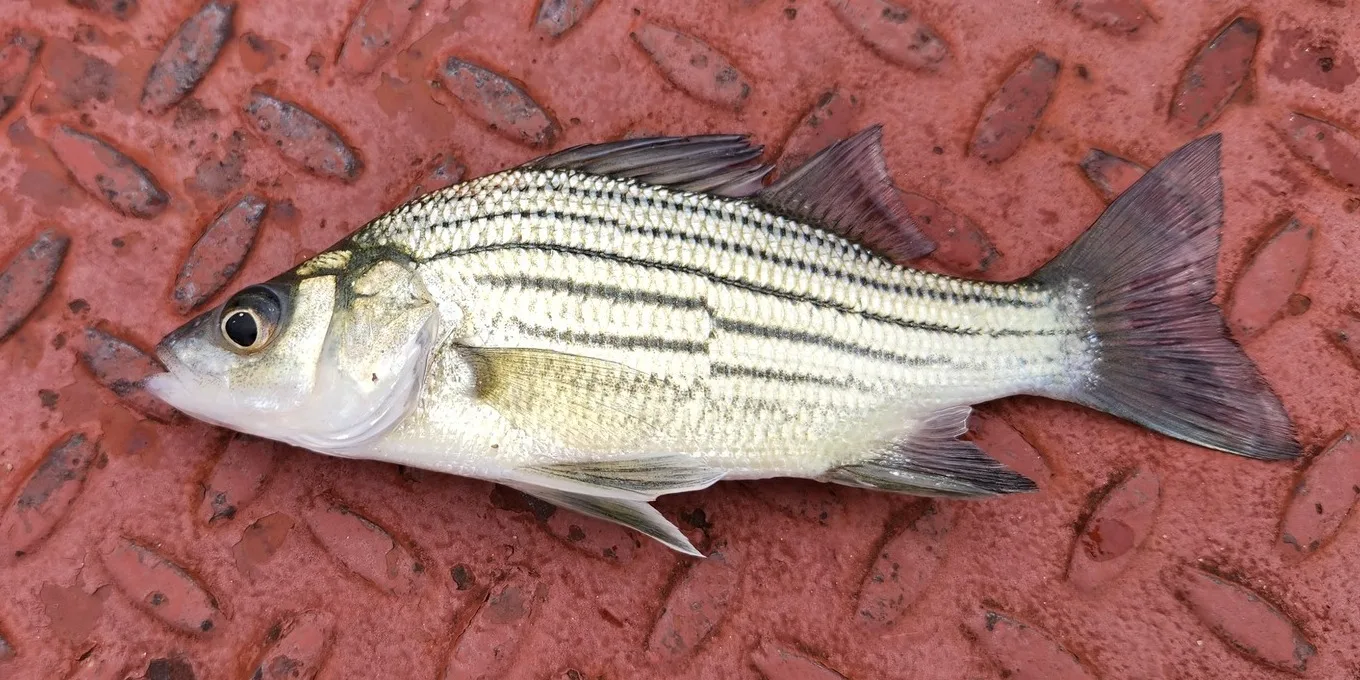
A yellow bass is a small, brassy-gold temperate bass, about half a pound on average and seldom over 12 inches. It’s one of the many fish called bass. You’ll know it by its dark stripes: the lower ones break and jog sharply just above the anal fin. You’ll find it in schools in the quiet pools, backwaters and lakes of the Mississippi basin, and it bites tiny jigs. Missouri says it tastes better than a white bass. In some Iowa lakes there are so many that the state poisons them.
Iowa’s Lake Cornelia held an estimated 385 lb of yellow bass per acre. That’s about a million fish in 242 acres. In November 2022 the state treated it with rotenone at eight parts per billion, a dose aimed at the yellow bass alone.
Is a yellow bass the same as a white bass?
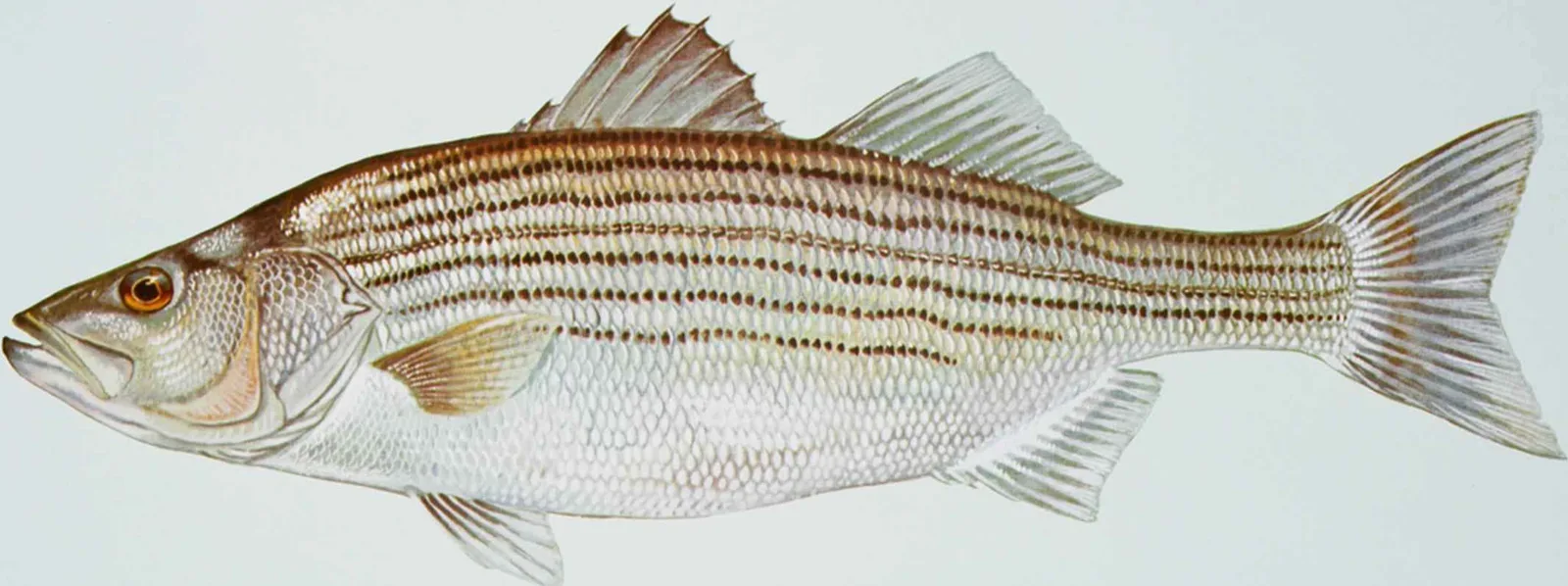
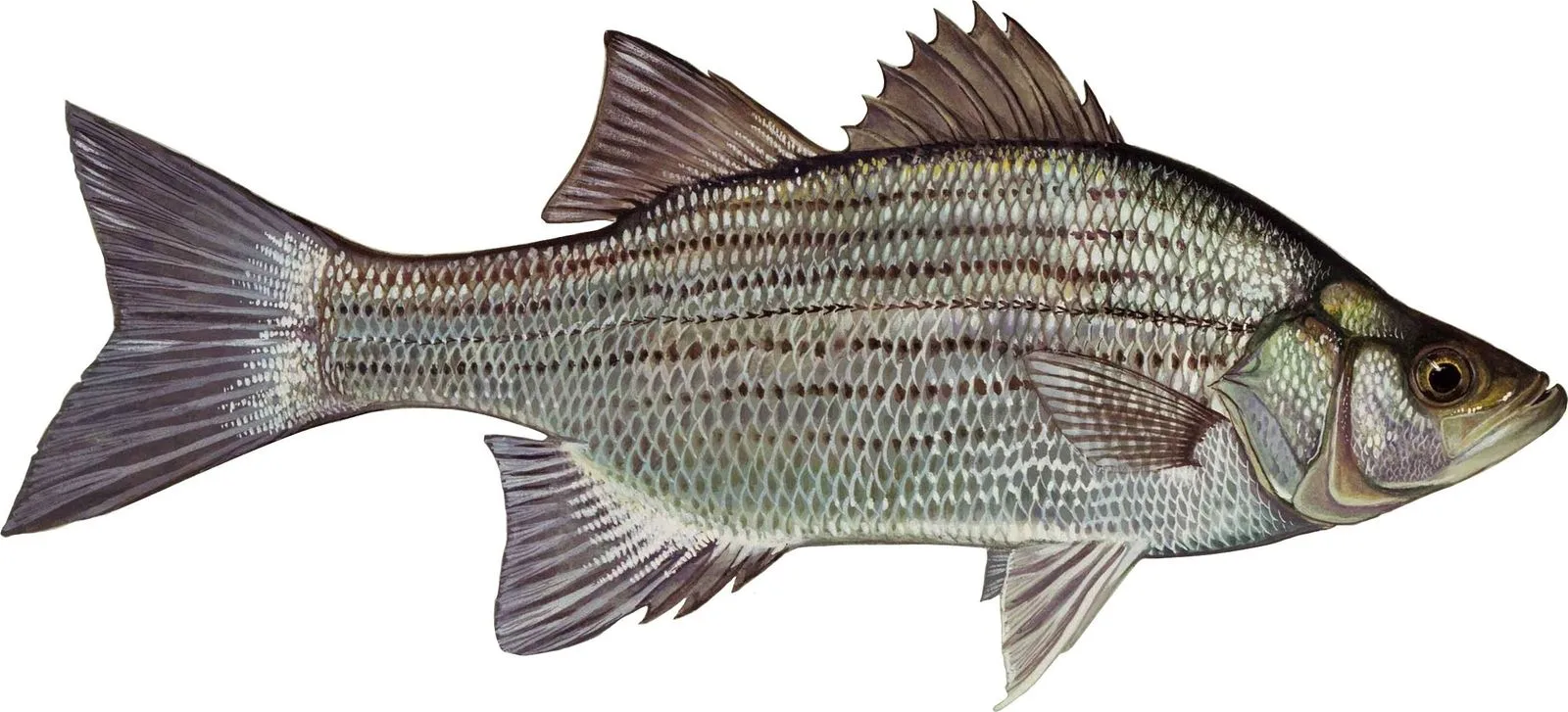
No. Both are temperate basses, the family of the striped bass, and you’ll find them in the same rivers and reservoirs. Three marks tell them apart, and you can see the first one from the boat. On a yellow bass the lower stripes are broken and offset above the front of the anal fin, as if the stripe slipped a notch. Next, check the tongue. A white bass carries a tooth patch there, a rough pad of tiny teeth, and a yellow bass has none. Last, look at the two dorsal fins. On a yellow bass they’re joined at the base, and on a white bass they stand apart.
| Mark | Yellow bass | White bass |
|---|---|---|
| Stripes | Six or seven dark, distinct stripes; the lower ones broken and offset above the front of the anal fin | Faint; only one reaches the tail |
| Color | Silvery yellow; the belly may be yellow | Silver, dark gray back, white belly |
| Tooth patch on tongue | None | One, near the midline at the back |
| Dorsal fins | Joined by a membrane | Two, separate |
| Anal fin | Second and third spines nearly equal; 9 soft rays, sometimes 10 | Second spine about two-thirds of the third; 11–13 soft rays |
| Size | Seldom over 12 in (30 cm) or 1 lb (0.45 kg) | 9–15 in (23–38 cm), ¼–1¼ lb (0.1–0.6 kg) |
| World record | 2 lb 9 oz (1.16 kg) | 6 lb 13 oz (3.09 kg) |
Don’t go on one mark alone. Texas Parks and Wildlife’s key adds a warning that fits every fish in this family: “all characteristics should be considered in combination.” When you’re still not sure, count the anal spines. That’s the tiebreaker. On a white bass the three spines step up in length, and on a yellow bass the second and third are nearly the same. Wisconsin’s DNR confirmed its 2025 state-record yellow bass that way, by counting the spiny rays of the anal fin.
Two more fish muddy the picture. Where yellow bass are stocked into white bass water, the two species cross, the USGS says. Oklahoma even keeps a separate state record for the hybrid yellow bass: 2 lb 5 oz, from the Kiamichi River in 1991. And Texas lists young stripers among the fish people mistake for yellow bass. You’ll find the full five-fish table, with the striper, the hybrid striped bass and the white perch, on the striped bass hub. A yellow perch is a different fish entirely. It’s a true perch, with vertical bars instead of stripes.
Where do yellow bass live?
Their native range is the Lake Michigan and Mississippi River basins, from Wisconsin and Minnesota south to the Gulf. It also covers the Gulf drainages from lower Mobile Bay, and from the Pearl River in Louisiana to Galveston Bay. In Texas they run from the Red River south to the San Jacinto. Inside that range, look in quiet lowland water: the pools and backwaters of large rivers, oxbows, natural lakes and reservoirs.
They’re scarce at the edges. In Missouri you’ll find them mainly in the Mississippi River and its overflow waters. The state calls the species “too rare in our state to be of much importance as a sport fish.” Minnesota is the northern limit of the range. Only the Mississippi below Red Wing still holds them, and dams block their way upstream. The state has listed them as a species of special concern since 1984.
Iowa is where you can really fish for them. The DNR names North Twin Lake, Clear Lake and Lake Manawa, plus Hartwick Lake on the Maquoketa River, where they’re abundant. The table below lists the waters that state agencies and record lists name.
| State | Waters named for yellow bass | Note |
|---|---|---|
| Iowa | Clear Lake, North Twin, Lake Manawa, Hartwick Lake, East and West Okoboji, Spirit Lake, Mississippi pools 17 and 18 | The strongest fishery; harvested fish about ½ lb |
| Missouri | Mississippi River and its overflow waters; Table Rock Lake | “Too rare” to matter, yet the 2026 state record came from Table Rock |
| Minnesota | Mississippi River below Red Wing | Special concern since 1984 |
| Wisconsin | Lake Mendota | State record, 2025 |
| Tennessee | Duck River at Waverly | IGFA world record, 1998 |
| Texas | Red River south to the San Jacinto | No bag or size limit |
Outside their native waters, they got around mostly by stocking, legal or not. The USGS logs transplanted populations in 16 states. The first was a Kansas stocking in 1885 that didn’t take. It reports them established in Arizona, where its records cluster in the Salt and Gila basins, and in Wisconsin. They reached the upper Tombigbee River on their own, through the Tennessee-Tombigbee Waterway.
Free PDF · Water temperature chart When do striped bass bite?
One reading, and the 16-page chart shows which of 26 fish are spawning, feeding hard or slowing down; for bass, crappie, bluegill and walleye, where they sit and what to throw. Every number sourced.
No card, nothing to buy, and the PDF is yours to keep. It's in your inbox a minute later. Then a few short emails and one a week on what's biting. Unsubscribe anytime. Privacy.
Are yellow bass invasive?
In their native rivers, no. In a small lake where they don’t belong, they can take it over. In a crowded lake they stop growing. That’s called stunting: the numbers climb, and the fish never reach a size worth keeping.
Iowa shows it best. Yellow bass turned up in its constructed southern lakes, and nobody knows how. Outdoor News reports that anglers quite possibly dumped them there. The state has had to renovate one lake after another. Lake Anita came first in 2003. Viking, 12 Mile, Icaria and Afton followed in 2007 and 3 Mile in 2016. A renovation kills a lake’s fish so it can be restocked. Lake Cornelia got an experimental low dose of rotenone, eight parts per billion. It was meant to remove the yellow bass and leave most other fish alive.
Chris Larson, the Iowa DNR’s fish management supervisor for Southwest Iowa, put it plainly: “These constructed lakes in southern Iowa are not good choices for yellow bass.” Clear Lake is the exception. It’s a natural lake, and yellow bass were introduced there in the 1920s. The numbers swing widely, but the fishery hasn’t gone into a lasting decline. So the same fish is a problem in one Iowa lake, a protected rarity in Minnesota, and a prized panfish a few hours away.
Where are yellow bass in each season?
Look near the bottom. Iowa DNR says they spend the year in schools down there, feeding hard on bloodworms and other insect larvae in the mud. At dawn and dusk, when the light is low, they also feed up in the water column and near the surface. Iowa’s lakes give you the clearest pattern by season.
| Season | Depth | Where | Water temperature |
|---|---|---|---|
| Spring (spawn) | 2–3 ft (0.6–0.9 m) | Firm rock, gravel or sand | 60–65 °F (16–18 °C), usually May |
| Summer | 10–20 ft (3–6 m) | Mud flats across the main basin | – |
| Fall | Shallower | Outer edge of bulrush and cattails | – |
| Winter | 6–12 ft (2–4 m) | Main lake | – |
Missouri gives the spawn a little more room: April or May, at 61–72 °F (16–22 °C). The eggs drop over gravel in 2 or 3 ft of water. Either way they spawn later than white bass, whose run peaks at 55–60 °F. The water temperature chart shows the white bass run beside crappie and walleye. The yellow bass spawns a few degrees warmer.
How do you catch yellow bass?
Fish light, and fish the bottom. Iowa’s tackle advice is a 6 ft ultralight to medium-light rod and 4–6 lb monofilament. Tie on a jig from 1/16 oz down to 1/64 oz, Iowa’s favorite sizes, and keep it within six inches of the bottom. That’s lighter than most jig heads in a bass box, so think crappie tackle.
Live bait is the most popular way to catch them, Iowa adds. In spring, use small “crappie minnows.” Once summer begins, an inch of nightcrawler is plenty. When the bite is fast, cut a strip of belly meat from a yellow bass. It stays on the hook for fish after fish.
They take the same baits as white bass, Texas Parks and Wildlife says: spoons, spinners and live minnows. A small inline spinner works when the school is up, at first and last light. So start with the jig on the bottom, where they feed most of the day. Switch to the spinner when they come up at dawn and dusk.
They school, so the first fish tells you where the rest are. Stay put and keep working that spot. Missouri calls the fish “very scrappy on light tackle,” and that’s the reason to fish for one this small at all.
How big do yellow bass get, and what is the world record?
Small. Texas puts the average at about half a pound and says a trophy “may weigh one pound or less.” Missouri says they seldom top 12 in or 1 lb, and Iowa’s harvested fish weigh about half a pound. FishBase gives a common length of 9.4 in (24 cm).
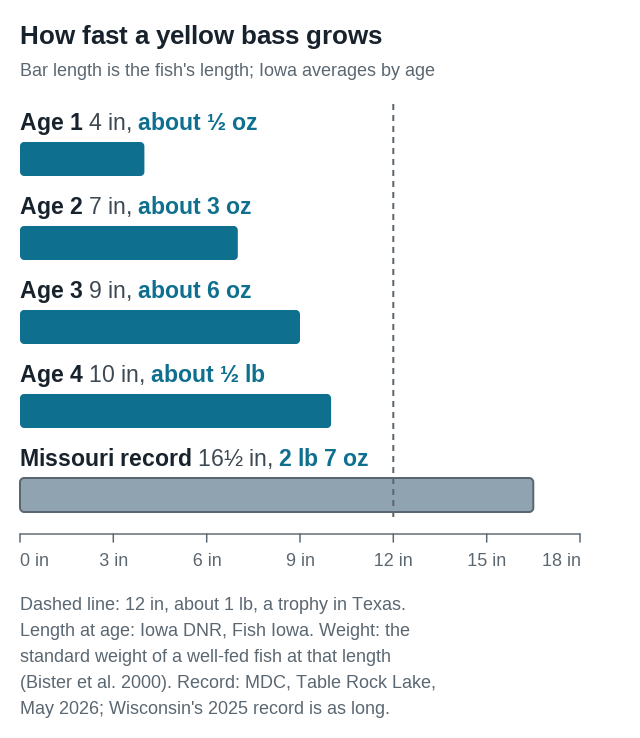
They grow fast, then stop. In Iowa a yellow bass averages 4 in at the end of its first year and 7 in after two. It’s 9 in after three and 10 in after four. Most reach keepable size in three years.
To turn length into weight, use the standard-weight curve for yellow bass (Bister et al. 2000). It gives you the weight of a well-fed fish. An 8-in fish weighs about 0.27 lb (120 g), a 10-in fish 0.54 lb (245 g), and a 12-in fish just under a pound. So a 12-incher is the one-pound trophy Texas means.
Go carefully with the records. IGFA’s own record database lists the all-tackle world record at 2 lb 9 oz (1.16 kg). John Chappell caught it in the Duck River at Waverly, Tennessee, on February 27, 1998. You’ll see a 4 lb 5 oz world record from Indiana in many reports, Outdoor Life among them. Wikipedia places it at Morse Reservoir in 2023. But that fish isn’t in IGFA’s database when you look up its yellow bass record (checked October 2026). Indiana’s own record list stops at a 2 lb 15 oz Morse Reservoir fish from 2000. That one is heavier than the IGFA record, yet IGFA still lists the 1998 Tennessee fish.
| Record | Weight | Where and when |
|---|---|---|
| IGFA all-tackle | 2 lb 9 oz (1.16 kg) | Duck River, Tennessee, 1998 |
| Wisconsin | 2 lb 13.8 oz (1.3 kg), 16½ in (42 cm) | Lake Mendota, April 2025 |
| Missouri | 2 lb 7 oz (1.1 kg), 16½ in (42 cm) | Table Rock Lake, May 2026 |
| Oklahoma, hybrid | 2 lb 5 oz (1.05 kg) | Kiamichi River, 1991 |
| Iowa | 1.75 lb (0.79 kg), 14½ in (37 cm) | Lake Manawa, April 1991 |
| IGFA, hybrid | 4 lb 0 oz (1.81 kg) | Lake Fork, Texas, 2003 |
Oklahoma calls its hybrid a “hybrid yellow bass.” IGFA keeps the hybrid in a separate category, “Bass, yellow (hybrid)”, a white bass and yellow bass cross. It doesn’t count against the pure yellow bass record. Iowa’s own pages disagree on their record. The record database and Fish Iowa both say 1.75 lb, but the DNR’s fishing page lists 1 lb 9 oz for the same fish. The standard-weight curve puts a well-fed 14½-inch fish at 1.74 lb, which sides with the database.
Missouri’s record shows how little anyone fishes for them there. Danny Naugle of Cassville caught his on Table Rock Lake on May 13, 2026, and weighed it on a certified scale at the Roaring River hatchery. The record it replaced, from 1995, was a 9 oz fish from a slough off the Mississippi. Naugle told MDC he’d filleted fish over a pound, record-breakers on paper, before he thought to check. So if you catch a big one, weigh it before it hits the cutting board.
Wisconsin’s fish came from shore on Lake Mendota, in Madison. It was weighed on a certified scale at a meat market and is now on the state’s hook-and-line record list. It’s heavier than the fish IGFA lists. But a state record and a world record are separate applications, and IGFA only lists the fish anglers submit to it.
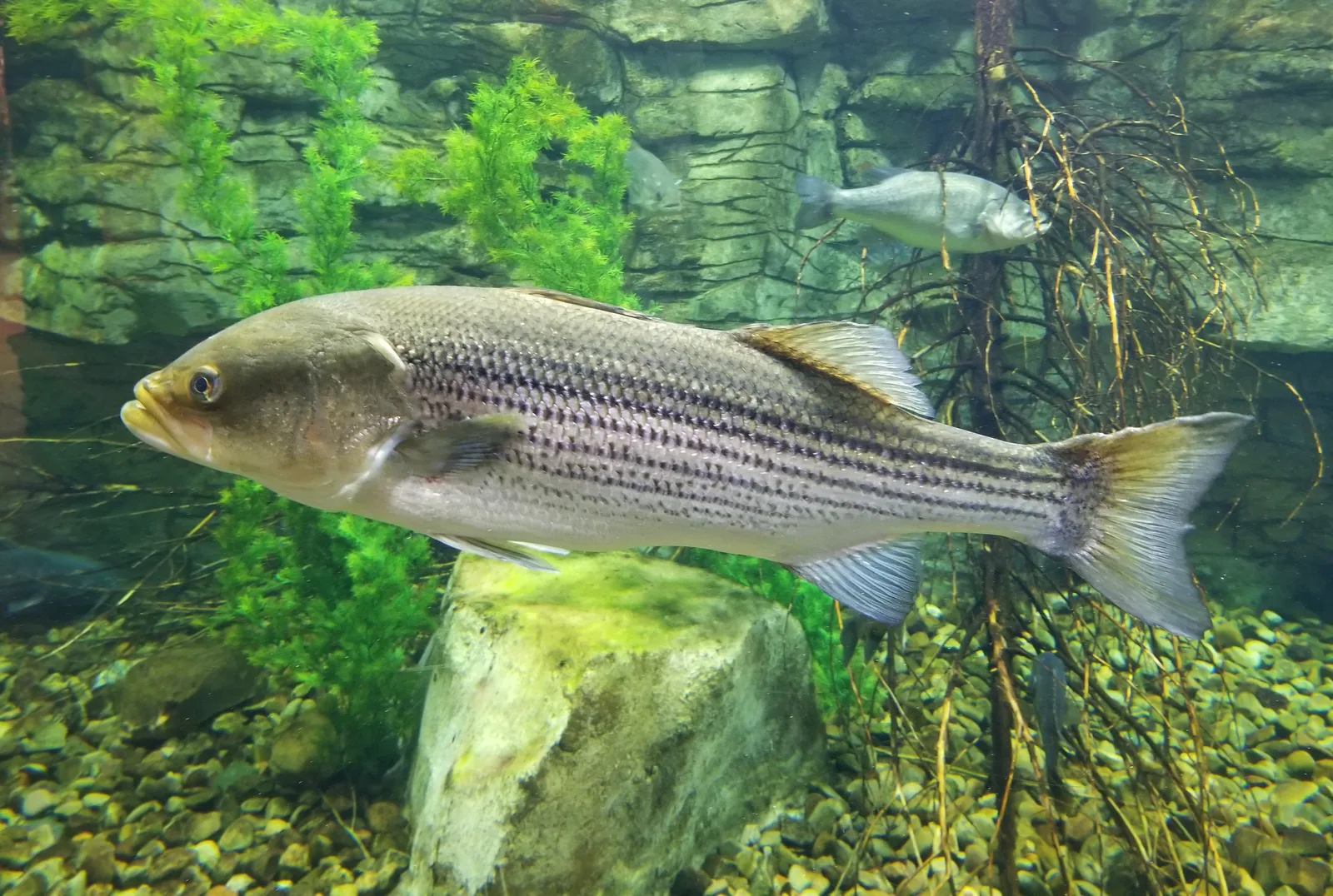
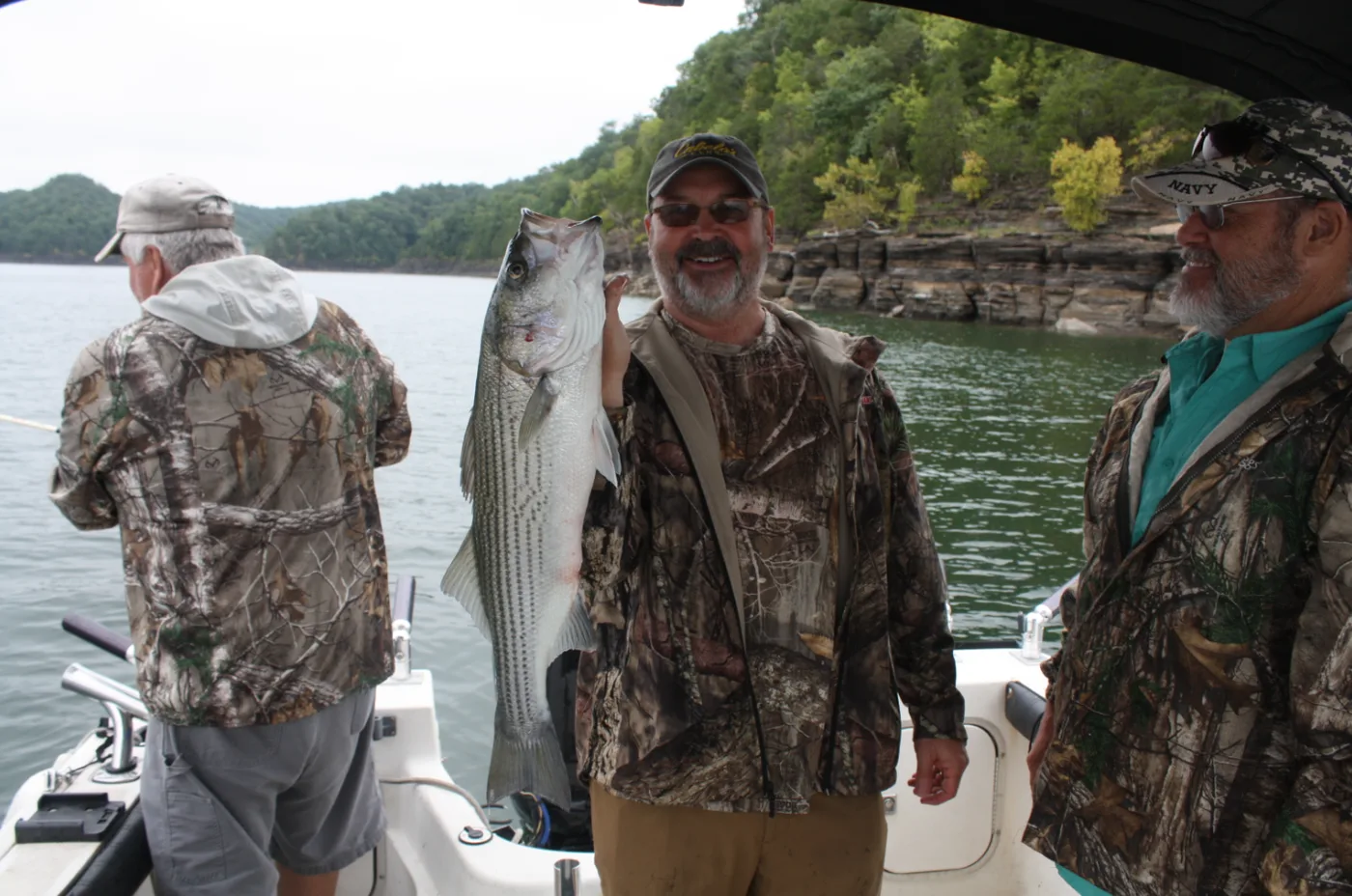
A striped bass. Photo: khairil77 / Depositphotos.
How long do yellow bass live?
Not long. Both sexes mature at age 3, and Iowa DNR says few adults live beyond 4 or 5 years, and Minnesota says few live beyond five. FishBase gives 11 years as the oldest reported age, and that’s the exception, not the rule.
What are the limits, and are yellow bass good to eat?
Limits are loose or absent. Texas sets no bag or size limit on yellow bass. Missouri counts them in a combined bag with white, striped and hybrid bass. The limit is 15 a day and 30 in possession, only four of them over 18 in, a size few yellow bass ever reach. Both state records above are 16½ in long. Check your own state’s rules before you keep a bucketful.
On the table they beat their size. Missouri’s field guide says the yellow bass “is a better tasting fish than the white bass.” Iowa calls them “a fish of the highest quality to eat.” The fillets are small, so a meal takes a school, and a school is what you’ll usually find.
What else are yellow bass called?
Anglers call it barfish, brassy bass or streaker. In Texas some call it a striper, which it isn’t. Its scientific name is Morone mississippiensis, after the Mississippi River it was first described from. It belongs to the temperate basses with the white bass, the striped bass and the white perch. Young yellow bass eat small crustaceans and insects, and adults eat fish too, including their own young.

Free PDF · 16 pages
Stop guessing. Know what's biting before your first cast
A whole Saturday on the water with nothing to show for it. One reading tells you who's feeding.
The Water Temperature Fishing Chart. Take one water temperature reading, find it on the chart, and see which of 26 freshwater fish are spawning, feeding hard or slowing down.
- Where bass, crappie, bluegill and walleye sit, and what to throw. Trout: the reading where you stop.
- Why a 3 ft drop beats a cold front, and what to throw each day of the front
- The three thermometer mistakes that make a reading lie
The chart's numbers come from state fish and wildlife agencies and fisheries research: 64 sources, each listed on the site.
No card, nothing to buy. The PDF is in your inbox a minute later, one version for your phone and one to print, yours to keep. Then a few short emails and one a week on what's biting, with an unsubscribe link in every one. Privacy.
Related
Section guide
Striped Bass: The Striper, Its Kin and the 2026 StockStriped bass, striper, rockfish: one fish. The tongue test that sorts it from white, hybrid and yellow bass, its age by weight, and the 2026 stock.
 Striper Fishing: How to Catch Striped Bass, Coast and Lake
Striper fishing on the coast and inland: the months the fish arrive, the tide and the hour, bait or lures, and the one-fish slot limit.
 White Bass: How Big They Get, Where They Live and How to Catch Them
White bass from the agency data: how big they get, why most die by age four, the one-tooth-patch test against stripers and the 55–60 °F run.
Sources (25)
- Texas Parks and Wildlife, yellow bass (Morone mississippiensis)
- Texas Parks and Wildlife, bass comparison and identification
- Texas Parks and Wildlife, white bass (anal spines, color)
- Missouri Department of Conservation, yellow bass field guide
- Missouri Department of Conservation, white bass field guide (size)
Show all 25 sourcesShow fewer sources
- Missouri Department of Conservation, Barry County man catches new state record yellow bass (May 28, 2026)
- Iowa DNR, yellow bass
- Iowa DNR, Fish Iowa: yellow bass (growth, lifespan, feeding, waters, state record)
- Iowa DNR, Fish Iowa: white bass (anal rays, size)
- Minnesota DNR, Rare Species Guide: yellow bass (special concern)
- USGS Nonindigenous Aquatic Species, yellow bass fact sheet
- Outdoor News, fight continues against yellow bass in some of Iowa's lakes (February 2024)
- IGFA world record database, Bass, yellow (all-tackle)
- Outdoor Life, Wisconsin yellow bass record (April 2025)
- Wikipedia, yellow bass (the reported 4 lb 5 oz Morse Reservoir record)
- Indiana DNR, Indiana's record fish list
- Iowa DNR, state record fish: yellow bass (Bill Campbell, Lake Manawa, 1991)
- Wisconsin DNR, hook and line record fish
- Oklahoma Department of Wildlife Conservation, state record fish (hybrid yellow bass)
- Oklahoma Department of Wildlife Conservation, white bass angler guide (spawning run temperatures)
- FishBase, Morone mississippiensis
- FSA package, standard weight equations (yellow bass from Bister et al. 2000)
- Texas Parks and Wildlife, freshwater bag and length limits
- Missouri Department of Conservation, white, yellow and striped bass limits (combined daily and possession limit)
- Missouri Wildlife Code, 3 CSR 10-6.545 white bass, yellow bass, striped bass