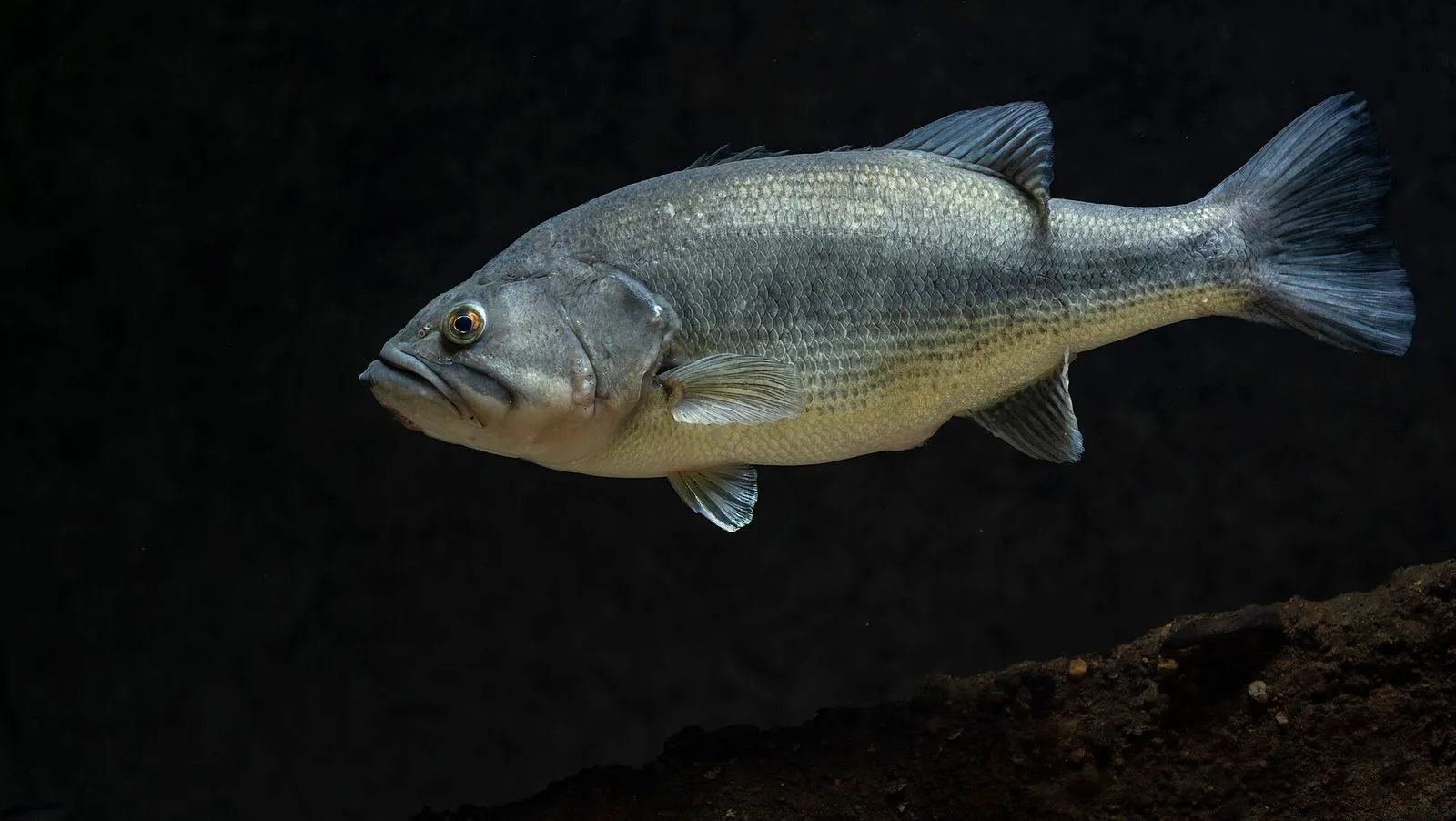
Yes, bass is good to eat: Arizona’s game and fish department describes largemouth meat as “mild tasting, white, flaky, firm and good tasting.” The bad name comes from three other things: big old fish, warm water and mercury. Keep a small bass from cool water, put it on ice at once, and check the eating advice for the lake you fish.
Mercury in bass is not a city problem. In a federal survey of U.S. streams, largemouth from undeveloped, forested and swampy basins carried more mercury than largemouth from urban ones.
What does bass taste like?
Mild and white, with a firm flake, when the fish is handled well. The complaints anglers trade about muddy or soft fillets mostly come down to two things: where the fish lived and how fast it was iced.
Hank Shaw, a hunter-cook who writes on wild food for Outdoor Life, puts the water first: “In a perfect world, you want to eat largemouth out of a cold river, not a hot farm pond.” Cold water gives firmer meat, he writes, and the muddy taste in the skin disappears in river fish. The second rule is ice. It is “critical to ice your fish down as soon as they are dead,” he writes, or they turn “to mush.”
Will Brantley, Field & Stream’s hunting editor, adds a practical point: a bass fillet is bigger and easier to clean than a bluegill fillet.
One naming trap: the bass on the FDA’s chart for store-bought fish are saltwater fish. Black sea bass is a Best Choice; Chilean sea bass and ocean striped bass are Good Choices. Freshwater black bass are not on that chart at all, so their advice comes from your state.
Largemouth, smallmouth or spotted: which eats best?
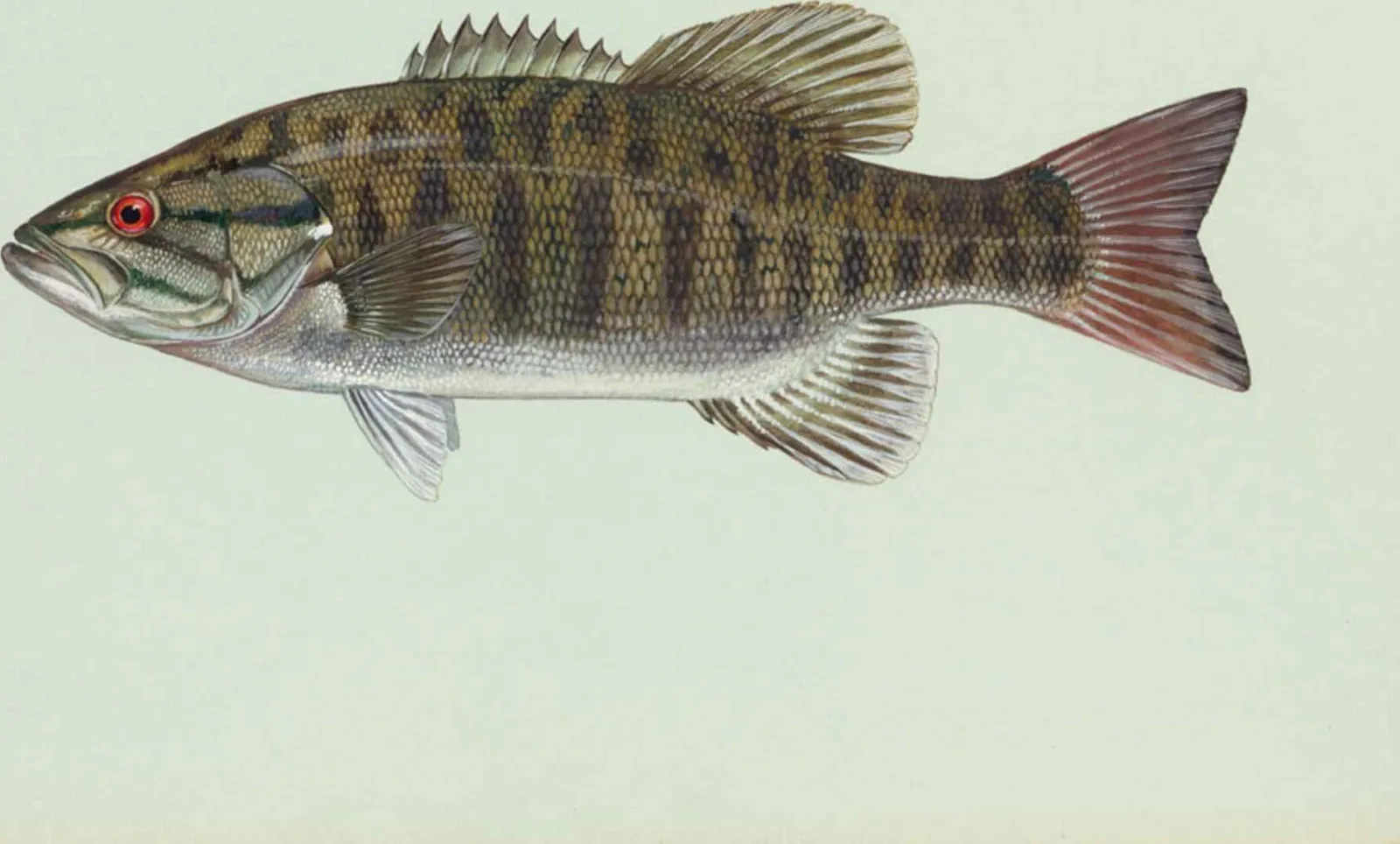
The water decides more than the species. Brantley, who has eaten plenty of both, calls largemouth and smallmouth fillets “pretty much indistinguishable.” Smallmouth do have one head start: they live in cool, clear, rocky water, which is exactly the water Shaw wants his bass from. The smallmouth vs largemouth page shows how to tell the two apart before one goes in the cooler.
Health agencies treat them alike too. Minnesota’s advice has a single row for “bass,” Wisconsin’s puts bass in one row with walleye and pike, and Florida’s bag limit counts its black bass species together in one daily total of five.
Spotted bass are cleaned and cooked the same way. Their look-alike, the Alabama bass, is a bass some agencies ask you to keep. Where it has spread in North Carolina, the state wildlife commission tells anglers to “harvest all Alabama Bass they catch.” It removed every size and creel limit on them on August 1, 2020, and warns that releasing them “will only make our bass fisheries worse.”
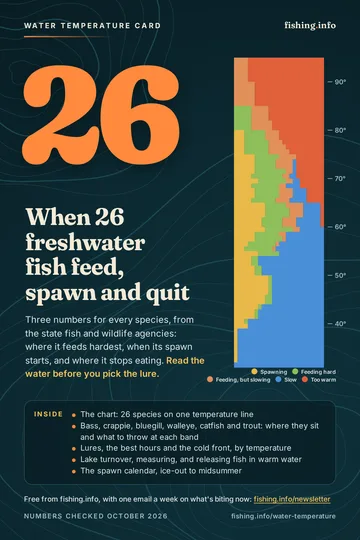
Free card: what 26 species do at your water temperature
Plus one email a week on what's biting now. No sales pitches. Privacy.
Which bass should you keep?
The small ones. Shaw’s personal rule is to keep no largemouth “heavier than about 3 pounds.” He gives three reasons. The biggest bass tend to be the breeding females. Their flake “gets very coarse, which isn’t an advantage at the table.” And “large bass are more apt to be wormy than younger ones,” though that depends on the water. Brantley usually lets bass over 4 lb go and calls a 12-inch largemouth tasty.
Mercury points the same way. Florida’s health department notes that the level in a fish depends on its age, its species and the water it lives in. A big bass is an old bass that has eaten for longer.
Some fisheries managers say the same. Gene Gilliland, B.A.S.S. National Conservation Director, argues that “keeping smaller, more abundant bass” is needed “to reduce competition for food and increase growth rates.” That is selective harvest: release where it helps, keep where it helps.
Florida’s fishing law reads like the same advice. Anglers may keep five black bass a day, only one of them 16 in (41 cm) or longer, and there is no minimum length for largemouth. Where a lake has a slot limit, the slot decides which sizes may go home. Look up the rule for your water on the state license and regulations page before a fish goes in the cooler.
Is bass safe to eat? What the mercury advice says
Yes, within limits, and the limits are tighter for bass than for panfish. Start with the federal default. The FDA and EPA write their fish advice for people who are or may become pregnant or are breastfeeding, and for children aged 1 to 11. For fish caught by family and friends, they say to check the local advisory. “If there is no advisory, eat only one serving and no other fish that week.” A serving is 4 oz (113 g) in pregnancy; for children it runs from about 1 oz at ages 1 to 3 to 4 oz at age 11.
Bass get stricter advice than the panfish in the same lake because they are predators, and mercury builds up along the food chain. A U.S. Geological Survey study of streams sampled from 1998 to 2005 found fish above EPA’s human-health criterion of 0.3 parts per million at 27% of its sites. The highest levels came from blackwater streams draining forest and wetland in the East and Southeast, and from mined basins in the West. The top samples there reached 1.80 and 1.95 parts per million, six times the criterion or more.
Here is what that looks like in the advice itself, bass beside the panfish from the same water. Read the rows across: on every line the panfish gets as many servings or meals as the bass, or more.
| Water (agency) | Who it is for | Bass | Panfish, same water |
|---|---|---|---|
| Any water with no advisory (FDA/EPA) | Pregnant or breastfeeding, children 1 to 11 | 1 serving, no other fish that week | Same rule |
| Minnesota, statewide | Men and boys 15+, anyone not planning a pregnancy | 1 serving a week | Crappie or sunfish: up to 4 a week |
| Minnesota, statewide | Children under 15; may become pregnant, pregnant or breastfeeding | 1 serving a month | Crappie or sunfish: 1 a week |
| Wisconsin, most inland waters | Over 15; not pregnant or nursing, not likely to become pregnant in 3 to 5 years | 4 servings a month | Bluegill or crappie: unrestricted |
| Wisconsin, most inland waters | Under 15; pregnant, nursing or may become pregnant in the next 3 to 5 years | 1 serving a month | Bluegill or crappie: 4 a month |
| Lake Okeechobee and rim canals, Florida | Women of childbearing age, young children | 1 meal a month | Bluegill: 1 a week |
| Lake Okeechobee and rim canals, Florida | Everyone else | 1 meal a week | Bluegill: 2 a week |
| Fisheating Creek, Florida | Everyone | Do not eat | Bluegill: 1 a month |
Minnesota’s table works by the week. You pick one category each week and stay within its count, so a week with a bass serving is a one-serving week, while a crappie week allows four. Once a month you may also add one species from any category. The statewide table leaves out Cook, Lake and St. Louis counties, which have their own, and bases its numbers on mercury, PFOS and PCBs in fillets. Florida counts a meal as 6 oz (170 g) of cooked fish. For women of childbearing age and young children who do not know whether their water was tested, Florida says to eat only one 6 oz meal of largemouth a month.
Keep it in proportion. For most people, Florida’s guide says, the mercury risk from fish “is not a health concern”; the extra caution is for unborn babies and young children. The same guide calls bream such as bluegill and redear sunfish “generally low in mercury,” which is why bluegill is the easier fish to eat often.
The rows also show why the lake matters more than the species. Florida lists hundreds of waters, and its largemouth advice runs from two meals a week to do not eat. Its printed guide dates from 2021, so the state’s online search is the current word. Every state publishes a consumption advisory like these: search your state health department by waterbody name before you plan a fish fry.
Why do bass anglers let them go?
Not because of the taste. Catch and release became the custom in bass fishing through tournaments. In 1972 B.A.S.S. founder Ray Scott started a campaign called Don’t Kill Your Catch and required aerated tanks, the livewell, in tournament boats. “I didn’t invent catch and release,” Scott said later, “but we did make it popular in bass fishing.” He added: “We preached that a bass is too valuable to be caught only once.”
Ordinary anglers followed. A Florida survey in 1989 found voluntary release of largemouth running from 8% to 85% across 11 lakes, with a mean of 40%, and nine lakes surveyed over the previous decade showed the share rising.
The argument is still live. In a 2026 Field & Stream debate, Derek Horner, a tournament angler, makes the case for releasing bass and eating crappie, bluegill, perch or walleye instead. Horner concedes that a licensed angler may take a fair share of the daily limit; Brantley answers that he eats his, and that delayed deaths after release happen “more often than catch-and-release advocates would like to admit.” Gilliland’s middle road sits between them: keep some small ones, let the big ones go. How many released bass survive, and what raises the odds, is on the catch and release page.
How do you clean and cook a bass?
The steps below follow Shaw, the Minnesota DNR and the federal food-safety chart.
- Check the fish before you keep it. Length, bag limit and any slot come first. Florida forbids filleting a black bass, or cutting off its head or tail, until you finish fishing for the day, so the fish can still be checked against the length rule.
- Ice it at once. Shaw’s rule is ice as soon as the fish is dead; a bass left warm turns soft.
- Fillet it. Cut each side away from the backbone and off the ribs, the same way you would fillet a big bluegill.
- Scale or skin. Shaw scales a river bass and skins a pond bass.
- Do not worry about tapeworms. Long, coiled flat worms in the gut or belly are the bass tapeworm. They make the fish unappealing, but the Minnesota DNR says “the eating quality of the fish is not affected” and there is “no human danger if the fillets are cooked thoroughly.” Bury the guts or put them in the household trash; never throw them back in the lake.
- Cook to 145°F (63°C). That is the federal safe temperature for fish, bass named among them, or the point where the flesh “is no longer translucent and separates easily with a fork.”
As for the pan: “Nothing beats skinned and fried, whether it’s in cornmeal, breadcrumbs, or beer batter,” Shaw writes. He also grills bass whole or on the half shell, skin on to protect the meat, and steams the smaller scaled fish. For pickled bass, which is never cooked, he freezes the fish first to kill any parasites. Brantley’s split is simpler: small bass to fry, bigger ones to grill.
The small bass you want for the table are also the easiest to catch in numbers; the beginner’s season guide shows where they are in each season, and the bass hub has the rest of the family.
Gear for bass
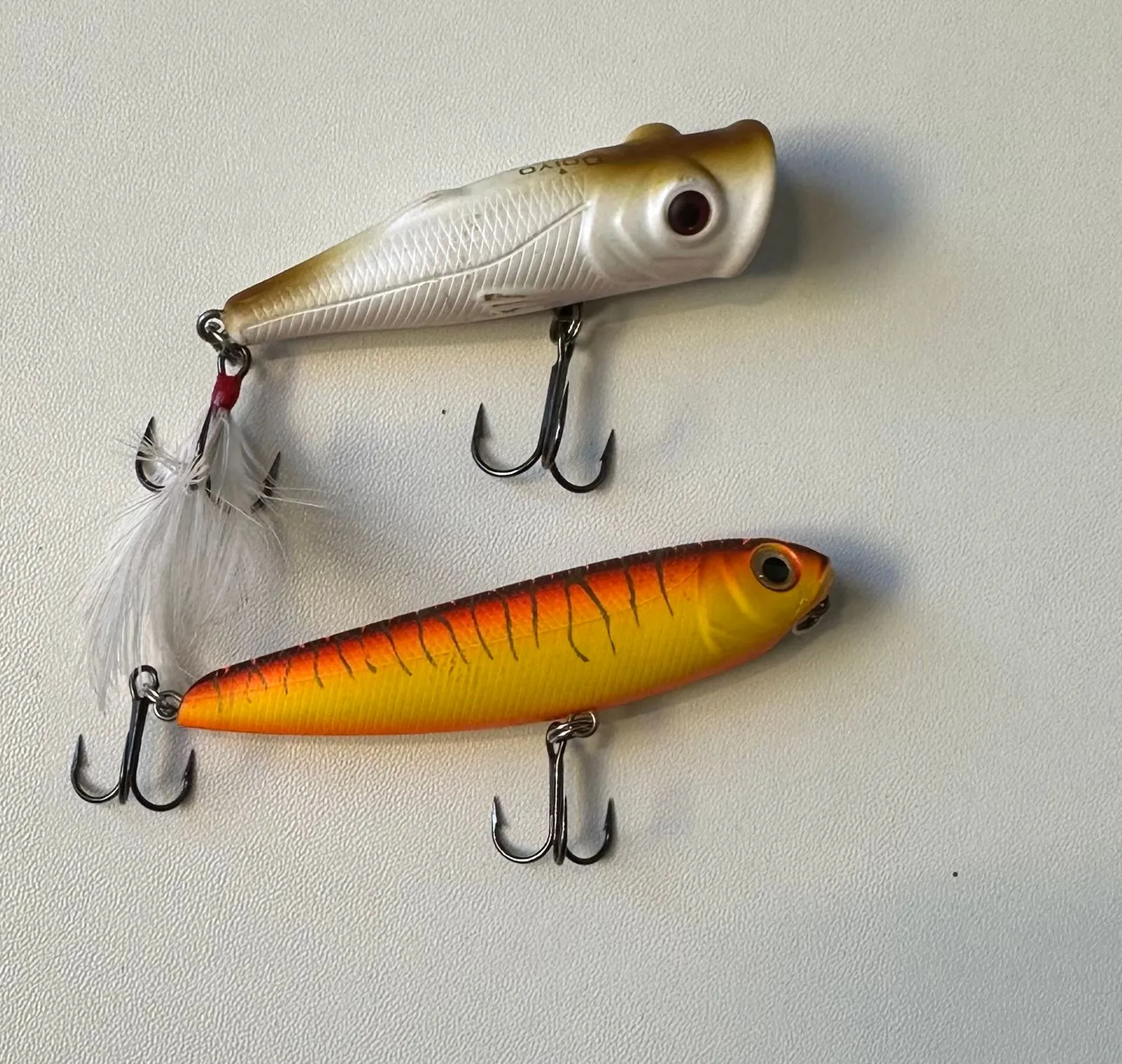
Gear guide
Best Bass Lures: What Won the 2025 and 2026 Elite Series, Season by SeasonBest bass lures from two seasons of Elite Series winning baits: a lure for each water color, depth, cover and season, with smallmouth and spotted bass picks.
Free download
The water temperature card
Read your water temperature and the card tells you who is spawning, who is feeding and what to throw. 26 species, 16 pages, for your phone and the tackle box.
Plus one email a week on what's biting now. No sales pitches. Privacy.
Related
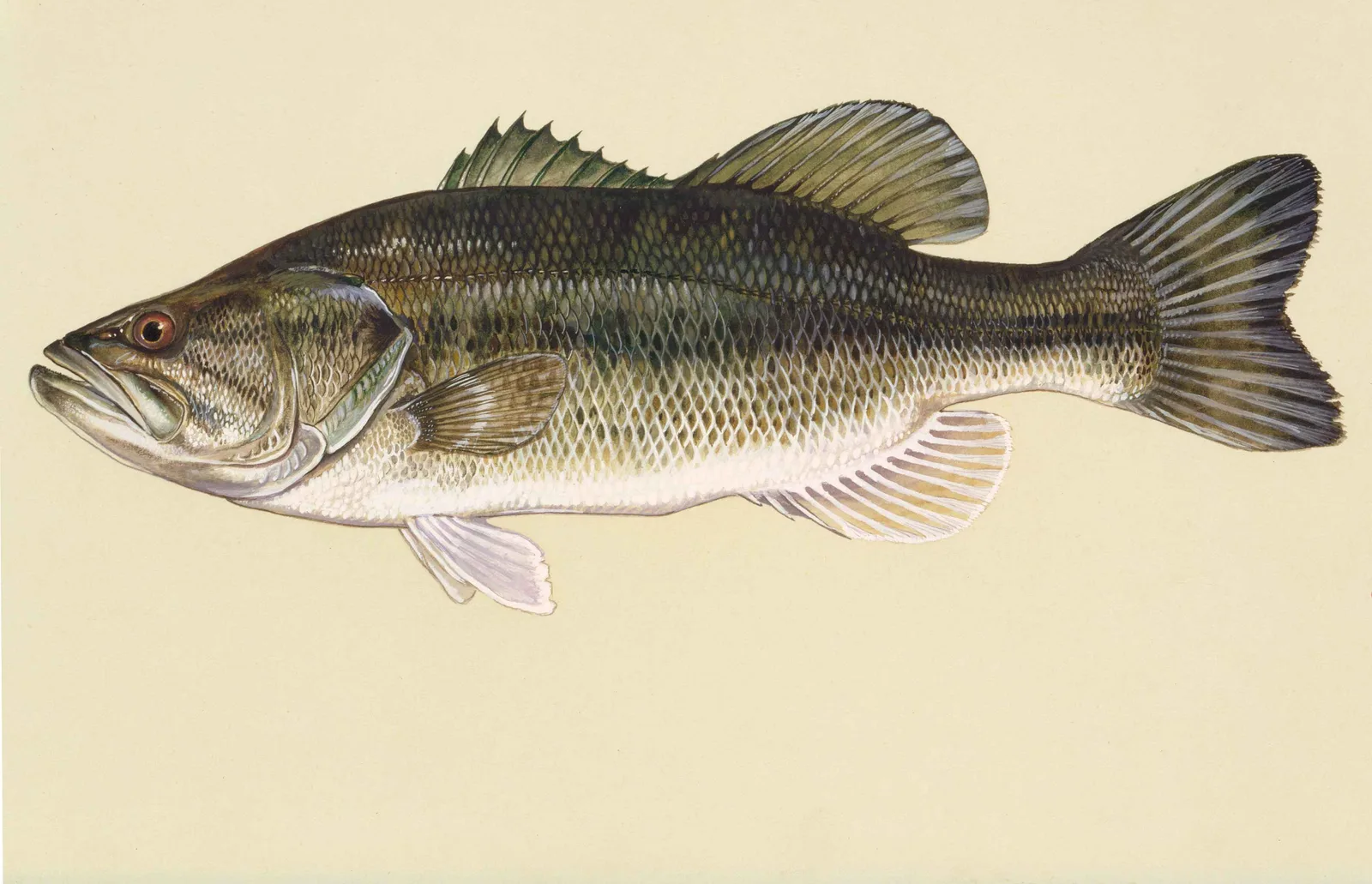
Section guide
Bass Fishing: Where the Bass Are, What to Throw, and the Three Bass You Will MeetBass fishing from the angler's side: where largemouth, smallmouth and spotted bass are at each water temperature, what to throw first, how to tell them apart.
 World Record Smallmouth Bass: The Hayes Fish and the False Affidavit
The world record smallmouth bass weighs 11 lb 15 oz, caught at Dale Hollow in 1955. How it was struck off and restored, the IGFA records, the state records.
 Bass Bait: The Best Live Bait and Lures, Matched to What Bass Eat
The best bass bait is whatever your bass already eat: shiners, crawfish, shad or bluegill, live or as a lure. What works, what size, and where it's legal.
- Black Bass: What the Name Means, and All 19 Species
Black bass are the genus Micropterus: 19 species, from largemouth to Bartram's bass. What the name means in science, law and the record book.
 Best Time to Fish for Bass: Season, Time of Day and Weather
The best time to fish for bass is the pre-spawn at 48–55 °F and the fall feed, at dawn and dusk. Season table, hours, night and weather.
 When Do Bass Spawn? Water Temperature and Timing by Region
Bass spawn when the water holds about 60 °F: February in Florida, June in Minnesota. The temperature bands, a calendar by region and how to fish each stage.
- Smallmouth vs Largemouth Bass: How to Tell Them Apart
Smallmouth vs largemouth bass: the jaw, the stripe and the dorsal fin settle the identification in seconds. Then habitat, size, records and how each one fights.
Sources
- Arizona Game and Fish Department, Largemouth bass: table quality
- Hank Shaw, Secrets for a better tasting largemouth bass fry, Outdoor Life (May 20, 2026)
- Derek Horner and Will Brantley, Catch-and-release vs. catch-and-eat bass fishing, Field & Stream (March 23, 2026)
- Will Brantley, Grilled bronzeback vs baked bucketmouth, Field & Stream (March 26, 2024; archived copy)
- U.S. FDA and EPA, Advice about eating fish: fish caught by family and friends, serving sizes, the Best Choices chart
- Minnesota Department of Health, Statewide fish consumption guidelines (based on mercury, PFOS and PCBs)
- Minnesota Department of Health, Statewide guidelines for general populations (March 10, 2026)
- Minnesota Department of Health, Statewide guidelines for sensitive populations (March 10, 2026)
- Wisconsin DNR, Eating your catch: statewide safe-eating guidelines for most inland waters
- Florida Department of Health, Your guide to eating fish caught in Florida (June 2021, v2): untested waters, meal size, Table 1 by waterbody
- Florida Department of Health, Fish advisories (search by waterbody)
- Scudder and others (2009), Mercury in fish, bed sediment, and water from streams across the United States, 1998–2005, USGS Scientific Investigations Report 2009-5109
- North Carolina Wildlife Resources Commission, Alabama bass: harvest all Alabama bass you catch
- Minnesota DNR, Bass tapeworm
- FoodSafety.gov, Safe minimum internal temperatures
- Florida FWC, General freshwater fishing regulations: black bass bag and length limits, no filleting before the day's fishing ends
- Greg Tinsley, Ray Scott: Bassmaster extraordinaire, Mossy Oak (May 11, 2022)
- Champeau and Thomas (1991), Voluntary release of largemouth bass by Florida anglers, Proceedings of the SEAFWA
- Bass Fishing Hall of Fame, Do you eat bass? Gene Gilliland, B.A.S.S. National Conservation Director, on selective harvest (August 29, 2025)