 By
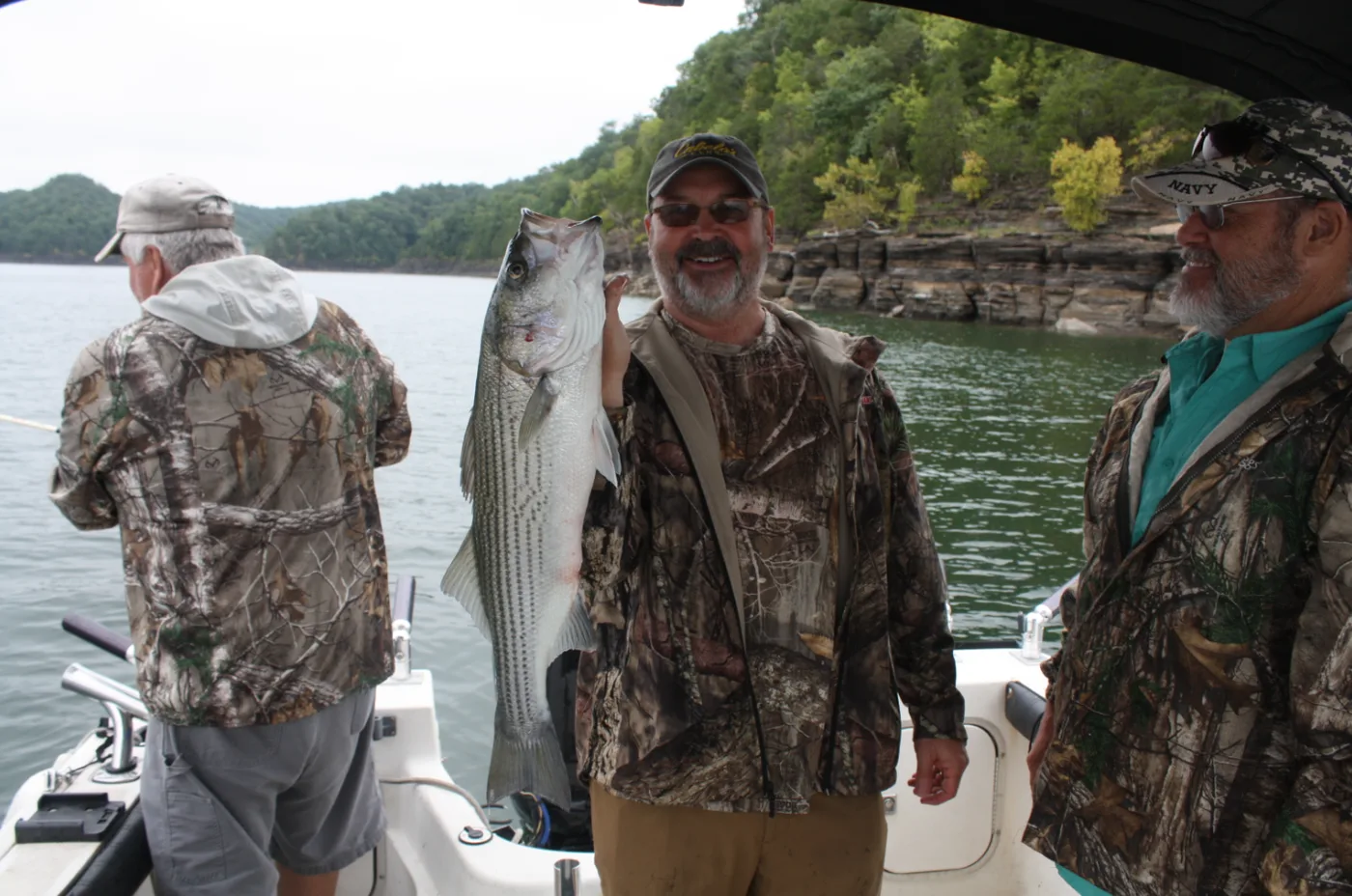
A striper is the angler’s name for the striped bass, and striper fishing pays best in water of about 55–68 °F (13–20 °C), at dawn, dusk or after dark, wherever the water moves. On the coast that means a tide; on a reservoir it means wind on a point, current at a creek mouth or a school of shad. Find the bait fish and the striped bass are close, because a striper spends its life following food. The details change between a beach in Massachusetts and a lake in Oklahoma; the rule does not.
Anglers release about 90 percent of the Atlantic stripers they catch, and about 9 percent of those die afterward, ASMFC estimates. Recreational fishing now accounts for about 82 percent of all striped bass removals, counted by number of fish.
What month is best for striper fishing?
It depends on where you stand, because the Atlantic fish migrate. They winter offshore, most of them in deeper water off Virginia and North Carolina, move into the Chesapeake in mid-March, and spawn there and in the Delaware and Hudson in April and May. Then they spread north. Massachusetts has them from May to November, and Maine by early June, peaking in July and August.
The two big windows on the coast are the spring run, March to June from the Chesapeake north, and the fall run on the way back south. The fall run is September to November in the Northeast and November to January in the Mid-Atlantic, by The Tackle Room’s calendar. The fall dates rest on angler reports rather than agency surveys; a warm autumn pushes them later.
Inland the calendar is set by temperature and shad. On Lake Texoma, Texas Parks and Wildlife has the stripers running up the Red and Washita in February, then following shad over the flats after the spawn. Oklahoma’s guide puts the best bank fishing on windblown shorelines and the dam during the shad spawn in May, and again in the fall feed before winter. Summer is deep-water fishing everywhere: Texas puts the striper’s preferred water below 75 °F (24 °C) and calls fish over 10 lb “particularly dependent on cool water”. The water temperature chart shows when stripers switch on beside the other species.
What time of day, and what tide?
Low light, every time. Jerry Audet’s shore guide for Farmers’ Almanac names the first 90 minutes of light, the last 90 minutes, and full darkness with a moving tide. On Lake Cumberland, Kentucky’s fisheries agency tells anglers to fish from daybreak until 9 a.m., and again from the last hours of daylight into the night. The time of day page explains why most predators follow that clock.
On the coast, Audet puts the tide ahead of the hour: fish from about two hours before to two hours after high tide, and skip slack water, when nothing moves. That is an angler’s rule of thumb, not a measured result. He adds a seasonal twist: the outgoing tide in spring and fall, and the incoming tide in summer, which brings in cooler ocean water. A 2–4 ft (0.6–1.2 m) swell fishes better than a glassy calm.
Free PDF · Water temperature chart When do striped bass bite?
One water temperature reading, and the 16-page chart tells you who's spawning, who's feeding hard, where they sit and what to throw. 26 fish, every number sourced.
Enter your email, confirm it with one click, and the PDF is in your inbox. Plus one email a week on what's biting. Unsubscribe anytime. Privacy.
Where are the stripers, season by season?
The table is the year in one view: where the fish are and what takes them, for the three ways most people fish. Coastal rows assume the mid-Atlantic to New England; reservoir rows are the Southern and Plains lakes with shad.
| Season | Surf and shore | Boat, coast and bay | Reservoir |
|---|---|---|---|
| Winter | Holdover schoolies in rivers and bays; the North Carolina and Virginia beach run, November to January | Wintering schools off Virginia and North Carolina; Virginia’s ocean season opens January 1 | Deep with the shad schools; find them on sonar and lower live shad to that depth |
| Spring | Fish arrive in April and May; plugs at night, worms and clams on the bottom | Big females head for the spawning rivers; some rivers close to all striper fishing | Texoma’s run up the rivers starts in February; heavy jigs, slabs, plastic shad, live gizzard shad |
| Summer | North of Cape Cod: dawn and dark, sand eels and herring | Live bunker and eels, trolling, jigging on reefs; Maryland’s Bay closes in August | 25–30 ft (8–9 m) humps near the channel; jigging spoons and live bait at first light |
| Fall | The fall run: blitzes on bait, chunk bunker, bucktails and plugs | Birds over bait schools as the fish move south | The pre-winter feed: windblown points, riprap, topwater when they boil |
The summer reservoir cell is Walker Smith’s pattern on Wired2Fish: humps topping out at 25–30 ft beside a creek or river channel, which he likens to rest stops on a highway the fish travel.
What do you need?
A striper outfit is heavier than a bass outfit and, on the beach, much longer: a 10 ft surf rod or a 7–8 ft boat rod. On a reservoir, Oklahoma’s guide specs a medium to medium-heavy rod with 8–14 lb line; for vertical spoons over humps, Smith uses a medium-heavy casting rod and 17 lb fluorocarbon. The striper fishing gear for surf, boat and reservoir differs mainly in rod length, reel size and line. Bait for Atlantic stripers goes on an inline circle hook by law.
Maryland adds gear rules of its own in the early season. Through May 15 in 2026, its DNR bans stinger hooks, limits trolling to six rods and requires barbless hooks while trolling, to keep released spring fish alive.
Bait or lures?
The best bait is whatever the stripers in your water are eating, alive if the rules allow it. A coast-wide diet study (Walter and colleagues, 2003) found menhaden, anchovies, river herring and Atlantic herring dominating the diet after the first year. South of Cape Cod that means menhaden, called bunker; north of it, herring and sand eels. Reservoir stripers eat threadfin shad, gizzard shad and blueback herring. The world record took a live eel, the landlocked record a live gizzard shad.
Lures cover water bait cannot: plugs and poppers on the beach, bucktails in current, shad imitations on a lake. Those are the core striped bass lures, and each has a situation it is for.
How do you find and catch a striper, step by step?
- Pick the window by temperature. Plan around 55–68 °F water and low light. In late summer, when the water passes 70 °F, fish early and short, or fish somewhere cooler.
- Find the bait first. On the coast, look for birds diving, bait spraying, or a blitz, when stripers drive bait to the surface. On a lake, run the channel edges and humps on sonar until you see bait balls with big arches under them.
- Fish the moving water. Troughs and holes along the beach, rips, sandbar breaks, inlets on a falling tide. Inland, the windblown point, the creek mouth and the tailwater below a dam when water is released.
- Match the size of the bait. A 4 in (10 cm) shad school wants a 4 in lure; a fall run on adult bunker wants a big plug or a chunk.
- Choose the method for the spot. A fish-finder rig with chunk bait on the beach; live-lining a bunker or an eel from a boat; a live shad on a downline straight under a reservoir boat.
- Stay on a school, not on singles. When you find fish, mark the spot and work it. Smith’s advice for reservoirs is to keep looking until the screen fills, and not to stop for one fish.
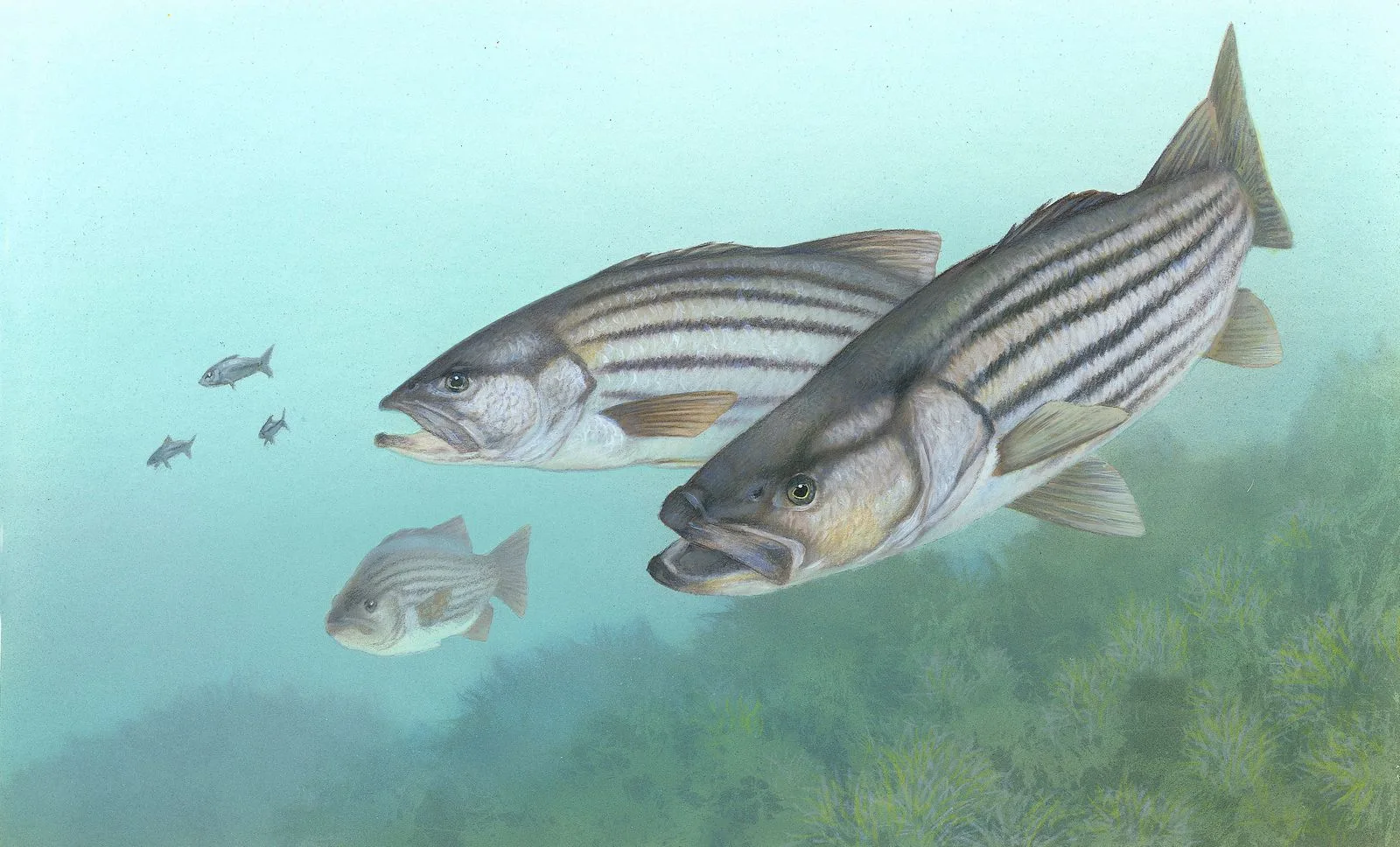
Steps 2 and 6 in one picture: stripers hunt in groups and stay with the bait, so where you find the bait you find the school. Painting: Timothy Knepp, U.S. Fish and Wildlife Service (public domain).
What does a striper bite feel like?
It varies with the method. On a plug it is a hard thump or a swirl behind the lure; keep reeling until you feel the weight. On a jigging spoon, Smith finds most bites come as the spoon falls: the line stops short or goes slack, and you set at once. On bait with a circle hook, do the opposite of a bass hookset. Let the fish take the bait, then reel until the rod loads, and the hook turns into the corner of the jaw by itself.
A good striper will take drag, and fighting it to a standstill on locked-down drag breaks line or kills the fish. The working rule from The Fisherman’s striper column is a drag of 25–30 percent of the line’s breaking strength; then let the fish run. In warm water, keep the fight short.
What are the rules, and how do you release one?
Along the Atlantic coast in 2026 you may keep one striper a day: 28–31 in (71–79 cm) in the ocean, 19–24 in (48–61 cm) in the Chesapeake Bay. The stock is officially overfished; ASMFC rejected a proposed 12 percent cut in October 2025 and kept those slots for 2026. States add their own rules on top. Maryland closes its spawning rivers to targeting from March 1 to May 31, and the whole Bay to striper fishing in August, when hot water makes released fish more likely to die.
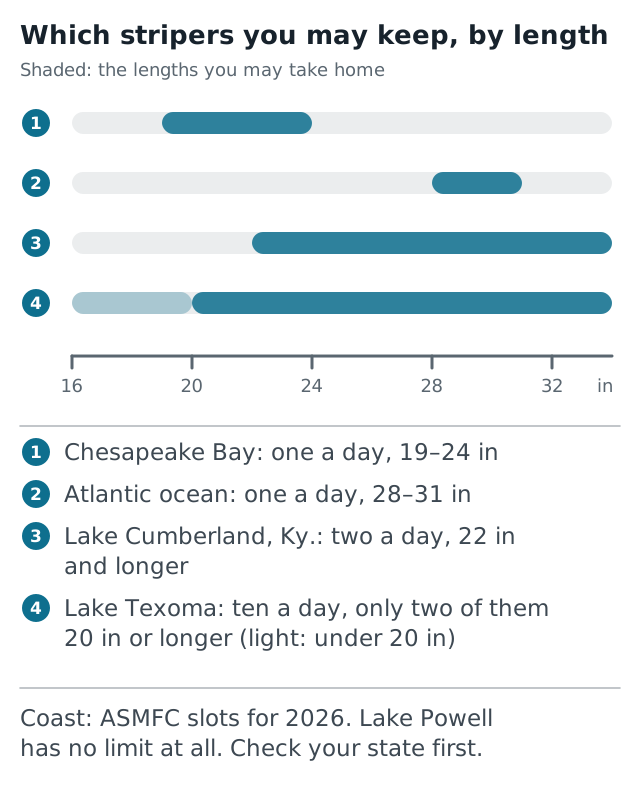
The same fish, four sets of rules: a 26 in striper is too long for the Chesapeake, too short for the ocean, and a keeper on Lake Cumberland. Chart: fishing.info, from ASMFC, Kentucky and Oklahoma regulations.
Inland, the state sets the rule, and it varies widely. Lake Texoma allows 10 stripers and hybrids combined, of which only two may be 20 in (51 cm) or longer. Lake Powell has no limit at all, and Lake Cumberland allows two a day with a 22 in (56 cm) minimum. Check the agency page for your water before you go.
Release is where an angler makes the most difference. Keep the fish in the water while you unhook it, support it upright facing into the current, and let it swim off on its own. The catch and release page has the handling steps. Most stripers over 30 lb are female, Massachusetts’ fisheries division says, and those big females are the fish the slot exists to send back.
Mistakes to avoid
- Fishing the heat of the day in summer. Stripers go deep in warm water, and a fish fought hard in water over 70 °F is more likely to die after release, which is why Maryland closes August. Fish at first light or at night.
- Fishing slack water. No current, no feeding. Plan the trip around the tide chart or the dam’s release schedule.
- Locking the drag. A bass angler’s habit. Smith warns it breaks either the line or the reel on a big striper; set the drag and let the fish run.
- A J-hook with bait. Illegal for Atlantic stripers since January 1, 2021. In Cooke and Suski’s review of 43 studies, striped bass died at 0.8–5.9 percent on circle hooks against 8.7–18.2 percent on J-hooks.
- Mistaking a white bass or a hybrid for a striper. On reservoirs where all three swim, the limits differ. Check the tongue: a white bass has one tooth patch; a striper and a hybrid both have two, but the hybrid’s sit close together or merged, on a deeper body with broken stripes.
Is a striper good to eat?
Yes. The FDA’s survey puts mean mercury at 0.167 ppm for saltwater bass, a group that includes stripers, black sea bass and rockfish; canned light tuna averages 0.126 ppm. PCBs are the bigger, local problem. The Hudson from Troy to Catskill is do-not-eat, and other waters have their own advisories. The striped bass hub has the meal advice by water, and the age-and-weight table for the fish you just landed.
Free PDF · 16 pages
Know what's biting before your first cast
The Water Temperature Fishing Chart. Take one water temperature reading, find it on the chart, and you know which of 26 freshwater fish are feeding today, where they are and what to throw. For your phone and the tackle box.
- The 26-fish chart: who's spawning, feeding hard or shut down at your reading
- Where they sit and what to throw at every band: bass, crappie, bluegill, walleye, catfish and trout
- The best hours at your reading, the cold front day by day, and the spawn calendar from ice-out to midsummer
- The three thermometer mistakes that make a reading lie (the first one is the surface)
Every number from state fish and wildlife agencies and fisheries research: 61 sources, all on the site.
Enter your email, confirm it with one click, and the PDF is in your inbox. Plus one email a week on what's biting. Unsubscribe anytime. Privacy.
Related
Section guide
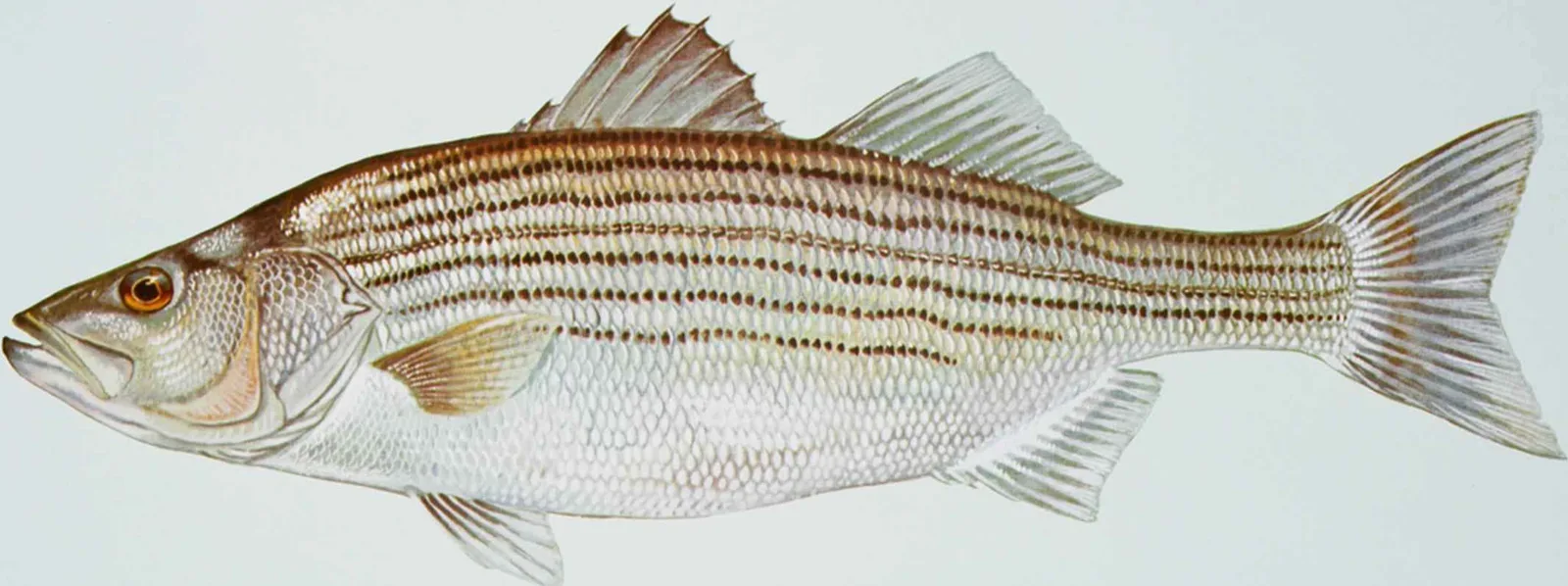
Striped Bass: The Striper, Its Kin and the 2026 StockStriped bass, striper, rockfish: one fish. The tongue test that sorts it from white, hybrid and yellow bass, its age by weight, and the 2026 stock.
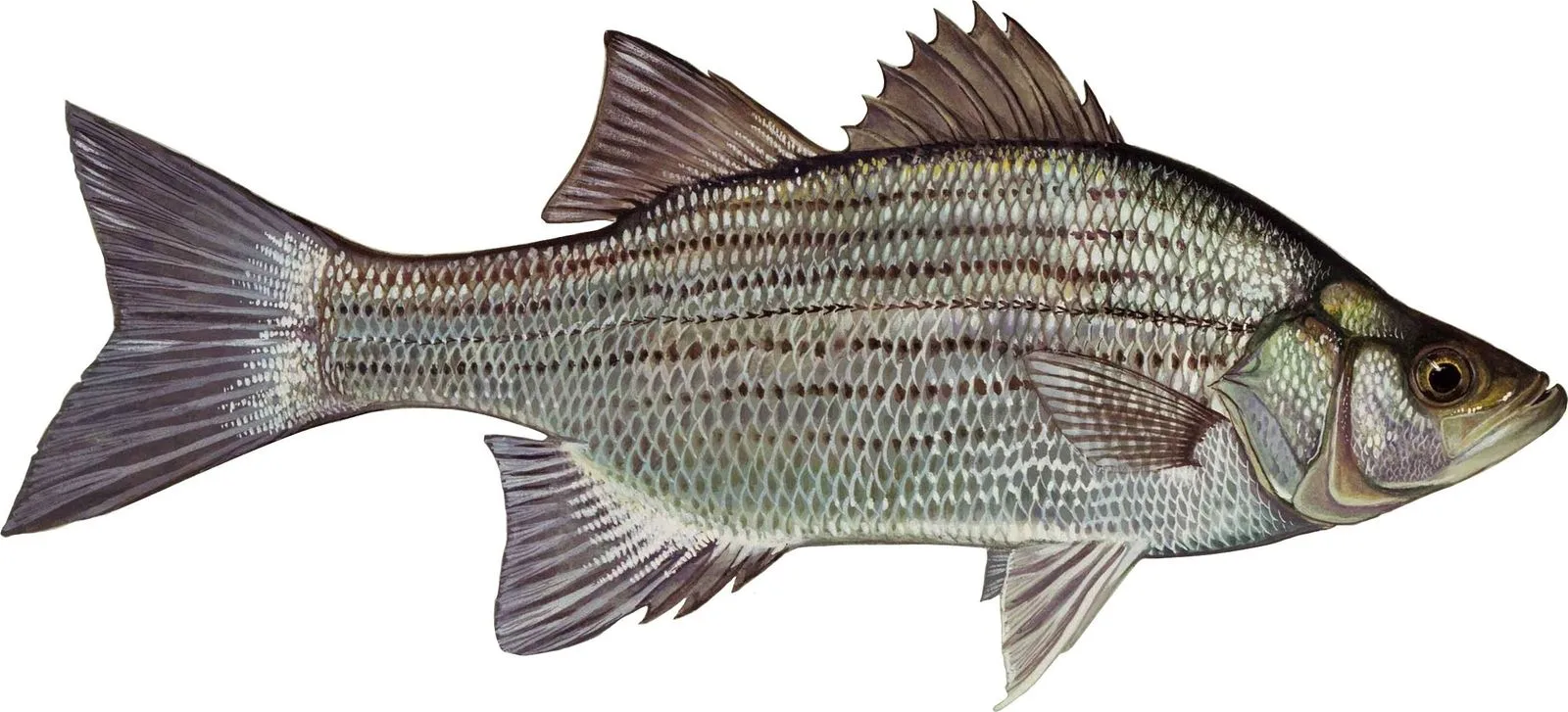 White Bass: How Big They Get, Where They Live and How to Catch Them
White bass from the agency data: how big they get, why most die by age four, the one-tooth-patch test against stripers and the 55–60 °F run.
Sources
- Atlantic States Marine Fisheries Commission, Atlantic striped bass (stock status, slots, release mortality, circle hooks)
- ASMFC press release, Board approves Addendum III without reductions (October 2025)
- Massachusetts Division of Marine Fisheries, learn about striped bass
- On The Water, the striper migration: when will the bass return?
- Maryland DNR, Maryland's 2026 striped bass season opens for catch-and-release fishing in April (closures and gear rules)
- On The Water, striper migration map, June 5, 2026
- Virginia Marine Resources Commission, recreational fishing rules (striped bass seasons)
- Kentucky Administrative Regulations, 301 KAR 1:201 (Lake Cumberland striped bass: 22 in, two a day)
- Texas Parks and Wildlife, striped bass in the Gulf of Mexico? (temperature)
- Texas Parks and Wildlife, fishing Lake Texoma
- Oklahoma Department of Wildlife Conservation, striped and hybrid striped bass angler guide
- Oklahoma Department of Wildlife Conservation, Lake Texoma limits
- Kentucky Afield (KDFWR), striped bass fishing at Lake Cumberland, via NKyTribune (2023)
- National Park Service, Glen Canyon fishing regulations (Lake Powell)
- South Carolina DNR, striped bass (freshwater forage)
- Walter, Overton, Ferry and Mather 2003, striped bass diets along the Atlantic coast, Fisheries Management and Ecology
- Jerry Audet, how to catch striped bass from shore, Farmers' Almanac (tides, times)
- The Tackle Room, striped bass fishing guide (seasons, methods, the 70 °F rule)
- StriperSpace, finding striped bass (temperature band, wintering grounds)
- Wired2Fish (Walker Smith), how to catch striped bass in the summer
- The Fisherman, setting your drag for stripers
- Cooke and Suski 2004, are circle hooks an effective tool for conserving catch-and-release fisheries? Aquatic Conservation 14:299–326
- FDA, mercury levels in commercial fish and shellfish (1990–2012)
- New York State Department of Health, can you eat that striped bass from the Hudson?