 By
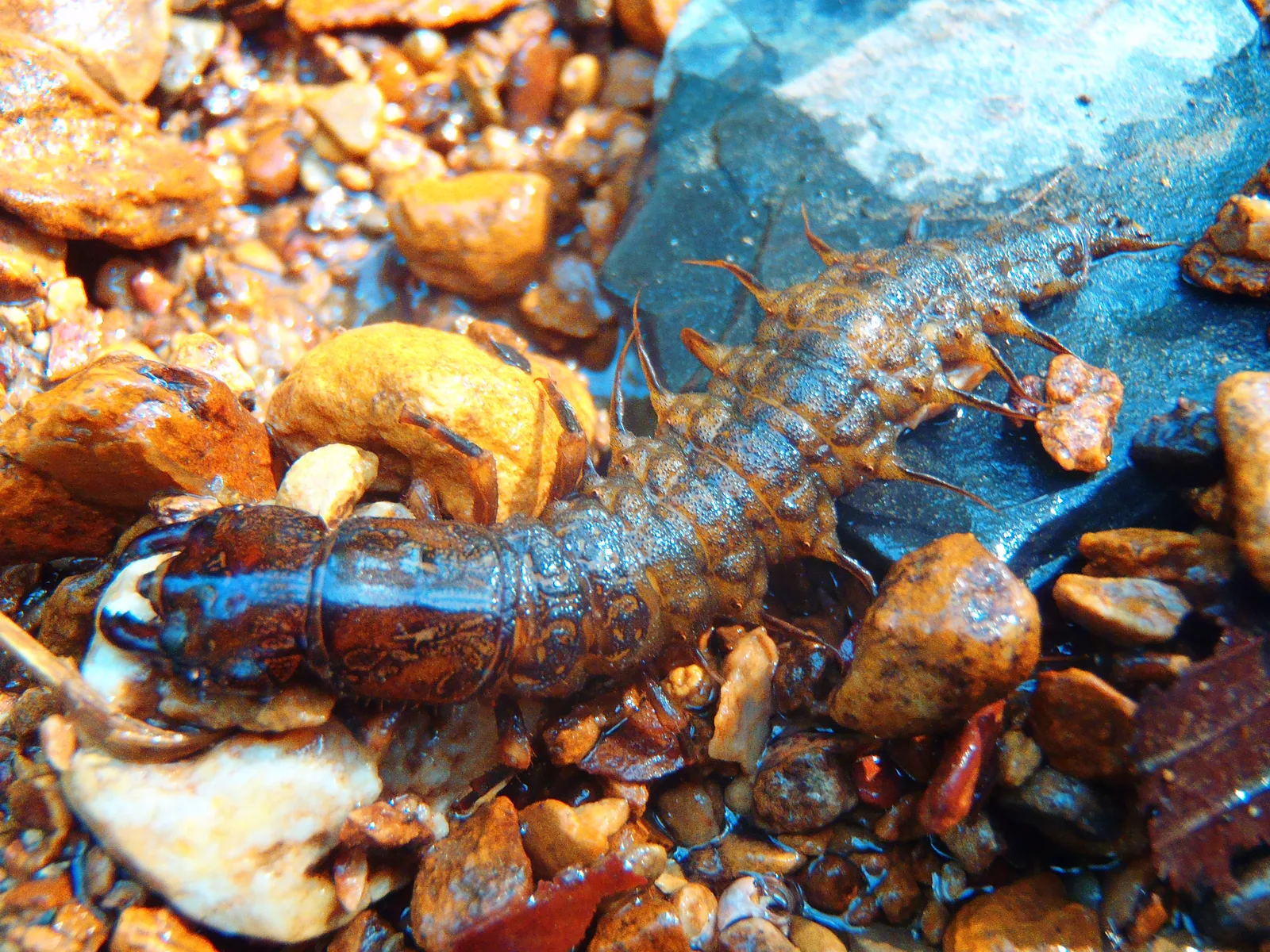
A hellgrammite is the larva of the dobsonfly, a dark bug with pincers, up to about 4 inches long, that hides under rocks in fast streams. It can pinch you hard, but it isn’t venomous. River anglers collect them because smallmouth bass eat them, and a fresh one “will rarely last long” on the hook, Outdoor Life says. Hook it once through the collar behind the head and fish it near the bottom.
In many rivers, smallmouth eat more hellgrammites than any other single food, says Virginia fly shop owner Harry Murray.
What is a hellgrammite?
It’s the water stage of the eastern dobsonfly, and it looks a lot worse than it is. If you just flipped a rock and something long and dark ran at you with its jaws open, this is probably it.
Here’s how to tell. A hellgrammite is usually dark brown, tan or black. It has a pair of big, sharp pincers on the head and six true legs up front. Down the sides of the belly run eight pairs of leglike parts, each with a tuft of gills. At the back end are two small hooks.
The ones bait collectors write about are mostly 2 to 3 inches. Missouri’s conservation department puts the top end at about 4.
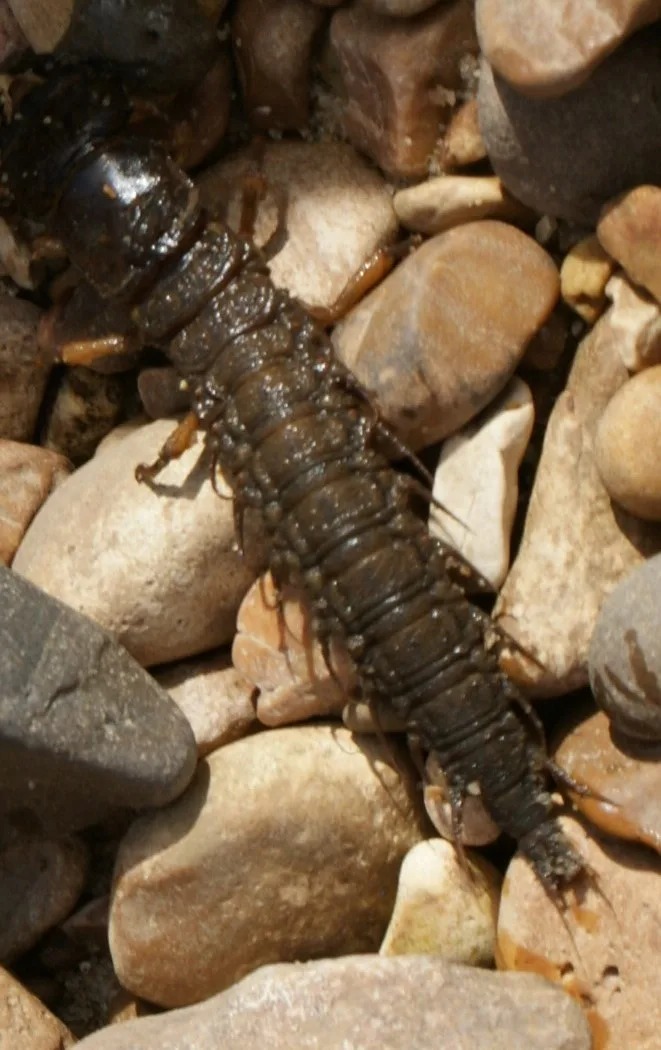
A dobsonfly larva on the rocks. Photo: National Park Service (public domain).
A hellgrammite is a hunter. It’ll “snatch nearly anything that swims or ambles by,” Missouri says, including other water insects and small fish. It stays in the water for 2 or 3 years before it’s done growing.
What does a hellgrammite turn into?
It crawls out of the river, makes a cocoon under cover near the bank, and comes out as an adult dobsonfly. The adult is a huge, mothlike insect that flies at night and often comes to lights, mostly in late spring and early summer. It doesn’t eat, and it lives from a few days to about a week.
The male’s long tusks look like the scariest part of the whole bug. They can’t hurt you, because they don’t have the leverage. The female, with her short pincers, can.
Why do people call it so many things?
Because anglers have been digging them up for a long time. The word was in print in Pittsburgh by 1850, spelled “helgramites.” The regional dictionary of American English lists names like toe-biter, conniption bug, grampus, go-devil and hell-diver. In the same dictionary, a 1950 note from Wisconsin says: “Hellgrammite: used here more than crawler.”
Watch out for one thing at the bait shop. The word doesn’t mean the same bug everywhere.
| Where you hear it | What “hellgrammite” can mean |
|---|---|
| The usual meaning | The dobsonfly larva, the bug on this page |
| Chiefly the West | A stonefly nymph |
| Especially Wisconsin and Washington | A dragonfly nymph, sold in places as “Spider Hellgrammites” |
| Michigan in 1939, California later | A caddis worm, by mistake |
If a shop in Montana sells you hellgrammites, ask what’s in the box.
Can a hellgrammite hurt you?
Yes, a little. “Dobsonflies are not venomous and the worst they can do is pinch you hard,” Missouri’s field guide says. The pincers can pierce the skin, but the bites aren’t harmful, the Bangor Daily News reports from Maine. MeatEater’s writer rates it no worse than a crawfish pinch or a hook prick.
So don’t be scared of them, but don’t be careless either. Pick one up the way Missouri says: “Grasp them behind the head.” That keeps your fingers away from the pincers.
If you just found one in your yard or by a stream, you can leave it alone. Finding one is good news.
Free PDF · Water temperature chart Which fish are biting at today's water temperature?
One reading, and the 16-page chart shows which of 26 fish are spawning, feeding hard or slowing down; for bass, crappie, bluegill and walleye, where they sit and what to throw. Every number sourced.
No card, nothing to buy, and the PDF is yours to keep. Confirm with one click and it's on its way. Then a few short emails and one a week on what's biting. Unsubscribe anytime. Privacy.
Where do hellgrammites live?
Under rocks, in fast, clean moving water. Missouri’s guide says they usually pick the swiftest parts of large streams and rivers. Harry Murray’s description is more exact: under cobblestones, in riffles and runs with plenty of air in the water. A riffle is a shallow, fast, broken stretch over gravel or cobble, and that’s the first place to look. Moss-covered rocks are a good sign. The eastern dobsonfly is the only dobsonfly species in eastern North America, Missouri says.
Want a shortcut? In late summer, look at the leaves hanging over the river. Dobsonflies lay their eggs on branches and rocks near the water, and on the Shenandoah the egg masses show up as white paint splats on the leaves. The larvae fall into the water when they hatch.
You also won’t find them in dirty water, which is the other reason to be glad of them. Hellgrammites live only in clean, pollution-free river water, the Bangor Daily News reports, and they sit in that water for years. “If the larva is there for three years and still thriving, that’s a good thing,” says Jeanne DiFranco, the biologist who runs Maine’s biological monitoring program. A river full of them is a healthy river, and a healthy river holds smallmouth bass.
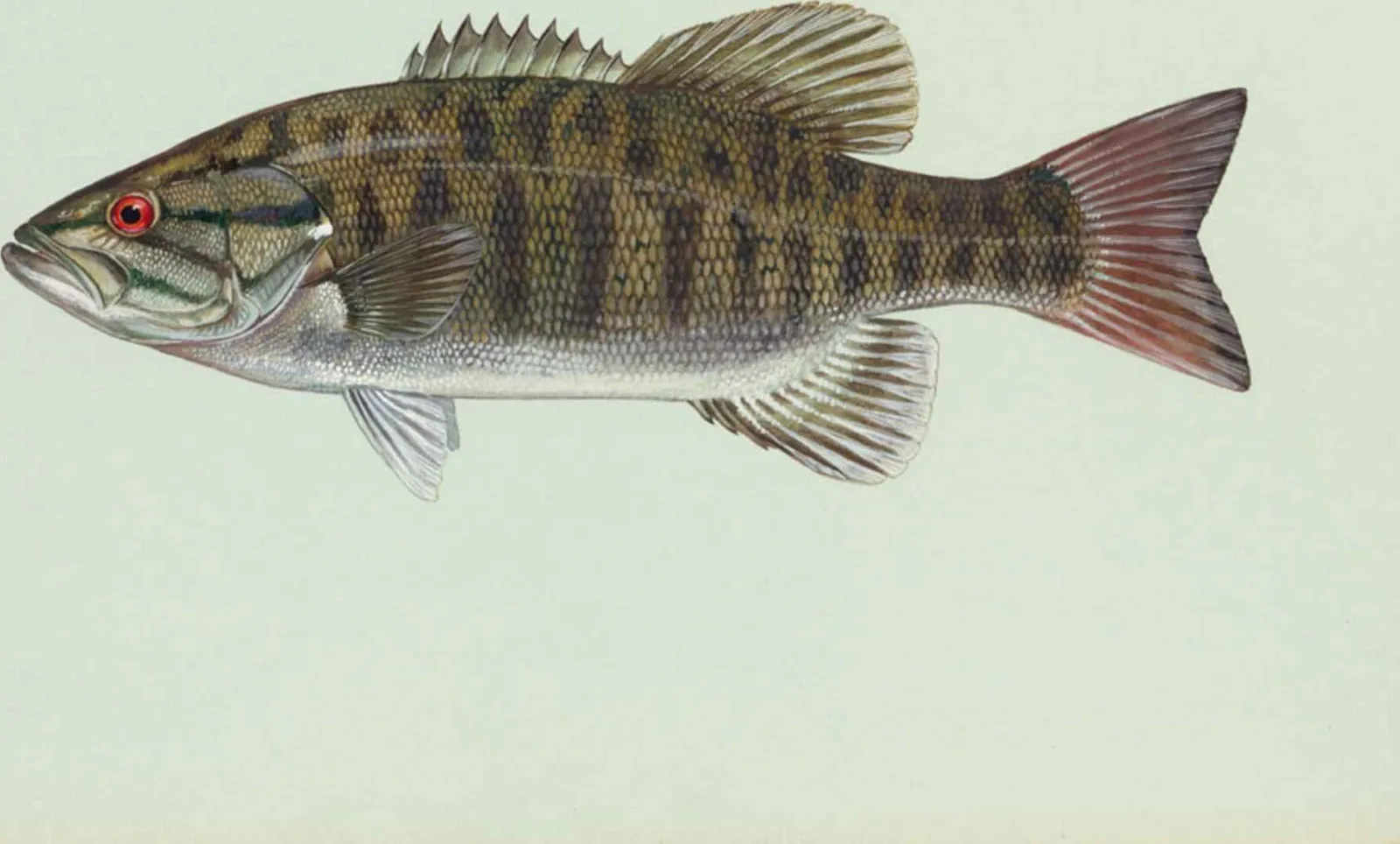
The smallmouth, the fish most people collect hellgrammites for. Illustration: Duane Raver, U.S. Fish and Wildlife Service (public domain).
How do you catch hellgrammites?
With a net and a rock. It can be slow work, so give yourself time.
- Make or bring a net. A fine-mesh dip net works. So does a homemade seine: a 3 by 3 ft (0.9 by 0.9 m) piece of window screen stapled around two wooden dowels.
- Find a shallow riffle with lots of rocks. MeatEater likes shallow, fast streams that run into bigger rivers.
- Set the net downstream of a good rock. Face downstream and hold a dip net on the bottom in front of you, at arm’s length. A seine can go 10 to 20 ft (3–6 m) below where you’re working.
- Lift or roll the rock. Lift it quickly and let the current wash whatever was under it into the mesh. Kicking the rocks over works too.
- Check the net. Pick out the hellgrammites behind the head and drop them in your bucket.
- Move on after one or two passes. MeatEater’s advice is to keep it to that per spot. Remember that each bug took 2 or 3 years to grow.
That last step matters more than it sounds. Maine bait shops once sold hellgrammites, and those sales drew down the natural numbers. Today the serious bass anglers there turn over rocks and collect their own.
Check your state’s rules before you go. Not every net is legal everywhere, and Ohio even sets the hours. The rules section below has examples.
How do you keep hellgrammites alive?
Keep them damp, cool and out of the sun. A hellgrammite doesn’t need to sit in water, as long as its gills stay moist.
For the trip, put them in a container of damp moss, grass or leaves. Store them the same way you’d store crawfish. At the river, a bucket of fresh stream water works fine, set in the shade.
Two things kill them: dry gills and a bad hook job. Keep them out of direct sun. And if you puncture the body while you’re baiting up, the bait is done.
Treat them as a bait for this trip, not one to stockpile like nightcrawlers. MidWest Outdoors says they’ll keep in cool, damp grass “for some time,” and that’s as exact as it gets. Collect what you’ll fish, and fish them in the river they came from.
How do you hook a hellgrammite?
Once, through the collar. That’s the hard band of shell right behind the head.
- Use a light-wire hook, size 8 to 4. A long shank helps. The hook size chart shows what those numbers look like. Light wire lets the bait keep struggling.
- Go under the collar with the point entering at the head side. One pass is all it takes.
- Stay out of the body. A hook through the thorax, the chest behind the collar, lets it flip around and clamp its jaws on your line. And if you puncture the body cavity, it dies.
- Let it swim. Hooked through the collar, the bug keeps struggling in the current. That’s what you’re after.
Hooked this way, a hellgrammite can slide up the line on the hook set. Slide it back down and keep fishing. Outdoor Life says one bait can catch several fish that way, so check it before you tie on a new one.
There’s one more trick. A hellgrammite’s two tail hooks grab moss on the bottom, and that can pin your bait in place. Snip them off with nail clippers. Some anglers also take off one pincer, but you don’t need to.
How do you fish a hellgrammite for smallmouth?
Near the bottom, drifting with the current. Use an ultralight or light rod and 4 to 8 lb line, and go light when the water’s low and clear. Virginia’s DWR suggests dropping from 10 to 12 lb down to 6 to 8 lb in that water.
Pick your rig by how fast the water is moving.
| Water | Rig | Set the hook when |
|---|---|---|
| Long, slow pools | Pencil float set at about the depth of the water. 2 to 4 small split shot below it, about 2 in (5 cm) apart. Drift it at a walking pace | The float vanishes, flutters or hesitates |
| Fast water | A heavy split shot 12 to 18 in (30–46 cm) below the hook, tight line, rod at about 45 degrees | The bait suddenly stops, or you feel a jerk or pull |
| Very fast water | The same rig. MeatEater says you can also use a 1/4 oz (7 g) drop weight | The same |
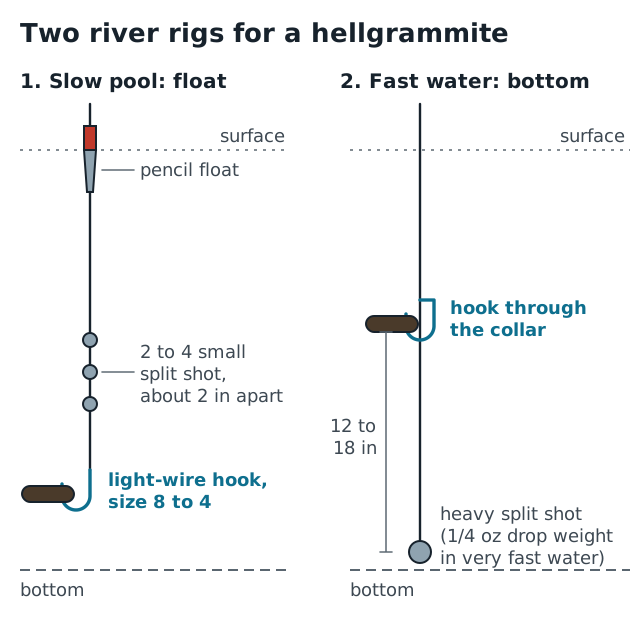
The two rigs to start with: the float for slow pools, the bottom rig for fast water.
Start with the float rig if you’ve got a slow pool in front of you, because it shows you the bite. In faster water, go to the bottom rig. The weight goes below the hook, the same idea as a drop shot.
Throw it up and across the current and let it tumble down. Give it a slight tug now and then, so it doesn’t cling to the bottom. Don’t wait for a big thump. Anytime the bait stops, set the hook.
Where to put it? Current seams, where fast water meets slow, are the first spots. After those, try rock ledges and log jams. As the summer sun climbs, Murray looks for bass in cooler, deeper spots under ledges and shaded banks.
What other fish eat hellgrammites?
Almost anything in the same river. Panfish, perch, pickerel, channel catfish, bass and trout all take them, MeatEater says. Use the same two rigs.
When is the best time to fish hellgrammites?
Summer. “During summer, these larvae are especially active and abundant,” Harry Murray writes. On Virginia rivers, the state’s smallmouth writer likes mid-summer into early fall best, when flows drop and the water clears.
Within the day, start early. Early morning and late afternoon are the prime times on the Shenandoah. On hot, bright days Virginia’s DWR says fishing can be best early and again in the evening.
Stuck out there at noon in late summer? Don’t quit. DWR’s own note says crawfish and hellgrammite patterns can be productive during the heat of the day that time of year. Fish them close to the bottom.
Hellgrammites are in the river all year, because each one spends 2 or 3 years there. You’re just more likely to notice the adults, which fly in late spring and early summer.
What if you can’t find live ones?
Use a fake. A soft plastic or a fly doesn’t need a bucket, and it doesn’t pinch.
Soft plastics. Nikko’s 3-inch hellgrammite goes on a small 1/20 or 1/32 oz mushroom jig. Pull the wire keeper off the jig with pliers first, Nikko’s sales manager told In-Fisherman, because the bait rigs easier without it. Store it by itself. He warns that ordinary soft plastics will destroy it. MeatEater also likes the Lunkerhunt Hive on a jig head. Twitch it and crawl it along the bottom. Around cover, use a Texas rig with a 2 to 1/0 worm hook.
Flies. The hellgrammite fly to know is Murray’s Hellgrammite, a black fly in sizes 4 to 12. It’s been his shop’s most productive smallmouth fly for over forty years. Crawl it slowly across the bottom below a riffle, or dead-drift it under a strike indicator. A split shot a foot above the fly gets it down fast.
Are hellgrammites legal to use as bait?
Usually, but your state decides. Some states write hellgrammites into their bait rules by name. Here are three, as examples.
| State | The rule |
|---|---|
| Virginia, the limit | A shared limit of 50, with minnows, chubs, madtoms and crawfish. That’s 50 total, not 50 of each. Bought bait is unlimited with a receipt |
| Virginia, the gear | By hand, or a seine up to 4 ft deep by 10 ft long (1.2 by 3 m). An umbrella net up to 5 by 5 ft. A hand-held bow net up to 20 in across, handle up to 8 ft. Dip nets “may be used to take shad, herring, mullet, and suckers only” |
| Connecticut | On the bait list, for personal use with a fishing license. In rivers and streams, seines up to 15 ft long and 4 ft deep. In the open season, also by hand or scoop net. Selling them takes an inland commercial bait license |
| Ohio | “At any time and in any number,” unless another rule says otherwise. From 9 p.m. to 4 a.m., only “by trapping, angling or by hand picking,” outside a few named waters |
Virginia’s rule matters for the net you carry. The state code says a hand-held bow net inside those sizes “shall not be deemed” a dip net. Not sure which one yours is? Ask the agency before you wade in. Virginia also closes its designated stocked trout waters to bait collecting from October 1 to June 15.
Your state may be different, so read its bait page before you start turning over rocks.
Fishing bait law changes at every state line, so check yours each year. Don’t carry live bait from one river to another.
Where can you buy hellgrammites?
Mostly, you can’t count on it. “Few bait dealers offer live hellgrammites,” MidWest Outdoors says, and Outdoor Life warns you “can expect to pay handsomely for a dozen” when a shop does have them. Call ahead, and ask the price before you drive. If nobody has them, it’s a net and a rock.
Mistakes that cost you the bait or the fish
- Grabbing it from the front. Hold it right behind the head, every time.
- Hooking the body. It dies, or it clamps onto the line. Go through the collar once.
- A hook too heavy for it. Light wire, size 8 to 4, so it can keep struggling.
- A hot bucket on the tailgate. Shade and damp moss, or a bucket of stream water in the shade.
- Heavy line in clear water. Go down to 6 to 8 lb when the river’s low.
- Waiting for a thump. If the bait stops, set the hook.
- Cleaning out one spot. One or two passes, then leave the rest.
When does something else win?
When you can’t get hellgrammites, or you can’t get them legally, use what the same fish already eat. Wisconsin’s DNR calls crawfish the smallmouth’s favorite food, so where they’re legal they’re the next thing to try. Or drift a nightcrawler along the bottom. The bass bait page sets these baits side by side.

Free PDF · 16 pages
Stop guessing. Know what's biting before your first cast
A whole Saturday on the water with nothing to show for it. One reading tells you who's feeding.
The Water Temperature Fishing Chart. Take one water temperature reading, find it on the chart, and see which of 26 freshwater fish are spawning, feeding hard or slowing down.
- Where bass, crappie, bluegill and walleye sit, and what to throw. Trout: the reading where you stop.
- Why a 3 ft drop beats a cold front, and what to throw each day of the front
- The three thermometer mistakes that make a reading lie
The chart's numbers come from state fish and wildlife agencies and fisheries research: 61 sources, each listed on the site.
No card, nothing to buy. Confirm with one click and the PDF is on its way, one version for your phone and one to print, yours to keep. Then a few short emails and one a week on what's biting, with an unsubscribe link in every one. Privacy.
Related
Section guide
Fishing Bait: Live, Cut and Prepared, and Which One to UseFishing bait made simple: live, cut and prepared bait, what to use for each fish, how to hook it and how to keep it alive until you fish.
Sources (16)
- Missouri Department of Conservation, Hellgrammite (field guide)
- Kubie Brown, Creepy Crawlers: How to Catch and Fish with Hellgrammites, MeatEater (April 18, 2024)
- Joe Cermele, The Best Live Baits Most Anglers Ignore (But Fish Can't Resist), Outdoor Life (April 6, 2026)
- Paul Liikala, Capturing, Using Freshest Streams Baits Possible, MidWest Outdoors (April 2015)
- MidWest Outdoors, hellgrammite bait notes (June 6, 2024)
Show all 16 sourcesShow fewer sources
- Harry Murray, How to Fish and Tie the Murray's Hellgrammite, Murray's Fly Shop
- Harry Murray, Hellgrammites, Murray's Fly Shop blog (July 8, 2025)
- Alex McCrickard, Summer Smallmouth Bass Fishing in Virginia, Virginia DWR (July 20, 2020)
- Julia Bayly, Finding this scary-looking bug in Maine's rivers is a good thing, Bangor Daily News (June 1, 2022)
- Dictionary of American Regional English, Quarterly Update 21, hellgrammite (summer 2020)
- Ned Kehde, Nikko Baits' Hellgrammites, In-Fisherman (October 18, 2017)
- Virginia DWR, Fish Bait Information
- Virginia Administrative Code 4VAC15-360-10, Taking aquatic invertebrates, amphibians, reptiles, and nongame fish for private use
- Connecticut DEEP, Freshwater Fishing Guide: Definitions
- Ohio Administrative Code 1501:31-13-04, Bait and bait dealers (effective January 1, 2025)
- Wisconsin DNR, smallmouth bass