 By
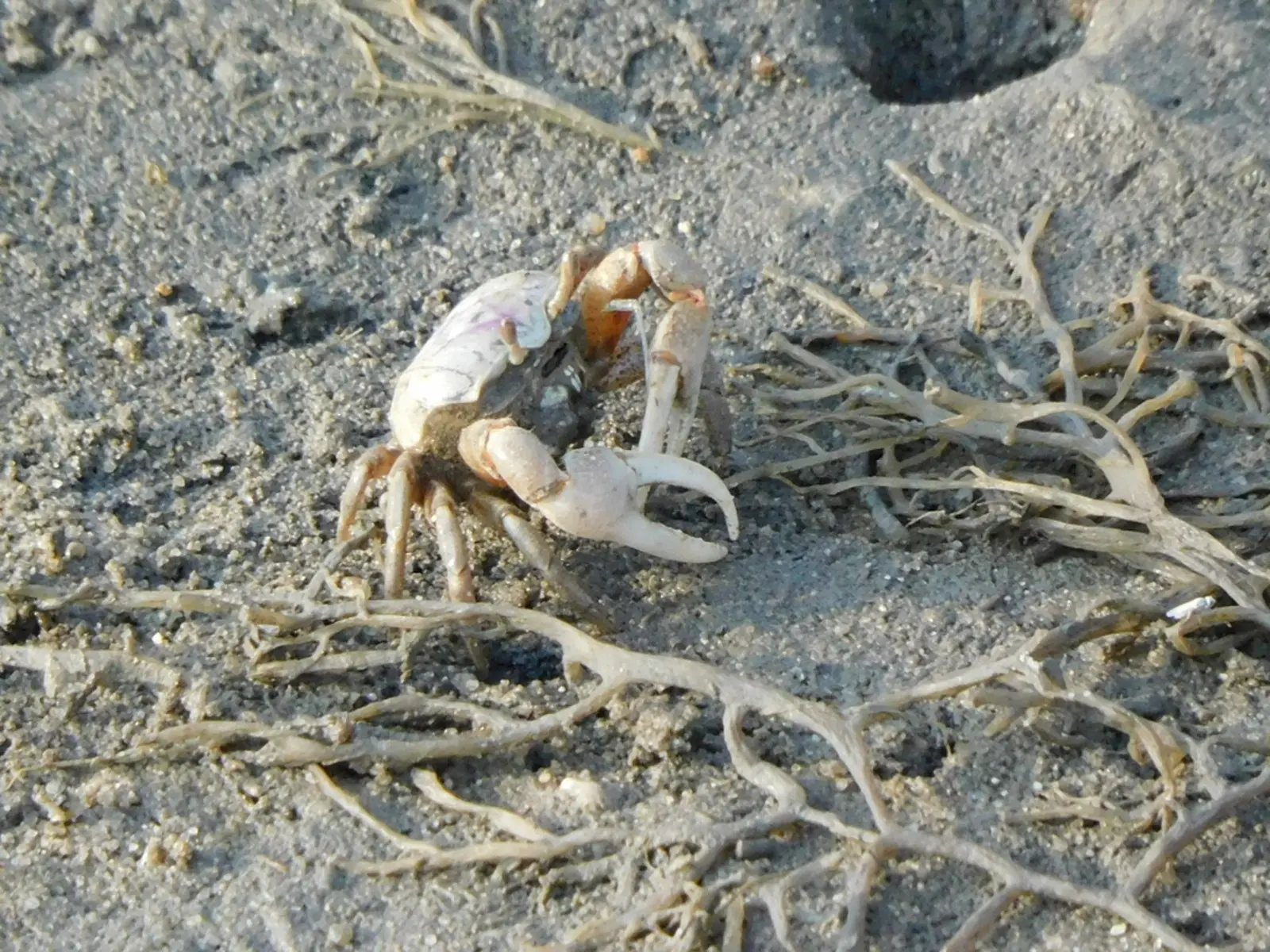
A live fiddler crab on a small hook, dropped to the bottom next to a piling, is the classic sheepshead bait. Florida’s wildlife agency names it, with live shrimp and sand fleas, as the bait to use. You can dig your own at low tide with a hand shovel and a bucket. The crab is compact, so it’s harder for a sheepshead to nibble off your hook.
As a male fiddler grows up, his big claw goes from 2% to 65% of his body weight, South Carolina’s DNR says.
Why is fiddler crab bait so good for sheepshead?
Sheepshead eat crabs. They have incisors, molars and rounded grinders, FWC says. Around pilings and rocks they use those teeth on barnacles and small shellfish, Texas Parks and Wildlife says. North Carolina’s fisheries agency names fiddler crabs as one of the things those teeth crush. So a fiddler is food the fish already knows.
The second reason is the bite. Texas Parks and Wildlife calls the sheepshead “an adept bait stealer.” It can crush a bait, swallow the meat and spit out the shell with your hook still in it, Visit Natural North Florida says. A fiddler is compact, Mississippi Sportsman points out, which helps keep it from being nibbled off. And live shrimp under a dock draws pinfish and small grunts that clean your hook first, The Tackle Room says.
Fiddler crab bait isn’t only for sheepshead. Salt Strong lists black drum, redfish, snook and even tarpon as fish that eat them. Up north, tautog anglers use them too.
What does a fiddler crab look like?
A fiddler crab has a square body, and the males carry one claw much bigger than the other. Females have two small claws of the same size, Texas Parks and Wildlife says. The shell is 1 to 2 inches (2.5 to 5 cm) long. Fiddlers walk sideways and live in burrows at the edge of salt marshes, in soft sand or mud.
South Carolina’s DNR names three that are common on the southeastern Atlantic coast. You don’t need to know which one you’ve got to fish it. But the table helps you find them, because sand and mud fiddlers like different bottoms.
| Fiddler | Tell it by | Bottom it likes | Male’s big claw |
|---|---|---|---|
| Sand fiddler | Pinkish purple | Sand | No row of bumps inside |
| Mud fiddler | Brownish yellow | Mud | A row of small granules inside |
| Red-jointed fiddler | Bigger than the other two | Not given | Red joints |
Source: South Carolina DNR. On the Gulf, Texas lists the fiddler crab as the most common crab in a salt marsh.
The best size for sheepshead is dime to nickel sized, The Tackle Room says. For tautog in the Northeast, The Fisherman likes crabs around 1 inch across the shell.

Free PDF · Water temperature chart Which fish are biting at today's water temperature?
One reading, and the 16-page chart shows which of 26 fish are spawning, feeding hard or slowing down; for bass, crappie, bluegill and walleye, where they sit and what to throw. Every number sourced.
No card, nothing to buy, and the PDF is yours to keep. Confirm with one click and it's on its way. Then a few short emails and one a week on what's biting. Unsubscribe anytime. Privacy.
How to catch fiddler crabs
Go at low tide. Fiddlers are easier to catch then, Mississippi Sportsman says. When the tide is out, they often feed in large groups along creek banks. At high tide they plug their burrows with sand and wait, Texas Parks and Wildlife says.
Kyle Perry, the angler in that Mississippi Sportsman piece, looks for marsh with dense spartina, the tall marsh grass. “The best areas are areas that spend half their time under water and half out,” he says. Salt Strong’s Tony Acevedo looks for soft sandy or muddy shorelines. He skips spots with foot traffic, noise or cars, where the crabs are more skittish.
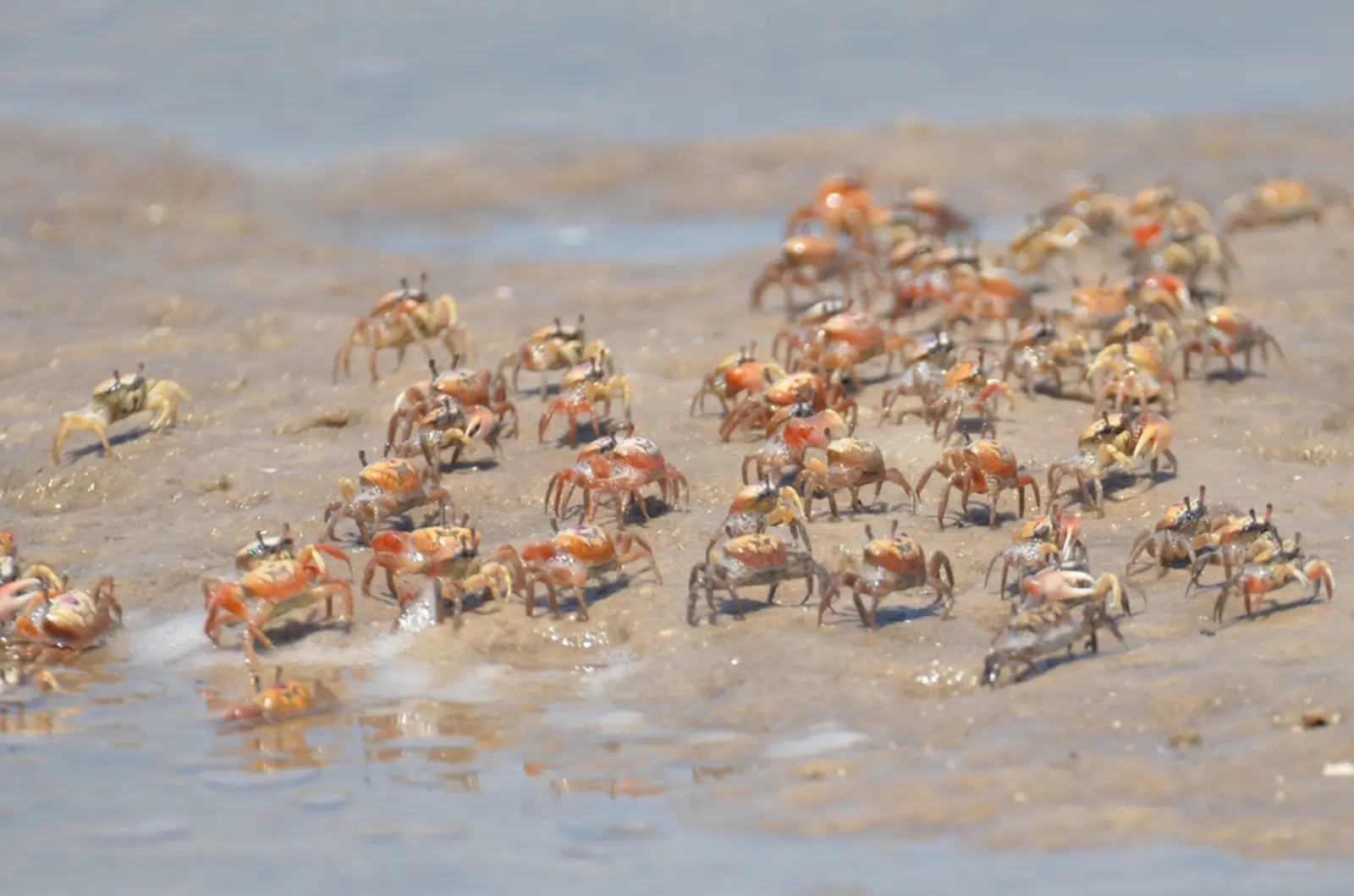
Sand fiddlers out on a wet flat, Gulf County, Florida. Photo: Jody Shugart, iNaturalist (CC BY).
Here’s the shovel method, step by step:
- Find the holes. They’re round, from 1/4 to 1/2 inch across, depending on the size of the crab. Little pellets of sand or mud around a hole mean a crab lives there, Texas Parks and Wildlife says.
- Get the bucket ready first. Put an inch or two of mud or sand in the bottom.
- Cut the hole off below the crab. Jab a hand shovel or spade about 3 or 4 inches down at an angle, just outside the hole. The blade cuts off the hole under the crab.
- Grab it as it comes out. Perry says the crab senses its hole is cut off and comes out. Have your hand ready.
- Grab from behind or by the big claw. That’s how Acevedo avoids a pinch. He says it “doesn’t hurt too bad” anyway.
- Take enough. Mississippi Sportsman says at least 25 per person. Take the ones you don’t use back to where you caught them.
There’s a lazier way, from Florida Sportsman. Bury a can so the lip is flush with the sand, bait it with smashed mussel or oyster, and walk off. “Come back before the tide reaches the can, and you’ll have a bucket full of bait.” The same writer asks you to let the females go. They’re the ones with two small claws.
In winter it gets harder. You see “armies” of fiddlers on the shore in summer, Acevedo says, but in winter they hide in their holes. That’s the shovel’s season. And it matters, because winter is sheepshead time in much of Florida.
How to keep fiddler crabs alive
Keep them damp, not wet. Fiddler crabs breathe air and drown if you put them under water, The Tackle Room says. Use a container with air holes and damp sand or a wet towel. Perry says that if you keep an inch or two of mud moist in the bucket, fiddlers will last upwards of a week.
Don’t let them dry out either. “A fiddler crab that has been in your pocket for an hour and dried out gets ignored,” The Tackle Room says. Live ones get hit faster than dead ones.
How to hook a fiddler crab
Anglers hook them three ways. The drawing shows where the hook goes in each.
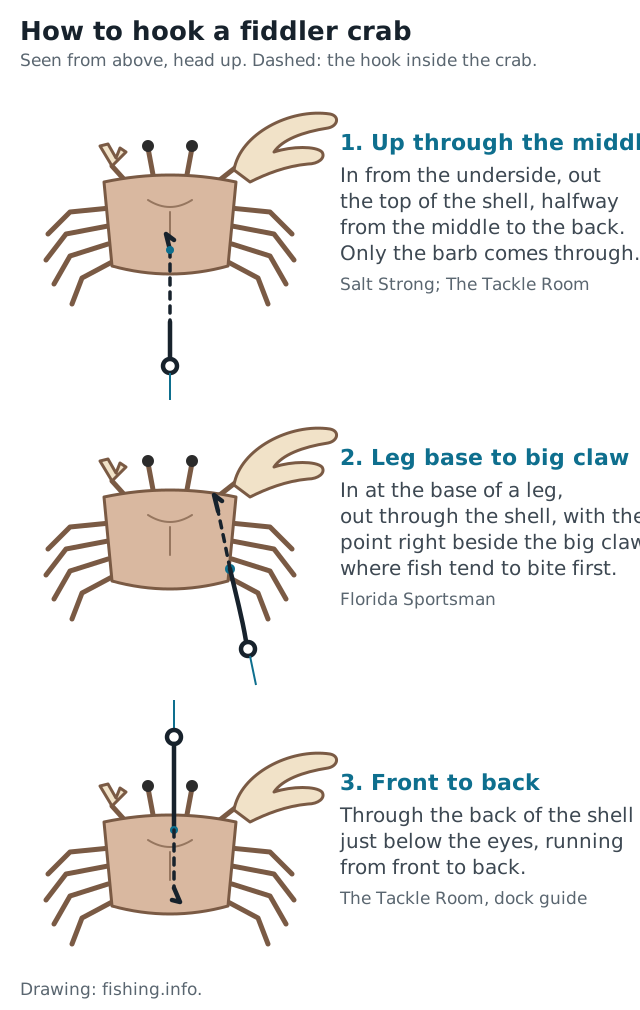
Three ways to hook a fiddler. Drawing: fishing.info.
1. Up through the middle. This is the one to start with. Salt Strong’s Acevedo brings the hook up from the bottom of the crab, through the middle of the body and out the top. The Tackle Room’s fiddler rig guide puts the entry halfway between the back end and the middle. The barb should just barely come out of the shell. “Too deep kills the crab. Too shallow, it falls off,” The Tackle Room says.
2. Leg base to the big claw. Florida Sportsman pushes the hook into the base of a leg and out the shell, with the point right beside the big claw. “It’s the first place fish tend to chomp.” Florida Shore Fishing does something close, threading the hook just inside the legs with only the very tip showing on top. The Tackle Room’s rig guide disagrees: through the body, it says, not through the legs.
3. Front to back. The Tackle Room’s guide to fishing sheepshead from a dock hooks the crab through the back of the shell from front to back, just below the eyes.
Hook size. Use a #1 thin-wire hook. Acevedo uses #1 to 1/0, and says “thick hooks can kill these crabs quickly.” Its rig guide says #1 to 1/0 thin wire too, because heavy-gauge hooks bounce off the sheepshead’s tooth plates. Its pick is a thin-wire octopus hook in #1. Maryland’s DNR puts it plainly: sheepshead have a knack for stealing bait, so a small hook is necessary. Florida Sportsman’s rule of thumb works for any brand: a hook gap about as deep as the crab’s shell.
Tip: Use a #1 thin-wire hook with a gap about as deep as the crab’s shell. Thick hooks can kill the crab and bounce off the sheepshead’s tooth plates.
Keep the big claw or pull it. The sources split. The Tackle Room removes it because it gets in the way of the hookset. Acevedo keeps it on, as a flag that waves fish down. Florida Sportsman puts the hook point right beside it. Try both on the same day and see which gets more bites where you fish.
What rig do you use for sheepshead?
Keep it light and simple. FWC’s tip is the whole idea: a small hook, fished on the bottom.
- Sinker. A 1/4 to 1/2 oz egg sinker slid onto the leader above the hook. The Tackle Room calls that a knocker rig. It’s simpler, and it works well around pilings. A Carolina rig is the same idea with a swivel between the sinker and the leader.
- Leader. Florida Shore Fishing uses 12 to 16 inches of 20 lb fluorocarbon.
- Main line. 10 to 20 lb braid, The Tackle Room says. UF/IFAS gives 10 to 20 lb mono or 15 to 20 lb braid.
Then put the crab where the fish eat. Sheepshead hang around pilings, rocks, jetties and wrecks, South Carolina’s DNR says. Many anglers fish right next to a piling. The Tackle Room says to fish within 6 inches of the pilings. Drop straight down instead of casting at an angle, which puts slack in the line and hides the bite.
Timing depends on where you fish. From Tampa Bay south, winter (December to February) is peak season, The Tackle Room says. In North Carolina it’s around Mother’s Day through fall. UF/IFAS says late winter into early spring is the best time on Florida’s Gulf coast.
When do you set the hook on a sheepshead?
Here’s where the advice splits the most. “The first tap is testing,” The Tackle Room says, and North Carolina says they’re hard to hook because “they take the bait fast.” Three camps have three answers.
| Hookset | Hook | What you do | Who says it |
|---|---|---|---|
| Set on the first real tap | J-hook, or octopus or circle | Don’t wait for a second pull. With a J-hook, a fast upward jerk. With a circle hook, sweep the rod sideways | Florida Shore Fishing says most anglers do this with a J-hook; The Tackle Room’s dock guide says the same with an octopus or circle |
| Count, then sweep | #1 to 1/0 | After the first tap, count 2 to 3, then sweep the rod | The Tackle Room’s fiddler rig guide |
| Don’t set, lift | Light-wire circle | Feel the “tap tap,” wait for the rod tip to bend as the fish swims off, then reel and lift | Florida Shore Fishing |
Pick one before you drop the bait. If you fish a J-hook, set on the first solid tap. If you fish a circle hook, let it load and lift, or sweep the rod sideways, as The Tackle Room says. With a light-wire hook, check its shape after a big fish and retie if it’s bent, Florida Shore Fishing says.
Mistakes to avoid
- Keeping fiddlers in a bucket of water. They drown. Damp sand, not water.
- A hook too big or too thick. It kills the crab and bounces off the teeth. Drop to a #1 thin wire.
- Burying the hook point. Let the barb come through the shell, or the point sit beside the claw.
- Fishing away from the structure. Sheepshead feed on the pilings. Six inches off is the zone.
- Too much slack. A bite you can’t feel is a bait you lose. Fish straight down and keep light contact.
Other fish that eat fiddler crabs
Redfish do. Florida Sportsman calls fiddlers “great baits for reds, sheepshead and many other fish.” Black drum, snook and tarpon eat them too, Salt Strong says.
In the Northeast, fiddlers are a tautog bait. The Fisherman’s Matt Broderick says they’re native to back bays there and calls them “another small preferred choice for tautog fishing.” He likes crabs around 1 inch across the shell, fished whole on a hi-lo rig or on a jig. You’ll find them in some bait shops, or dig them at low tide in the back bays.
When does another bait win?
When you can’t find fiddlers. On Florida’s Big Bend the big spawning sheepshead come in late winter or spring. Most anglers fish whole live shrimp for them, and fiddlers are “sometimes hard to find,” Visit Natural North Florida says. Shrimp works, it just feeds every pinfish on the dock too.
Good to know: In Florida, barnacles have no size or bag limit, up to 100 pounds per person per day with a saltwater fishing license.
Near a beach, use sand fleas. They’re the other crab bait FWC names for sheepshead, and The Tackle Room says they’re tougher than fiddlers and stay on the hook longer. And in Florida you can scrape barnacles off a bridge piling to chum the fish up. FWC says barnacles have no size or bag limit, up to 100 pounds per person per day with a saltwater fishing license. Don’t scrape them off private docks without the owner’s permission.
Quick answers about fiddler crabs
How long do fiddler crabs live? Up to 1.5 years, Texas Parks and Wildlife says.
What do fiddler crabs eat? Algae, bacteria, fungus scraped off sand grains, and dead plant and animal matter, Texas says. They roll the mud they’ve picked clean into little balls and drop them, South Carolina’s DNR says.
Do fiddler crabs regrow a claw? Yes. If one claw is lost, the crab soon regrows a new one, Texas Parks and Wildlife says.
Do fiddler crab pinches hurt? Not much. Acevedo says it “doesn’t hurt too bad.” Only the males have the big claw.
What are the rules on sheepshead and fiddler crabs?
In Florida, a sheepshead must be 12 inches total length, with a daily bag of 8 per person, FWC says. In March and April there’s also a vessel limit of 50 per trip. The season is open year-round. Using more than one hook with live or dead natural bait is not allowed, and neither is snatching. Other states set their own limits, so check yours.
For the crabs themselves, check your state’s saltwater rules before you dig, and whether you need a fishing license to gather bait. The live bait page covers keeping and moving other baits, and the bait hub has everything else you can catch, dig or buy.

Free PDF · 16 pages
Stop guessing. Know what's biting before your first cast
A whole Saturday on the water with nothing to show for it. One reading tells you who's feeding.
The Water Temperature Fishing Chart. Take one water temperature reading, find it on the chart, and see which of 26 freshwater fish are spawning, feeding hard or slowing down.
- Where bass, crappie, bluegill and walleye sit, and what to throw. Trout: the reading where you stop.
- Why a 3 ft drop beats a cold front, and what to throw each day of the front
- The three thermometer mistakes that make a reading lie
The chart's numbers come from state fish and wildlife agencies and fisheries research: 61 sources, each listed on the site.
No card, nothing to buy. Confirm with one click and the PDF is on its way, one version for your phone and one to print, yours to keep. Then a few short emails and one a week on what's biting, with an unsubscribe link in every one. Privacy.
Related
Section guide
Fishing Bait: Live, Cut and Prepared, and Which One to UseFishing bait made simple: live, cut and prepared bait, what to use for each fish, how to hook it and how to keep it alive until you fish.
 Bloodworms for Fishing: How to Hook Them and Avoid the Bite
The bait-shop bloodworm is a Maine marine worm with four venomous jaws. How to hook it, which fish eat it, how to keep it alive, and what a bite does.
 Ice Fishing Bait: The Live Bait for Each Fish, From Wax Worms and Spikes to Minnows
Live ice fishing bait, fish by fish: wax worms, spikes, mousies and minnows, how to tip a jig, keep bait from freezing, and the minnow rules.
 Live Bait: Which One to Use, How to Hook It and Keep It Alive
Live bait made simple: which bait for which fish, how to hook it so it stays alive, the rigs, how to keep it alive, and the rules on moving it.
 Minnows: What They Are, Which to Buy and What Size to Use
Minnows are small fish of the minnow family, and the top live bait. Which minnows bait shops sell, what size for each fish, and when they work.
 Sand Fleas: What They Are, Do They Bite, and How to Catch Them
The sand flea surf anglers dig is a clawless mole crab, not an insect. What bites you instead, and how to rake, keep and hook sand fleas.
 Hellgrammite: What It Is, Where to Find It, How to Fish It
A hellgrammite is a dobsonfly larva up to 4 inches long and a top smallmouth bait. How to find one, hold it without a pinch, hook it and fish it.
Sources (18)
- Florida Fish and Wildlife Conservation Commission, Sheepshead (species profile)
- Florida Fish and Wildlife Conservation Commission, Sheepshead (recreational regulations)
- South Carolina Department of Natural Resources, ACE Basin Species Gallery: Fiddler Crab
- South Carolina Department of Natural Resources, Sheepshead
- Texas Parks and Wildlife Department, Fiddler Crab (Uca rapax)
Show all 18 sourcesShow fewer sources
- Texas Parks and Wildlife Department, Sheepshead
- North Carolina Division of Marine Fisheries, Sheepshead
- Maryland Department of Natural Resources, Fish Facts: Sheepshead
- Dr. Megan Moore, Gulf Coast Catch and Cook March: Sheepshead, UF/IFAS Extension Pasco County (March 5, 2025)
- Tommy Thompson, Sheepshead, A Favorite Cool Weather Nearshore Fish Species on Natural North Florida's Gulf Coast, Visit Natural North Florida (November 27, 2018)
- Sam Davis, Fiddler crabs as sheepshead bait, Mississippi Sportsman (September 15, 2013)
- Tony Acevedo, How To Catch Fiddler Crabs For Bait (Quick & Easy Way), Salt Strong (February 27, 2020)
- Tony Acevedo, How To Rig Fiddler Crabs To Catch More Sheepshead, Salt Strong (March 10, 2020)
- Sheepshead Bait and Rig - What Actually Works on a Fiddler Crab Setup, The Tackle Room (May 20, 2026)
- How to Catch Sheepshead from a Dock or Pier, The Tackle Room (May 21, 2026)
- Daniel Hagan, Light Wire Circle Hooks for Sheepshead, Florida Shore Fishing (December 3, 2014)
- Fiddler Crabs for Bait, Florida Sportsman (October 16, 2019)
- Matt Broderick, Blackfish Buffet: Crab Choices For The Avid Togger, The Fisherman (October 2023)