 By
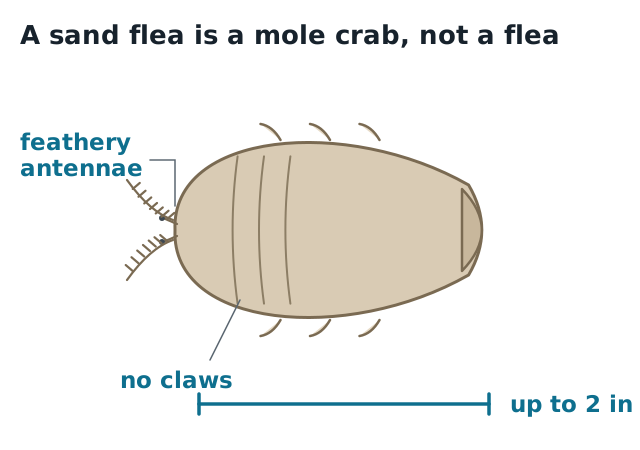
The sand flea surf anglers dig for bait is a mole crab, a small clawless crab up to 2 inches long. It lives in the wet sand where the waves wash up. It can’t bite you. The itchy bites people blame on “sand fleas” aren’t from this crab. A common biter on the beach is the no-see-um, a biting midge about 1 mm long. So if you’re here for bait, the crab in the wash is the best one on the beach for pompano, and it’s free.
Pompano feed mostly on mole crabs, the sand fleas digging in the wash at your feet.
What is a sand flea?
On the beach, a sand flea is a mole crab. It’s an oval, light brownish-gray crab with no claws and two feathery antennae, FWC says. It digs in tail first in the swash, the strip of wet sand where the waves run up and back. Then it pokes its antennae up to sift food out of the water. It lives two to three years.
You’ll hear other names for it: sand crab, beach flea, sand bug, sand fiddler. Most are around half an inch to an inch. Females grow up to 2 inches, males only to about 3/4 inch, says the Fishing Destin Guide. So any flea much over 3/4 inch is a female.
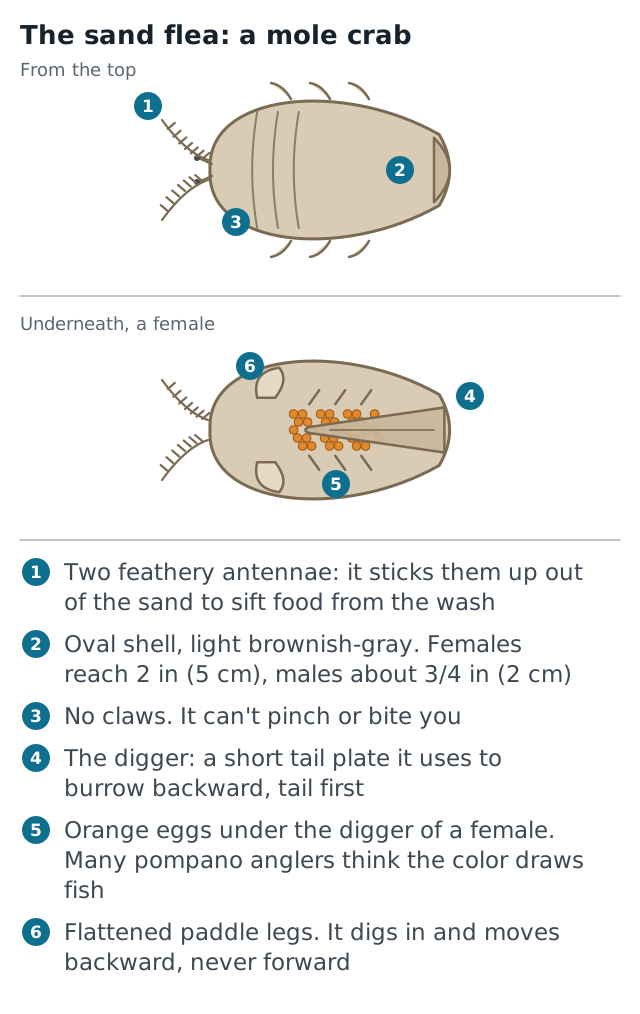
The parts that matter when you hook one. Drawing: fishing.info.
Flip one over and you’ll see the digger, a short triangular tail plate folded under the body. On a female you’ll often find a clump of orange eggs under it. The breeding season runs February through October, says the Fishing Destin Guide. Many pompano anglers believe that orange is what pulls fish in. It’s why a lot of them like orange or pink pompano jigs. On pompano rigs, orange and yellow beads often stand in for the eggs.
The trouble is the name. Three other animals get called sand fleas too, and the bites come from them.
| Called a “sand flea” | What it really is | Where you meet it | Bites? |
|---|---|---|---|
| Mole crab | A clawless crab, up to 2 in (5 cm) | In the wet sand where the waves wash | No, it can’t pinch or bite |
| Beach hopper | A tiny crustacean that jumps | High-tide line, under washed-up seaweed | May leave itchy red bumps, Cleveland Clinic says |
| No-see-um (biting midge) | A fly about 1 mm (0.04 in) long | Coastal marsh and beach, dusk through morning | Yes, a stinging bite with a red spot |
| Chigoe flea | A true flea that burrows into skin | Tropics: Caribbean, Central and South America, Africa | Yes, but it’s rare in the US |
Do sand fleas bite?
The mole crab doesn’t. It has no claws, so it can’t bite or pinch, UF/IFAS Extension says.
A common biter on the beach is the no-see-um. These are biting midges, also called sand flies or sand gnats, and many are smaller than 1/24 inch. UF/IFAS calls them “abundant and persistent pests of campers, beachgoers, fishers” along the coast. The bite stings or burns and leaves a red spot. It usually fades in minutes to hours, though someone sensitive to them may itch for two to three days.
Here’s what to do about them, from UF/IFAS:
- Wear a DEET repellent. The same kind you use for mosquitoes is the main one for biting midges.
- Don’t count on window screen. Regular screen doesn’t keep them out. Only no-see-um mesh, with its finer holes, does.
- Know when they bite. Most bite at dusk, at night and in the morning. Near the coast many bite in broad daylight too.
Beach hoppers are the little jumpers that hide under the seaweed at the high-tide line. Cleveland Clinic says they might cause red, itchy bumps that usually go away in a few days. It suggests washing your feet after going barefoot and wearing closed shoes when you can.
The chigoe flea is the dangerous one. It burrows into skin, mostly on the feet, but it lives in the tropics and is rare in the US. Never try to dig one out with a sharp object, Cleveland Clinic says. Open sores, ulcers or signs of infection need a doctor right away. Anything beyond that is a question for your own doctor, not a fishing page.
Free PDF · Water temperature chart Which fish are biting at today's water temperature?
One reading, and the 16-page chart shows which of 26 fish are spawning, feeding hard or slowing down; for bass, crappie, bluegill and walleye, where they sit and what to throw. Every number sourced.
No card, nothing to buy, and the PDF is yours to keep. Confirm with one click and it's on its way. Then a few short emails and one a week on what's biting. Unsubscribe anytime. Privacy.
Where and when do you find sand fleas?
Find them in the swash zone, between where the waves break and the highest point they wash up. Walk the waterline and watch the sand as each wave runs back. You’re looking for small V marks. Each V is a flea’s antennae sticking up into the backwash. On a big colony it almost looks like the sand is boiling.
The marks tell you what size they are before you rake, Florida Sportsman’s Mike Conner says. Small marks mean small fleas. The small ones also sit higher on the beach. The jumbos like the rougher wash, sometimes right where the sand turns to broken shell.
Rake on a falling tide. Salt Strong says outgoing is best. Conner likes high and falling, “but that depends on the beach.” The fleas move up the beach as the tide comes in and back down as it goes out, so follow them. On some days they’ve moved out a few feet deep and you’ll have to wade.
Season matters too. On Conner’s southeast Florida beaches you can catch them year-round, with September through November best. On the Panhandle, colonies form in late March or early April, depending on the water temperature. Cold weather puts them down deep in the sand. If you don’t see any marks, don’t dig blind. Walk to the next beach access.
Farther north, sand fleas start working on stripers in the surf as spring turns to summer. Capt. Al Ristori writes that stripers caught in the summer surf “almost always have sand fleas in their stomachs.”
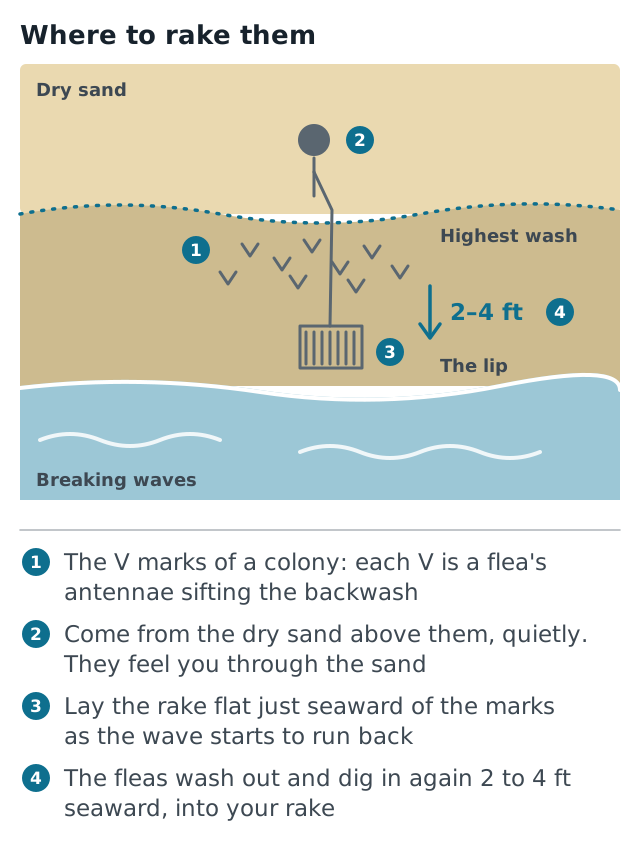
Where to stand and where to lay the rake. Drawing: fishing.info.
How do you catch sand fleas with a rake?
A sand flea rake is a wire basket on a long handle. UF/IFAS calls it “required equipment for catching decent numbers.” Here’s the method, mostly Conner’s, step by step.
- Walk the wash with a 5-gallon bucket and find the V marks.
- Come at them from the dry sand above, quietly. They feel you walking through the sand. Don’t stomp up to them.
- Hold the rake about knee high and wait for the next wave to wash over the colony.
- As the wave starts to run back, lay the rake flat on the sand just seaward of the marks. Don’t dig.
- Let the water carry them in. The fleas pop out and bury themselves again 2 to 4 feet seaward, right into the basket.
- Dunk the rake in the wash to rinse the sand out. The fleas stay behind.
- Dump them in the bucket and keep going. One good scoop can be all the bait you need, Salt Strong says.
No rake? Salt Strong’s Wyatt Parcel has a trick for a good colony. Grab a big handful of sand where the V marks are, drop it on a bucket lid and sift the fleas out with your fingers. It’s slower, but it costs nothing.
How do you keep sand fleas alive?
Keep them damp and cool, and never in a bucket of water. In standing water they use up the oxygen and die. A cooler with ice and a little seawater works too, Tackle Room says. They’ll last all day that way.
On the beach: keep them in a bucket of damp sand, out of the sun, with a wet towel over it. Rinse the sand with fresh seawater every hour or so. Conner keeps his in a mesh bag instead. He drags it in the surf now and then and parks it in the shade of the cooler. The mesh keeps them frisky and stops them sitting in their own urine.
Overnight: use two buckets. Drill holes in the bottom of one, put ice packs in the other, and set the holed bucket inside the first. Rinse the fleas about every four hours, says Blane Roberts, a Panhandle surf guide, on Salt Strong. Surf angler Joey Antonelli keeps his alive up to 5 or 6 days in his garage this way. He rinses them with saltwater at least once a day. Just don’t let them touch the ice, or they’ll die.
At home: layer them between damp newspaper in the fridge or a cooler with ice, and change or rinse the paper every day. After a few days, freeze them.
To freeze them, Conner’s way: rinse them in a mesh bag several times over an hour or two so they purge. Then dip the bag in 2 to 3 gallons of boiling water for a count of 15. Cool them under the hose for at least 3 minutes, drain them, and freeze them in quart bags. Vacuum-sealed, they keep for months. Thaw them before you put a hook in.
Live ones are still better. They hold the hook better, Conner says, and Tackle Room says they outfish dead ones by a lot.
How do you hook a sand flea?
Hook it up through the soft underside and out the top of the shell. That’s the standard on a pompano rig. The flea stays alive longer and sits shell up on the hook.
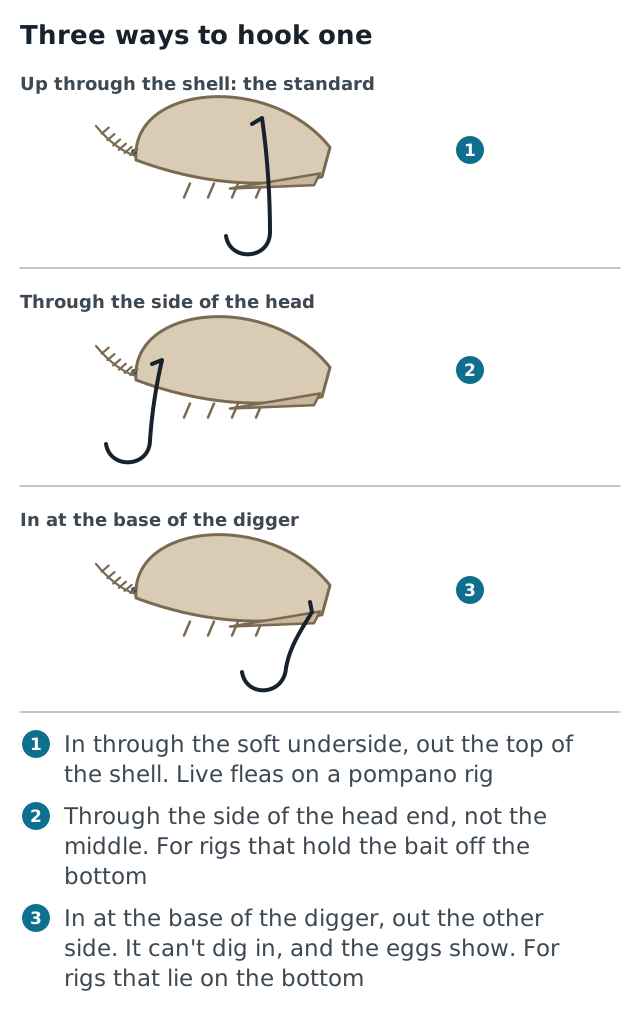
Three ways to hook one, and which rig each is for. Drawing: fishing.info.
Roberts adds two more on Salt Strong. On a rig that holds the bait off the bottom, run the hook through the side of the head end. Stay out of the middle of the body. On a Carolina rig the bait lies on the sand. Open the digger, push the hook in at its base and bring it out the other side. The flea can’t dig in, and the eggs show.
Match the hook to the flea. Conner calls the big ones “ones” because you fish one to a hook. Smaller fleas are “twos” and “threes.”
| Flea size | How many per hook | Hook | Rig | Fish |
|---|---|---|---|---|
| 3/4–1 in (2–2.5 cm) | One | 1/0 circle | Pompano rig | Pompano |
| Small, under 3/4 in (2 cm) | Two or three | #1 | Pompano rig | Pompano, on small-flea days |
| Big female, 1 1/2–2 in (4–5 cm) | Half a flea | 1/0 or 2/0 | Pompano rig | Pompano. Cut it with scissors |
| Whatever you raked | Two or three | 5/0 circle | Hi-lo rig | Striped bass |
The hook size chart shows how those numbers run. Most surf anglers use a 1/0 or 2/0 on a pompano rig, Roberts says. Don’t go bigger for pompano. They have small mouths.
What fish eat sand fleas?
Pompano first. They feed mostly on mole crabs, Louisiana Sportsman’s Brian Cope says. Tackle Room calls sand fleas the number one pompano bait on most of the Atlantic and Gulf coast. But a lot of surf fish eat them.
| Fish | Where they hit fleas | How to fish them |
|---|---|---|
| Pompano | Sandy beaches, Atlantic and Gulf | Two-hook pompano rig, short cast into the first trough |
| Whiting (kingfish) | Sandbars in rough surf | Two-hook bottom rig, North Carolina’s fisheries agency says |
| Redfish and black drum | The surf, the same beaches as pompano | Cast into the trough |
| Sheepshead | Rocks, jetties and pilings near the beach | Tight to the structure. Watch the line, they steal bait |
| Striped bass | Northeast surf in summer | Hi-lo rig, 5/0 circle, two or three fleas |
Whiting is the beach name for kingfish. FWC says they like rough water over sandbars, where the waves knock small crabs and other crustaceans loose. North Carolina names mole crabs alongside shrimp, bloodworms and squid as their bait.
Redfish and black drum eat sand fleas off the same beaches, Salt Strong says. Cast a flea into the trough, the deeper lane between the beach and the first bar. If you’d rather fish one flea on the bottom with a sliding sinker, a fish finder rig lets a fish run without feeling the weight.
Sheepshead eat crabs, barnacles, clams and shrimp, SC DNR says. Fish a sand flea right against the rocks or the pilings. Texas Parks and Wildlife calls the fish “an adept bait stealer,” so watch the line.
Striped bass feed on them along the Northeast beaches from late spring through summer. Ristori fills a 5/0 circle with two or three fleas on a basic hi-lo rig and casts to cuts in the bars. Most of what you’ll catch are schoolies. “This isn’t a good way to catch a ‘50,’” he writes.
Mistakes to avoid
- Keeping them in a bucket of water. They run out of oxygen and die. Use damp sand or a mesh bag.
- Stomping up to a colony. They feel you coming and dig deeper. Walk in from above, quietly.
- Digging instead of raking. Lay the rake flat and let the backwash do the work.
- A hook through the middle. Roberts warns against it. Go in through the underside or the head end.
- Hooking a frozen flea. Thaw it first.
- Digging blind on a cold day. Cold puts them down. If there are no V marks, move to another spot.
When does another bait win?
When you can’t find a flea, use shrimp. Tackle Room calls whole or halved fresh shrimp the next best pompano bait. Peel it, cut it in 1 inch pieces and hold it on with a bait spring.
Blanched frozen fleas are your backup, so keep a bag in the freezer.
Quick answers about sand fleas
Do sand fleas infest your house? The mole crab can’t. It needs wet sand. Out of the water it lasts a few hours to a few days, depending on the heat and on its gills staying damp. No-see-ums are another story. They get through regular window screen, UF/IFAS says.
How do you know if a sand flea is in your skin? Only the chigoe flea of the tropics burrows into skin. Cleveland Clinic says the bump swells and turns white, and a black spot might show in the middle. It tends to be on the ankles and feet. That’s one for a doctor, not for a needle.
Can sand fleas lay eggs in you? Only the chigoe flea. The female lays eggs while burrowed in the skin, and the eggs fall out before they hatch, Cleveland Clinic says. The mole crab can’t. It carries its eggs under its tail.
How do you treat sand flea bites? Mild bites may ease with antihistamines (topical or oral, not both), cold packs or an anti-itch cream like calamine lotion, Cleveland Clinic says. Open sores or signs of infection need a doctor.
How do you get rid of sand fleas? You don’t need to get rid of mole crabs. They live in the wash and can’t bite. For no-see-ums, UF/IFAS points to a DEET repellent and no-see-um screen.
Are sand fleas the same as sand flies? Not the one in the wash. “Sand fly” is one of the names for biting midges, the no-see-ums, UF/IFAS says. The sand flea anglers dig is a crab.
Do you need a license to rake sand fleas?
Check before you rake. Florida lists mole crabs as unregulated. Other states set their own rules, and the fishing itself still needs whatever license your state asks for. For a 10 to 12 ft rod that can throw a pompano rig past the shore break, see surf fishing rods. The bait hub covers what else you can catch, dig or buy.

Free PDF · 16 pages
Stop guessing. Know what's biting before your first cast
A whole Saturday on the water with nothing to show for it. One reading tells you who's feeding.
The Water Temperature Fishing Chart. Take one water temperature reading, find it on the chart, and see which of 26 freshwater fish are spawning, feeding hard or slowing down.
- Where bass, crappie, bluegill and walleye sit, and what to throw. Trout: the reading where you stop.
- Why a 3 ft drop beats a cold front, and what to throw each day of the front
- The three thermometer mistakes that make a reading lie
The chart's numbers come from state fish and wildlife agencies and fisheries research: 61 sources, each listed on the site.
No card, nothing to buy. Confirm with one click and the PDF is on its way, one version for your phone and one to print, yours to keep. Then a few short emails and one a week on what's biting, with an unsubscribe link in every one. Privacy.
Related
Section guide
Fishing Bait: Live, Cut and Prepared, and Which One to UseFishing bait made simple: live, cut and prepared bait, what to use for each fish, how to hook it and how to keep it alive until you fish.
 Hellgrammite: What It Is, Where to Find It, How to Fish It
A hellgrammite is a dobsonfly larva up to 4 inches long and a top smallmouth bait. How to find one, hold it without a pinch, hook it and fish it.
Sources (23)
- Florida Fish and Wildlife Conservation Commission, Mole Crab (Sand Flea, Sand Crab)
- National Park Service, Padre Island National Seashore, Atlantic Sand Crab
- Ask Extension, What are these beach critters? (New Hanover County, North Carolina, September 25, 2020)
- Carrie Stevenson, Weekly "What is it?": Sand fleas (mole crabs), UF/IFAS Extension Escambia County (September 1, 2021)
- Rick O'Connor, Barrier Island Wildlife in the Florida Panhandle; Part 4 On the Beach, UF/IFAS Extension Escambia County (December 30, 2022)
Show all 23 sourcesShow fewer sources
- Nathan D. Burkett-Cadena, Vilma M. Cooper, Charlotte Addae and Eva A. Buckner, Biting Midges, No-See-Ums Culicoides spp., UF/IFAS EDIS EENY-349 (2025)
- LiMPETS Sandy Beach Monitoring Program, The Sandy Beach Habitat (fact sheet, 2018)
- Cleveland Clinic, Sand Flea Bites: What They Look Like, Treatment & Prevention
- Fishing Destin Guide, Sand Fleas (Mole Crabs or Sand Crabs)
- Mike Conner, Sand Flea 101: How to Find, Catch and Save Sand Fleas, Florida Sportsman (January 17, 2023)
- Wyatt Parcel, How To Catch Sand Fleas (Without A Sand Flea Rake), Salt Strong (July 21, 2020)
- Luke Simonds, How To Catch & Store Sand Fleas For Surf Fishing, Salt Strong (June 1, 2024)
- Joseph Simonds, How To Keep Sand Fleas Alive An Extra 3-5 Days (POMPANO FISHING), Salt Strong (February 12, 2019)
- Luke Simonds, How to Rig Sand Fleas (Pro Guide SECRETS for Surf Fishing), Salt Strong (June 27, 2024)
- How to Catch Pompano from the Surf: The Complete System, Tackle Room
- Pompano Surf Fishing: The Pompano Rig, Bait, and Where to Fish It, Tackle Room (May 20, 2026)
- Pompano Rigs for Surf Fishing: Setup, Bait & Tips for Success, Dr.Fish Tackle (December 2025)
- Brian Cope, Species spotlight: Florida pompano, Louisiana Sportsman (July 18, 2021)
- North Carolina Division of Marine Fisheries, Kingfishes
- Florida Fish and Wildlife Conservation Commission, Southern Kingfish
- South Carolina Department of Natural Resources, Sheepshead
- Texas Parks and Wildlife Department, Sheepshead
- Capt. Al Ristori, Sand Fleas and Stripers: Key to the Summer Surf, The Fisherman (May 2019)