 By
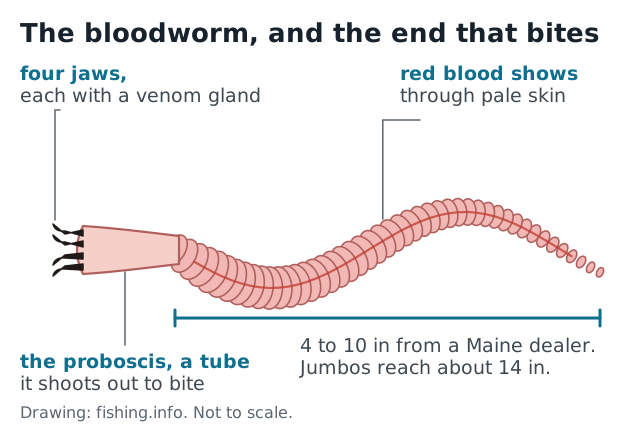
Bloodworms for fishing are marine worms, dug by hand from Maine mud flats at low tide and sold by the dozen in wet seaweed. Spot, kingfish, white perch, winter flounder and early-spring stripers all eat them. Watch the head end: a bloodworm bites, with four jaws that sting like a bee. The red “bloodworms” at the pet store are another animal, the larvae of a midge.
Maine’s bloodworm catch fell from more than 600,000 pounds in 2004 to under 300,000 pounds in 2016. You pay for that drop at the bait shop.
What are bloodworms?
The bloodworm in a bait shop is a saltwater worm that lives buried in tidal mud. Maine is one of the only US states with an active marine worm fishery, its Department of Marine Resources says. Diggers work the flats at low tide with a short rake. A digger gets 100 to 500 worms a tide, Salt Water Sportsman wrote in 2007. The worms ship out packed in seaweed, to the mid-Atlantic and far beyond.
The name comes from the blood you can see pumping through the pale skin, the Delaware Surf Fishing site says. A Maine dealer lists its worms at 4 to 10 inches. They can reach about 14 inches, and the big ones are sold as jumbos.
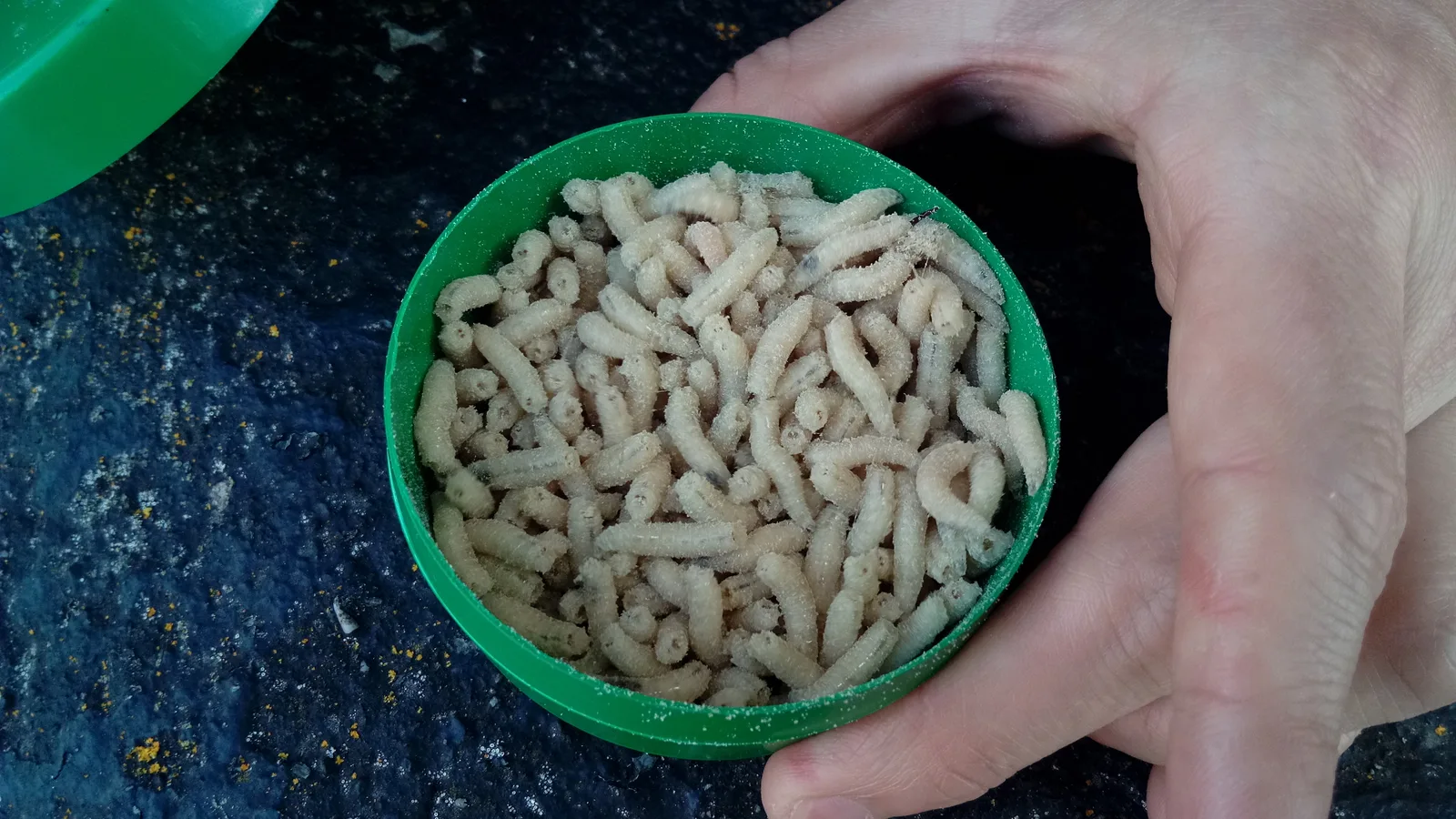
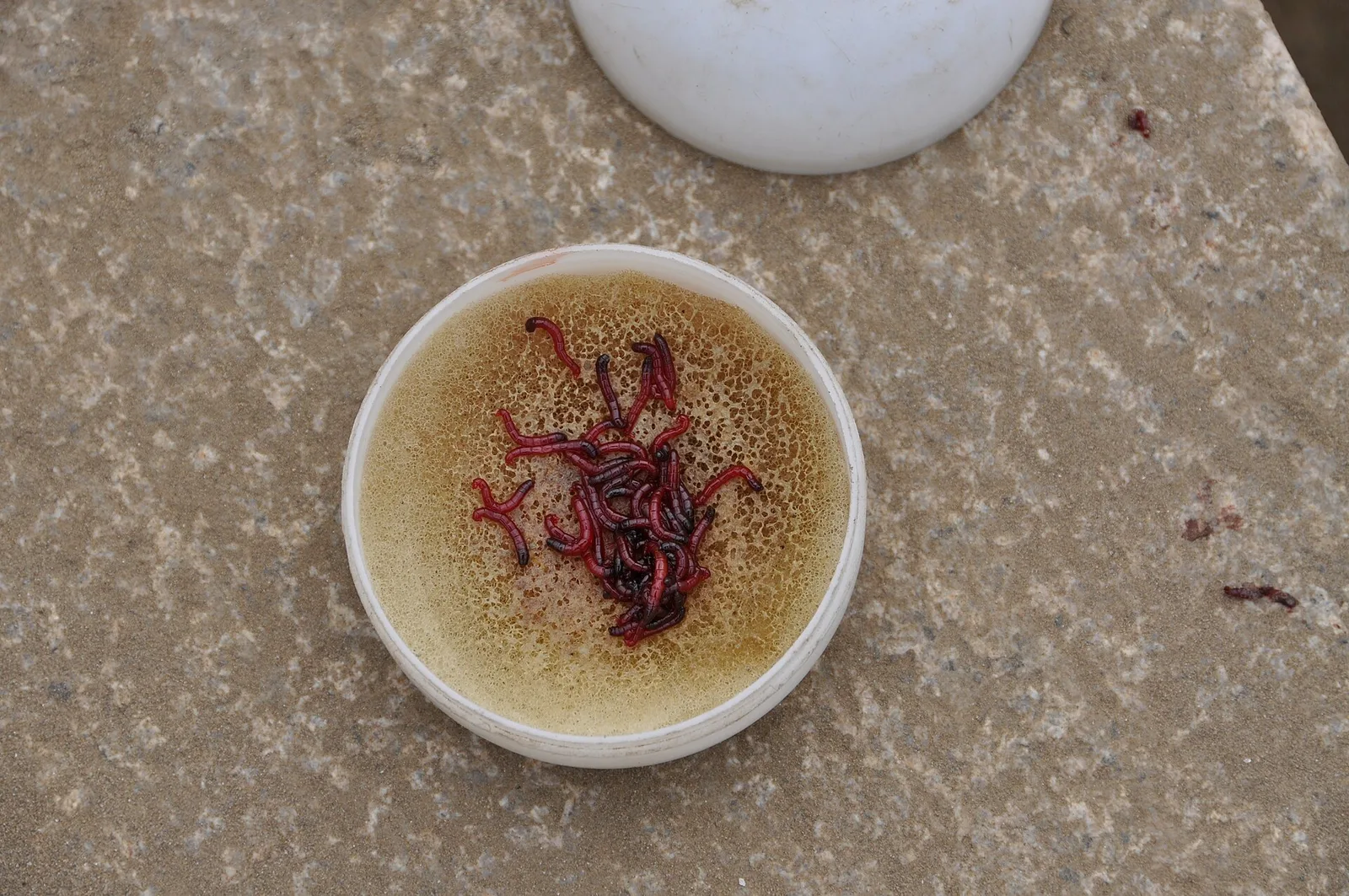
Search “bloodworms” and you’ll also get aquarium food. Those are midge larvae, tiny red insect larvae from the bottom of lakes and ponds. Here’s how to tell the worms apart.
| Called a “bloodworm” | What it is | Size | Bites you? | Used for |
|---|---|---|---|---|
| Bait-shop bloodworm | A marine worm dug in Maine | 4–10 in (10–25 cm), jumbos to about 14 in (36 cm) | Yes. Four jaws, a sting like a bee | Saltwater and brackish bait |
| Sandworm | The other Maine bait worm, sold beside it | Packed and shipped the same way | Has two black pincers | Bait, mostly north of New Jersey |
| Midge larva | A red insect larva from lakes and ponds | Stream ones rarely over 1/4 in (6 mm) | No. Harmless, Missouri’s agency says | Frozen or freeze-dried aquarium food |
Do bloodworms bite?
Yes. The jaws sit at the tip of a tube, the proboscis. The worm shoots it out of its front end to catch food or to defend itself. There are four of them, hollow fangs, and each one has a venom gland. Salt Water Sportsman puts it plainly: bloodworms are “quick to latch onto your hand.”
It feels like a bee sting, the Delaware site says. It calls the venom harmless to people, though it notes the occasional allergic reaction.
The first bite written up in a medical journal, its authors say, appeared in 2022. A field biologist near San Francisco got bitten on the index finger. It felt “much like a ‘bee sting’,” with pain, itching and numbness for about a day. Then the holes closed and left red spots. About a week later the finger was “very swollen, warm but not painful,” with blisters where the jaws went in. She took an antibiotic as a precaution and it cleared up. The doctors say these bites aren’t known to be dangerously venomous. They may raise the risk of an infection from saltwater bacteria, though. In the fishing trade, bites like this go by names like “bait-diggers hand.”
What to do about it:
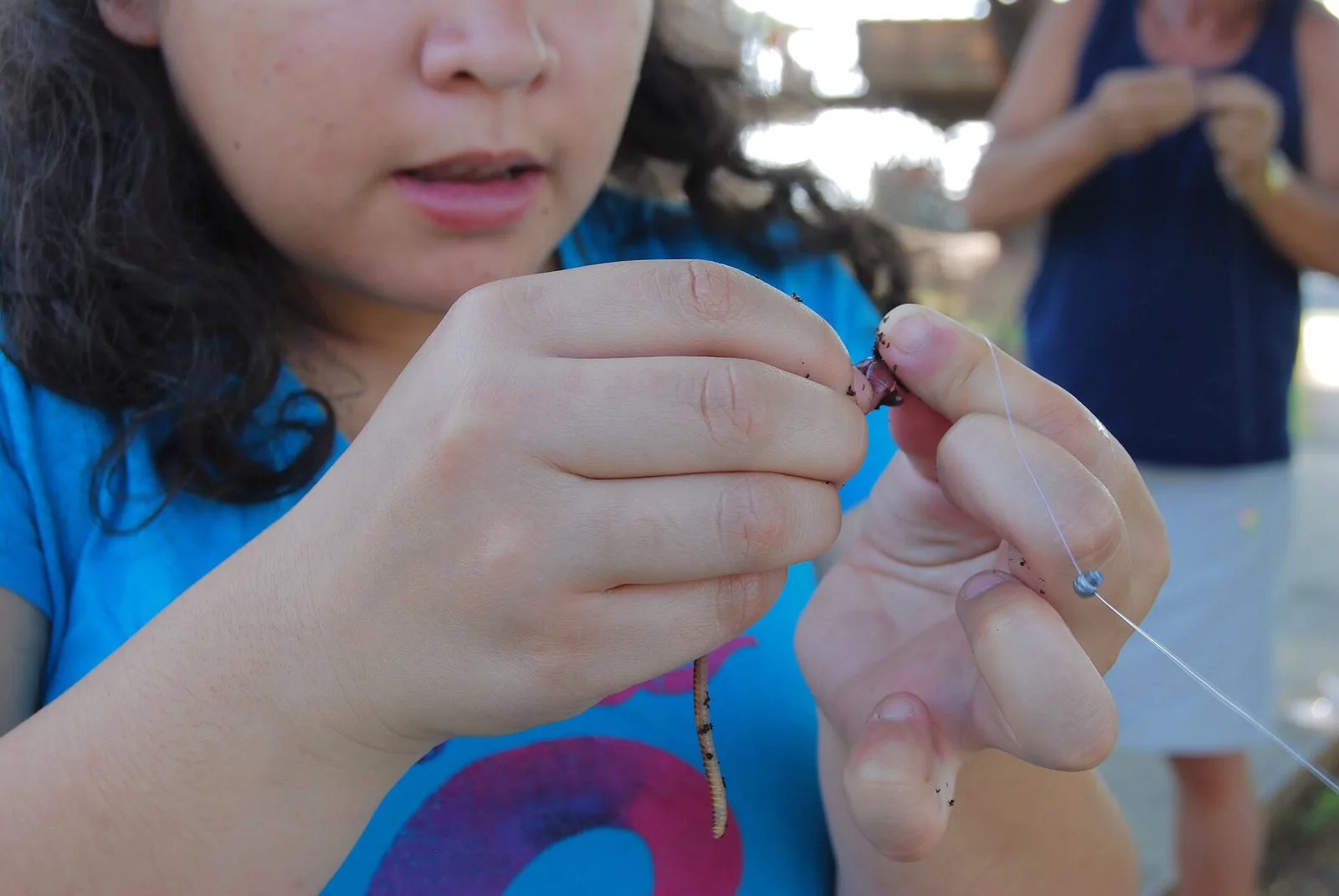
- Cut the head off before you bait up. Most anglers do, unless they’re fishing the whole worm.
- Wear gloves if you like. Some anglers do when they handle bloodworms.
- Don’t write a bite off when the sting fades. In that case the swelling showed up on day 8. If a bitten finger swells, turns warm or blisters, see a doctor, the case report’s authors say.
Free PDF · Water temperature chart Which fish are biting at today's water temperature?
One reading, and the 16-page chart shows which of 26 fish are spawning, feeding hard or slowing down; for bass, crappie, bluegill and walleye, where they sit and what to throw. Every number sourced.
No card, nothing to buy, and the PDF is yours to keep. Confirm with one click and it's on its way. Then a few short emails and one a week on what's biting. Unsubscribe anytime. Privacy.
How do you hook a bloodworm?
Match the piece to the fish’s mouth. A small bit for spot and white perch, half a worm or more for stripers and weakfish. When in doubt, go small, FishTalk says.
- Cut the head off. Most anglers do, the Delaware site says. Skip this only when you fish the whole worm.
- Cut the piece. About half an inch for spot. For stripers, two to three inches on a high-low rig (two hooks on short droppers above the sinker), or half a worm.
- Use a baitholder hook for small fish. The small barbs on the shank keep a soft bit from sliding down. Stripers are the exception, see step 5.
- Run the point through the piece and slide it up. For spot, the bit runs from the point to the first barb, no farther.
- Leave a tail for big fish. On stripers, thread half a worm on and let an inch or two hang off the bend. The hook has to be an inline circle hook. That’s the law for stripers on bait along the Atlantic coast.
- Don’t cover the hook for small fish. An inch-long chunk on a #6 hook means missed bites. Spot grab it from every side and rip it off.
- Get it to the bottom. Use enough weight to keep a spot rig down. For stripers, pill floats (small foam floats on the rig) lift the worm just off the mud where the fish are cruising.
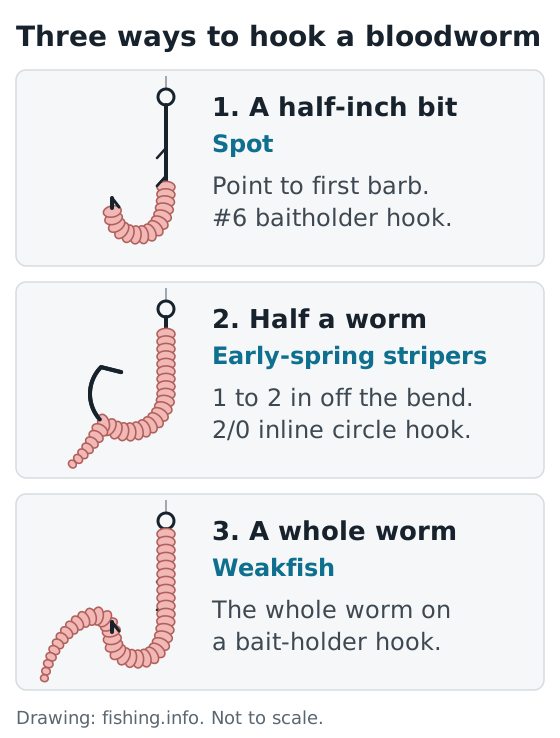
Three ways to hook one, and which fish each is for. Drawing: fishing.info.
The whole worm goes on for weakfish. Weakfish anglers use a whole worm on bait-holder hooks on a high-low rig, Salt Water Sportsman says. The hook size chart shows how a #6 compares to a 2/0.
What fish eat bloodworms?
Spot first. Bloodworm bits are the best bait for spot, FishTalk says: “hands-down, period, end of discussion.”
But a long list of bottom fish eat them, from the surf to the back bays.
| Fish | Bait and hook | Rig | Where |
|---|---|---|---|
| Spot | A 1/2 in (1.3 cm) bit on a #6 baitholder | Two-hook bottom rig | Oyster bars, 10–25 ft (3–8 m) |
| Kingfish | Bloodworm, shrimp, sand flea or squid | Two-hook bottom rig | Piers, jetties, the nearshore ocean |
| Striped bass, early spring | Half a worm, or 2–3 in pieces, on a 2/0 inline circle hook | High-low rig, or a fish-finder rig in a hard tide | Back-bay mud flats over 48 °F (9 °C) |
| Winter flounder | Bloodworm on narrow-gap Chestertown hooks | Two hooks on a spreader bar | New England, not common south of Delaware Bay |
| Weakfish | A whole worm on bait-holder hooks | High-low rig, or under a bobber | Deep-cut sod banks (marsh edges), creek mouths on an evening outgoing tide |
Striped bass: bloodworming is the easiest way to get your first stripers of the year, Nick Honachefsky wrote for TackleDirect in 2018. Stripers move onto shallow mud flats that warm up fastest, Salt Water Sportsman says, and the worms are what’s there. Honachefsky’s rig was a pre-tied high-low rig with pill floats and a 2 oz bank sinker, a teardrop weight with a molded eye. When the tide rips he switched to a fish-finder rig, a sliding sinker with 24 inches of 25 lb fluorocarbon. He tied on baitholder hooks. You can’t anymore. Since 2021 the Atlantic coast’s striped bass plan requires inline circle hooks when you fish bait for stripers. Every state from Maine to North Carolina follows it. Salt Water Sportsman’s high-low rig already used small 2/0 circle hooks, fished along the edges of the flats. Don’t expect big ones. Honachefsky says 95% of the early fish in New Jersey’s back bays are schoolies, small stripers of 18 to 26 inches.
Jumbos and regulars work about as well, says Gulf of Maine, a dealer. Jumbos are often picked for bigger stripers.
Spot need small hooks: #6 is ideal and #8 isn’t too small, FishTalk says, writing about the 4-inch spot you’d catch to live-line for stripers. You don’t need circle hooks for them. Look over oyster bars and wherever white perch and croaker are biting.
Kingfish bite bloodworms on two-hook bottom rigs from piers and jetties, North Carolina’s fisheries agency says. On a sandy beach the sand flea is the other bait for them.
It’s hard to beat a bloodworm for white perch, Eric Burnley writes in PropTalk. Look for them far up the tidal creeks and rivers or out in the open Chesapeake, depending on the water temperature and the season.
Winter flounder have small mouths, so Maryland DNR’s Keith Lockwood describes a narrow-gap hook called a Chestertown. Anglers often fished two on a spreader bar, a wire arm that holds the hooks apart. Flounder anglers chum with crushed clams and mussels, then bait with small bits of worm, Salt Water Sportsman says.
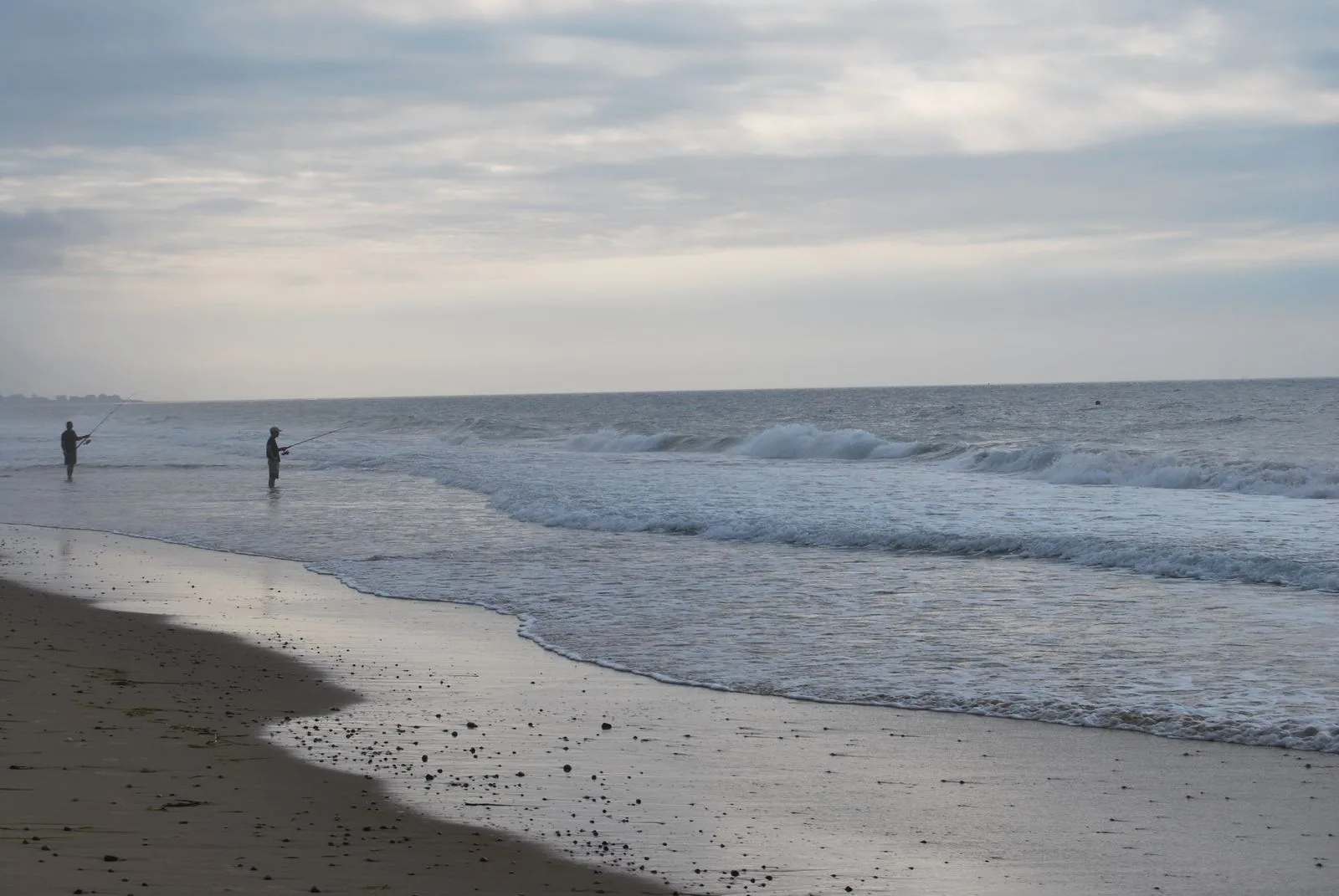
Surfcasting at Misquamicut Beach, Rhode Island. Photo: Juliancolton, Wikimedia Commons (public domain).
Bloodworm vs sandworm: which one?
Both come out of the same Maine mud and ship in the same seaweed. The bloodworm is the more popular of the two. You can tell them apart at the mouth. A sandworm has two black pincers. A bloodworm has four, and they come out when the front end is bothered.
Where you fish decides it. Sandworms are the usual bait north of New Jersey, and bloodworms get the nod south of it, Salt Water Sportsman says. For stripers on the flats, either one goes on the same high-low rig in 2 to 3 inch pieces.
How do you keep bloodworms alive?
Keep them cold and wet with salt water, never fresh. Gulf of Maine, which ships them from the flats, says to keep them at 32 to 38 °F (0 to 3 °C). Here’s the rest of its routine:
- Take them out of the tub. Spread them in a bigger, flat container with the wet seaweed they came in.
- Rinse them once a day in seawater. Never tap water.
- Pull out any dead or dying worm. One dead worm can rot and kill the others.
- Keep ice-pack drip off them. The water that beads on an ice pack is fresh water, and fresh water can kill bloodworms.
Simpler routines work too. Here’s how three others keep them:
| Who | How | What you get |
|---|---|---|
| FishTalk | The bag in the fridge, flipped over once a day | A couple of trips out of one bag |
| Delaware Surf Fishing | In the fridge, the package turned every day | Worms alive for a week |
| A Baltimore shop, 2017 (Soundings) | Shallow trays of chilled salt water, the water changed as often as twice a day | Worms that plump up to double or triple their size in a few minutes |
Gulf of Maine says they last up to a week in the fridge.
Where to buy bloodworms, and what they cost
In Delaware you’ll find bloodworms at nearly every bait shop, the Delaware surf site says. They’re not cheap. In 2017 a well-known Baltimore shop sold them at $12 a dozen and $18 for jumbos, Soundings reported. Call the shop before you drive. In cold weather they can be hard to find, because the flats in Maine and Canada freeze. Nobody had figured out how to farm them, Burnley wrote in 2015, so every one is dug by hand.
Mail order costs more. In November 2026 Gulf of Maine charged $125 for a baker’s dozen (13 worms) of its jumbo bloodworms, overnight shipping included. Two dozen were $160. The second dozen adds only $35, so most of the first price is the overnight box. Order for a group or a long trip.
You can dig your own in Maine. Anyone can take up to 50 marine worms a day for personal use without a digger’s license, state law says. Every other state sets its own rules, so check yours before you dig.
Mistakes to avoid
- A whole worm for spot. The little fish grab an end and rip it free every time. Use a half-inch bit.
- Grabbing the head end. That’s the end the jaws come out of. Cut the head off first.
- Fresh water or ice melt on the worms. Both kill them. Rinse with seawater only.
- A dead worm left in the box. It rots and takes the rest with it.
- Dumping leftovers in the water. The seaweed can carry live animals from Maine that don’t belong where you fish. North Carolina Sea Grant counted 46,262 live hitchhikers in the packing weed, most of them in spring and summer shipments. Throw worms and seaweed in the trash, Maryland Sea Grant says.
Watch out: Fresh water and ice melt both kill bloodworms, so rinse them with seawater only. Pull a dead worm from the box before it rots the rest.
When does another bait win?
When the shop is out of bloodworms, or the ones you have are old, use Fishbites. These artificial bloodworms work as well as the real thing at times “and maybe half as well at other times,” FishTalk says. They make no mess and keep for a year or two, so a bag in the tackle box is a good backup.
In winter, the baits white perch like best can run out at the shop. Then white perch take small lures, two inches or less, because they’re used to taking small bites. In the surf, a sand flea or a piece of shrimp catches the same kingfish. And for everything else you can dig, catch or buy, start at the bait hub or the live bait guide.
Quick answers about bloodworms
Why can’t I touch bloodworms? You can. Just keep your fingers off the head end, where the jaws come out, or cut it off first.
Are bloodworms poisonous? They’re venomous, through the bite. The doctors who wrote up a bite say these worms aren’t known to be dangerously venomous, but the bite hurts and may get infected.
What do bloodworms turn into? The bait worm stays a worm. The red pet-store kind, midge larvae, turn into midges, small flies that look like mosquitoes but don’t bite people, Missouri’s conservation department says.
Are bloodworms good bait? For spot, the best there is, and for white perch hard to beat. Bloodworming is also the easiest way to your first stripers of spring, Honachefsky says.

Free PDF · 16 pages
Stop guessing. Know what's biting before your first cast
A whole Saturday on the water with nothing to show for it. One reading tells you who's feeding.
The Water Temperature Fishing Chart. Take one water temperature reading, find it on the chart, and see which of 26 freshwater fish are spawning, feeding hard or slowing down.
- Where bass, crappie, bluegill and walleye sit, and what to throw. Trout: the reading where you stop.
- Why a 3 ft drop beats a cold front, and what to throw each day of the front
- The three thermometer mistakes that make a reading lie
The chart's numbers come from state fish and wildlife agencies and fisheries research: 61 sources, each listed on the site.
No card, nothing to buy. Confirm with one click and the PDF is on its way, one version for your phone and one to print, yours to keep. Then a few short emails and one a week on what's biting, with an unsubscribe link in every one. Privacy.
Related
Section guide
Fishing Bait: Live, Cut and Prepared, and Which One to UseFishing bait made simple: live, cut and prepared bait, what to use for each fish, how to hook it and how to keep it alive until you fish.
 Ice Fishing Bait: The Live Bait for Each Fish, From Wax Worms and Spikes to Minnows
Live ice fishing bait, fish by fish: wax worms, spikes, mousies and minnows, how to tip a jig, keep bait from freezing, and the minnow rules.
 Live Bait: Which One to Use, How to Hook It and Keep It Alive
Live bait made simple: which bait for which fish, how to hook it so it stays alive, the rigs, how to keep it alive, and the rules on moving it.
 Minnows: What They Are, Which to Buy and What Size to Use
Minnows are small fish of the minnow family, and the top live bait. Which minnows bait shops sell, what size for each fish, and when they work.
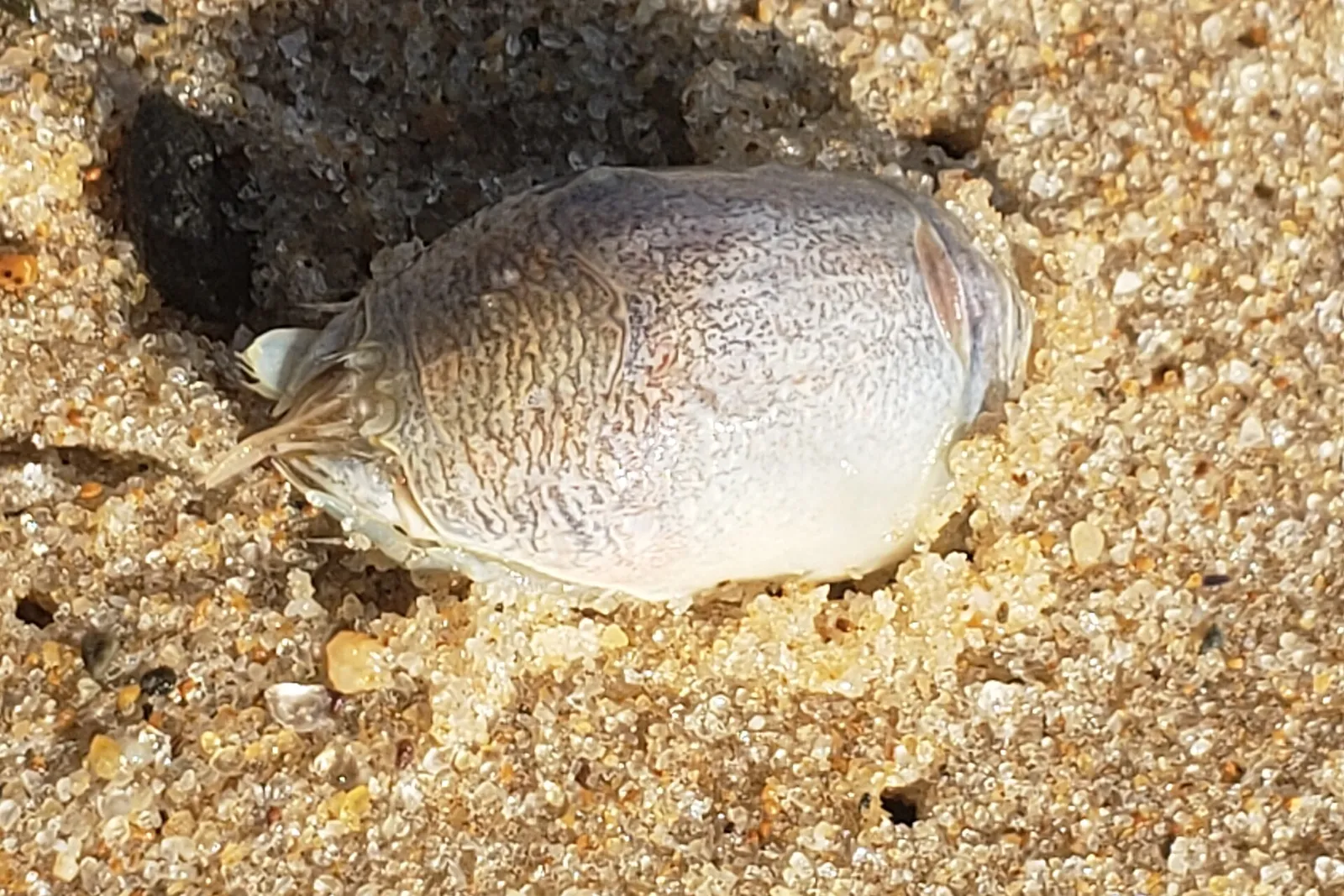 Sand Fleas: What They Are, Do They Bite, and How to Catch Them
The sand flea surf anglers dig is a clawless mole crab, not an insect. What bites you instead, and how to rake, keep and hook sand fleas.
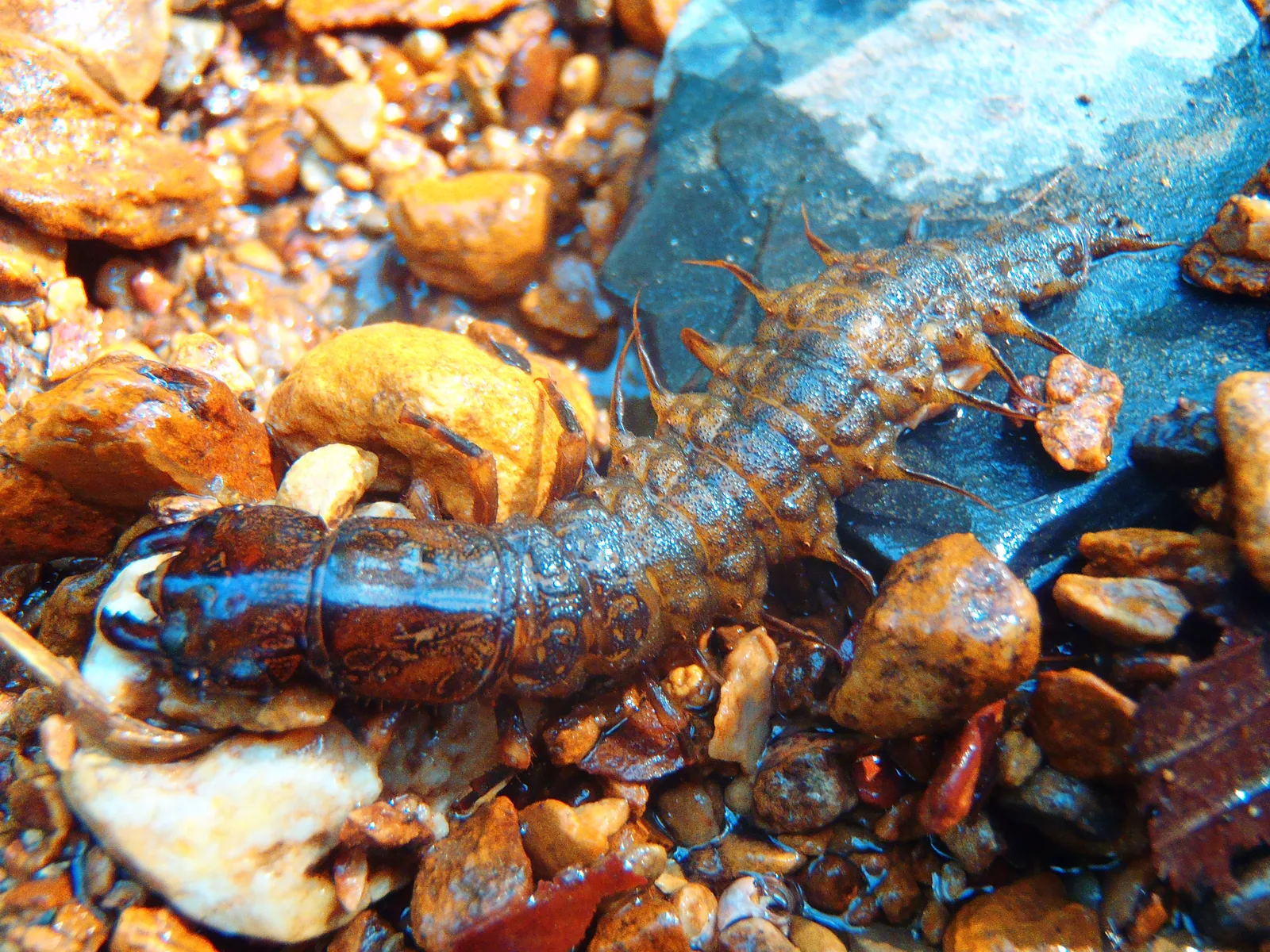 Hellgrammite: What It Is, Where to Find It, How to Fish It
A hellgrammite is a dobsonfly larva up to 4 inches long and a top smallmouth bait. How to find one, hold it without a pinch, hook it and fish it.
Sources (22)
- Maine Department of Marine Resources, Marine Worms
- Maine Revised Statutes, Title 12, §6752: Exception for personal use
- Daniela M. Durkin, Alison N. Young, Kent Khtikian, Zuzana Karjala, Arin L. Isenstein, Bryan G. Fry and Matthew R. Lewin, Envenoming by a Marine Blood Worm (Glycera), Toxins 14(7): 495 (2022)
- Delaware Surf Fishing, Bloodworms
- Missouri Department of Conservation, Midge Fly Larvae
Show all 22 sourcesShow fewer sources
- Missouri Department of Conservation, Midges
- Darren Dorris, Inshore: As the Worm Turns, Salt Water Sportsman (September 21, 2007)
- Nick Honachefsky, Bloodwormin' for Bass, TackleDirect (March 9, 2018)
- Atlantic States Marine Fisheries Commission, Atlantic Striped Bass (Addendum VI to Amendment 6)
- New Jersey Division of Fish and Wildlife, Striped Bass Circle Hook Requirement Update (April 15, 2021)
- FishTalk Magazine, How to Live Line With Spot, Part I
- FishTalk Magazine, Rigging for Beginners, Part III: Rigging Baits
- FishTalk Magazine, Pounding Winter White Perch
- Eric Burnley, White Perch: The New White Meat, PropTalk (September 29, 2015)
- North Carolina Division of Marine Fisheries, Kingfishes
- Keith Lockwood, Digging Bloodworms, Maryland Angler's Log, Maryland Department of Natural Resources (March 10, 2021)
- Gulf of Maine, Inc., JUMBO Bloodworms (BAIT) Live
- Timothy Sheehan, Jumbo vs Regular Bloodworms: Which Size Fishing Bait Should You Use?, Gulf of Maine, Inc. (January 5, 2026)
- Gary Reich, 'Worm Girl' Brings Science To Bait, Soundings (November 2017)
- Associated Press via Maine Public, Mysterious Drop In Prized Bait Worms Threatens A Way Of Life (April 27, 2017)
- Maryland Sea Grant, Bait Worm Study
- North Carolina Sea Grant, Hook, Line & Science: What Should We Do with Unused Marine Bloodworms and Packing Material? (June 8, 2020)