 By
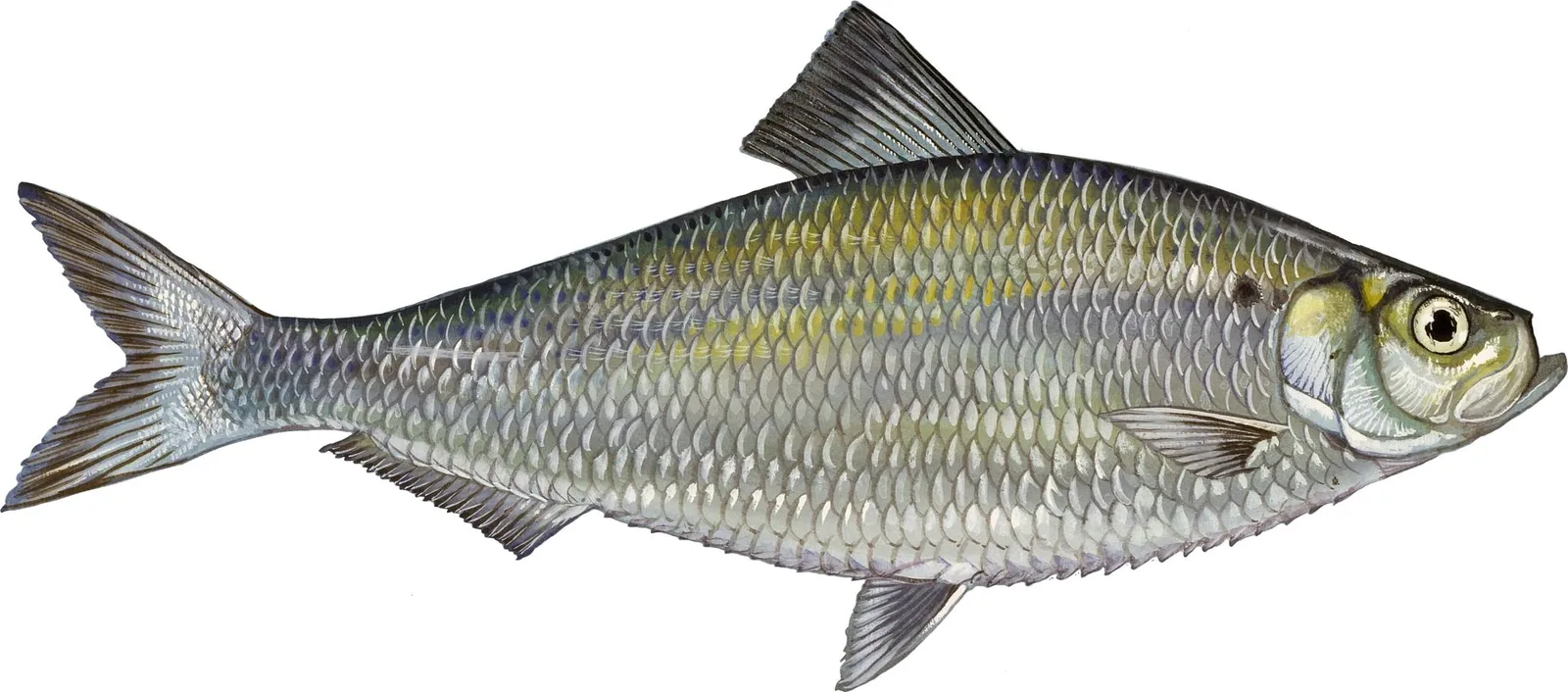
An alewife is a small silver herring, 4 to 9 inches long on average, and it lives two lives. Along the Atlantic coast it grows up at sea and runs up rivers each spring to spawn. In the Great Lakes and a long list of stocked lakes it never sees salt water. Either way it’s bait for the fish you want: salmon, trout, stripers and bass follow it. Most Atlantic states won’t let you keep a sea-run one.
In June 1967 dead alewives lay in windrows on beaches in Michigan, Indiana, Illinois and Wisconsin. The pile was worst from Benton Harbor to Chicago.
What is an alewife?
It’s a member of the herring family. With its cousin the blueback herring it goes by “river herring” on the East Coast. It’s also called a sawbelly, for the row of sharp, overlapping scales along the belly that make a saw-like edge. You’ll also hear grayback, golden shad, branch herring and big-eye herring.
Say it “AYL-wife,” plural alewives. Merriam-Webster lists the older meaning too: a woman who keeps an alehouse. The name turns up on bars and brewpubs too.
Here’s what to look for in your hand:
- Silver body, deep and flat. The back runs bronze to gray-green, the sides silver, the belly white.
- One dark spot just behind the gill cover, about level with the eye. Chesapeake Bay’s field guide says it shows on fish longer than 3.9 inches.
- A big mouth. It opens to below the front of the eye, and the lower jaw sticks out past the upper.
- A plain back fin. No long thread trailing off the last ray, which is the quickest way to rule out a gizzard shad.
- A big eye, bigger than a blueback herring’s.
Alewife vs blueback herring: how do you tell them apart?
You often can’t from the outside. Maryland calls the two hard to tell apart, and Delaware says they’re almost identical except for the alewife’s bigger eye. The sure test is inside. Slit the belly and look at the lining of the gut cavity. An alewife’s is white. A blueback’s is black to dusky.
| Check | Alewife | Blueback herring | Gizzard shad |
|---|---|---|---|
| Back color | Bronze to gray-green | Deep bluish green | Silver-blue |
| Eye | Larger | Smaller | Not the test |
| Body | Deeper, less long | Slimmer, longer | 8–12 in typical |
| Belly lining | White | Black to dusky | Not the test |
| Last ray of the back fin | Short | Short | Very long and thin |
| Spawns (Maryland, Illinois) | Late February–April | Late March–mid-May | April–May |
In Lake Michigan, alewives often get confused with shad, says west Michigan guide Jeff Elliott. Both are small, silver and school up. His tip: an alewife has a large mouth, a shad a much smaller one. Add the long thread on a gizzard shad’s back fin and you’ve got it. A silver fish with a huge eye and teeth on its tongue is a mooneye or a goldeye, not a herring.
Free PDF · Water temperature chart Which fish are biting at today's water temperature?
One reading, and the 16-page chart shows which of 26 fish are spawning, feeding hard or slowing down; for bass, crappie, bluegill and walleye, where they sit and what to throw. Every number sourced.
No card, nothing to buy, and the PDF is yours to keep. Confirm with one click and it's on its way. Then a few short emails and one a week on what's biting. Unsubscribe anytime. Privacy.
Sea-run or landlocked: what’s the difference?
Same fish, two ways of living, and they don’t grow to the same size. A sea-run alewife spends its adult life in the ocean and comes into fresh water only to spawn. Maryland says river herring can travel more than 1,200 miles along the coast. That’s what anadromous means: born in fresh water, grown at sea, back to fresh water to spawn. A landlocked alewife does all of it in one lake.
| Sea-run (anadromous) | Landlocked | |
|---|---|---|
| Where | Atlantic rivers, Labrador to South Carolina | Great Lakes, Finger Lakes, Lake Champlain and other lakes; established in 22 states |
| Usual size | 9–11 in (23–28 cm), Connecticut | 3–6 in (8–15 cm), Connecticut |
| Spawns | Spring runs up rivers into ponds and lakes | Shoreward at night once the lake passes about 59 °F (15 °C) |
| Grown up | Males at 3–4, females by 5 (Maryland) | A year sooner: males at 2, females at 3 (USGS) |
| Can you keep one? | Closed in most states (table below) | Your state’s fishing and bait rules apply |
How the landlocked fish got there is the Great Lakes story. Illinois says alewives invaded through the Welland Canal, which lets ships get around Niagara Falls, from the 1930s through the 1960s. The USGS dates the first reports to Lake Erie in 1931, Huron in 1933, Michigan in 1949 and Superior in 1954. Other lakes got them on purpose, as food for game fish. Maine first stocked landlocked alewives in 1966, and Virginia has added them to several waters.
When and where do alewives run?
Sea-run alewives come in early. Maryland’s spawn from late February through April, Virginia’s from February to May. In Maine they head upstream between late April and early June, and the actual spawning starts at about 55 °F and stops around 68 °F. They pick slack water: ponds, lakes and the quiet backwaters of rivers.
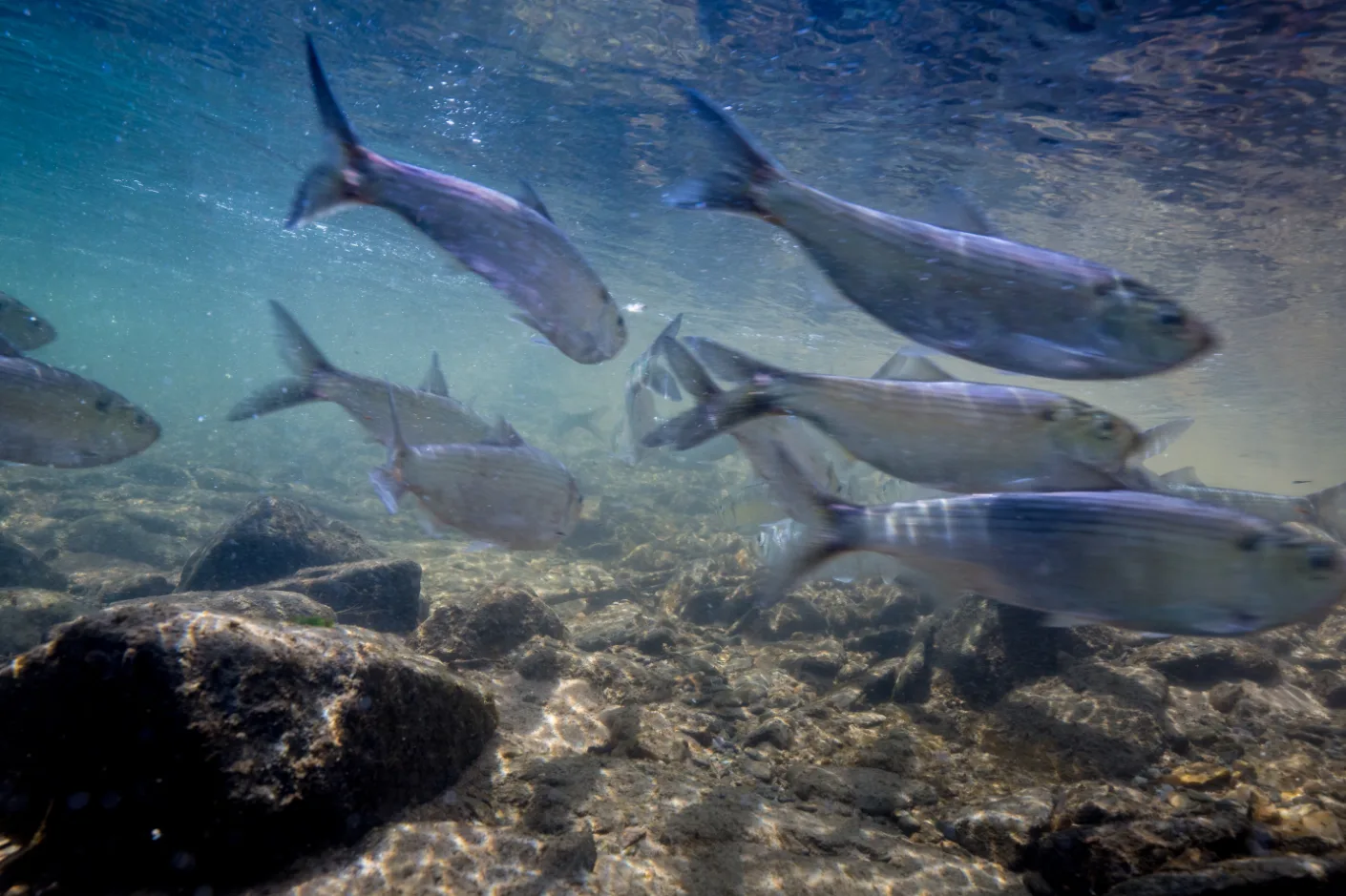
A school of alewives at Deer Park, Maryland, in April 2019. Photo: Ryan Hagerty, U.S. Fish and Wildlife Service (public domain).
Want to see a run? Connecticut says the best way is a local fishway on a warm night in April. Maine gives the fish their own day, the Saturday before Memorial Day. And the numbers can still be huge. In 2025 more than 9.1 million river herring returned to the Kennebec River, Maine’s marine agency says.
In a big lake they move with the seasons. This is the alewife’s year, from the USGS profile, Maine and the 1967 Lake Michigan report.
| Season | Sea-run alewives | Landlocked alewives | What it means for you |
|---|---|---|---|
| Late winter | First spawners in Maryland and Virginia rivers | Start moving shoreward from deep water | Watch the fishways and river mouths |
| Spring | Runs and spawning, at 55–68 °F (13–20 °C) in Maine | Lake Michigan fish come inshore in April and May | Fish the river mouths and shorelines |
| Early summer | Adults head back downstream after spawning | Spawning near shore at night. Near shore they favor rock over sand. West Michigan river-mouth lakes in June | Fish low light, near shore, for bass |
| Summer | Young grow up in fresh water | Young stay in the warm top layer, older fish drop into the thermocline | Look deeper, down at the thermocline |
| Fall | Young head down to the sea | Fish move off shore and deeper as the thermocline sinks | Follow the bait out to deeper water |
| Winter | At sea | Deep water | Hard winters bring die-offs |
Are alewives invasive in the Great Lakes?
Yes, above Niagara Falls. They may be native to Lake Ontario, where they were known by 1873, the National Invasive Species Information Center says. From there they spread through the Welland Canal to Lake Erie and on to the upper lakes. The USGS lists them as established in 22 states, Ontario and throughout the Great Lakes.
The trouble is what they eat. Alewives pick out the biggest plankton in a lake, and they eat fish eggs and fish larvae too. They feed well in midwater and in dim light. The USGS ties the loss of native whitefish in part to alewives eating the plankton those fish needed. A 1983 reference put alewives at 70 to 90 percent of the weight of all the fish in Lake Michigan.
Smaller lakes feel it too. In East Twin Lake in Salisbury, Connecticut, alewives that showed up around 1990 ended a popular kokanee fishery. Lake St. Catherine in Vermont most likely got its alewives from a bait bucket. That’s why New York and Vermont have rules against moving fish and bait from one water to another, Bassmaster says. Don’t dump leftover bait in a new lake.
Why do alewives die off on the beaches?
Cold and crowding. Die-offs in the Great Lakes and Lake Champlain usually come with a hard winter, the USGS says. They also come when too many fish are packed together and they’re in poor shape. Water that stays at or below about 34 °F (1 °C) can kill them, and the small ones die more often. A young-of-the-year alewife has to be at least 60 mm, about 2.4 inches, to make it through a Great Lakes winter.
The 1967 die-off is the one people remember. Alewife numbers in Lake Michigan exploded in the 1960s and peaked in 1966. In June and early July 1967 they died in huge numbers, and wind and waves piled them up along the shores of four states. An aerial survey on June 22 found dead fish all the way around the lake. They lay from Arcadia, Michigan, south to Michigan City, Indiana, and up the west shore to Sturgeon Bay, Wisconsin. Back then a die-off came every spring and summer, as the fish moved inshore to spawn. Illinois puts it simply: sometimes huge numbers die and wash ashore.
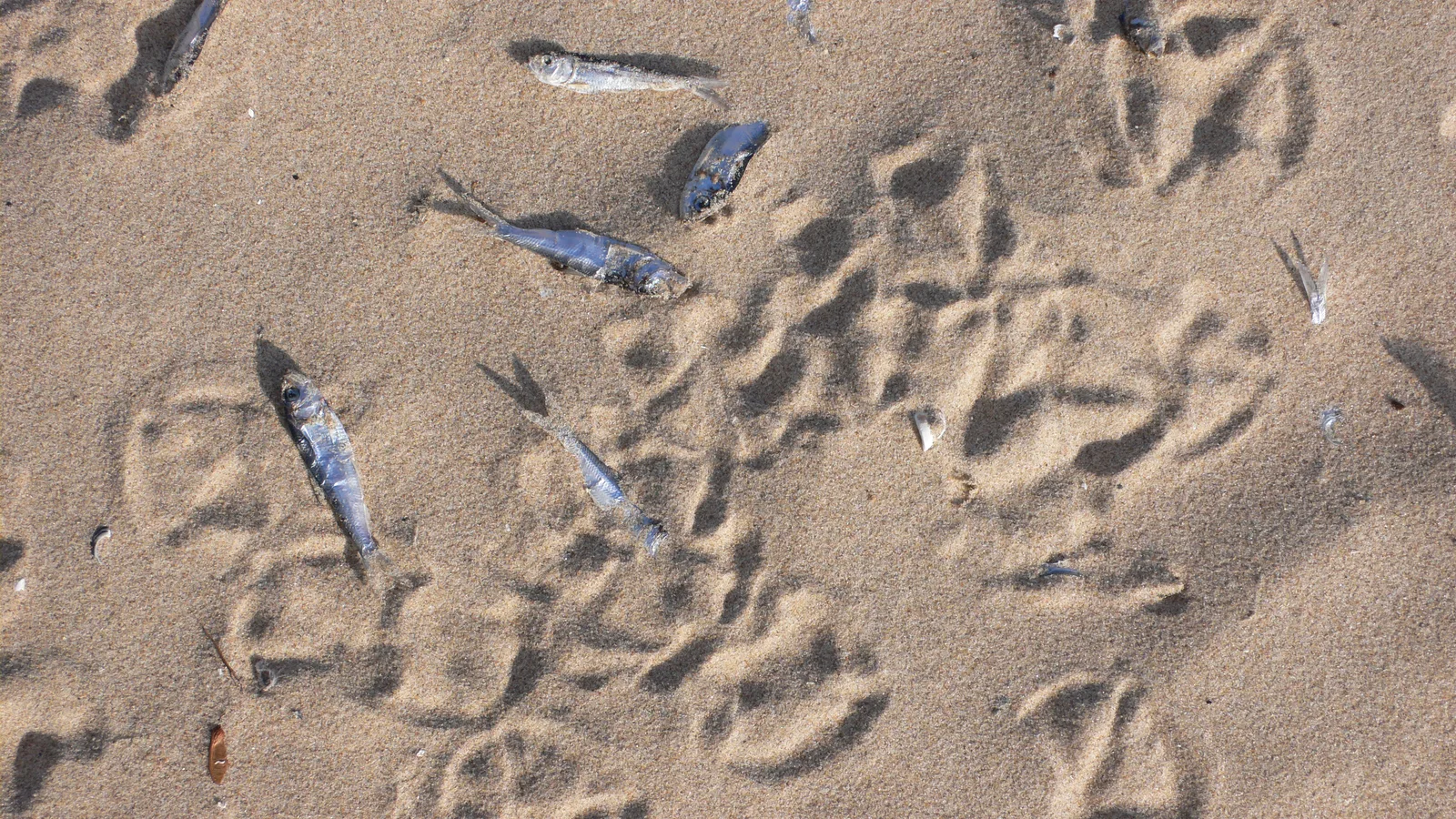
Dead alewives on the beach at Whitefish Dunes State Park, Wisconsin, June 2006. Photo: kjell, via Wikimedia Commons (CC BY-SA 2.0).
So a beach full of dead alewives in spring is nothing new in alewife country.
Why do salmon, trout and bass anglers care about alewives?
Because the fish they want eat them, and in the Great Lakes the fishing was built around that.
Salmon. On April 2, 1966, Michigan’s DNR started stocking coho salmon in Lake Michigan. The program had two jobs: make up for the decline of lake trout, the old top predator, and control an exploding alewife population. Illinois says coho and chinook were both brought in to feed on alewives. The USGS puts it the same way: Pacific salmon came in to control the alewives and to turn them into food for a sport fishery.
Trout. Big open-water brown trout feed on landlocked alewives, Connecticut says. In Maine the young ones feed brook trout, lake trout, landlocked salmon, perch and pickerel. In the Great Lakes add walleye, yellow perch and burbot. There’s one catch for trout and salmon. Alewives carry thiaminase, which keeps the fish that eat them from taking up thiamine, a vitamin. That can leave trout and salmon in poorer shape and swimming worse, the USGS says.
Bass. Maine’s marine agency says adult alewives help grow trophy-sized bass and pike. On Bassmaster LIVE from Lake Champlain, pro Chris Zaldain showed alewives that bass had spit up in his boat. Elliott’s west Michigan pattern is the one to copy. In June, alewives spawn in the weeds of the drowned river-mouth lakes, and big bass eat with reckless abandon, he says. The bass like a topwater. Fish it in low light, and listen for the swirl of several spawning alewives at once, a sound like nothing else. Smallmouth eat them too, Elliott says. For the rest of the menu, see the smallmouth bass page and what bass eat.
Stripers. On the coast, sea-run alewives are big food for striped bass, Maryland and Delaware both say. But you’ll usually have to match them with a lure, because the herring itself is off-limits in most states.
How do you catch alewives?
With a tiny lure or a net. Connecticut says both sea-run and landlocked alewives can be enticed to hit a small jig or fly, even though they mostly eat plankton. If you want several small hooks on one line, that’s a sabiki rig. The old ways on the rivers were snagging in the main river and dip netting in the spawning streams.
Time it for evening. Landlocked alewives school up and come into the shallows at night, and in the evening you’ll see them flip and pop at the surface. In Lake Michigan, Elliott finds them in open water or by the pierheads. They often school by size and commonly run up to about 7 inches.
Two things before you go. Check that the water is open, using the table below. And check the net rules. Maine’s open runs allow only a dip net or hook and line, and the fishing net you bring has to fit your state’s rule.
Where can you keep a sea-run alewife?
In most of the East, you can’t. The Atlantic States Marine Fisheries Commission sets the river herring plan. Under it, a state has to close both recreational and commercial harvest unless it has an approved plan. The commission lists approved plans for Maine, New Hampshire, New York, South Carolina and three named runs in Massachusetts. Everywhere else is closed, and a plan on paper doesn’t mean your river is open.
| State | Sea-run alewife | Worth knowing |
|---|---|---|
| Maine | Open on runs with a fishery | 25 a day for your own use, dip net or hook and line. Closed 6 a.m. Thursday to 6 a.m. Sunday. On a town-leased run, ask the town |
| New York | Approved plan | The Hudson and its tributaries have their own herring seasons, limits and net rules, so check the current book. Bought alewife bait only on listed waters, from Lake Erie to the Finger Lakes |
| New Hampshire, South Carolina | Approved plans | Read the state’s own rules for season and limit |
| Massachusetts | Closed, except runs with an approved plan | Plans cover the Nemasket River, Herring River and Herring Brook. Check the current rules before you dip a net |
| Connecticut | Closed | Renewed April 1, 2026. Landlocked alewives from 12 named lakes, Candlewood among them, may be taken by angling or scoop net |
| New Jersey | Closed in streams, rivers and the sea | Lakes in Morris, Passaic, Sussex and Warren counties and Spruce Run Reservoir: 35 a day, 6 in at most, and they stay at that lake. Other lakes: bought herring only, with a receipt |
| Delaware | Closed | Statewide moratorium. Release at once |
| Maryland | Closed | Moratorium since December 26, 2011 |
| Every other Atlantic state | Closed | No approved plan on the commission’s list, read November 2026 |
Rules change, so read this year’s book before you fish. The closures came after a long slide. NOAA blames dams and road crossings that block the runs, overfishing, catch in other fisheries and pollution. In 2019 it decided the alewife doesn’t need to be listed as threatened or endangered.
Can you use alewives as bait?
In alewife lakes, often yes, with limits. New York is a good example. Bought alewives may be used only on a listed set of waters. Among them are Lake Ontario, Lake Erie, the Finger Lakes, the St. Lawrence and Niagara rivers and parts of the Hudson. You can collect your own alewives for hook-and-line bait with legal gear, but not sell them. The Hudson has its own special rules for that. A baitfish you catch yourself may be used only on the water where you caught it. It can’t ride in your car outside a set corridor.
On the coast, adult alewives are the preferred bait for Maine’s spring lobster fishery. Where you can’t keep a sea-run fish, the live bait guide covers the legal choices.
Are alewives good to eat?
Yes, people eat them. The Chesapeake Bay Program says alewives are sold fresh, smoked, salted or pickled, and also go for pet food, lobster bait and fish meal. In the 1800s most of the catch was eaten, because they kept so well in salt or smoke, says the Downeast Salmon Federation. Today most of Maine’s harvest goes for bait. Where you can’t keep a sea-run fish, the question answers itself. For a landlocked fish from the Great Lakes, check your state’s fish consumption advisory first.
How big do alewives get?
On average they run 4 to 9 inches, Illinois says. The sea-run fish are the big ones: 9 to 11 inches against 3 to 6 for landlocked fish in Connecticut. The biggest Connecticut lists is 16 inches. Old repeat spawners in Maine can reach 14 inches and a pound or more. In Lake Champlain, adults usually run 5 to 8 inches but can hit 11 or 12.
Don’t plan on a record. Delaware won’t count one for a state record, because alewives there are protected.
What do alewives eat?
Alewives eat plankton, algae and tiny water animals, and the young of other fish. They live six to eight years in Illinois, and fish of 9 or 10 have turned up on spawning runs. A female lays 60,000 to 103,000 eggs, Maryland says, and they hatch in three to six days. Very few make it. In Maine fewer than 5 percent of the young survive to age three. Everything eats them: herons, eagles, otters, seals, whales and most of the fish you’d like to catch. The Wabanaki name for the alewife translates as “the fish that feeds all.”
That’s the whole reason to know this fish. Where alewives run, the big fish aren’t far behind. More of the other freshwater species are in the hub, and smelt fishing is the other Great Lakes baitfish worth a look.

Free PDF · 16 pages
Stop guessing. Know what's biting before your first cast
A whole Saturday on the water with nothing to show for it. One reading tells you who's feeding.
The Water Temperature Fishing Chart. Take one water temperature reading, find it on the chart, and see which of 26 freshwater fish are spawning, feeding hard or slowing down.
- Where bass, crappie, bluegill and walleye sit, and what to throw. Trout: the reading where you stop.
- Why a 3 ft drop beats a cold front, and what to throw each day of the front
- The three thermometer mistakes that make a reading lie
The chart's numbers come from state fish and wildlife agencies and fisheries research: 61 sources, each listed on the site.
No card, nothing to buy. Confirm with one click and the PDF is on its way, one version for your phone and one to print, yours to keep. Then a few short emails and one a week on what's biting, with an unsubscribe link in every one. Privacy.
Related
Section guide
Freshwater Fish Species Outside the Big Families: Sturgeon, Gar, Bowfin, BurbotThe freshwater fish species outside the bass, trout, catfish and pike families: sturgeon, gar, bowfin, burbot, drum, eel and paddlefish, with records.
 Candiru: The Amazon's Vampire Catfish and the Urethra Myth
The candiru is a tiny see-through Amazon catfish that drinks blood from fish gills. What it really does, its size, and the urethra story checked.
 Fathead Minnows: ID, Bait, Pond Stocking and Rosy Reds
Fathead minnows are tough 2 to 3 in baitfish. How to identify them, keep them alive in a bucket, stock a pond by the pound, and spot a rosy red.
 Golden Shiner: How to ID, Catch and Fish This Trophy Bait
Golden shiners are deep-bodied minnows and Florida's top live bait for big bass. How to tell one from a rudd, catch your own, and hook it right.
 Snakehead Fish: How to Identify, Catch, and Handle One
The snakehead fish is an invasive, air-breathing predator. How to identify one, catch one on a frog, and what each state says to do with it.
 Creek Chub: How to Identify, Catch and Use Them as Bait
A creek chub is a 5 to 7 in minnow with a black spot on its back fin. How to identify one, catch it on light tackle, and rig it as live bait.
 Gizzard Shad: How to Identify, Catch and Use Them for Bait
Gizzard shad commonly run 9 to 14 in. How to tell one from a threadfin, net it, keep it alive, and which states ban it as live bait.
Sources (24)
- Illinois DNR, Wild About Illinois Fishes: alewife
- Illinois DNR, Wild About Illinois Fishes: gizzard shad
- U.S. Geological Survey, Nonindigenous Aquatic Species: Alewife (Alosa pseudoharengus) species profile
- Brown, E. H. (1968), Population characteristics and physical condition of alewives, Alosa pseudoharengus, in a massive dieoff in Lake Michigan, 1967. Great Lakes Fishery Commission Technical Report No. 13
- Michigan DNR, 50th anniversary of Michigan's salmon program to be celebrated on April 4 (2016)
Show all 24 sourcesShow fewer sources
- Maryland DNR, Fish Facts: Alewife and Blueback Herring
- River Herring - Atlantic States Marine Fisheries Commission
- ASMFC, Shad and River Herring Management Board meeting materials, November 2026
- New York fishing regulations (eRegulations), Baitfish regulations
- New Jersey Freshwater Fishing - Baitfish (eRegulations, updated September 23, 2026)
- New York fishing regulations (eRegulations), Tidal Hudson River regulations
- Delaware DNREC, Delaware Fish Facts: Alewife
- Connecticut DEEP, Freshwater fishes of Connecticut: Alewife
- Connecticut DEEP, The taking of migratory alewives and blueback herring is prohibited in Connecticut waters (declaration effective April 1, 2026)
- Downeast Salmon Federation, Alewife (sea-run fish facts)
- Maine Department of Marine Resources, Alewife
- Maine Department of Marine Resources, 2026 Maine Marine Recreational Fishing Regulations: Sea Run Fish
- Alewife | National Invasive Species Information Center
- Virginia DWR, Alewife
- Chesapeake Bay Program, Field guide: Alewife
- NOAA Fisheries, River herring
- Merriam-Webster, Alewife
- Bassmaster, What's an alewife?
- Jeff Elliott Outdoors, Bait profile: alewife