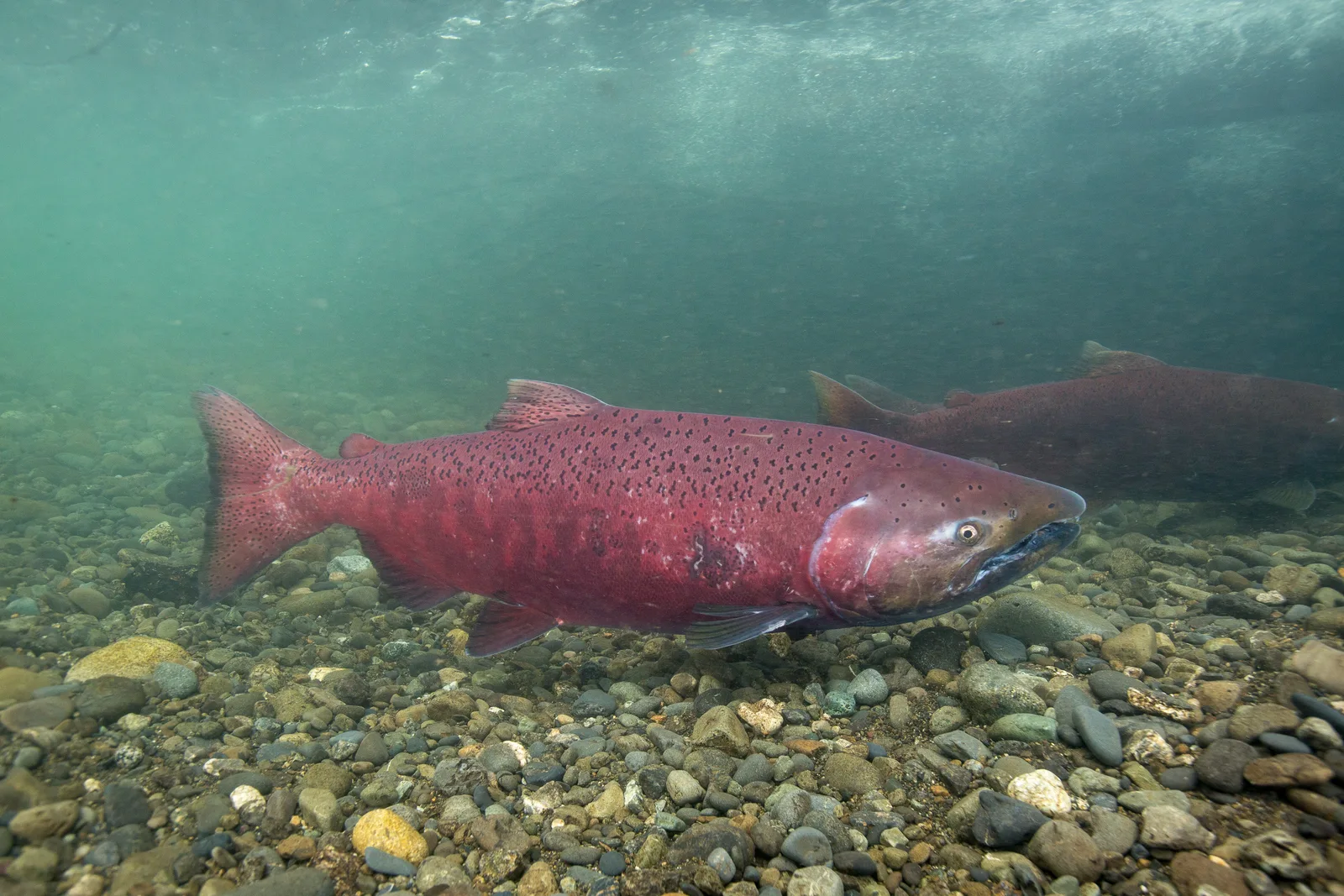
The king salmon, also called the chinook, is the largest Pacific salmon: Alaska’s fish and game department puts a typical adult at 36 in (91 cm) and often over 30 lb (14 kg). It ranges from Monterey Bay in California to Alaska’s Chukchi Sea, and stocked kings swim in all five Great Lakes. A black gum line and spots on both halves of the tail set it apart from a coho.
Les Anderson’s 97 lb 4 oz king from Alaska’s Kenai River, caught on May 17, 1985, is still the world record. In 2026 the lower Kenai was closed to king fishing from May 1 to August 15, catch-and-release included.
Is a king salmon the same as a chinook?
Yes. King and chinook are two names for one species, Oncorhynchus tshawytscha. “King” refers to its size; the scientific name comes from the name used by natives in Alaska and Siberia. Alaska made it the state fish in 1963, and Oregon calls it its state fish too.
The fish collects names by place and age. Washington calls an immature king a blackmouth, after its dark gums. Spring salmon and quinnat are older or regional names. In Campbell River, British Columbia, a tyee is a king of 30 lb (13.6 kg) or more: that is the entry ticket to the Tyee Club, founded in 1924. A small male that comes back after only one winter at sea is a jack.
King or coho: check the gums, then the tail
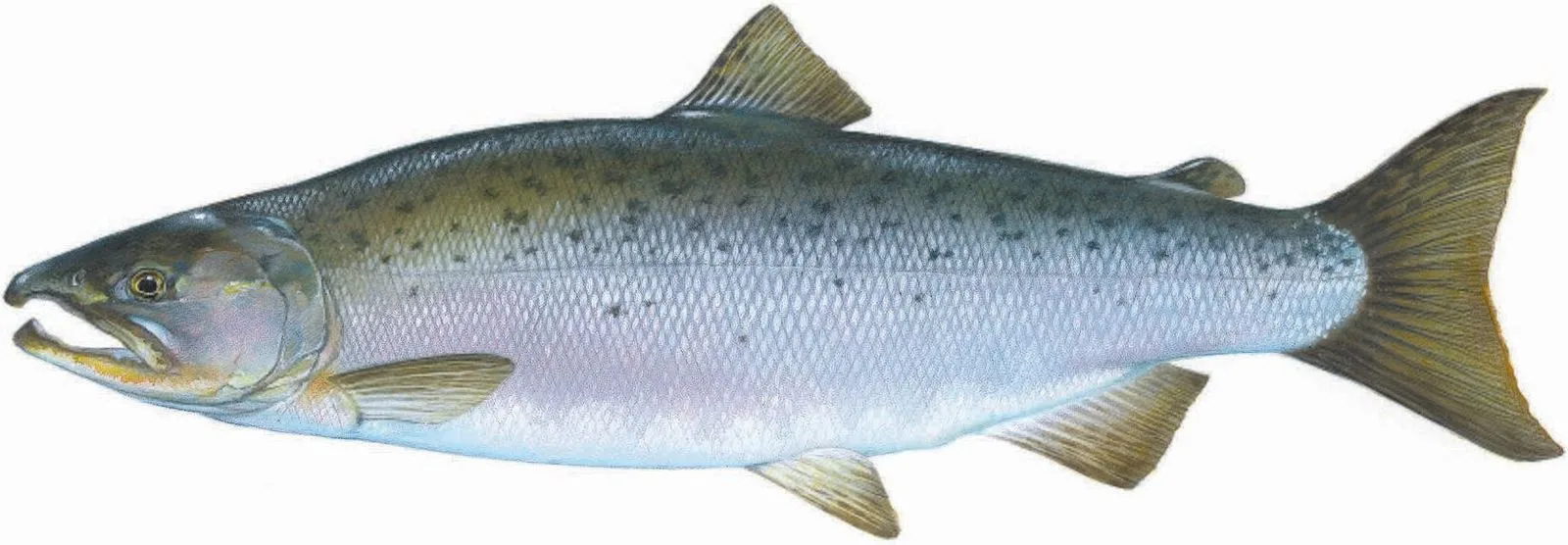
Look in the mouth first. A king has a dark mouth and black gums at the base of its lower teeth. A coho has white gums. Oregon’s fish and wildlife department calls the gum line on the lower jaw “the single best feature to use”, and the one enforcement officers are most likely to check.
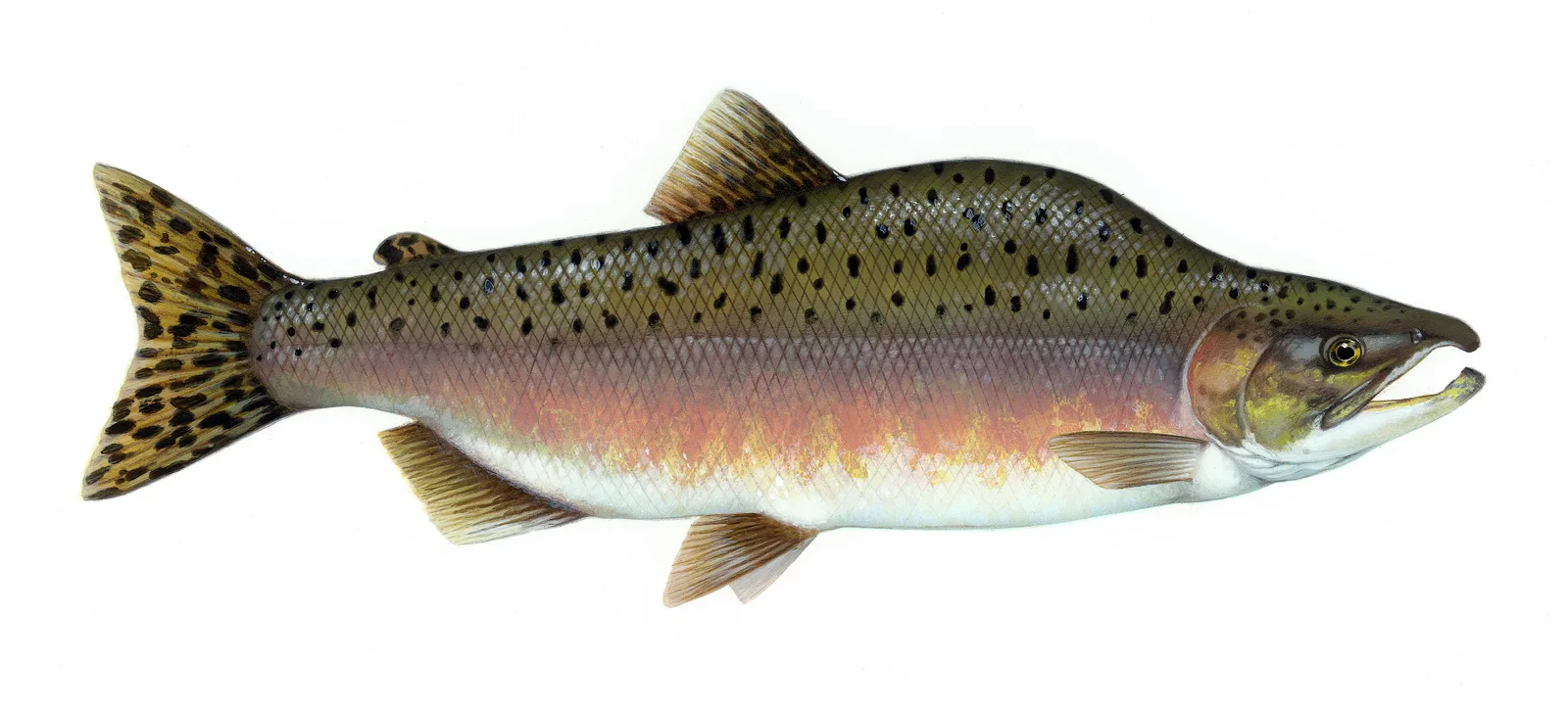
Black gums alone do not make a king, though: a pink salmon has them too. Then the tail and the spots decide it.
| Mark | King (chinook) | Coho | Pink |
|---|---|---|---|
| Gum line | Black | White | Black |
| Inside of mouth | Dark | Light to dark; guides differ | White |
| Teeth | Large, sharp | Medium, sharp | Almost none at sea |
| Tail spots | Both lobes; silver in the tail | Upper lobe, usually | Large ovals on both lobes; no silver |
| Back spots | Large, wavy | Small or none | Large, black |
| Tail ray segments | Cannot be felt with a fingernail | Can be felt | — |
| Anal fin rays | 15 to 17 | 13 or more | — |
The fingernail test is Oregon’s: run a nail along the top of a tail fin ray. On a coho you feel the bone segments; on a king you do not. Oregon also warns that silver can hide the tail spots on a fish fresh from the ocean, and that size and a hooked nose prove nothing.
 The black gum line of a king salmon. Photo: Chuck Young, U.S. Fish and Wildlife Service (public domain).
On the spawning run a king keeps its black spots but turns deep maroon or dark olive. In Southeast Alaska spawning kings run dark brown to nearly black. Older males grow a ridged back and a hooked upper jaw. The salmon hub sets all five Pacific salmon and the Atlantic side by side, and the coho page covers the silver in full.
Free card: what 26 species do at your water temperature
Plus one email a week on what's biting now. No sales pitches. Privacy.
How big do king salmon get?
Alaska puts a typical adult at 36 in and 30 lb, and its fishing guide gives a range of 15 to 40 lb (7–18 kg) and 34 to 50 in (86–127 cm). Oregon says 10 to 25 lb (4.5–11 kg) is more common. The extreme is about 126 lb and 58 in by Alaska’s figure, 129 lb and 4.9 ft by NOAA’s.
Age explains most of it. A king can mature in any year from its second to its seventh, so the fish in one run vary greatly in size. Alaska’s example: a mature 3-year-old probably weighs under 4 lb (1.8 kg), a 7-year-old can pass 50 lb (23 kg). Alaska’s commercial kings averaged about 12 lb (5.4 kg) from 2014 to 2018.
They are getting smaller. A 2018 study in Fish and Fisheries found wild and hatchery kings along most of the coast, from California to western Alaska, returning younger and smaller over four decades, with fewer old fish. The authors suggest that the selective removal of large fish has likely contributed.
Lake Ontario’s kings come back young. New York says age-2 and age-3 fish make up 90% of the run and weigh 15 to 25 lb.
When do king salmon run?
Kings are named for the season they enter fresh water, and one river can have several runs. California’s Central Valley has four.
| Run and place | In fresh water | Spawning |
|---|---|---|
| Alaska, most streams | One run, May through July | — |
| Central Valley spring run, California | Late March through September | Mid-August to early October |
| Sacramento River winter run | December through early August | Mid-April through August |
| Central Valley fall run | July through December | Early October to late December |
| Central Valley late-fall run | Mid-October through December | January to mid-April |
| Oregon spring chinook | — | August to early November |
| Oregon fall chinook | — | October to early March |
| Lake Ontario tributaries | Early September to early November; peak in early October | — |
| Lake Michigan, Wisconsin | September to November | — |
A spring king enters the river months early and holds all summer in cool water before it spawns in the fall. On the Salmon and Oswego rivers in New York, where dams control the flow, the peak comes from mid-September to mid-October. In many Alaska rivers the kings are the first salmon to return.
Where king salmon live, from Alaska to the Great Lakes
The native range runs from Monterey Bay to the Chukchi Sea, and in Asia from Siberia’s Anadyr River to Hokkaido. In Alaska the big runs return to the Yukon, Kuskokwim, Nushagak, Susitna, Kenai, Copper, Alsek, Taku and Stikine. Yukon kings bound for spawning grounds at the headwaters in Canada swim more than 2,000 river miles in about 60 days, without feeding.
Kings are anadromous: born in fresh water, grown at sea. In Washington most spawn in large rivers such as the Columbia and Snake, and their size lets them use larger gravel than most other salmon.
The Great Lakes kings were introduced. Stocked on and off since 1877, they took hold only after massive plantings began in 1967, to prey on the invasive alewife and give anglers a big game fish. New York stocks about 1.7 million a year into Lake Ontario, yet in a marking study that ended in 2015, wild fish made up 47% of the age-2 and age-3 kings harvested in the lake. On Lake Michigan the agencies cut chinook stocking in 1999, 2006 and 2013 (and again in 2017–18) to bring the predators back in line with the alewife, then raised it in 2020 and 2023 as the balance improved. Anglers on Wisconsin’s waters of Lake Michigan and Green Bay kept 163,923 kings in 2024, the most since 2012 and about 52% above the ten-year average.
Kings now run wild in Patagonia too. Introduced to southern Chile, they have spread into Argentine rivers that drain to the Atlantic, and the IGFA’s all-tackle length record, 122 cm (48 in), came from Argentina’s Río de las Vueltas in March 2026.
How to catch king salmon
Kings fight hard and hold deep. These are the methods the state agencies describe, by water.
- In salt water, troll herring. Alaska’s guide names trolling herring and lures on downriggers with flashers. Oregon goes deep with spoons, imitation squid or a whole herring or anchovy behind a dodger.
- Or mooch. Washington’s old Seattle method drops a plug-cut herring, which spins as it rises and falls, on a light banana-shaped weight. The department’s rig: 10 to 20 lb main line, 8 to 15 lb leader, a 4/0 and a 3/0 hook for a 5 to 6 in herring. Keep the line at 45 degrees.
- In tidewater, go heavier. Washington wants at least 20 to 25 lb line. Rig a three-way swivel with 2 to 8 oz on a dropper and a 4 to 8 ft leader to a cut-plug herring or lure. “Bottom is always a good bet for chinook.”
- In rivers, fish eggs near the bottom. Alaska lists back-trolling or casting cured salmon eggs, a Spin-N-Glo, or roe under a slip bobber. Oregon adds spinners, shrimp and anchovies. River kings have stopped feeding, but New York’s biologists say they strike out of aggression and an attraction to eggs, so keep an egg or an egg-shaped lure in the bottom 15 in (38 cm).
- On the Great Lakes, troll and watch the wind. Kings roam the open lake, usually in water under 100 ft (30 m), and Wisconsin’s method is a plug or spoon on a downrigger. A westerly wind pulls cold water to its shore, and kings follow the baitfish in close enough to reach from the piers.
The water temperature chart gives coho and chinook a comfort band of 50 to 60 °F (10–16 °C); Wisconsin DNR narrows it to 50 to 57 °F. In one radio-tracking study, river water reaching 70 °F (21 °C) stopped spring kings migrating upstream.
Can you still fish for king salmon in Alaska?
Yes, but not everywhere. In 2026 Alaska closed the Kenai River from its mouth to Skilak Lake to all king fishing from May 1 to August 15, catch-and-release included. A king caught by accident may not be taken out of the water. The early-run forecast was 2,325 large kings, which would be the fifth-lowest run on record, against a goal of 3,900 to 6,600. The department says kings across Cook Inlet are in “a period of low productivity and below average run strength.”
Farther south, nine populations are listed under the Endangered Species Act. The Sacramento River winter run and the Upper Columbia River spring run are endangered; seven more are threatened, among them Puget Sound and the Snake River runs. Kings matter beyond fishing: they are the preferred food of the endangered Southern Resident killer whales. Check the current regulations and emergency orders for the river before you go, and release a king the way Alaska’s guide says: wet hands, a knotless net, the fish kept in the water. The catch-and-release guide covers the rest.
What is the record king salmon?
| Record | Weight | Angler, water, year |
|---|---|---|
| World (IGFA) | 97 lb 4 oz (44.11 kg) | Les Anderson, Kenai River, Alaska, 1985 |
| Oregon | 83 lb (37.6 kg) | Ernie St Claire, Umpqua River, 1910 |
| Washington, salt water | 70.50 lb (31.98 kg) | Chet Gausta, Sekiu, 1964 |
| Washington, fresh water | 68.26 lb (30.96 kg) | Mark Salmon, Elochoman River, 1992 |
| New York | 47 lb 13 oz (21.7 kg) | Kurtis Killian, Salmon River, 1991 |
| Michigan | 47.86 lb (21.7 kg) | Lake Michigan, Mason County, 2021 |
| Wisconsin | 44 lb 15 oz (20.4 kg) | Lake Michigan, Door County, 1994 |
Anderson, a Soldotna car dealer of 68, was fishing a Spin-N-Glo and salmon eggs for early-season kings with his partner Bud Lofstedt. Three times he reeled the fish to the boat, and three times it was too big to haul in, so he led it to shore. The mount is on display in the Soldotna Visitors Association building. New York’s record took an orange fly.
Are king salmon good to eat?
Yes. NOAA calls kings the most highly prized salmon in the culinary world, with a “pronounced buttery, rich taste” and oily, flaky, meaty flesh, and a good source of omega-3 fatty acids. Alaska credits their high oil content. About 3% of kings have white flesh; NOAA says white kings taste the same as red ones.
Is king salmon always wild-caught? No. A king you catch in North America is wild or hatchery-raised, but farmed king is sold too, mostly from New Zealand. Kings were brought there from northern California as a game fish in the late 19th century, king is the only salmon farmed there, and New Zealand King Salmon calls itself the world’s largest producer of farmed king. In a 2015 SeafoodSource report, that one company’s Ōra King brand made up roughly 62% of global chinook production.
Advisories treat kings more strictly than the smaller salmon. In Puget Sound’s Marine Area 11, around Tacoma, Washington’s health department advises one serving of chinook a week, and only two a month of resident blackmouth, against two or three a week of coho, chum, pink or sockeye. For Great Lakes kings, Wisconsin DNR’s 2008 species sheet gives PCB trimming advice: remove the skin, the fat along the back, the belly flap and the dark flesh along the lateral line.
How long do king salmon live?
Three to seven years. A king hatches in river gravel, and most Alaska juveniles spend a full year in fresh water before going to sea as smolts. Some populations, called ocean type, go to sea in their first year. NOAA says most kings come back at 3 or 4.
At sea they eat herring, sand lance, squid and crustaceans, and often double their weight in one summer. A female lays 3,000 to 14,000 eggs in several redds dug in deep, fast water. Oregon’s environmental agency recommends 42 to 55 °F (6–13 °C) for spawning. Every king dies after spawning, within two weeks by Oregon’s count. For the sea-run rainbow trout that shares many king rivers, see the steelhead page; every other fish is in the species guides.
Free download
The water temperature card
Read your water temperature and the card tells you who is spawning, who is feeding and what to throw. 26 species, 16 pages, for your phone and the tackle box.
Plus one email a week on what's biting now. No sales pitches. Privacy.
Related
Section guide
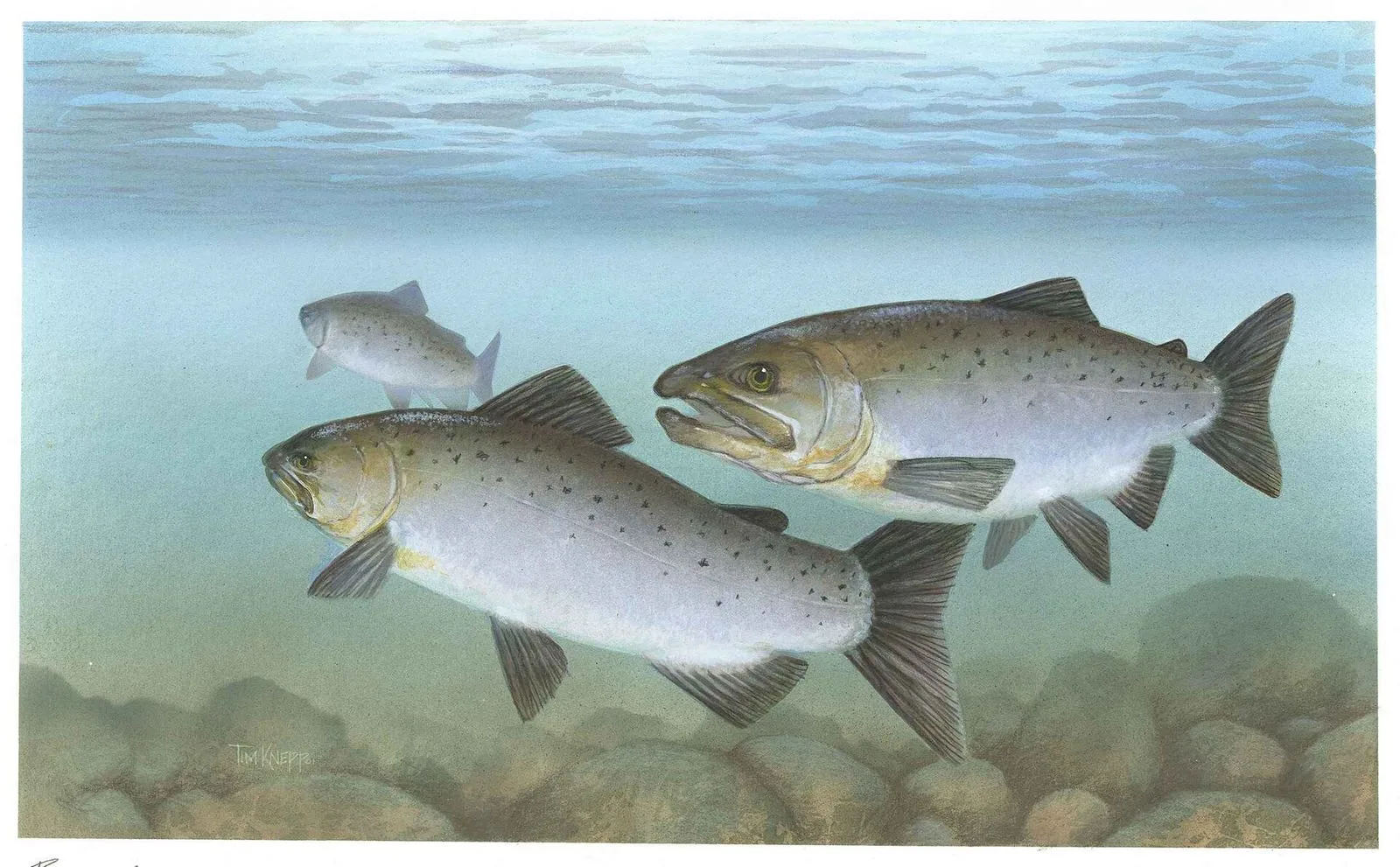
Types of Salmon: The Five Pacific Species and the Atlantic, Told ApartThe six types of salmon a North American angler meets: chinook, coho, sockeye, pink, chum and Atlantic, by gum line, tail spots, size and record.
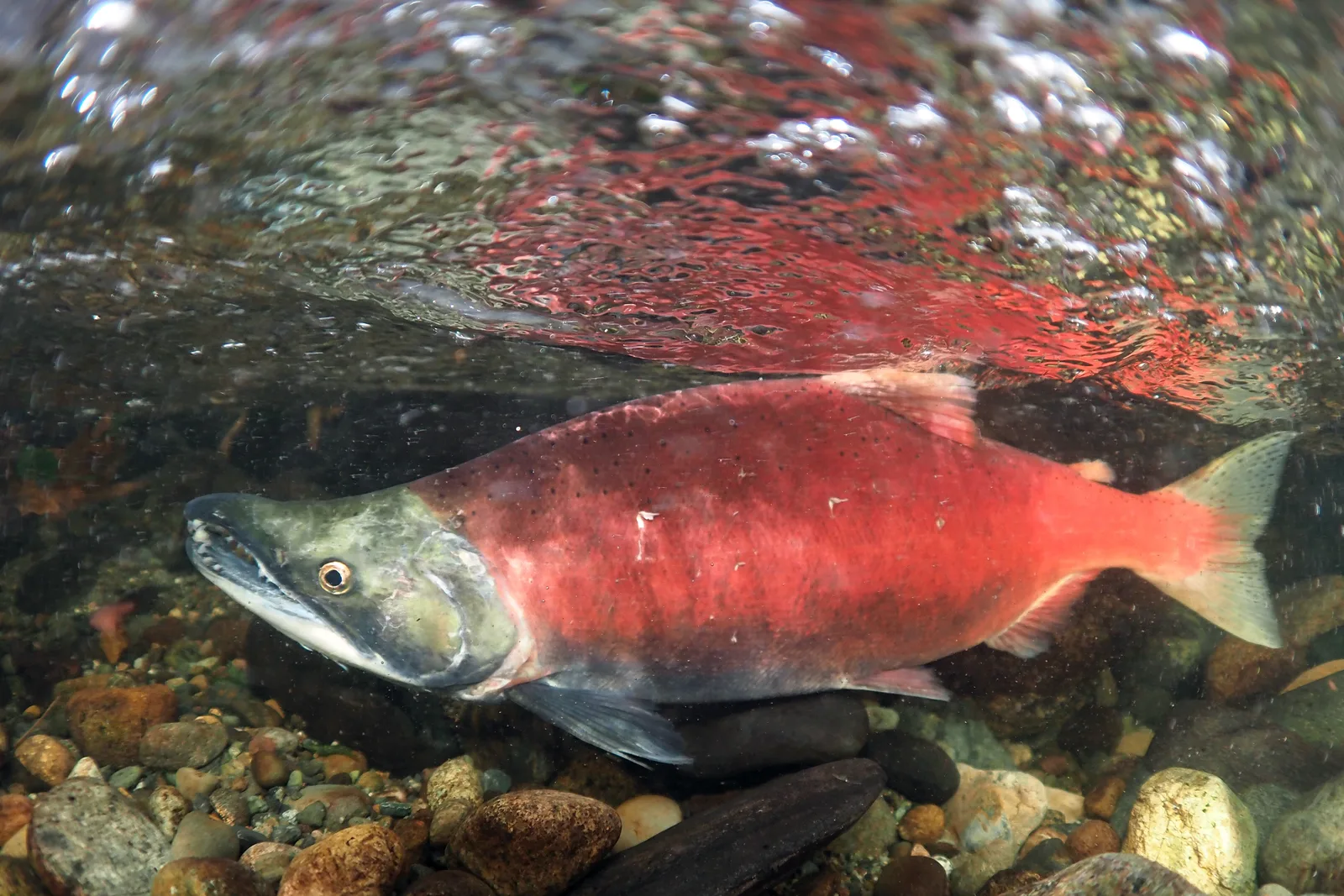 Kokanee Salmon: The Landlocked Sockeye, Season by Season
Kokanee salmon are sockeye that never reach the sea. How to tell one, the 50 °F depth they hold at each season, how to troll for them, and the record.
 Pink Salmon: Odd-Year Runs, How to Tell a Humpy, Size and Records
Pink salmon live two years, so Puget Sound gets humpies only in odd years. When they run, how to tell one from a king, how to catch it and the record.
 Sockeye Salmon: How to Tell a Red, Where They Run, and the Record
Sockeye salmon: a 4–15 lb red salmon that needs a lake. Tell it from a chum, find the runs from Bristol Bay to Lake Washington, hook one, and the record.
 Coho Salmon: How to Tell a Silver From a King, Size, Runs and Records
Coho salmon: the white gum line that separates a silver from a king, how big they get, when they run from Alaska to the Great Lakes, and the record.
Sources
- Alaska Department of Fish and Game, Chinook salmon species profile: size, names, life history, range, white meat
- Alaska Department of Fish and Game, Alaska salmon fishing guide: size, techniques, the world record
- Alaska Department of Fish and Game, Pacific salmon marine and spawning phase identification (2018)
- ADF&G Emergency Order 2-KS-1-8-26: Kenai River early-run king salmon closed (2026)
- ADF&G Emergency Order 2-KS-1-7-26: Kenai River late-run king salmon closed (2026)
- NOAA Fisheries, Chinook salmon: appearance, size, age, diet, seafood profile
- NOAA Fisheries, Chinook salmon (protected): Endangered Species Act listings
- NOAA Fisheries, Killer whale: Southern Residents and their chinook prey
- Washington Department of Fish and Wildlife, Chinook salmon: names, spawning, state records
- Washington Department of Fish and Wildlife, Pacific salmon ID card (2024)
- Washington Department of Fish and Wildlife, Salmon fishing in marine areas: mooching
- Washington Department of Fish and Wildlife, Salmon fishing in estuaries and tidewater
- Washington State Department of Health, Puget Sound seafood eating advice, Marine Area 11
- Oregon Department of Fish and Wildlife, Chinook salmon: size, state fish, spawning, technique
- Oregon Department of Fish and Wildlife, Is it a coho or Chinook?
- Oregon Department of Fish and Wildlife, Oregon's record fish
- California Department of Fish and Wildlife, Chinook salmon: the Central Valley runs
- Michigan DNR, Chinook salmon: identification
- Michigan DNR, State record fish
- Wisconsin DNR, Chinook salmon, PUBL-FM-106 (2008): names, temperature, stocking, trolling, eating
- Wisconsin DNR, Hook-and-line record fish
- Wisconsin DNR, Wisconsin's 2024 open water sportfishing effort and harvest, Lake Michigan
- Lake Michigan Committee, Lake Michigan salmonine stocking strategy (2025)
- New York State DEC, Pacific salmon fishing in Lake Ontario tributaries
- New York State DEC, Freshwater fishing records
- Great Lakes Sea Grant Network, Salmon and Trout of the Great Lakes: a visual identification guide
- North Coast Regional Water Quality Control Board, Shasta River TMDL, Appendix A: the effects of temperature on steelhead, coho and chinook salmon
- IGFA world records, Salmon, Chinook
- Alaska Sports Hall of Fame, Les Anderson's world record king salmon
- Tyee Club of British Columbia
- Ohlberger, Ward, Schindler and Lewis (2018), Demographic changes in Chinook salmon across the Northeast Pacific Ocean, Fish and Fisheries 19:533–546
- Riva-Rossi et al. (2025), Between oceans: stepping-stone dispersal and the Pacific-to-Atlantic expansion of Chinook salmon across Patagonia, Frontiers in Marine Science 12
- New Zealand King Salmon, Our salmon
- SeafoodSource, Seafood Watch gives green rating to NZ farmed king salmon (2015)
- Ryan Ragan, Alaska's Five Species of Pacific Salmon: Lifecycle and Identification, Alaska Fish & Wildlife News, ADF&G (2015)