 By
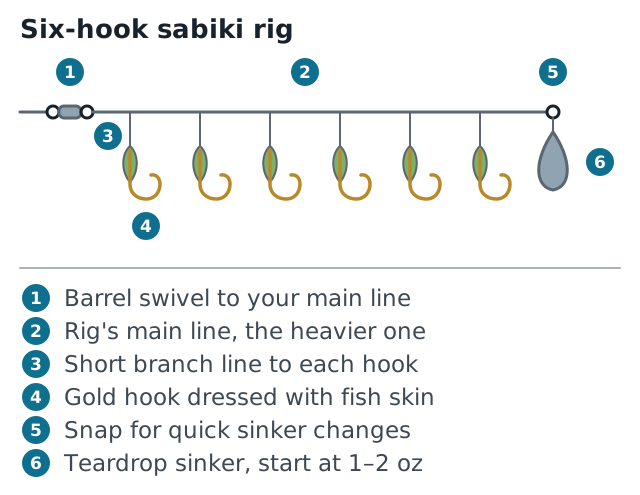
A sabiki rig is a 4- to 5-foot string of four to eight tiny dressed hooks with a sinker clipped to the bottom. It can put five or more baitfish on your line in one drop. Buy a size 6, clip on a 1 to 2 oz teardrop sinker, lower it to the bait and jig it gently. When you feel the first bump, wait a few seconds so more fish climb on. Then reel steady.
On a Hayabusa sabiki pack, the bigger number is the bigger hook. That’s backward from the #2 and #8 hooks in your tackle box.
What is a sabiki rig?
It’s one main line with short branch lines coming off it, and a small hook on each branch. Each hook wears a scrap of fish skin, flash, feather or glow material, so it looks like something tiny to eat. A barrel swivel at the top ties to your line. A snap at the bottom holds the sinker. It comes ready to fish, out of a pack.
The idea came from Japan. Hayato Tajiri began building these multi-lure rigs in the mid-1960s and sold them as Sabiki in 1974. His company, Hayabusa, didn’t bring them to the US until 1991.
Most people buy one for bait: herring, sardines and cigar minnows for the fishing they really came to do. It also catches fish you’d keep.
What size sabiki rig should you buy?
Buy a size 6 for your first pack. It’s the middle of the 4, 6 and 8 that Florida Sportsman says pros in southeast Florida favor, and it suits mid-sized herring and sardines. Go down to a 3 or 4 when the bait is small. Go up to an 8 or 10 for bigger bait.
Here’s what trips people up. Hayabusa marks every rig in Japanese sizes, and those numbers climb as the hook gets bigger. A size 6 is about a US #10, an 8 about a #8, and a 10 about a #6 or #4. A size 3 or 4 falls around #12 to #16. A normal hook size chart runs the other way.
Two sources agree on those numbers: Great Days Outdoors, and a chart America Go Fishing drew with Hayabusa USA’s graphics. Past a 10 the hooks get big fast. The chart puts a size 16 at a US 2/0 and a 22 at a 6/0.
Not every pack or guide counts this way. American makers size their rigs like normal hooks, from 16 up to 6/0, America Go Fishing says. One guide gives size 8 to 12 for tiny anchovies and 4 to 8 for adult herring, which only fits the US way. So don’t trust the number alone. Read the line strength on the pack. On Hayabusa’s rigs the line gets heavier as the size number climbs.
The line figures below come from Hayabusa’s own spec pages, except sizes 20 and 22. The US sizes come from the chart.
| Size on a JP pack | About a US | Line (main / branch) | Use it for |
|---|---|---|---|
| 3 | #16 | 5 lb / 3 lb | The smallest cigar minnows, sardines and herring |
| 4 | #12 or #14 | 13 lb / 7 lb | The same small bait, on stronger line |
| 6 | #10 | 13 lb / 7 lb | Your first pack: mid-sized herring and sardines |
| 8 | #8 | 17 lb / 10 lb | Bigger herring, jumbo sardines, small blue runners |
| 10 | #4 or #6 | 20 lb / 13 lb up to 25 lb / 20 lb | Spot and white perch, small blue runners |
| 12 to 16 | #3 to 2/0 | 25 lb / 16 lb up to 32 lb / 24 lb | Bigger bait. Hayabusa’s rig for Hawaii’s akule and opelu comes in a 12 |
| 20 and 22 | 4/0 to 6/0 | 20–40 lb mono | Spanish mackerel, bluefish, blue runners, ladyfish |
For a first rig, take fish skin on a gold hook. That’s the same dressing the Florida pros go to. Carry a glow rig for deep water: The Tackle Room says glow hooks outperform plain metal in clear California water below 40 feet.
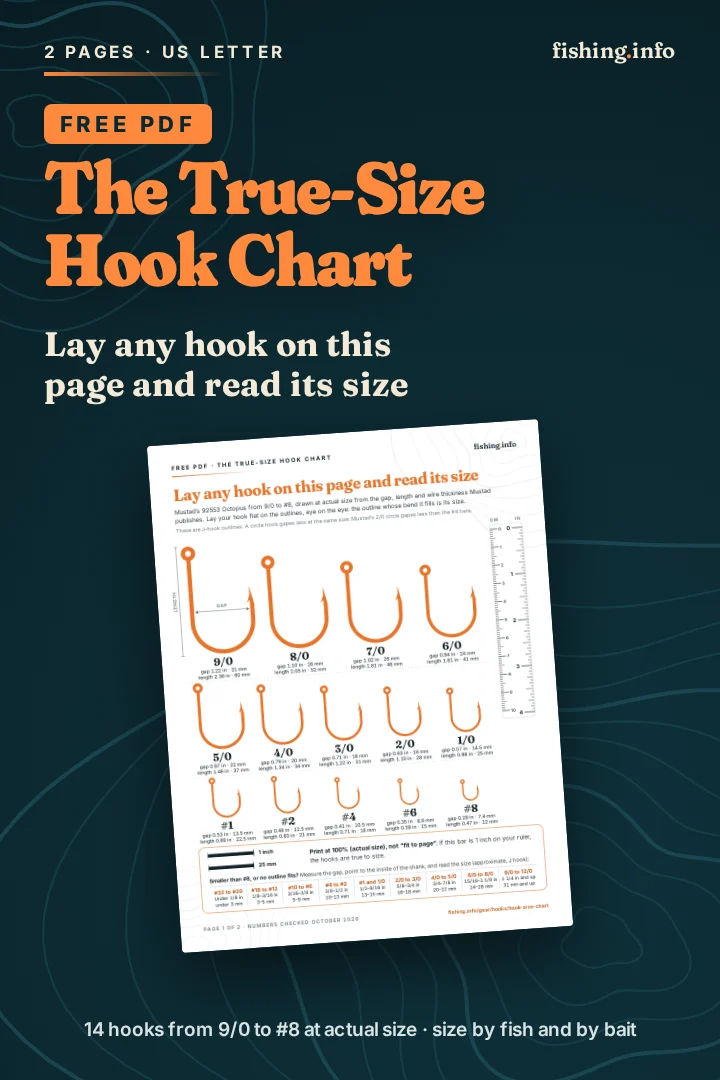
Free PDF · Hook size chart What size is that hook? Lay it on the chart.
Print the free chart, lay any hook on it and read its size: 14 hooks from 9/0 to #8 at actual size, a gap ladder from #32 to 12/0, and the size for 17 fish and 16 baits on the back.
No card, nothing to buy, and the PDF is yours to keep. Confirm with one click and it's on its way. Then a few short emails and one a week on what's biting. Unsubscribe anytime. Privacy.
What rod, reel and sinker do you use with a sabiki rig?
Use the light spinning outfit you already own. A light or ultralight spinning rod of 6 to 7 feet works from a pier or a boat. Pair it with a 2000 to 3000 size reel and 10 to 20 lb braid. Tie your line to the top swivel with a Palomar knot.
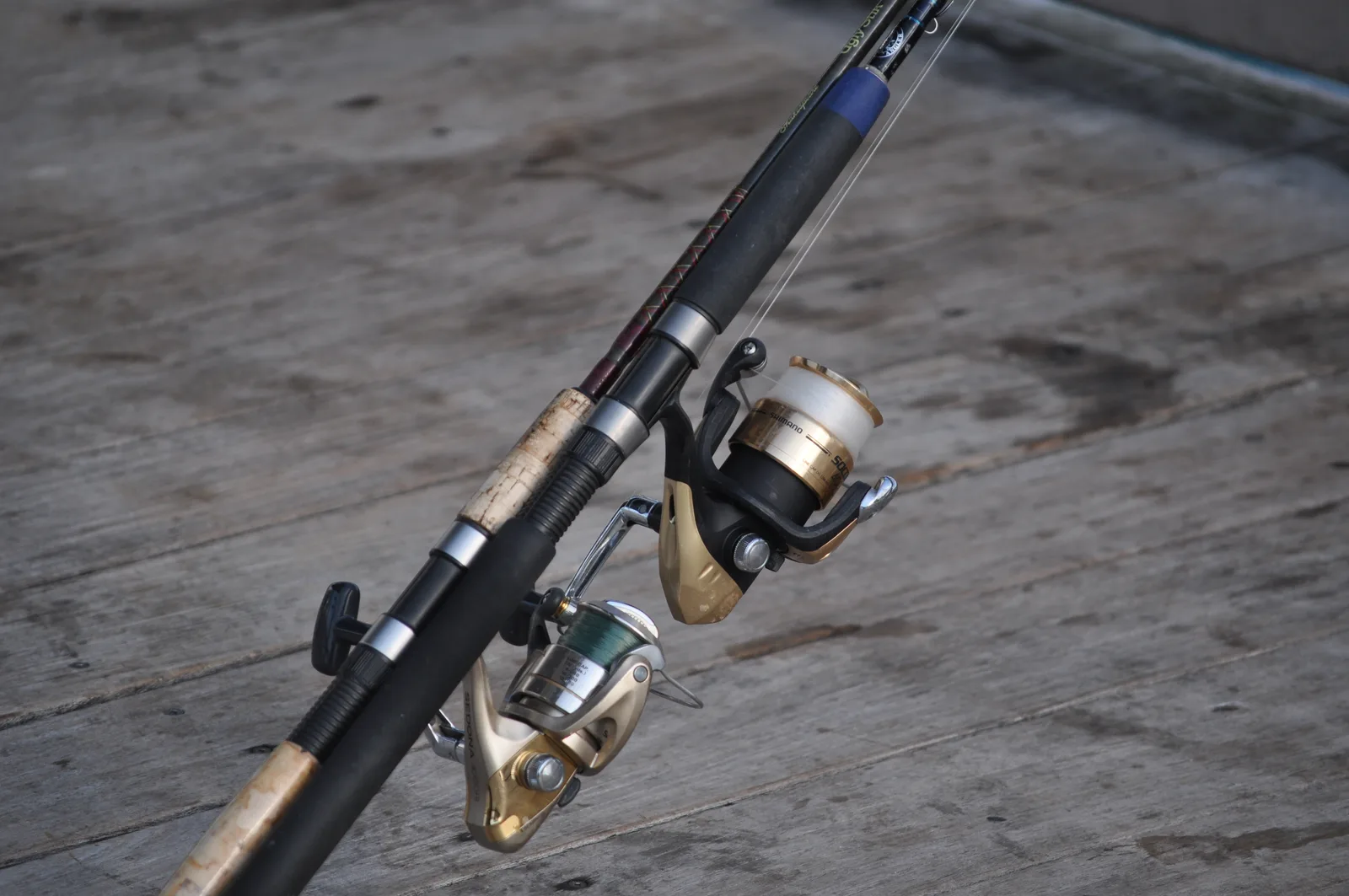
Spinning outfits on the pier at Deerfield Beach, Florida. Photo: Juliancolton, Wikimedia Commons (public domain).
The sinker matters more than the rod. You want the rig to fall slowly through the bait. Too much weight and it plummets past them. Too little and it tangles.
| Where you’re fishing | Sinker | Why |
|---|---|---|
| Pier, dock or boat, under 60 ft (18 m) | 1–2 oz (28–57 g) | Falls slowly and stays straight |
| Deeper bait schools | 2–4 oz (57–113 g) | Gets down and stays tight |
| Florida boats on bait schools | 1.5–3 oz (43–85 g) | Lighter lets the baits swim up and tangle |
| Chesapeake spot and white perch | 1–2 oz (28–57 g) | Reaches and holds bottom |
| Your own 4-hook rig | 1/4–3/4 oz (7–21 g) | A light rig, by depth |
Pick a teardrop shape over a pyramid. A bank sinker often won’t fit the small snap at the end of a sabiki. A “bass casting” sinker is teardrop shaped with a small brass ring, and it fits. The fishing weights guide shows the shapes.
How do you use a sabiki rig?
Here’s the whole drop, step by step. It works the same from a pier or a boat.
- Find the bait before you drop. Look for fish flashing at the surface, or marks on a depthfinder. Check around piers, docks, markers, bridge pilings and jetties.
- Tie on and clip the sinker to the bottom snap. Keep the hooks away from your clothes and skin. Ask a buddy to help, because bait on six hooks is a lot to handle alone.
- Lower it with control. Don’t free-spool it. Keep light tension on the line all the way down.
- Stop at the right depth. Start at 20 feet and work down 10 feet at a time until you find the school. Fishing for spot or white perch? Go to the bottom.
- Jig it short. Lift the tip 6 to 12 inches, then let it fall. Shaking the tip usually helps. Keep it gentle, because big fast jerks shake off the fish.
- Wait after the first bump. Come tight, then give it a few seconds. The other hooks often load up, and you don’t need a hookset on bait.
- Reel steady. Don’t pump the rod. The fish pull in different directions, and a jerk on the line wraps them around each other.
- Get them off with a dehooker. Hold the rig straight and run the tool down the branch to the bend of the hook. Then shake the bait into a bucket or livewell. Bait you handle gently swims better on your hook.
Fishing for spot and white perch instead of bait? Set the hook when you feel a nibble. FishTalk suggests short six-inch lifts every few seconds over oyster bars and shoals. From a pier, cast out, let it settle and hop it a foot or two at a time.
Do you need bait on a sabiki rig?
No. The dressing on the hooks is usually enough, and bait is “often not necessary,” Cast & Spear says. A little helps when the bite is slow. Add a sliver of squid, bloodworm or Fishbites to the hooks, or chum with tiny pieces of shrimp or baitfish. Block chum fires up some species, Florida Sportsman says.
How do you stop a sabiki rig from tangling?
A tight line stops most tangles. Do these in order:
| What goes wrong | The fix |
|---|---|
| Bait swims up and wraps the other hooks | Add sinker first. The rig is too light |
| Rig balls up on the way down | Keep tension on the line. Don’t drop it free |
| Rig spins and fouls while you jig | Keep your lifts small. Don’t sweep the rod high |
| Fish wrap each other on the way up | Reel slowly and steadily. Don’t pump the rod |
| Rig snags the bottom | Cut it free with a bait knife. Popping a dropper loop ruins it |
Moving spots is when hooks start flying. Hook them together in pairs at the bends. Then wrap the sinker around the reel mount, or clip the bottom snap to the rod’s line keeper.
How do you store a sabiki rig?
Plan on a short life for each one. Carry about three on a trip. Store-bought rigs often last a single day, Salt Strong’s Luke Simonds says. Florida Sportsman’s Ron Kowalyk says to trash them after the trip, because the hooks rust before the next one. Throw a tangle away ashore, never overboard.
For clean rigs, wrap the line around a 12-inch piece of pool noodle and stick each hook into the foam. Don’t put a rig in your box loose.
Do you need a sabiki rod?
You don’t need one yet. A sabiki rod is a hollow tube about 5 feet long with a reel mounted on it. The rig reels up inside, so the hooks stay hidden. It’s handy, but expect to pay $50 or more. Fishing a few times a year, your spinning rod does the job.
Kowalyk has a cheap fix for the hooks flying around. Cut a piece of thin-walled PVC, 3/4 to 1 inch across and as long as the whole rig, and tie-wrap it to your rod. Run the rig in when you move. Rinse the tube with fresh water after the trip if you plan to reuse the rig.
What can you catch on a sabiki rig?
Bait first, then whatever eats bait. Spot the school, and these are the usual catches.
| Where | What you’ll catch | Where to look |
|---|---|---|
| Florida and the Gulf | Cigar minnows, herring, sardines, pilchards, blue runners | Herring midwater, pilchards deeper |
| Pacific Northwest | Herring | 40–100 ft of water (12–30 m), usually 20–60 ft down (6–18 m) |
| California bays | Anchovies | 10–40 ft (3–12 m) |
| Chesapeake Bay | Spot, croaker, white perch | On the bottom over oyster bars and shoals |
| Lake Norman, North Carolina | Perch, spotted bass | Bait 25–35 ft down (8–11 m) |
Go early. “Most species bite best just after sunrise,” Florida Sportsman says, and evenings can be slow. Goggle-eyes are the exception. They bite best in total darkness.
It works in freshwater too. North Carolina guide Craig Price fishes a size 10 on a 7-foot spinning rod and 20 lb braid on Lake Norman. He typically weights it with a 1/2 oz jigging spoon in place of a sinker. He drops to the bottom, reels up about a foot and keeps jigging, 20 to 25 times. On his first school of perch he boated more than 50 in under an hour.
Catfish anglers use one too. Hayabusa sells a five-hook Skipjack rig for catching skipjack herring as catfish bait. On the bottom in saltwater a sabiki will also catch pinfish, grunts, croakers and whiting.
Expect to lose some. Small mackerel and bluefish bite through light line, and when too many fish pull in different directions, the rig breaks. Tie on another.
Can you tie your own sabiki rig?
Yes, and it’s cheap. You’ll want it if your state limits hooks or you don’t want to throw a rig away. Salt Strong’s version has four hooks and uses one knot, the surgeon’s knot, for every connection. The hook spacing and price below come from Great Days Outdoors.
- Cut a length of 10 lb mono. Salt Strong uses 10 lb.
- Use size 8 or 10 gold hooks. These are US sizes, so a #8 here is a real #8. Gold Aberdeens cost about 10 cents each.
- Tie your branches about 6 inches apart. Use a surgeon’s knot for each. A dropper loop does the same job.
- Keep the weight detachable so you can swap sinkers fast. Salt Strong’s rig has one.
- Clip on 1/4 to 3/4 oz, depending on depth.
- Tip each hook with a scrap of Gulp or squid. Bare hooks don’t have the fish skin of a store rig.
- Keep the hooks after the trip. Take the rig apart and use them again.
How many hooks can a sabiki rig have?
Check before you tie on, because a store rig can carry more hooks than your state allows. Here are three states’ rules, in their own words. Others set their own, and rules change, so read your state’s page.
| Where | The rule |
|---|---|
| Maryland tidal waters | “No more than two hook units per line.” The state’s 2026 guide lists it as illegal “to use Sabiki rigs or mackerel trees in Maryland” |
| California ocean and bays | “Any number of hooks and lines,” except as below |
| San Francisco Bay | “only one line with not more than three hooks” |
| California with rockfish and certain other fish aboard | “only one line with not more than two hooks” |
| California inland waters | One rod and line, “with not more than three hooks” |
| Washington forage fish jig | “Up to 3 treble hooks or 9 single-point hooks,” gap no wider than 3/8 in, for forage fish or squid only |
Maryland is the one to watch. Its guide adds only that multiple-hook rigs, sabikis included, “are allowed in the Exclusive Economic Zone of the Atlantic Ocean.” Hayabusa sells a 2-hook Chesapeake rig, and FishTalk says its two flies keep to Maryland law. Not sure about your rig? Ask Maryland DNR before you fish it.
In Washington that gear is for anchovy, sand lance, herring, sardine, all smelt and squid.
Mistakes to avoid
- Buying by the number alone. A “size 8” can mean two different hooks. Check the line strength.
- Going too heavy so you never tangle. The rig drops straight through the school. Add weight only until it falls slowly without tangling.
- Handling the bait. Injured baitfish don’t swim right. Use the dehooker and drop them straight in the bucket.
- Keeping a used saltwater rig. It rusts before the next trip. Bin it, ashore.
- Fishing a light rig over teeth. Small mackerel and bluefish cut light line. If you’re after them, step up to a size 20 or 22.
When does something else win?
A sabiki only works where bait is. Shallow water full of shad? Use a cast net instead. For freshwater minnows you can set and leave, try a minnow trap. Once the bucket’s full, put that bait on a fish finder rig and go fish. The rigs hub has the other rigs worth knowing.

Free PDF · 2 pages
Stop guessing hook sizes. Lay any hook on this page and read it
A jar of loose hooks and no packet in sight. Guess wrong and you find out with a fish on.
The True-Size Hook Chart. Print it at actual size, lay a hook on the outlines, and the one its bend fills is its size. One sheet, front and back, for the tackle box.
- 14 hooks from 9/0 to #8 at true size, plus a ladder from #32 to 12/0
- The size for 17 fish and 16 baits, from bluegill to tuna
- A 2/0 circle that gapes less than a #4: why a 2/0 is not always a 2/0
Every outline drawn from Mustad's published dimensions; every size from the 25 sources on the page, Maryland DNR and Idaho Fish and Game among them.
No card, nothing to buy. Confirm with one click and the PDF is on its way, one version for your phone and one to print, yours to keep. Then a few short emails and one a week on what's biting, with an unsubscribe link in every one. Privacy.
Related
Section guide
Fishing Rigs: Texas, Carolina, Drop Shot, Ned and WackyFishing rigs explained: the Texas, Carolina, drop shot, Ned and wacky rigs, the weight for each depth, and which rig fits which cover and fish.
 Fish Finder Rig: How to Tie It, Sinker Weights and Leader Length
How to tie a fish finder rig for the surf in seven steps, a size for every part, sinker weight by surf, leader length, and when a circle hook is the law.
 Wacky Rig: How to Rig It, and When It Beats a Texas Rig
The wacky rig hooks a stick bait through its middle so both ends quiver on the fall. The O-ring method, hook and line, weightless or weighted, when to use it.
 Drop Shot Rig: How to Tie It, Hook and Weight Sizes, How to Fish It
Drop shot rig step by step: a #1–1/0 hook tied 12–18 in above a 1/8–1/4 oz weight, the tag trick that stands it out, the baits, tackle and how to fish it.
 Ned Rig: How to Fish It, the Right Jig Head and Where It Came From
The Ned rig is a 2–4 in floating bait on a 1/16 oz mushroom head, fished slowly; the head and bait for each depth, six retrieves, the tackle, its 2006 origin.
- Carolina Rig: How to Tie It, Leader Length and When to Use It
Carolina rig: a 1/2–3/4 oz sinker, bead and swivel, then an 18–36 in leader to a 3/0–5/0 hook. Sizes, leader by cover, the retrieve and the bite.
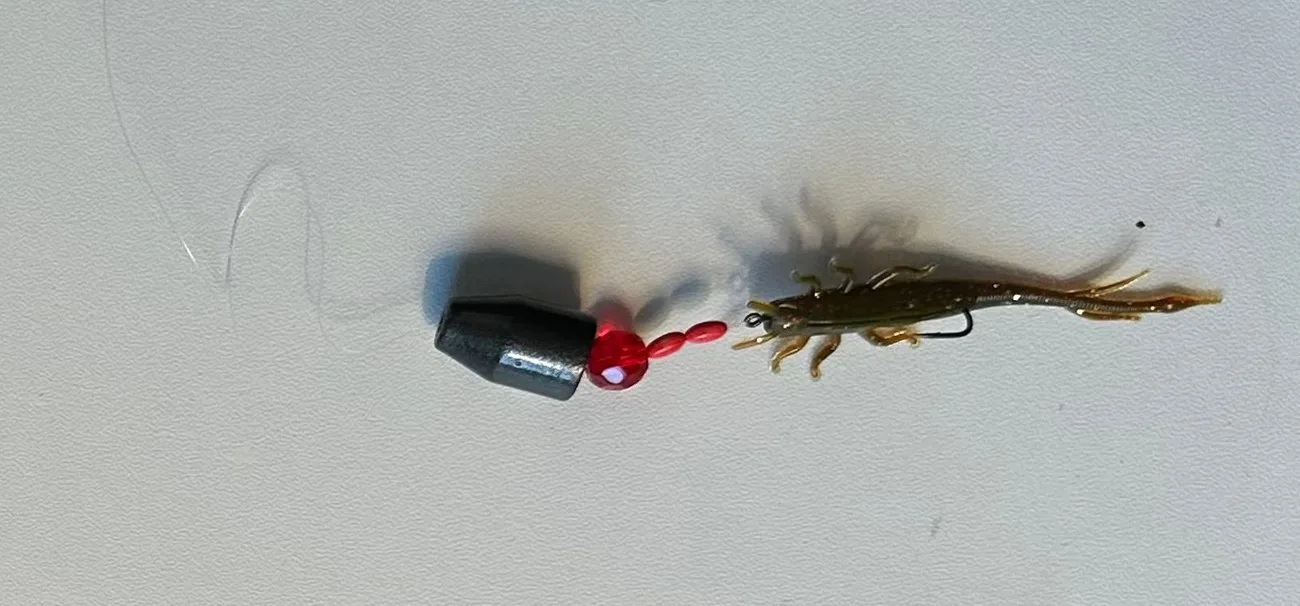 Texas Rig: How to Rig It, Which Weight and Hook, and How to Fish It
A Texas rig is a bullet weight above a worm hook with the point buried in the plastic. Weights from 1/8 oz in 5 ft to 2 oz for mats, and how to fish it.
Sources (19)
- Ron Kowalyk, Sabiki Sense, Florida Sportsman (August 14, 2012)
- David Thornton, Sabiki Rig, Great Days Outdoors (May 16, 2023)
- Sabiki Rig Guide: How to Catch Live Bait for Saltwater Fishing, The Tackle Room (March 27, 2026)
- How to Fish With Sabiki Rigs, FishTalk
- Luke Simonds, How To Make A Sabiki Rig For Catching Bait, Salt Strong (September 22, 2016)
Show all 19 sourcesShow fewer sources
- Brett Forde, How To Use A Sabiki Rig, Mystery Tackle Box (September 28, 2020)
- Jon Stenstrom, The Sabiki Rig, Cast & Spear
- James Bandt, Sabiki Rigs: The Greatest Rig Ever Made, Outdoor Life (December 4, 2016)
- Sabiki S-002AE Hage Fish Skin, Hayabusa Fishing USA
- Sabiki EX110 Silver Flasher Fish Skin, Hayabusa Fishing USA
- T90158A1 Chesapeake Sabiki, Hayabusa Fishing USA
- Akule / Opelu Sabiki, Hawaiian Edition, Hayabusa Fishing USA
- Skipjack Sabiki, Hayabusa Fishing USA
- Sabiki Rigs: Selection, Setup and Use (with the Hayabusa JP hook size chart), America Go Fishing
- Code of Maryland Regulations 08.02.25.03, Recreational Gear, Tidal Waters
- Maryland Fishing Regulations 2026, tidal: recreational gear and sport fishing, eRegulations (updated September 16, 2026)
- California Code of Regulations, title 14, section 28.65
- California Code of Regulations, title 14, section 2.00
- Washington Fishing Regulations, definitions