 By
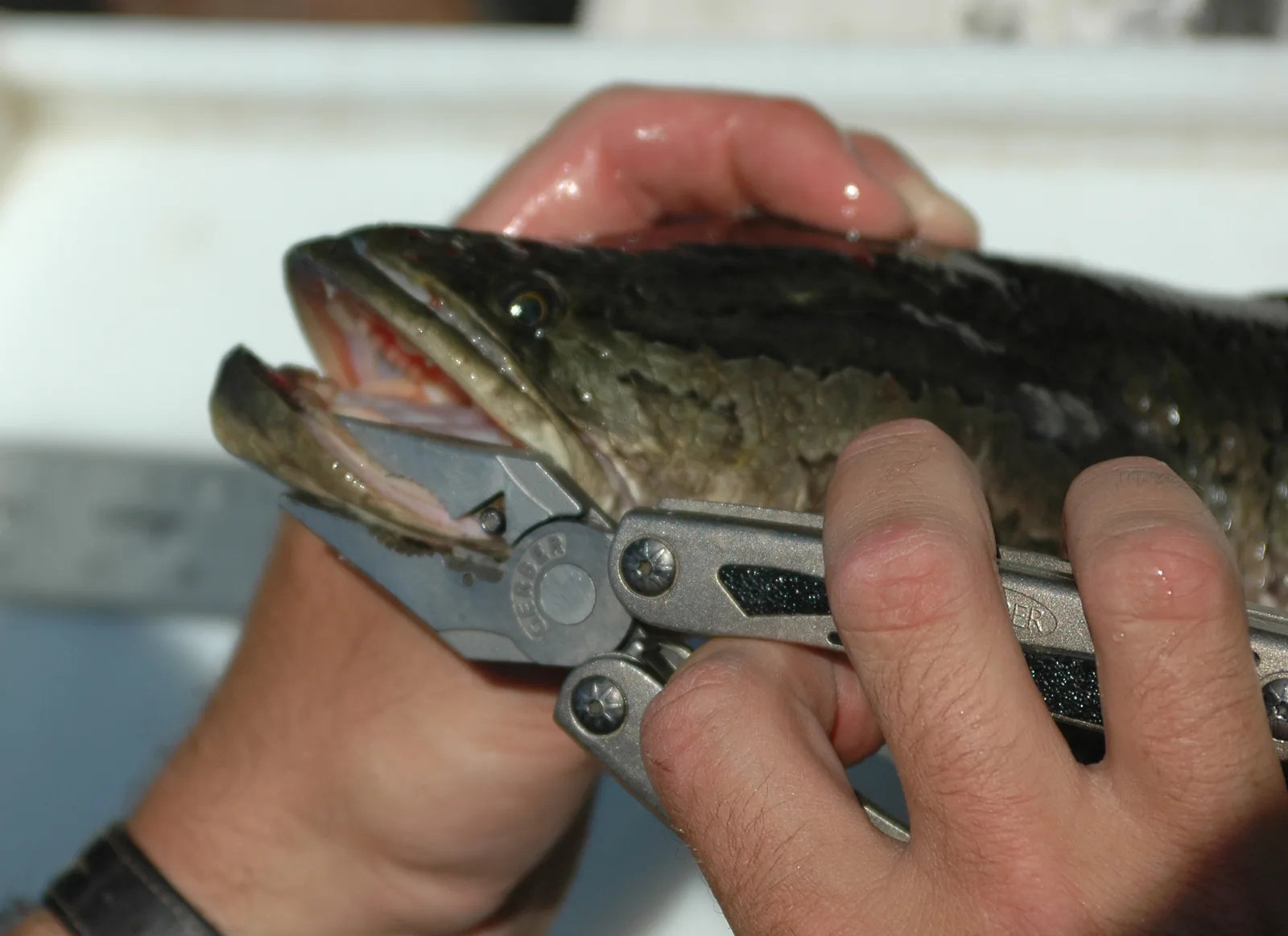
A snakehead fish is a long, toothy predator from Asia that breathes air, and in the U.S. it’s an invasive species you’re told not to put back. The one you’ll meet is the northern snakehead: 20 to 24 in (51 to 61 cm) is common. The rod-and-reel world record is 21 lb (9.53 kg). You catch them on a frog in weedy, shallow water. If you land one, most state agencies say don’t release it.
Throw a snakehead up on the bank and you haven’t killed it. It can live out of water for up to four days if it stays moist.
How do you identify a snakehead fish?
Look at the belly fin. A snakehead has one long fin down the back. It also has a long anal fin, the fin on the underside near the tail, about two-thirds the length of the back fin. That second fin is the check that counts, because the native bowfin looks a lot like it and its anal fin is short.
Then look at the sides and the head. A northern snakehead is brown with big dark blotches, a pattern the U.S. Fish and Wildlife Service calls “python-like.” The head is flat and pointy with scales on top, and the big mouth runs back past the eye. The pelvic fins, the pair under the belly, sit almost under the front fins behind the gills.
Snakehead or bowfin: how do you tell them apart?
In New Jersey, every “snakehead” reported before the first real one in 2009 turned out to be a bowfin. Bowfin are natives and belong back in the water, so get this right before you kill anything.
| Check | Northern snakehead | Bowfin (native) |
|---|---|---|
| Anal fin | Long, about 2/3 of the back fin | Short, under 1/4 of the back fin |
| Pelvic fins | Almost under the front fins | Set well back toward the middle |
| Top of the head | Scales, in a snake-like pattern | No scales |
| Sides | Bold dark blotches | Little or no pattern |
| What you do | Follow your state’s rule below | Release it unharmed |
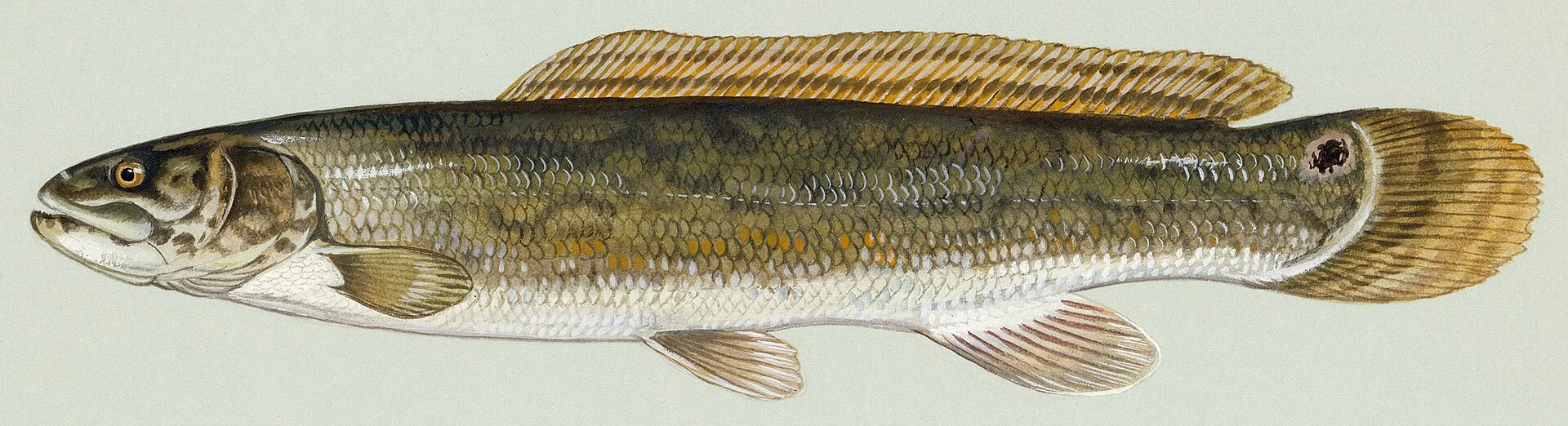
The native bowfin. Check how short that belly fin is. Illustration: Duane Raver, U.S. Fish and Wildlife Service (public domain)
The burbot is the other fish that gets mixed up here. It has very fine scales and a whisker under the chin, so it’s a quick one to rule out. Virginia also lists lamprey and American eel as look-alikes.
Maryland now calls the fish Chesapeake Channa, so don’t be thrown if your regulations book uses that name.
Free PDF · Water temperature chart Which fish are biting at today's water temperature?
One reading, and the 16-page chart shows which of 26 fish are spawning, feeding hard or slowing down; for bass, crappie, bluegill and walleye, where they sit and what to throw. Every number sourced.
No card, nothing to buy, and the PDF is yours to keep. Confirm with one click and it's on its way. Then a few short emails and one a week on what's biting. Unsubscribe anytime. Privacy.
What should you do if you catch a snakehead?
Follow these five steps unless your state says otherwise. They track what the U.S. Fish and Wildlife Service asks.
- Be sure it’s a snakehead. Check the anal fin against the table above.
- Don’t let it go, and don’t toss it on the bank. “Do not release the fish or throw it up on the bank,” the Service says.
- Kill it. The Service’s way: “Kill the fish by freezing it or putting it on ice for an extended length of time.” Virginia lists faster ways. Take off the head, separate the gill arches from the body, or remove the organs and ice it fast.
- Take a picture that shows the fins and the mouth, and note exactly where you caught it.
- Report it to your state, using the contact in the table.
Keep it simple on the water: no snakehead rides home alive. Moving a live one is illegal in Maryland, Virginia, Delaware, Pennsylvania, New York and Texas. Federal law has listed snakeheads as injurious wildlife since 2002. Under that listing you need a permit to import one or to move one across state lines.
What does each state say?
The rules aren’t all the same, and that catches people out. Virginia doesn’t require you to kill a fish you let go right away, for one. These are the agencies’ own instructions.
| State | What the agency says | Report to |
|---|---|---|
| Virginia | “Anglers are required to report snakeheads kept but are not required to kill them if caught and immediately released.” “Snakeheads must be dead if in possession (contained in live well, cooler, etc.)” “the Department asks that all snakeheads be killed if possible.” | Hotline 804-367-2925 |
| Maryland | “If you catch a Chesapeake Channa and want to eat it, you must immediately kill the fish.” “It is illegal to possess live Chesapeake Channa.” | Tagged fish: 800-448-8322 |
| Delaware | “If you catch a snakehead in Delaware, you should kill it.” | DNRECFisheries@Delaware.gov or 302-739-9914 |
| Pennsylvania | Anglers are “encouraged to NOT release it” and “should dispose of them properly.” Live possession is prohibited. | 814-359-5163 |
| New York | “DO NOT RELEASE IT.” Take photos from several angles, freeze the fish, trash it once the ID is confirmed. | DEC, iMapInvasives or your local PRISM |
| New Jersey | “Anglers must destroy these species if encountered while fishing and are directed to submit specimen(s) to the Bureau of Freshwater Fisheries personnel for verification.” (2011 digest) | (908) 236-2118 north, (856) 629-4950 south |
| Missouri | “MDC asks anglers not to release any live snakehead fish they capture.” Kill it by “severing the head, gutting it, or placing it in a sealed plastic bag.” | 573-290-5730 |
| Georgia | “If it does not appear to be a bowfin, do not release it.” “Retain the fish in a secure container.” The 2019 notice said “Kill it immediately and freeze it.” | Your regional WRD Fisheries Office |
| Texas | “Don’t release the fish!” “It is illegal in this state to possess, purchase, import, sell, or transport any living snakehead” | aquatic.invasives@tpwd.texas.gov |
| Florida (bullseye) | “If you catch one, do not release it! Immediately place it on ice or humanely euthanize it.” (Everglades CISMA) | 888-483-4681 or IveGot1.org |
Rules change, so check your state’s current regulations before your trip. Delaware and Maryland set no size or creel limit on them, and Maryland encourages you to catch and keep them year round. A caught fish with a tag in it is worth a call too: the Fish and Wildlife Service takes tag reports at 800-448-8322.
Are snakeheads invasive, and do they matter?
Yes. They’re native to China, Russia and Korea. Adults get over 90 percent of their food from other fish. They compete with the fish already here for food and cover, Pennsylvania’s agency says.
Your catch counts for something. The Fish and Wildlife Service says harvest by anglers can remove over 25 percent of the local population. That’s why the Service asks anglers to target and keep them, and why nobody should ever move a live one to a new pond.
Bullseye snakehead: what’s the Florida fish?
If you’re in South Florida, the snakehead on your line isn’t a northern. It’s the one everybody calls the bullseye, found in canals in northern Broward County and southern Palm Beach County. Nearly every adult has a dark dot ringed in red or orange on the upper tail. A bowfin has a tail spot too, so check the anal fin here as well.
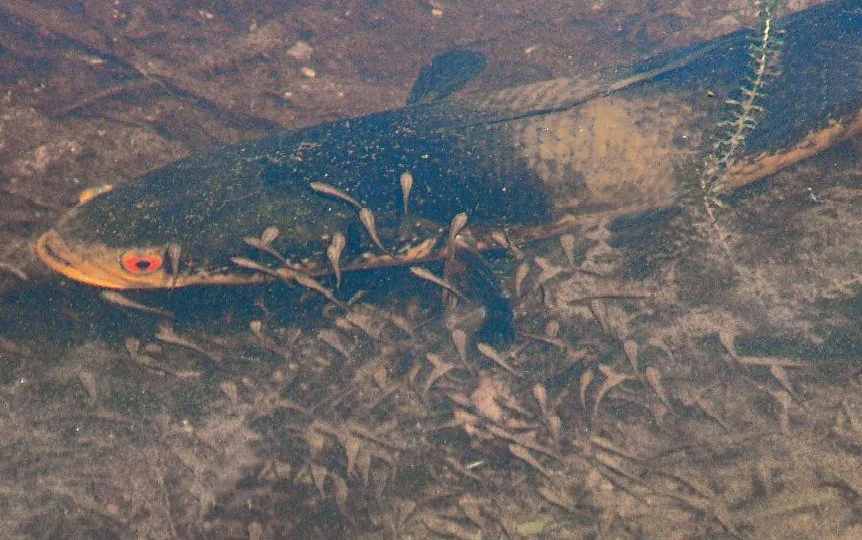
An adult guarding its young, Broward County, Florida, 2003, captioned as a bullseye snakehead. Photo: Ianaré Sévi (public domain, via Wikimedia Commons)
Anglers typically catch them between 3 and 6 lb (23 to 28 in). The biggest documented fish was more than 14 lb and 37 in. Cold keeps them in the south: they die in water below 50 °F (10 °C).
The name is a bit of a mess. The U.S. Geological Survey now treats the fish in southeast Florida and the Manatee River as goldline snakeheads, a close cousin in the same bullseye group. You’ll still see “bullseye” on most Florida pages.
Where do snakeheads live in the U.S.?
The Fish and Wildlife Service lists northern snakeheads in Delaware, Maryland, New York, Pennsylvania, Virginia and West Virginia. They’ve spread through nearly all of the Chesapeake Bay watershed. Here are the waters the agencies name.
| State | Where to look |
|---|---|
| Virginia | The Potomac from above Great Falls to the Bay, thickest in tidal water from D.C. to Colonial Beach; the Rappahannock below Fredericksburg; Lake Anna and reservoirs in the James River watershed |
| Maryland | Nearly 60 rivers and tidal waters, with a large population in the Potomac |
| Delaware | The Delaware and Nanticoke river systems and their tributaries, plus ponds such as Becks Pond. The state record came from Marshyhope Ditch near Harrington |
| Pennsylvania | Meadow Lake in Philadelphia’s FDR Park; the agency thinks more live in the lower Schuylkill, Delaware and lower Susquehanna rivers |
| New Jersey | The Delaware River and its tributaries, from Mantua Creek to Dredge Harbor as of 2011 |
| New York | Two connected ponds in Queens |
| Missouri | The St. Francis River system in the southeast, and a tributary of the Eleven Point River in Oregon County, confirmed in 2026. Missouri says both connect to established populations in Arkansas |
| Georgia | Gwinnett County, where an angler caught the state’s first confirmed one in a private pond in 2019 |
| Florida | Canals in Broward and Palm Beach counties (the bullseye) |
Inside those waters, think shallow, quiet and full of plants. They like ponds, creeks and backwaters with grass, lily pads or wood. In tidal rivers skip the main channel and work the creeks that feed it. In a lake, look at shallow bays with pads or grass and the backs of feeder creeks.
Snakehead fishing: how do you catch one?
Throw a hollow-body frog at the thickest cover you can reach, and wait for it to disappear. If you only pack one lure, make it that one. Potomac guide Steve Chaconas likes the frog because it’s heavy enough to cast a long way, it floats, and it’s weedless. It also makes noise, and snakeheads hunt by sound as well as by sight. His second reason matters just as much. A frog has heavier hooks than most lures, and a snakehead is strong enough to bend thin ones.
Your second lure is a chatterbait, run along the edge of the grass to find fish. The current world record came on one. Keep a fluke handy too. Throw it at a fish you can see, or right back at the spot where a fish just missed your frog.
| Situation | Throw | Why |
|---|---|---|
| Pads and thick grass, spring and summer | Hollow-body frog, black or white | Weedless, floats, makes noise |
| Edges of grass, looking for fish | Chatterbait | Covers water and comes through grass |
| A fish you can see, or one that just missed | Fluke | A second chance, right there |
| You’d rather use bait | Live minnow under a bobber, heavy wire hook | Only where live bait is legal |
Tackle. This isn’t your light bass rod. Use a 7 to 7½ ft heavy or medium-heavy casting rod with 50 to 80 lb braid, and skip the leader. Potomac guide Mike Sielicki ties straight to the lure with a Palomar knot. Heavy braid resists cuts and stretches less than mono, which matters in the thick hydrilla they like.
When. Prime time runs from spring warm-up, around the bass spawn, until the water cools in fall. Low light and overcast days bring more topwater strikes, and the evening before a storm can be very good. In winter they feed infrequently. Fish that are actively spawning won’t eat lures, so move to another creek or another part of the lake.
Tide. On tidal water a falling tide is usually your best bet. Sielicki likes the last three hours of an outgoing and the first three of an incoming. If one tide does nothing, try another.
The hookset. This is where anglers go wrong. They set too soon, because snakeheads often slash at a frog without taking it. So wait. “Set the hook when it disappears, not when a fish hits it,” Chaconas says. Crank up the slack first, then hit it hard, because snakeheads have “bony mouths.”
No boat? You don’t need one. Delaware’s state record came from shore, in a ditch outside Harrington. Walk the bank of a weedy creek or pond and cast along the edges. Spring fish also sit near wood like docks and fallen trees, before the plants grow in.
Landing it. Use a big net, and don’t lip one, because they’re toothy. Clamp a lip gripper on the jaw and use pliers to get your hooks back. Once it’s in the net, go straight to the kill steps above.
Bowfishing is popular too, because the fish come up to gulp air. Many bowfishers go at night from boats with lights. Check your state’s rules first.
How big do snakeheads get, and what is the record?
A northern snakehead commonly runs 20 to 24 in, and 28 in and up isn’t rare. In Virginia the average fish in the agency’s sampling had dropped from about 5 lb to 3 or 4 lb by 2017. Fish over 10 lb still turned up regularly. New York says they can reach three feet, and the world record fish was 36 in.
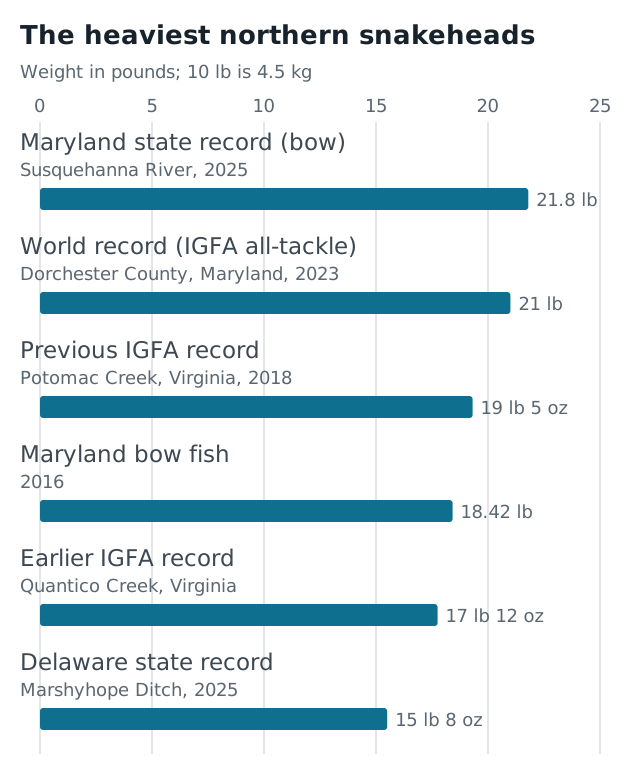
The IGFA all-tackle record, the one for rod and reel, is 21 lb 0 oz (9.53 kg). Damien Cook caught it on July 5, 2023, from a kayak on a tidal river in Dorchester County, Maryland. He was throwing a chatterbait on 30-lb braid. It replaced Emanuel Tankersley’s 19 lb 5 oz fish from Potomac Creek, Virginia, which took an imitation frog in lily pads in 2018. If a page tells you 19 lb is the record, it’s out of date.
One heavier fish is on the books. Matt Foreman shot a 21.8 lb snakehead with a bow on June 7, 2025, in the Susquehanna River below Conowingo Dam. It’s the Maryland state record. The IGFA doesn’t recognize fish taken by bow or spear, so Cook’s fish is still the world record.
Are snakeheads good to eat?
Yes. Virginia’s agency calls them “excellent table fare,” Fish & Hunt Maryland calls it “tasty white meat,” and Florida’s bullseye has a mild flavor. Cut the gills, then get the fish on ice right away. Don’t use a stringer or a live well. Before you keep any for the table, check your state’s fish consumption advisory for that water.
Can snakeheads walk on land, and are they dangerous?
They can move on land, but “walk” oversells it. A snakehead wriggles across wet ground, rowing with its front fins. It breathes air with an organ that works a bit like a lung. That lets it last a few days out of water if its skin stays moist. That’s why you can’t just leave one on the bank.
The danger is mostly to the other fish in the lake. Watch the teeth when you’re unhooking one. The National Zoo calls them dagger-like, so keep your fingers out of the mouth.
The biology behind the bite
Snakeheads spawn from the end of April through August. A female matures at about two and can lay as many as 15,000 eggs, one to five times a year. Both parents guard the nest. That guarding is why you sometimes see a cloud of tiny fry with a big fish over them. Young fish are golden brown or pale gray.
They eat mostly fish, but frogs, crustaceans and small birds, mammals and reptiles go down too. They can also lie dormant in mud through a drought.
For the other odd predators in the same water, the other freshwater fish hub has the rest of the lineup.

Free PDF · 16 pages
Stop guessing. Know what's biting before your first cast
A whole Saturday on the water with nothing to show for it. One reading tells you who's feeding.
The Water Temperature Fishing Chart. Take one water temperature reading, find it on the chart, and see which of 26 freshwater fish are spawning, feeding hard or slowing down.
- Where bass, crappie, bluegill and walleye sit, and what to throw. Trout: the reading where you stop.
- Why a 3 ft drop beats a cold front, and what to throw each day of the front
- The three thermometer mistakes that make a reading lie
The chart's numbers come from state fish and wildlife agencies and fisheries research: 61 sources, each listed on the site.
No card, nothing to buy. Confirm with one click and the PDF is on its way, one version for your phone and one to print, yours to keep. Then a few short emails and one a week on what's biting, with an unsubscribe link in every one. Privacy.
Related
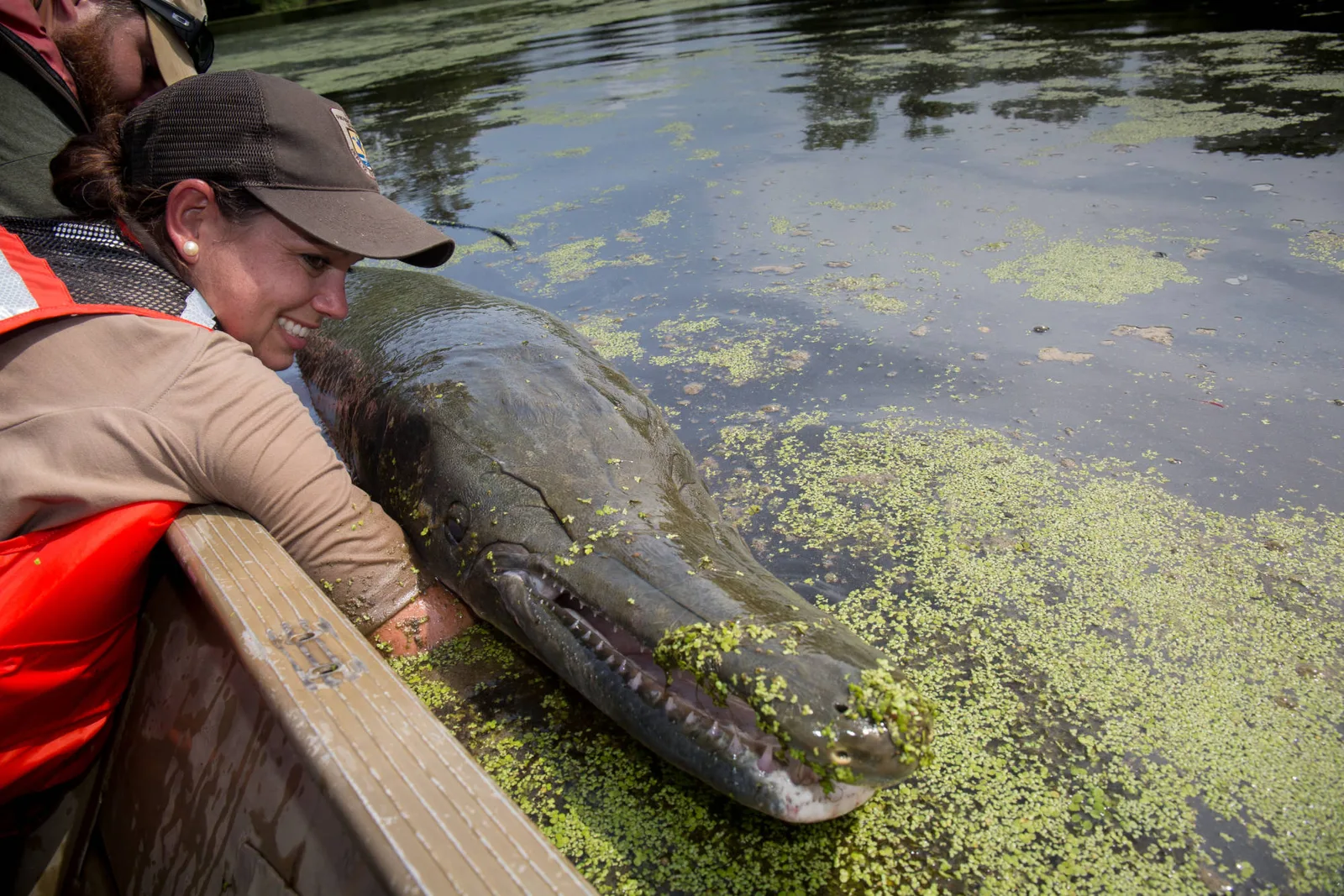
Section guide
Freshwater Fish Species Outside the Big Families: Sturgeon, Gar, Bowfin, BurbotThe freshwater fish species outside the bass, trout, catfish and pike families: sturgeon, gar, bowfin, burbot, drum, eel and paddlefish, with records.
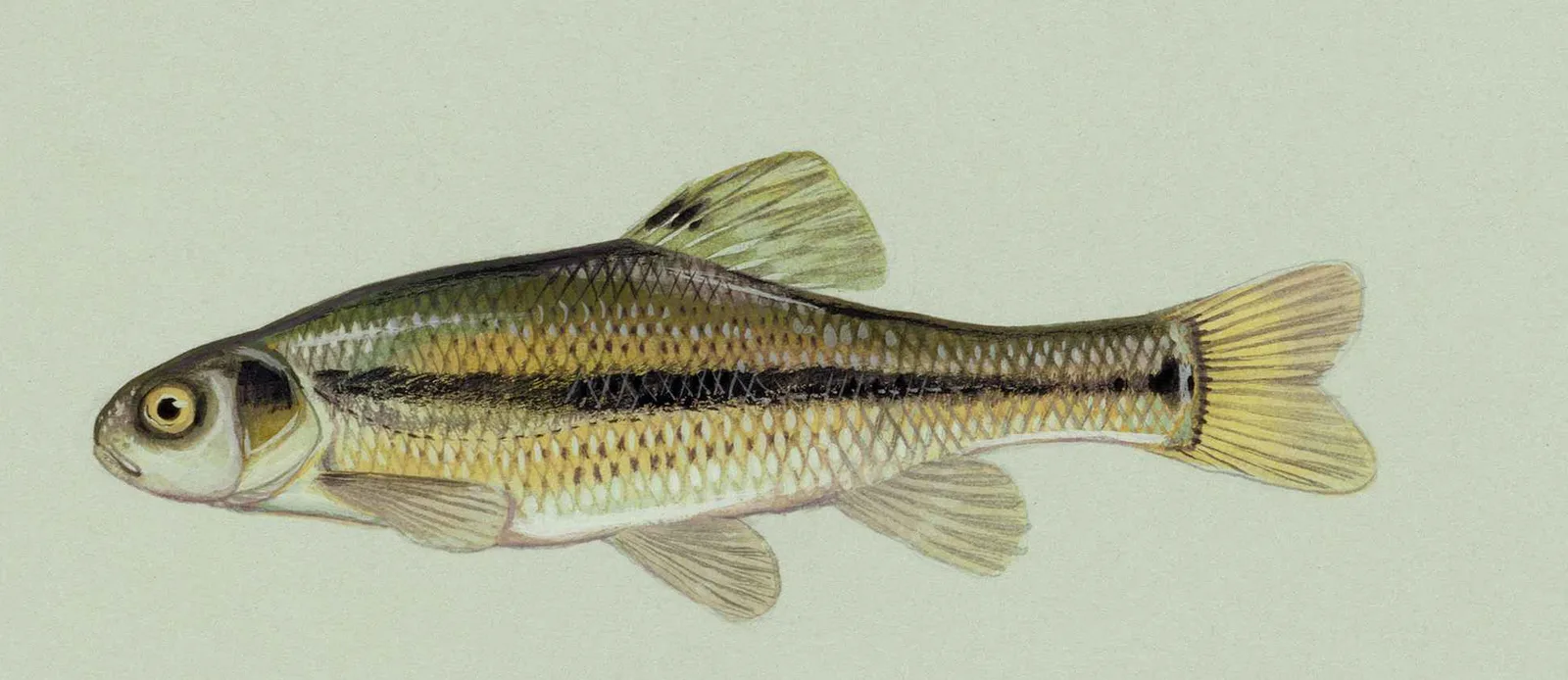 Fathead Minnows: ID, Bait, Pond Stocking and Rosy Reds
Fathead minnows are tough 2 to 3 in baitfish. How to identify them, keep them alive in a bucket, stock a pond by the pound, and spot a rosy red.
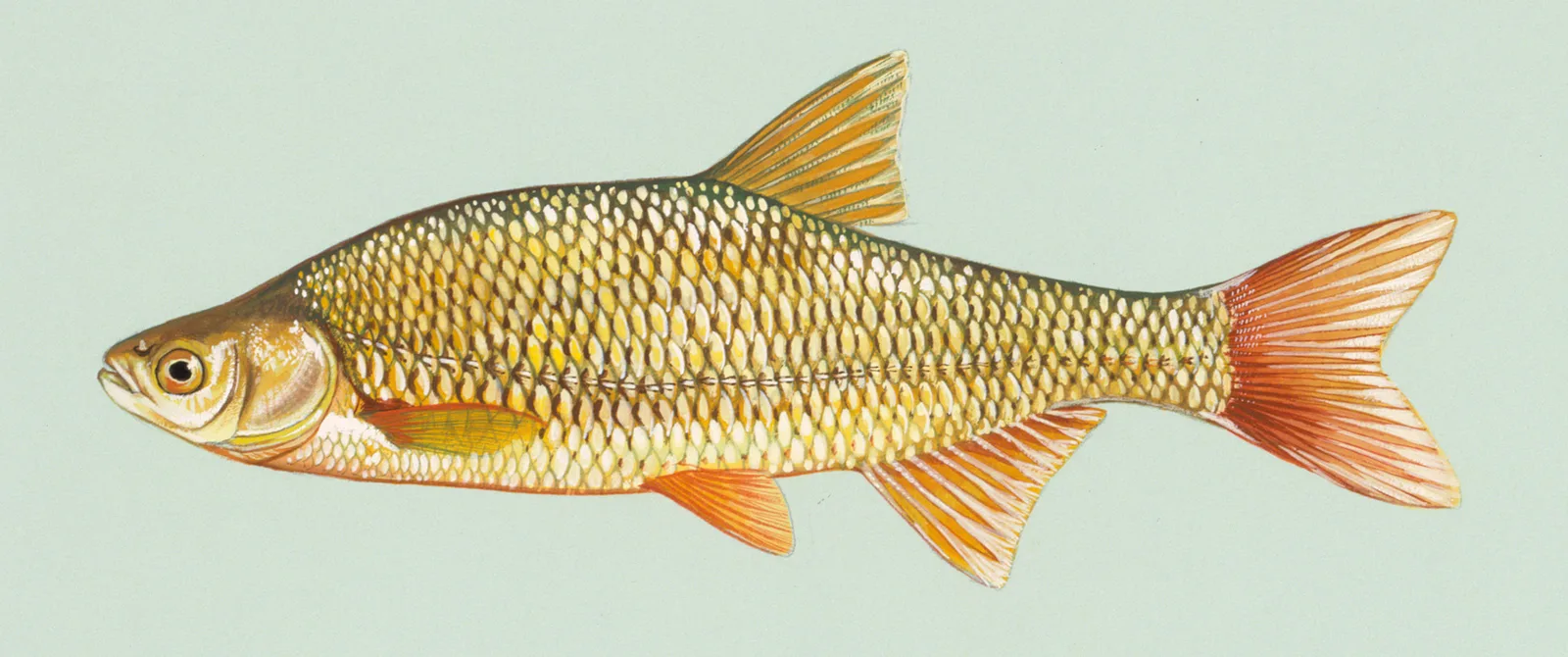 Golden Shiner: How to ID, Catch and Fish This Trophy Bait
Golden shiners are deep-bodied minnows and Florida's top live bait for big bass. How to tell one from a rudd, catch your own, and hook it right.
 Creek Chub: How to Identify, Catch and Use Them as Bait
A creek chub is a 5 to 7 in minnow with a black spot on its back fin. How to identify one, catch it on light tackle, and rig it as live bait.
 Gizzard Shad: How to Identify, Catch and Use Them for Bait
Gizzard shad commonly run 9 to 14 in. How to tell one from a threadfin, net it, keep it alive, and which states ban it as live bait.
 Shad Fishing: When the Run Hits, What to Throw, What You Can Keep
Shad fishing for American and hickory shad: when the spring run hits each river, the darts and spoons to throw, and which states let you keep one.
 Smelt Fishing: Net a Spring Run or Jig Them Through the Ice
Smelt fishing two ways: dip a spring run at night or jig them through the ice. When the run hits, the gear, and each state's rule.
Sources (30)
- International Game Fish Association, World Record Search: Snakehead, northern (all-tackle, Damien Cook, 21 lb 0 oz)
- U.S. Fish and Wildlife Service, Snakehead (Channa argus)
- U.S. Fish and Wildlife Service, Northern Snakehead Control and Management
- Virginia Department of Wildlife Resources, Northern Snakehead
- David Hart, Snakes in the Grass, Virginia Wildlife (May/June 2017)
Show all 30 sourcesShow fewer sources
- Maryland Fishing Guide (eRegulations), Invasive Species
- Fish & Hunt Maryland, Snakehead
- Delaware DNREC, Snakeheads
- Delaware News (2025), DNREC Confirms New State Records for Two Invasive Fish Species Increasingly Sought After by Anglers
- Pennsylvania Fish and Boat Commission, All About Snakehead
- New York State DEC, Northern Snakehead
- New Jersey Division of Fish and Wildlife, Invasive Alert, 2011 Freshwater Fishing Digest
- Missouri Department of Conservation (2025), MDC reminds anglers in southeast Missouri to kill, report northern snakehead fish
- Missouri Department of Conservation (2026), MDC officials confirm northern snakehead fish in Oregon County's Eleven Point River
- Georgia DNR Wildlife Resources Division, Aquatic Nuisance Species (ANS) in Georgia: Northern Snakehead
- CBS News (2019), After fish that survives on land is found, Georgia tells anglers: Kill them immediately
- Texas Parks and Wildlife Department, Snakehead
- Wisconsin DNR, Did I catch a snakehead?
- Everglades Cooperative Invasive Species Management Area, Bullseye Snakehead
- Nico, L. et al. (2022), Occurrence of a reproducing wild population of Channa aurolineata (Pisces: Channidae) in the Manatee River drainage, Florida, Aquatic Invasions
- U.S. Geological Survey, Nonindigenous Aquatic Species: Goldline Snakehead (Channa aurolineata)
- New Jersey Division of Fish and Wildlife, Snakehead Management Activities: 2010
- Chesapeake Bay Program, Chesapeake Channa (field guide)
- Smithsonian's National Zoo, Northern snakehead fish
- Wake Forest University News, on how snakeheads move on land
- Scott Einsmann (2026), These Invasive Dragons Are the Ultimate Gamefish. Here's How to Catch Them, Outdoor Life
- Outdoor Life, Kayak Fisherman Catches New Maryland State-Record Snakehead
- Maryland DNR (2025), Anne Arundel County Angler Breaks Maryland State Record for Chesapeake Channa
- Capt. Mike Sielicki, Ask an Expert, FishTalk Magazine
- Chesapeake Bay Magazine, Wild Chesapeake: World-Record Snakehead Caught in VA