 By
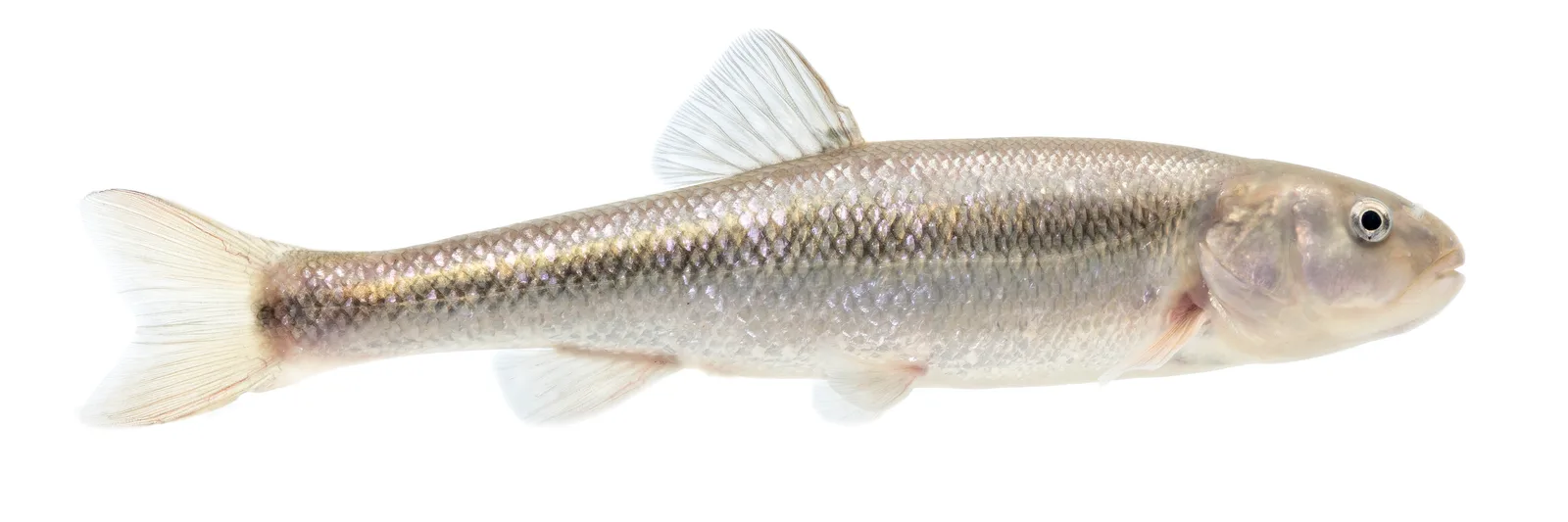
A creek chub is a minnow, usually 5 to 7 in long, with a black spot at the front of its back fin. It lives in small gravel creeks across the eastern two-thirds of the US and into southeastern Canada. Catch one on a tiny spinner or a bit of worm. Then let it go, or put it on a hook, because it’s one of the hardiest live baits you can catch yourself.
Pennsylvania’s state record walleye, 18 lb 1 oz, ate a live creek chub on a No. 2 hook and 6 lb line, fished from the bank of the Youghiogheny River.
How do you identify a creek chub?
Look at the back fin first. Adults usually carry a black spot at the front of its base, on the first three rays. Then check for these:
- A dark stripe running from the snout to the tail. Young fish have it, and most adults do too.
- A second dark spot at the base of the tail.
- A big mouth on a broad, blunt head, with a tiny barbel tucked in the groove of the upper jaw.
- A dark olive back and silver sides with a green or purple shine.
In spring, males can turn rosy and grow hard bumps called breeding tubercles on the head. Old books call this fish the horned dace. Don’t go by the spot alone. Connecticut’s fish page only says adults “usually” have it.
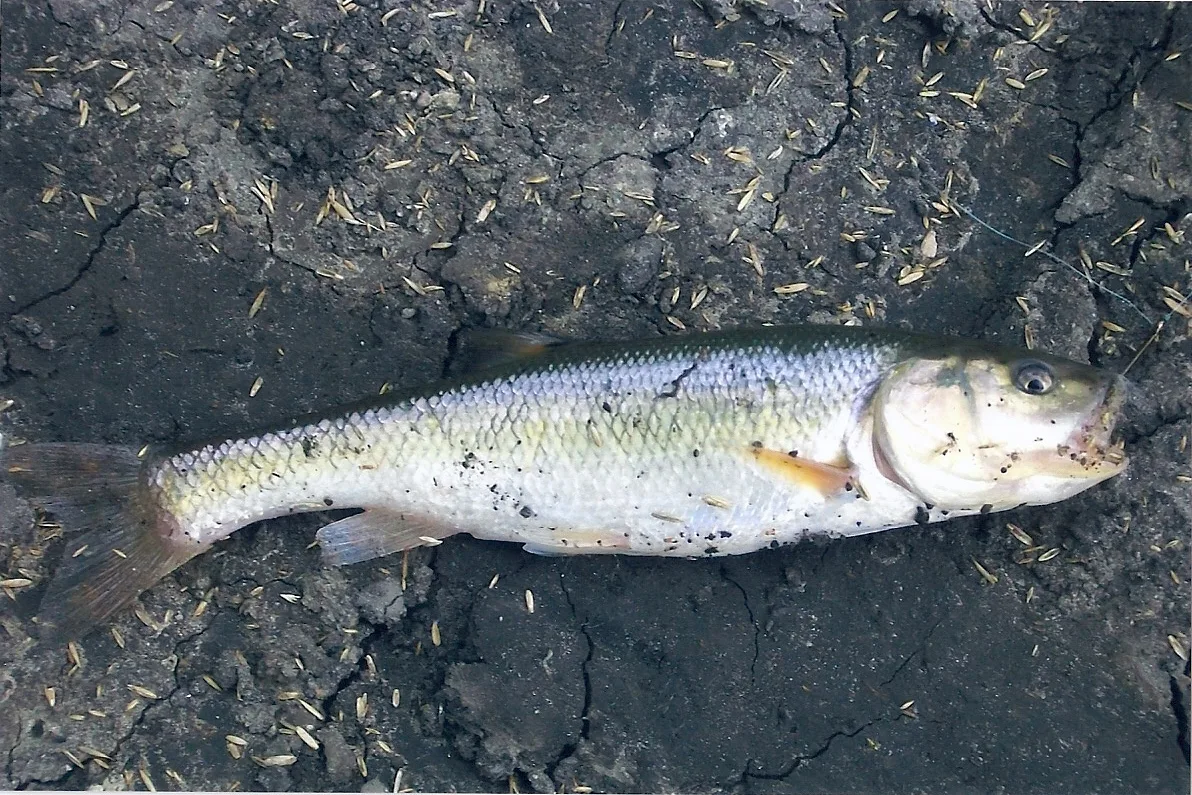 An 8 in creek chub from Hart Ditch in Munster, Indiana. The photographer named it by the black spot on the back fin. Photo: JR22496, via Wikimedia Commons (CC BY-SA 3.0)
| Look-alike | How it differs from a creek chub |
|---|---|
| Fallfish | Bigger scales, fewer than 50 along the lateral line, and no black spot on the back fin. Connecticut reports them up to 20 in |
| Hornyhead chub | Barbel at the corner of the mouth, and dark-edged scales that look crosshatched. Breeding males have bumps on the head and a red spot behind the eye |
| River chub | Mouth set slightly under the snout, bumps on the snout tip, and back and tail fins usually edged pale orange or red-orange |
| Common shiner | Silvery, deep, flat-sided body and no barbels. Usually only 3 to 5 in |
Is a fallfish a creek chub?
No, but they’re close cousins, and they’re easy to mix up. If it has big scales and no spot, you’ve got a fallfish. Their nests differ too. A creek chub builds a long, low ridge of gravel. A fallfish piles small rocks into a pyramid 4 to 18 in tall, Connecticut says. Fallfish get much bigger, and many trout anglers there catch them without knowing what they’ve got.

Free PDF · Water temperature chart Which fish are biting at today's water temperature?
One reading, and the 16-page chart shows which of 26 fish are spawning, feeding hard or slowing down; for bass, crappie, bluegill and walleye, where they sit and what to throw. Every number sourced.
No card, nothing to buy, and the PDF is yours to keep. Confirm with one click and it's on its way. Then a few short emails and one a week on what's biting. Unsubscribe anytime. Privacy.
Where do creek chubs live?
Small creeks. In Missouri they’re most abundant in small headwater creeks where few other fish are around, the kind that can stop flowing in dry weather. When a creek quits, they hang on in the pools that are left, or move back in from downstream when the water returns. That’s why you’ll find them in ditches and spring branches where little else lives.
Look for a mix of riffles and pools over clean gravel, with cover like holes, brush or roots. Iowa puts them among the biggest and most dominant fish in its creeks. They need flowing water to spawn, and they don’t do well in strong, steady current where other fish outcompete them.
The native range runs through the eastern US and southeastern Canada, west to Saskatchewan, Wyoming and the Brazos River in Texas. They’re missing from Florida and south Georgia. They’ve also been moved around by people and now cause trouble in the West. In Colorado they can outcompete native roundtail chubs. So never dump a bait bucket.
How do you catch creek chubs?
Go small and go light. This is fun on an ultralight rod, the lightest kind, built for thin line and tiny lures. Missouri says a creek chub “rises like a trout” to a fly or small lure, and it’s sport on light tackle. Iowa calls these fish good angling for kids.
- First pick: a tiny spinner. Iowa’s profile names a Mepps size 0. Work it through the pools.
- Second pick: a piece of nightcrawler on a small hook. A bit of worm is plenty, since a creek chub’s mouth is big but the fish usually isn’t.
- On a fly rod: a small wet fly. Iowa recommends small wet flies, the kind that sink.
Connecticut says they’re easily caught on bait and small lures, so don’t overthink it.
How do you use creek chubs as bait?
Rig a 4 to 6 in chub for walleye. Wild creek chubs trigger more big walleyes than bait-shop minnows, Cory Schmidt writes in In-Fisherman, and he calls a “creeker” one tough customer. Iowa rates them a main baitfish because they’re hardy, abundant and easy to keep. Pennsylvania’s record shows what one can do. Richard Nicholson’s live creek chub took the 18 lb 1 oz state record walleye on a spinning reel from the bank in 2021. “It was so big that it actually broke the net,” he said.
Here’s Schmidt’s setup for a chub that size:
| Part | What he uses |
|---|---|
| Hook | A No. 1, 1/0 or 2/0 octopus hook. A small hook on a big chub misses fish |
| Hooking | In through the mouth and out a nostril. It keeps the chub lively and hooks better |
| Leader | A snell knot on 6.6 or 8.2 lb mono, 3 ft (0.9 m) to start, sometimes as short as 1 ft (0.3 m) |
| Weight | A 1/4 to 7/16 oz (7 to 12 g) tungsten bullet weight, a bead and a No. 1 swivel |
Watch the rod tip. In the same In-Fisherman piece, a chub “suddenly pulsing on the rod tip almost always is the early warning signal” that a predator is close. Nicholson’s record rig was simpler: a No. 2 hook, BB split shot and a slip sinker, worked along the bottom at the edge of a sandbar.
Walleye aren’t the only taker. Brown trout, northern pike and smallmouth bass all eat creek chubs, and bass and catfish anglers use them. Iowa says to keep a few for live bait, or for cut bait for catfish.
Catch your bait with a baited hook or a Sabiki rig (a string of tiny hooks). Schmidt finds those often easiest, easier than traps, with a seine for deeper pools. A minnow trap can work too. Let the big ones go: he releases almost every chub over about 6 in, so the creek keeps its spawners. In a round tank with no sharp edges, he says, they can thrive for months. They’ll also eat smaller minnows you keep with them. Schmidt says they “chomp minnow heads off clean.”
Is it legal to use creek chubs as bait?
Often yes, but check first. Wild-caught minnows often get tighter rules than bait from a shop. Here’s what eight states say, as of November 2026:
| State | The rule |
|---|---|
| North Dakota | Creek chubs are one of only three legal live baitfish: “the only legal live baitfish are fathead minnows, creek chubs and sticklebacks.” White suckers are also legal on the Red and Bois de Sioux rivers, and some waters ban live baitfish outright |
| New York | Creek chub is on the Green List of baitfish. Personally harvested bait: “Transportation of personally harvested baitfish overland by a motorized vehicle is prohibited,” except in a designated corridor |
| Maine | On the legal baitfish list. Bringing live fish or eggs into the state needs a permit |
| Vermont | To use, sell or transport wild-harvested bait beyond the water where you caught it, you “must have a wild baitfish endorsement” on your license |
| Wisconsin | Trapped minnows may be used only “in the same waterbody where they were trapped” and “must be killed before you leave” |
| Michigan | Minnows for personal use “may only be used in the waters where they are collected” |
| Minnesota | “All minnows and leeches must be transported in tap/well or bottled water” |
| Washington | It is “unlawful to possess or use live aquatic animals as bait” in fresh water, with narrow exceptions |
A big reason for rules like these is disease. In Wisconsin’s words, the virus behind VHS “can survive in water for up to 2 weeks,” so water moved with bait can carry it to a new lake. Don’t drive your leftovers to other water. Michigan tells you to put leftover minnows “in a trash receptacle.”
Missouri sets a daily limit of 150 total across crayfish, freshwater shrimp and non-game fish. Traps have their own rules on size and labels in many states. Read your state’s current regulations before you set one.
How big do creek chubs get?
Expect 5 to 7 in long. Connecticut says 2 to 6 in is common, and the biggest fish in its state survey ran 8.3 in long. Missouri, Connecticut and Iowa all print a top end near 12 in long. Iowa says a chub reaches that after four years. Ontario’s fish database goes a little higher, to 13 in (33 cm).
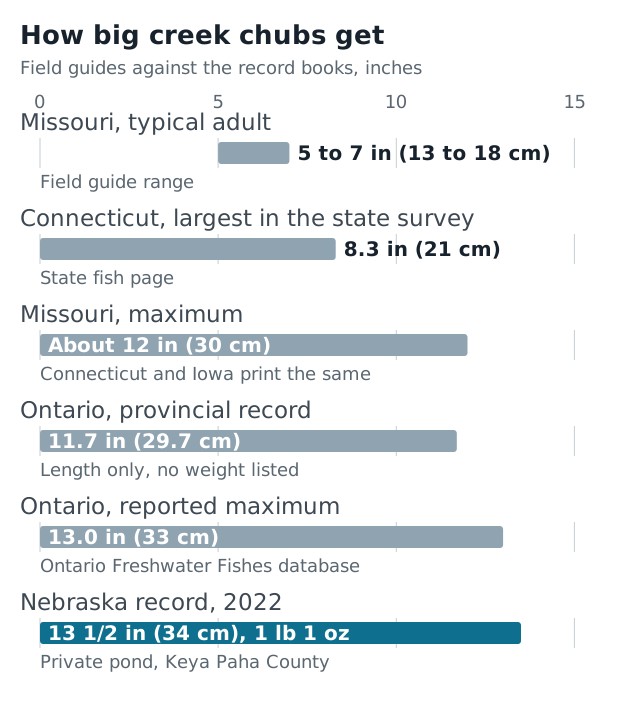
Chart: fishing.info, from the Missouri, Connecticut and Ontario fish references and Nebraskaland Magazine (read November 9, 2026)
Is there a world record creek chub?
Not that we can find. Creek chub isn’t on the list of fish the IGFA’s record search covers, as of November 9, 2026. Its bigger cousin the fallfish is, at 4 lb 1 oz (1.84 kg). So the state books are the place to look. Here’s what they hold:
| Record book | Fish | Water and date |
|---|---|---|
| Nebraska | 13 1/2 in (34 cm), 1 lb 1 oz (0.48 kg) | Private pond, Keya Paha County, February 2022 |
| Kentucky | 0.59 lb (0.27 kg) | Otter Creek, Hardin County, March 26, 2006 |
| Tennessee | 8 oz (0.23 kg) | West Blackburn Fork Creek, June 21, 2017 |
| Ontario | 11.7 in (29.7 cm), no weight listed | Province-wide |
| Iowa | None listed | — |
Nebraska’s fish is the one to tell people about. Kirk Sharp of Valentine caught two through the ice in a private pond in February 2022, both on wax worms. The first went 13 1/4 in and 1 lb even. Five days later he caught one 1/4 in longer and 1 oz heavier. Those two beat the state’s old hook-and-line record of 11 oz by five and six ounces. A pond also isn’t where the books say they do best, so don’t assume the big ones stay in the creek. Records move, so check your state’s current list.
Are creek chubs good to eat?
You can eat one, but few people bother. Iowa’s fish profile does call them “an excellent food-fish.” The catch is the bones. Minnows in general are “quite bony” and are usually eaten whole, Pond Informer says. If you keep one from a small creek, check your state’s consumption advisories for that water first. Most anglers put them on a hook instead.
Can you keep a creek chub in a pond or aquarium?
A small one can live in a tank, and creek-caught fish are kept in aquariums. Remember they eat smaller fish. Check your state’s rules before you bring any wild fish home. In a pond they can live, as Nebraska’s record shows, but Iowa says they seldom get established in lakes. They need flowing water over gravel to spawn, so a still pond likely won’t keep them going by itself.
The biology behind the fishing
Males dig a pit and heap stones just upstream of it, then keep extending the ridge as they spawn. In Missouri, spawning runs from early April to late May. Iowa says it starts in May when the water reaches about 65 °F (18 °C). Ontario gives 54 to 63 °F (12 to 17 °C) in May and June, and Virginia gives March to May at 55 to 67 °F (12.5 to 19.5 °C). The male guards the nest hard. Lots of other minnows lay their eggs in the same gravel. Common shiners use the pits, Missouri says, so one nest can serve several kinds of minnows.
They eat mostly insects, plus small fish, crayfish, worms and mollusks. Bigger fish take more fish. Males grow larger than females. They can live up to 8 years. Ontario’s database calls them tolerant of pollution and low oxygen, which helps them hang on in water other fish leave.
One more “creek chub” you’ll run into is a lure. The Creek Chub Bait Company of Garrett, Indiana, built the Wiggler around 1915, which Bassmaster’s Bernie Schultz credits as the first crankbait. George Perry’s 22 lb 4 oz world record largemouth ate a Creek Chub Fintail Shiner in 1932.
The other freshwater fish hub has more of what you’ll run into on small water. If you’re heading out for bait, the fishing terms page explains the rigs.

Free PDF · 16 pages
Stop guessing. Know what's biting before your first cast
A whole Saturday on the water with nothing to show for it. One reading tells you who's feeding.
The Water Temperature Fishing Chart. Take one water temperature reading, find it on the chart, and see which of 26 freshwater fish are spawning, feeding hard or slowing down.
- Where bass, crappie, bluegill and walleye sit, and what to throw. Trout: the reading where you stop.
- Why a 3 ft drop beats a cold front, and what to throw each day of the front
- The three thermometer mistakes that make a reading lie
The chart's numbers come from state fish and wildlife agencies and fisheries research: 61 sources, each listed on the site.
No card, nothing to buy. Confirm with one click and the PDF is on its way, one version for your phone and one to print, yours to keep. Then a few short emails and one a week on what's biting, with an unsubscribe link in every one. Privacy.
Related
Section guide
Freshwater Fish Species Outside the Big Families: Sturgeon, Gar, Bowfin, BurbotThe freshwater fish species outside the bass, trout, catfish and pike families: sturgeon, gar, bowfin, burbot, drum, eel and paddlefish, with records.
 Gizzard Shad: How to Identify, Catch and Use Them for Bait
Gizzard shad commonly run 9 to 14 in. How to tell one from a threadfin, net it, keep it alive, and which states ban it as live bait.
 Shad Fishing: When the Run Hits, What to Throw, What You Can Keep
Shad fishing for American and hickory shad: when the spring run hits each river, the darts and spoons to throw, and which states let you keep one.
 Smelt Fishing: Net a Spring Run or Jig Them Through the Ice
Smelt fishing two ways: dip a spring run at night or jig them through the ice. When the run hits, the gear, and each state's rule.
 Beluga Sturgeon: How Big It Gets, Where It Lives and the Caviar Ban
The beluga sturgeon reaches 26 ft on the books and lives only in the Caspian and Black Sea basins. Its size, record, status and the US caviar rules.
 Goliath Tigerfish: How Big They Get, Teeth, and the Crocodile Stories
Goliath tigerfish facts that hold up: the 97 lb IGFA record, real size, the teeth, the attack and crocodile stories, and where anglers go.
 Nile Perch: How Big They Get, the Record, and Where to Catch One
Nile perch grow to about 2 m and 200 kg, and the record is 230 lb from Lake Nasser. Where to catch one, why the US bans it, and the Lake Victoria story.
Sources (34)
- Missouri Department of Conservation, Creek Chub (field guide)
- Iowa DNR, Creek Chub (Fish Iowa species profile)
- Connecticut DEEP, Creek Chub (Semotilus atromaculatus) - Native
- Connecticut DEEP, Fallfish
- Virginia Tech, EFISH: The Virtual Aquarium, Creek Chub
Show all 34 sourcesShow fewer sources
- Virginia Tech, EFISH: The Virtual Aquarium, River Chub
- Missouri Department of Conservation, Hornyhead Chub (field guide)
- Missouri Department of Conservation, Common Shiner (field guide)
- Ontario Freshwater Fishes Life History Database, Creek Chub
- FishBase, Semotilus atromaculatus, Creek chub
- Animal Diversity Web, Semotilus atromaculatus
- Wikipedia, Creek chub
- Cory Schmidt, Walleye Week: Minnow Methods: Old School Livebait Secrets for Walleyes, In-Fisherman (May 22, 2024)
- Pennsylvania Fish and Boat Commission, New State Record Walleye Recorded
- Nebraskaland Magazine, State Record Update, Through an Ice Hole, 2022
- Nebraskaland Magazine, State Record Summary, 2022
- Nebraska Game and Parks Commission, 2019 Fishing Guide (state record table: creek chub, rod and reel, 11 oz)
- Kentucky Department of Fish and Wildlife Resources, State Record Fish List
- Tennessee Wildlife Resources Agency, Fishing Records & Awards
- IGFA World Record Search, the list of common names it searches (fallfish is on it, creek chub is not; read 2026-11-09)
- Doug Leier, North Dakota Outdoors: A little bit about baitfish in North Dakota, Minot Daily News (August 2025)
- New York State DEC, Baitfish regulations
- Maine Department of Inland Fisheries and Wildlife, Baitfish and Smelt Information
- Vermont Fish and Wildlife, Baitfish Use and Restrictions (eRegulations)
- Wisconsin DNR, How VHS rules affect anglers
- Michigan DNR Fishing Guide, Lawful Fishing Methods (eRegulations)
- Minnesota DNR Fishing Regulations, General Regulations (eRegulations): minnow traps and minnow transport
- Missouri Wildlife Code, 3 CSR 10-6.605 Live Bait (Cornell LII)
- Washington WDFW, Statewide Freshwater Regulations (eRegulations): live aquatic animals as bait
- Pond Informer, Can You Eat Minnows? (Nutrition & Recipes)
- Bassmaster (Bernie Schultz), The first crankbait (2016)
- Bassmaster, George Perry's world record bass
- U.S. Fish and Wildlife Service, creek chub (photo, Sam Stukel, via Wikimedia Commons)
- JR22496, Chub from Munster Creek (photo, Wikimedia Commons)