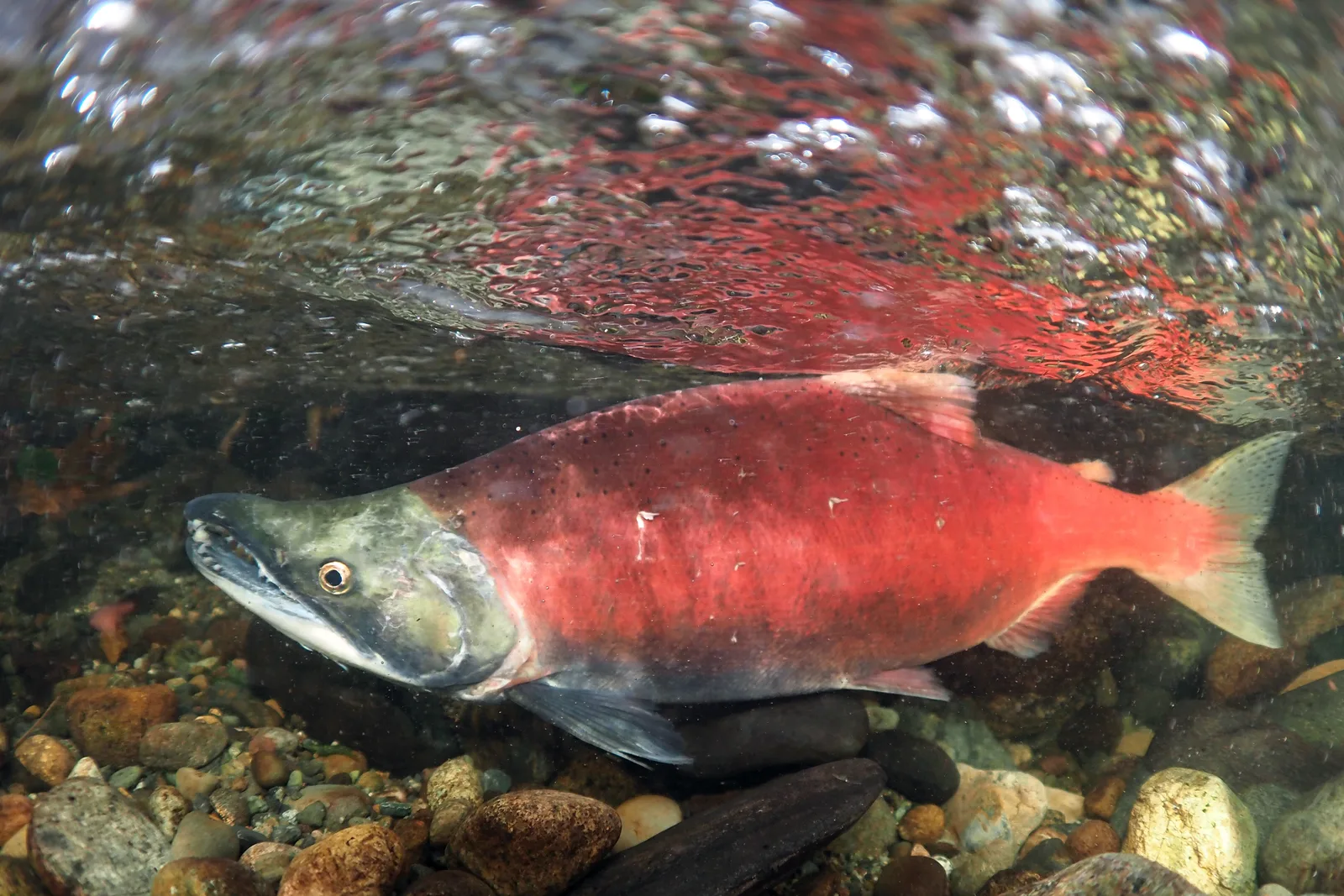
The kokanee salmon is a sockeye salmon that never goes to sea. It is the same species, Oncorhynchus nerka, living its whole life in a cold lake or reservoir, and it stays small: 9 to 12 in (23–30 cm) on average in Washington. It schools in open water, eats zooplankton, and dies after it spawns in fall, bright red with an olive-green head.
The world-record kokanee weighed 9 lb 10 oz and came from Oregon’s Wallowa Lake in June 2010. By 2012 the same lake held more than 900,000 kokanee, and the trophies had given way to a crowd of young fish under 12 in.
Kokanee or sockeye: what is the difference?
Only the trip to sea, and the size that comes with it. A sockeye usually spends its first years in a lake, then one to three years in the ocean, and comes back big. A kokanee stays in the lake. IGFA puts it plainly: the two are the same species, but the freshwater kokanee “does not grow as large as the sockeye.” The salmon hub sets the sockeye beside the other Pacific salmon.
| Kokanee | Sea-run sockeye | |
|---|---|---|
| Lives | Its whole life in a lake or reservoir | Lake as a juvenile, then 1–3 years at sea |
| Typical size | 9–12 in (23–30 cm), rarely over 14 in (36 cm) | 18–31 in (46–79 cm), 4–15 lb (1.8–6.8 kg) |
| IGFA record | 9 lb 10 oz (4.37 kg), Wallowa Lake, 2010 | 15 lb 3 oz (6.88 kg), Kenai River, 1987 |
| Eats | Zooplankton, strained with fine gill rakers | Zooplankton, crustaceans, small fish, squid |
| Spawning dress | Red body, olive-green head | Red body, green head |
Kokanee did not split from sockeye just once. A 1996 genetic study by Eric Taylor, Chris Foote and Chris Wood found that kokanee “have arisen from sea-run sockeye salmon several times independently.” In many cases a lake’s kokanee are closer kin to the sockeye that spawn downstream than to kokanee elsewhere.
The name comes from nsyilxcən, the language of the Okanagan (Syilx) people: kikinee is their name for the landlocked sockeye. Washington’s fish and wildlife department lists “silver trout” as another name, but a kokanee is a salmon.
How to tell a kokanee from a trout
In a reservoir the fish to tell it from is the rainbow trout. A rainbow has black spots right across its tail. A kokanee has a blue back, silver sides and no distinct dark spots on its back or tail fin, Washington’s fish and wildlife department says. It also has finer scales, larger eyes and a deeply forked tail.
Two counts settle a doubtful fish. The anal fin has 13 to 17 rays, with a base longer than the base of the dorsal fin. The first gill arch carries 29 to 40 fine gill rakers, the comb that strains plankton.
Before spawning (September and October in Utah’s waters), the silver fish turns. Both sexes go bright red while the head and tail stay olive green. Males grow a hump, a hooked jaw called a kype, and long teeth.
That red is a small puzzle. Sea-run sockeye get their red pigments from ocean food; lakes offer far less. In a two-year breeding study, Kevin Craig and Chris Foote found kokanee about three times more efficient than sockeye at storing those pigments, which helps explain how a lake fish ends up as red as its sea-run cousin.
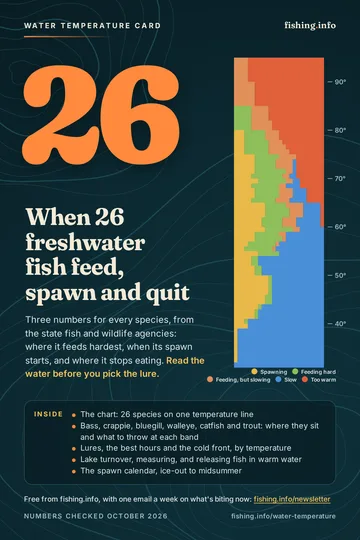
Free card: what 26 species do at your water temperature
Plus one email a week on what's biting now. No sales pitches. Privacy.
Where kokanee live
Kokanee occur naturally in Alaska, Washington, Oregon and Idaho, in British Columbia and the Yukon, and in Japan and Russia, IGFA says. Elsewhere they were stocked. Montana put them into Flathead Lake in 1914. California followed in 1941, looking for a sport fish that could live in reservoirs whose levels rise and fall.
Today California plants about 750,000 fingerlings a year in 15 reservoirs. Colorado’s program centers on Blue Mesa Reservoir, stocked since 1965, whose fish supply about 60 percent of the state’s eggs. Each fall they run upstream to the Roaring Judy hatchery, where the eggs are taken to restock 26 lakes and reservoirs. Flaming Gorge holds northeastern Utah’s largest population. In the Northeast, Connecticut has stocked kokanee since the 1940s and keeps fisheries in East Twin Lake and West Hill Pond.
What these waters share is cold, deep, open water. Washington’s biologists say kokanee hold at the depth where the water is near 50 °F (10 °C). California gives a preferred range of 50 to 55 °F (10–13 °C) and a limit of 59 °F (15 °C). The lake water temperature page shows how to read that layer before you launch.
When and how deep: kokanee through the year
The 50 °F layer moves, and the school moves with it.
| Season | Where they hold | What to run |
|---|---|---|
| Spring (April–June) | Near the surface; best in late spring as plankton blooms | Long-lining: dodger and lure on 100–150 ft of line, no weight, reaches as deep as 10–12 ft |
| Summer | Deep offshore, near the thermocline; they go deeper as the surface warms and the lake stratifies | Downriggers or a dropper weight to the depth on the sonar |
| Weeks before the run | Dense schools off the mouths of spawning streams | Troll the stream mouths; jig a school you have marked |
| Fall run (Sept.–Dec.) | Shallows and tributaries; spawning fish stop feeding but can still strike | Small bright lures or flies for males from shore, where legal; snagging only where a state opens a season |
| At night | Under a light on an anchored boat | Size 10–12 hook with maggot or shoepeg corn at or just below the thermocline |
Most anglers fish from April through August, Oregon’s fish and wildlife department says, though kokanee can be caught year-round. Connecticut rates May through July best. Fishing for spawning kokanee is a different matter: Utah bars keeping any kokanee caught in the state from Sept. 10 to Nov. 30, so check your state’s rules before a fall trip.
How to catch kokanee salmon
Most kokanee are caught from a boat, kayak or float tube; very few come from the bank, Oregon says. The agencies agree on the method.
- Find the school first. Mark the fish on the sonar, then set your lure to that depth. The how to read a fish finder page shows what a school looks like on screen.
- Troll slowly. California gives 0.8 to 1.5 mph; Oregon 0.8 to 1.6 mph, with S-turns to change the speed. That is slower than for their salmon cousins.
- Run a dodger or other flasher ahead of a small lure. Hoochies, small spinners, spoons and wedding-ring spinners all work. Oregon’s rule for the leader between them: 2½ times the dodger’s length, usually 9 to 24 in (23–61 cm).
- Start with pink or orange. Both California and Oregon name those two first; Oregon adds chartreuse.
- Tip the hooks with white shoepeg corn. California calls it the habit of the most successful anglers; Oregon calls it a must. Maggots and shrimp also work.
- Get the depth right. Oregon’s numbers: 100 to 150 ft of line with no weight reaches as deep as 10 to 12 ft. A dropper of 1 to 3 oz reaches as deep as 40 ft. Past 6 oz of weight, a downrigger is the better tool.
- Fish soft. Kokanee have very soft mouths. Washington recommends a snubber or a very soft rod. Oregon notes most kokanee rods run 7 to 8 ft, and a slow, steady retrieve lands more fish.
Jigging works when you sit on a big school: Washington suggests ¼ to 1 oz, matched to the depth. Kokanee also feed the big fish. Idaho calls them the foundation of Lake Pend Oreille’s trophy rainbow fishery.
How big do kokanee get?
Most stay small. Washington gives an average of 9 to 12 in and up to 20 in (51 cm) in quality populations. In Montana, 1-pounders are most common and 3 to 5 lb is possible.
Age decides less than crowding does. Montana says size depends on two things, the number of kokanee and the food available, and that kokanee can overpopulate into “large numbers of stunted fish.” Wallowa Lake shows both ends. It held about 70,000 kokanee in 2008 and grew record fish; by 2012 it held over 900,000, and Oregon’s biologists described the trophies as replaced by a bigger population of smaller fish. Oregon biologist Jeff Yanke noted that in several Idaho and Canadian lakes, trophy kokanee were followed by population crashes.
What is the record kokanee?
| Record | Weight | Where and when |
|---|---|---|
| World (IGFA) | 9 lb 10 oz (4.37 kg) | Ron Campbell, Wallowa Lake, Oregon, June 13, 2010 |
| Colorado | 7.31 lb (3.32 kg) snagged; 6.81 lb (3.09 kg) on hook and line | Blue Mesa, 2002; Spinney Mountain Reservoir, 1986 |
| Idaho | 6.59 lb (2.99 kg), 24.5 in (62 cm) | Jerry Verge, Priest Lake, June 9, 1975 |
| California | 5 lb 2 oz (2.32 kg) | Lake Tahoe, 2013 |
| Connecticut | 2 lb 14 oz (1.30 kg) | East Twin Lake, 2011; tied at West Hill Pond, 2018 |
Campbell’s fish broke a world record of 9 lb 6 oz that had stood since 1988, from Okanagan Lake in British Columbia. Oregon’s own list weighs it at 9 lb 10.72 oz. IGFA’s all-tackle length record is a 54 cm (21.3 in) kokanee from Holter Reservoir, Montana, caught in 2024.
What happened to Flathead Lake’s kokanee?
Flathead Lake in Montana shows how fast a kokanee fishery can vanish. By 1940 kokanee were the main catch there. In 1979–1983 the lake held 1.6 to 2.3 million of them, and in the early 1980s the fall run drew peaks of more than 600 bald eagles to McDonald Creek in Glacier National Park.
To give kokanee more to eat, managers stocked opossum shrimp, Mysis, into five lakes upstream between 1968 and 1976. The shrimp reached Flathead and ate the same zooplankton the kokanee needed. They also fed the lake’s few lake trout, which then boomed and ate kokanee. The sport fishery collapsed the year after the shrimp peaked, in the mid-1980s, and kokanee never recovered.
Idaho’s Lake Pend Oreille shows the fight back. In 2009 Idaho Fish and Game was paying anglers $15 for every lake trout and rainbow trout they turned in, and contract netters had removed nearly 40,000 lake trout. The lake has also been held higher in most winters since 1996, because a full 11.5 ft (3.5 m) drawdown left the best spawning gravel dry.
Are kokanee good to eat?
Yes, and the agencies say so with unusual warmth. Oregon calls the flesh delicate and the fish excellent on the table; Connecticut calls kokanee one of the state’s best-tasting freshwater fish. Bleed each fish and put it on ice right away, Oregon advises.
Connecticut DEEP says to treat them like any salmon: cook them whole, butterflied or filleted, and for a treat, plank them on cedar or fruitwood. In Colorado, the hatchery gives away spawned kokanee on Fridays during the egg take, to anyone with a Colorado fishing license, so the meat is not wasted. Mercury advice, where a state gives any, is set water by water, so check your state’s fish consumption advisory for the lake you fish.
How long do kokanee live?
Two to four years in most waters, a few older, and the whole life cycle ends in one spawning run. California’s kokanee typically live two to three years; Colorado’s about four; in Montana most mature in their fourth year. They are plankton eaters all their lives, which is why they school in open water and follow the food up and down.
Some run up tributary streams to spawn; others spawn on gravel along the lake shore. In Montana they spawn in pairs in November and December, and the eggs hatch in about 110 days at 43 °F (6 °C). The fry swim to the lake in spring. Every adult dies after spawning, and the carcasses feed eagles and bears. For the other Pacific salmon, start with coho salmon, the silver of the Pacific coast and the Great Lakes.
Free download
The water temperature card
Read your water temperature and the card tells you who is spawning, who is feeding and what to throw. 26 species, 16 pages, for your phone and the tackle box.
Plus one email a week on what's biting now. No sales pitches. Privacy.
Related
Section guide
Types of Salmon: The Five Pacific Species and the Atlantic, Told ApartThe six types of salmon a North American angler meets: chinook, coho, sockeye, pink, chum and Atlantic, by gum line, tail spots, size and record.
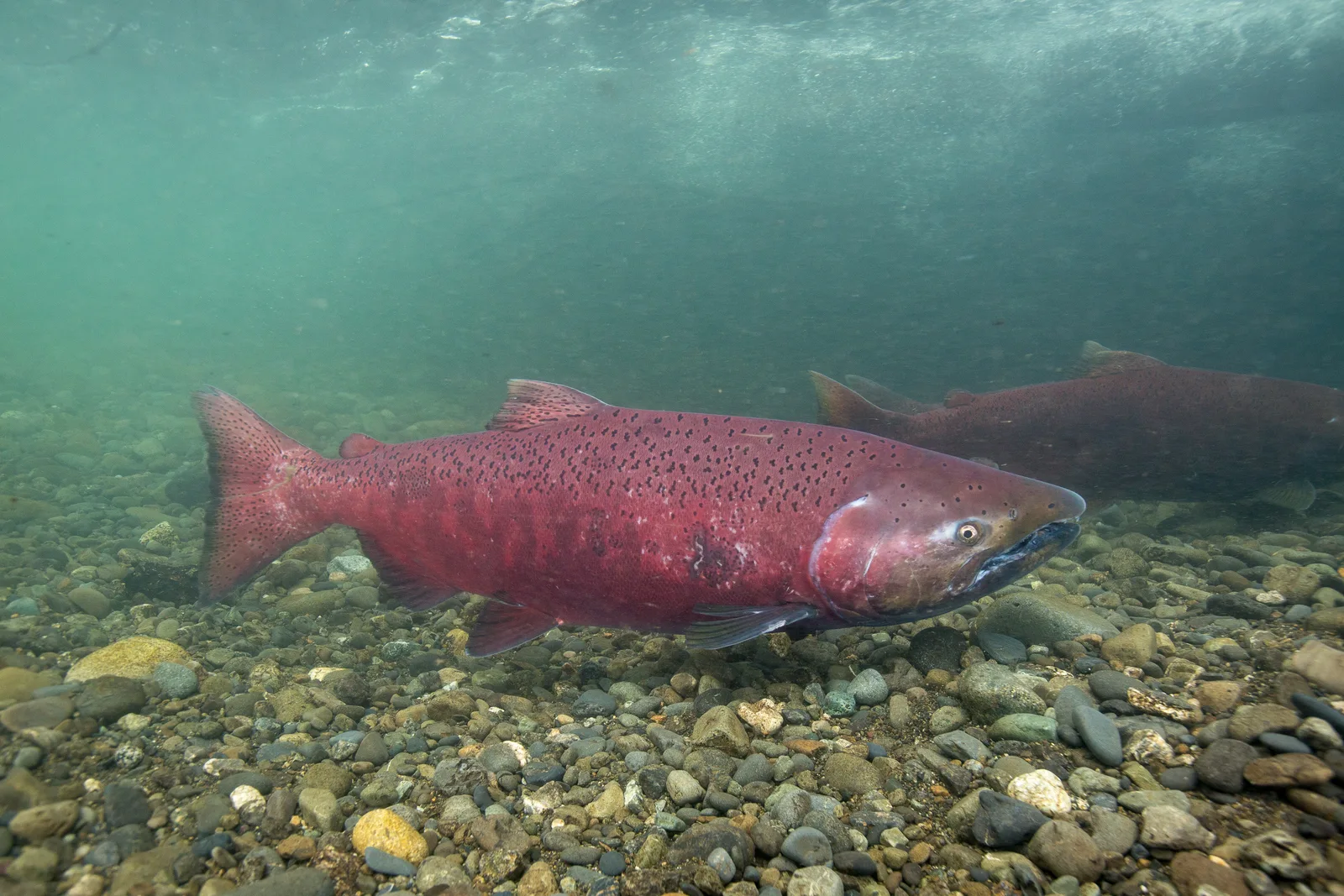 King Salmon (Chinook): Black Gums, Size, Runs and the 97-Pound Record
King salmon, or chinook: the black gums that mark a king, how big they get from Alaska to the Great Lakes, when each run starts, and the 97 lb 4 oz record.
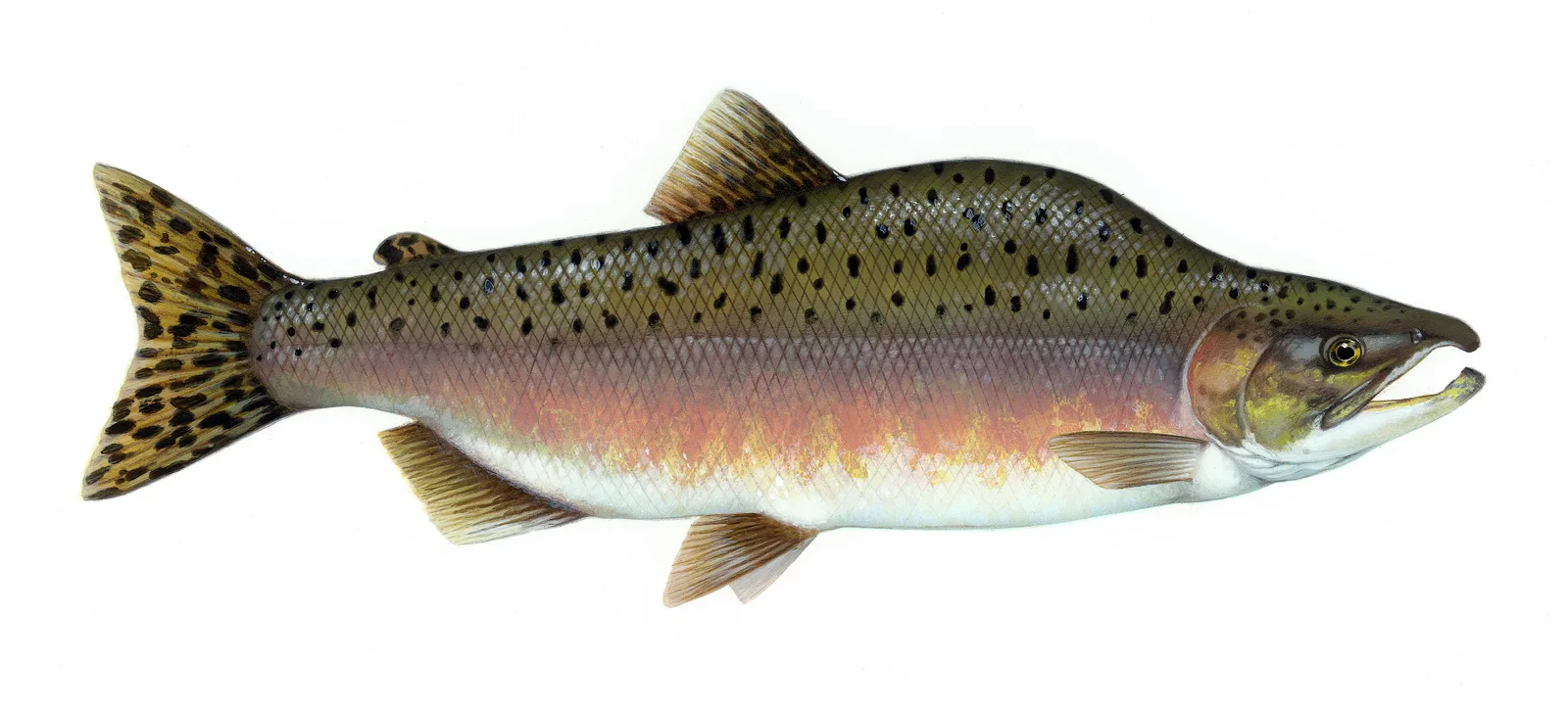 Pink Salmon: Odd-Year Runs, How to Tell a Humpy, Size and Records
Pink salmon live two years, so Puget Sound gets humpies only in odd years. When they run, how to tell one from a king, how to catch it and the record.
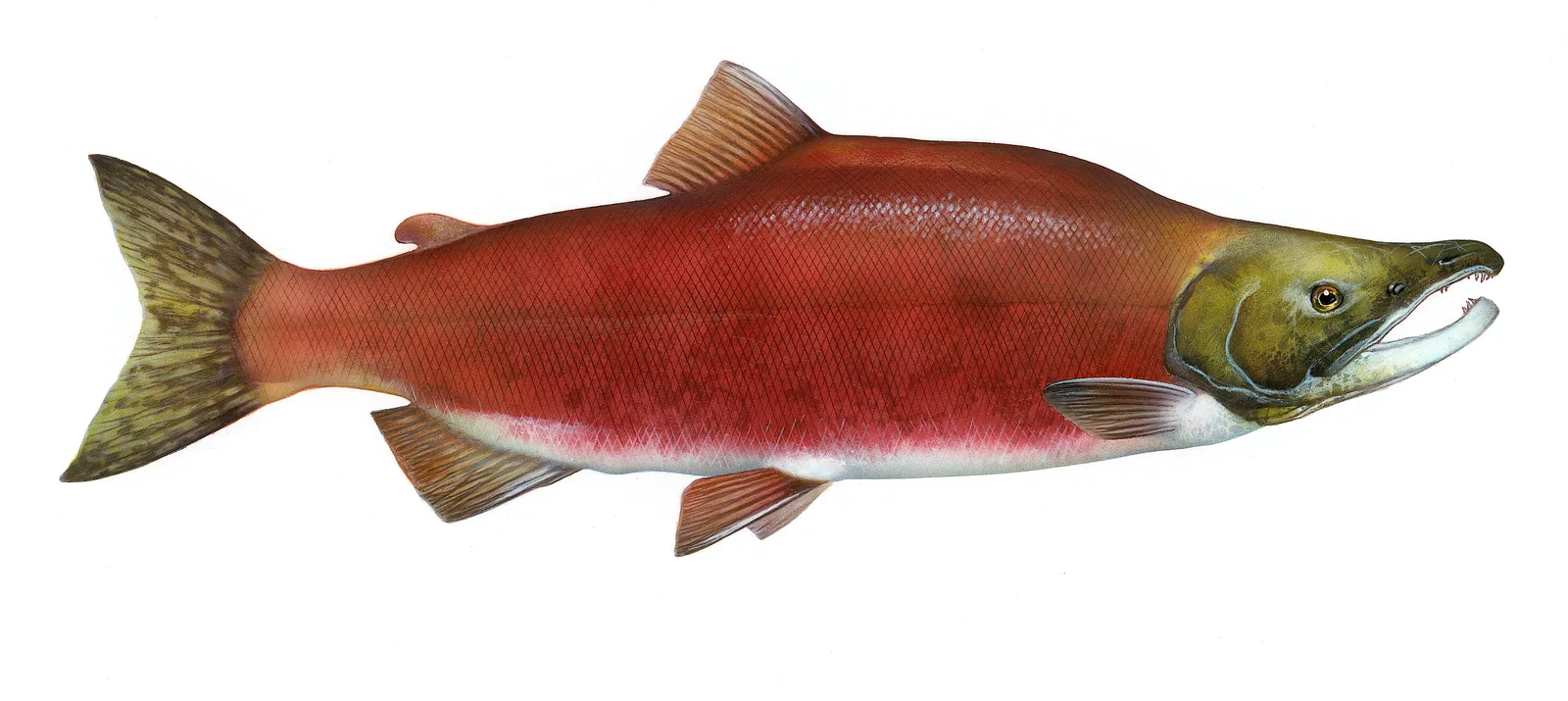 Sockeye Salmon: How to Tell a Red, Where They Run, and the Record
Sockeye salmon: a 4–15 lb red salmon that needs a lake. Tell it from a chum, find the runs from Bristol Bay to Lake Washington, hook one, and the record.
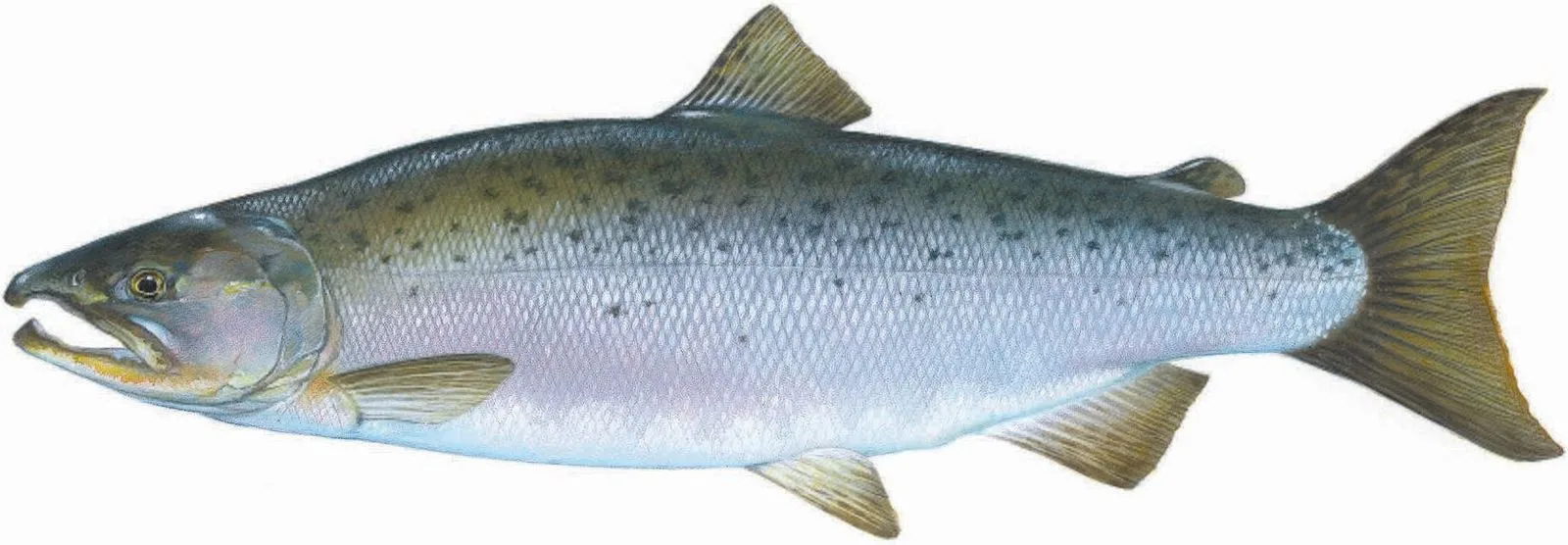 Coho Salmon: How to Tell a Silver From a King, Size, Runs and Records
Coho salmon: the white gum line that separates a silver from a king, how big they get, when they run from Alaska to the Great Lakes, and the record.
Sources
- Washington Department of Fish and Wildlife, Kokanee: identification, size, 50 °F, season, methods
- Washington Department of Fish and Wildlife, Sockeye salmon: common names
- Alaska Department of Fish and Game, Sockeye salmon species profile
- NOAA Fisheries, Sockeye salmon
- California Department of Fish and Wildlife, Fishing for Kokanee
- California Department of Fish and Wildlife, 1.53 million inland salmon released to enhance recreational fishing (state record)
- Oregon Department of Fish and Wildlife, Kokanee fishing in Oregon
- Oregon Department of Fish and Wildlife, Oregon's record fish
- Oregon Department of Fish and Wildlife, Wallowa Lake
- Oregon Department of Fish and Wildlife (2013), Wallowa Lake kokanee bag limit increased
- IGFA world records: Kokanee and Salmon, sockeye
- U.S. Geological Survey, Nonindigenous Aquatic Species: Oncorhynchus nerka
- Colorado Parks and Wildlife, Kokanee Salmon
- Colorado Parks and Wildlife, Fish records by weight
- Colorado Outdoors (2016), Kokanee: Blue Mesa and the Roaring Judy hatchery
- Montana Field Guide, Kokanee (Montana Natural Heritage Program and Montana Fish, Wildlife and Parks)
- Idaho Department of Fish and Game, Certified weight fish records
- Idaho Department of Fish and Game (2010), Lake Pend Oreille kokanee recovery shows positive signs
- Connecticut DEEP, Kokanee Salmon Program
- Nevada Department of Wildlife, Kokanee Salmon
- Utah Division of Wildlife Resources (2023), Where you can see bright red kokanee salmon in Utah this fall
- Utah Division of Wildlife Resources (2020), 9 places to see bright red kokanee salmon in Utah this fall
- Utah Division of Wildlife Resources, 2026 Utah Fishing Guidebook (kokanee possession rule)
- Ellis et al. (2011), Long-term effects of a trophic cascade in a large lake ecosystem, PNAS 108(3):1070–1075
- Flathead Lake Biological Station, Flathead Lake trophic cascade
- Taylor, Foote and Wood (1996), Molecular genetic evidence for parallel life-history evolution within a Pacific salmon (sockeye salmon and kokanee, Oncorhynchus nerka), Evolution 50(1):401–416
- Craig and Foote (2001), Countergradient variation and secondary sexual color: phenotypic convergence promotes genetic divergence in carotenoid use between sympatric anadromous and nonanadromous morphs of sockeye salmon (Oncorhynchus nerka), Evolution 55(2):380–391
- Okanagan Rail Trail, Ribbleworth Falls: the origin of the word kokanee
- La Grande Observer (2010), It's official, kokanee is world record