 By
The scariest fish that can really kill you is a shark. The great white leads the record, with 351 unprovoked bites on people and 59 deaths. The most venomous fish is the reef stonefish. The scariest-looking fish, the deep-sea anglerfish and fangtooth, are no longer than your hand and live far below where you’ll ever be. Most freshwater “monsters” have no confirmed kill at all.
The black seadevil, the deep-sea anglerfish with the glowing lure, was 3.5 inches long when it was first filmed in its own water.
What is the scariest fish in the world?
It depends on what scares you: teeth, venom or a face. So here are the fish people call the scariest, sorted by what each one can actually do to a person. The top group can kill. The middle group hurts. The bottom group mostly looks the part.
| Fish | What it does | The worst on record | Source |
|---|---|---|---|
| Great white shark | Bites | 351 unprovoked bites, 59 fatal | ISAF |
| Tiger shark | Bites | 142 unprovoked bites, 39 fatal | ISAF |
| Bull shark | Bites, and swims up rivers | 119 unprovoked bites, 26 fatal | ISAF |
| Reef stonefish | 13 venom spines | Most venomous fish, believed to have killed many islanders | Australian Museum |
| Pufferfish | Poison in the meat | Death by paralysis in extreme cases | FDA |
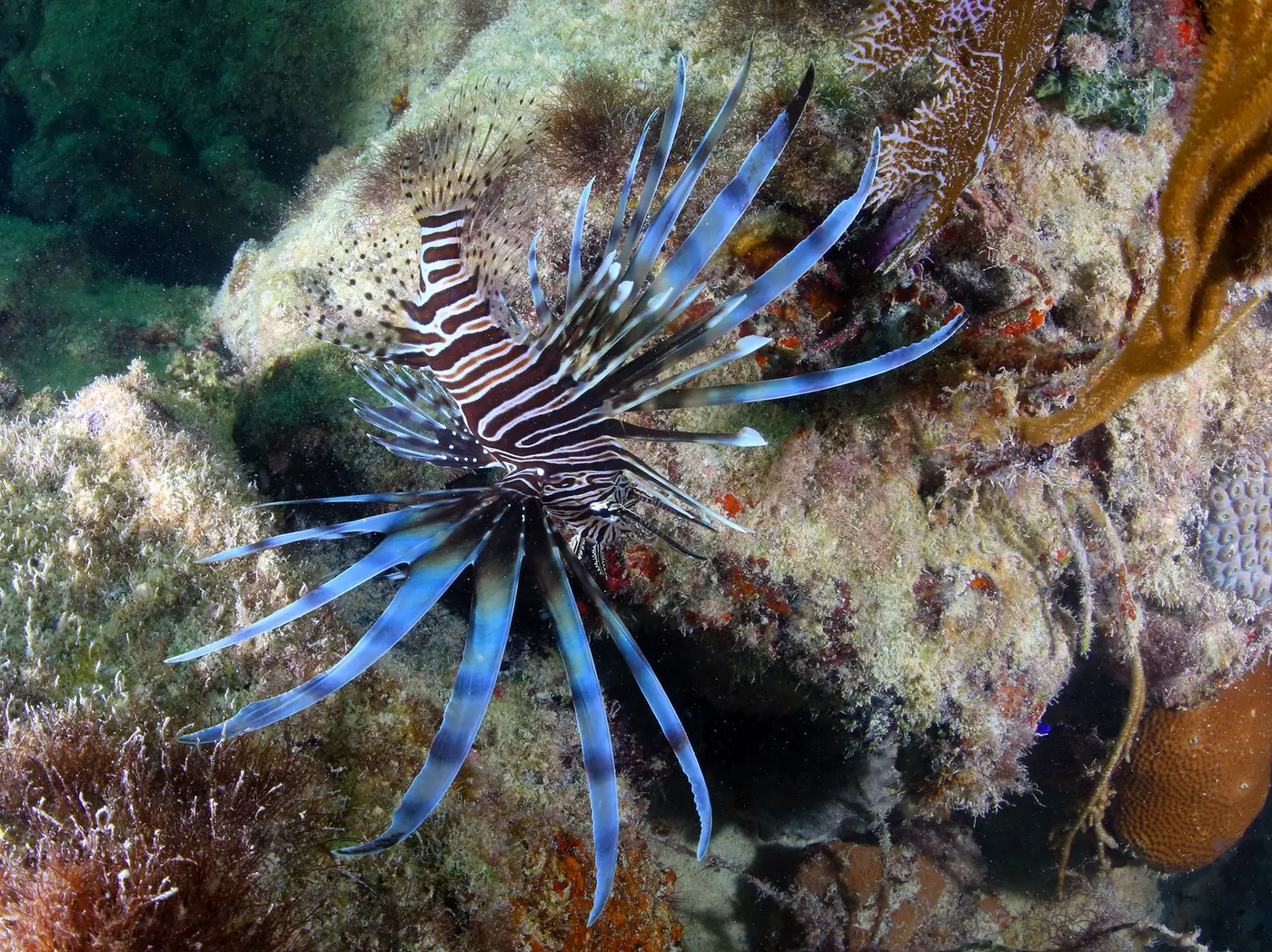
| Red lionfish | Up to 18 venom spines | Extreme pain that can last for days | NOAA, FWC |
| Stingray | Venom spine in the tail | A sting when you step on one | UF/IFAS |
| Channel catfish and kin | Venom spines in 3 fins | A painful sting, worst from small fish | Our catfish guide |
| Great barracuda | Bites, carries ciguatera | Rare quick strikes, poisoning when eaten | Florida Museum, FDA |
| Piranha | Bites | Mostly single bites near a nest | Discover Wildlife |
| Electric eel | Shocks | 860 volts, enough to kill prey | Smithsonian |
| Goliath tigerfish | Fangs | Bites reported, no killing substantiated | A-Z Animals, FishBase |
| Wels catfish | Size, swallows birds | No documented harm to people | USFWS |
| Alligator gar | Two rows of teeth | No confirmed attack on a person | Texas Parks and Wildlife |
| Northern snakehead | Dagger-like teeth | A danger to other fish | National Zoo |
| Sea lamprey | Sucker mouth of teeth | Bites on people appear to be rare | The Weather Network |
| Candiru | The urethra legend | Ignored human urine in tank tests | Spotte et al. 2001 |
ISAF is the International Shark Attack File at the Florida Museum. Its species table was last updated on January 25, 2022. The pages linked in the first column carry the full story for each fish, with their own sources.
What is the most dangerous fish in the world?
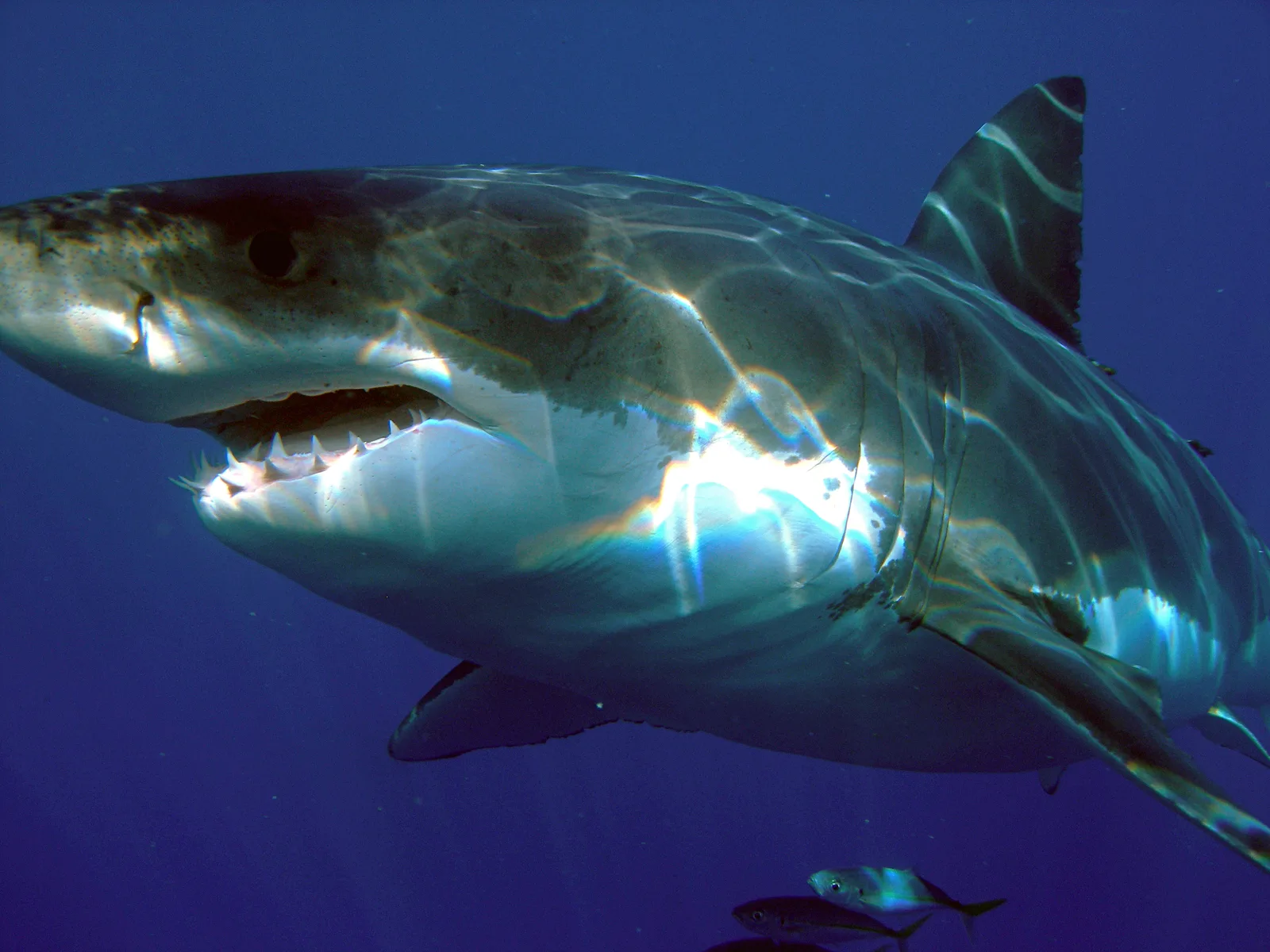
The great white shark. It has more unprovoked bites and more deaths on record than any other shark. The Shark Attack File calls the white, tiger and bull shark the “Big Three.” They’re big, they swim where people go in the water, and their teeth shear.
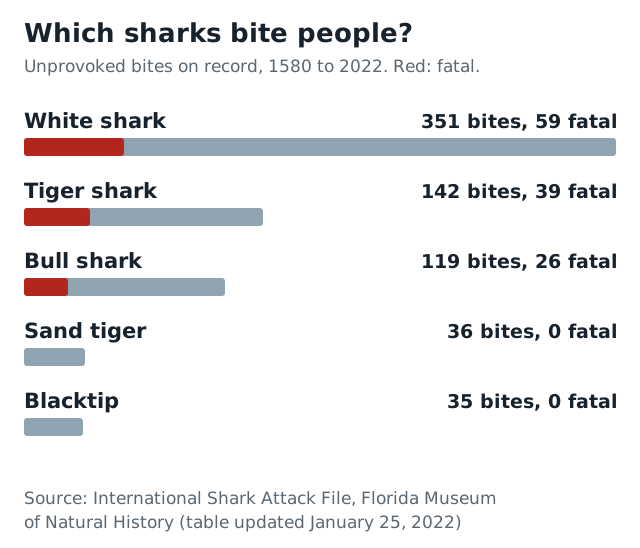
Unprovoked bites credited to a known species, from 1580 to the table’s update in January 2022. Chart: fishing.info, from the International Shark Attack File.
Keep the numbers in proportion. In 2025 the file confirmed 65 unprovoked bites in the whole world, and 9 of them killed. The United States had 25 of those bites and 1 death, and 11 of the bites were in Florida. The file also warns its species list leans toward sharks that are easy to name. Almost any shark around 6 feet (1.8 m) or longer can be a threat, it says.
The bull shark is the one a freshwater angler should know about. It’s one of very few sharks that moves into fresh water. Bull sharks have been reported more than 1,800 miles up the Mississippi, in Illinois, the Florida Museum says. The museum has two counts for it. The 2022 table says 119 unprovoked bites and 26 deaths. Its bull shark page, which carries no date, says “at least 100” and 27 deaths.
Here’s the part for anglers. A bite while you’re unhooking a shark, or taking one out of a net, counts as “provoked” in the file. So the 25 American bites don’t include the ones on the boat. Treat every shark at the side like it can turn on you, because it can. The great white also holds the record for the biggest fish ever caught on rod and reel, at 2,664 lb (1,208 kg).
Free PDF · 7-day beginner fishing pack Starting fishing? What do you buy, what does it cost, and what do you do at the water?
The 16-page beginner pack: the $85–100 kit with the spec to ask for in the store, the license rules, the first knot, the rig drawn, the cast, the bite and the release. A free seven-day email course comes with it, one step a day.
No card, nothing to buy, and the PDF is yours to keep. Confirm with one click and it's on its way. Then a few short emails and one a week on what's biting. Unsubscribe anytime. Privacy.
What is the most venomous fish?
The reef stonefish. The Australian Museum calls it “the most venomous fish in the world.” It looks like a lump of rock or coral, and 13 stout spines on its back inject the venom. The pain is intense, and the museum says it is believed to have killed many Pacific and Indian Ocean islanders. Yet Australia has recorded no deaths since European arrival, and an antivenom has existed since 1959.
You’re far more likely to meet the other three in this table. Here’s where the spines are, and what to do if one gets you.
| Fish | Where the spines are | What to do if stung | Source |
|---|---|---|---|
| Reef stonefish | 13 stout spines on the back | “Very hot water (not scalding)” for the pain, but get medical treatment | Australian Museum |
| Red lionfish | Up to 18, in the back, belly and rear fins | “immerse the wound in hot (not scalding) water for 30 to 90 minutes” | FWC |
| Stingray | A spine in the tail | Hot water “no hotter than 113°F (45°C) for 30 to 90 minutes, if told to do so by trained personnel” | MedlinePlus |
| Catfish | One in the back fin, one in each side fin | “nonscalding hot water (45 °C/113 °F) for 30–90 min,” and no ice | Dorooshi 2012 |
More on each one:
- Red lionfish. An invasive species from Florida up to North Carolina. FWC counts up to 18 venomous spines. NOAA says a sting can last for days and bring “extreme pain, sweating, respiratory distress, and even paralysis.” The venom can stay active in the spines of a dead fish on ice. Wear puncture-resistant gloves, FWC says.
- Stingrays. The spine sits in the tail. Rays sting when they get stepped on. So do the stingray shuffle where rays live. MedlinePlus puts it this way: “keep your feet on the bottom and shuffle them as you move forward.” The ray knows you’re coming and can get out of the way.
- Catfish. A catfish has a stiff spine in the back fin and one in each side fin. Small ones sting worst. Our guide to holding a catfish shows the grip that keeps your hand behind all three.
MedlinePlus gives one set of first aid for every sea sting, stingrays and stonefish included. It says to call 911 if the person has “difficulty breathing, chest pain, nausea, vomiting, or uncontrolled bleeding.” Heat eases the pain. It doesn’t replace a doctor.
Which fish are deadly to eat?
Pufferfish, and it’s the meat, not the bite. The toxin can paralyze the muscles you breathe with, and in extreme cases that kills, the FDA says. Symptoms usually start within 3 hours. That’s why puffers are “a highly regulated product in the United States.”
Florida has a lesson for anglers here. Between 2002 and 2004, 28 people on the East Coast got sick from southern puffers out of the Indian River Lagoon. In fish from there, the toxin sits in the meat itself, “making safe preparation impossible,” the FDA says. Florida “has banned the commercial and recreational harvesting of all puffer species” in Volusia, Brevard, Indian River, St. Lucie and Martin counties.
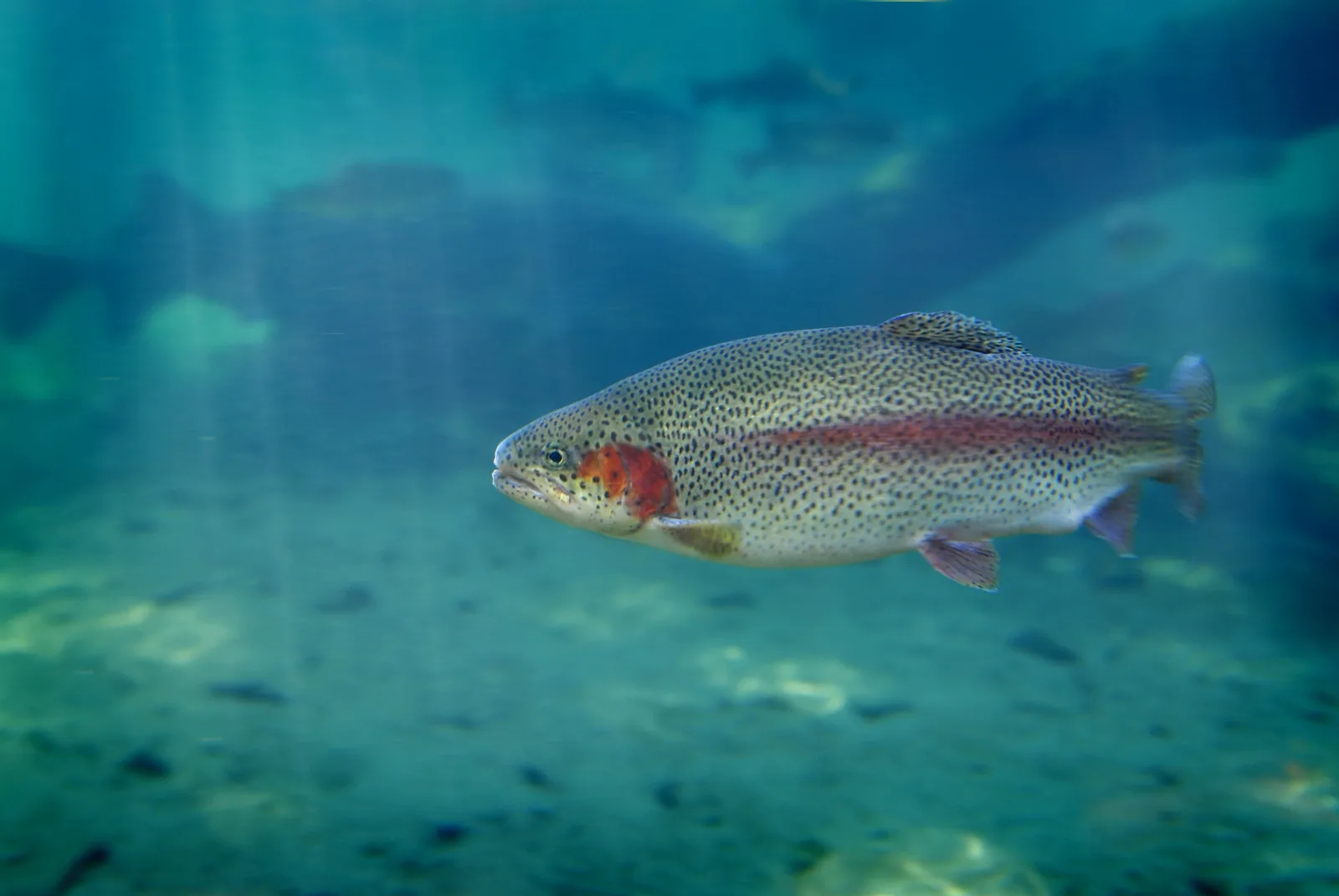
A rainbow trout. Photo: eric1513 / Depositphotos.
Big reef predators carry a different poison, ciguatera. The FDA names barracuda, grouper, snapper, jacks, moray eels and parrotfish among the fish linked to it. Symptoms usually start within 6 hours. In bad cases some can come back for years. Deaths are rare. Don’t count on the pan to save you: “Cooking does not destroy the toxins,” the CDC says.
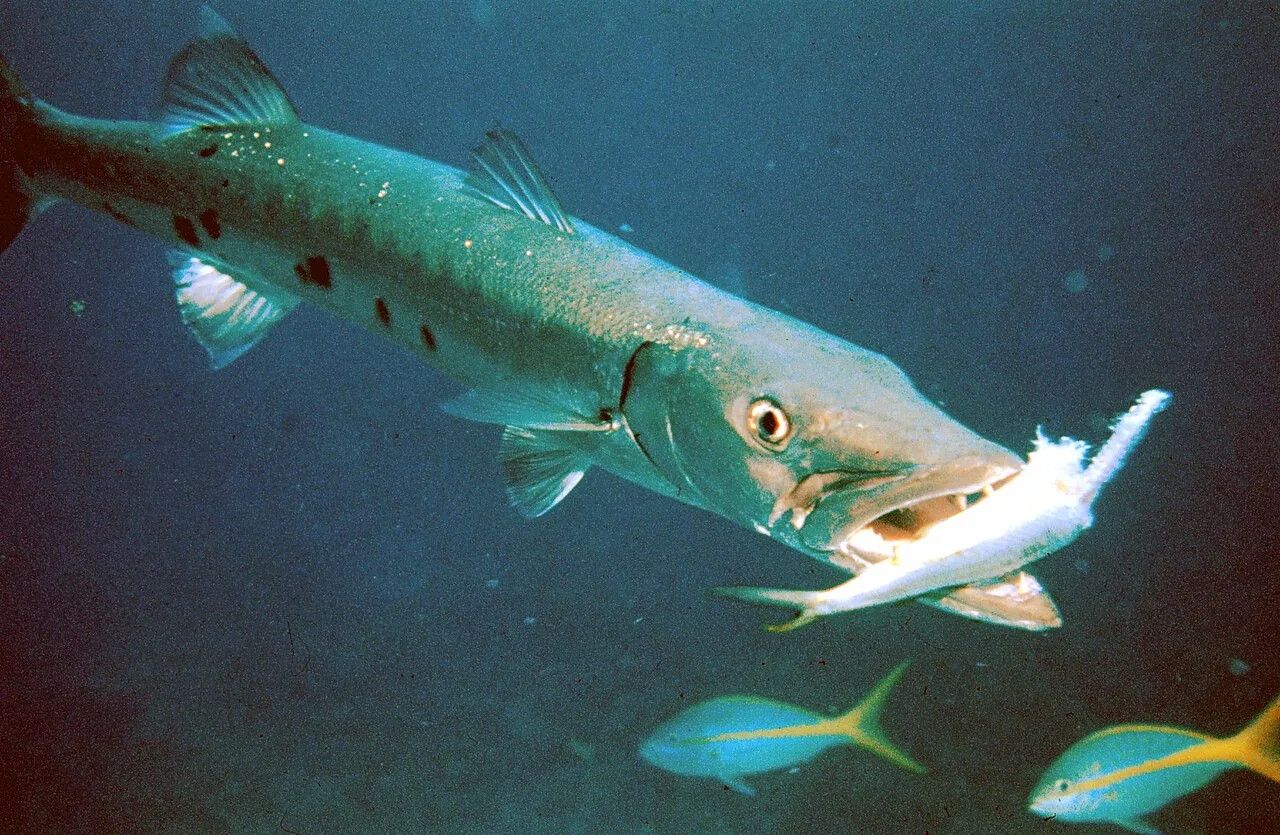
The great barracuda is a good example of a fish that scares people for the wrong reason. Its teeth look awful, but attacks on people are rare, the Florida Museum says. Most come when it tries to steal a speared fish or mistakes something shiny, like a diving knife, for a fish. It’s usually one very quick strike. The bigger risk is eating a big one.
Which freshwater fish are the scariest?
The freshwater fish with the worst name mostly don’t live up to it. Here’s what the record shows:
- Piranhas do bite people. Most attacks are a single bite, and they seem more likely when a swimmer disturbs a nest, Discover Wildlife says. Whether one has ever killed a living person is far from clear.
- The goliath tigerfish of the Congo has the fangs for a horror film. Bites get reported. But of the stories of goliaths killing people, “none have been substantiated,” A-Z Animals says. FishBase rates the fish harmless.
- The wels catfish of Europe has a 297 lb rod-and-reel record, and in one French town it beaches itself to grab pigeons. When the U.S. Fish and Wildlife Service banned its import in 2016, it found no documentation of harm to people.
- Electric eels aren’t eels at all. They’re eel-shaped knifefish from South America, about 8 feet long, and one species makes shocks of 860 volts, the Smithsonian says. That’s enough to kill prey.
- The candiru is the tiny Amazon catfish of the urethra legend. In tank tests it ignored human urine. It seemed to find live fish by sight.
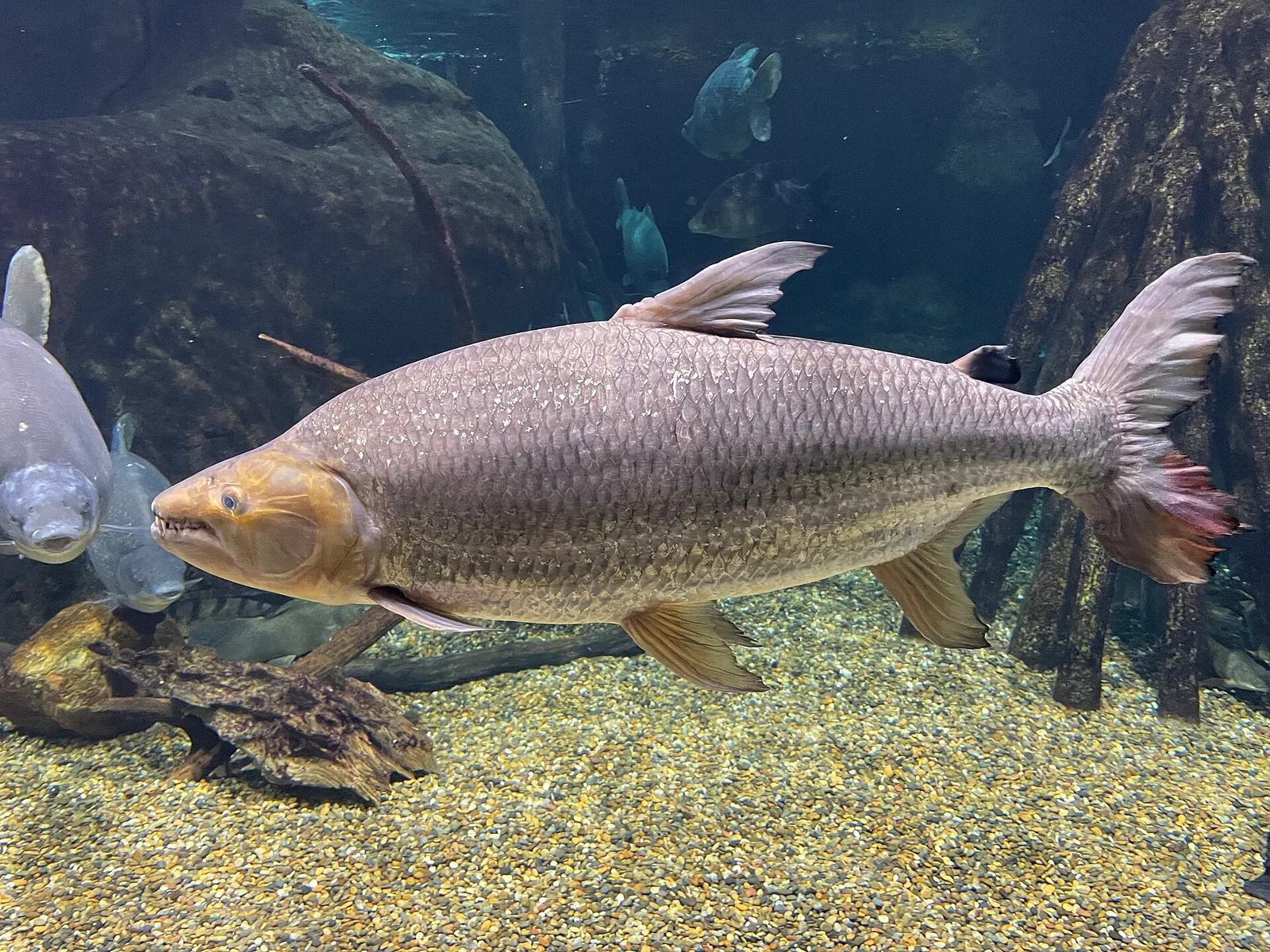
The goliath tigerfish has the teeth, but no killing of a person by one has ever been substantiated. Photo: Totti, Aqua Totto Gifu, Wikimedia Commons (CC BY-SA 4.0)
Scary fish you could catch in the US
You don’t have to fly to the Congo for teeth. These are the scary ones in American water, and in each case the danger is at the boat, not in the water.
The alligator gar has two rows of teeth in its upper jaw. The rod-and-reel record weighed 283 lb (128.4 kg). “While there are no confirmed attacks on people, alligator gar continue to be feared by many,” Texas Parks and Wildlife says. Its advice for the boat is short: “Never stick your hands in the fish’s mouth and stay clear of the powerful tail.”
The northern snakehead has “dagger-like teeth,” the National Zoo says. The danger is mostly to the other fish in the lake. Most state agencies say don’t release a snakehead, so check your state’s rule before you go.
The sea lamprey looks like something from a nightmare when it comes up stuck to a lake trout. It feeds on fish. “Human bites appear to be rare,” The Weather Network says, and a bite “won’t be fatal.”
The everyday biters are the ones you already target. A muskie or northern pike has a mouth full of sharp teeth too. Use pliers, keep your fingers out of the gill plates, and tie on a wire leader when the teeth can cut your line. Our page on which fish have teeth shows which ones you can lip and which you can’t.
What are the scariest deep-sea fish?
The fish with the scariest faces are tiny, and they live far deeper than any person swims. The black seadevil is the anglerfish with the glowing lure. The Monterey Bay Aquarium Research Institute filmed one in its own water for the first time in 2014, 1,900 feet down off California. She was 3.5 inches long.
| Deep-sea fish | Scary part | Real size | Where it lives |
|---|---|---|---|
| Black seadevil (anglerfish) | Glowing lure, toothy jaw | 3.5 in (9 cm), the first one filmed | 1,900 ft (580 m) down, Monterey Canyon |
| Fangtooth | Biggest teeth for its size of any ocean animal | Up to 7 in (17 cm) | Seen at 2,600 ft (800 m) |
| Goblin shark | Jaws that shoot forward | 9–13 ft (2.6–3.8 m) measured, 18–20 ft judged from photos | Mostly 890–3,150 ft (270–960 m) |
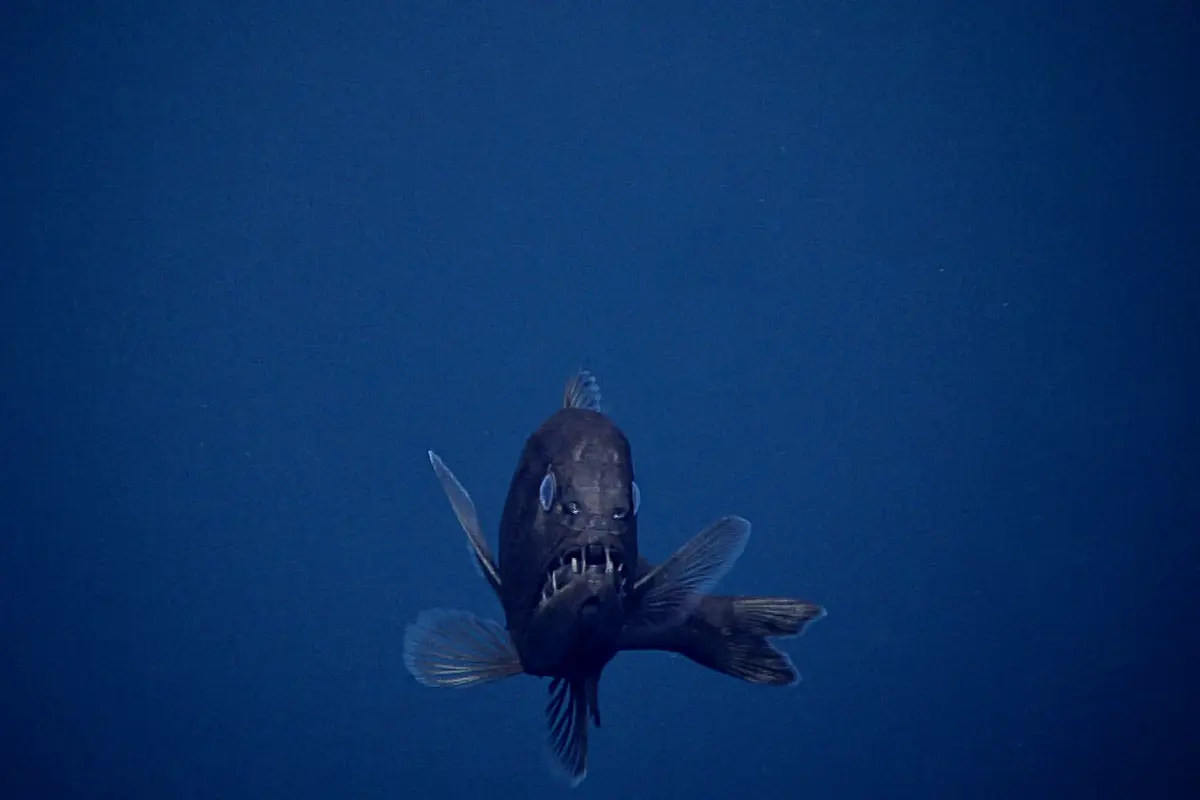
A fangtooth 2,600 feet down, looking at a NOAA dive robot in 2017. Photo: NOAA Ocean Exploration, Deep-Sea Symphony: Exploring the Musicians Seamounts (public domain)
The goblin shark is the only one big enough to worry about. The Florida Museum calls it potentially dangerous because of its size, but it rarely meets people. The fangtooth’s teeth are so long it can’t fully close its mouth, NOAA says, and the whole fish is no longer than your hand.
How to handle the scary fish you do catch
The fish on this page that hurt anglers do it at the boat or on the cleaning table. So the safety rules are simple:
- Never put your hand in a toothy mouth. Use long pliers on gar, pike, muskie, snakeheads and barracuda. Texas asks for tools and cut-resistant gloves on gar.
- Find the spines before you grab. On a catfish, slide your hand up from the belly so the spines sit behind your fingers. Wear puncture-resistant gloves for lionfish, alive or dead.
- Shuffle when you wade salt flats. It warns a stingray before you step on it.
- Treat every shark at the boat as dangerous. Bites while unhooking aren’t even in the unprovoked count.
- Know what you’re eating. No puffers from Florida’s East Coast lagoon counties. Go easy on big barracuda and reef fish where ciguatera is known.
- Hot water for a fin sting, then a doctor if it’s bad. MedlinePlus says no hotter than 113°F (45°C), “if told to do so by trained personnel.” Test the water before it goes on a child.
For more of the odd, the big and the strange, the fish facts page has every question we’ve answered.

Free PDF · 16 pages
Your first fishing trip, from the store aisle to the first fish
Lost in the tackle aisle, the wrong gear in the cart, and home with nothing. Skip all of that.
The 7-Day Beginner Fishing Pack. A 16-page PDF plus a free seven-day email course, one step a day: the whole first trip in order, from the store to the release.
- Walk out of the store with the right rod and nothing extra: the $85–100 kit, item by item
- Know if you need a license, in 13 states, and the places where nobody needs one
- What to do when the bobber goes under, and the ten-second rule for letting the fish go
Every line from the beginner pages on fishing.info and the 247 sources behind them, the U.S. Fish and Wildlife Service and the Missouri Department of Conservation among them.
No card, nothing to buy. Confirm with one click and the PDF is on its way, one version for your phone and one to print, yours to keep. Then a few short emails and one a week on what's biting, with an unsubscribe link in every one. Privacy.
Related
Section guide
Fish Facts: The Questions Kids Ask About Fish, Answered With the ScienceFish facts with a number and a source for each: how fish sleep, breathe, hear and feel, and what every answer means when you hook and release one.
 Smallest Fish in the World: Three Fish Under a Third of an Inch
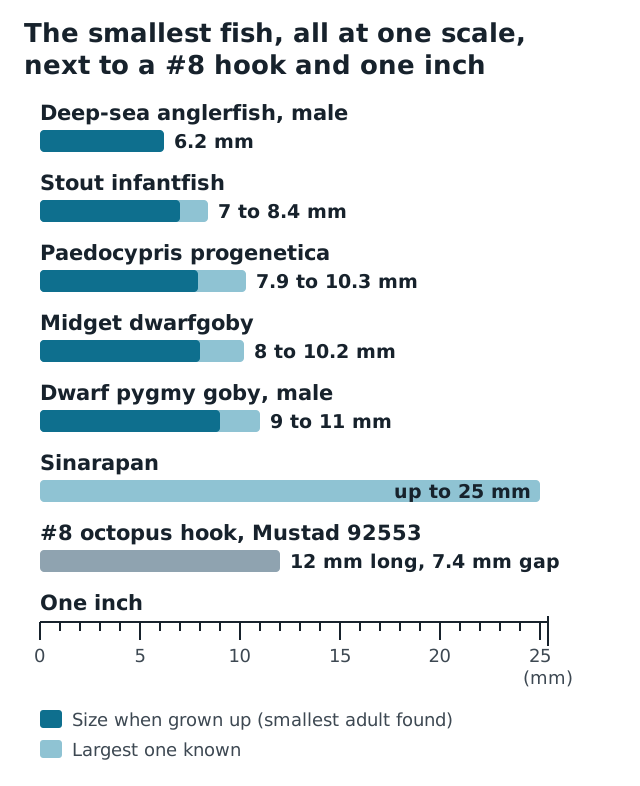
The smallest fish in the world is a swamp fish grown at 7.9 mm, shorter than a #8 hook. Its two rivals, how each was measured, and tiny fish in US water.
 What Do Fish Eat? Wild, Pond and Pet Fish, and the Bait That Matches
What do fish eat? Insects, small fish, crayfish, worms, plankton and plants, by species. Read the mouth, match the bait, and feed a pond or tank right.
 Are Fish Animals? Yes: Vertebrates, Not Mammals, Mostly Cold-Blooded
Are fish animals? Yes: animals with a backbone and gills. Why fish aren't mammals, which fish run warm, and why California law calls a bee a fish.
 Biggest Fish Ever Caught: A 2,664 lb Great White on Rod and Reel
The biggest fish ever caught on rod and reel is a 2,664 lb great white from 1959. The IGFA top 10, the bigger fish that don't count, and the US giants.
 Is Fish Meat? Biology Says Yes, Lent Says No, Here's Why
Is fish meat? Biology says yes, Lent rules and US food law say no. See what vegetarian, kosher, halal and Hindu rules each say about fish.
 Do Fish Drink Water? Freshwater Fish, Saltwater Fish and Sharks
Do fish drink water? Freshwater fish barely do, saltwater fish drink all day, sharks use urea. Do fish get thirsty? Why bait dies in the wrong water.
Sources (25)
- Florida Museum of Natural History, International Shark Attack File: Species Implicated in Attacks (updated January 25, 2022)
- Florida Museum of Natural History, International Shark Attack File: Yearly Worldwide Shark Attack Summary (2025)
- Florida Museum of Natural History, Discover Fishes: Bull Shark
- Florida Museum of Natural History, Discover Fishes: Great Barracuda
- Florida Museum of Natural History, Discover Fishes: Goblin Shark
Show all 25 sourcesShow fewer sources
- Australian Museum, Reef Stonefish
- NOAA National Ocean Service, What is a lionfish?
- Florida Fish and Wildlife Conservation Commission, Lionfish
- UF/IFAS Extension St. Lucie County (Ken Gioeli), Doing the Stingray Shuffle (February 14, 2022)
- U.S. Food and Drug Administration, How to Report Seafood-Related Toxin and Scombrotoxin Fish Poisoning Illnesses
- CDC Travelers' Health, Food Poisoning from Seafood
- Smithsonian Magazine (Lila Thulin), Smithsonian Researchers Triple the Number of Electric Eel Species, Including One With Record-Setting Shock Ability (September 10, 2019)
- Spotte, S., Petry, P. and Zuanon, J. A. S. (2001), Experiments on the Feeding Behavior of the Hematophagous Candiru, Vandellia cf. Plazaii, Environmental Biology of Fishes 60: 459–464
- Smithsonian Magazine (Maris Fessenden), The Black Sea Devil, a Rare Deep-Sea Anglerfish, Filmed for the First Time (November 24, 2014)
- NOAA Ocean Exploration, What deep-sea creature has the biggest teeth?
- MedlinePlus (U.S. National Library of Medicine), Marine animal stings or bites
- Texas Parks and Wildlife Department, Alligator Gar - Not A Threat to Humans
- Smithsonian's National Zoo, Northern snakehead fish
- U.S. Fish and Wildlife Service, Injurious wildlife species; listing 10 freshwater fish and 1 crayfish, final rule, 81 FR 67862 (September 30, 2016)
- FishBase, Hydrocynus goliath, Giant tigerfish
- A-Z Animals, Goliath Tigerfish
- Discover Wildlife (Stuart Blackman), You've seen the horror films but can piranhas ACTUALLY kill a human? (August 1, 2026)
- Invasive 'vampire fish' populations spiking in the Great Lakes, The Weather Network (July 18, 2023)
- Cucherousset et al. 2012, Freshwater killer whales: beaching behavior of an alien fish to hunt land birds, PLoS ONE 7(12): e50840
- Dorooshi, G. (2012), Catfish stings: a report of two cases, Journal of Research in Medical Sciences 17(6): 578–581