 By
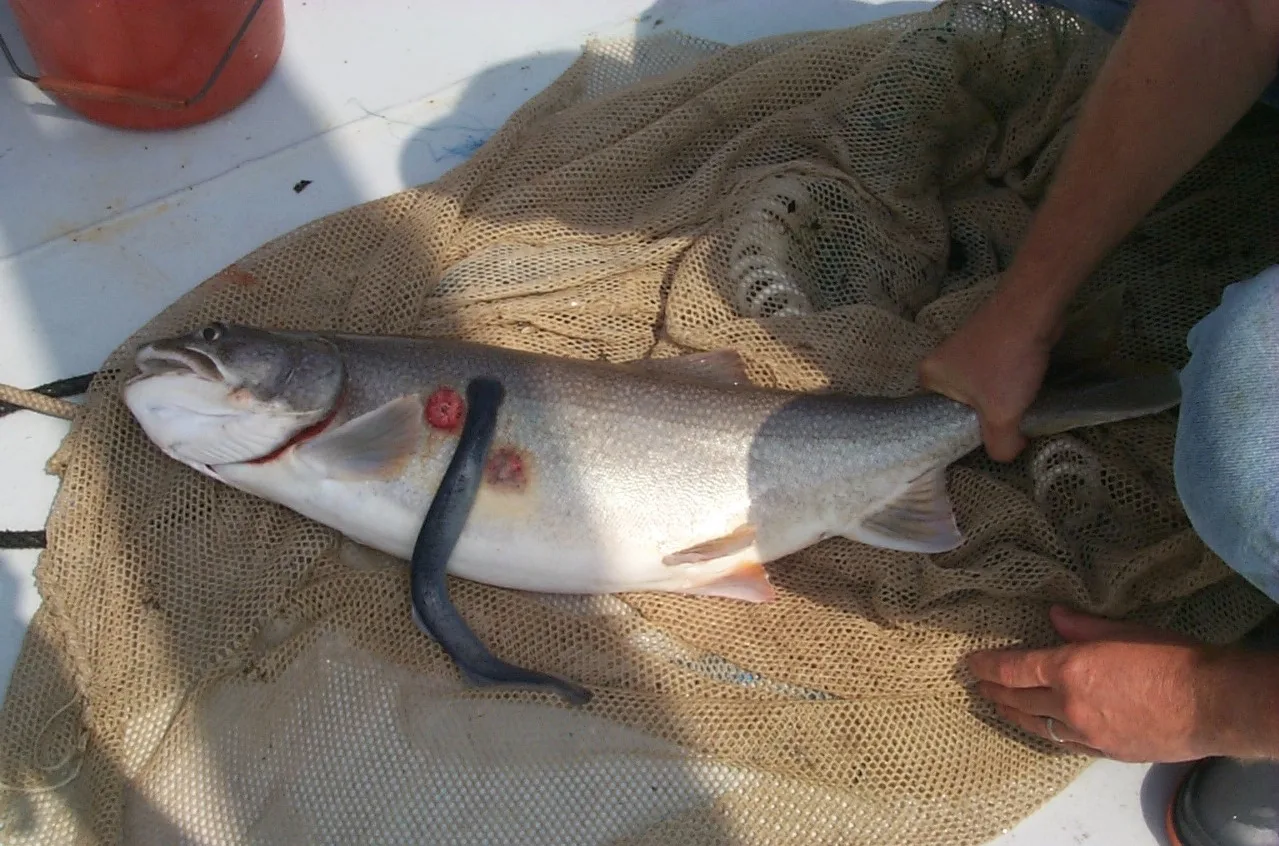
A lamprey is a jawless, eel-like fish with a round sucker mouth full of teeth. The one you’ll see on a Great Lakes trout or salmon is the sea lamprey, an invader that clamps on and feeds on blood. If one comes up on your fish, check the fins on its back first. Two separate fins and you’ve got the invader, and agencies want it dead. One fin and it’s a native, so let it go.
One sea lamprey can kill up to 40 lb (18 kg) of fish. As few as one in seven fish may survive the attack.
What is a lamprey, and is it an eel?
It’s a fish, and it’s no eel. People call it a “lamprey eel” all the time, but the two aren’t related. A lamprey has no jaws, no bones and no paired fins. Its skeleton is cartilage, the bendy stuff in your ear.
The mouth is the part you won’t forget. It’s a sucking disk lined with sharp, horn-shaped teeth, with a rasping tongue in the middle. The lamprey clamps on, files a hole through the skin and drinks. Its spit keeps the blood from clotting, so the wound keeps running.
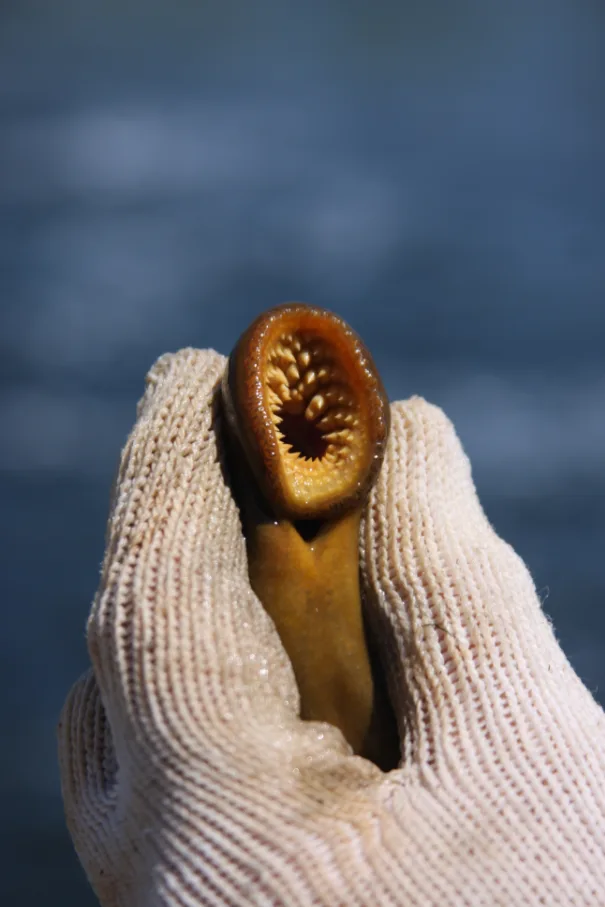
The mouth of a sea lamprey. Photo: Karla Bartelt, U.S. Fish and Wildlife Service (public domain)
There are about 38 kinds of lamprey in the world, and only 18 feed on other animals. The rest live in fresh water and don’t feed at all once they’re grown. The sea lamprey has barely changed in more than 340 million years, so it’s seen a lot of fish come and go.
If you’re holding one and an American eel is your other guess, look at the head.
| Lamprey | Eel | |
|---|---|---|
| Mouth | Jawless sucker disk | Real jaws, many small teeth |
| Gills | Open holes down the side | Covered slits |
| Skeleton | Cartilage | Bones |
| Fins | No rays in them | Rays in the fins |
| Heads to spawn | Upriver from the sea (Pacific lamprey) | Downriver to the ocean |
| Eats | Blood and body fluids of bigger fish | Insects, fish, crabs, worms, frogs |
What do lamprey teeth look like, and how does it feed?
Look straight into the disk and you’ll see rings of teeth. A sea lamprey’s are sharp and horn-shaped, set around a toothed tongue, with rows of 5 to 7 down the sides. The disk holds on and the tongue does the cutting. A Pacific lamprey has three big teeth at the front of its disk, which is how you pick one out.
It feeds on blood and body fluids, then lets go. On the West Coast, feeding Pacific lampreys go after larger fish and marine mammals out at sea. In the Great Lakes, a sea lamprey feeds for 12 to 18 months before it heads upstream.
How big it gets depends on where it lives:
| Lamprey | Usual adult length | Note |
|---|---|---|
| Sea, Great Lakes | 1–2.5 ft (30–76 cm) | Ontario’s range. Larvae up to 7 in (18 cm) |
| Sea, Atlantic rivers | 24–32 in (61–81 cm) | Largest reported 47 in (1.2 m) |
| Pacific | 1.5–2.5 ft (46–76 cm) | About 1 lb on average |
| Silver | 4–13 in (10–33 cm) | Average about 8 in (21 cm). Largest on the commission’s chart: 16.3 in (41.5 cm) |

Free PDF · Water temperature chart Which fish are biting at today's water temperature?
One reading, and the 16-page chart shows which of 26 fish are spawning, feeding hard or slowing down; for bass, crappie, bluegill and walleye, where they sit and what to throw. Every number sourced.
No card, nothing to buy, and the PDF is yours to keep. Confirm with one click and it's on its way. Then a few short emails and one a week on what's biting. Unsubscribe anytime. Privacy.
How do you tell a sea lamprey from a native lamprey?
Count the fins on its back. A sea lamprey has two separate ones. The silver and chestnut lampreys, the two natives that also feed on fish, have a single fin with a shallow notch in it.
Size helps too. A Great Lakes sea lamprey runs 1 to 2.5 ft (30–76 cm). The biggest silver lamprey on the Great Lakes Fishery Commission’s chart is 16.3 in (41.5 cm), and the biggest chestnut is 14.3 in (36.3 cm). Don’t count gill holes. Every lamprey has seven a side, and none has side fins.
| Lamprey | The mark that settles it | What to do with it |
|---|---|---|
| Sea | Two separate back fins, up to 2.5 ft (76 cm) in the Great Lakes | Great Lakes: kill it (see below). Atlantic rivers: it’s a native, leave it |
| Silver | One back fin with a shallow notch, up to 16.3 in (41.5 cm) | Native. Let it go |
| Chestnut | One back fin with a shallow notch, up to 14.3 in (36.3 cm) | Native. Let it go |
| Northern brook | One back fin, small blunt teeth, up to 6.5 in (16.5 cm) | Native. It won’t be on your fish |
| American brook | Two back fins, up to 9.4 in (24 cm), and it doesn’t feed as an adult | Native. It won’t be on your fish |
| Pacific | Three big teeth at the front of the disk, 1.5–2.5 ft (46–76 cm) | Native. Rules are tight, see below |
Get this right before you do anything. “Native lampreys are an important part of our ecosystem,” the Great Lakes Fishery Commission says. “They are found in some of our best fishing waters.” The commission warns that some anglers kill natives by mistake, thinking they’ve got the invader.
What should you do if you catch a fish with a sea lamprey on it?
Kill the lamprey, as long as you’re sure it’s a sea lamprey and you’re on the Great Lakes. Here are the agency lines, word for word.
- Check the back fins. Two separate fins means sea lamprey. One fin means a native.
- In Ontario, follow the rule. “If you catch a fish with a sea lamprey attached, do not return the sea lamprey to the water.” “Kill it and put it in the garbage.”
- In the U.S. Great Lakes, look for a tag. Michigan Public passed on a federal sea lamprey supervisor’s advice. Anglers “should kill them unless they appear to have been tagged by researchers.”
- Leave barriers alone. “Don’t help Sea Lampreys pass over dams and culverts that block their spawning migration.”
- In Ontario, you can report it. The Invading Species Hotline is 1-800-563-7711. Fisheries and Oceans Canada’s sea lamprey office in Sault Ste. Marie answers at 1-800-553-9091.
None of this applies to the coast. On a Maine river, a sea lamprey is home, and it isn’t hurting your fishing.
Is a fish with lamprey scars safe to eat?
Yes, according to an old Sea Grant guide. Compiled in February 1982 by a Minnesota Sea Grant fisheries agent, it says of a fish with the round lamprey wound: “Edible. If open sore, remove inflamed area” and then “clean fish and prepare as usual.” The same guide says “it is advisable to thoroughly cook all fish whether parasites are observed or not.”
That line covers the wound and nothing else. A big Great Lakes lake trout has its own eating advice, so check your state’s list for that lake and that size of fish before you keep one.
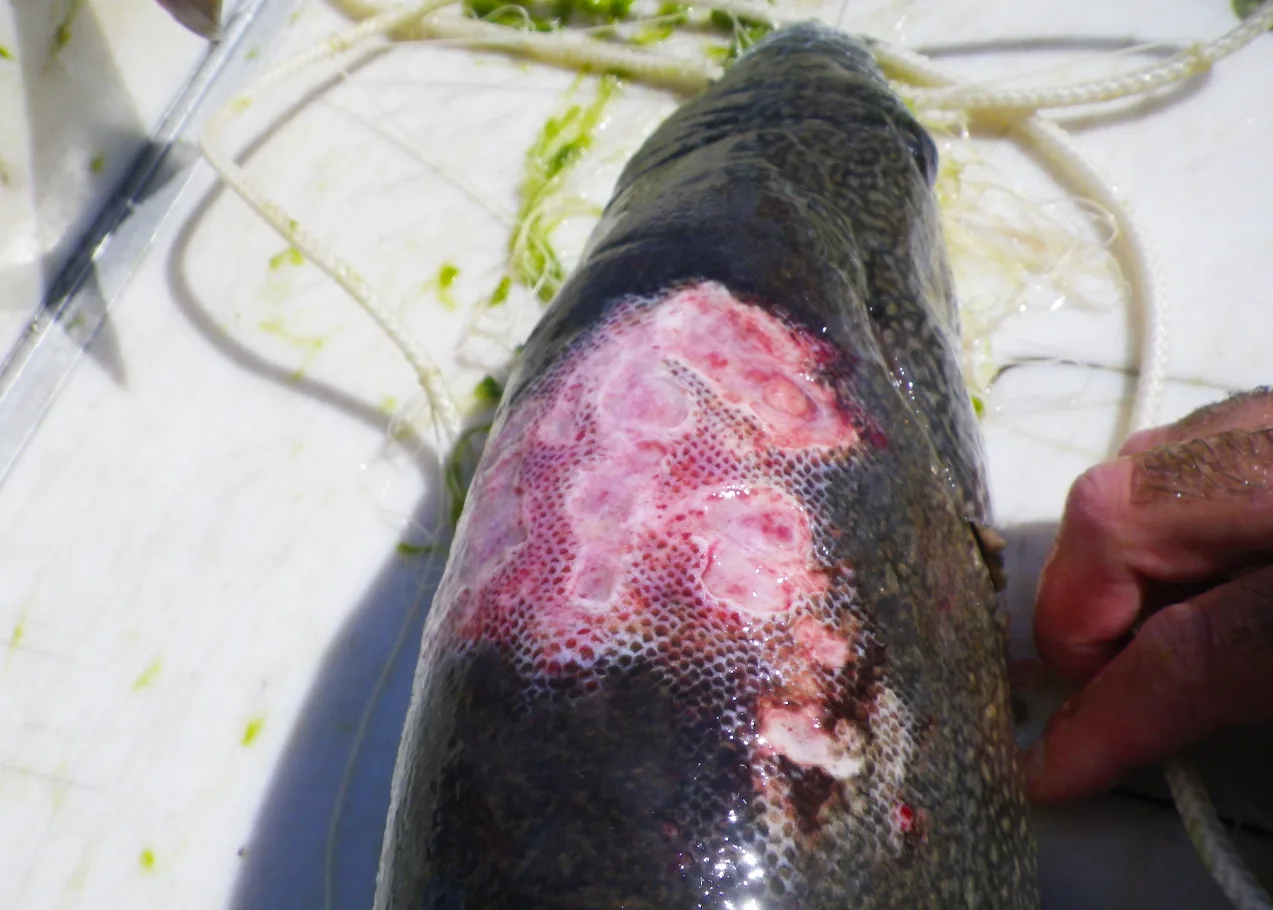
A lake trout with severe sea lamprey wounds. Photo: Ted Treska, U.S. Fish and Wildlife Service (public domain)
Expect a thin fish if it’s been hit. Fish that live through an attack “often suffer from weight loss and a decline in health and condition.” Plenty don’t live. A fish can die during the attack or later from an infection in the wound.
When sea lampreys were at their worst in the Great Lakes, up to 85% of the fish they didn’t kill carried attack wounds. Scarred fish still come over the side today. Charter captains and tourists have landed wounded trout and salmon on Lake Superior and Lake Michigan.
Do lampreys attack humans?
No, not as a habit. Lampreys latch on to cold-water fish, and you’re warm. “One might latch on if the person is really cold or if the lamprey is starving to death,” a Michigan State research assistant told the Great Lakes Echo.
Has one ever bitten a person? Not often, if ever. “Human bites appear to be rare,” as The Weather Network puts it, and Scripps News knows of no case at all. Wikipedia does say attacks have been documented, and that a lamprey generally won’t go for a person unless it’s starved.
If one did get you, “a bite won’t be fatal, but it can be painful, and untreated wounds could lead to infection.” So get any bite cleaned and looked at. It’s no reason to stay out of the Great Lakes.
Why are sea lampreys such a problem in the Great Lakes?
They came in through the shipping canals and found fish that had never met them. Niagara Falls held them in Lake Ontario until the canals opened the way around it. By 1938 they’d reached Superior.
| Year | What happened |
|---|---|
| 1835 | First sea lamprey recorded in Lake Ontario |
| By 1921 | In Lake Erie |
| By 1936 and 1937 | In Lakes Michigan and Huron |
| By 1938 | In Lake Superior |
| 1950s | Chemical control starts: crews kill the larvae in their home streams with TFM |
| Early 1960s | Upper Great Lakes lake trout catch down to about 300,000 lb, around 2% of the old 15 million lb a year |
Here’s why it was so bad. Each sea lamprey can kill up to 40 lb (18 kg) of fish over its 12 to 18 months of feeding. Its list of targets reads like a Great Lakes tackle-shop wall: lake trout, lake whitefish, ciscoes, walleye, lake sturgeon, burbot, catfish, coho and Chinook salmon, and steelhead.
The fix took nearly 6,000 chemicals tested before one worked. TFM goes into the streams where the larvae live, about 200 tributaries and hot spots on a regular schedule. Barriers keep adults out of spawning water, and traps can take up to 40% of the adult run in a stream. All of it together has cut sea lampreys by 90% in most of the lakes.
That’s what keeps your fishing alive. The Great Lakes fishery is worth more than $5.1 billion a year. “Without sea lamprey control there would be no sport fishing on the Great Lakes,” a former U.S. Fish and Wildlife Service employee told the Door County Pulse.
How many sea lampreys are in the Great Lakes now?
Fewer than a few years ago. COVID stopped the crews: in 2020 only 25% of streams could be treated, in 2021 only 75%. Lampreys jumped. Control is back at its pre-pandemic level, the Great Lakes Fishery Commission says. Its 2026 count shows four of the five lakes with fewer adults than in 2025.
| Lake | 2026 adult index | 2025 | Three-year average | Target |
|---|---|---|---|---|
| Superior | 29,767 | 40,610 | 41,976 | 10,421 |
| Huron | 29,602 | 44,591 | 38,026 | 31,274 |
| Michigan | 20,211 | 21,273 | 22,094 | 20,526 |
| Ontario | 7,281 | 11,584 | 13,747 | 14,065 |
| Erie | 923 | 803 | 865 | 3,263 |
Don’t call it won. The commission judges each lake on its three-year average, here 2024 through 2026. Superior, Michigan and Huron are still above their targets. Erie and Ontario are below theirs. Superior is the one to watch, with an average about four times its target.
The index comes from adults caught and counted in a set of index streams. Read it as a yardstick, not a head count of every lamprey in the lake.
Will a lampricide treatment hurt your fishing?
Usually not. A lampricide is a chemical that kills lamprey larvae, and TFM is the main one. Crews dose a stream with “just a little bit above what is needed to kill the lamprey,” and TFM “kills invasive lamprey larvae while leaving most native fish unharmed.” It breaks down on its own. A few other fish, insects and broadleaf plants are sensitive to it. The risk goes up at the base of dams, “where both lamprey larvae and salmon congregate.”
During one Michigan treatment, anglers were told they could keep fishing unless “the water has a green or yellow hue that would indicate concentrated TFM.” So if the river’s run a strange color on a treatment day, go fish somewhere else.
Why does the dam on your river matter so much?
Because a dam is often the only thing stopping lampreys from reaching more spawning water. In May 2020 the Edenville Dam in Michigan burst and took the Sanford Dam with it. With those gone, sea lampreys “have spread upstream of the former impoundments” in the Tittabawassee and Tobacco River watersheds. Crews had to treat four spots up there with TFM.
On the Boardman-Ottaway River in Michigan, a project called FishPass is built to do both jobs: let the good fish through and keep lampreys out. It’s scheduled to finish construction in 2027. Barriers have already “reduced or eliminated the need for lampricide treatments in thousands of miles of tributaries.”
Where do lampreys live?
Sea lampreys are native to the north Atlantic and the Atlantic coast of North America. In Maine’s rivers they spawn and die without feeding, and they “pose no risk to freshwater fish populations.” Their nests loosen gravel and leave spots that salmon and brook trout use later. So the same fish is a villain in Lake Superior and a helper in a Maine river. Spawning lampreys carry ocean nutrients inland too, feeding the insects that young fish eat. Medicine wants to know how a lamprey heals itself after severe nerve damage.
The West Coast has the Pacific lamprey, which runs from Japan to Baja California and up the Columbia and Sacramento rivers. It’s native, and several tribes have long counted it a “first fish” whose return signals the start of spring and summer harvests. They prize its rich, fatty meat. Alaska has five kinds, and subsistence fishermen take Arctic lamprey on the Yukon in winter.
The Great Lakes hold four natives: silver, chestnut, northern brook and American brook. The sea lamprey makes five.
Can you fish for lamprey? The rules by state
It depends on the state, and on the West Coast it’s mostly closed. These are the lines as the agencies print them, and your own state’s book is the one that counts.
| Where | The rule, in the agency’s words |
|---|---|
| Oregon, 2026–27 | “Harvest Prohibited. It is illegal to harvest or possess any species of lamprey except:” “Pacific lamprey may be taken at Willamette Falls only.” Lamprey is also on Oregon’s list of what may not be used as bait |
| Washington, 2026–27 | “All freshwater areas are closed to fishing for salmon, Dolly Varden/bull trout, lamprey, and grass carp.” |
| California | “Open season: All year, except for closures listed under district or special regulations.” “Limit: 5.” “Lamprey may be taken only by hand, hook and line, spear, bow and arrow fishing tackle, or dip net.” |
| Ontario | “If you catch a fish with a sea lamprey attached, do not return the sea lamprey to the water.” “Kill it and put it in the garbage.” |
California anglers use lamprey as bait too. The state lists it, as “eel,” among the most common sturgeon baits for white sturgeon. You can’t do that in Oregon.
Can you keep one as a pet? Not in Oregon, where it’s illegal to possess any lamprey outside the Willamette Falls exception. On the Great Lakes you’re told to kill a sea lamprey, so it’s not going home in a bucket.
Can you eat lamprey?
Yes, and people have for a long time. It’s a delicacy in southwestern Europe, Finland and Latvia. King Henry I of England loved them. He’s said to have died from eating “a surfeit of lampreys,” though nobody can say that’s what killed him. The city of Gloucester sent the crown a lamprey pie every year, a habit that lasted through the reign of Queen Victoria.
Don’t eat one from the Great Lakes. Adult sea lampreys from the Lake Superior basin averaged 3.01 micrograms of mercury per gram, by the Great Lakes Indian Fish and Wildlife Commission’s count. U.S. guidelines rule out fish above 0.3, Canadian ones above 0.5. Adults there ran ten times the mercury of the trout they feed on. Skip it.
How does a lamprey’s life work?
A lamprey spends most of its life as a blind worm in a stream, and only a small slice of it as the monster on your fish. A single female can lay as many as 100,000 eggs. In Maine, spawning usually begins once the water reaches at least 50 °F (10 °C).
| Stage | How long, and where | What it means for you |
|---|---|---|
| Larva | Three to ten or more years in stream mud, up to 7 in (18 cm), blind and filtering food | This is the stage TFM kills |
| Feeding adult | 12 to 18 months in the lake. About the same at sea, up to two years | The one on your fish |
| Spawner | Spring and early summer, in streams | Stops feeding, then dies shortly after spawning |
A Pacific lamprey is built the same way, but it lives seven to eleven years. It’s anadromous, born in fresh water and grown at sea. It can shrink by up to 20 percent in the year or so it waits in fresh water before it spawns.
For more of the odd fish outside the big families, try the other freshwater fish guide.

Free PDF · 16 pages
Stop guessing. Know what's biting before your first cast
A whole Saturday on the water with nothing to show for it. One reading tells you who's feeding.
The Water Temperature Fishing Chart. Take one water temperature reading, find it on the chart, and see which of 26 freshwater fish are spawning, feeding hard or slowing down.
- Where bass, crappie, bluegill and walleye sit, and what to throw. Trout: the reading where you stop.
- Why a 3 ft drop beats a cold front, and what to throw each day of the front
- The three thermometer mistakes that make a reading lie
The chart's numbers come from state fish and wildlife agencies and fisheries research: 61 sources, each listed on the site.
No card, nothing to buy. Confirm with one click and the PDF is on its way, one version for your phone and one to print, yours to keep. Then a few short emails and one a week on what's biting, with an unsubscribe link in every one. Privacy.
Related
Section guide
Freshwater Fish Species Outside the Big Families: Sturgeon, Gar, Bowfin, BurbotThe freshwater fish species outside the bass, trout, catfish and pike families: sturgeon, gar, bowfin, burbot, drum, eel and paddlefish, with records.
 Buffalo Fish: Not a Carp, and How to Catch and Eat One
Buffalo fish are native suckers, not carp. How to tell bigmouth from smallmouth buffalo, the bait that catches them, and how to cook around the bones.
 Piranha: Are They Dangerous, and Are They Illegal in the US?
Piranhas bite swimmers, but it's unclear one has ever killed a living person. Their real size, the pacu look-alike, how to catch one, and US state law.
 Arapaima: How Big They Really Get, and Where You Can Catch One
The arapaima breathes air, tops out near 10 ft and 440 lb, and is legal to catch in only a few places. Its real size, the record, and where to fish.
 Lake Sturgeon: Size, Age, Where They Live and When You Can Fish
Lake sturgeon grow to 7 ft and may live centuries. How to identify one, where they live, the Winnebago spearing season and where you may keep one.
 Paddlefish (Spoonbill): Facts, Snagging Seasons, Records and Rules
The paddlefish, or spoonbill, eats only plankton, so anglers snag it. Size, age, the 164 lb record and the snagging seasons state by state.
 Sturgeon Fishing: Where to Go, the Rig, the Bait and the Rules by State
Sturgeon fishing for white and lake sturgeon: where it is open, when to go, the sliding-sinker rig, the best baits and the keep-it-in-the-water rules.
Sources (32)
- Great Lakes Fishery Commission, Sea lamprey
- Great Lakes Fishery Commission, Sea lamprey lifecycle
- Great Lakes Fishery Commission, Sea lamprey control
- Great Lakes Fishery Commission, Lampreys of the Great Lakes (fact sheet)
- U.S. Fish & Wildlife Service, All about invasive sea lamprey
Show all 32 sourcesShow fewer sources
- U.S. Fish & Wildlife Service, Sea lamprey (Petromyzon marinus)
- U.S. Fish & Wildlife Service, Pacific lamprey (Entosphenus tridentatus)
- U.S. Fish & Wildlife Service, A note on lampreys
- NOAA National Ocean Service, What is a sea lamprey?
- Government of Ontario, Sea lamprey
- Invading Species Awareness Program, Sea lamprey
- Columbia River Inter-Tribal Fish Commission, Differences between a lamprey and an eel
- COSEWIC, Northern brook lamprey assessment and status report, chapter 3
- Animal Diversity Web, Ichthyomyzon unicuspis (silver lamprey)
- Maine Salmon Rivers, Sea lamprey
- Sea Lamprey: A Great Lakes Invader
- Vivian La, Invasive sea lamprey numbers declining across nearly all Great Lakes, Michigan Public (November 2, 2026)
- Great Lakes Fishery Commission, Sea Lamprey Populations Decline Across Most Great Lakes in 2026 (press release, October 19, 2026)
- Great Lakes Fishery Commission, Status of sea lamprey
- Darren MacDonald, Sea lamprey population plunges in Lake Superior, decline in most Great Lakes, CTV News (October 21, 2026)
- More fallout from Midland dam failures: blood-sucking parasites in rivers, Michigan Public (May 11, 2023)
- Blood-sucking sea lampreys on the rise in Great Lakes again, Scripps News
- Invasive 'vampire fish' populations spiking in the Great Lakes, The Weather Network (July 18, 2023)
- 'Vampire fish' in Great Lakes take bites out of large catches, Fox News (July 3, 2023)
- Jeff Gunderson, Parasites: Are the Fish Good Enough to Eat?, Minnesota Sea Grant Extension Program (February 1982), NOAA Institutional Repository
- Shocking mercury levels in invasive sea lamprey from the Lake Superior basin, Info Superior (2018)
- Oregon sport fishing regulations 2026–2027, General statewide regulations (eRegulations)
- Washington sport fishing rules 2026–2027, Statewide freshwater regulations (eRegulations)
- California Code of Regulations, Title 14, § 5.40, Lamprey
- California Department of Fish and Wildlife, White sturgeon (baits)
- National Geographic, Fit for a king
- Wikipedia, Lamprey (species count, food history, Henry I)