 By
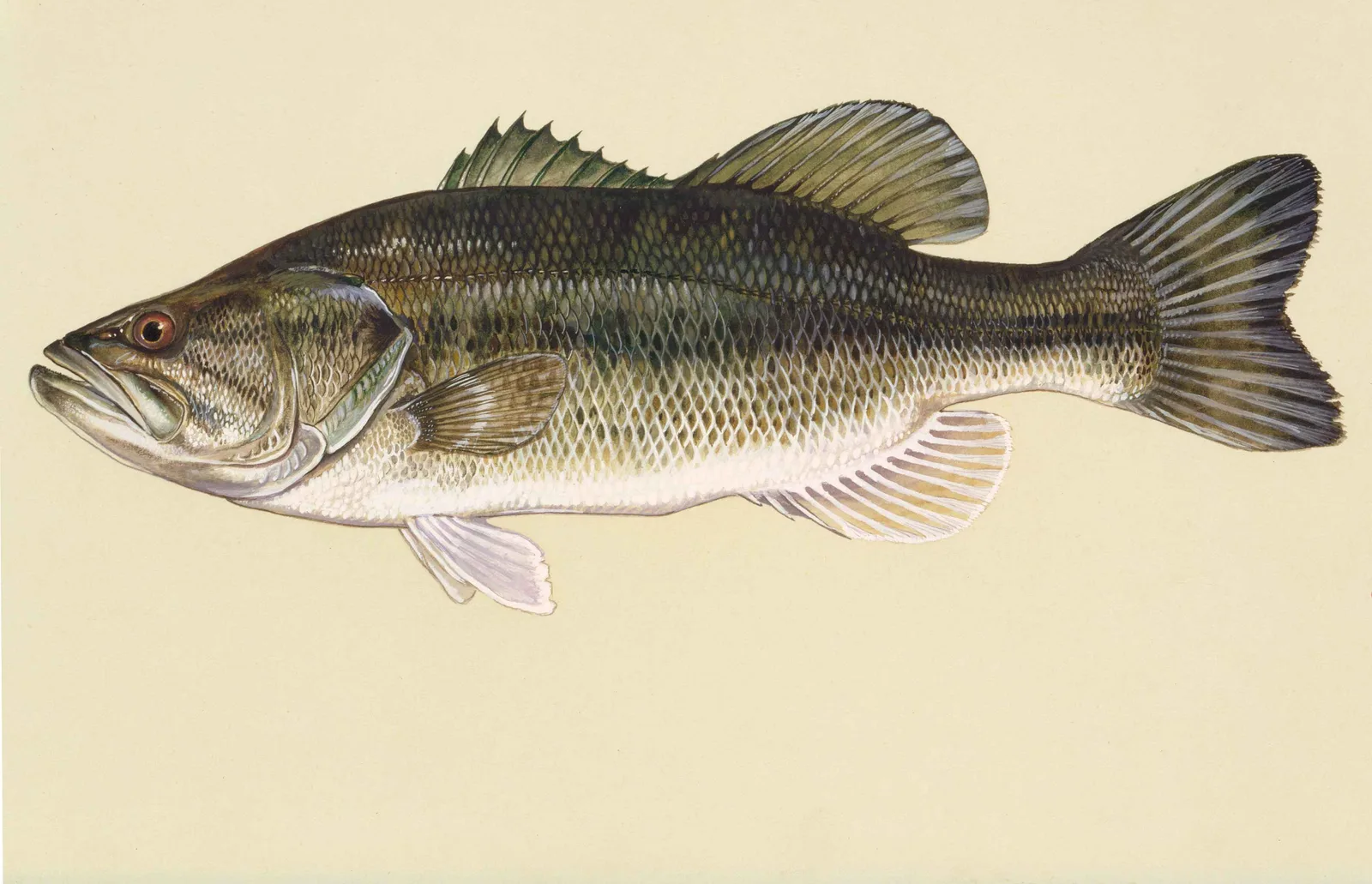
Fish anatomy is the map of a fish’s body: fins, scales and gills on the outside, and a swim bladder, heart, stomach and kidney on the inside. A bass has seven fins if you count the notched back fin as one, a gill cover on each side and a row of tiny pores down each flank. Learn these parts and you’ll know where to put your hands and what to count to name the fish. You’ll also know what to scrape out at the cleaning table.
A trout can burp and a bass can’t. That one difference is why a bass pulled up from deep water comes up bloated.
What are the parts of a fish on the outside?
Here’s a bass from the side, numbered head to tail. Most fish you’ll catch carry the same parts in the same places. Nobody expects you to learn all fourteen on day one.
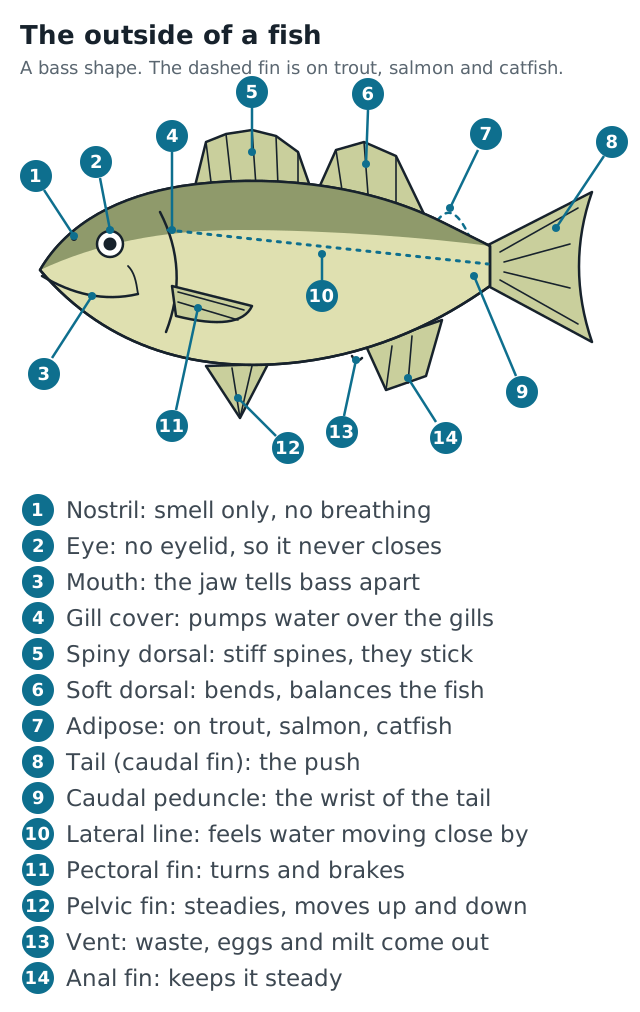
The three worth learning first are the gill cover, the lateral line and the fin spines. They tell you where your hands go and what the fish can feel. The rest come in handy when you want to name a fish or read a regulation.
| Part | What it does | Why you care |
|---|---|---|
| Eyes | See color, and see a short distance | Most fish have no eyelids, so they can’t close them. Never hold a fish by the eye sockets |
| Nostrils (nares) | Smell, and nothing else. A fish doesn’t breathe through them | A fish can smell your bait. Breathing water goes through the mouth and gills instead |
| Barbels | The whiskers on catfish, bullheads and sturgeon. They help find food | They’re soft. A catfish stings with its spines, never its whiskers |
| Mouth | Takes in food. Its position hints at how the fish eats | A largemouth bass has a jaw reaching past the back of the eye. On a smallmouth it doesn’t |
| Gill cover (operculum) | A bony flap that shields the gills and opens and closes to move water over them | Keep your fingers out from under it. On a walleye the back edge is sharp |
| Lateral line | A row of pores from the gill cover to the tail that feels vibration | It’s how a fish can find a lure it can’t see |
| Scales | Protect the body from injury | Their growth rings can tell a fish’s age |
| Slime coat | The fish’s first layer of defense | Wet your hands before you touch it |
| Vent | Lets out waste, and eggs or milt (the male’s sperm) at spawning time | It’s where the cleaning cut starts: from the vent forward to the gills, with a shallow blade |
The mouth is a free clue to how a fish feeds. A mouth that points down usually means a bottom feeder, so put your bait on the bottom. One that opens straight ahead usually eats other fish. One that opens upward usually belongs to a fish that hides, waits and strikes. Before you grab any of them by the lip, check which fish have teeth that’ll cut you.
What does each fin do?
Fins do the steering. The tail does most of the pushing. The fin names sound like school, but you’ll see them in every species guide and regulation book, so here they are once in plain words.
| Fin | What it does | What to know |
|---|---|---|
| Dorsal (on the back) | Balances the fish and stops it from rolling | On bass, perch and walleye the front part is stiff spines. Mind them when you grip the fish |
| Adipose (small, fleshy, near the tail) | Nobody’s sure. South Carolina DNR says “Its purpose is unknown” | Only on trout, salmon, catfish and a few others. Hatcheries clip it to mark their fish |
| Caudal (the tail) | Pushes the fish forward | Pinch it together before you measure |
| Anal (under the rear of the body) | Keeps the fish steady | Walleye carry two spines here. Watch your palm |
| Pectoral (one each side, behind the gill cover) | Quick turns and braking | On a catfish the front of this fin is a stiff, sharp spine |
| Pelvic (a pair on the belly) | Steadies the fish and helps it go up or down | The fins you’ll worry about least |
Spines and rays are the two things a fin is built from. A spine is stiff and sharp, and it’s one solid piece. A ray is soft and jointed, and it bends when you push on it. That difference names fish. Lift the back fin on a crappie and count the stiff spines. Seven or eight is a black crappie, five or six is usually a white.
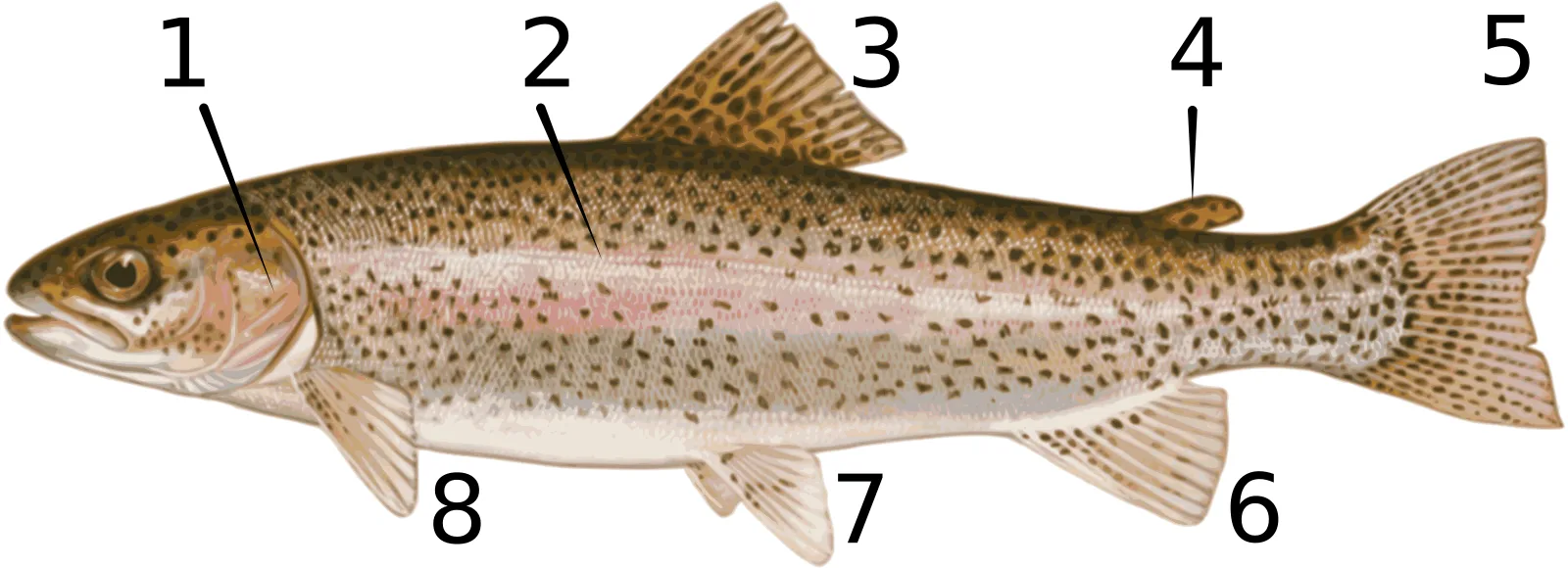
A rainbow trout has the fin a bass lacks: 1 gill cover, 2 lateral line, 3 dorsal fin, 4 adipose fin, 5 tail, 6 anal fin, 7 pelvic fins, 8 pectoral fins. Illustration: Duane Raver, U.S. Fish and Wildlife Service, numbered by Andreas Plank, Wikimedia Commons (public domain).
Check for that little adipose fin before you keep a salmon or steelhead. Washington clips it on virtually all the coho and Chinook salmon its hatcheries raise. In its mark-selective fisheries you may keep a clipped fish, and any unmarked salmon or steelhead goes back. Rules differ by river, so read yours.
The tail tells you how a fish lives. Slow swimmers tend to have round tails with no lobes. Some of the fastest fish, the tunas among them, have deep crescent tails with narrow lobes. It’s a quick read on a fish you’ve never seen before.
Free PDF · 7-day beginner fishing pack Starting fishing? What do you buy, what does it cost, and what do you do at the water?
The 16-page beginner pack: the $85–100 kit with the spec to ask for in the store, the license rules, the first knot, the rig drawn, the cast, the bite and the release. A free seven-day email course comes with it, one step a day.
No card, nothing to buy, and the PDF is yours to keep. Confirm with one click and it's on its way. Then a few short emails and one a week on what's biting. Unsubscribe anytime. Privacy.
What does the lateral line do?
The lateral line feels water moving near the fish. Look along the side of a bass or trout and you’ll see a thin row of marks from the gill cover back to the tail. Under those pores sit tiny hair cells. They pick up low, thumping vibration, and only close by, within one to two body lengths. Think of it as touch at a distance.
That’s how a bass can find a minnow in muddy water at night. It’s also the reason to fish something that thumps when the water’s dirty. A spinnerbait blade pushes water a bass can feel before it can see the lure. The longer version, with what fish hear and what they don’t, is in do fish hear.
What’s under the gill cover?
The gills are what a fish breathes with. Each side has a stack of bony arches, and each arch holds rows of thin, feathery red filaments. Water comes in the mouth, passes over the filaments and leaves under the gill cover. Those filaments pull more than 80 percent of the oxygen out of the water going past them. Water holds about one twenty-sixth of the oxygen air does, so a fish has to be that good at it.
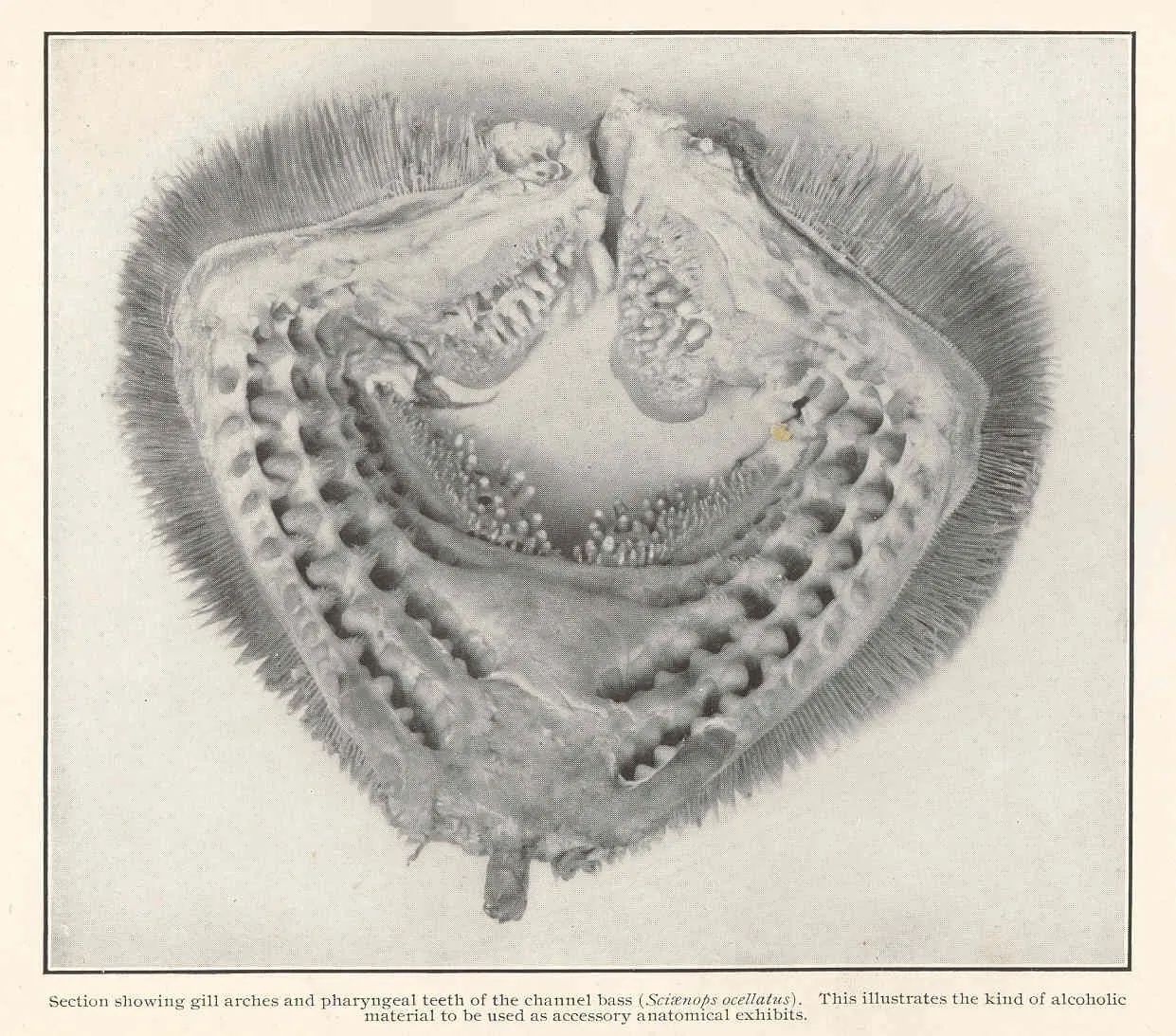
The gill arches, with the rakers on the inside edge and the filaments on the outside. Illustration: Roy W. Miner (public domain).
Those comb-like bits on the inside of each arch are the gill rakers, small spikes that help filter food from the water. Biologists use them to tell some look-alike species apart. You can skip that for now.
The filaments are the most fragile thing on the fish. Keep your hands and fingers away from the gills and arches, Virginia’s wildlife agency says. A hook in there is a bad sign too, since every drop of blood crosses the gills right after the heart. If you want the full story of how a fish gets its oxygen, how do fish breathe has it.
Why is a fish slimy?
The slime coat is the fish’s first line of defense against infection. It’s a layer of mucus over the skin and scales. Dry hands take it off, so wet your hands before you touch a fish you’re going to release.
Under the slime sit the scales, and they come in four kinds. You’ll only ever need the first two.
| Scale | What it feels like | Who has it |
|---|---|---|
| Cycloid | Smooth, round edge | Soft-finned fish such as trout, salmon and carp |
| Ctenoid | Rough, with tiny teeth on the edge | Spiny-finned fish such as perch |
| Ganoid | Hard, enamel-covered plates | Gar |
| Placoid | Like sandpaper, tiny tooth shapes | Sharks and rays |
Most catfish have no scales at all, which is why they feel so smooth. On fish that do, the scales grow in rings, and those rings can be read to age the fish.
What’s inside a fish?
If you’ve ever cleaned one, you’ve already seen most of this. Here’s the map, head to tail.
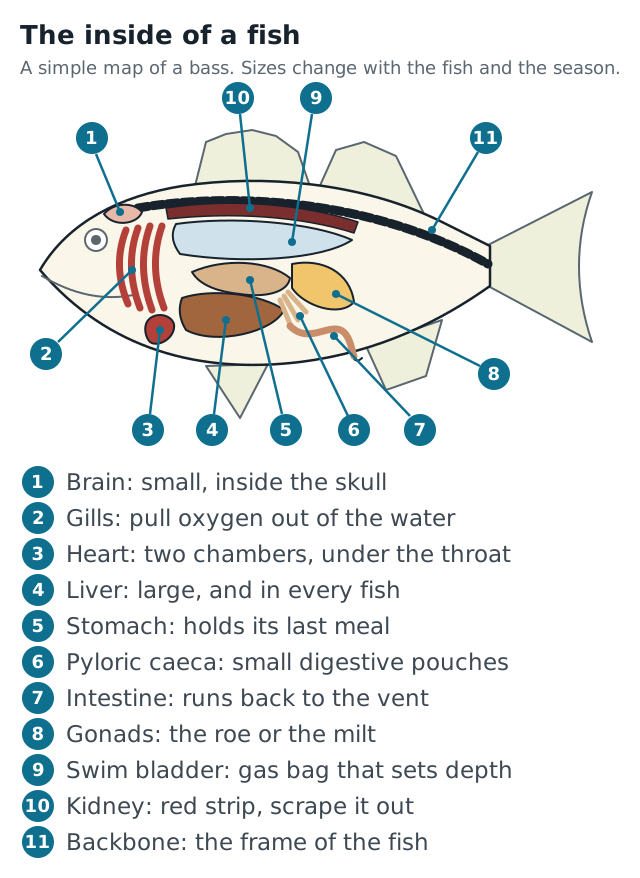
| Organ | What it does | What you’ll notice |
|---|---|---|
| Heart | Two chambers, pumping blood through one loop: heart, gills, body | Low in the body, just behind the gills, under the throat |
| Liver | A large organ every fish has | Trim it out with the rest of the organs if you’re eating the fish |
| Stomach | Holds and starts to break down food | Open it on a fish you keep and you’ll see its last meal |
| Pyloric caeca | Small finger-like pouches off the gut | That cluster of little fingers near the stomach is normal |
| Intestine | Takes up food on the way to the vent | In bony fish, about one and a half times as long as the body |
| Gonads | Make eggs (roe) or milt | Full of eggs in a female before the spawn |
| Spleen | Filters the blood | Easy to miss. You don’t need to find it |
| Swim bladder | Holds the fish at its depth | A thin bag along the top of the body cavity |
| Kidney | Cleans the blood | The long red strip against the backbone. Scrape it out |
| Backbone | Holds the fish together | Runs head to tail, with the ribs curving off it |
Some fish have no stomach at all, lampreys among them. Food goes straight into the intestine. Bass, trout and the other fish you’ll usually clean do have one. Check it first if you’re curious what they’ve been eating.
Don’t skip the kidney. Some fish “have a long, red kidney that runs along the backbone on the inside of the body cavity,” New York’s beginner guide says. Scrape it out with the knife blade or your thumbnail. Do it before you rinse the cavity.
What does a swim bladder do?
The swim bladder is a bag of gas that lets a fish hang in the water without working to stay there. Fill it and the fish floats higher. Let gas out and it sinks. Sharks and rays don’t have one at all.
The bladder comes in two kinds, and this is where it matters to you. Trout, salmon and pike have a small tube joining the bladder to the stomach, so they can burp gas out on the way up. Bass, walleye and perch don’t have that tube. Their gas has to leave through the blood and the gills, which is much slower.
So a bass hauled up fast from deep water can’t let the gas go, and the bladder swells. North Dakota Game and Fish says deaths climb sharply once the depth passes about 33 ft (10 m). Its advice is blunt: if you fish that deep for bass, walleye or perch, plan to keep what you catch, up to your limit. Releasing them often doesn’t work. For a fish that comes up bloated anyway, do fish fart lays out the options.
Carp, catfish and their relatives use the bladder for one more job. A chain of tiny bones joins it to the inner ear, and that’s why they hear far better than a bass does.
How do you measure a fish?
Measure total length unless your rules say otherwise. That’s the tip of the snout to the tip of the tail, with the tail pinched together. Pinch it before you read the number, since a spread tail reads shorter.
| Measure | From | To |
|---|---|---|
| Total length | Tip of the snout | Tip of the pinched tail |
| Fork length | Tip of the snout | The fork in the middle of the tail |
South Carolina measures its freshwater fish by total length and some saltwater fish by fork length. Other states split it their own way, so check the rules for the water you’re on.
What parts of a fish can’t you eat?
You eat the meat. The organs, gills and scales stay out of the pan. Where a fish advisory covers PCBs, a chemical that collects in fat, the Oregon Health Authority goes further and gives these exact steps:
- “Throw away internal organs, skin, head and tail.”
- “Remove all skin.”
- “Cut away the dark fat on top of fish along its backbone.”
- “Slice off fat belly meat along the bottom of fish.”
- “Cut away the dark, V-shaped wedge of fat located along the lateral line on each side of the fish.”
That’s the lateral line again, this time as a cutting guide. Oregon adds a warning: these steps won’t get rid of mercury. Check your own state’s advisory for the water you fished.
What makes a fish a fish?
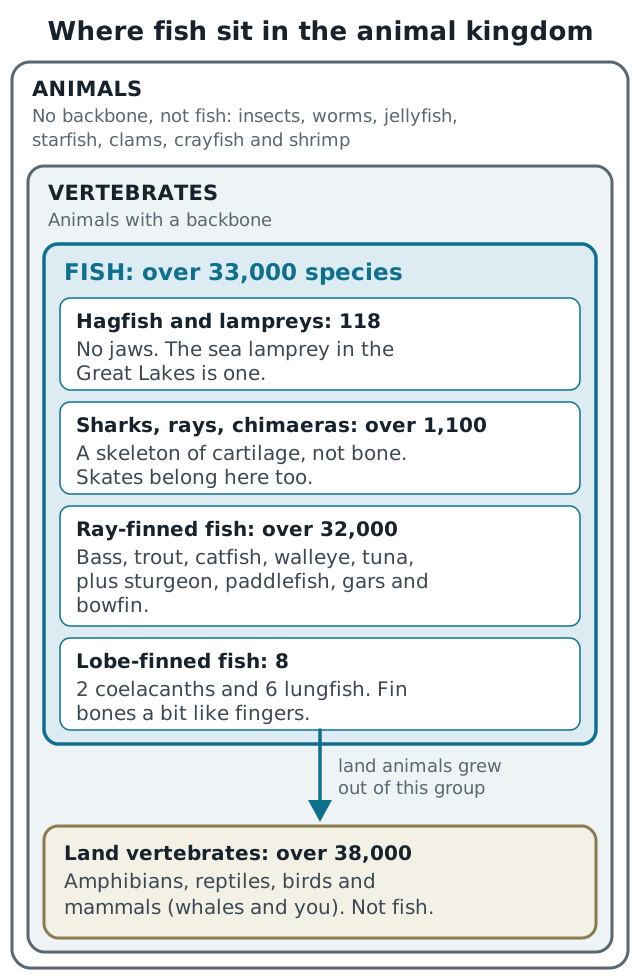
A fish has a backbone, fins and gills, and in nearly every species its body temperature follows the water. Most have scales, with catfish the well-known exception. Some do without bones altogether: sharks and rays are built of cartilage.
If a word on a regulation sheet still trips you up, the fishing terms page defines every body part in a line. There’s more about what goes on inside the animal in fish facts.

Free PDF · 16 pages
Your first fishing trip, from the store aisle to the first fish
Lost in the tackle aisle, the wrong gear in the cart, and home with nothing. Skip all of that.
The 7-Day Beginner Fishing Pack. A 16-page PDF plus a free seven-day email course, one step a day: the whole first trip in order, from the store to the release.
- Walk out of the store with the right rod and nothing extra: the $85–100 kit, item by item
- Know if you need a license, in 13 states, and the places where nobody needs one
- What to do when the bobber goes under, and the ten-second rule for letting the fish go
Every line from the beginner pages on fishing.info and the 247 sources behind them, the U.S. Fish and Wildlife Service and the Missouri Department of Conservation among them.
No card, nothing to buy. Confirm with one click and the PDF is on its way, one version for your phone and one to print, yours to keep. Then a few short emails and one a week on what's biting, with an unsubscribe link in every one. Privacy.
Related
Section guide
Fish Facts: The Questions Kids Ask About Fish, Answered With the ScienceFish facts with a number and a source for each: how fish sleep, breathe, hear and feel, and what every answer means when you hook and release one.
 Ugliest Fish in the World: The Blobfish, and the Ugly Ones You Can Catch
The ugliest fish in the world is the blobfish, by a 2013 vote. Why it only looks like that out of water, and ten ugly fish with their size and home.
 Is a Shark a Fish? Yes, and Why It Isn't a Mammal
Is a shark a fish? Yes: it breathes with gills and is built of cartilage, not bone. How sharks differ, why they aren't mammals, and seahorses and eels.
 Scariest Fish: Which Ones Really Hurt People, and Which Only Look It
The scariest fish in the world, sorted by what each can really do to you: sharks that bite, the most venomous fish, fish that poison and harmless monsters.
 Smallest Fish in the World: Three Fish Under a Third of an Inch
The smallest fish in the world is a swamp fish grown at 7.9 mm, shorter than a #8 hook. Its two rivals, how each was measured, and tiny fish in US water.
 What Do Fish Eat? Wild, Pond and Pet Fish, and the Bait That Matches
What do fish eat? Insects, small fish, crayfish, worms, plankton and plants, by species. Read the mouth, match the bait, and feed a pond or tank right.
 Are Fish Animals? Yes: Vertebrates, Not Mammals, Mostly Cold-Blooded
Are fish animals? Yes: animals with a backbone and gills. Why fish aren't mammals, which fish run warm, and why California law calls a bee a fish.
Sources (18)
- South Carolina Department of Natural Resources, Fish anatomy
- South Carolina Department of Natural Resources, How to properly measure a fish
- Fish anatomy (overview: fin functions, stomach, pyloric caeca, liver, kidneys, heart, spleen, intestine length)
- Fish fin (overview: spines and soft rays, tail shapes)
- Fish scale (overview: cycloid, ctenoid, ganoid and placoid scales, annuli)
Show all 18 sourcesShow fewer sources
- Fish gill (overview: gill rakers, oxygen in water and in air, how much of it the gills take out)
- Swim bladder (overview: open and closed bladders, the link to the inner ear)
- Fletcher, Altringham, Peakall, Wignall and Dorrell (2014), Hydrodynamics of fossil fishes, Proceedings of the Royal Society B 281(1788): 20140703
- Gill raker (overview: used to classify and identify fish species)
- DOSITS (Discovery of Sound in the Sea), How do fish detect sound?
- Popper, A. N. and Hawkins, A. D. (2019), An overview of fish bioacoustics and the impacts of anthropogenic sounds on fishes, Journal of Fish Biology
- North Dakota Game and Fish (2021), Understanding barotrauma
- FISHBIO, A high-pressure situation: how fish cope with living at variable depths
- Virginia Department of Wildlife Resources, Grab a big net and keep your hands wet: catch-and-release best practices
- Florida Museum of Natural History, Mouth types
- New York State Department of Environmental Conservation, I FISH NY Beginners' Guide to Freshwater Fishing, Section 3: Success! You caught a fish! What you do next
- Oregon Health Authority, PCBs and fish
- WDFW, Hatchery fish mass-marking: the clipped adipose fin