 By
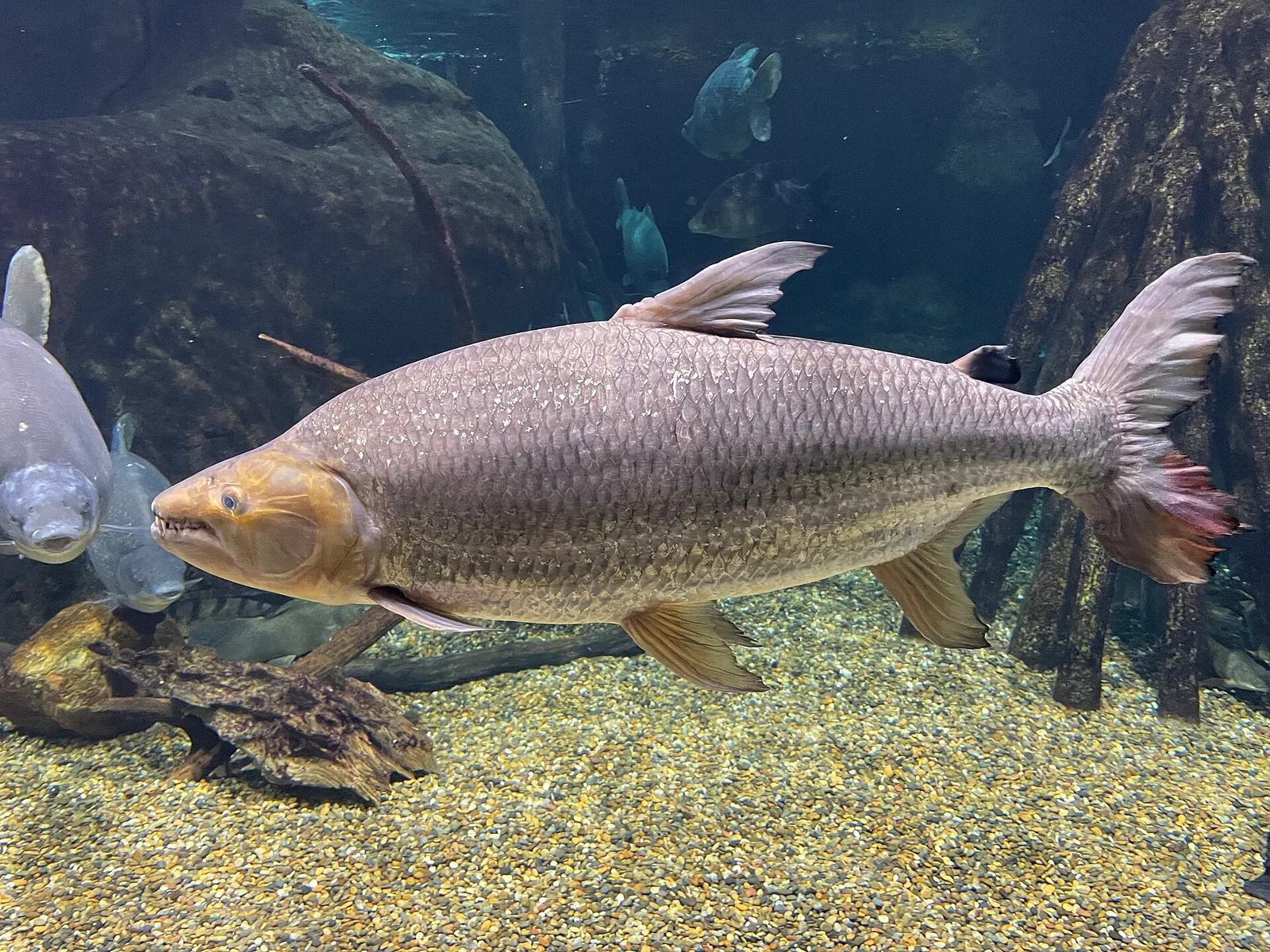
The goliath tigerfish is the biggest of Africa’s tigerfish, a silver predator of the Congo basin with teeth up to an inch long. The IGFA world record weighs 97 lb (44 kg), and it was caught at Kinshasa in 1988. The 150-pound fish you’ve read about have no certificate behind them. It lives only in the Congo system and Lake Tanganyika, so seeing one means a trip to central Africa.
Six of the seven goliath tigerfish rows in the IGFA record book come from one city, Kinshasa, between 1985 and 1989. The heaviest has stood since July 9, 1988.
How big does a goliath tigerfish get?
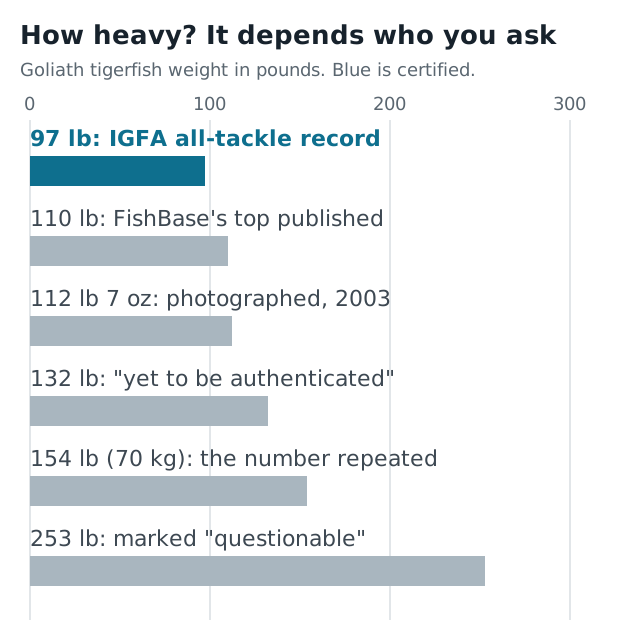
The honest answer is about 100 lb, give or take. The IGFA all-tackle record is 97 lb (44 kg). FishBase tops out at 52 in (133 cm), measured to the fork of the tail, and 110 lb (50 kg).
The IGFA’s own note goes about that far and stops. It says the largest “may exceed 110 lbs (50 kg).” Stories of fish up to 132 lb, it adds, “have yet to be authenticated.”
Above that, you’re reading numbers with no fish attached. Wikipedia and Discover Wildlife both give 6 ft 7 in (2 m) and 154 lb (70 kg). Fishing World Records lists a 253 lb fish and marks it questionable itself. It also has a 127 lb 14 oz rod-and-reel fish from Zambia’s Lufubu River, and the year on that one reads “19??”. The heaviest rod-and-reel fish it shows a photo of weighed 112 lb 7 oz, from the Congo in 2003. It also pictures a 123 lb 7 oz fish from 2002, and marks that one “not verified.”
Most fish run smaller. Discover Wildlife says adults average around half of that 70 kg figure. On one five-day fly trip to the Republic of Congo, the biggest goliath hooked was put at more than 40 lb. It broke the fly line and got away.
It’s a big fish, but it isn’t in the class of the largest freshwater fish. The giant arapaima and the Nile perch both weigh far more.
How big was Jeremy Wade’s goliath tigerfish?
The River Monsters clip of the catch describes it as an 80-pound fish from the Congo River. It’s not in the IGFA book, and at 80 lb it wouldn’t have touched the 97 lb mark.
What does the IGFA record book show?
It’s a short list, and most of it is old. These are all seven rows, with the all-tackle and 12 lb entries sharing one fish.
| Record | Weight | Who, where, when |
|---|---|---|
| All-tackle and 12 lb line | 97 lb (44 kg) | Raymond Houtmans, Kinshasa, July 9, 1988 |
| 16 lb line | 92 lb 9 oz (42 kg) | Raymond Houtmans, Kinshasa, July 19, 1987 |
| 20 lb line | 88 lb 2 oz (40 kg) | Jean van Loock, Kinshasa, June 28, 1987 |
| 30 lb line | 71 lb 10 oz (32.5 kg) | Raymond Houtmans, Kinshasa, July 28, 1985 |
| 8 lb line | 41 lb (18.6 kg) | Raymond Houtmans, Kinshasa, July 23, 1989 |
| 20 lb fly tippet | 33 lb 15 oz (15.39 kg) | Jeremy Block, Vovado River, Central African Republic, Feb. 22, 2021 |
The IGFA still writes “Zaire River” for the Congo at Kinshasa and “Central African Empire” for the last row. One man, Raymond Houtmans, holds five of the seven rows. The other 73 slots the IGFA keeps for this fish are empty. That means no all-tackle length record, no junior record and no women’s record. The fly record is the only entry set since 1989. The striped tigerfish, by comparison, has 22 rows filled.

Free PDF · Water temperature chart Which fish are biting at today's water temperature?
One reading, and the 16-page chart shows which of 26 fish are spawning, feeding hard or slowing down; for bass, crappie, bluegill and walleye, where they sit and what to throw. Every number sourced.
No card, nothing to buy, and the PDF is yours to keep. Confirm with one click and it's on its way. Then a few short emails and one a week on what's biting. Unsubscribe anytime. Privacy.
Goliath tigerfish or tigerfish: which one do anglers travel for?
Almost always the smaller one. The fish most anglers book a trip for is the striped tigerfish of the Zambezi, which Sporting Classics calls “Africa’s most revered freshwater quarry.” It calls the goliath “much larger and less frequently targeted by anglers.”
| Goliath tigerfish | Striped tigerfish | |
|---|---|---|
| Where | Congo River system, Lualaba, Lake Upemba, Lake Tanganyika | West Africa to the Nile, south to the Congo, Zambezi and Limpopo |
| Color | Silver, no clear stripes | Silver with a bluish back, dark stripes, tail edged black |
| IGFA record | 97 lb (44 kg), Kinshasa, 1988 | 35 lb 7 oz (16.1 kg), Kariba, 2001 |
| FishBase top weight | 110 lb (50 kg) | 62 lb (28 kg) |
| IGFA records filled | 7 | 22 |
Dead fish can fool you. The IGFA says a goliath is silver with no clear stripes, but “a few broad stripes may show up under the scales after death.”
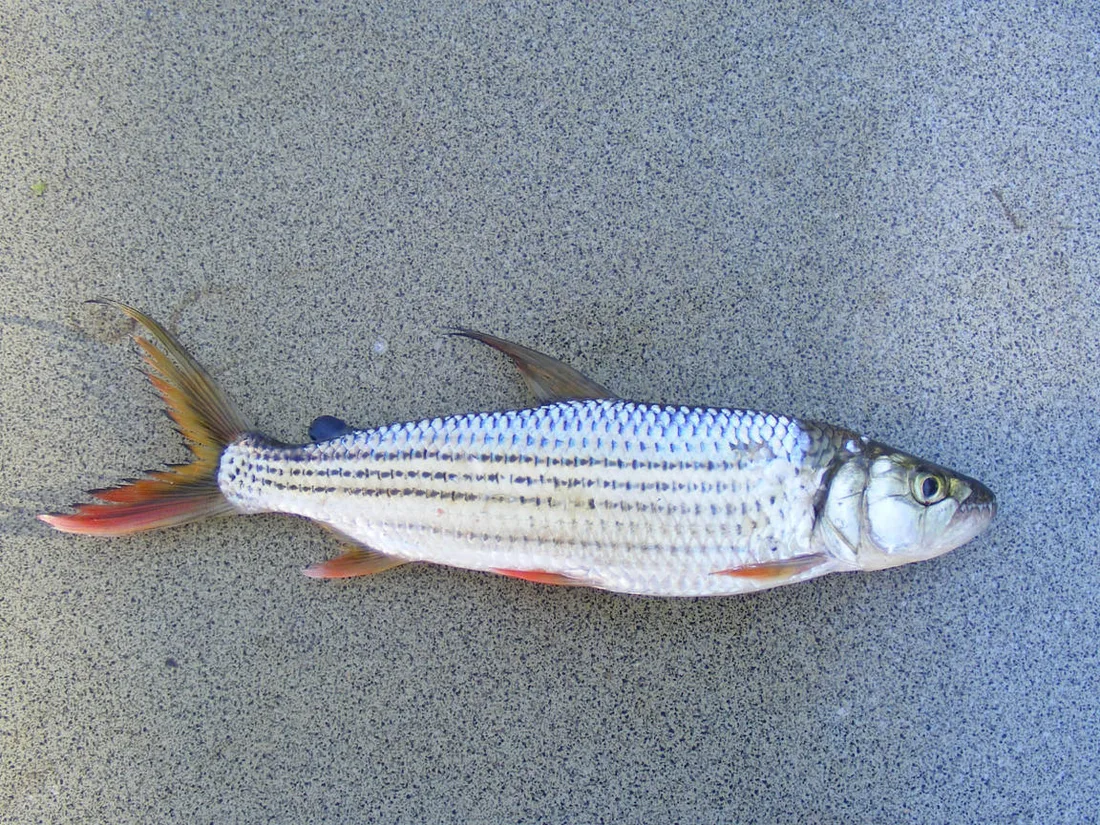 A striped tigerfish, the fish most anglers mean by “tigerfish.” Note the stripes and the red tail. Photo: Andrew Deacon, iNaturalist via Wikimedia Commons (CC0).
There’s a third fish you’ll hear about. The Tanzanian tigerfish lives in the Mnyera and Ruhudji rivers of Tanzania’s Kilombero Valley, and it’s a separate species that grows large. A 28 lb fish from there was described as “clearly the largest tigerfish ever caught on a fly.” Five tigerfish species have names so far, and DNA work points to five more lines still waiting for one.
So here’s the pick. For a first trip, go for striped tigerfish on the Zambezi. Save the goliath for the trip after that, if you still want it.
Want a number to beat? The striped tigerfish all-tackle record is 35 lb 7 oz (16.1 kg), caught by Jennifer Daynes at Kariba, Zimbabwe, in 2001. The heaviest fly-caught fish the IGFA files under that name weighed 22 lb 8 oz (10.21 kg), from a Kilombero River tributary in Tanzania in 2007.
What do goliath tigerfish teeth look like?
They’re long, triangular and locked together when the mouth shuts. They can reach about 1 in (2.5 cm), a figure credited to Jeremy Wade. Discover Wildlife counts 32 of them and says they compare in size to a great white shark’s.
Don’t bet money on the count. The IGFA says 14 or more in the upper jaw alone. Wikipedia gives 12 to 20 on top and 8 to 14 below.
The fish keeps growing new ones. Wikipedia says all the teeth in a section of jaw go at once, over about five days. In striped tigerfish from Kruger National Park the swap took about 3 to 5 days, top and bottom jaws together. The fish fed differently while it happened.
Those teeth are why nobody hand-lands one. Seriously Fish, writing about keeping them in tanks, warns of “adult fish easily being able to sever a man’s hand.” Carry long fishing pliers, and keep your fingers out of the mouth.
Has a goliath tigerfish ever attacked a person?
Bites get reported, but the killings don’t hold up. A-Z Animals says goliaths “have been known to attack humans, causing substantial wounds.” On the worst stories it’s blunt: “there are stories about Goliath tigerfish killing and eating humans in the Congo, none have been substantiated.” FishBase rates the fish “Harmless.”
River Monsters spread the tales. One of its clips is titled “Goliath Tigerfish Latches Onto Man’s Throat.” In it, Jeremy Wade hears the story from someone else, so you’re getting it secondhand. Wikipedia says only that “a number of incidents have been reported in the Congo.” Discover Wildlife calls attacks rare, set off by movement or a flash of color.
Compare the piranha, whose bites in Brazil have doctors’ case notes behind them. The goliath could certainly cut you badly. None of the sources here points to a medical report for one.
Are goliath tigerfish aggressive?
Toward a lure, yes. Outdoor Life describes “lightning fast strikes” and “blistering speed that will drain a reel of line in seconds,” with jumps on top. On the Flylords trip, strikes snapped a 50 lb leader before the angler could get control of the fish.
Congolese people call the goliath the mbenga, and it’s the name you’ll hear on the river. Toward swimmers, the case is much thinner. Save the respect for when it’s on the end of your line.
Do goliath tigerfish really eat crocodiles?
Nobody has shown it. Outdoor Life says they “reportedly” eat small crocodiles, and the line gets repeated everywhere. The evidence runs the other way. “Aside from humans, the crocodile is probably the only predator of adult goliath tigerfish,” says Discover Wildlife.
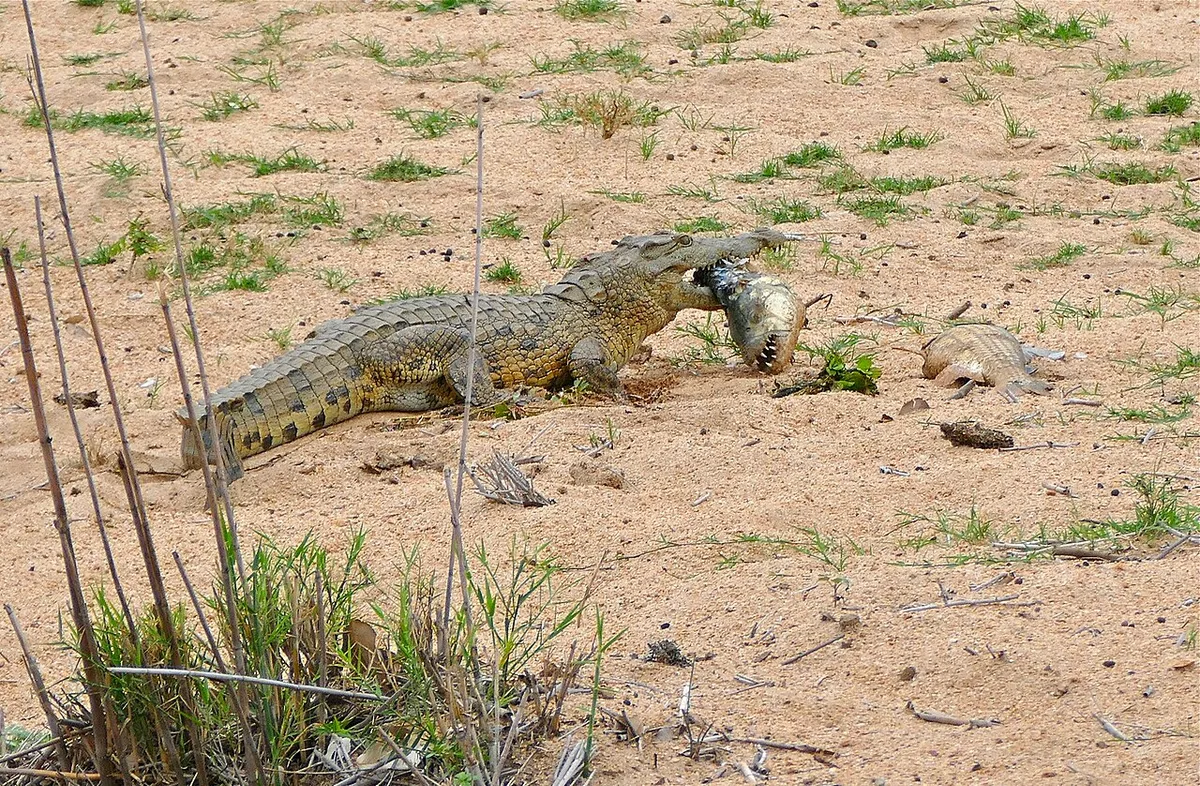 A Nile crocodile with a big striped tigerfish at Sabie Bridge, Kruger National Park. In the stories we can check, the crocodile is the one eating. Photo: Bernard Dupont, Wikimedia Commons (CC BY-SA 2.0).
Mostly, they eat fish. Wikipedia says the goliath takes any fish it can overpower, smaller goliaths included, and hunts from the calmer eddies in rapids. Discover Wildlife says it can take fish almost as large as itself.
The wildest true story belongs to its smaller cousin. At Schroda Dam in South Africa, striped tigerfish were filmed leaping as far as three feet out of the water. They grabbed barn swallows in flight, about 20 times a day.
Where do goliath tigerfish live?
Only in Africa, in the Congo River system, the Lualaba River, Lake Upemba and Lake Tanganyika. The IGFA uses the word “restricted” for that list. FishBase puts them in lakes and large rivers at 73 to 79 °F (23 to 26 °C). Wikipedia says they favor fast water with plenty of oxygen.
They aren’t in trouble so far. The IUCN lists the goliath tigerfish as Least Concern.
Where can you actually fish for one?
You have two choices: a hard trip for the goliath, or a much easier trip for its cousins. Here’s when to go for the cousins.
| Water | Fish | Best window |
|---|---|---|
| Upper Zambezi, above Victoria Falls | Striped | June is the prime month; November to March closed to fly fishing |
| Middle Zambezi, Victoria Falls to Kariba | Striped | August to December |
| Lake Kariba | Striped | October, when the annual tournament runs |
| Lower Zambezi, below Kariba Dam | Striped | Late August to mid-November |
| Mnyera and Ruhudji, Tanzania | Tanzanian | August to mid-November, October first |
On the Zambezi, a tigerfish over 10 lb is a trophy. In Tanzania, the mark is 20 lb. You’ll need a license in Zambia. Bait Your Hook says sport fishing there runs from March 1 to the end of November and is catch and release only. Get your outfitter to confirm the current rules.
The Congo is another story. The U.S. State Department rates the Democratic Republic of the Congo Level 4, Do Not Travel, in an advisory issued July 15, 2026. The Republic of the Congo, across the river, is Level 2. Read both before you price anything. The DRC advisory also covers an Ebola outbreak. It says, “Travelers who have been in the DRC within 21 days of their flight will not be allowed to board flights with U.S. destinations.” Outdoor Life says anglers may spend three to five weeks in the DRC to hook one or two fish.
How do you catch a goliath tigerfish?
Use wire and heavy line, expect to lose fish, and bring a deep-diving lure. Outdoor Life’s pick is a large deep-diving crankbait, because goliaths are spread thin across big water. It names the Yo-Zuri 3D Magnum Deep Diver and the Manns Stretch 30.
On the fly, Flylords’ Congo crew fished 10- and 12-weight rods with sinking line and a 50 lb leader above a wire trace. Their custom goliath flies lost out to small brush flies. Over five days they lost three goliaths, some on the strike, and landed one striped tigerfish.
For striped tigerfish, one South African tackle shop lists a lighter setup:
- Rod: medium-heavy or heavy spinning or baitcasting, at least 5 ft 3 in (1.6 m).
- Reel: a 3000 to 4000 spinning reel with a strong drag.
- Line: 20 to 30 lb braid.
- Trace: 6 to 12 in of steel, so the teeth can’t reach your line.
- Lures: spinners, spoons, crankbaits and surface plugs.
Put treble hooks on lures, and use a circle hook on bait if you want a clean release. Bait fishing is common too: whole kapenta and fillets cut from local fish, the Victoria Falls Guide says.
Set the hook hard. On the fly, Aardvark McLeod says to use “a (very) firm strip-strike” with the rod low. Keep stripping right to the end, because tigerfish will follow the fly for several yards before they hit. When one jumps, keep your rod down and get the slack back fast.
Can you keep a goliath tigerfish in the US?
Not in Texas or Florida. Texas prohibits “All species of genus Hydrocynus,” and no one may possess them “except as authorized by the department.” Florida’s prohibited list carries “Genus Hydrocynus, all species.” Check your own state’s rules before you buy anything.
Even where it’s legal, skip it. Seriously Fish calls it “a species totally unsuited to aquarium life.”
Can you eat a goliath tigerfish?
Yes, and people in Africa do. FishBase lists the goliath as a commercial fish as well as a game fish. Nobody publishes much on how it tastes. For the striped tigerfish, the Victoria Falls Guide says the fillets are “meaty but bony and slightly oily,” and the writer loves the white flesh pickled.
On a sport trip it’s usually moot. Bait Your Hook says fishing in Zambia is catch and release only.
How do goliath tigerfish breed?
Not much is known. A-Z Animals says “scientists have not studied the species extensively.” By Wikipedia’s account, females travel together and lay thousands of eggs in thick vegetation near riverbanks or lake shores, then leave them. Young fish grow about 4 to 6 inches a year and can take up to ten years to reach full size.
Is it a giant piranha? Not quite. A-Z Animals says goliaths “are often considered a bigger and deadlier version of the piranha,” but the two are different fish that are only distantly related. There’s more on the river oddballs in our other freshwater fish hub.

Free PDF · 16 pages
Stop guessing. Know what's biting before your first cast
A whole Saturday on the water with nothing to show for it. One reading tells you who's feeding.
The Water Temperature Fishing Chart. Take one water temperature reading, find it on the chart, and see which of 26 freshwater fish are spawning, feeding hard or slowing down.
- Where bass, crappie, bluegill and walleye sit, and what to throw. Trout: the reading where you stop.
- Why a 3 ft drop beats a cold front, and what to throw each day of the front
- The three thermometer mistakes that make a reading lie
The chart's numbers come from state fish and wildlife agencies and fisheries research: 61 sources, each listed on the site.
No card, nothing to buy. Confirm with one click and the PDF is on its way, one version for your phone and one to print, yours to keep. Then a few short emails and one a week on what's biting, with an unsubscribe link in every one. Privacy.
Related
Section guide
Freshwater Fish Species Outside the Big Families: Sturgeon, Gar, Bowfin, BurbotThe freshwater fish species outside the bass, trout, catfish and pike families: sturgeon, gar, bowfin, burbot, drum, eel and paddlefish, with records.
 Beluga Sturgeon: How Big It Gets, Where It Lives and the Caviar Ban
The beluga sturgeon reaches 26 ft on the books and lives only in the Caspian and Black Sea basins. Its size, record, status and the US caviar rules.
 Nile Perch: How Big They Get, the Record, and Where to Catch One
Nile perch grow to about 2 m and 200 kg, and the record is 230 lb from Lake Nasser. Where to catch one, why the US bans it, and the Lake Victoria story.
 Buffalo Fish: Not a Carp, and How to Catch and Eat One
Buffalo fish are native suckers, not carp. How to tell bigmouth from smallmouth buffalo, the bait that catches them, and how to cook around the bones.
 Lamprey: What It Is, and What to Do If You Catch One
A lamprey is a jawless, eel-like fish that feeds on blood. How to tell a sea lamprey from a native one, what to do if you catch one, and the rules.
 Piranha: Are They Dangerous, and Are They Illegal in the US?
Piranhas bite swimmers, but it's unclear one has ever killed a living person. Their real size, the pacu look-alike, how to catch one, and US state law.
 Arapaima: How Big They Really Get, and Where You Can Catch One
The arapaima breathes air, tops out near 10 ft and 440 lb, and is legal to catch in only a few places. Its real size, the record, and where to fish.
Sources (27)
- IGFA World Record Search: Tigerfish, giant, Hydrocynus goliath (all-tackle, line-class and fly records; read November 9, 2026)
- IGFA World Record Search: Tigerfish, Hydrocynus vittatus (read November 9, 2026)
- FishBase, Hydrocynus goliath, Giant tigerfish
- FishBase, Hydrocynus vittatus
- Wikipedia, Hydrocynus goliath
Show all 27 sourcesShow fewer sources
- Fishing World Records, Hydrocynus goliath
- Discover Wildlife (Kevin Parr), Meet the fearsomely fanged, freshwater monster with a bite like a crocodile (July 18, 2026)
- A-Z Animals, Goliath Tigerfish
- Seriously Fish, Hydrocynus goliath, Giant Tigerfish
- River Monsters, The 'Murderous Animal' With A Double-Hinged Jaw (YouTube)
- River Monsters, Goliath Tigerfish Latches Onto Man's Throat (YouTube)
- Sporting Classics Daily (William Douglass), Tiger Hunting in Africa (December 27, 2023)
- Goodier, S. A. M., Cotterill, F. P. D., O'Ryan, C., Skelton, P. H. and de Wit, M. J. (2011), Cryptic Diversity of African Tigerfish (Genus Hydrocynus) Reveals Palaeogeographic Signatures of Linked Neogene Geotectonic Events, PLoS ONE 6(12): e28775
- Gagiano, C. L., Steyn, G. J. and du Preez, H. H. (1996), Tooth replacement of tigerfish Hydrocynus vittatus from the Kruger National Park, Koedoe 39(1)
- Aardvark McLeod (Charlotte Chilcott), Tigerfish Top Tips
- Aardvark McLeod (Charlotte Chilcott), In pursuit of African tigers … a short summary of when to go
- Phys.org, Researchers capture video of freshwater fish grabbing birds out of the air (January 13, 2014), on O'Brien, Jacobs, Evans and Smit, Journal of Fish Biology 84: 263–266
- Flylords (Henry Clayton-Hatfield), Exploring the Congo for Goliath Tigerfish (November 5, 2024)
- Outdoor Life (Steve Ryan), The 10 Gnarliest Freshwater Fish in the World (and How to Catch Them) (May 21, 2026)
- Western Accessories (Zainab Loonat), The Ultimate Guide to Tigerfish Fishing in South Africa (July 8, 2025)
- Bait Your Hook, Fishing in Zambia: What you need to know
- Victoria Falls Guide, The Legendary Tigerfish
- U.S. Department of State, Democratic Republic of the Congo Travel Advisory (Level 4, issued July 15, 2026)
- U.S. Department of State, travel advisories data feed (both advisories in full; read November 9, 2026)
- U.S. Department of State, Republic of Congo Travel Advisory (Level 2, issued October 2, 2024)
- Texas Parks and Wildlife Department, Exotic Fish, Shellfish and Invasive Aquatic Plants (prohibited exotic species list)
- Florida Fish and Wildlife Conservation Commission, Prohibited Nonnative Species List (archived copy, December 10, 2025)