 By
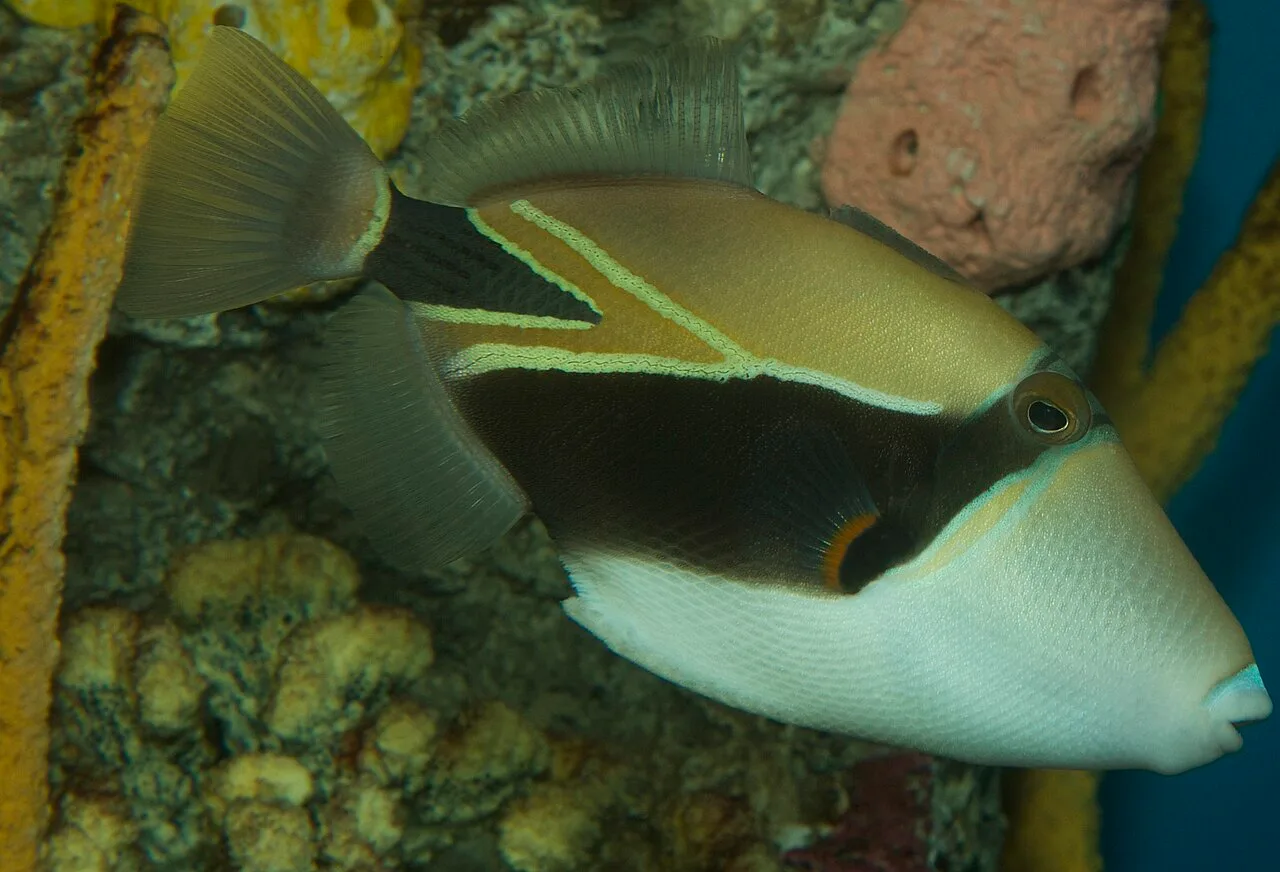
Hawaii’s state fish is the humuhumunukunukuāpuaʻa, the reef triggerfish, a sturdy reef fish of up to 10 inches. State law calls it the rectangular triggerfish, and it’s known as humuhumu for short. It has held the title for good since 2006, and that was its second time.
From 1990 to 2006, Hawaii had no legal state fish. The five-year law had run out, and almost nobody noticed.
How do you say humuhumunukunukuāpuaʻa, and what does it mean?
Say it in twelve beats: HOO-moo-HOO-moo-NOO-koo-NOO-koo-AH-poo-AH-ah. That’s how Boss Frog’s, a Hawaii snorkel outfit, writes it out, and it works. Break it into three chunks and it gets easy: humuhumu, nukunuku, āpuaʻa.
Each chunk means something. The Waikīkī Aquarium explains it this way:
- Humuhumu is the Hawaiian word for all triggerfishes. It may mean “to fit pieces together,” which could point to the blocks of color on some of them.
- Nukuāpuaʻa means “snout like a pig.”
The pig part isn’t only about the nose. Early Hawaiians saw it root through sand and rock for food. They also heard it grunt when they handled it. To them, those were pig habits.
The fish has a pile of English names too. The law says rectangular triggerfish. State Symbols USA adds Hawaiian triggerfish. Fish guides outside Hawaii call it the wedgetail triggerfish. Look at its tail and you’ll see why. Some tour pages call it a Picasso triggerfish. FishBase says the whole group got that nickname, “picassofish,” from its bold patterns, so the name can mean more than one fish.
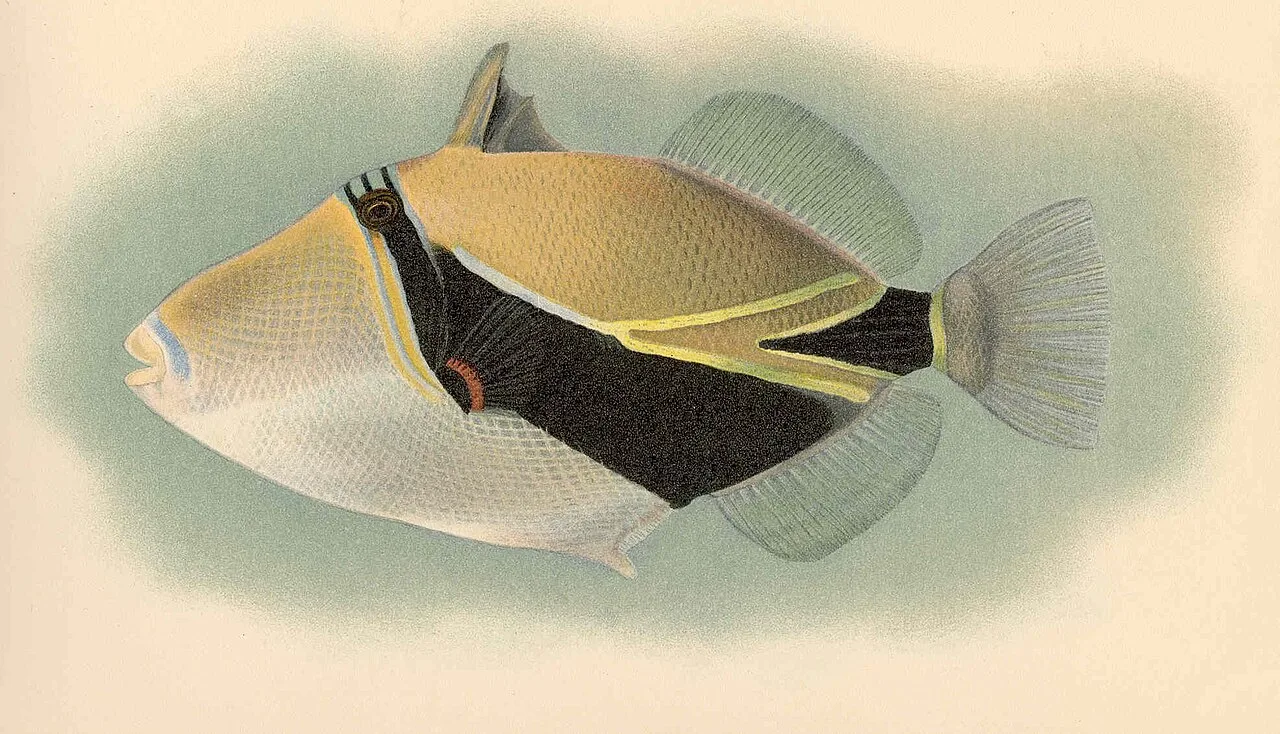
The humuhumu as the U.S. Fish Commission painted it for Shore Fishes of the Hawaiian Islands in 1905. Plate: Jordan and Evermann, Wikimedia Commons (public domain).
Even the Legislature spelled it two ways. The 1985 law wrote “humuhumu-nukunuku-a-pua’a,” with hyphens. The 2006 law ran it together as one word. You’ll see it written both ways, with or without the Hawaiian spelling marks.
Why is the humuhumu Hawaii’s state fish?
It won a popular vote. In 1984 the Legislature asked the University of Hawaiʻi and the Waikīkī Aquarium for candidates for a state fish. University students paraded in fish costumes for their picks, and teachers helped schoolchildren join in, Star-Bulletin columnist Susan Scott wrote. The humuhumu came out on top, and lawmakers made it official in 1985.
There was a catch. The 1985 law said it would be repealed five years after the day it was signed. So in June 1990 the title quietly ran out. The date passed pretty much unnoticed, Scott wrote, and people went on calling the humuhumu the state fish.
In 2006 the Legislature admitted the gap in writing. Its new law says many people “mistakenly assume” the humuhumu is still the state fish, and that Hawaii “does not currently have a fish designated.” The purpose, it says, was to make the humuhumu the official fish of the State for good. Here’s how it played out.
| Year | What happened |
|---|---|
| 1984 | The Legislature asks UH and the Waikīkī Aquarium for candidates; the humuhumu wins a public vote |
| June 8, 1985 | Act 289 makes it the official fish of the State, set to be repealed five years later |
| 1990 | The law runs out by itself; the fish keeps the title in everyday use |
| By February 2006 | Rep. Blake Oshiro has drawn up a new bill. He credits a friend’s 6-year-old son for spotting the gap |
| May 2, 2006 | Act 67, signed by Gov. Linda Lingle, makes it the state fish for good |
It wasn’t a sure thing the second time either. Another representative favored the ʻoʻopu, a freshwater goby found only in Hawaii, Scott wrote. The humuhumu won again, and today it sits in Hawaii law as section 5-11.5.
Free PDF · Water temperature chart Which fish are biting at today's water temperature?
One reading, and the 16-page chart shows which of 26 fish are spawning, feeding hard or slowing down; for bass, crappie, bluegill and walleye, where they sit and what to throw. Every number sourced.
No card, nothing to buy, and the PDF is yours to keep. It's in your inbox a minute later. Then a few short emails and one a week on what's biting. Unsubscribe anytime. Privacy.
What does the Hawaii state fish look like?
It’s a sturdy, angular fish with a pale face and a bold black band, up to about 10 inches long. The Waikīkī Aquarium says its body shape, its color pattern and the spine on top of its head make it easy to tell apart. You’re looking for four marks:
- A broad black band running at an angle from the eye, past the base of the side fin, to the anal fin. That’s the rear fin on its underside.
- A black wedge on the narrow part just in front of the tail.
- Two yellow V-shaped lines in front of that wedge. They’re white on young fish.
- A blue bar across the upper lip, with black bands between the eyes.
The back is pale brown to yellowish and the head pale gray to whitish. The big spine sits on top of its head. In fish anatomy terms, it belongs to the dorsal fin, the fin on the back. It’s the spine the fish locks in place, more on that below.
Reef triggerfish or lagoon triggerfish?
Here’s where most quick answers slip. Two fish in Hawaii share the long Hawaiian name. The reef triggerfish is the state fish. The lagoon triggerfish is a close relative and less common in Hawaii, the Waikīkī Aquarium says. The law names only the reef triggerfish. One Maui attraction even gives the state fish the lagoon fish’s Latin name.
| What to check | Reef triggerfish (state fish) | Lagoon triggerfish |
|---|---|---|
| Latin name | Rhinecanthus rectangulus | Rhinecanthus aculeatus |
| Band through the eye | Broad black band from the eye to the anal fin | Dark bar from the eye to the side-fin base only |
| Front of the tail | Black wedge with two yellow V marks | Rows of small black spots |
| Face | Blue bar on the upper lip | Yellow band from the snout back below the side fin |
| Above the anal fin | Where the black band ends | Dark diagonal bands |
| In Hawaii | The common one | Less common |
Here’s the quick tell when you’re floating above one: a solid black wedge at the tail means reef triggerfish. Black spots back there means lagoon triggerfish.
How big do they get? The Waikīkī Aquarium says the reef triggerfish reaches up to 10 inches. FishBase lists 30 cm, about 12 inches, as the longest on record, for both fish. Some sites put it at 8 inches, which is short of the aquarium’s figure.
How does the triggerfish lock itself in the reef?
This is the trick worth knowing before you reach for one. When a reef triggerfish is threatened, it dives into a hole and raises the big spine on top of its head. A second, smaller spine behind it locks the big one upright. A spine on its belly comes out too. Now it’s wedged in tight, and the aquarium says only the fish can unlock it.
It uses the same move at night. The humuhumu rests wedged in a favorite hole in the reef, one it may use over and over.
A few more things you’ll notice in the water:
- It swims with its back and belly fins, waving them. That lets it hover and even back up. The tail is for a quick dash into cover.
- Its eyes sit high and move on their own, so it can scan the reef for food and for fish that would eat it.
- It grunts. When something chases it, it sometimes makes grunting sounds. Some observers think that warns other triggers nearby. How another fish picks up a sound like that is on the page about whether fish can hear.
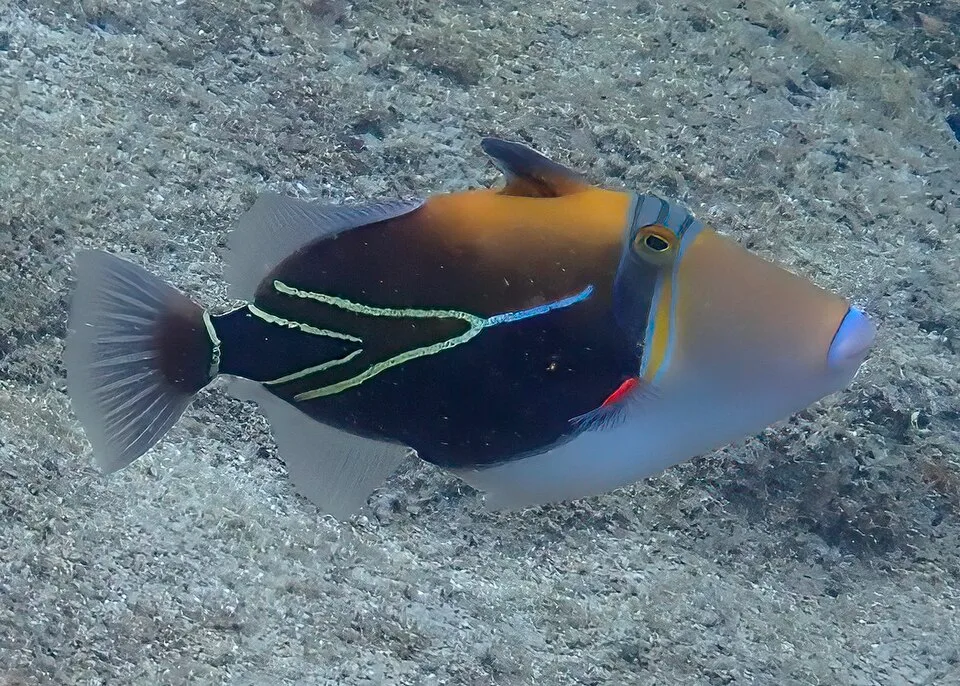
A wild humuhumu over sand off the north shore of Oʻahu. Photo: Thomas Irvine, iNaturalist via Wikimedia Commons (CC BY 4.0).
Where can you see the state fish in Hawaii?
You’ll find it in shallow water on the outer reef, often over surge-swept lava rock, the Waikīkī Aquarium says. FishBase puts its depth at 0 to 20 m, or about 0 to 66 ft. It stays close to the bottom, picking at food. That food is algae plus small crustaceans like crabs, worms, brittle stars, sea urchins and snails. More on that in what fish eat.
Don’t expect it to swim up to your mask. The aquarium calls it hard to approach and says it keeps its distance. It’s easy to watch from a distance, so float still and let it go about its business.
It’s one of the most widely recognized Hawaiian fishes, the Waikīkī Aquarium says. You won’t only find it in Hawaii, though. FishBase lists it from the Red Sea and East Africa across to Hawaii and Pitcairn, and north to southern Japan.
Photos of wild humuhumu from Hanauma Bay on Oʻahu and Kealakekua Bay on the Big Island are on Wikimedia Commons. Both are famous reef parks, called Marine Life Conservation Districts, and the fishing rules there are strict. Hanauma Bay is a State Underwater Park as well, so the state park rules apply on top. Here’s what the 2025 Hawaii fishing rule booklet says about four of the best known.
| Reef park | Island | Fishing allowed? |
|---|---|---|
| Hanauma Bay | Oʻahu | No. No fishing, no fishing gear in the water, no feeding the fish |
| Waikīkī, Kapahulu groin to the Natatorium | Oʻahu | No. No fishing and no fishing gear in the water |
| Kealakekua Bay | Hawaiʻi (Big Island) | Finfish only in Subzone B, the southern part, by hook-and-line or throw net. No fish feeding anywhere |
| Molokini Shoal | Off Maui | Only trolling, in Subzone B outside the crater. Nothing inside the crater |
Can you catch the Hawaii state fish?
Yes, outside the closed areas. Being the state fish doesn’t protect it. Hawaii’s May 2025 fishing rule booklet has no size limit, season or bag limit for the reef triggerfish. It isn’t on the list of regulated species at all. An old Reddit post that still shows up for this search says it’s illegal to kill or eat one. That’s true inside parks like Hanauma Bay, but not statewide.
The booklet’s statewide rules apply everywhere “unless exempted or modified for certain specific management areas.” So the park you’re standing in can change the answer. Right past the Waikīkī park, the shore from the Natatorium to the Diamond Head Lighthouse is open to fishing only in even-numbered years. Check the map for the spot before you wet a line.
What you need to fish the ocean in Hawaii:
- If you live in Hawaii: nothing. Recreational ocean fishing for residents is free, with no registration, the state says.
- If you’re visiting and 15 or older: a Nonresident Recreational Marine Fishing License. It costs $20 for a day, $40 for 7 days or $70 for a year, plus an online processing fee. It’s sold only online, at fishing.hawaii.gov.
- Kids 14 and under don’t need one. Active-duty military stationed in Hawaii, with their spouses and minor children, are exempt too.
The visitor license has been required since May 2, 2024. For game fish in Hawaii’s streams and reservoirs, you need a separate freshwater license. Every state runs its own system, and our page on fishing licenses by state covers how they differ.
Watch out: The license is for fishing. Inside Hanauma Bay or the Waikīkī park, even carrying fishing gear in the water is against the rules.
Can you eat a humuhumunukunukuāpuaʻa?
You can, but few people bother. The Waikīkī Aquarium says it isn’t highly valued as a food fish by today’s tastes, though it’s edible. Early Hawaiians knew it as food. They lured it into baskets lowered into the water, baited with cooked pumpkin or sweet potato.
Not everyone liked the taste, then or now. Hawaiians who didn’t care for it dried the fish and burned it as cooking fuel, the aquarium says. That was also the fallback when fuel ran short. Both fish called humuhumunukunukuāpuaʻa were also used in place of pigs in some religious ceremonies.
So if one comes up on your line, it’s legal to keep outside the closed areas.
What if one ends up on your hook?
Treat it like any triggerfish: carefully. It has small, powerful jaws and sharp, cutting teeth, the aquarium says. Use pliers on the hook and keep your fingers away from its mouth. How fish teeth differ from one fish to the next is on the do fish have teeth page.
Watch the spine too. A triggerfish that wedges itself into a crack in the rocks will lock that spine up, and only the fish can unlock it. Don’t try to force the spine down with your hand. Leave the fish be, or wait for it to come out.
Tip: Unhook a humuhumu with pliers, never your fingers.
Expect noise. Early Hawaiians knew it for grunting when handled, so a grunting humuhumu in your hand is normal. Letting it go? Unhook it fast and put it back in the water near the reef.
Quick answers about the Hawaii state fish
Does Hawaii have a state fish?
Yes. The humuhumunukunukuāpuaʻa, or reef triggerfish, has been the state fish by law since May 2, 2006. It held the title before, from 1985 to 1990.
Is the Hawaii state fish a triggerfish?
Yes. It’s the reef triggerfish. The law calls it the rectangular triggerfish.
Is it found only in Hawaii?
No. It lives on reefs from the Red Sea and East Africa to Hawaii and Pitcairn, FishBase says.
Is the Hawaii state fish protected?
Not as a species. Hawaii’s 2025 rule booklet lists no size or bag limit for it. It’s protected inside the no-take parks like Hanauma Bay and the Waikīkī park, where no fish may be taken.
Is it aggressive?
It’s more shy than mean. The Waikīkī Aquarium calls it wary, a fish that keeps its distance from people watching it. Its teeth are sharp, so don’t grab one.
Why did the state fish law expire?
The 1985 law had a five-year limit written into it. It ran out in 1990, and the 2006 law made the title permanent.
For more short answers about fish, from teeth to sleep, start at the fish facts page.

Free PDF · 16 pages
Stop guessing. Know what's biting before your first cast
A whole Saturday on the water with nothing to show for it. One reading tells you who's feeding.
The Water Temperature Fishing Chart. Take one water temperature reading, find it on the chart, and see which of 26 freshwater fish are spawning, feeding hard or slowing down.
- Where bass, crappie, bluegill and walleye sit, and what to throw. Trout: the reading where you stop.
- Why a 3 ft drop beats a cold front, and what to throw each day of the front
- The three thermometer mistakes that make a reading lie
The chart's numbers come from state fish and wildlife agencies and fisheries research: 64 sources, each listed on the site.
No card, nothing to buy. The PDF is in your inbox a minute later, one version for your phone and one to print, yours to keep. Then a few short emails and one a week on what's biting, with an unsubscribe link in every one. Privacy.
Related
Section guide
Fish Facts: The Questions Kids Ask About Fish, Answered With the ScienceFish facts with a number and a source for each: how fish sleep, breathe, hear and feel, and what every answer means when you hook and release one.
 Do Fish Pee? Yes, a Trout About Twice an Hour, a Plaice Every Few Days
Do fish pee? Yes. Freshwater fish go all day, saltwater fish hardly at all. How fish urinate, and what it means for your livewell and bait bucket.
 Fish Anatomy: The Parts of a Fish and What Each One Does
Fish anatomy with labeled diagrams: the parts of a fish inside and out, what each one does, and which ones change how you hold, name or clean it.
 Ugliest Fish in the World: The Blobfish, and the Ugly Ones You Can Catch
The ugliest fish in the world is the blobfish, by a 2013 vote. Why it only looks like that out of water, and ten ugly fish with their size and home.
 Is a Shark a Fish? Yes, and Why It Isn't a Mammal
Is a shark a fish? Yes: it breathes with gills and is built of cartilage, not bone. How sharks differ, why they aren't mammals, and seahorses and eels.
 Scariest Fish: Which Ones Really Hurt People, and Which Only Look It
The scariest fish in the world, sorted by what each can really do to you: sharks that bite, the most venomous fish, fish that poison and harmless monsters.
 Smallest Fish in the World: Three Fish Under a Third of an Inch
The smallest fish in the world is a swamp fish grown at 7.9 mm, shorter than a #8 hook. Its two rivals, how each was measured, and tiny fish in US water.
Sources (18)
- Session Laws of Hawaii 1985, Act 289 (H.B. No. 479), A Bill for an Act Relating to the State Fish
- Session Laws of Hawaii 2006, Act 67 (H.B. No. 1982), A Bill for an Act Relating to the State Fish
- Hawaii Revised Statutes §5-11.5, State fish
- State Symbols USA, Hawaii State Fish: Humuhumunukunukuapua`a
- Waikīkī Aquarium, Reef Triggerfish
Show all 18 sourcesShow fewer sources
- Honolulu Star-Bulletin, Ocean Watch (Susan Scott), Lawmakers miss boat on ocean issues (February 24, 2006)
- HeraldNet (Associated Press), Little fish with long name set to regain Hawaii state fish title
- Boss Frog's Hawaii, Official State Fish of Hawaii (pronunciation)
- Maui Ocean Center, Reef Triggerfish
- FishingBooker Blog, Hawaii State Fish (the 8-inch figure)
- Fishes of Australia (Bray, D.J. 2019), Rhinecanthus rectangulus, Wedgetail Triggerfish
- Fishes of Australia (Bray, D.J. 2023), Rhinecanthus aculeatus
- Australian Museum, Wedgetail Triggerfish, Rhinecanthus rectangulus
- FishBase, Rhinecanthus rectangulus, Wedgetail triggerfish
- FishBase, Rhinecanthus aculeatus
- Hawaii Division of Aquatic Resources, Hawai'i Fishing Regulations, May 2025
- Hawaii Division of Aquatic Resources, Nonresident Recreational Marine Fishing License (NRMFL) Frequently Asked Questions
- Jordan and Evermann, Shore Fishes of the Hawaiian Islands, Bulletin of the United States Fish Commission vol. 23 for 1903, part I (1905), Color Plate LXIII