 By
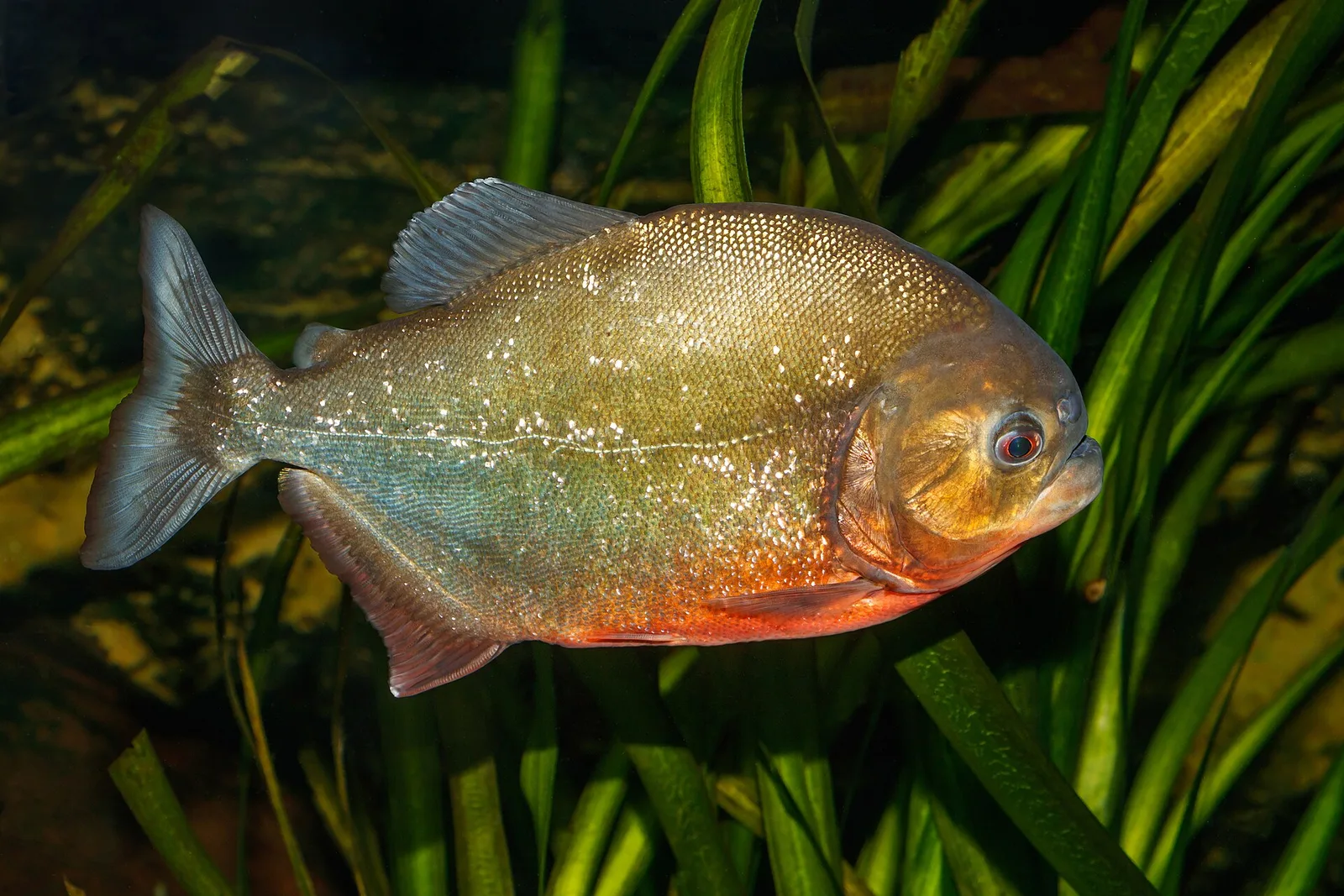
A piranha is a sharp-toothed South American freshwater fish, most of them 5 to 14 inches long. Piranhas do bite people, usually on the leg or foot, but whether one has ever killed a living person is far from clear. In the United States you won’t find a wild population at all. The ones anglers catch here are most likely dumped pets, and in many states it’s against the law to own one.
A black piranha can bite with a force more than 30 times its own weight. The scientists who measured it called that “unmatched among vertebrates.”
Are piranhas dangerous to people?
They can hurt you, and they rarely do. Discover Wildlife sums it up: “attacks on humans are rare.” Most attacks are a single bite, though some species can take off a chunk of flesh, a finger or a toe.
The best numbers come from Brazil. Dr. Vidal Haddad treated 38 people bitten while swimming at Santa Cruz da Conceição, over five Sundays. He checked close to a hundred more accidents at Iacanga and Itapuí. In 2009, 74 bathers were bitten at two beaches on a dammed stretch of river at Adolfo and Ubarana. Haddad and zoologist Ivan Sazima wrote that the bites have become “a common problem in dammed portions of rivers and streams” in São Paulo state.
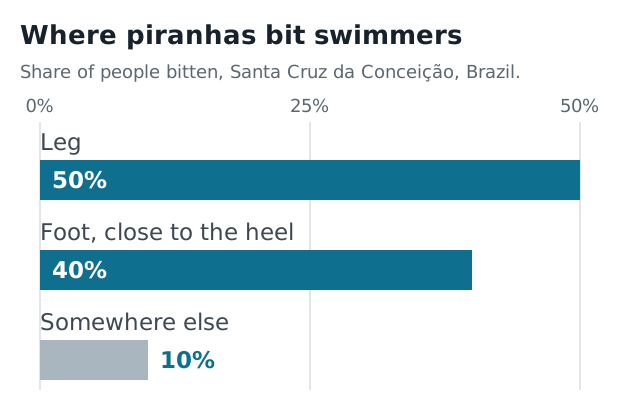
The bites land low. At Santa Cruz da Conceição, half the people hurt were bitten on the leg, and another 40 percent on the foot, close to the heel.
Why bite at all? They’re guarding their young. Pesquisa FAPESP, reporting on Haddad’s work, says piranhas “generally attack to defend their offspring (eggs or larvae).” Sazima calls it a warning: “The piranhas are sending a message: get away from my nest.”
So the water to watch is the calm, shallow edge of a dammed river, where the fish nest among floating plants. At Adolfo and Ubarana the bites stopped once fine-mesh nets went up and the water plants came out.
If you do get bitten, Pesquisa FAPESP gives the treatment as “the cleaning of the wound for around ten minutes with water and soap.” For deeper bites, it says, “taking an anti-tetanus vaccine is recommended.”
Has a piranha ever killed anyone?
Nobody can say for sure. “Whether piranhas ever actually kill humans is far from clear,” Discover Wildlife says, because “it’s always hard to know if the victims were already dead when the piranhas found them.”
The U.S. Geological Survey makes the same point about the red-bellied piranha. Many experts think its danger to people is “greatly exaggerated,” and its man-eater reputation “may be derived from scavenging on human corpses.”
The closest modern case is Paraguay in early January 2022. Fox News reported four dead and 20 or more injured in river attacks. Even there, a forensic doctor found that one of the men “died of asphyxia by submersion,” with bite marks on his face and feet. The same report says a 49-year-old man “drowned as a result of a piranha attack,” so the question stays open.
Do piranhas really strip a cow to the bone?
The famous case was set up for a visitor. The legend comes straight from Teddy Roosevelt’s 1913 trip to Brazil. In his 1914 book he called them “the most ferocious fish in the world.” He also called the piranha “the fish that eats men when it can get the chance.”
What he saw was a show. Mental Floss reports that locals “used nets to block off a section of the Amazon” days ahead and kept the fish unfed. When he arrived, they chucked in a live cow. Hungry fish in a pen will do that. In the wild, Discover Wildlife says, piranhas are “scavenging more often than they kill.”
Piranha schools look less like hunting packs than you’d think. Red-bellied piranhas in shoals of eight calmed down faster after a mock bird attack than fish in shoals of two. The school looks like protection from the things that eat them.

Free PDF · Water temperature chart Which fish are biting at today's water temperature?
One reading, and the 16-page chart shows which of 26 fish are spawning, feeding hard or slowing down; for bass, crappie, bluegill and walleye, where they sit and what to throw. Every number sourced.
No card, nothing to buy, and the PDF is yours to keep. Confirm with one click and it's on its way. Then a few short emails and one a week on what's biting. Unsubscribe anytime. Privacy.
How big do piranhas get?
Most reach 5 to 14 inches (12 to 35 cm). The top figures run higher, and they don’t all agree, so here’s who says what. Standard length, written SL, is measured without the tail.
| Piranha | Biggest listed | Who says so |
|---|---|---|
| Red-bellied | 50 cm SL (20 in), 3.9 kg (8.6 lb) | FishBase |
| Red-bellied | 32 cm SL (12.6 in) | USGS |
| Black (redeye) | 41.5 cm SL (16.3 in), 3.8 kg (8.4 lb) | FishBase |
| Black (redeye) | 50 cm (20 in), 3.83 kg (8 lb 7 oz), rod-and-reel record | Fishing World Records |
That record is 8 lb 7 oz, caught by Russell Jensen on Brazil’s Rio Jatapu in 2009. Fishing World Records marks it as verified by the International Game Fish Association. Count on most fish being far smaller. That’s still a lot of teeth for a fish you could hold in one hand, and it’s nowhere near the largest freshwater fish.
How many kinds are there? Nobody agrees. Estimates run “from fewer than 30 to more than 60” species, and a review counted 38 or 39. The extinct megapiranha, a relative, reached about 71 cm (28 in). The one you’ve seen in a pet store is the red-bellied piranha. USGS calls it “the most common piranha in the aquarium trade.”
Is it a piranha or a pacu?
Look at the teeth. A piranha has a single row of sharp, serrated teeth that look like incisors. A pacu, its plant-eating cousin, has two rows of molars. Fox News described them as “jagged square-like teeth that bear resemblance to human molars,” and that’s the picture to keep in your head.
It matters because a red belly proves nothing. The red-bellied pacu has one too, and it grows to 85 cm SL (33 in) and 20 kg (44 lb). USGS has logged it in 43 states and says many taken in U.S. waters “have been misidentified and reported as the red piranha.” Fox News, passing on a local TV report, says South Carolina’s DNR finds pacu “are occasionally caught in Lake Hartwell, but they’re also illegal to release.”
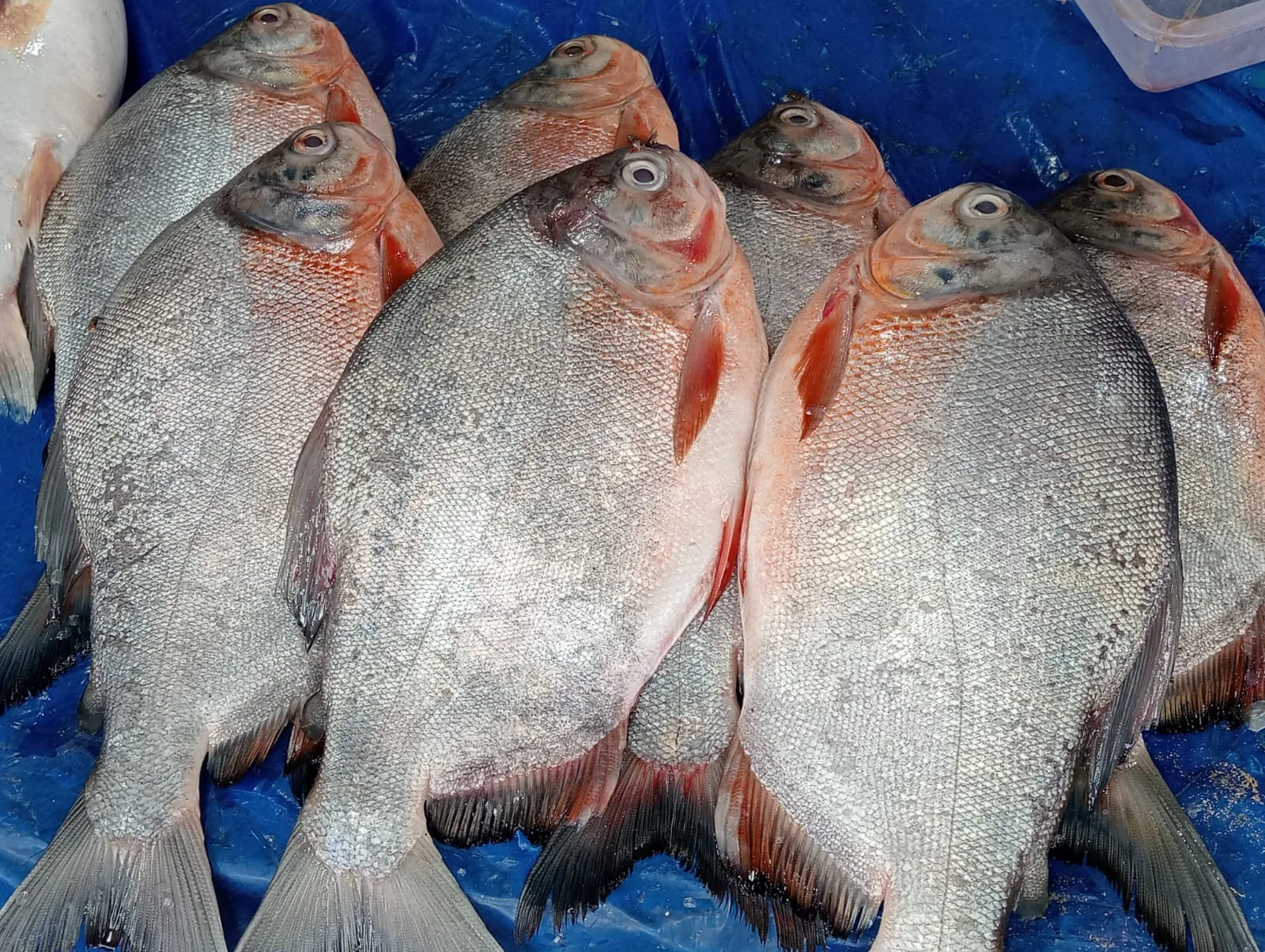 Red-bellied pacu at a market. The red belly doesn’t make it a piranha, so check the mouth. Photo: Sannidhishetty, Wikimedia Commons (CC0).
Newspapers get this wrong too. A fish from the Elk River in Alabama, reported as a red piranha, turned out to be a pacu when a museum checked it. So check the mouth before you call the local paper, and open it with pliers, never a finger. Flat teeth like yours mean a pacu. A single row of points means a piranha.
How do piranha teeth work?
Each jaw has one row of triangular teeth, packed tight and locked together by small cusps. Our guide to fish teeth puts them beside the other biters. The teeth on each side of the mouth lock into a solid block. So piranhas change them the same way: every tooth on one side goes at once, and a new set comes up in its place. Then they do it again, over and over, through their whole lives.
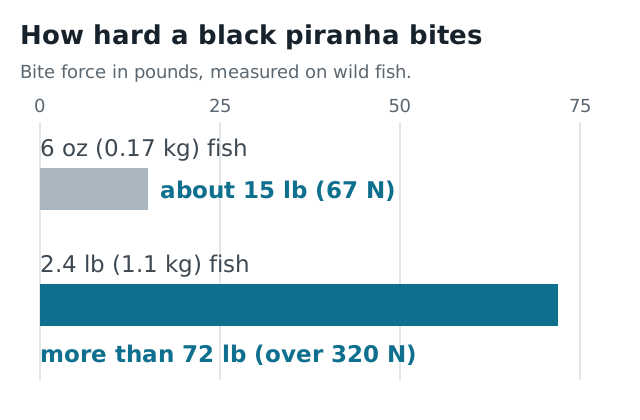
The bite itself has been measured on wild fish. Black piranhas in the Xingu and Iriri rivers bit with 67 newtons at 0.17 kg (6 oz). At 1.1 kg (2.4 lb) they bit with more than 320 newtons. A newton is a unit of force, and 320 of them is about 72 pounds.
That’s why anyone who handles one takes care. Even USGS, in its plain government voice, says “considerable care must be taken in handling live individuals.”
What do piranhas eat, and where do they live?
Mostly fish, insects and worms, and they scavenge too. FishBase says adult red-bellied piranhas “feed mainly at dusk and dawn on insects, worms and fish.” In more than 250 black piranhas from one Brazilian river, 75 to 81 percent of the stomach contents were fish and about 10 percent were fruits or seeds. Young ones nip fins and scales more often than adults do.
They live in South American rivers east of the Andes. For the red-bellied piranha, FishBase lists the Amazon basin, the Paraguay-Paraná basin, the Essequibo and the coastal rivers of northeastern Brazil. The water runs 73 to 81 °F (23 to 27 °C). When a red-bellied piranha is caught it can bark. It makes three calls: quick barks, low grunts or thuds, and percussive clicks.
North America’s own toothy oddballs, the bowfin and the gars, are legal to catch at home. For the piranha, that means traveling. The river giant that shares its water, the arapaima, makes the same trip worth planning.
How do you catch a piranha?
Use cut bait on a wire leader, and let the guide handle the fish. Piranha fishing is mostly a South American trip by boat or canoe. Here’s the setup Acute Angling lists:
- Rod: medium spinning or light baitcasting.
- Main line: 20 to 40 lb braid or mono.
- Leader: 40 to 80 lb wire or heavy mono. It calls that “essential to avoid bite-offs.”
- Hook: a strong 2/0 to 4/0 J hook or a small circle hook.
- Bait: cut bait, fish pieces or chicken scraps.
Start with cut bait on a wire leader. If you’d rather throw a lure, take a lipless rattle bait, then a spoon or spinner. Outdoor Life says the vibration and flash get their attention. When the bite slows, “a piece of cut bait on a jig will get the job done.” It also warns that piranhas “make mincemeat of fishing line, light wire leaders, and 1X hooks.”
Keep it simple if you’re on a lodge trip. One traveler fished an 8-foot pole cut from a rainforest branch, with nothing on it but a line and a hook. Her method is to move the rod “up and down in a steady fashion.” When it feels like a fish is on, “quickly pull your rod upwards.” One more tip of hers is worth repeating: “Wear sunglasses, in case of flying hooks.”
Then keep your fingers away. Acute Angling’s rule is “Pliers or boga grip (never unhook with bare hands!).” A pair of fishing pliers long enough to keep your hand out of the mouth is the one piece of gear you shouldn’t skip.
Are piranhas illegal in the US?
In many states, yes. The Associated Press counted “more than two dozen states” in 2014 where they’re illegal, and New York City bans them too. The Justice Department’s count that year was 25 states that “have either banned or regulated piranhas.” The table below gives the rule as eight states publish it, word for word. Rules change, so read your own state’s current list before you buy one. If your state isn’t here, that doesn’t mean a piranha is legal there.
| State | The rule, as published | Where it is |
|---|---|---|
| Florida | “Subfamily Serrasalminae, all species of piranha and pirambeba”; “Prohibited species may only be possessed by permit for educational exhibition, research or eradication/control activities.” | FWC Prohibited Nonnative Species List; FWC nonnative regulations page (Rule 68-5.006) |
| Texas | “All species of genera Catoprion, Pristobrycon, Pygocentrus, Pygopristis, and Serrasalmus”; “No person may possess or place them into water of this state except as authorized by the department.” | TPWD prohibited exotic species list |
| California | “It shall be unlawful to import, transport, or possess live animals restricted in subsection (c) below” except under permit; “All species of the genera Serrasalmus, Serrasalmo, Pygocentrus, Taddyella, Rooseveltiella, and Pygopristis (Piranhas) (D).” | 14 CCR § 671 |
| Louisiana | “No person shall have in possession or sell in this state a piranha or Rio Grande Cichlid” (exception: display at the Aquarium of the Americas by special permit) | La. R.S. 56:319(D) |
| Alabama | “No person, firm, corporation, partnership, or association shall possess, sell, offer for sale, import”; “Any Piranha or any fish of the genera Serrasalmus, Pristobrycon, Pygocentrus, Catorprion, or Pygopristus” | Ala. Admin. Code r. 220-2-.26 |
| Arizona | Listed as restricted live wildlife: “All species of the genera Pygocentrus, Pygopristis, and Serrasalmus. Common name: piranha.” | R12-4-406 |
| Nevada | “the importation, transportation or possession of the following species of live wildlife or hybrids thereof, including viable embryos or gametes, is prohibited”; “(9) Piranhas” | NAC 503.110 |
| Virginia | “A special permit is required and may be issued by the department”; piranhas listed under Characidae | 4VAC15-30-40 |
Federal law works differently. Piranhas aren’t on the federal injurious fish list in 50 CFR 16.13. But the Lacey Act reaches across state lines. It’s a federal offense to move or sell “any fish or wildlife taken, possessed, transported, or sold in violation of any law or regulation of any State.” The Lacey Act also bars false labels on imported wildlife, and that’s what caught one New York importer. Joel Rakower and his company pleaded guilty in January 2014. The Justice Department says their packing lists carried “false identifications of 39,548 piranhas,” labeled “as silver tetras, a common and unaggressive aquarium fish.” Between them they agreed to pay $38,000 in fines and $35,000 in restitution to New York State.
What if you catch one in a US lake?
Don’t put it back. In 2021 a red piranha turned up in Baton Rouge’s University Lakes. Louisiana’s wildlife agency told anglers: “please do not return it to the water.” Keep it out of the water, take a photo of the mouth, and call your state fish and wildlife agency.
You might be holding a real one. USGS has red piranha records in 15 states, from Florida and Texas to Michigan and Minnesota. It has more records of piranhas it couldn’t name to species, in 16 states. Its verdict on the red-bellied piranha is short: “Failed in all states.” USGS lists them as probable aquarium releases, and says this fish “has small chance of surviving cold periods.” In northern states, reports are typically of fish caught on a hook in summer or found dead when it cools off.
Some agencies have poisoned a whole lake after one turned up. So if your pet outgrows its tank, don’t dump it. Find a shop or a hobbyist who can legally take it. Not sure what you’re allowed to do? Your state’s fishing page is a good place to start.
Can you eat a piranha?
Yes, and in the Pantanal, people do it on purpose. Flavors of Brazil calls it “an important food fish in the Pantanal,” the big wetland in Brazil. There it goes into a soup called caldo de piranha. Cooks take the bones out by hand before blending the fish back into the broth.
Those bones are the catch. One traveler said hers “tasted like a mild, very dry white fish” with “a lot of tiny little bones to watch out for.” Don’t expect fillets like a walleye’s. Keep it to a meal on a trip. In the US, a live piranha you keep to eat is a live piranha you may not be allowed to have.
How do piranhas breed?
FishBase says eggs are “laid on tree roots trailing in the water and are guarded,” and they hatch in 9 to 10 days. How well a year’s young do depends on how the savanna floods. That guarding is the reason for most of the bites at the top of this page. The fish isn’t hunting you, it’s telling you to move your foot.
The other oddballs of warm water and old rivers are on the other freshwater fish hub.

Free PDF · 16 pages
Stop guessing. Know what's biting before your first cast
A whole Saturday on the water with nothing to show for it. One reading tells you who's feeding.
The Water Temperature Fishing Chart. Take one water temperature reading, find it on the chart, and see which of 26 freshwater fish are spawning, feeding hard or slowing down.
- Where bass, crappie, bluegill and walleye sit, and what to throw. Trout: the reading where you stop.
- Why a 3 ft drop beats a cold front, and what to throw each day of the front
- The three thermometer mistakes that make a reading lie
The chart's numbers come from state fish and wildlife agencies and fisheries research: 61 sources, each listed on the site.
No card, nothing to buy. Confirm with one click and the PDF is on its way, one version for your phone and one to print, yours to keep. Then a few short emails and one a week on what's biting, with an unsubscribe link in every one. Privacy.
Related
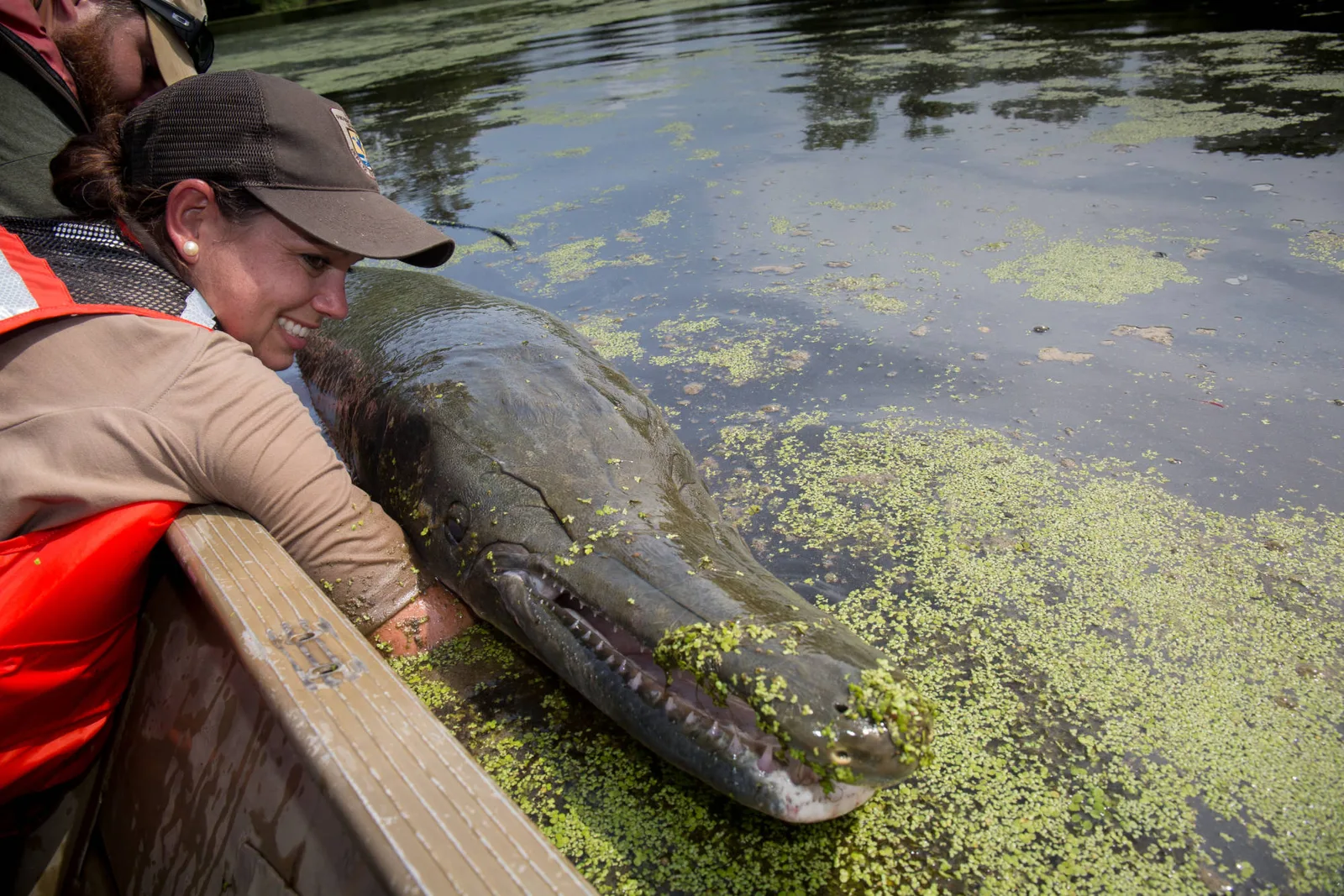
Section guide
Freshwater Fish Species Outside the Big Families: Sturgeon, Gar, Bowfin, BurbotThe freshwater fish species outside the bass, trout, catfish and pike families: sturgeon, gar, bowfin, burbot, drum, eel and paddlefish, with records.
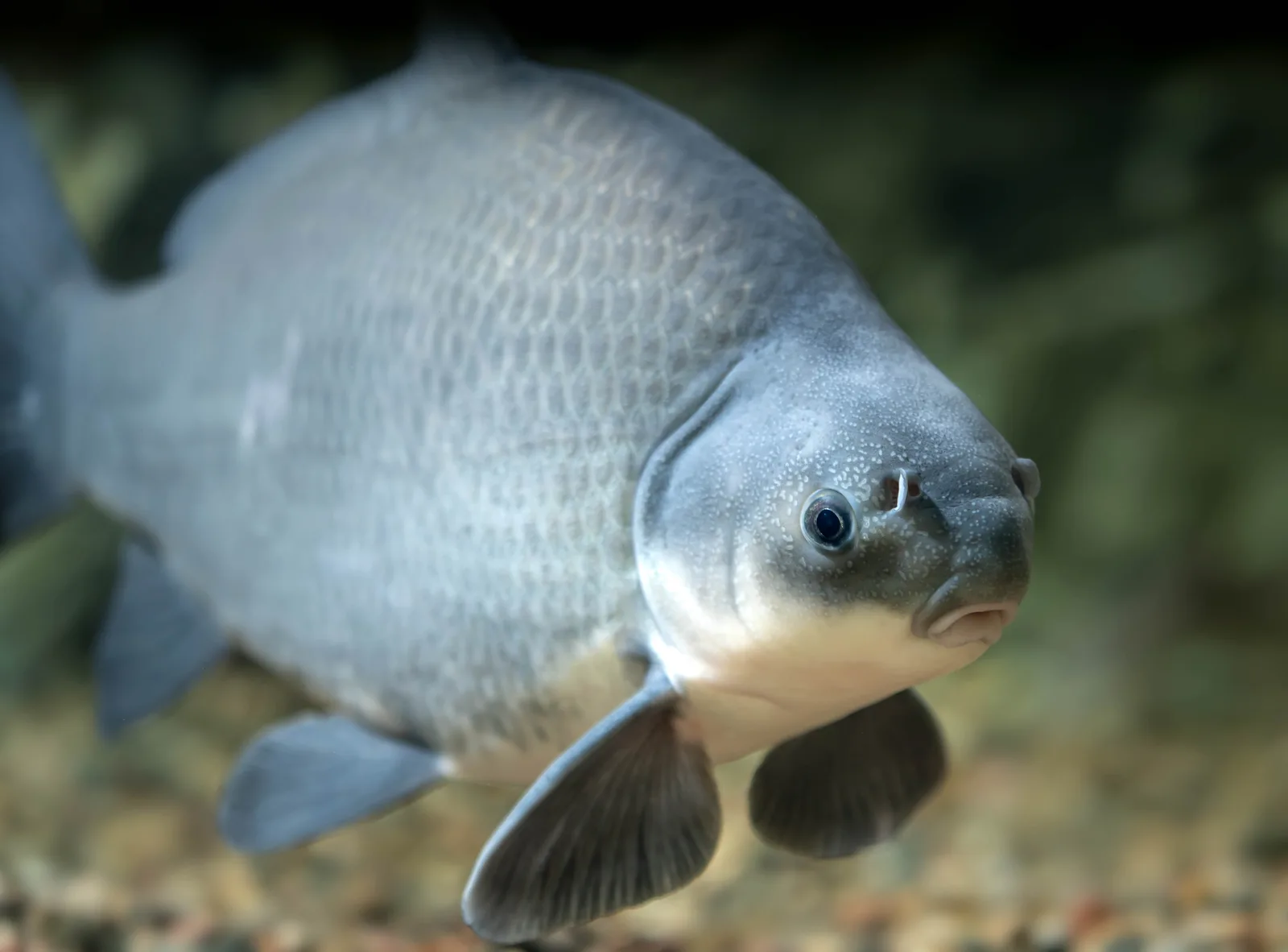 Buffalo Fish: Not a Carp, and How to Catch and Eat One
Buffalo fish are native suckers, not carp. How to tell bigmouth from smallmouth buffalo, the bait that catches them, and how to cook around the bones.
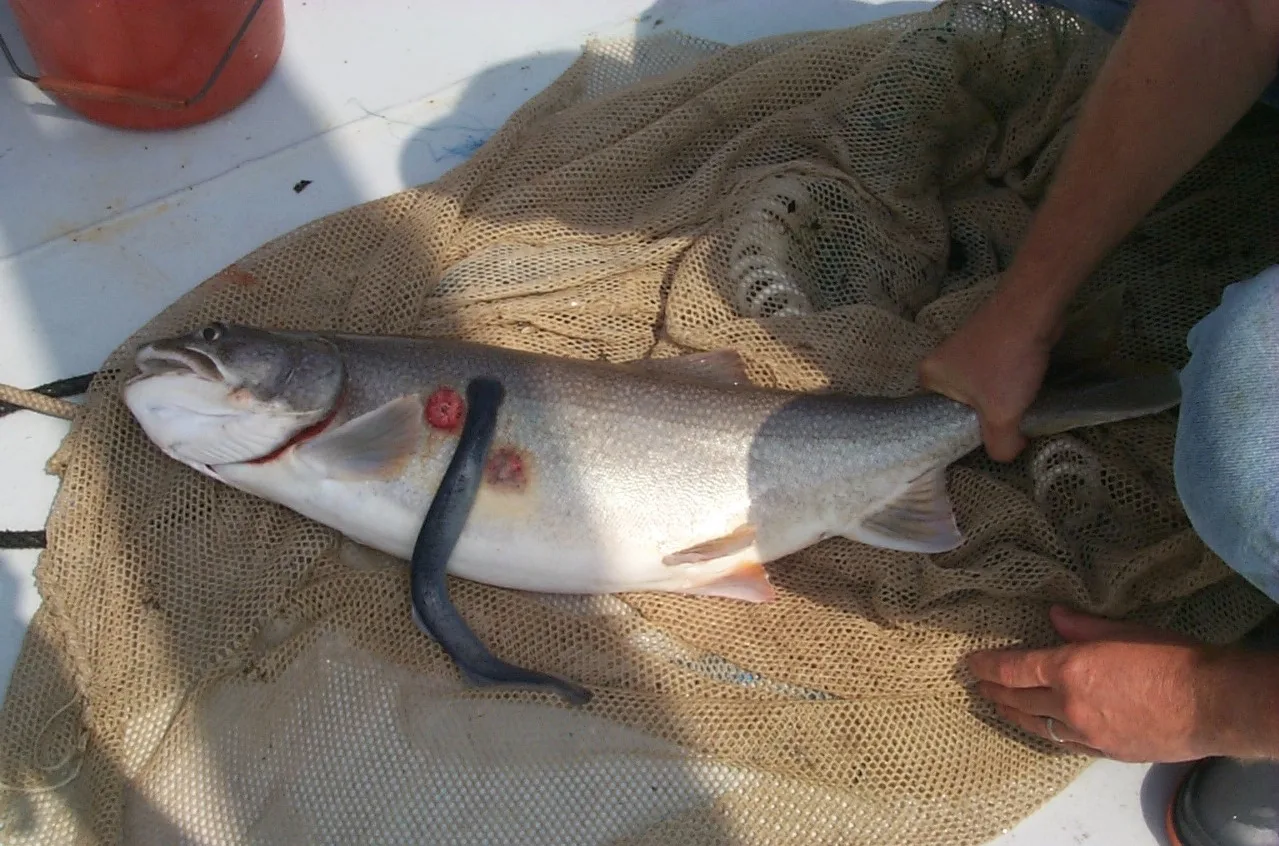 Lamprey: What It Is, and What to Do If You Catch One
A lamprey is a jawless, eel-like fish that feeds on blood. How to tell a sea lamprey from a native one, what to do if you catch one, and the rules.
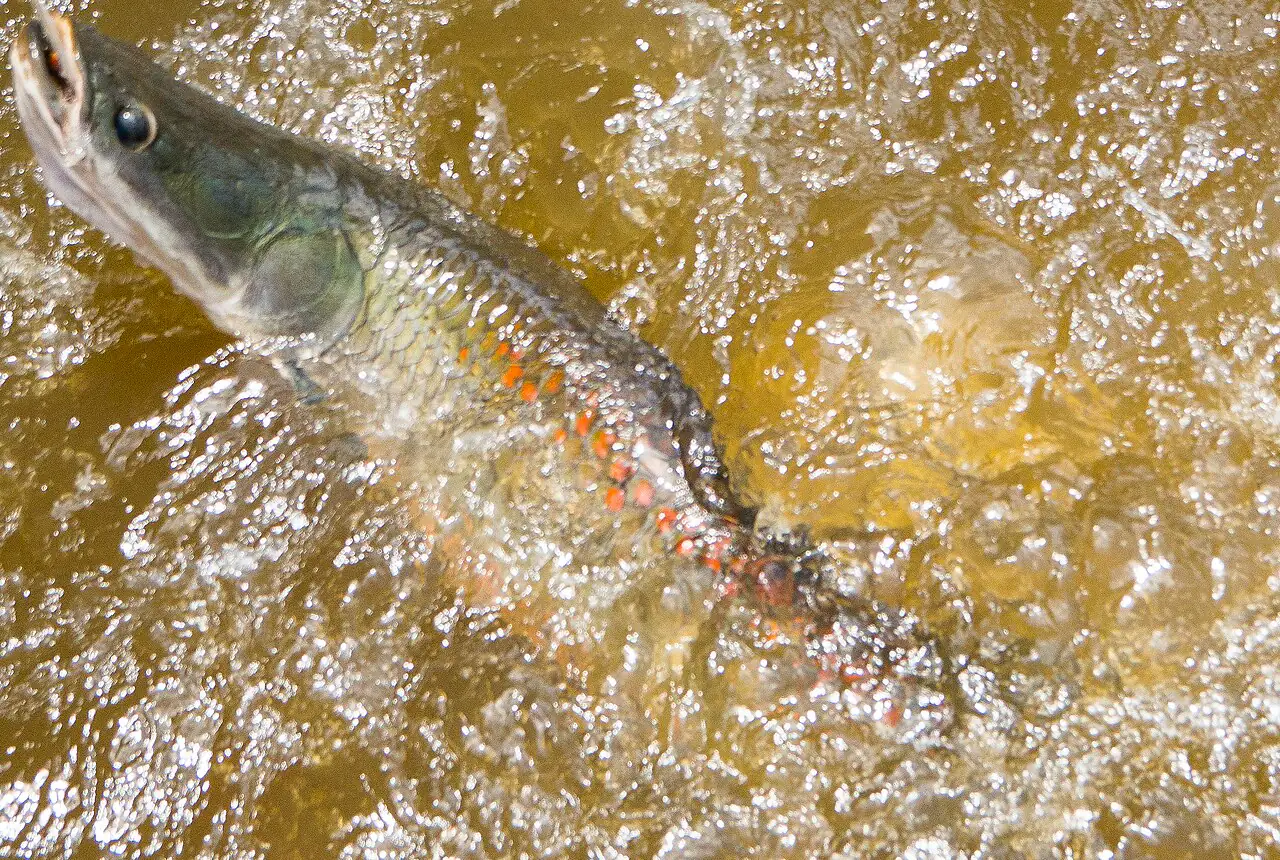 Arapaima: How Big They Really Get, and Where You Can Catch One
The arapaima breathes air, tops out near 10 ft and 440 lb, and is legal to catch in only a few places. Its real size, the record, and where to fish.
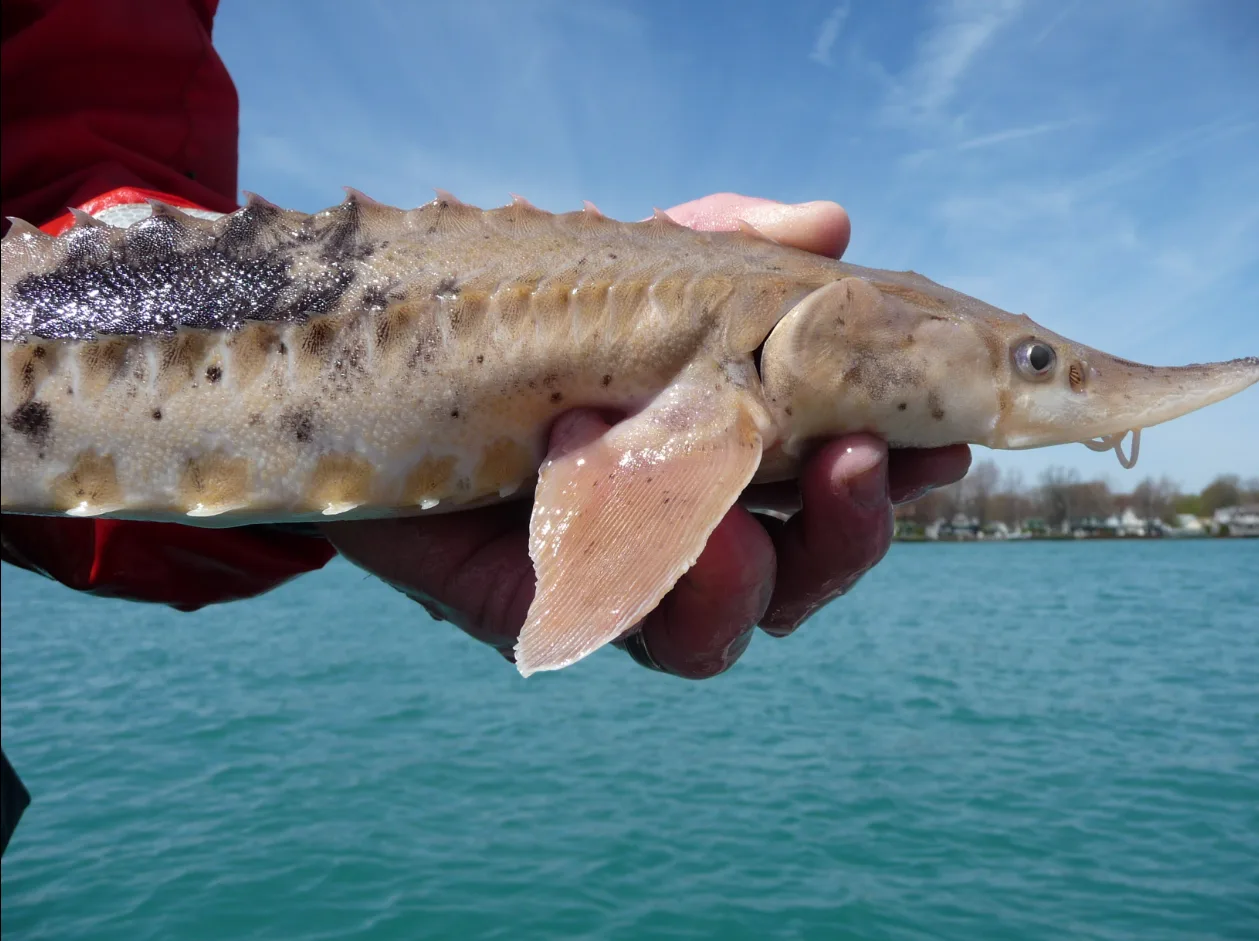 Lake Sturgeon: Size, Age, Where They Live and When You Can Fish
Lake sturgeon grow to 7 ft and may live centuries. How to identify one, where they live, the Winnebago spearing season and where you may keep one.
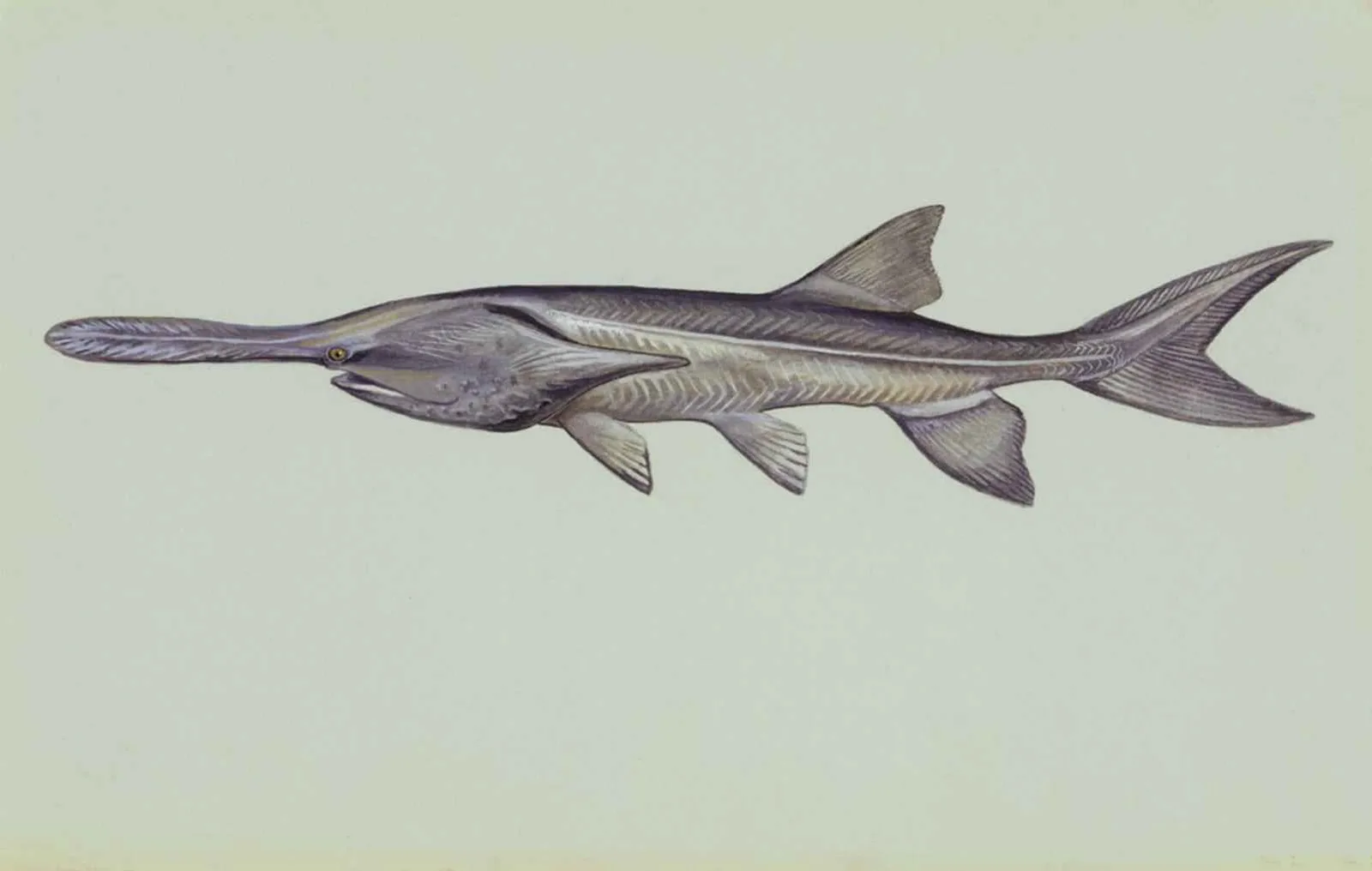 Paddlefish (Spoonbill): Facts, Snagging Seasons, Records and Rules
The paddlefish, or spoonbill, eats only plankton, so anglers snag it. Size, age, the 164 lb record and the snagging seasons state by state.
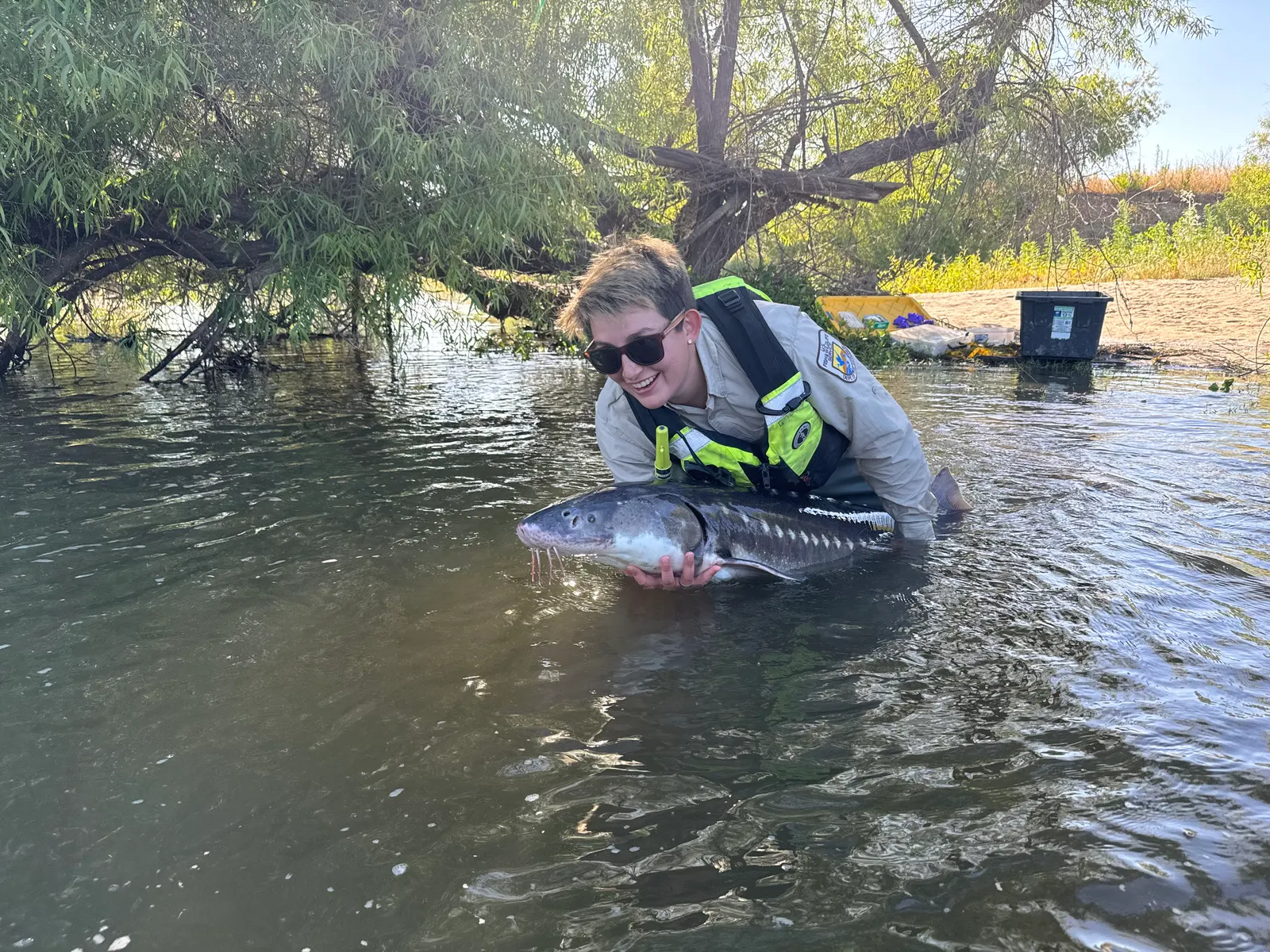 Sturgeon Fishing: Where to Go, the Rig, the Bait and the Rules by State
Sturgeon fishing for white and lake sturgeon: where it is open, when to go, the sliding-sinker rig, the best baits and the keep-it-in-the-water rules.
Sources (39)
- Pesquisa FAPESP (Alfred R. Wallace), Motherly bites, issue 98 (April 2004)
- Haddad, V. Jr. and Sazima, I. (2003), Piranha attacks on humans in southeast Brazil: epidemiology, clinics, and natural history, with description of a bite outbreak, Wilderness & Environmental Medicine 14(4): 249–254 (reference summary at FishBase)
- Haddad Junior, V. and Sazima, I. (2010), Piranha attacks in dammed streams used for human recreation in the State of São Paulo, Brazil, Revista da Sociedade Brasileira de Medicina Tropical 43(5)
- Fox News (Lawrence Richard), Piranha attacks in Paraguay leave 4 dead, more than 20 injured this year (January 6, 2022)
- Discover Wildlife (Stuart Blackman), You've seen the horror films but can piranhas ACTUALLY kill a human? (August 1, 2026)
Show all 39 sourcesShow fewer sources
- Discover Wildlife (Jo Caird), It barks like a dog, has razor-sharp teeth and is a horror movie favourite (March 2, 2025)
- Theodore Roosevelt, Through the Brazilian Wilderness (1914), chapter 2 (Standard Ebooks)
- Mental Floss (Ethan Trex), Teddy Roosevelt Turned Piranhas Into Ferocious Maneaters (June 22, 2014)
- Queiroz, H. and Magurran, A. E. (2005), Safety in numbers? Shoaling behaviour of the Amazonian red-bellied piranha, Biology Letters 1: 155–157
- FishBase, Pygocentrus nattereri, Red piranha
- FishBase, Serrasalmus rhombeus, Redeye piranha
- Wikipedia, Piranha (species counts and size range, citing Freeman et al. 2007 and FishBase)
- Fishing World Records, Serrasalmus rhombeus
- U.S. Geological Survey, Nonindigenous Aquatic Species Database, Pygocentrus nattereri fact sheet (Leo Nico and Matt Neilson, revised 2013; archived copy)
- U.S. Geological Survey, Nonindigenous Aquatic Species Database, Pygocentrus or Serrasalmus sp. fact sheet (P. Fuller, revised 2019; archived copy)
- U.S. Geological Survey, Nonindigenous Aquatic Species Database, Piaractus brachypomus fact sheet (archived copy)
- Fox News, South Carolina teen catches invasive piranha-like fish, sparks reminders that it's illegal to release: report (April 10, 2023)
- Grubich, J. R., Huskey, S., Crofts, S., Orti, G. and Porto, J. (2012), Mega-Bites: Extreme jaw forces of living and extinct piranhas (Serrasalmidae), Scientific Reports 2: 1009
- UW News (Michelle Ma), Piranha fish swap old teeth for new simultaneously (October 15, 2019)
- Acute Angling, Piranha Species Guide
- Outdoor Life (Steve Ryan), The 10 Gnarliest Freshwater Fish in the World (and How to Catch Them) (May 21, 2026)
- Bucket List Journey (Annette White), A Guide to Piranha Fishing (& Eating) in the South American Rainforest
- Flavors of Brazil, RECIPE - Piranha Soup (Caldo de Piranha) (July 5, 2010)
- Florida Fish and Wildlife Conservation Commission, Prohibited Nonnative Species List (archived copy, December 10, 2025)
- Florida Fish and Wildlife Conservation Commission, Regulations for Nonnative Fish and Wildlife: Conditional and Prohibited Species
- Texas Parks and Wildlife Department, Exotic Fish, Shellfish and Invasive Aquatic Plants (prohibited exotic species list)
- California Code of Regulations, Title 14, § 671, Importation, Transportation and Possession of Live Restricted Animals
- Louisiana Revised Statutes 56:319, Exotic fish
- Alabama Administrative Code r. 220-2-.26
- Arizona Administrative Code R12-4-406, Restricted Live Wildlife
- Nevada Administrative Code 503.110
- Virginia Administrative Code 4VAC15-30-40
- 16 U.S. Code § 3372, Prohibited acts (Lacey Act)
- 50 CFR § 16.13, Importation of live or dead fish, mollusks, and crustaceans
- Associated Press via The Christian Science Monitor, 39,000 piranhas smuggled into NYC (January 30, 2014)
- U.S. Department of Justice, Tropical Fish Importer Pleads Guilty in New York Federal Court to Piranha Import Violations (press release 14-093, January 29, 2014)
- Yahoo News / The State (Bailey Aldridge), 'Illegal' piranha found in Louisiana lake has officials worried there are more lurking (May 31, 2021)
- Outdoor Life (Bob McNally), Dangerous Red Piranha Found in Louisiana Lake (June 2, 2021)
- WorldAtlas (Kevin Senor), The US Rivers Where Piranhas Have Been Caught (October 25, 2026)